Anba' Moussawarah (Pictorial News) No. 16/54: The Issues at Geneva (illustrated news sheet distributed in Beirut)
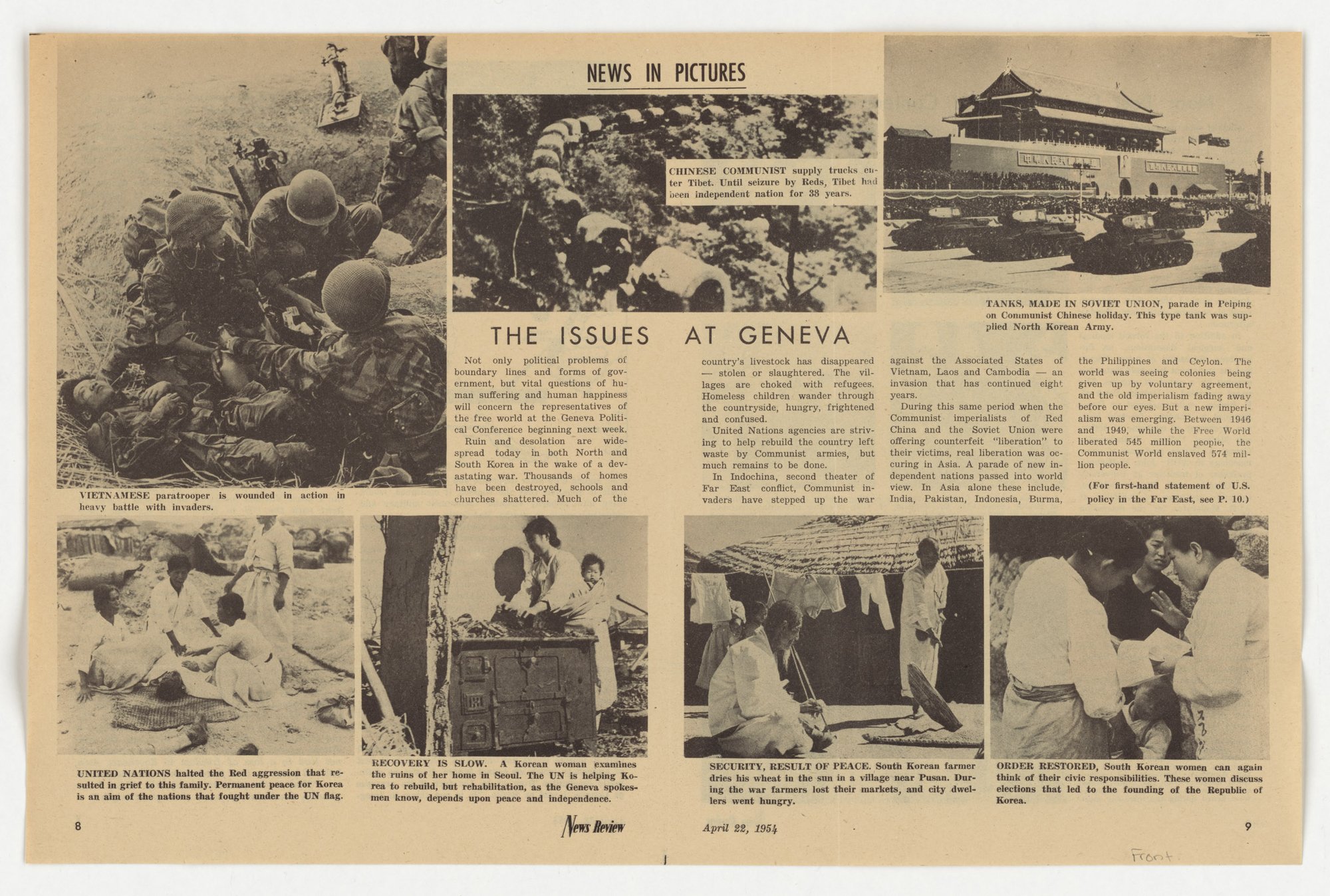
A two-page photo spread headed 'The Issues at Geneva', ahead of the 1954 Geneva Conference. Photographs show a wounded Vietnamese paratrooper, Chinese supply trucks entering Tibet, Soviet-made tanks in Peking and scenes of postwar South Korea; the text describes Korean ruin, the war in Indochina and a claim that 545 million people were liberated and 574 million enslaved between 1946 and 1949. The tell is name-calling and card-stacking: 'Communist imperialists', 'counterfeit liberation' and 'enslaved' are paired with selected images and figures.
Propaganda techniques used in this poster
- Date
- March 21, 1954
- Period
- Cold War
- Made by
- U.S. Information Agency (predecessor: State Department International Information and Educational Exchange Program), Propaganda Posters Distributed in Asia, Latin America and the Middle East series
- Region
- North America
- Country
- United States
- Medium
- Poster
- Issuer type
- State
- Regime
- Eisenhower Administration
- Leader
- Dwight D. Eisenhower
- Audience
- Foreign public
- Purpose
- Persuade or win support
- Themes
- War and the military, Empire and colonialism, Media and information
- Event
- Geneva Conference 1954
- Source
- Unidentified Source blurred: contractors, cutouts, buried disclosure
- Source
- U.S. National Archives (NARA), RG 306, Propaganda Posters Distributed in Asia, Latin America and the Middle East, retrieved October 3, 2026
- Rights
- Public domain (U.S. government work; NARA RG 306)
U.S. Information Agency / Department of State, March 21, 1954. National Archives, Record Group 306 (NAID 6948764, 306-PPB-15d).
Text on the object
NEWS IN PICTURES

VIETNAMESE paratrooper is wounded in action in heavy battle with invaders.

CHINESE COMMUNIST supply trucks enter Tibet. Until seizure by Reds, Tibet had been independent nation for 38 years.

TANKS, MADE IN SOVIET UNION, parade in Peiping on Communist Chinese holiday. This type tank was supplied North Korean Army.

THE ISSUES AT GENEVA

Not only political problems of boundary lines and forms of government but vital questions of human suffering and human happiness will concern the representatives of the free world at the Geneva Political Conference beginning next week.

Ruin and desolation are widespread today in both North and South Korea in the wake of a devastating war. Thousands of homes have been destroyed, schools and churches shattered. Much of the country's livestock has disappeared — stolen or slaughtered. The villages are choked with refugees. Homeless children wander through the countryside, hungry, frightened and confused.

United Nations agencies are striving to help rebuild the country left waste by Communist armies, but much remains to be done.

In Indochina, second theater of Far East conflict, Communist invaders have stepped up the war against the Associated States of Vietnam, Laos and Cambodia — an invasion that has continued eight years.

During this same period when the Communist imperialists of Red China and the Soviet Union were offering counterfeit "liberation" to their victims, real liberation was occuring in Asia. A parade of new independent nations passed into world view. In Asia alone these include, India, Pakistan, Indonesia, Burma, the Philippines and Ceylon. The world was seeing colonies being given up by voluntary agreement, and the old imperialism fading away before our eyes. But a new imperialism was emerging. Between 1946 and 1949, while the Free World liberated 545 million people, the Communist World enslaved 574 million people.

(For first-hand statement of U.S. policy in the Far East, see P. 10.)

UNITED NATIONS halted the Red aggression that resulted in grief in this family. Permanent peace for Korea is an aim of the nations that fought under the UN flag.

RECOVERY IS SLOW. A Korean woman examines the ruins of her home in Seoul. The UN is helping Korea to rebuild, but rehabilitation, as the Geneva spokesmen know, depends upon peace and independence.

SECURITY, RESULT OF PEACE. South Korean farmer dries his wheat in the sun in a village near Pusan. During the war farmers lost their markets, and city dwellers went hungry.

ORDER RESTORED, South Korean women can again think of their civic responsibilities. These women discuss elections that led to the founding of the Republic of Korea.

8   News Review   April 22, 1954   9

[handwritten:] Front
'occuring' is as printed. The caption text of the first photograph (left, bottom row) is partly hidden by the page edge and was read as printed. The 'Peiping' spelling is as printed.