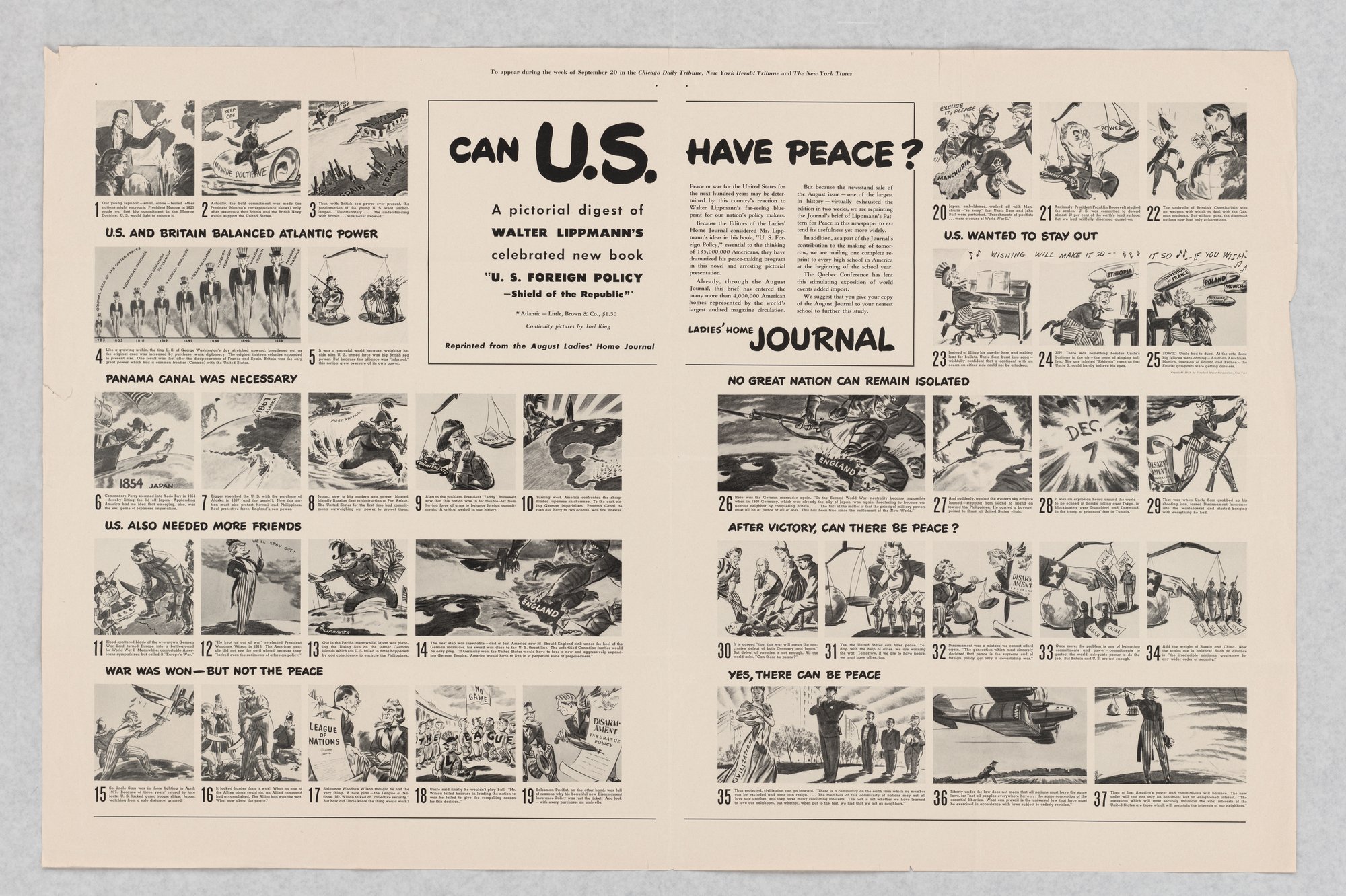
Can U.S. Have Peace?
Newspaper-advertisement reprint of a 37-panel cartoon digest of Walter Lippmann's 'U.S. Foreign Policy'. Uncle Sam figures, scales and maps retell American foreign policy from the Monroe Doctrine to a hoped-for postwar balance of powers. The technique is one-sided selection of history toward a stated conclusion (card-stacking), with war images such as 'Dec. 7' as warnings.
Propaganda techniques used in this advertisement
- Date
- 1943
- Period
- Second World War
- Made by
- Ladies' Home Journal (Curtis Publishing Company); continuity pictures by Joel King, after Walter Lippmann
- Region
- North America
- Country
- United States
- Medium
- Advertisement
- Issuer type
- Corporation
- Regime
- Roosevelt Administration
- Leader
- Franklin D. Roosevelt
- Audience
- Domestic public
- Purpose
- Persuade or win support
- Themes
- War and the military, Media and information, Elections and party politics
- Event
- World War II
- Regime
- Roosevelt administration
- Leader
- Franklin D. Roosevelt
- Source
- Identified Openly sourced: the speaker is who they say they are
- Source
- U.S. National Archives and Records Administration, Record Group 44, World War II Posters, retrieved October 4, 2026
- Rights
- Public domain (U.S. government work)
Ladies' Home Journal / Curtis Publishing Company. National Archives and Records Administration, RG 44, 44-PA-543 (NAID 514022).
Text on the object
To appear during the week of September 20 in the Chicago Daily Tribune, New York Herald Tribune and The New York Times
CAN U.S. HAVE PEACE?
A pictorial digest of WALTER LIPPMANN'S celebrated new book "U. S. FOREIGN POLICY -Shield of the Republic"*
* Atlantic - Little, Brown & Co., $1.50
Continuity pictures by Joel King
Reprinted from the August Ladies' Home Journal
Peace or war for the United States for the next hundred years may be determined by this country's reaction to Walter Lippmann's far-seeing blueprint for our nation's policy makers.
Because the Editors of the Ladies' Home Journal considered Mr. Lippmann's ideas in his book, "U. S. Foreign Policy," essential to the thinking of 135,000,000 Americans, they have dramatized his peace-making program in this novel and arresting pictorial presentation.
Already, through the August Journal, this brief has entered the many more than 4,000,000 American homes represented by the world's largest audited magazine circulation.
But because the newsstand sale of the edition in two weeks, was one of the largest in history - virtually exhausted the edition, we are reprinting the Journal's brief of Lippmann's Pattern for Peace in this newspaper to extend its usefulness yet more widely.
In addition, as a part of the Journal's contribution to the making of tomorrow, we are mailing one complete reprint to every high school in America at the beginning of the school year.
The Quebec Conference has lent this stimulating exposition of world events added import.
We suggest that you give your copy of the August Journal to your nearest school to further this study.
LADIES' HOME JOURNAL
U.S. AND BRITAIN BALANCED ATLANTIC POWER
1 Our young republic - small, alone - feared other nations might encroach. President Monroe in 1823 made our first big commitment in the Monroe Doctrine. U.S. would fight to enforce it.
2 Actually, the bold commitment was made (as President Monroe's correspondence shows) only after assurance that Britain and the British Navy would support the United States.
3 Thus, with British sea power ever present, the proclamation of the young U.S. went unchallenged. "Unfortunately" - the understanding with Britain ... was never avowed.
4 Like a growing urchin, the tiny U.S. of George Washington's day stretched upward, broadened out as the original area was increased by purchase, war, diplomacy. The original thirteen colonies expanded to present size. One result was that after the disappearance of France and Spain, Britain was the only great power which had a common frontier (Canada) with the United States.
5 It was a peaceful world because, weighing beside slim U.S. armed force was big British sea power. But because this alliance was "informal," this nation grew oversure of its own power.
PANAMA CANAL WAS NECESSARY
6 Here was the German marauder... [illegible]
U.S. WANTED TO STAY OUT
NO GREAT NATION CAN REMAIN ISOLATED
U.S. ALSO NEEDED MORE FRIENDS
WAR WAS WON - BUT NOT THE PEACE
AFTER VICTORY, CAN THERE BE PEACE?
YES, THERE CAN BE PEACE
[Remaining panel captions 6-37 are set in type too small to read reliably at this scan resolution: illegible]
Panel labels and signs within the drawings: KEEP OFF; MONROE DOCTRINE; SPAIN; FRANCE; 1854 JAPAN; ALASKA 1867; PORT ARTHUR; POWER; COMMITMENTS; ENGLAND; PHILIPPINES; WE'LL STAY OUT!; LEAGUE OF NATIONS; NO GAME; THE LEAGUE; DISARMAMENT INSURANCE POLICY; MANCHURIA; ETHIOPIA; POLAND; MUNICH; DEC. 7; DISARMAMENT; U.S.A.; U.S.S.R.; CHINA; CIVILIZATION; NAVY
[imprint: small copyright line below panel 25, illegible]
Panel captions 6-37 are not legible at this scan size and are marked as such; the transcription is not complete for those captions.