Content note: Uses the wartime term 'Jap' for Japanese aircraft and people in the headline and article, as printed. This object is shown as it was published. Why
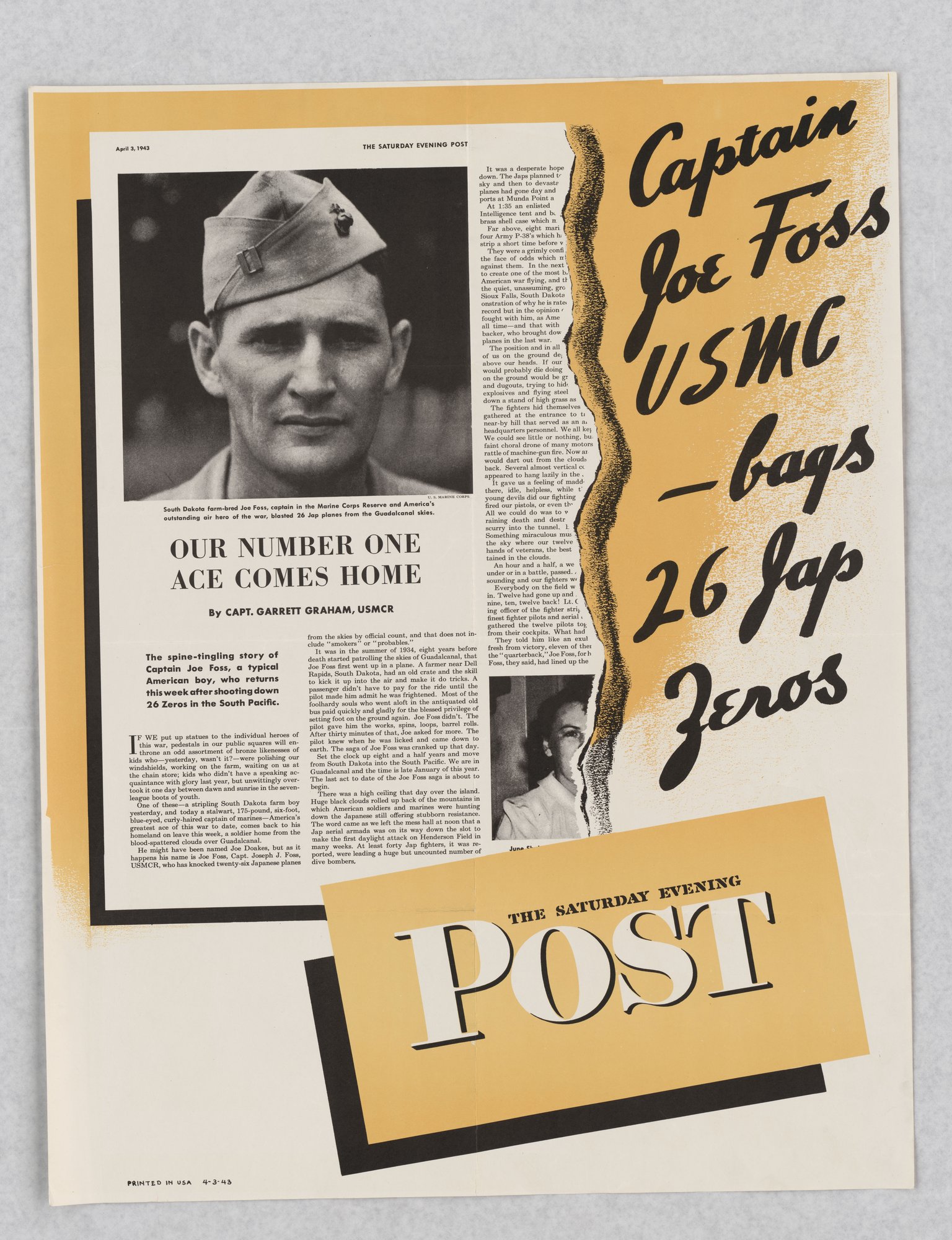
Captain Joe Foss USMC bags 26 Jap Zeros
Magazine promotion sheet: a torn-edge reproduction of a Saturday Evening Post page (3 April 1943) with a portrait of Marine Captain Joe Foss under 'Our Number One Ace Comes Home', beside hand-lettered headline text and the magazine's logo. The article calls him 'a typical American boy', a plain-folks frame, and the sheet presents his record as the selling point.
Propaganda techniques used in this advertisement
- Date
- 1943
- Period
- Second World War
- Made by
- The Saturday Evening Post
- Region
- North America
- Country
- United States
- Medium
- Advertisement
- Issuer type
- Media
- Regime
- Roosevelt Administration
- Leader
- Franklin D. Roosevelt
- Audience
- Domestic public
- Purpose
- Persuade or win support
- Themes
- War and the military, Media and information
- Event
- World War II
- Regime
- Roosevelt administration
- Leader
- Franklin D. Roosevelt
- Source
- Identified Openly sourced: the speaker is who they say they are
- Source
- U.S. National Archives and Records Administration, Record Group 44, World War II Posters, retrieved October 4, 2026
- Rights
- Public domain (U.S. government work)
The Saturday Evening Post. National Archives and Records Administration, RG 44, 44-PA-550 (NAID 514029).
Text on the object
[left page, top:] April 3, 1943    THE SATURDAY EVENING POST
[photo credit:] U. S. MARINE CORPS
South Dakota farm-bred Joe Foss, captain in the Marine Corps Reserve and America's outstanding air hero of the war, blasted 26 Jap planes from the Guadalcanal skies.
OUR NUMBER ONE
ACE COMES HOME
By CAPT. GARRETT GRAHAM, USMCR
The spine-tingling story of Captain Joe Foss, a typical American boy, who returns this week after shooting down 26 Zeros in the South Pacific.
IF WE put up statues to the individual heroes of this war, pedestals in our public squares will enthrone an odd assortment of bronze likenesses of kids who-yesterday, wasn't it?-were polishing our windshields, working on the farm, waiting on us at the chain store; kids who didn't have a speaking acquaintance with glory last year, but unwittingly overtook it one day between dawn and sunrise in the seven-league boots of youth.
One of these-a stripling South Dakota farm boy yesterday, and today a stalwart, 175-pound, six-foot, blue-eyed, curly-haired captain of marines-America's greatest ace of this war to date, comes back to his homeland on leave this week, a soldier home from the blood-spattered clouds over Guadalcanal.
He might have been named Joe Doakes, but as it happens his name is Joe Foss, Capt. Joseph J. Foss, USMCR, who has knocked twenty-six Japanese planes from the skies by official count, and that does not include "smokers" or "probables."
It was in the summer of 1934, eight years before death started patrolling the skies of Guadalcanal, that Joe Foss first went up in a plane. [remaining column text continues in the same vein about Foss's flying career and a Guadalcanal air raid; the right-hand column is torn off at its right edge and the small caption of a second photograph, beginning "June St", is cut off; not transcribed line by line]
[poster headline:]
Captain
Joe Foss
USMC
-bags
26 Jap
Zeros
THE SATURDAY EVENING
POST
[imprint:] PRINTED IN USA 4-3-43