FBIS Daily Report: Havana International Service lines up foreign voices against Radio Marti
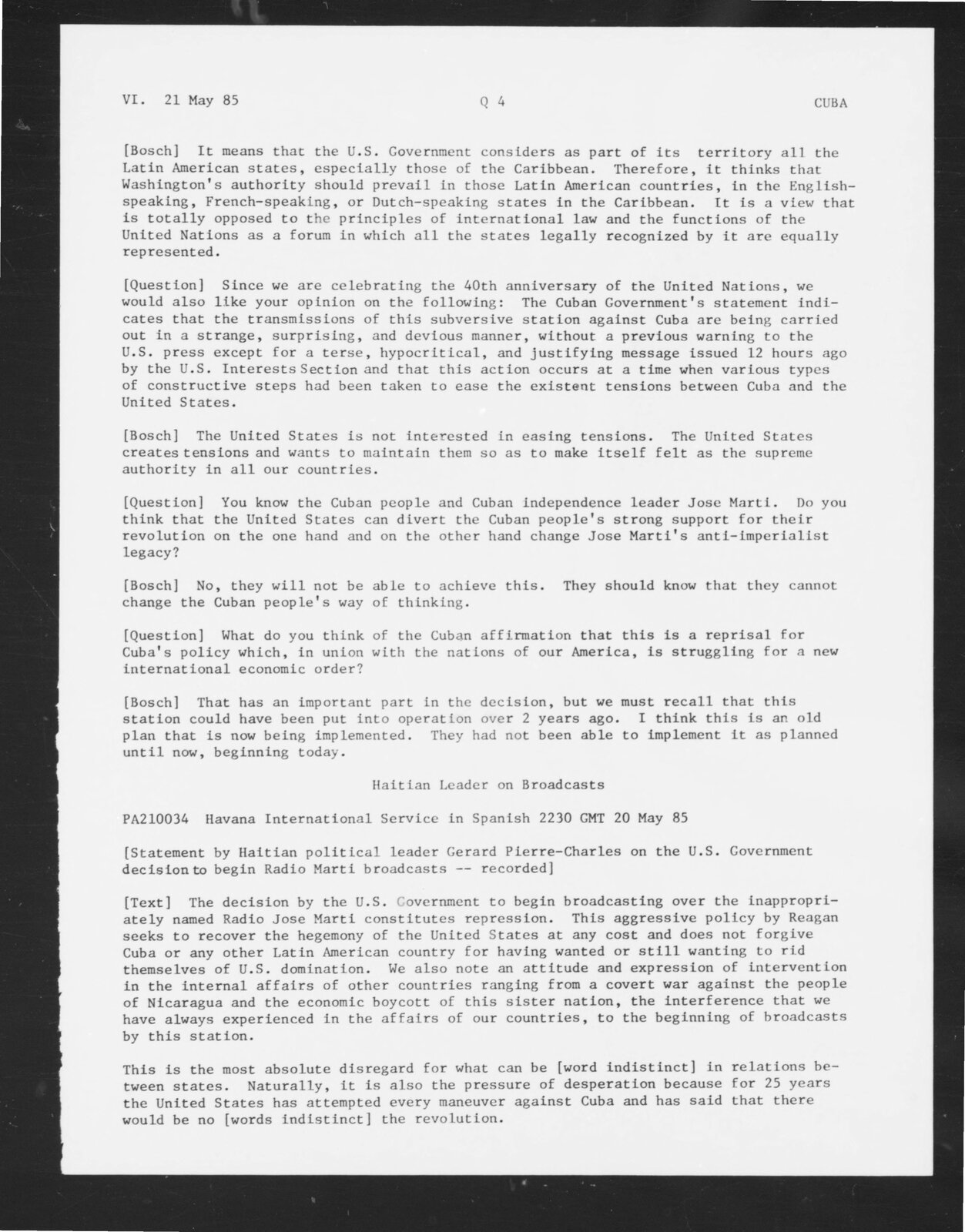
Page Q 4 of the U.S. FBIS Daily Report (Latin America, 21 May 1985): the Cuban state's international radio service answers the first broadcasts of the U.S. government's Radio Marti on 20 May 1985 by airing a succession of friendly foreign figures, here Dominican ex-president Juan Bosch (answering leading questions that call the station 'subversive' and its launch 'devious' and 'hypocritical') and Haitian leader Gerard Pierre-Charles ('inappropriately named Radio Jose Marti'). The named speakers vouch for Havana's line, and the station's name is attacked rather than its content.
- Date
- May 20, 1985
- Period
- Cold War
- Made by
- Cuban government (Havana International Service / Radio Havana Cuba); FBIS (U.S.) translation
- Region
- Latin America
- Country
- Cuba
- Medium
- Broadcast
- Issuer type
- State
- Regime
- Fidel Castro Government
- Leader
- Fidel Castro
- Audience
- Mixed
- Purpose
- Persuade or win support
- Techniques
- TestimonialName-calling
- Source
- Identified Openly sourced: the speaker is who they say they are
- Source
- Internet Archive (U.S. Government Publishing Office microfiche collection), retrieved October 2, 2026
- Rights
- Public domain (U.S. government work)
FBIS Daily Report, U.S. government work (public domain); Internet Archive scan from the US GPO microfiche collection, no usage restriction shown. FBIS-LAM-85-098 (PrEx 7.10:FBIS-LAM-85-098), Latin America Vol. VI No. 098, p. Q 4.
Text on the object
VI. 21 May 85 Q 4 CUBA
[Bosch] It means that the U.S. Government considers as part of its territory all the Latin American states, especially those of the Caribbean. Therefore, it thinks that Washington's authority should prevail in those Latin American countries, in the English-speaking, French-speaking, or Dutch-speaking states in the Caribbean. It is a view that is totally opposed to the principles of international law and the functions of the United Nations as a forum in which all the states legally recognized by it are equally represented.
[Question] Since we are celebrating the 40th anniversary of the United Nations, we would also like your opinion on the following: The Cuban Government's statement indicates that the transmissions of this subversive station against Cuba are being carried out in a strange, surprising, and devious manner, without a previous warning to the U.S. press except for a terse, hypocritical, and justifying message issued 12 hours ago by the U.S. Interests Section and that this action occurs at a time when various types of constructive steps had been taken to ease the existent tensions between Cuba and the United States.
[Bosch] The United States is not interested in easing tensions. The United States creates tensions and wants to maintain them so as to make itself felt as the supreme authority in all our countries.
[Question] You know the Cuban people and Cuban independence leader Jose Marti. Do you think that the United States can divert the Cuban people's strong support for their revolution on the one hand and on the other hand change Jose Marti's anti-imperialist legacy?
[Bosch] No, they will not be able to achieve this. They should know that they cannot change the Cuban people's way of thinking.
[Question] What do you think of the Cuban affirmation that this is a reprisal for Cuba's policy which, in union with the nations of our America, is struggling for a new international economic order?
[Bosch] That has an important part in the decision, but we must recall that this station could have been put into operation over 2 years ago. I think this is an old plan that is now being implemented. They had not been able to implement it as planned until now, beginning today.
Haitian Leader on Broadcasts
PA210034 Havana International Service in Spanish 2230 GMT 20 May 85
[Statement by Haitian political leader Gerard Pierre-Charles on the U.S. Government decision to begin Radio Marti broadcasts -- recorded]
[Text] The decision by the U.S. Government to begin broadcasting over the inappropriately named Radio Jose Marti constitutes repression. This aggressive policy by Reagan seeks to recover the hegemony of the United States at any cost and does not forgive Cuba or any other Latin American country for having wanted or still wanting to rid themselves of U.S. domination. We also note an attitude and expression of intervention in the internal affairs of other countries ranging from a covert war against the people of Nicaragua and the economic boycott of this sister nation, the interference that we have always experienced in the affairs of our countries, to the beginning of broadcasts by this station.
This is the most absolute disregard for what can be [word indistinct] in relations between states. Naturally, it is also the pressure of desperation because for 25 years the United States has attempted every maneuver against Cuba and has said that there would be no [words indistinct] the revolution.
The page is itself an FBIS English translation of Spanish-language Havana International Service broadcasts of 20 May 1985; no further translation is needed.
Read against the page image, with OCR as an aid. Two scan-damaged letters were restored ('U.S. Government'); line-end hyphens in the original typescript were joined. Bracketed text is FBIS's own.