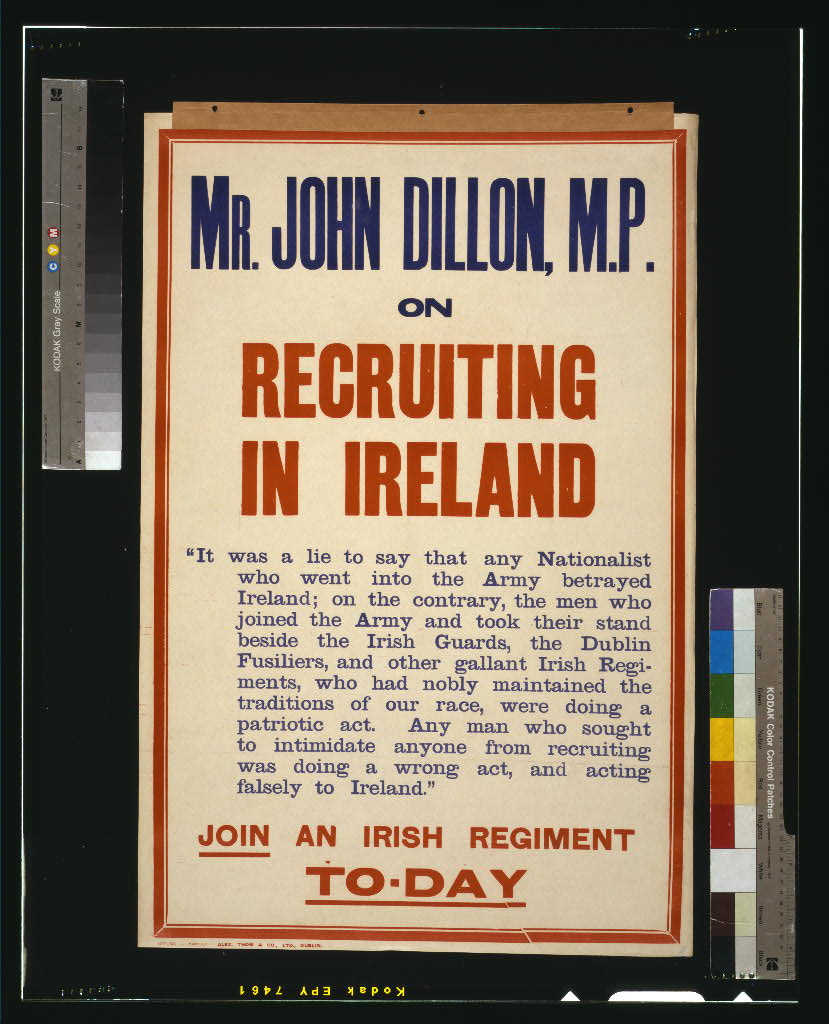
Mr. John Dillon, M.P., on recruiting in Ireland. Join an Irish regiment to-day
An all-text poster, without a picture, gives a named Irish Nationalist MP's words as its whole argument: enlisting is 'a patriotic act', and to say a Nationalist who joined the Army 'betrayed Ireland' is 'a lie'. The named speaker vouches (testimonial), and the word 'patriotic' is stretched to cover service in an Irish regiment of the British Army, a meaning that rival Irish movements of the same years contested.
- Date
- 1915
- Period
- First World War
- Made by
- Recruiting campaign in Ireland, United Kingdom (issuing committee not printed on the sheet); printed by Alex. Thom & Co., Ltd., Dublin
- Region
- Western and Central Europe
- Country
- United Kingdom
- Medium
- Poster
- Issuer type
- Mixed
- Regime
- Asquith Government
- Leader
- Herbert Henry Asquith
- Audience
- Domestic public
- Purpose
- Recruit
- Themes
- War and the military, Empire and colonialism
- Event
- World War I
- Techniques
- TestimonialSemantic hijacking
- Source
- Identified Openly sourced: the speaker is who they say they are
- Source
- Library of Congress, retrieved September 29, 2026
- Rights
- Public domain (published 1915, before 1931; LOC: no known restrictions)
Alex. Thom & Co., Ltd., Dublin, printer. [1915]. Library of Congress, Prints and Photographs Division, LC-USZC4-10990.
Text on the object
MR. JOHN DILLON, M.P.
ON
RECRUITING
IN IRELAND

"It was a lie to say that any Nationalist who went into the Army betrayed Ireland; on the contrary, the men who joined the Army and took their stand beside the Irish Guards, the Dublin Fusiliers, and other gallant Irish Regiments, who had nobly maintained the traditions of our race, were doing a patriotic act.  Any man who sought to intimidate anyone from recruiting was doing a wrong act, and acting falsely to Ireland."

JOIN AN IRISH REGIMENT
TO-DAY

[printer's line, bottom edge, small: ... ALEX. THOM & CO., LTD., DUBLIN.]
The printer's line at the foot is very small; only the Dublin printer's name is legible at this resolution. The photographed copy is bordered by Kodak calibration strips added for archival photography.