Content note: Newspaper-format sheet with photographs of wounded servicemen, including one blood-stained wounded man receiving a transfusion, and period wartime wording for the Japanese enemy in the text. This object is shown as it was published. Why
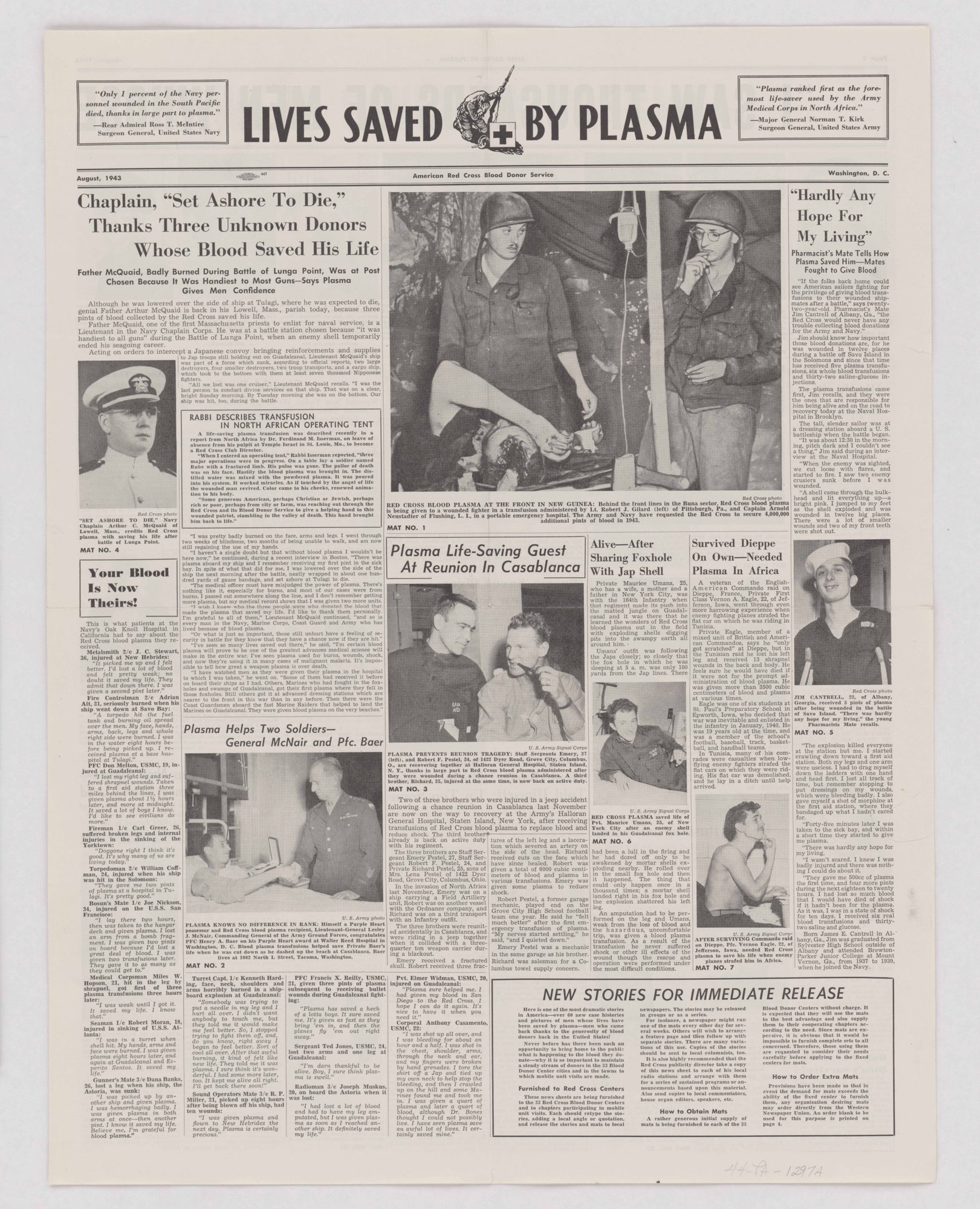
Lives saved by plasma
Press-release news sheet dated August 1943: a masthead reading 'Lives Saved By Plasma' between two official quotations, then columns of wounded servicemen's stories, photographs and numbered mats. Named patients and surgeons-general vouch for plasma (testimonial), and the sheet is written for local papers to reprint, to encourage blood donation.
Propaganda techniques used in this newspaper page
- Date
- 1943
- Period
- Second World War
- Made by
- American Red Cross, Blood Donor Service
- Region
- North America
- Country
- United States
- Medium
- Newspaper pages
- Issuer type
- NGO
- Regime
- Roosevelt Administration
- Leader
- Franklin D. Roosevelt
- Audience
- Domestic public
- Purpose
- Fundraise
- Themes
- Health, War and the military
- Event
- World War II
- Regime
- Roosevelt administration
- Leader
- Franklin D. Roosevelt
- Source
- Identified Openly sourced: the speaker is who they say they are
- Source
- U.S. National Archives and Records Administration, Record Group 44, World War II Posters, retrieved October 4, 2026
- Rights
- Public domain (U.S. government work)
American Red Cross, Blood Donor Service. National Archives and Records Administration, RG 44, 44-PA-1297 (NAID 514903).
Text on the object
"Only 1 percent of the Navy personnel wounded in the South Pacific died, thanks in large part to plasma."
-Rear Admiral Ross T. McIntire, Surgeon General, United States Navy
LIVES SAVED BY PLASMA
"Plasma ranked first as the foremost life-saver used by the Army Medical Corps in North Africa."
-Major General Norman T. Kirk, Surgeon General, United States Army
August, 1943
American Red Cross Blood Donor Service
Washington, D. C.
Chaplain, "Set Ashore To Die," Thanks Three Unknown Donors Whose Blood Saved His Life
Father McQuaid, Badly Burned During Battle of Lunga Point, Was at Post Chosen Because It Was Handiest to Most Guns-Says Plasma Gives Men Confidence
Although he was lowered over the side of ship at Tulagi, where he was expected to die, genial Father Arthur McQuaid is back in his Lowell, Mass., parish today, because three pints of blood collected by the Red Cross saved his life.
Father McQuaid, one of the first Massachusetts priests to enlist for naval service, is a Lieutenant in the Navy Chaplain Corps. He was at a battle station chosen because "it was handiest to most guns" during the Battle of Lunga Point, when an enemy shell temporarily ended his seagoing career.
Acting on orders to intercept a Japanese convoy bringing reinforcements and supplies to Jap troops still holding out on Guadalcanal, Lieutenant McQuaid's ship was part of a force which sank, according to official reports, two large destroyers, four smaller destroyers, two troop transports, and a cargo ship, which took to the bottom with them at least seven thousand Nipponese fighters.
"All we lost was one cruiser," Lieutenant McQuaid recalls. "I was the last person to conduct divine services on that ship. That was on a clear, bright Sunday morning. By Tuesday morning she was on the bottom. Our ship was hit, too, during the battle.
RABBI DESCRIBES TRANSFUSION IN NORTH AFRICAN OPERATING TENT
A life-saving plasma transfusion was described recently in a report from North Africa by Dr. Ferdinand M. Isserman, on leave of absence from his pulpit at Temple Israel in St. Louis, Mo., to become a Red Cross Club Director.
"When I entered an operating tent," Rabbi Isserman reported, "three major operations were in progress. On a table lay a soldier named Rube with a fractured limb. His pulse was gone. The pallor of death was on his face. Hastily the blood plasma was brought in. The distilled water was mixed with the powdered plasma. It was poured into his system. It worked miracles. As if touched by the angel of life the wounded man revived. Color came to his cheeks, renewed animation to his body.
"Some generous American, perhaps Christian or Jewish, perhaps rich or poor, perhaps from city or farm, was reaching out through the Red Cross and its Blood Donor Service to give a helping hand to this wounded patriot, stumbling in the valley of death. This hand brought him back to life."
"I was pretty badly burned on the face, arms and legs. I went through two weeks of blindness, two months of being unable to walk, and am now still regaining the use of my hands.
"I haven't a single doubt but that without blood plasma I wouldn't be here now," he continued, during a recent interview in Boston. "There was plasma aboard my ship and I remember receiving my first pint in the sick bay. In spite of what that did for me, I was lowered over the side of the ship the next morning after the battle, neatly wrapped in about one hundred yards of gauze bandage, and set ashore at Tulagi to die.
"The medical officer must have misjudged the power of plasma. There's nothing like it, especially for burns, and most of our cases were from burns. I passed out somewhere along the line, and I don't remember getting more plasma, but my medical record shows that I was given two more units.
[Text continues in many further columns of articles, photo captions and quotations; the rest of the page is omitted at the 4000-character cap.]
Full page is several thousand words of small type; transcribed in reading order from the masthead and first article, then cut at the cap with a bracketed note. Some words in the small print are uncertain.