Một phương pháp chăn nuôi mới (A New and Better Way to Raise Pigs)
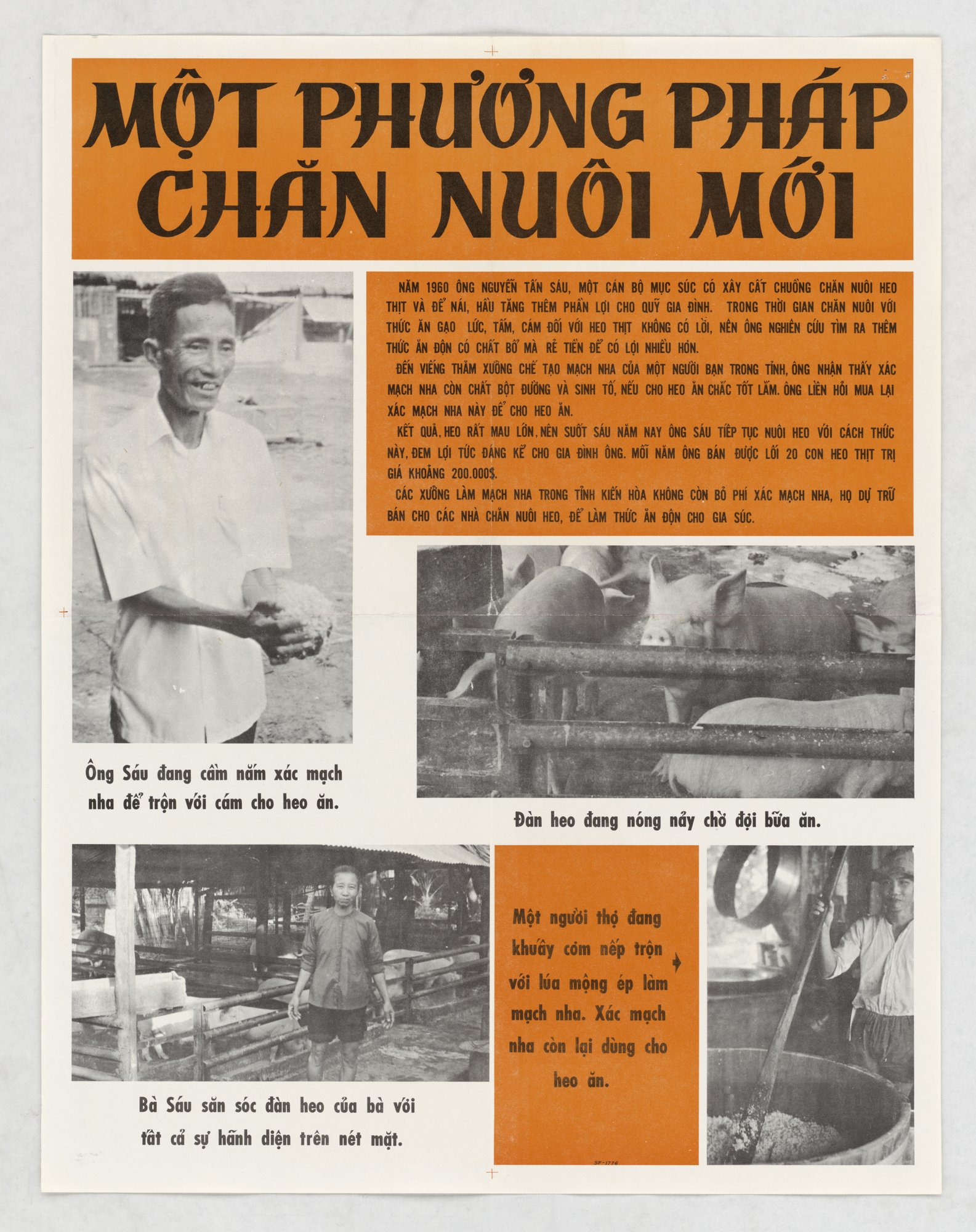
A picture-story sheet tells of Mr. and Mrs. Sau of Kien Hoa province, who since 1960 have fed their pigs a mix of bran and the spent residue from noodle-making and say they sell about 20 pigs a year worth roughly 200,000 piastres. Photographs show Mr. Sau holding the residue, the penned pigs, Mrs. Sau among them and a worker stirring the mash. The tell is a named farmer's own profit offered as the reason to copy the method.
Propaganda techniques used in this poster
- Date
- 1966
- Period
- Cold War
- Made by
- South Vietnamese government agricultural extension (issuer inferred; printed code SP-1776)
- Region
- North America
- Country
- United States
- Medium
- Poster
- Issuer type
- State
- Regime
- Johnson Administration
- Leader
- Lyndon B. Johnson
- Audience
- Domestic public
- Purpose
- Warn or inform
- Themes
- Economy and finance, Home front
- Event
- Vietnam War
- Source
- Unidentified Source blurred: contractors, cutouts, buried disclosure
- Source
- U.S. National Archives (NARA), RG 306, Psychological Warfare Posters, Vietnam War (NAID 561393), retrieved October 3, 2026
- Rights
- NARA Unrestricted; hosted by owner decision
South Vietnamese government agricultural extension (issuer inferred; printed code SP-1776). National Archives and Records Administration, 306-VP-7-1776.
Text on the object
MỘT PHƯƠNG PHÁP CHĂN NUÔI MỚI

NĂM 1960 ÔNG NGUYỄN TẤN SÁU, MỘT CÁN BỘ MỤC SÚC CÓ XÂY CẤT CHUỒNG CHĂN NUÔI HEO THỊT VÀ ĐỂ NÁI, HẦU TĂNG THÊM PHẦN LỢI CHO QUỸ GIA ĐÌNH. TRONG THỜI GIAN CHĂN NUÔI VỚI THỨC ĂN GẠO LỨC, TẤM, CÁM ĐỐI VỚI HEO THỊT KHÔNG CÓ LỜI, NÊN ÔNG NGHIÊN CỨU TÌM RA THÊM THỨC ĂN ĐỘN CÓ CHẤT BỔ MÀ RẺ TIỀN ĐỂ CÓ LỢI NHIỀU HƠN.
ĐẾN VIẾNG THĂM XƯỞNG CHẾ TẠO MẠCH NHA CỦA MỘT NGƯỜI BẠN TRONG TỈNH, ÔNG NHẬN THẤY XÁC MẠCH NHA CÒN CHẤT BỘT ĐƯỜNG VÀ SINH TỐ, NẾU CHO HEO ĂN CHẮC TỐT LẮM. ÔNG LIỀN HỎI MUA LẠI XÁC MẠCH NHA NÀY ĐỂ CHO HEO ĂN.
KẾT QUẢ, HEO RẤT MAU LỚN, NÊN SUỐT SÁU NĂM NAY ÔNG SÁU TIẾP TỤC NUÔI HEO VỚI CÁCH THỨC NÀY, ĐEM LẠI TỨC ĐÁNG KỂ CHO GIA ĐÌNH ÔNG. MỖI NĂM ÔNG BÁN ĐƯỢC LỐI 20 CON HEO THỊT TRỊ GIÁ KHOẢNG 200.000$.
CÁC XƯỞNG LÀM MẠCH NHA TRONG TỈNH KIẾN HÒA KHÔNG CÒN BỎ PHÍ XÁC MẠCH NHA, HỌ DỰ TRỮ BÁN CHO CÁC NHÀ CHĂN NUÔI HEO, ĐỂ LÀM THỨC ĂN ĐỘN CHO GIA SÚC.

Ông Sáu đang cầm nắm xác mạch nha để trộn với cám cho heo ăn.

Đàn heo đang nóng nảy chờ đợi bữa ăn.

Bà Sáu săn sóc đàn heo của bà với tất cả sự hãnh diện trên nét mặt.

Một người thợ đang khuấy cơm nếp trộn với lúa mọng ép làm mạch nha. Xác mạch nha còn lại dùng cho heo ăn.

SP-1776
A NEW METHOD OF LIVESTOCK RAISING

In 1960 Mr. Nguyen Tan Sau, a livestock cadre, built pens to raise meat pigs and breeding sows, to add to the family's funds. While raising them on feed of brown rice, broken rice and bran, there was no profit in the meat pigs, so he researched and found additional mixed feed that is nourishing yet cheap, to make more profit.
Visiting a friend's malt-making workshop in the province, he noticed that the malt residue still contained starch, sugar and vitamins and would surely be very good if fed to pigs. He at once asked to buy this malt residue to feed his pigs.
As a result the pigs grew very fast, so for the past six years Mr. Sau has continued raising pigs this way, bringing his family considerable income. Each year he sells about 20 meat pigs worth about 200,000$.
The malt-making workshops in Kien Hoa province no longer throw away the malt residue; they set it aside to sell to pig raisers, to make mixed feed for livestock.

Mr. Sau holding a handful of malt residue to mix with bran to feed the pigs.

The herd of pigs impatiently waiting for their meal.

Mrs. Sau tending her pigs with pride on her face.

A worker stirring sticky rice mixed with sprouted rice pressed to make malt. The remaining residue is used to feed the pigs.

SP-1776