Nurses in action
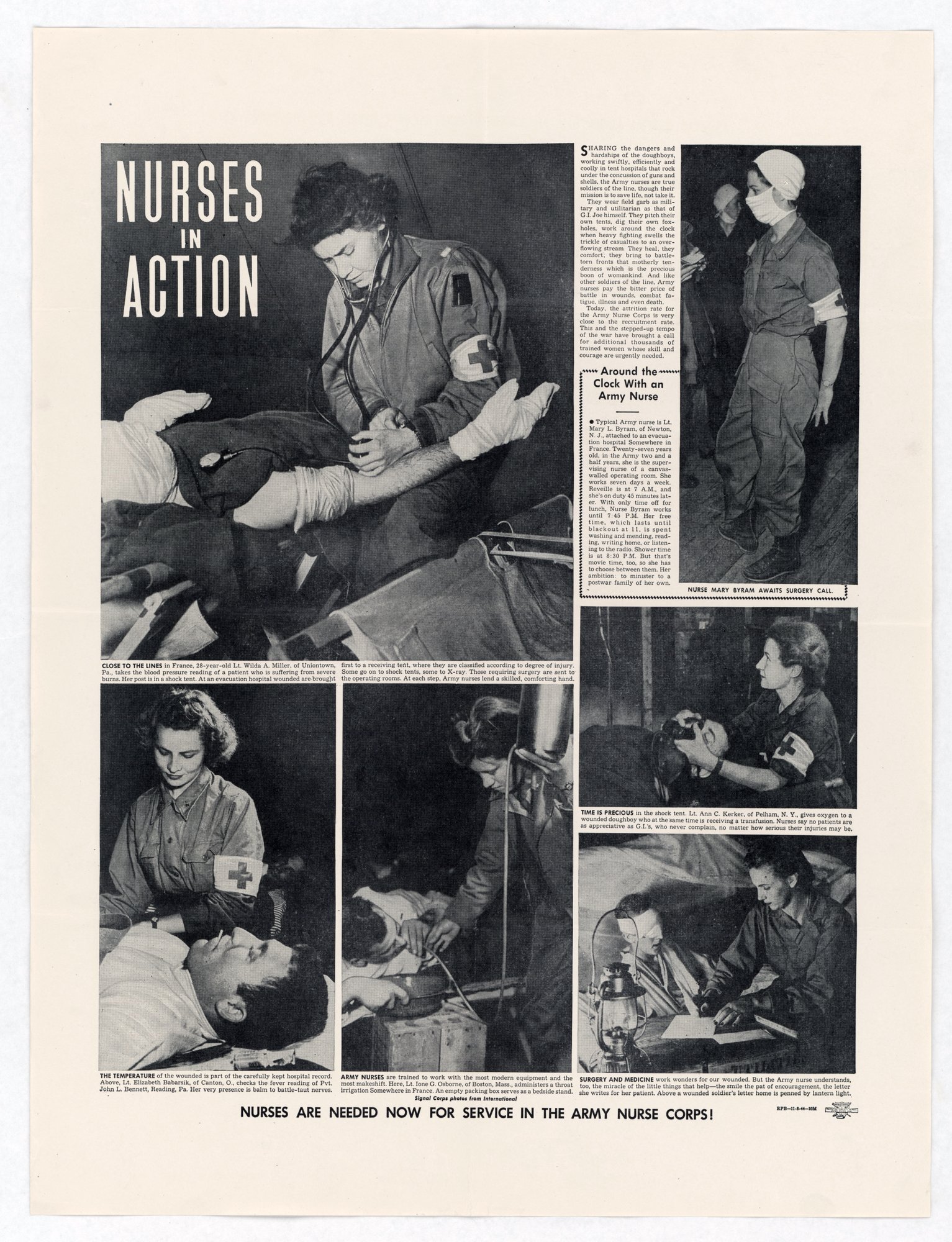
Black-and-white photo-essay page with the title 'Nurses in Action' and six photographs of named Army nurses treating wounded soldiers in field hospitals in France, with captions, a column of text and a boxed day-in-the-life panel; the last line asks for nurses. The tells are named nurses with hometowns as examples (testimonial) and a selection of tender, orderly scenes beside text that mentions casualties only briefly (card-stacking).
Propaganda techniques used in this poster
- Date
- 1944
- Period
- Second World War
- Made by
- U.S. Army, Army Nurse Corps (Signal Corps photographs from International)
- Region
- North America
- Country
- United States
- Medium
- Poster
- Issuer type
- Military
- Regime
- Roosevelt Administration
- Leader
- Franklin D. Roosevelt
- Audience
- Domestic public
- Purpose
- Recruit
- Themes
- War and the military, Health, Gender and suffrage
- Event
- World War II
- Regime
- Roosevelt administration
- Leader
- Franklin D. Roosevelt
- Source
- Identified Openly sourced: the speaker is who they say they are
- Source
- U.S. National Archives and Records Administration, Record Group 44, World War II Posters, retrieved October 4, 2026
- Rights
- Public domain (U.S. government work)
U.S. Army, Army Nurse Corps. National Archives and Records Administration, RG 44, 44-PA-1432 (NAID 515095).
Text on the object
NURSES IN ACTION
SHARING the dangers and hardships of the doughboys, working swiftly, efficiently and coolly in tent hospitals that rock under the concussion of guns and shells, the Army nurses are true soldiers of the line, though their mission is to save life, not take it.
They wear field garb as military and utilitarian as that of G.I. Joe himself. They pitch their own tents, dig their own foxholes, work around the clock when heavy fighting swells the trickle of casualties to an overflowing stream. They heal, they comfort, they bring to battle-torn fronts that motherly tenderness which is the precious boon of womankind. And like other soldiers of the line, Army nurses pay the bitter price of battle in wounds, combat fatigue, illness and even death.
Today, the attrition rate for the Army Nurse Corps is very close to the recruitment rate. This and the stepped-up tempo of the war have brought a call for additional thousands of trained women whose skill and courage are urgently needed.
Around the Clock With an Army Nurse
● Typical Army nurse is Lt. Mary L. Byram, of Newton, N. J., attached to an evacuation hospital Somewhere in France. Twenty-seven years old, in the Army two and a half years, she is the supervising nurse of a canvas-walled operating room. She works seven days a week. Reveille is at 7 A.M., and she's on duty 45 minutes later. With only time off for lunch, Nurse Byram works until 7:45 P.M. Her free time, which lasts until blackout at 11, is spent washing and mending, reading, writing home, or listening to the radio. Shower time is at 8:30 P.M. But that's movie time, too, so she has to choose between them. Her ambition: to minister to a postwar family of her own.
NURSE MARY BYRAM AWAITS SURGERY CALL.
CLOSE TO THE LINES in France, 28-year-old Lt. Wilda A. Miller, of Uniontown, Pa., takes the blood pressure reading of a patient who is suffering from severe burns. Her post is in a shock tent. At an evacuation hospital wounded are brought first to a receiving tent, where they are classified according to degree of injury. Some go on to shock tents, some to X-ray. Those requiring surgery are sent to the operating rooms. At each step, Army nurses lend a skilled, comforting hand.
TIME IS PRECIOUS in the shock tent. Lt. Ann C. Kerker, of Pelham, N. Y., gives oxygen to a wounded doughboy who at the same time is receiving a transfusion. Nurses say no patients are as appreciative as G.I.'s, who never complain, no matter how serious their injuries may be.
THE TEMPERATURE of the wounded is part of the carefully kept hospital record. Above, Lt. Elizabeth Babarsik, of Canton, O., checks the fever reading of Pvt. John L. Bennett, Reading, Pa. Her very presence is balm to battle-taut nerves.
ARMY NURSES are trained to work with the most modern equipment and the most makeshift. Here, Lt. Ione G. Osborne, of Boston, Mass., administers a throat irrigation Somewhere in France. An empty packing box serves as a bedside stand.
SURGERY AND MEDICINE work wonders for our wounded. But the Army nurse understands, too, the miracle of the little things that help—the smile the pat of encouragement, the letter she writes for her patient. Above a wounded soldier's letter home is penned by lantern light.
Signal Corps photos from International
NURSES ARE NEEDED NOW FOR SERVICE IN THE ARMY NURSE CORPS!
RPB-11-8-44-10M
Small print is dense; a few words at column joins may be misread.