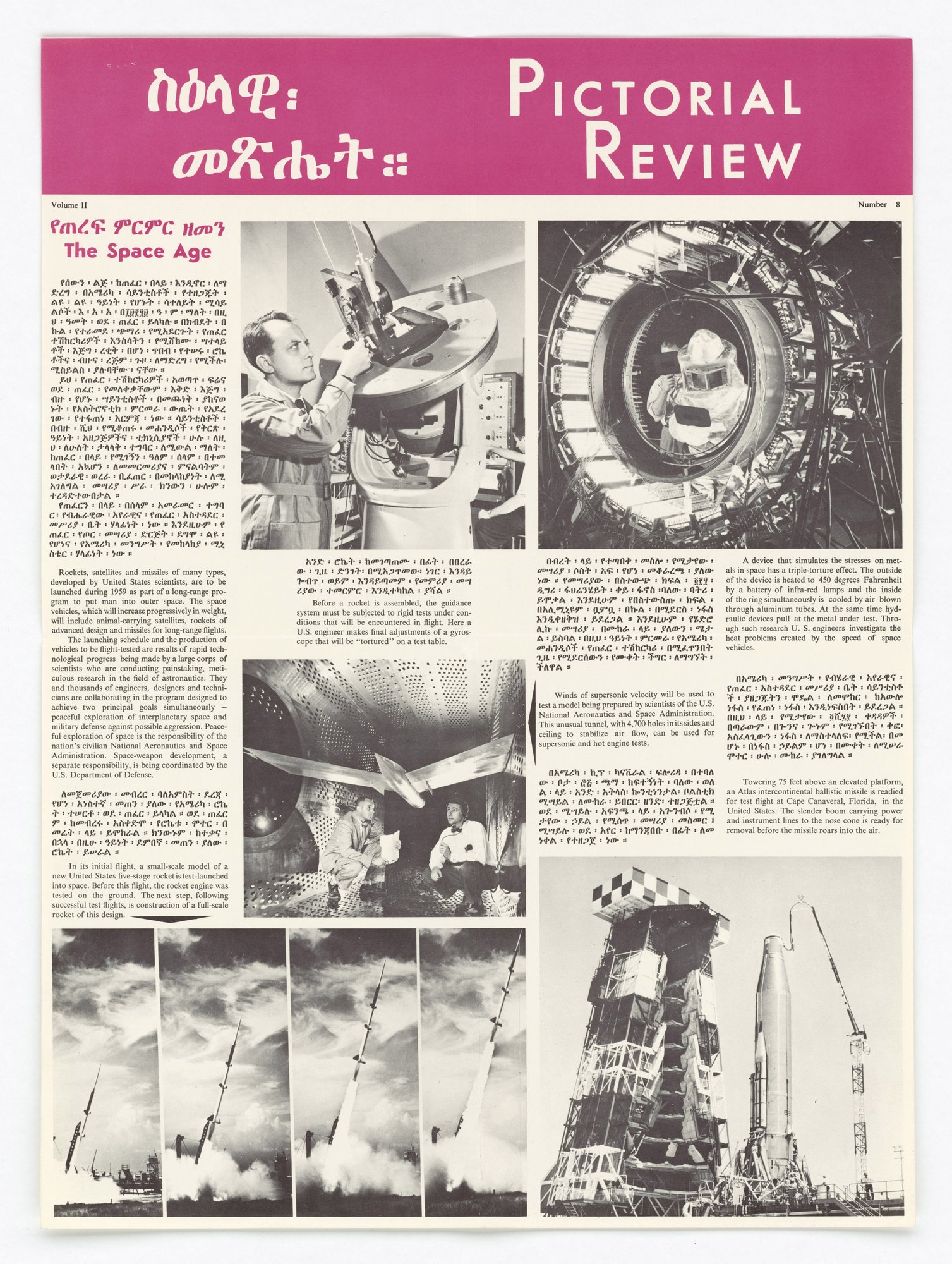
Pictorial Review poster, No. 8: The Space Age (Amharic-English, Addis Ababa)
A photo sheet headed 'The Space Age' showing U.S. engineers adjusting a gyroscope, a heat-stress test ring, a wind tunnel, a rocket test-firing sequence and an Atlas missile on its Cape Canaveral pad. The text lists 1959 launches and says the programme pursues 'peaceful exploration' and 'military defense against possible aggression'. The tell is card-stacking: U.S. rocketry is shown by selected successes and test photographs.
Propaganda techniques used in this poster
- Date
- June 17, 1959
- Period
- Cold War
- Made by
- U.S. Information Agency (predecessor: State Department International Information and Educational Exchange Program), Propaganda Posters Distributed in Asia, Latin America and the Middle East series
- Region
- North America
- Country
- United States
- Medium
- Poster
- Issuer type
- State
- Regime
- Eisenhower Administration
- Leader
- Dwight D. Eisenhower
- Audience
- Foreign public
- Purpose
- Persuade or win support
- Themes
- Science and technology, War and the military
- Event
- Cold War
- Source
- Unidentified Source blurred: contractors, cutouts, buried disclosure
- Source
- U.S. National Archives (NARA), RG 306, Propaganda Posters Distributed in Asia, Latin America and the Middle East, retrieved October 3, 2026
- Rights
- Public domain (U.S. government work; NARA RG 306)
U.S. Information Agency / Department of State, June 17, 1959. National Archives, Record Group 306 (NAID 6948757, 306-PPB-14l).
Text on the object
ስዕላዊ፡ መጽሔት። / PICTORIAL REVIEW
Volume II    Number 8

የጠረፍ ምርምር ዘመን
The Space Age

[Amharic text columns paralleling the English captions, not transcribed]

Rockets, satellites and missiles of many types, developed by United States scientists, are to be launched during 1959 as part of a long-range program to put man into outer space. The space vehicles, which will increase progressively in weight, will include animal-carrying satellites, rockets of advanced design and missiles for long-range flights. The launching schedule and the production of vehicles to be flight-tested are results of rapid technological progress being made by a large corps of scientists who are conducting painstaking, meticulous research in the field of astronautics. They and thousands of engineers, designers and technicians are collaborating in the program designed to achieve two principal goals simultaneously -- peaceful exploration of interplanetary space and military defense against possible aggression. Peaceful exploration of space is the responsibility of the nation's civilian National Aeronautics and Space Administration. Space-weapon development, a separate responsibility, is being coordinated by the U.S. Department of Defense.

In its initial flight, a small-scale model of a new United States five-stage rocket is test-launched into space. Before this flight, the rocket engine was tested on the ground. The next step, following successful test flights, is construction of a full-scale rocket of this design.

Before a rocket is assembled, the guidance system must be subjected to rigid tests under conditions that will be encountered in flight. Here a U.S. engineer makes final adjustments of a gyroscope that will be "tortured" on a test table.

Winds of supersonic velocity will be used to test a model being prepared by scientists of the U.S. National Aeronautics and Space Administration. This unusual tunnel, with 4,700 holes in its sides and ceiling to stabilize air flow, can be used for supersonic and hot engine tests.

A device that simulates the stresses on metals in space has a triple-torture effect. The outside of the device is heated to 450 degrees Fahrenheit by a battery of infra-red lamps and the inside of the ring simultaneously is cooled by air blown through aluminum tubes. At the same time hydraulic devices pull at the metal under test. Through such research U. S. engineers investigate the heat problems created by the speed of space vehicles.

Towering 75 feet above an elevated platform, an Atlas intercontinental ballistic missile is readied for test flight at Cape Canaveral, Florida, in the United States. The slender boom carrying power and instrument lines to the nose cone is ready for removal before the missile roars into the air.
English portions are as printed. The Amharic masthead reads 'Pictorial Review'; the Amharic captions and columns parallel the English text and are not separately translated here.
English text transcribed in full; the Amharic (Ge'ez script) columns, which parallel the English captions, are not transcribed. No imprint or credit line is printed on the scan. The Amharic heading is given.