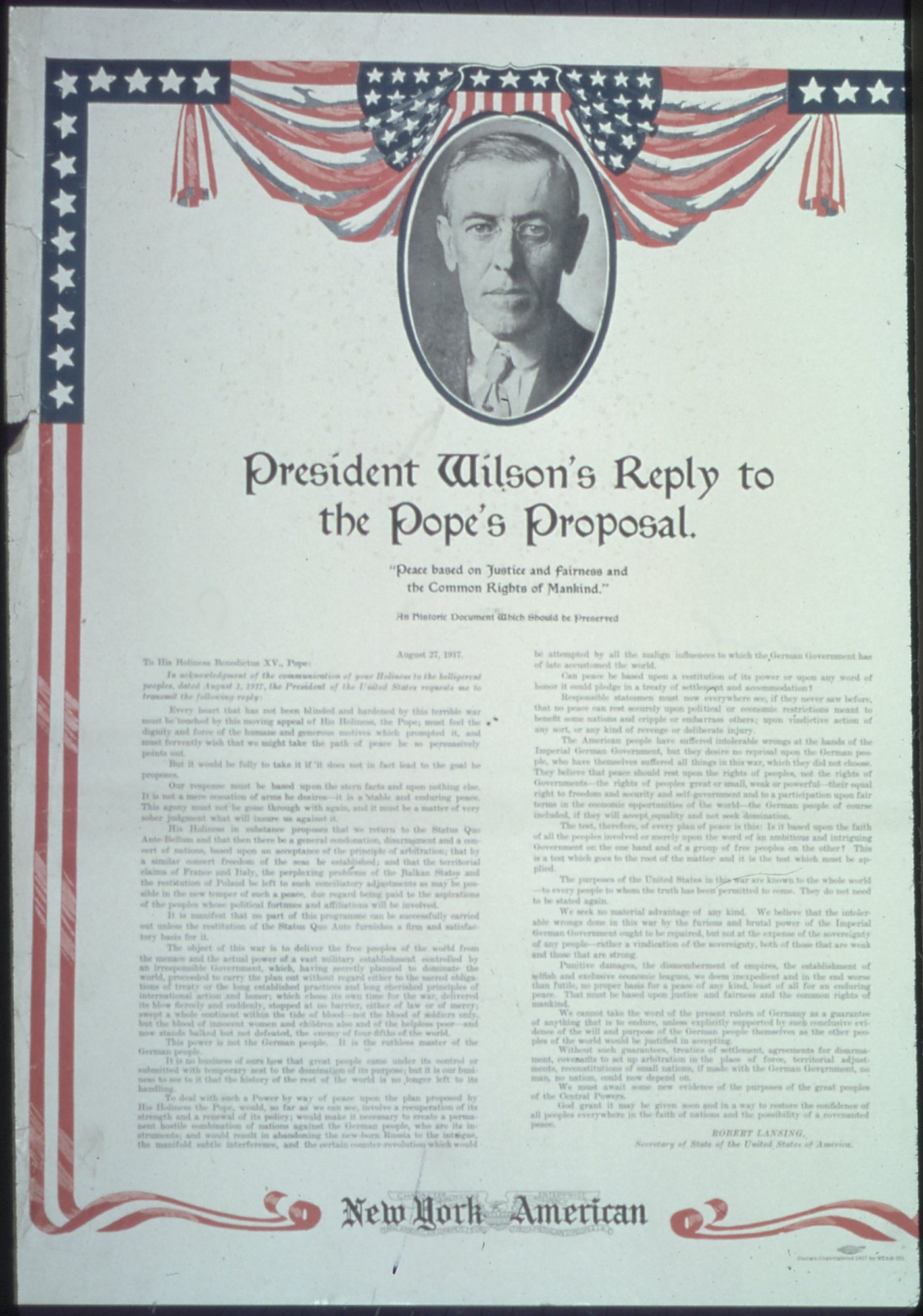
President Wilson's Reply to the Pope's Proposal
A portrait of President Wilson in an oval sits under draped flag bunting above the full text of the U.S. reply of August 27, 1917 to Pope Benedict XV's peace proposal, set in two dense columns. The headline quotes a phrase about 'Peace based on Justice and fairness and the Common Rights of Mankind', and the sheet describes itself as 'An Historic Document Which Should be Preserved'. The tell is the flag-and-portrait framing wrapped around a long official text, lending the national symbols to the document.
Propaganda techniques used in this poster
- Date
- 1917
- Period
- First World War
- Made by
- New York American (William Randolph Hearst); text issued by U.S. Department of State (Robert Lansing)
- Region
- North America
- Country
- United States
- Medium
- Poster
- Issuer type
- Media
- Regime
- Wilson Administration
- Leader
- Woodrow Wilson
- Audience
- Domestic public
- Purpose
- Persuade or win support
- Themes
- War and the military, Religion
- Event
- World War I
- Regime
- Wilson administration
- Leader
- Woodrow Wilson
- Source
- Identified Openly sourced: the speaker is who they say they are
- Source
- U.S. National Archives (NARA), RG 4 (U.S. Food Administration), World War I Posters (NAID 512439), retrieved October 3, 2026
- Rights
- NARA Unrestricted; hosted by owner decision
New York American (William Randolph Hearst); text issued by U.S. Department of State (Robert Lansing). National Archives and Records Administration, 4-P-213.
Text on the object
President Wilson's Reply to the Pope's Proposal.

"Peace based on Justice and Fairness and the Common Rights of Mankind."

An Historic Document Which Should be Preserved

August 27, 1917.

To His Holiness Benedictus XV., Pope:

In acknowledgment of the communication of your Holiness to the belligerent peoples, dated August 1, 1917, the President of the United States requests me to transmit the following reply:

Every heart that has not been blinded and hardened by this terrible war must be touched by this moving appeal of His Holiness, the Pope; must feel the dignity and force of the humane and generous motives which prompted it, and must fervently wish that we might take the path of peace he so persuasively points out.

But it would be folly to take it if it does not in fact lead to the goal he proposes.

Our response must be based upon the stern facts and upon nothing else. It is not a mere cessation of arms he desires--it is a stable and enduring peace. This agony must not be gone through with again, and it must be a matter of very sober judgment what will insure us against it.

His Holiness in substance proposes that we return to the Status Quo Ante-Bellum and that then there be a general condonation, disarmament and a concert of nations, based upon an acceptance of the principle of arbitration; that by a similar concert freedom of the seas be established; and that the territorial claims of France and Italy, the perplexing problems of the Balkan States and the restitution of Poland be left to such conciliatory adjustments as may be possible in the new temper of such a peace, due regard being paid to the aspirations of the peoples whose political fortunes and affiliations will be involved.

It is manifest that no part of this programme can be successfully carried out unless the restitution of the Status Quo Ante furnishes a firm and satisfactory basis for it.

The object of this war is to deliver the free peoples of the world from the menace and the actual power of a vast military establishment controlled by an irresponsible Government, which, having secretly planned to dominate the world, proceeded to carry the plan out without regard either to the sacred obligations of treaty or the long established practices and long cherished principles of international action and honor; which chose its own time for the war, delivered its blow fiercely and suddenly, stopped at no barrier, either of law or of mercy; swept a whole continent within the tide of blood--not the blood of soldiers only, but the blood of innocent women and children also and of the helpless poor--and now stands balked but not defeated, the enemy of four-fifths of the world.

This power is not the German people. It is the ruthless master of the German people.

It is no business of ours how that great people came under its control or submitted with temporary zest to the domination of its purpose; but it is our business to see to it that the history of the rest of the world is no longer left to its handling.

To deal with such a Power by way of peace upon the plan proposed by His Holiness the Pope, would, so far as we can see, involve a recuperation of its strength and a renewal of its policy; would make it necessary to create a permanent hostile combination of nations against the German people, who are its instruments; and would result in abandoning the new-born Russia to the intrigue, the manifold subtle interference, and the certain counter-revolution which would be attempted by all the malign influences to which the German Government has of late accustomed the world.

Can peace be based upon a restitution of its power or upon any word of honor it could pledge in a treaty of settlement and accommodation?

[text continues; truncated here at the archive's 4,000-character limit]

ROBERT LANSING,
Secretary of State of the United States of America.

New York American

Design Copyrighted 1917 by STAR CO.
The body text (two dense columns, small type, slightly soft in the scan) is transcribed from the image up to the schema limit; the middle and closing paragraphs of the note, which run on to 'the possibility of a covenanted peace.', are omitted where marked, and the signature block and imprint are given after the marker. A faint circular device behind the 'New York American' masthead carries small lettering that is not legible and is not transcribed.