Ranger VII moon close-ups poster (Spanish-language poster distributed in Guatemala)
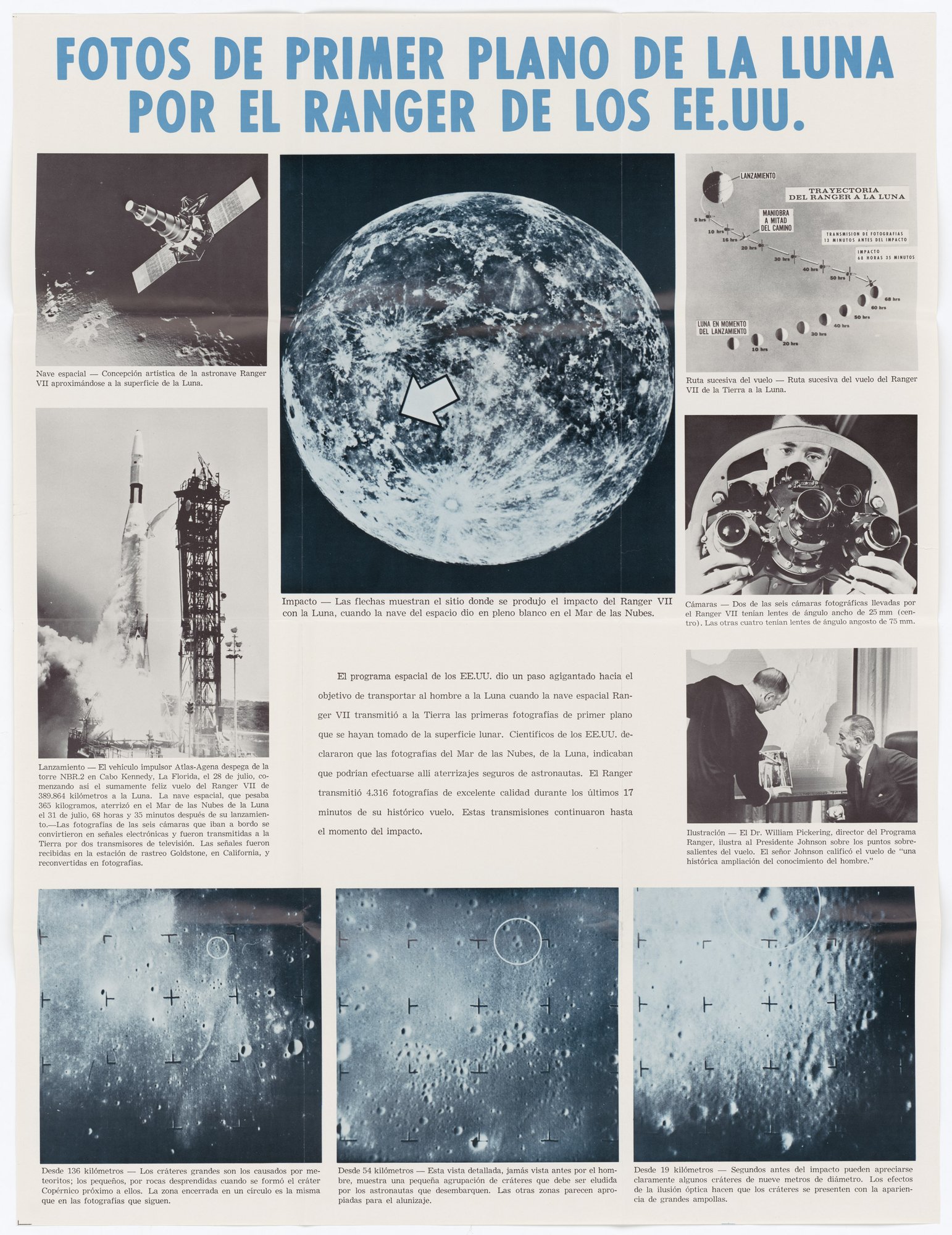
A folded photo poster on the Ranger VII lunar probe: the Moon with an arrow at the impact site, launch and camera photographs, a flight diagram, and three close-ups taken from 136, 54 and 19 kilometres. A panel shows President Johnson being briefed and calling the flight a historic extension of man's knowledge. The tell is testimonial: the President's quoted verdict is attached to a scientific result, alongside a text that frames it as a step toward a U.S. landing on the Moon.
Propaganda techniques used in this poster
- Date
- September 4, 1964
- Period
- Cold War
- Made by
- U.S. Information Agency (predecessor: State Department International Information and Educational Exchange Program), Propaganda Posters Distributed in Asia, Latin America and the Middle East series
- Region
- North America
- Country
- United States
- Medium
- Poster
- Issuer type
- State
- Regime
- Johnson Administration
- Leader
- Lyndon B. Johnson
- Audience
- Foreign public
- Purpose
- Persuade or win support
- Theme
- Science and technology
- Event
- Cold War
- Source
- Unidentified Source blurred: contractors, cutouts, buried disclosure
- Source
- U.S. National Archives (NARA), Record Group 306, Posters in Asia, Latin America, Middle East, retrieved October 4, 2026
- Rights
- Public domain (U.S. government work; NARA RG 306)
U.S. Information Agency / Department of State, September 4, 1964. National Archives, Record Group 306 (NAID 6949362, 306-PPB-421).
Text on the object
FOTOS DE PRIMER PLANO DE LA LUNA
POR EL RANGER DE LOS EE.UU.

Nave espacial — Concepción artística de la astronave Ranger VII aproximándose a la superficie de la Luna.

Ruta sucesiva del vuelo — Ruta sucesiva del vuelo del Ranger VII de la Tierra a la Luna.
[Diagram labels: TRAYECTORIA DEL RANGER A LA LUNA; LANZAMIENTO; MANIOBRA A MITAD DEL CAMINO; TRANSMISIÓN DE FOTOGRAFÍAS 13 MINUTOS ANTES DEL IMPACTO; IMPACTO 68 HORAS 35 MINUTOS; LUNA EN MOMENTO DEL LANZAMIENTO; 5 hrs, 10 hrs, 16 hrs, 20 hrs, 30 hrs, 40 hrs, 50 hrs, 60 hrs, 68 hrs]

Impacto — Las flechas muestran el sitio donde se produjo el impacto del Ranger VII con la Luna, cuando la nave del espacio dio en pleno blanco en el Mar de las Nubes.

Cámaras — Dos de las seis cámaras fotográficas llevadas por el Ranger VII tenían lentes de ángulo ancho de 25 mm (centro). Las otras cuatro tenían lentes de ángulo angosto de 75 mm.

Lanzamiento — El vehículo impulsor Atlas-Agena despega de la torre NBR.2 en Cabo Kennedy, La Florida, el 28 de julio, comenzando así el sumamente feliz vuelo del Ranger VII de 389.864 kilómetros a la Luna. La nave espacial, que pesaba 365 kilogramos, aterrizó en el Mar de las Nubes de la Luna el 31 de julio, 68 horas y 35 minutos después de su lanzamiento.—Las fotografías de las seis cámaras que iban a bordo se convirtieron en señales electrónicas y fueron transmitidas a la Tierra por dos transmisores de televisión. Las señales fueron recibidas en la estación de rastreo Goldstone, en California, y reconvertidas en fotografías.

El programa espacial de los EE.UU. dio un paso agigantado hacia el objetivo de transportar al hombre a la Luna cuando la nave espacial Ranger VII transmitió a la Tierra las primeras fotografías de primer plano que se hayan tomado de la superficie lunar. Científicos de los EE.UU. declararon que las fotografías del Mar de las Nubes, de la Luna, indicaban que podrían efectuarse allí aterrizajes seguros de astronautas. El Ranger transmitió 4.316 fotografías de excelente calidad durante los últimos 17 minutos de su histórico vuelo. Estas transmisiones continuaron hasta el momento del impacto.

Ilustración — El Dr. William Pickering, director del Programa Ranger, ilustra al Presidente Johnson sobre los puntos sobresalientes del vuelo. El señor Johnson calificó el vuelo del Ranger de "una histórica ampliación del conocimiento del hombre."

Desde 136 kilómetros — Los cráteres grandes son los causados por meteoritos; los pequeños, por rocas desprendidas cuando se formó el cráter Copérnico próximo a ellos. La zona encerrada en un círculo es la misma que en las fotografías que siguen.

Desde 54 kilómetros — Esta vista detallada, jamás vista antes por el hombre, muestra una pequeña agrupación de cráteres que debe ser eludida por los astronautas que desembarquen. Las otras zonas parecen apropiadas para el alunizaje.

Desde 19 kilómetros — Segundos antes del impacto pueden apreciarse claramente algunos cráteres de nueve metros de diámetro. Los efectos de la ilusión óptica hacen que los cráteres se presenten con la apariencia de grandes ampollas.
CLOSE-UP PHOTOS OF THE MOON BY THE U.S. RANGER

Spacecraft — Artist's conception of the Ranger VII spacecraft approaching the surface of the Moon.

Successive route of the flight — Successive route of the flight of Ranger VII from the Earth to the Moon. [Diagram labels: Ranger's trajectory to the Moon; launch; midcourse manoeuvre; transmission of photographs 13 minutes before impact; impact 68 hours 35 minutes; Moon at time of launch; hours marked along the path.]

Impact — The arrows show the site where Ranger VII struck the Moon, when the spacecraft hit squarely on target in the Sea of Clouds.

Cameras — Two of the six cameras carried by Ranger VII had 25 mm wide-angle lenses (centre). The other four had 75 mm narrow-angle lenses.

Launch — The Atlas-Agena booster lifts off from tower NBR.2 at Cape Kennedy, Florida, on 28 July, beginning Ranger VII's highly successful flight of 389,864 kilometres to the Moon. The spacecraft, which weighed 365 kilograms, landed in the Moon's Sea of Clouds on 31 July, 68 hours and 35 minutes after launch.—The photographs from the six cameras aboard were converted into electronic signals and transmitted to Earth by two television transmitters. The signals were received at the Goldstone tracking station in California and reconverted into photographs.

The U.S. space programme took a giant step toward the goal of carrying man to the Moon when the spacecraft Ranger VII transmitted to Earth the first close-up photographs ever taken of the lunar surface. U.S. scientists stated that the photographs of the Moon's Sea of Clouds indicated that safe landings by astronauts could be made there. Ranger transmitted 4,316 photographs of excellent quality during the last 17 minutes of its historic flight. These transmissions continued until the moment of impact.

Illustration — Dr. William Pickering, director of the Ranger Program, shows President Johnson the highlights of the flight. Mr. Johnson called the Ranger flight "a historic extension of man's knowledge."

From 136 kilometres — The large craters are those caused by meteorites; the small ones by rocks thrown out when the crater Copernicus nearby was formed. The circled area is the same as in the photographs that follow.

From 54 kilometres — This detailed view, never before seen by man, shows a small cluster of craters that must be avoided by astronauts who land. The other areas appear suitable for a moon landing.

From 19 kilometres — Seconds before impact some craters nine metres in diameter can be seen clearly. The effects of optical illusion make the craters appear like large blisters.
Photograph credits and any imprint are not printed on the sheet. Diagram labels are listed in the order they appear; small tick labels are abbreviated.