Content note: Photographs of seven wounded soldiers with bandages and casts; quoted text uses the period term 'Jap'. This object is shown as it was published. Why
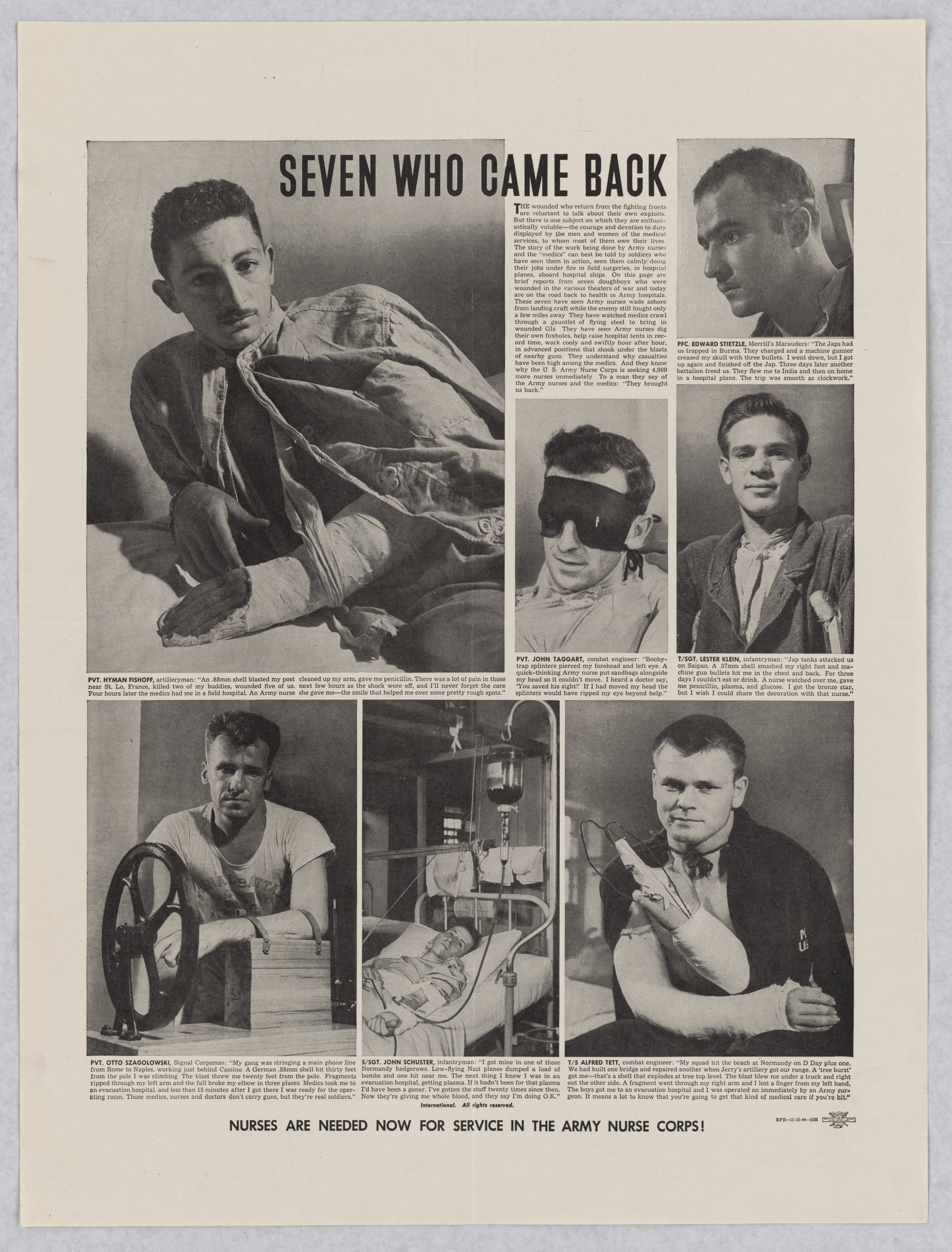
Seven who came back: nurses are needed now for service in the Army Nurse Corps!
Black-and-white photo page under the headline 'Seven who came back': seven wounded soldiers pictured in hospital or recovery, each with a short quoted account of nursing care they received. A column of text and the line 'Nurses are needed now' close the sheet. The tells are named first-person testimonials and a selection of only favourable accounts.
Propaganda techniques used in this poster
- Date
- 1944
- Period
- Second World War
- Made by
- U.S. Army, Army Nurse Corps recruiting (photographs from International)
- Region
- North America
- Country
- United States
- Medium
- Poster
- Issuer type
- Military
- Regime
- Roosevelt Administration
- Leader
- Franklin D. Roosevelt
- Audience
- Domestic public
- Purpose
- Recruit
- Themes
- War and the military, Health, Gender and suffrage
- Event
- World War II
- Regime
- Roosevelt administration
- Leader
- Franklin D. Roosevelt
- Source
- Identified Openly sourced: the speaker is who they say they are
- Source
- U.S. National Archives and Records Administration, Record Group 44, World War II Posters, retrieved October 4, 2026
- Rights
- Public domain (U.S. government work)
U.S. Army. National Archives and Records Administration, RG 44, 44-PA-1717 (NAID 515387).
Text on the object
SEVEN WHO CAME BACK
THE wounded who return from the fighting fronts are reluctant to talk about their own exploits. But there is one subject on which they are enthusiastically voluble—the courage and devotion to duty displayed by the men and women of the medical services, to whom most of them owe their lives. The story of the work being done by Army nurses and the "medics" can best be told by soldiers who have seen them in action, seen them calmly doing their jobs under fire in field surgeries, in hospital planes, aboard hospital ships. On this page are brief reports from seven doughboys who were wounded in the various theaters of war and today are on the road back to health in Army hospitals. These seven have seen Army nurses wade ashore from landing craft while the enemy still fought only a few miles away. They have watched medics crawl through a gauntlet of flying steel to bring in wounded GIs. They have seen Army nurses dig their own foxholes, help raise hospital tents in record time, work coolly and swiftly hour after hour, in advanced positions that shook under the blasts of nearby guns. They understand why casualties have been high among the medics. And they know why the U. S. Army Nurse Corps is seeking 4,000 more nurses immediately. To a man they say of the Army nurses and the medics: "They brought us back."
PFC. EDWARD STIETZLE, Merrill's Marauders: "The Japs had us trapped in Burma. They charged and a machine gunner creased my skull with three bullets. I went down, but I got up again and finished off the Jap. Three days later another battalion freed us. They flew me to India and then on home in a hospital plane. The trip was smooth as clockwork."
PVT. HYMAN FISHOFF, artilleryman: "An .88mm shell blasted my post near St. Lo, France, killed two of my buddies, wounded five of us. Four hours later the medics had me in a field hospital. An Army nurse cleaned up my arm, gave me penicillin. There was a lot of pain in those next few hours as the shock wore off, and I'll never forget the care she gave me—the smile that helped me over some pretty rough spots."
PVT. JOHN TAGGART, combat engineer: "Booby-trap splinters pierced my forehead and left eye. A quick-thinking Army nurse put sandbags alongside my head so it couldn't move. I heard a doctor say, 'You saved his sight!' If I had moved my head the splinters would have ripped my eye beyond help."
T/SGT. LESTER KLEIN, infantryman: "Jap tanks attacked us on Saipan. A 37mm shell smashed my right foot and machine gun bullets hit me in the chest and back. For three days I couldn't eat or drink. A nurse watched over me, gave me penicillin, plasma, and glucose. I got the bronze star, but I wish I could share the decoration with that nurse."
PVT. OTTO SZAGOLOWSKI, Signal Corpsman: "My gang was stringing a main phone line from Rome to Naples, working just behind Cassino. A German .88mm shell hit thirty feet from the pole I was climbing. The blast threw me twenty feet from the pole. Fragments ripped through my left arm and the fall broke my elbow in three places. Medics took me to an evacuation hospital, and less than 15 minutes after I got there I was ready for the operating room. Those medics, nurses and doctors don't carry guns, but they're real soldiers."
S/SGT. JOHN SCHUSTER, infantryman: "I got mine in one of those Normandy hedgerows. Low-flying Nazi planes dumped a load of bombs and one hit near me. The next thing I knew I was in an evacuation hospital, getting plasma. If it hadn't been for that plasma I'd have been a goner. I've gotten the stuff twenty times since then. Now they're giving me whole blood, and they say I'm doing O.K."
T/5 ALFRED TETT, combat engineer: [quotation of about 560 characters, an account of D Day plus one at Normandy and an Army surgeon's care, omitted at the 4000-character cap]
International. All rights reserved.
NURSES ARE NEEDED NOW FOR SERVICE IN THE ARMY NURSE CORPS!
RPB-11-10-44-10M