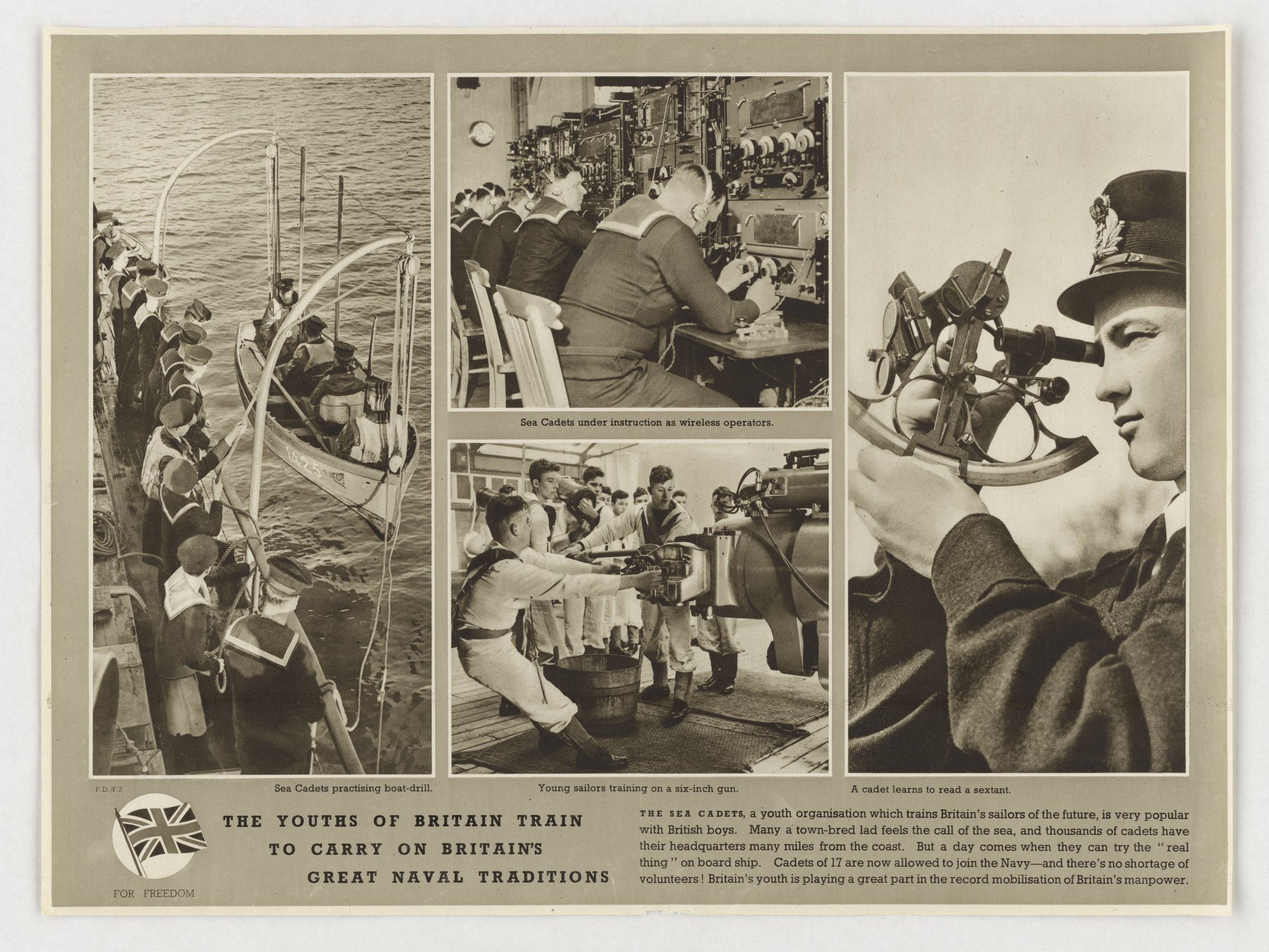
The Youths of Britain Train to Carry on Britain's Great Naval Traditions (For Freedom series, F.D./F.2)
Four photographs show Sea Cadets at boat-drill, as wireless operators, on a six-inch gun and reading a sextant, under the title on youth naval training. The tell for transfer is the Union Jack device and 'For Freedom' label with 'Britain's great naval traditions', and for bandwagon the statement that the Sea Cadets are 'very popular' and that 'there's no shortage of volunteers'.
Propaganda techniques used in this poster
- Date
- 1939
- Period
- Second World War
- Made by
- 'For Freedom' series poster (Union Jack device); issuing body not named on the poster
- Region
- Western and Central Europe
- Country
- United Kingdom
- Medium
- Poster
- Issuer type
- State
- Regime
- Churchill Government
- Leader
- Winston Churchill
- Audience
- Foreign public
- Purpose
- Persuade or win support
- Themes
- War and the military, Home front
- Event
- World War II
- Leader
- Winston Churchill
- Source
- Unidentified Source blurred: contractors, cutouts, buried disclosure
- Source
- U.S. National Archives and Records Administration, Record Group 44, World War II Foreign Posters, retrieved October 3, 2026
- Rights
- Held by NARA, Unrestricted; wartime British government-period print, hosted by owner decision
Issuer not named on the poster; British wartime poster. National Archives and Records Administration, 44-PF-561c.
Text on the object
F.D./F.2
Sea Cadets practising boat-drill.
Sea Cadets under instruction as wireless operators.
Young sailors training on a six-inch gun.
A cadet learns to read a sextant.

FOR FREEDOM
THE YOUTHS OF BRITAIN TRAIN TO CARRY ON BRITAIN'S GREAT NAVAL TRADITIONS

THE SEA CADETS, a youth organisation which trains Britain's sailors of the future, is very popular with British boys. Many a town-bred lad feels the call of the sea, and thousands of cadets have their headquarters many miles from the coast. But a day comes when they can try the "real thing" on board ship. Cadets of 17 are now allowed to join the Navy—and there's no shortage of volunteers! Britain's youth is playing a great part in the record mobilisation of Britain's manpower.