U.S. Astronaut Walks in Space poster, 65-360 (English poster distributed in Beirut)
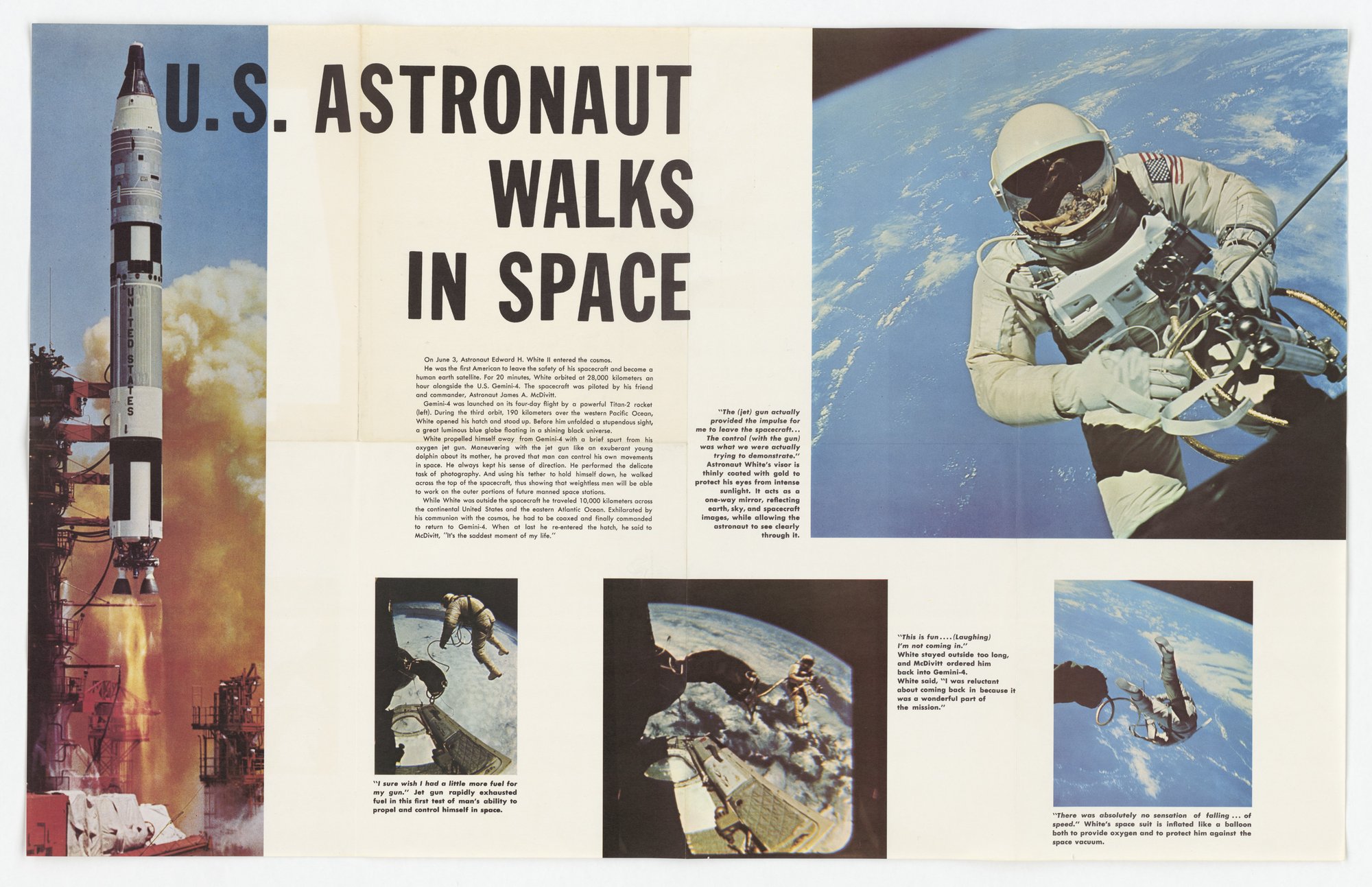
A fold-out sheet headlined 'U.S. Astronaut Walks in Space' on Edward H. White II's 3 June 1965 spacewalk from Gemini-4. A Titan-2 launch fills the left edge, a large colour photograph of White tethered above the Earth fills the upper right, and three smaller frames carry his quoted remarks. The text calls it the first such walk by an American. The tell is testimonial: the astronaut's own words carry the account, alongside card-stacking of a selected success.
Propaganda techniques used in this poster
- Date
- July 30, 1965
- Period
- Cold War
- Made by
- U.S. Information Agency (predecessor: State Department International Information and Educational Exchange Program), Propaganda Posters Distributed in Asia, Latin America and the Middle East series
- Region
- North America
- Country
- United States
- Medium
- Poster
- Issuer type
- State
- Regime
- Johnson Administration
- Leader
- Lyndon B. Johnson
- Audience
- Foreign public
- Purpose
- Persuade or win support
- Theme
- Science and technology
- Event
- Cold War
- Source
- Unidentified Source blurred: contractors, cutouts, buried disclosure
- Source
- U.S. National Archives (NARA), Record Group 306, Posters in Asia, Latin America, Middle East, retrieved October 4, 2026
- Rights
- Public domain (U.S. government work; NARA RG 306)
U.S. Information Agency / Department of State, July 30, 1965. National Archives, Record Group 306 (NAID 6949172, 306-PPB-248).
Text on the object
U.S. ASTRONAUT
WALKS
IN SPACE

On June 3, Astronaut Edward H. White II entered the cosmos.
He was the first American to leave the safety of his spacecraft and become a human earth satellite. For 20 minutes, White orbited at 28,000 kilometers an hour alongside the U.S. Gemini-4. The spacecraft was piloted by his friend and commander, Astronaut James A. McDivitt.
Gemini-4 was launched on its four-day flight by a powerful Titan-2 rocket (left). During the third orbit, 190 kilometers over the western Pacific Ocean, White opened his hatch and stood up. Before him unfolded a stupendous sight, a great luminous blue globe floating in a shining black universe.
White propelled himself away from Gemini-4 with a brief spurt from his oxygen jet gun. Maneuvering with the jet gun like an exuberant young dolphin about its mother, he proved that man can control his own movements in space. He always kept his sense of direction. He performed the delicate task of photography. And using his tether to hold himself down, he walked across the top of the spacecraft, thus showing that weightless men will be able to work on the outer portions of future manned space stations.
While White was outside the spacecraft he traveled 10,000 kilometers across the continental United States and the eastern Atlantic Ocean. Exhilarated by his communion with the cosmos, he had to be coaxed and finally commanded to return to Gemini-4. When at last he re-entered the hatch, he said to McDivitt, "It's the saddest moment of my life."

"The (jet) gun actually provided the impulse for me to leave the spacecraft... The control (with the gun) was what we were actually trying to demonstrate." Astronaut White's visor is thinly coated with gold to protect his eyes from intense sunlight. It acts as a one-way mirror, reflecting earth, sky, and spacecraft images, while allowing the astronaut to see clearly through it.

"I sure wish I had a little more fuel for my gun." Jet gun rapidly exhausted fuel in this first test of man's ability to propel and control himself in space.

"This is fun.... (Laughing) I'm not coming in." White stayed outside too long, and McDivitt ordered him back into Gemini-4. White said, "I was reluctant about coming back in because it was a wonderful part of the mission."

"There was absolutely no sensation of falling ... of speed." White's space suit is inflated like a balloon both to provide oxygen and to protect him against the space vacuum.
Ellipses in the quotations are as printed.