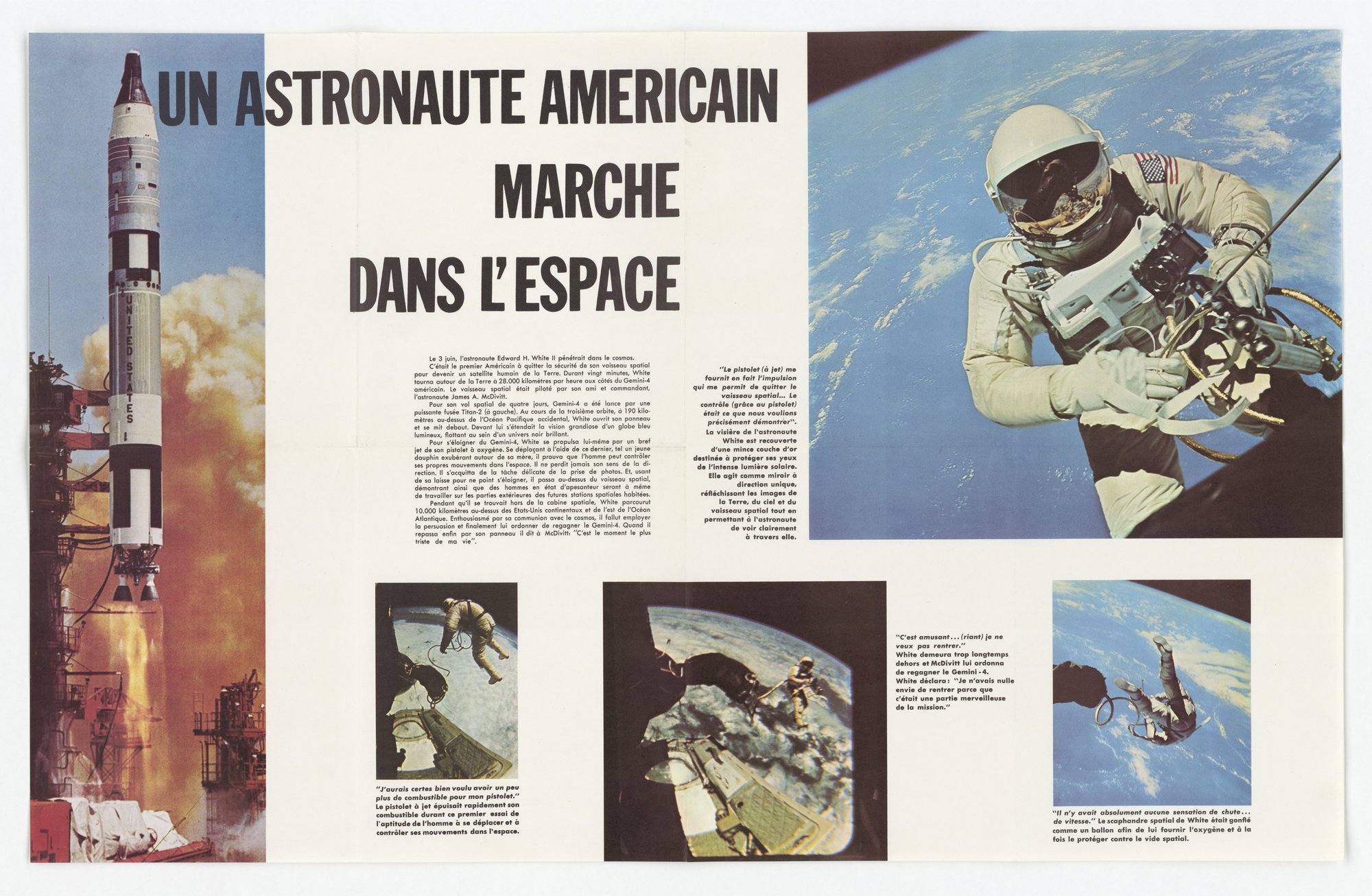
U.S. Astronaut Walks in Space poster, 65-361 (French poster distributed in Beirut)
A fold-out sheet headlined 'Un astronaute américain marche dans l'espace' (An American astronaut walks in space) on Edward H. White II's 3 June 1965 spacewalk from Gemini-4. A Titan-2 launch fills the left edge, a large colour photograph of White tethered above the Earth fills the upper right, and three smaller frames carry his quoted remarks. The text calls it the first such walk by an American. The tell is testimonial: the astronaut's own words carry the account, alongside card-stacking of a selected success.
Propaganda techniques used in this poster
- Date
- July 30, 1965
- Period
- Cold War
- Made by
- U.S. Information Agency (predecessor: State Department International Information and Educational Exchange Program), Propaganda Posters Distributed in Asia, Latin America and the Middle East series
- Region
- North America
- Country
- United States
- Medium
- Poster
- Issuer type
- State
- Regime
- Johnson Administration
- Leader
- Lyndon B. Johnson
- Audience
- Foreign public
- Purpose
- Persuade or win support
- Theme
- Science and technology
- Event
- Cold War
- Source
- Unidentified Source blurred: contractors, cutouts, buried disclosure
- Source
- U.S. National Archives (NARA), Record Group 306, Posters in Asia, Latin America, Middle East, retrieved October 4, 2026
- Rights
- Public domain (U.S. government work; NARA RG 306)
U.S. Information Agency / Department of State, July 30, 1965. National Archives, Record Group 306 (NAID 6949173, 306-PPB-249).
Text on the object
UN ASTRONAUTE AMERICAIN
MARCHE
DANS L'ESPACE

Le 3 juin, l'astronaute Edward H. White II pénétrait dans le cosmos.
C'était le premier Américain à quitter la sécurité de son vaisseau spatial pour devenir un satellite humain de la Terre. Durant vingt minutes, White tourna autour de la Terre à 28.000 kilomètres par heure aux côtés du Gemini-4 américain. Le vaisseau spatial était piloté par son ami et commandant, l'astronaute James A. McDivitt.
Pour son vol spatial de quatre jours, Gemini-4 a été lancé par une puissante fusée Titan-2 (à gauche). Au cours de la troisième orbite, à 190 kilomètres au-dessus de l'Océan Pacifique occidental, White ouvrit son panneau et se mit debout. Devant lui s'étendait la vision grandiose d'un globe bleu lumineux, flottant au sein d'un univers noir brillant.
Pour s'éloigner du Gemini-4, White se propulsa lui-même par un bref jet de son pistolet à oxygène. Se déplaçant à l'aide de ce dernier, tel un jeune dauphin exubérant autour de sa mère, il prouva que l'homme peut contrôler ses propres mouvements dans l'espace. Il ne perdit jamais son sens de la direction. Il s'acquitta de la tâche délicate de la prise de photos. Et, usant de sa laisse pour ne point s'éloigner, il passa au-dessus du vaisseau spatial, démontrant ainsi que des hommes en état d'apesanteur seront à même de travailler sur les parties extérieures des futures stations spatiales habitées.
Pendant qu'il se trouvait hors de la cabine spatiale, White parcourut 10.000 kilomètres au-dessus des Etats-Unis continentaux et de l'est de l'Océan Atlantique. Enthousiasmé par sa communion avec le cosmos, il fallut employer la persuasion et finalement lui ordonner de regagner le Gemini-4. Quand il repassa enfin par son panneau il dit à McDivitt: "C'est le moment le plus triste de ma vie".

"Le pistolet (à jet) me fournit en fait l'impulsion qui me permit de quitter le vaisseau spatial... Le contrôle (grâce au pistolet) était ce que nous voulions précisément démontrer". La visière de l'astronaute White est recouverte d'une mince couche d'or destinée à protéger ses yeux de l'intense lumière solaire. Elle agit comme miroir à direction unique, réfléchissant les images de la Terre, du ciel et du vaisseau spatial tout en permettant à l'astronaute de voir clairement à travers elle.

"J'aurais certes bien voulu avoir un peu plus de combustible pour mon pistolet." Le pistolet à jet épuisait rapidement son combustible durant ce premier essai de l'aptitude de l'homme à se déplacer et à contrôler ses mouvements dans l'espace.

"C'est amusant... (riant) je ne veux pas rentrer." White demeura trop longtemps dehors et McDivitt lui ordonna de regagner le Gemini-4. White déclara: "Je n'avais nulle envie de rentrer parce que c'était une partie merveilleuse de la mission."

"Il n'y avait absolument aucune sensation de chute... de vitesse." Le scaphandre spatial de White était gonflé comme un ballon afin de lui fournir l'oxygène et à la fois le protéger contre le vide spatial.
AN AMERICAN ASTRONAUT
WALKS
IN SPACE

On June 3, Astronaut Edward H. White II entered the cosmos.
He was the first American to leave the safety of his spacecraft to become a human satellite of the Earth. For twenty minutes White circled the Earth at 28,000 kilometers an hour beside the American Gemini-4. The spacecraft was piloted by his friend and commander, Astronaut James A. McDivitt.
For its four-day space flight Gemini-4 was launched by a powerful Titan-2 rocket (left). During the third orbit, 190 kilometers above the western Pacific Ocean, White opened his hatch and stood up. Before him stretched the grandiose vision of a luminous blue globe floating in a shining black universe.
To move away from Gemini-4, White propelled himself with a brief jet from his oxygen gun. Moving with its help, like a young exuberant dolphin around its mother, he proved that man can control his own movements in space. He never lost his sense of direction. He carried out the delicate task of taking photographs. And, using his tether so as not to drift away, he passed over the spacecraft, thus demonstrating that weightless men will be able to work on the outer parts of future manned space stations.
While he was outside the space cabin, White traveled 10,000 kilometers above the continental United States and the east of the Atlantic Ocean. Enthused by his communion with the cosmos, persuasion had to be used and finally he was ordered to return to Gemini-4. When he finally came back through his hatch he said to McDivitt: "It is the saddest moment of my life".

"The (jet) gun in fact provided me the impulse that allowed me to leave the spacecraft... The control (thanks to the gun) was just what we wanted to demonstrate". Astronaut White's visor is covered with a thin layer of gold meant to protect his eyes from the intense light of the sun. It acts as a one-way mirror, reflecting the images of the Earth, the sky and the spacecraft while allowing the astronaut to see clearly through it.

"I certainly would have liked to have a little more fuel for my gun." The jet gun quickly used up its fuel during this first test of man's ability to move and to control his movements in space.

"It's fun... (laughing) I don't want to go in." White stayed outside too long and McDivitt ordered him to return to Gemini-4. White declared: "I had no wish at all to go back in because it was a wonderful part of the mission."

"There was absolutely no sensation of falling... of speed." White's space suit was inflated like a balloon in order to supply him with oxygen and at the same time protect him against the vacuum of space.
Ellipses in the quotations are as printed. Accents were restored where the print is clear.