Waste No Food! Food Is Wasted. Demonstrate Thrift in Your Home
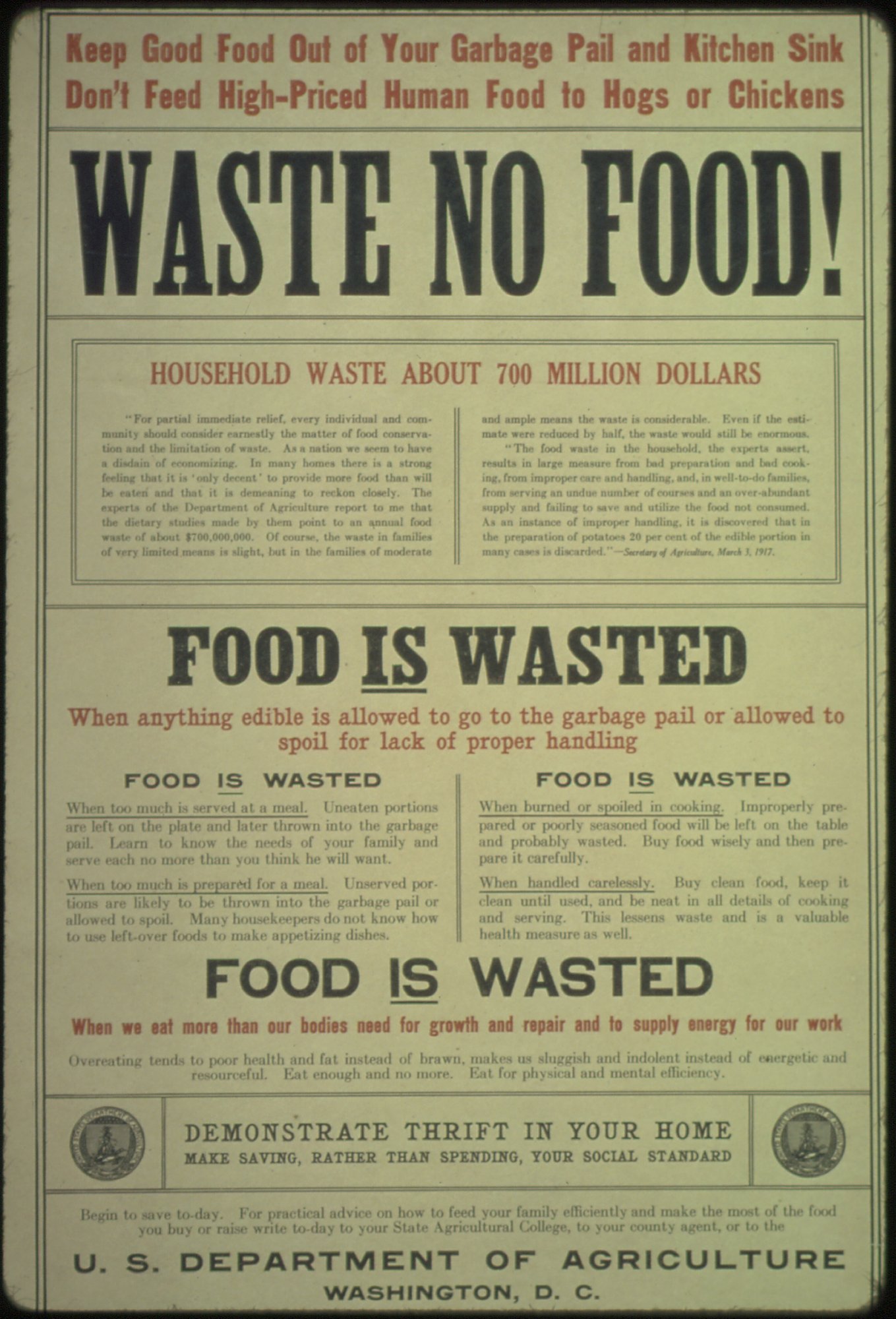
A text-only sheet in bold type headed 'Waste No Food!' gives a figure for household waste, a quotation from the Secretary of Agriculture, and three bold 'Food Is Wasted' panels listing practical household habits, closing with a call to 'Demonstrate thrift in your home'. The argument rests on a selected statistic and a series of household instructions, backed by the department's name and a printed address for further advice.
Propaganda techniques used in this poster
- Date
- 1917
- Period
- First World War
- Made by
- U.S. Department of Agriculture
- Region
- North America
- Country
- United States
- Medium
- Poster
- Issuer type
- State
- Regime
- Wilson Administration
- Leader
- Woodrow Wilson
- Audience
- Domestic public
- Purpose
- Mobilize or secure compliance
- Themes
- Home front, Economy and finance
- Event
- World War I
- Regime
- Wilson administration
- Leader
- Woodrow Wilson
- Source
- Identified Openly sourced: the speaker is who they say they are
- Source
- U.S. National Archives (NARA), RG 4 (U.S. Food Administration), World War I Posters (NAID 512439), retrieved October 3, 2026
- Rights
- NARA Unrestricted; hosted by owner decision
U.S. Department of Agriculture. National Archives and Records Administration, 4-P-72.
Text on the object
Keep Good Food Out of Your Garbage Pail and Kitchen Sink
Don't Feed High-Priced Human Food to Hogs or Chickens

WASTE NO FOOD!

HOUSEHOLD WASTE ABOUT 700 MILLION DOLLARS

"For partial immediate relief, every individual and community should consider earnestly the matter of food conservation and the limitation of waste. As a nation we seem to have a disdain of economizing. In many homes there is a strong feeling that it is 'only decent' to provide more food than will be eaten and that it is demeaning to reckon closely. The experts of the Department of Agriculture report to me that the dietary studies made by them point to an annual food waste of about $700,000,000. Of course, the waste in families of very limited means is slight, but in the families of moderate and ample means the waste is considerable. Even if the estimate were reduced by half, the waste would still be enormous.
"The food waste in the household, the experts assert, results in large measure from bad preparation and bad cooking, from improper care and handling, and, in well-to-do families, from serving an undue number of courses and an over-abundant supply and failing to save and utilize the food not consumed. As an instance of improper handling, it is discovered that in the preparation of potatoes 20 per cent of the edible portion in many cases is discarded."—Secretary of Agriculture, March 3, 1917.

FOOD IS WASTED
When anything edible is allowed to go to the garbage pail or allowed to spoil for lack of proper handling

FOOD IS WASTED
When too much is served at a meal. Uneaten portions are left on the plate and later thrown into the garbage pail. Learn to know the needs of your family and serve each no more than you think he will want.
When too much is prepared for a meal. Unserved portions are likely to be thrown into the garbage pail or allowed to spoil. Many housekeepers do not know how to use left-over foods to make appetizing dishes.

FOOD IS WASTED
When burned or spoiled in cooking. Improperly prepared or poorly seasoned food will be left on the table and probably wasted. Buy food wisely and then prepare it carefully.
When handled carelessly. Buy clean food, keep it clean until used, and be neat in all details of cooking and serving. This lessens waste and is a valuable health measure as well.

FOOD IS WASTED
When we eat more than our bodies need for growth and repair and to supply energy for our work
Overeating tends to poor health and fat instead of brawn, makes us sluggish and indolent instead of energetic and resourceful. Eat enough and no more. Eat for physical and mental efficiency.

[Department of Agriculture seal, twice]
DEMONSTRATE THRIFT IN YOUR HOME
MAKE SAVING, RATHER THAN SPENDING, YOUR SOCIAL STANDARD

Begin to save to-day. For practical advice on how to feed your family efficiently and make the most of the food you buy or raise write to-day to your State Agricultural College, to your county agent, or to the

U. S. DEPARTMENT OF AGRICULTURE
WASHINGTON, D. C.
Re-read from the 2000 px scan; all body text is now legible.