Indi na kami mga tao! (We are no longer people) (Hiligaynon poster distributed in the Philippines)
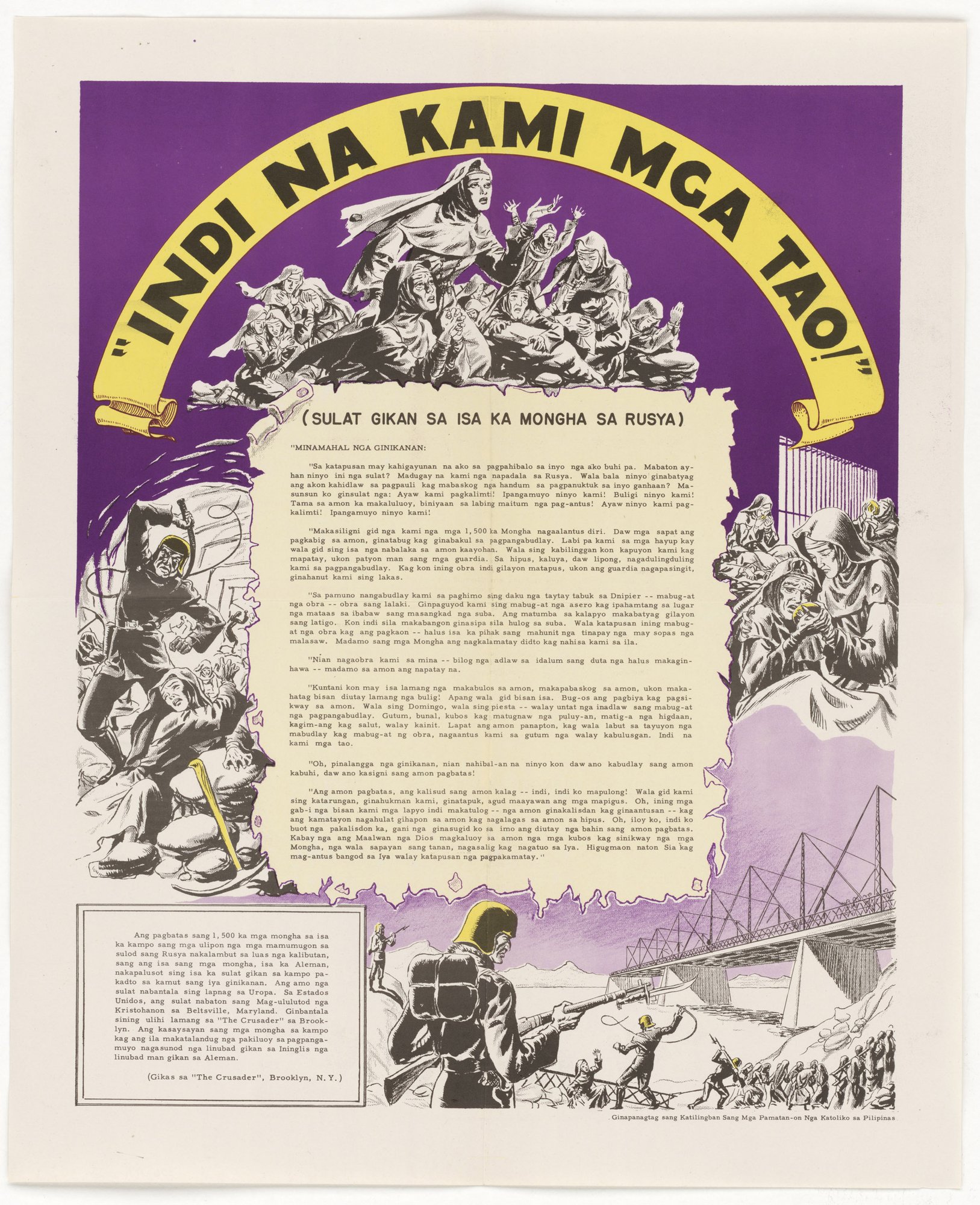
A purple-and-yellow poster reprinting a letter said to be from a German nun held with 1,500 others in a labour camp in Russia, ringed by drawings of guards whipping and beating nuns and of a bridge over the Dnieper. It asks readers to pray for the nuns. The tell is testimonial: an anonymous letter is vouched for only by the publications that carried it, with no checkable names or dates.
Propaganda techniques used in this poster
- Date
- March 29, 1951
- Period
- Cold War
- Made by
- U.S. Information Agency (predecessor: State Dept. information program), Asia posters series; imprint: Ginapanagtag sang Katilingban Sang Mga Pamatan-on Nga Katoliko sa Pilipinas
- Region
- North America
- Country
- United States
- Medium
- Poster
- Issuer type
- State
- Regime
- Truman Administration
- Leader
- Harry S. Truman
- Audience
- Foreign public
- Purpose
- Persuade or win support
- Themes
- Religion, War and the military
- Event
- Cold War
- Source
- Unidentified Source blurred: contractors, cutouts, buried disclosure
- Source
- U.S. National Archives (NARA), Record Group 306, Propaganda Posters Distributed in Asia, retrieved October 3, 2026
- Rights
- Public domain (U.S. government work; NARA RG 306)
U.S. Information Agency / Department of State, March 29, 1951. National Archives, Record Group 306 (NAID 5730158, 306-PPA-257).
Text on the object
"INDI NA KAMI MGA TAO!"

(SULAT GIKAN SA ISA KA MONGHA SA RUSYA)

"MINAMAHAL NGA GINIKANAN:

"Sa katapusan may kahigayunan na ako sa pagpahibalo sa inyo nga ako buhi pa. Mabaton ayhan ninyo ini nga sulat? Madugay na kami nga napadala sa Rusya. Wala bala ninyo ginabatyag ang akon kahidlaw sa pagpauli kag mabaskog nga handum sa pagpanuktok sa inyo ganhaan? Masunsun ko ginsulat nga: Ayaw kami pagkalimti! Ipangamuyo ninyo kami! Buligi ninyo kami! Tama sa amon ka makaluluoy, biniyaan sa labing maitum nga pag-antus! Ayaw ninyo kami pagkalimti! Ipangamuyo ninyo kami!

[...]

Ang pagbatas sang 1,500 ka mga mongha sa isa ka kampo sang mga ulipon nga mamumugon sa sulod sang Rusya nakalambut sa luas nga kalibutan, sang ang isa sang mga mongha, isa ka Aleman, nakapalusot sing isa ka sulat gikan sa kampo pa-kadto sa kamut sang iya ginikanan. Ang amo nga sulat nabantala sing lapnag sa Uropa. Sa Estados Unidos, ang sulat nabaton sang Mag-ululutod nga Kristohanon sa Beltsville, Maryland. Ginbantala sining ulihi lamang sa "The Crusader" sa Brook-lyn. Ang kasaysayan sang mga mongha sa kampo kag ang ila makatalandug nga pakiluoy sa pagpangamuyo nagasunod sang linubad gikan sa Ininglis nga linubad man gikan sa Aleman.

(Gikas sa "The Crusader", Brooklyn, N.Y.)

Ginapanagtag sang Katilingban Sang Mga Pamatan-on Nga Katoliko sa Pilipinas
"We Are No Longer People!" / (Letter from a nun in Russia) / "Beloved parents: At last I have the chance to let you know that I am still alive. Will you perhaps receive this letter? We were sent to Russia long ago. Do you not feel my longing to return home and my strong wish to knock at your gate? I have often written: Do not forget us! Pray for us! Help us! We are truly pitiable, left in the darkest suffering! Do not forget us! Pray for us! [...] / The endurance of 1,500 nuns in a camp of slave labourers inside Russia reached the wider world when one of the nuns, a German, slipped a letter from the camp into the hands of her parents. That letter was published widely in Europe. In the United States the letter was received by the Christian Brothers in Beltsville, Maryland. It was published recently in "The Crusader" in Brooklyn. The history of the nuns in the camp and their moving plea for prayer follows, translated from English which was itself translated from German. (From "The Crusader", Brooklyn, N.Y.) / Published by the Catholic Youth Association in the Philippines
Body text abridged at [...]; headline, subtitle, opening, explanatory box and imprint are given as printed. Translation is a literal best reading.