Proclamation (Woodrow Wilson, The White House, Jan. 18, 1918)
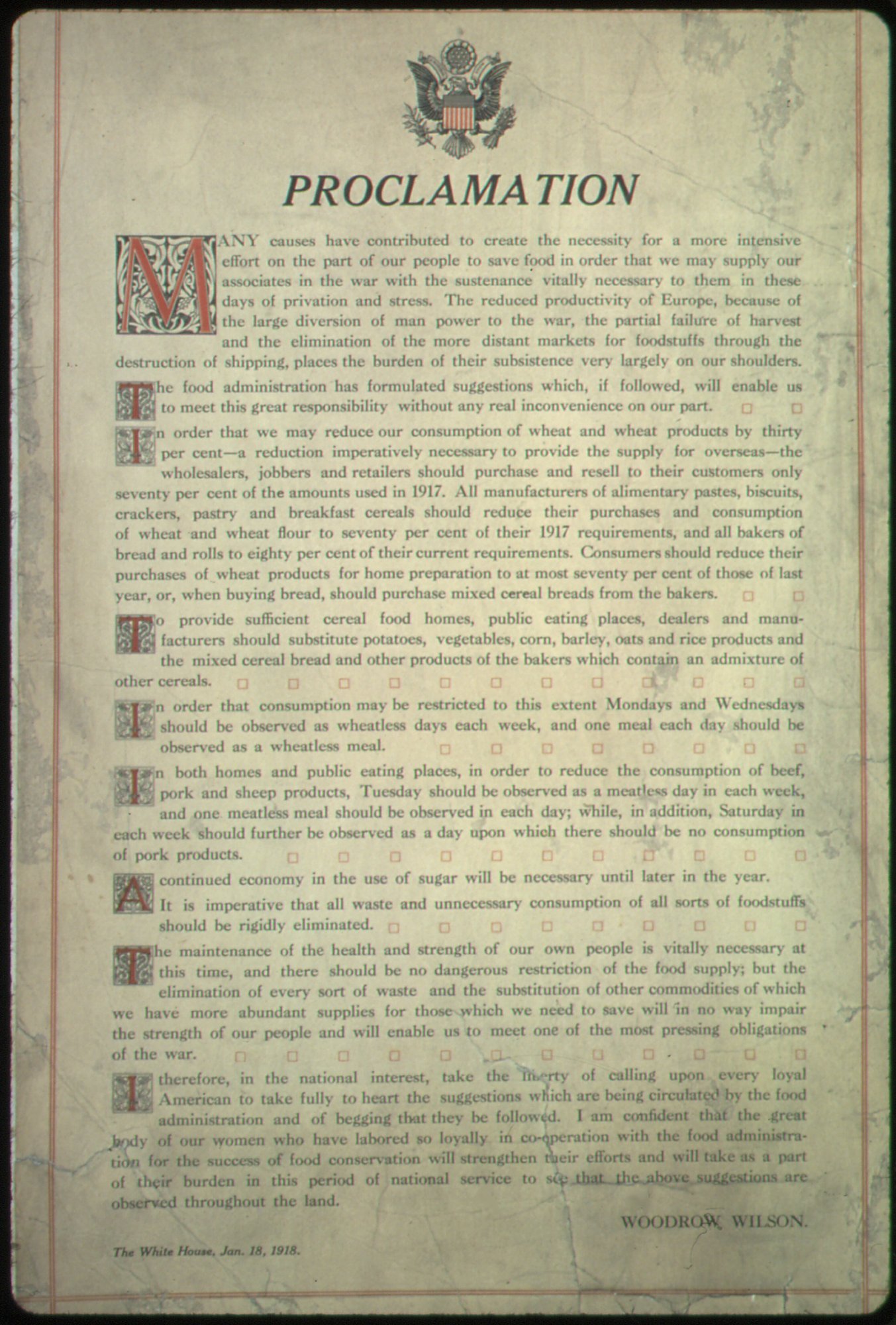
A text-only sheet under the national eagle reproduces a presidential proclamation asking Americans to cut wheat, meat, fats and sugar consumption so the Allies can be fed. It names wheatless Mondays and Wednesdays, meatless Tuesdays and a porkless Saturday, and ends over Wilson's signature. The tell of testimonial is the head of state's own name and office placed behind the request.
Propaganda techniques used in this poster
- Date
- January 18, 1918
- Period
- First World War
- Made by
- President Woodrow Wilson; U.S. Food Administration
- Region
- North America
- Country
- United States
- Medium
- Poster
- Issuer type
- State
- Regime
- Wilson Administration
- Leader
- Woodrow Wilson
- Audience
- Domestic public
- Purpose
- Mobilize or secure compliance
- Themes
- Home front, War and the military
- Event
- World War I
- Regime
- Wilson administration
- Leader
- Woodrow Wilson
- Source
- Identified Openly sourced: the speaker is who they say they are
- Source
- U.S. National Archives (NARA), RG 4 (U.S. Food Administration), World War I Posters (NAID 512439), retrieved October 3, 2026
- Rights
- NARA Unrestricted; hosted by owner decision
President Woodrow Wilson; U.S. Food Administration. National Archives and Records Administration, 4-P-84.
Text on the object
PROCLAMATION

MANY causes have contributed to create the necessity for a more intensive effort on the part of our people to save food in order that we may supply our associates in the war with the sustenance vitally necessary to them in these days of privation and stress. The reduced productivity of Europe, because of the large diversion of man power to the war, the partial failure of harvest and the elimination of the more distant markets for foodstuffs through the destruction of shipping, places the burden of their subsistence very largely on our shoulders.

The food administration has formulated suggestions which, if followed, will enable us to meet this great responsibility without any real inconvenience on our part.

In order that we may reduce our consumption of wheat and wheat products by thirty per cent—a reduction imperatively necessary to provide the supply for overseas—the wholesalers, jobbers and retailers should purchase and resell to their customers only seventy per cent of the amounts used in 1917. All manufacturers of alimentary pastes, biscuits, crackers, pastry and breakfast cereals should reduce their purchases and consumption of wheat and wheat flour to seventy per cent of their 1917 requirements, and all bakers of bread and rolls to eighty per cent of their current requirements. Consumers should reduce their purchases of wheat products for home preparation to at most seventy per cent of those of last year, or, when buying bread, should purchase mixed cereal breads from the bakers.

To provide sufficient cereal food homes, public eating places, dealers and manufacturers should substitute potatoes, vegetables, corn, barley, oats and rice products and the mixed cereal bread and other products of the bakers which contain an admixture of other cereals.

In order that consumption may be restricted to this extent Mondays and Wednesdays should be observed as wheatless days each week, and one meal each day should be observed as a wheatless meal.

In both homes and public eating places, in order to reduce the consumption of beef, pork and sheep products, Tuesday should be observed as a meatless day in each week, and one meatless meal should be observed in each day; while, in addition, Saturday in each week should further be observed as a day upon which there should be no consumption of pork products.

A continued economy in the use of sugar will be necessary until later in the year.

It is imperative that all waste and unnecessary consumption of all sorts of foodstuffs should be rigidly eliminated.

The maintenance of the health and strength of our own people is vitally necessary at this time, and there should be no dangerous restriction of the food supply; but the elimination of every sort of waste and the substitution of other commodities of which we have more abundant supplies for those which we need to save will in no way impair the strength of our people and will enable us to meet one of the most pressing obligations of the war.

I therefore, in the national interest, take the liberty of calling upon every loyal American to take fully to heart the suggestions which are being circulated by the food administration and of begging that they be followed. I am confident that the great body of our women who have labored so loyally in co-operation with the food administration for the success of food conservation will strengthen their efforts and will take as a part of their burden in this period of national service to see that the above suggestions are observed throughout the land.

WOODROW WILSON.

The White House, Jan. 18, 1918.
Read from the 2000 px scan. The sheet's wording differs in places from other printings of the proclamation (for example 'current requirements' for bakers and 'those of last year' for consumers); the text here follows this sheet. Small empty checkboxes printed after some paragraphs (for householders to tick) and the eagle emblem are not text.