Content note. Some objects here caricature Americans, Germans, priests and political opponents as grotesque or bestial figures, one is a Soviet poster showing a dead woman, and several glorify leaders whose governments are documented as having killed large numbers of their own people. They are shown as issued, as evidence of what audiences were told. Showing a poster is not endorsing it, and nothing here is a verdict on communism as an idea.
What does "communist propaganda" mean?
As a search term, "communist propaganda" means material issued by ruling Marxist-Leninist parties and their states, from the Bolshevik seizure of power in 1917 onward: Soviet, Chinese, North Korean, East German, Cuban and others. This page documents their practice with the same technique definitions the archive applies to American, British and German material. It does not argue for or against communism.
Explain moreShow less
The collection counts (made from the entry files in examples/entries/): 66 Soviet-era objects from 1924 to 1990, 55 from East Germany, 33 from North Korea, 17 from the People's Republic of China (the China tag also holds 19 earlier Republican-era items, which are not counted here), 13 from Romania, 6 from Albania and only 4 from Cuba. Cuba is thin, and the sections below say so rather than pad it. For Soviet posters in depth, see Soviet and Russian propaganda posters; this page adds other formats and countries.
How was communist propaganda organised?
The Soviet model came first. Lenin separated "propaganda" (many ideas for few people) from "agitation" (one idea for many), and after 1917 the Party turned the pair into a department, agitprop, set up in August 1920. Sources are in Lenin and the agitprop model; later censorship is in Glavlit and photo retouching. In Soviet usage "propaganda" was not a pejorative; party documents used it for political education.
Explain moreShow less
Other parties built their own versions. The regime pages cover the Soviet Union under Stalin, the People's Republic of China under Mao, North Korea under the Kims, the German Democratic Republic, Cuba under Castro, Albania under Hoxha, Ceausescu's Romania and Democratic Kampuchea. The objects below are scored for technique, not for the record of the regime behind them.
Stalin-era propaganda: scapegoats, virtue words and the leader
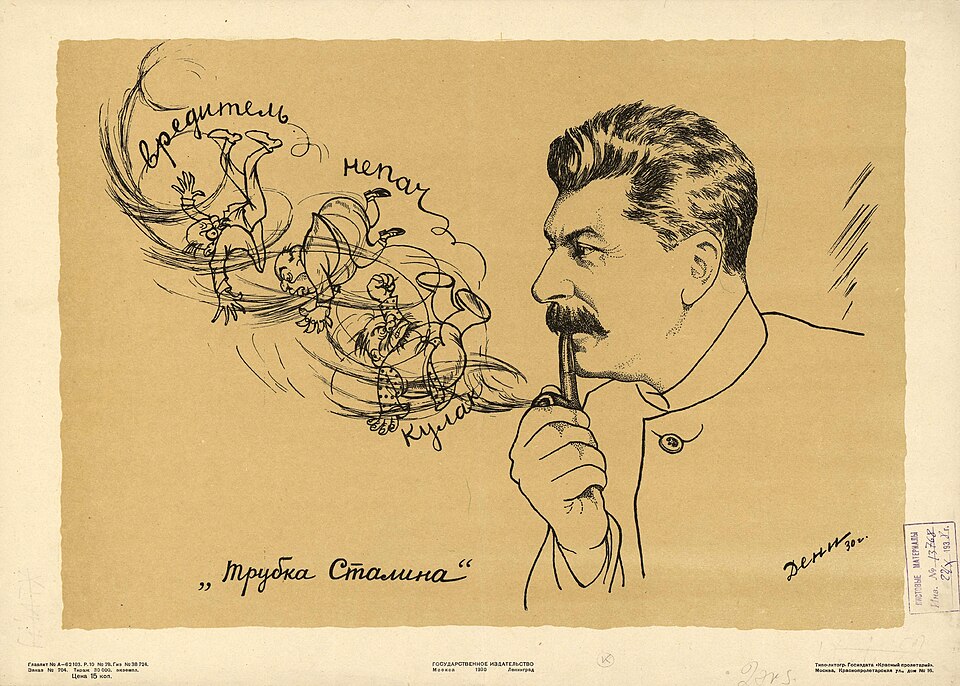
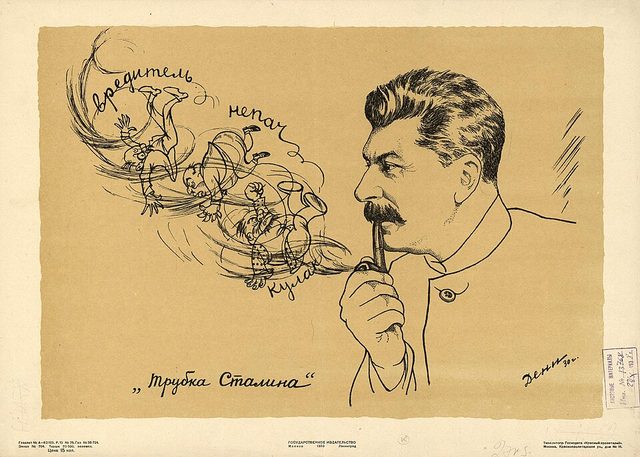
Viktor Deni signed this lithograph "30g", and it carries a State Publishing House imprint and a price of 15 kopecks. Three small caricatures tumble from the smoke of the pipe, each tagged with one word: "wrecker", "NEPman", "kulak". The entry notes these were categories pursued in the period: the sabotage charge of the 1928 Shakhty trial, the private traders of the 1920s, and the peasants targeted by dekulakisation from January 1930. Three groups blamed for the plan's difficulties are blown away by one breath. Read the technique: scapegoating.
Explain moreShow less
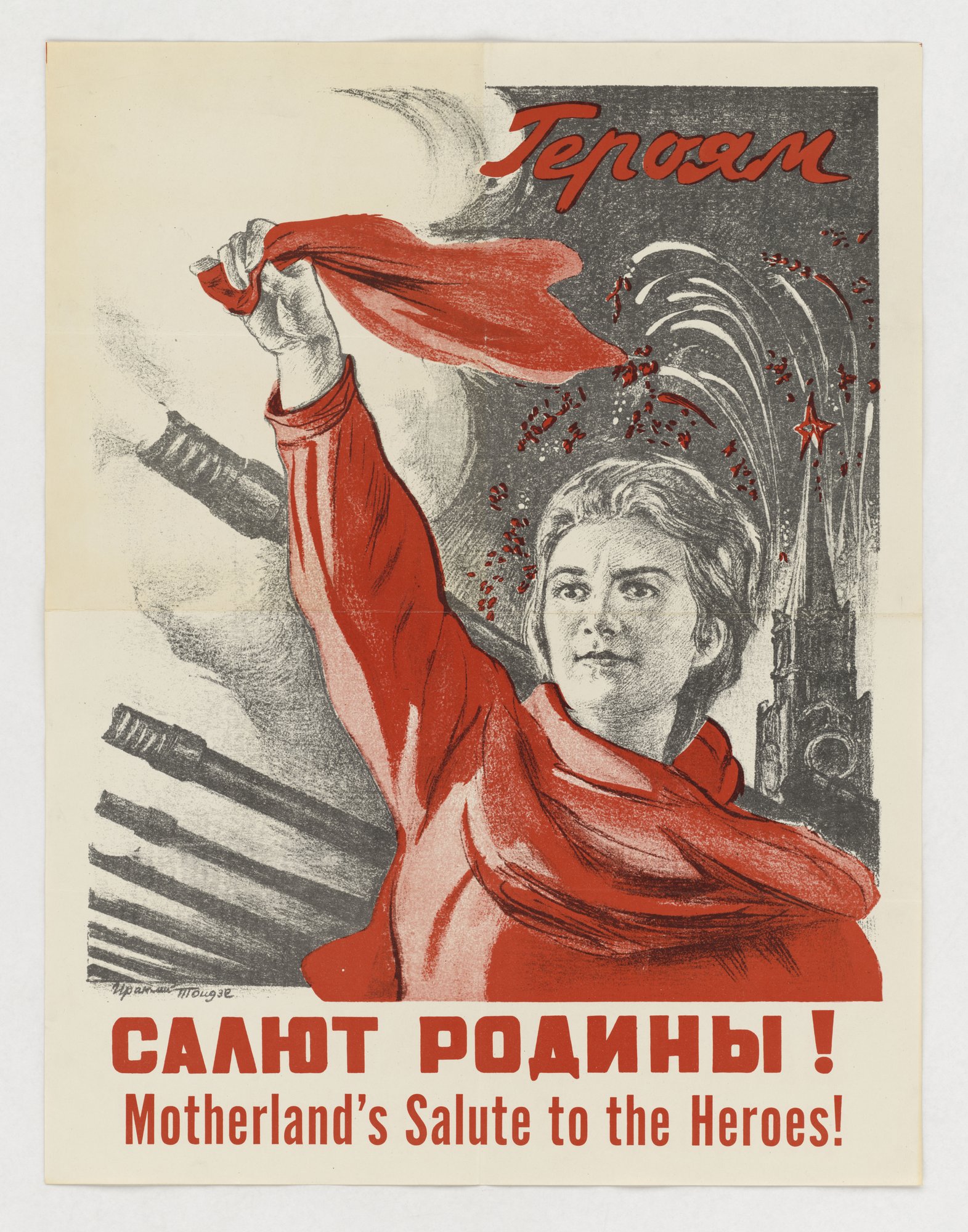
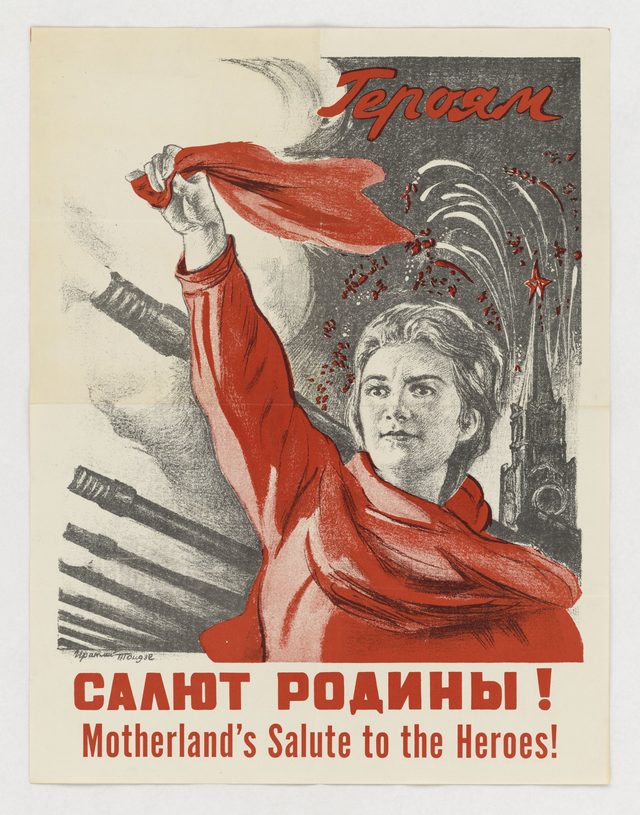
Irakli Toidze signed this sheet, held by the U.S. National Archives, and its Russian text has an English line added beneath. Whether it was issued in the USSR is not established; the date is the start of a 1939 to 1945 range. The words "Motherland" and "Heroes" stand in for any named deed, and the Kremlin tower and red star lend state prestige to the salute. Read the technique: glittering generalities.
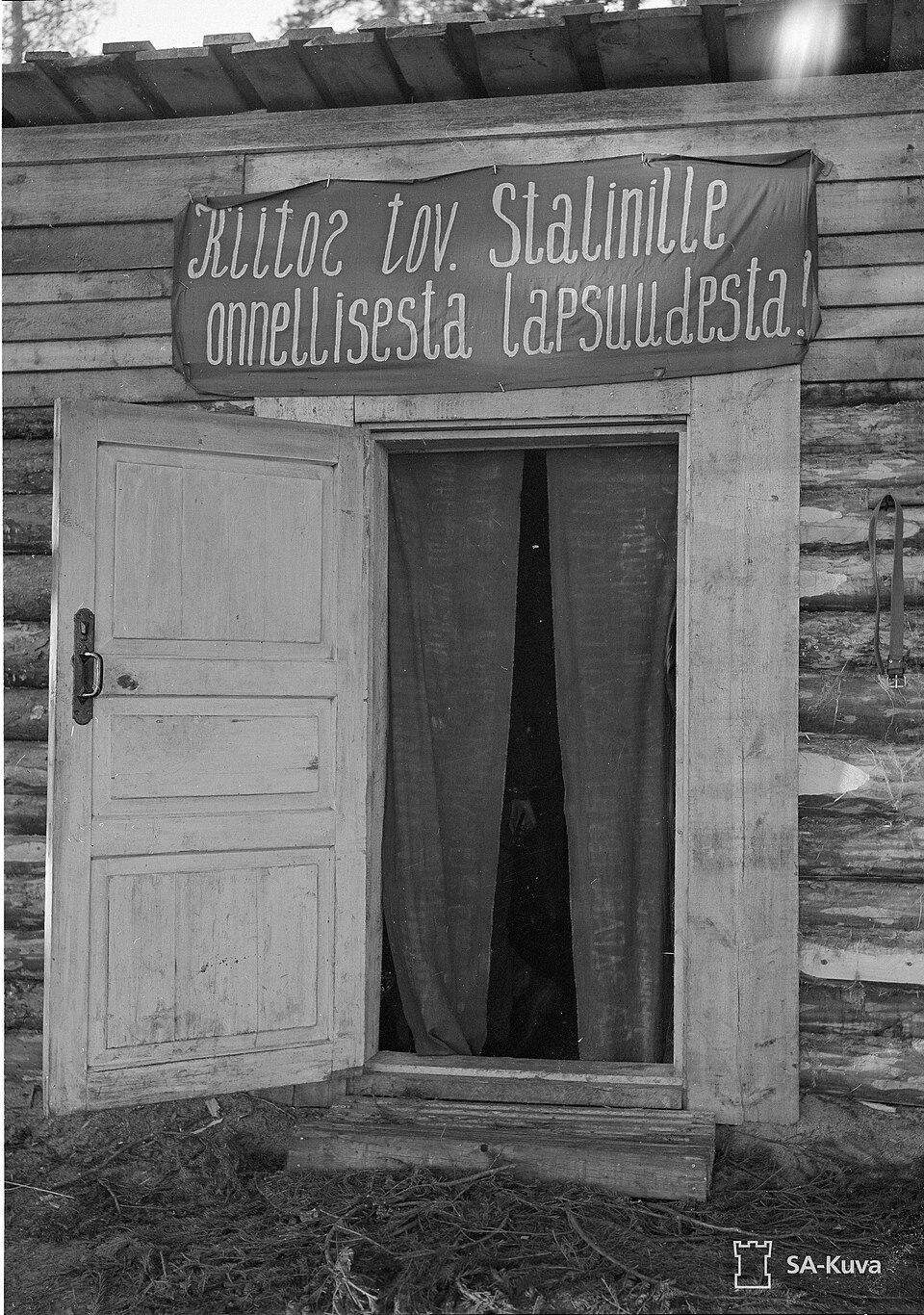
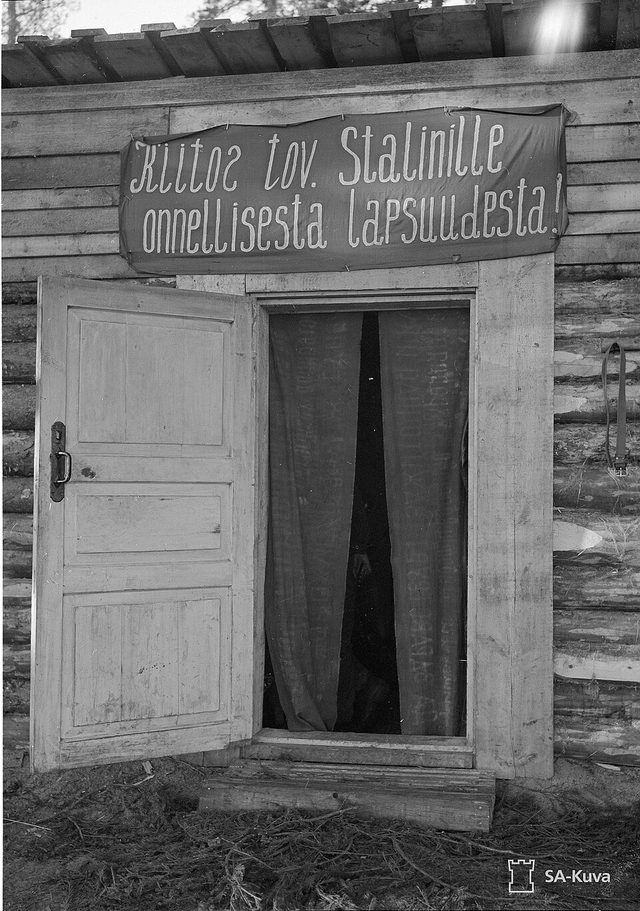
A Finnish military photographer recorded this banner at Vidlitsa on 12 September 1941, during the Continuation War. It is the Finnish form of the slogan "Thank you, Comrade Stalin, for a happy childhood". The leader is named as the giver of a virtue word, and the reader is asked to feel gratitude to him for it. Read the technique: transfer.
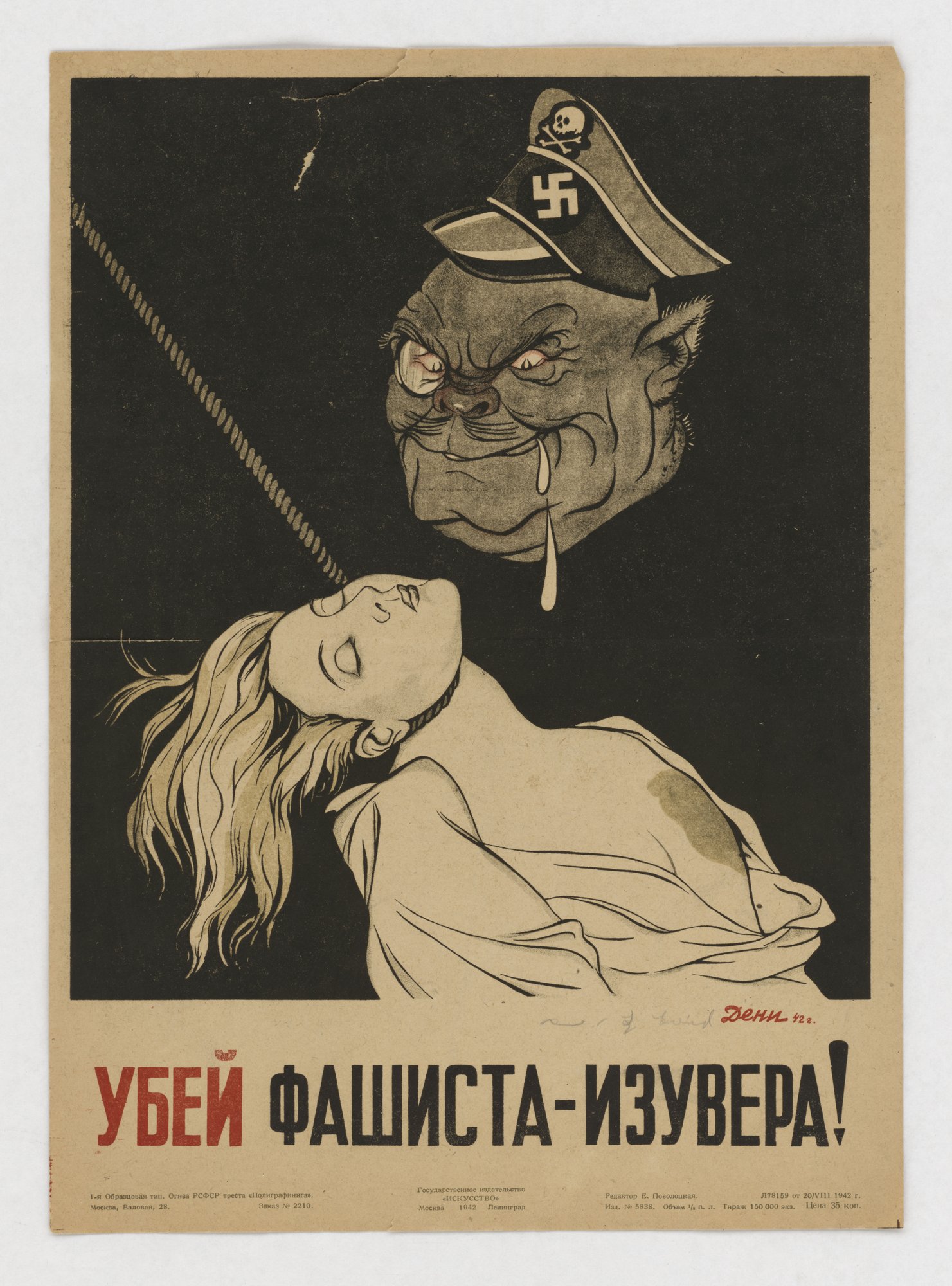
Deni's 1942 sheet from the State Publishing House "Art" gives an approval date of 20 August 1942 and a print run of 150,000. The headline orders the viewer to kill the "fascist brute". The label and the staged atrocity are name-calling, and the harm shown to a woman is a fear appeal; neither is evidence about a particular event. See Soviet wartime propaganda. Read the technique: name-calling.
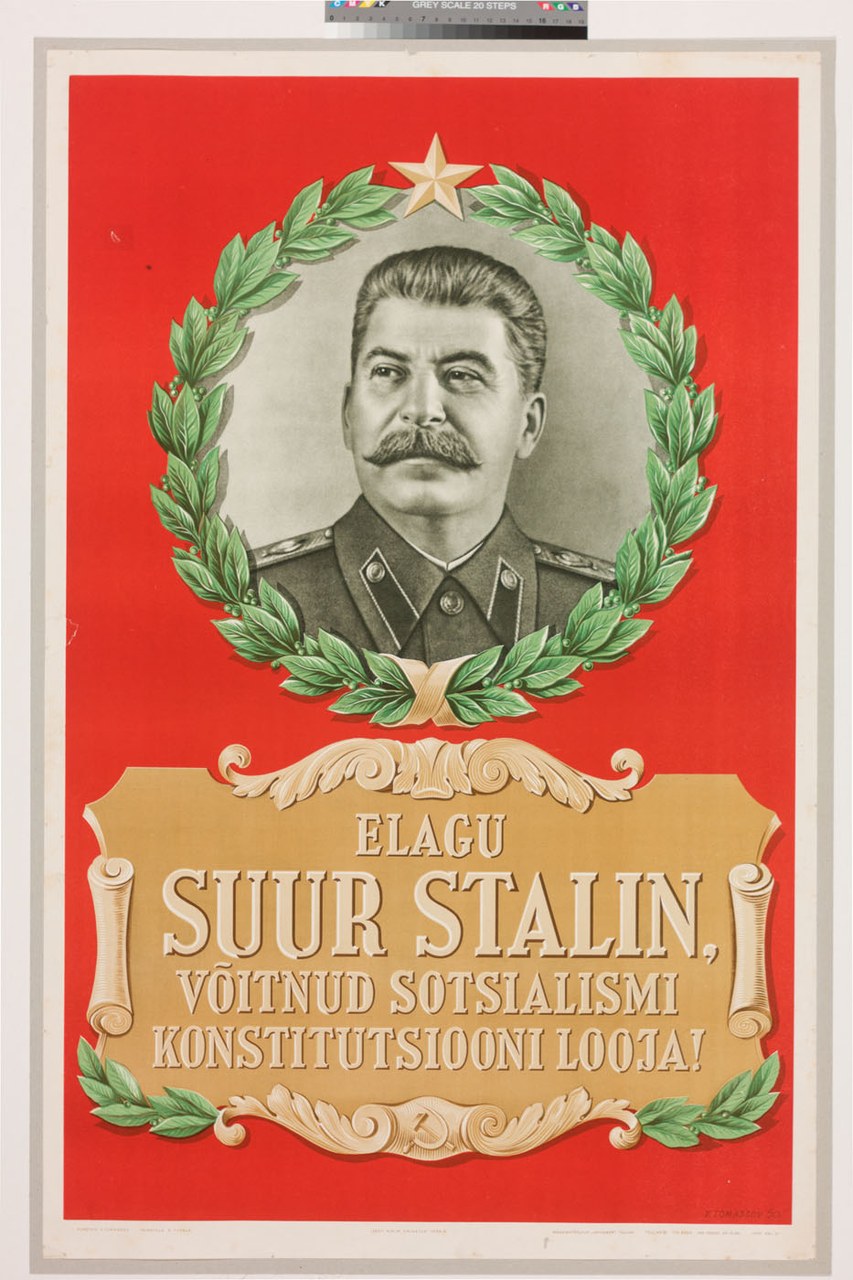
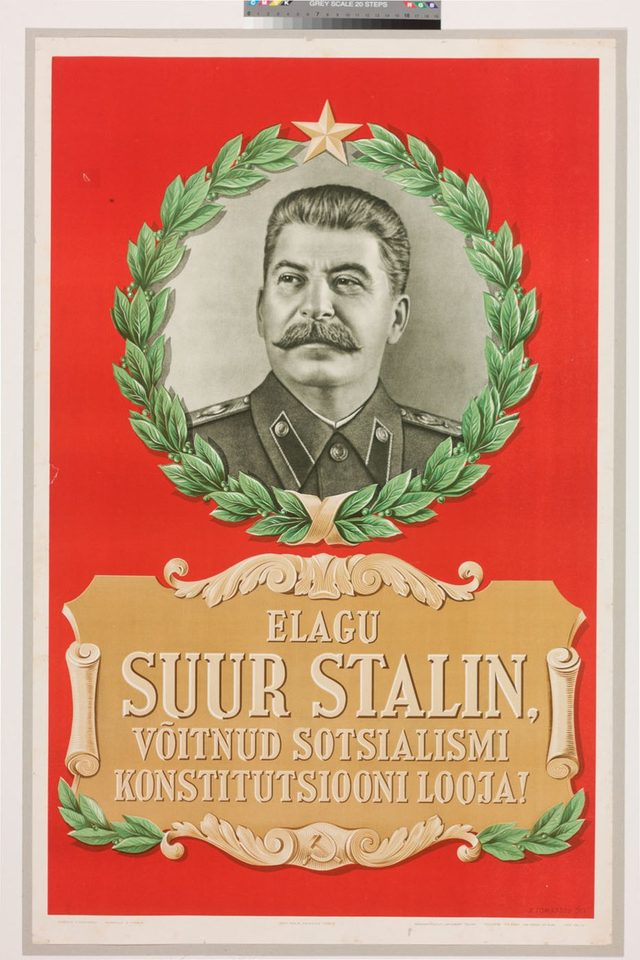
The Tartu Art Museum credits Voldemar Tomassov and dates this Estonian-language poster to 1950, five years after the Soviet re-occupation of Estonia. The slogan refers to the 1936 constitution, officially the "Stalin Constitution". "Great" and "victorious" stand in for any testable claim, and the wreath, star and scroll lend ceremony to the portrait. The collection tags it for cult of personality. Read the technique: cult of personality.
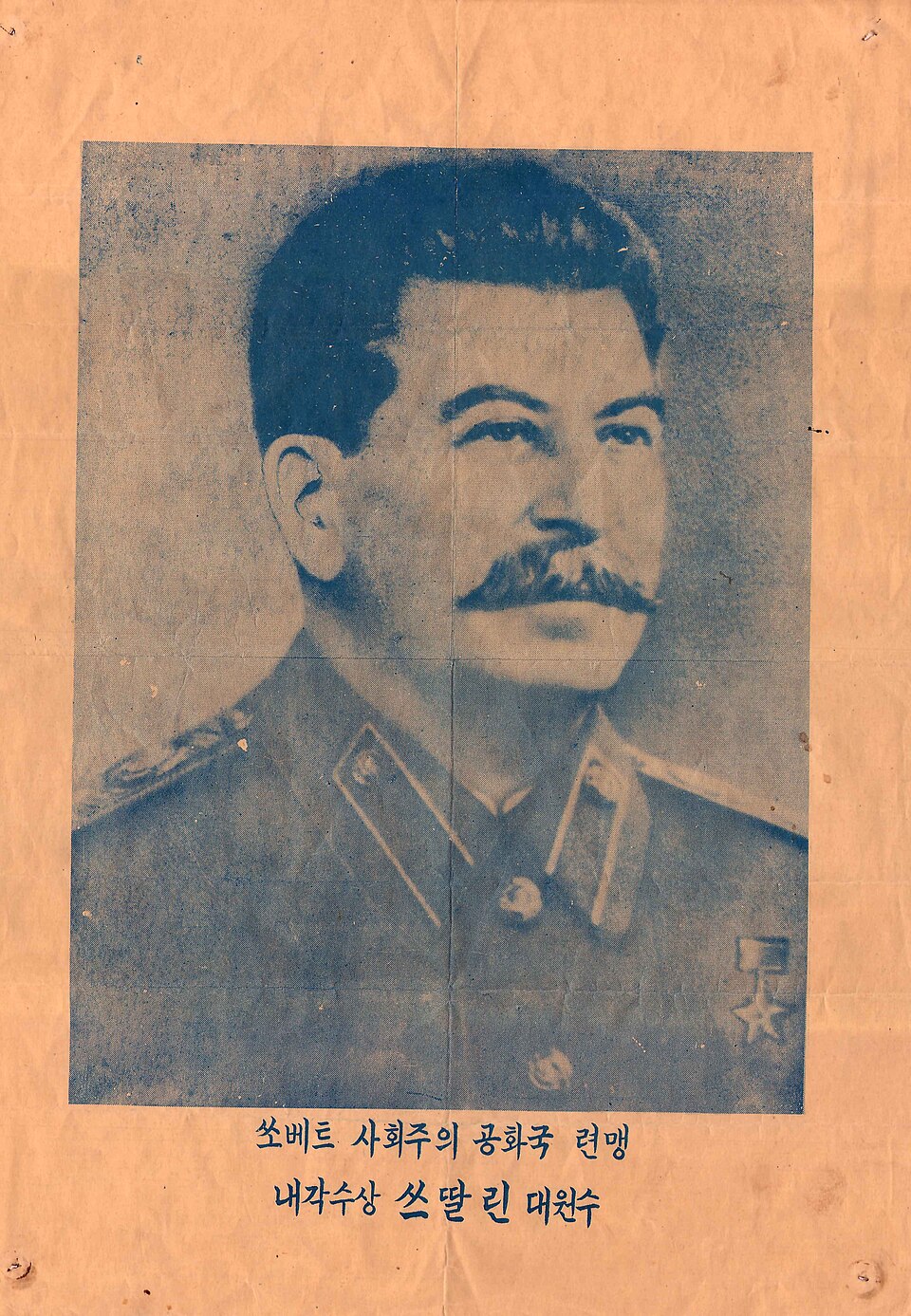
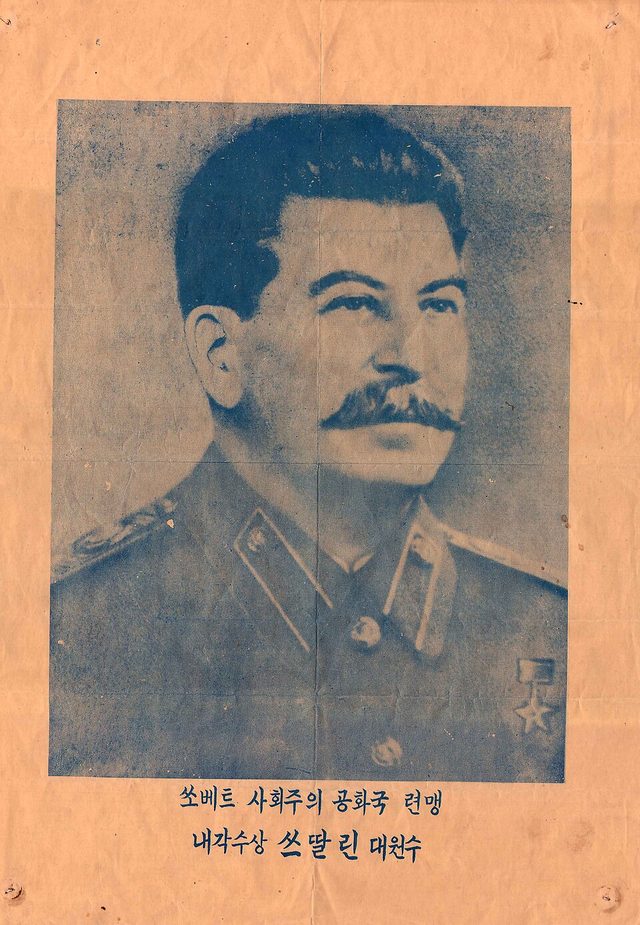
The Marine Corps Archives attributes this Korean-language broadside to North Korea in about 1951. The sheet carries no issuer, imprint or date, so that attribution is the archive's alone. Its Korean caption names Stalin as head of the Soviet government and "Generalissimo". The entry notes that portraits of allied leaders were used by both sides in the war. For Stalin's death, see how Joseph Stalin died.
Cold War radio, China and the leader's authority
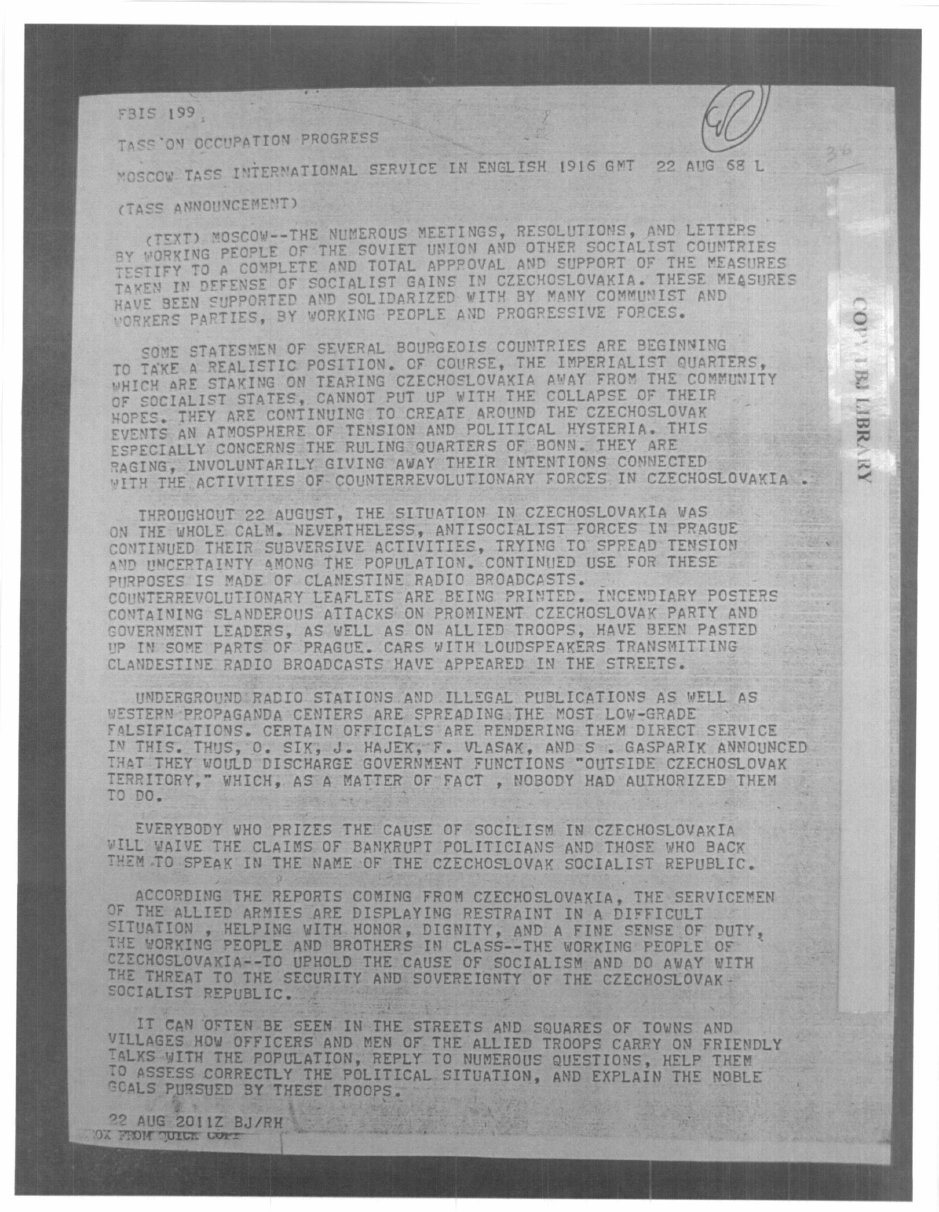
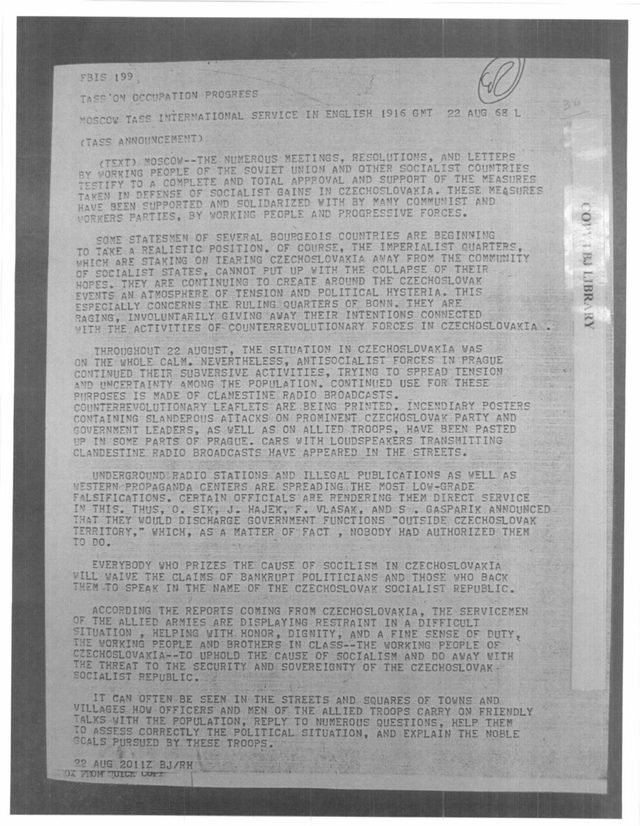
This is a U.S. monitor's page from the Lyndon B. Johnson Library files, copying a TASS English-language broadcast from Moscow on the second day of the invasion of Czechoslovakia. The text calls the troops "allied", their entry "measures taken in defense of socialist gains", and cites "numerous meetings, resolutions, and letters" as "complete and total approval". Opponents are labelled "counterrevolutionary". The entry notes that Czechoslovak broadcasts of the same days gave the opposite account. Read the technique: euphemism.
Explain moreShow less
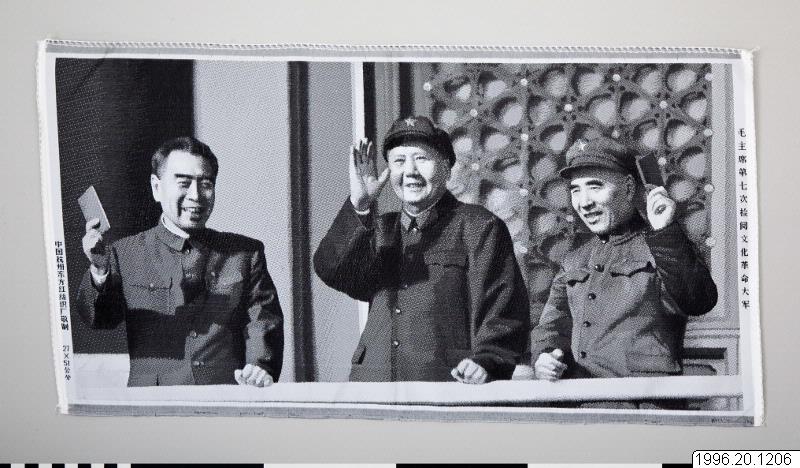
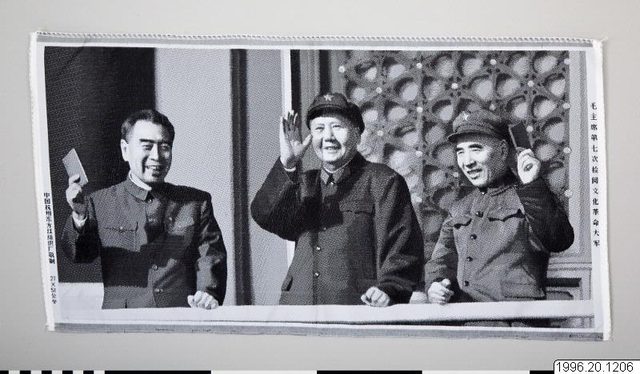
The Hangzhou Dongfanghong (The East Is Red) Silk Weaving Factory made this loom picture from an official photograph. Its caption calls the scene Mao's "seventh review" of the "great army of the Cultural Revolution", which places it in the autumn 1966 series of mass Red Guard receptions in Beijing. Mao stays at the centre between his two highest aides. See Mao cult origins. Read the technique: transfer.
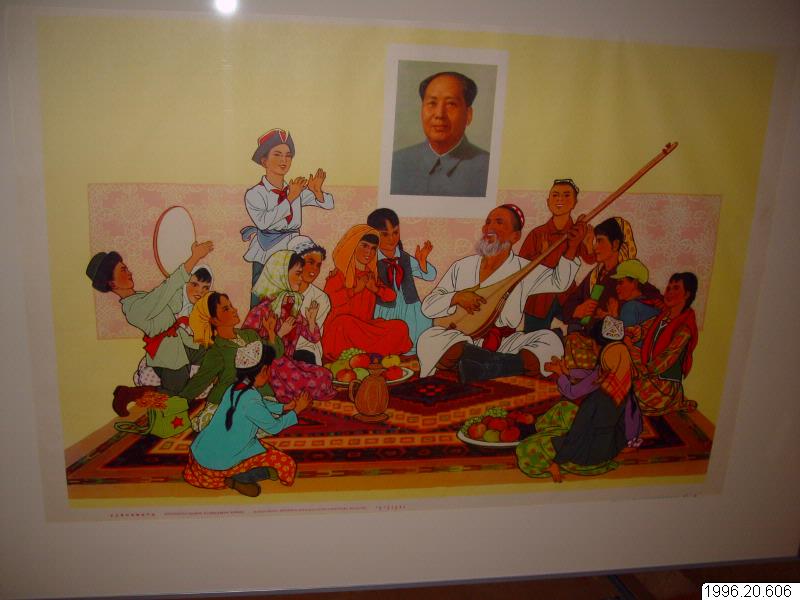
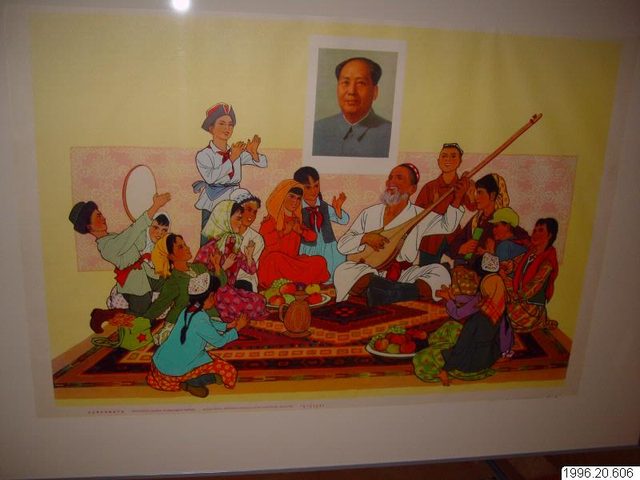
Zhu Huakun's 1973 Xinjiang poster is held in a Swedish museum collection and titled in its catalogue "We never stop praising the thoughts of our Chairmain [sic] Mao". The portrait is the focal point and the whole household joins in. The entry says such posters put the leader's portrait inside minority-nationality households as a sign of national unity under the Party, and scores the composition only. Read the technique: bandwagon.
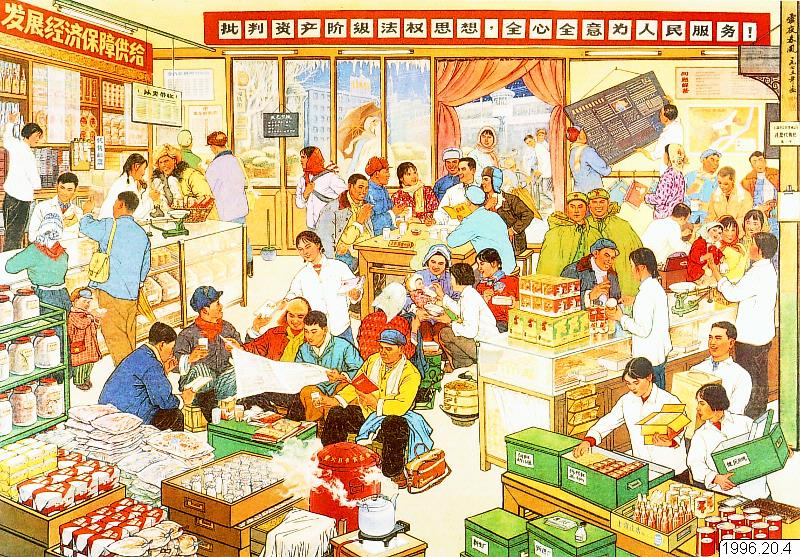
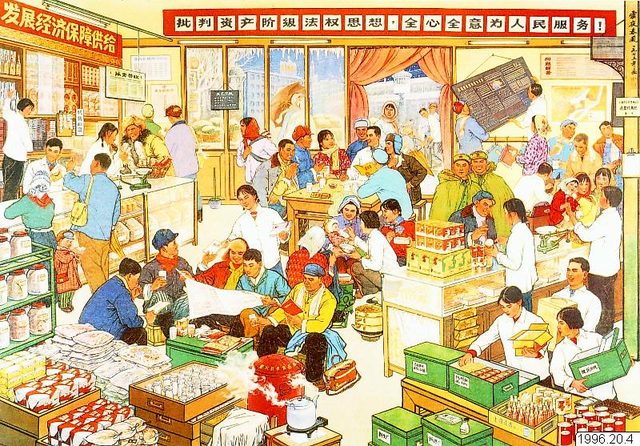
Catalogued by the museum as Shanghai, 1976, this poster uses the phrase "serve the people" as the warrant for a campaign line. "Bourgeois right" was a theme of the 1974 to 1976 study campaign associated with Zhang Chunqiao and the Shanghai group later labelled the Gang of Four. The entry notes it promotes a line and is not an account of retail conditions. Read the technique: glittering generalities.
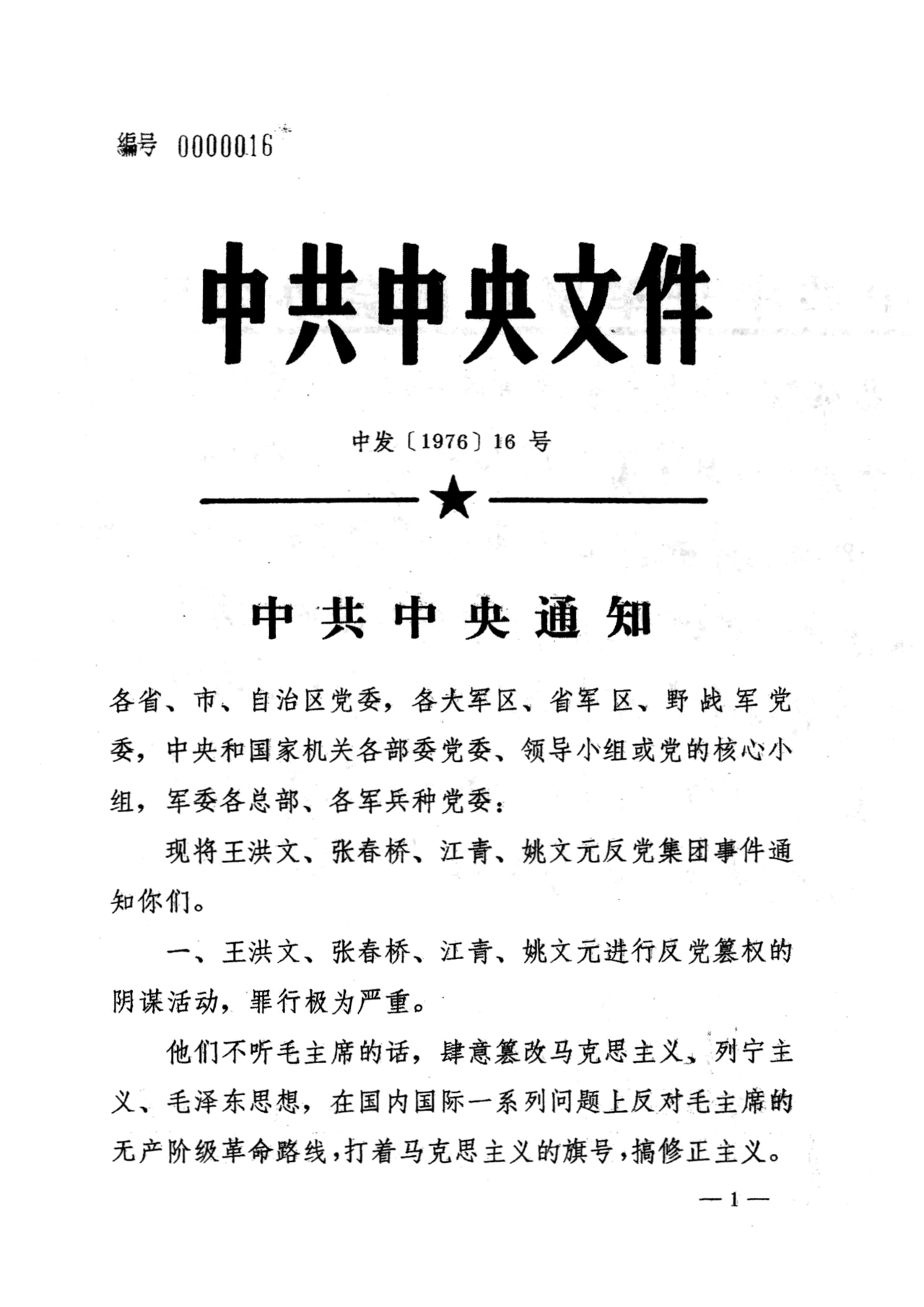
The Central Committee of the Chinese Communist Party sent this circular on 18 October 1976, twelve days after the four were detained. It labels them an "anti-Party clique" engaged in a "conspiracy to usurp power", and grounds the charge in their not obeying Chairman Mao. The four were tried in 1980 and 1981 and convicted; the entry scores only the wording. See Mao's death and succession propaganda. Read the technique: name-calling.
North Korea, East Germany and Cuba
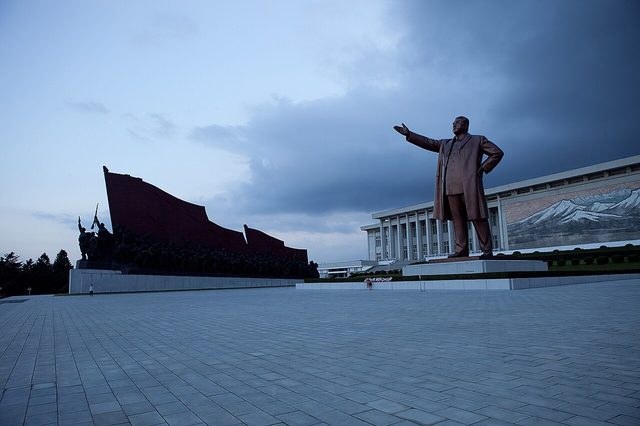
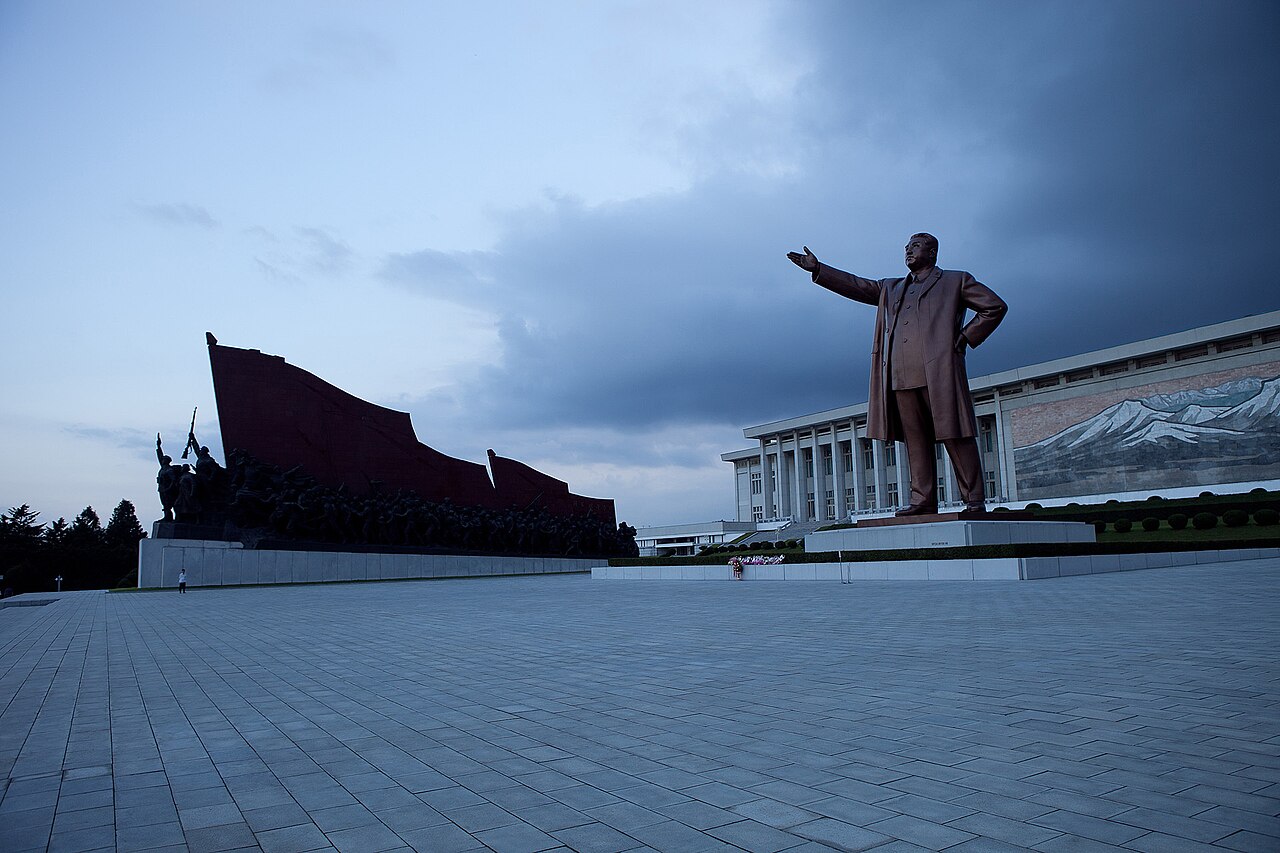
A photographer recorded the Mansudae Grand Monument on Mansu Hill, Pyongyang, on 4 September 2010. The caption records the photographer's note that there are over 500 statues of Kim in the country. The state's history is set in one ensemble around the leader's figure, with the people in relief beside him. See the Kim dynasty leader cult. Read the technique: cult of personality.
Explain moreShow less
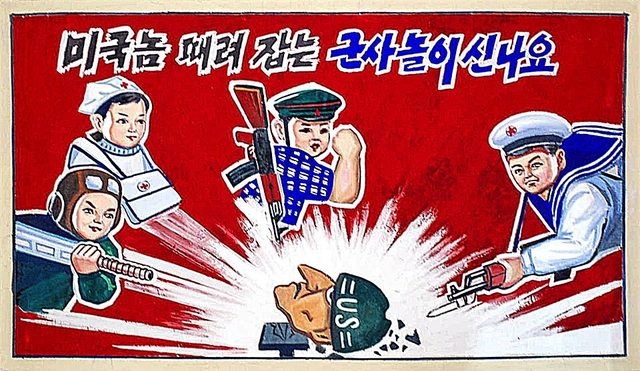
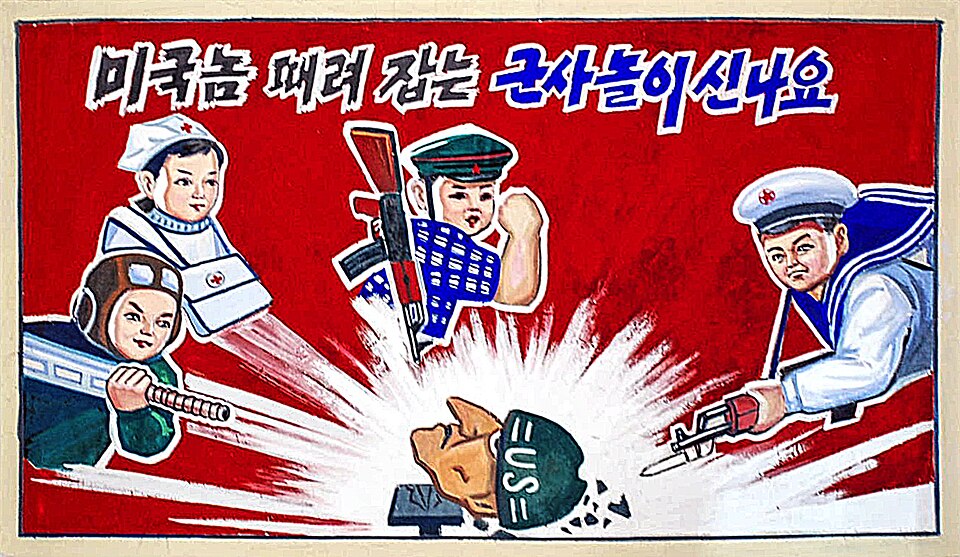
A Flickr photographer photographed this primary-school poster at a farm on 10 June 2008; the poster itself is undated. Its headline, "Playing soldiers, beating up the American bastard: isn't it fun?", uses a derogatory tag together with violence presented to children as a game. Read the technique: name-calling.
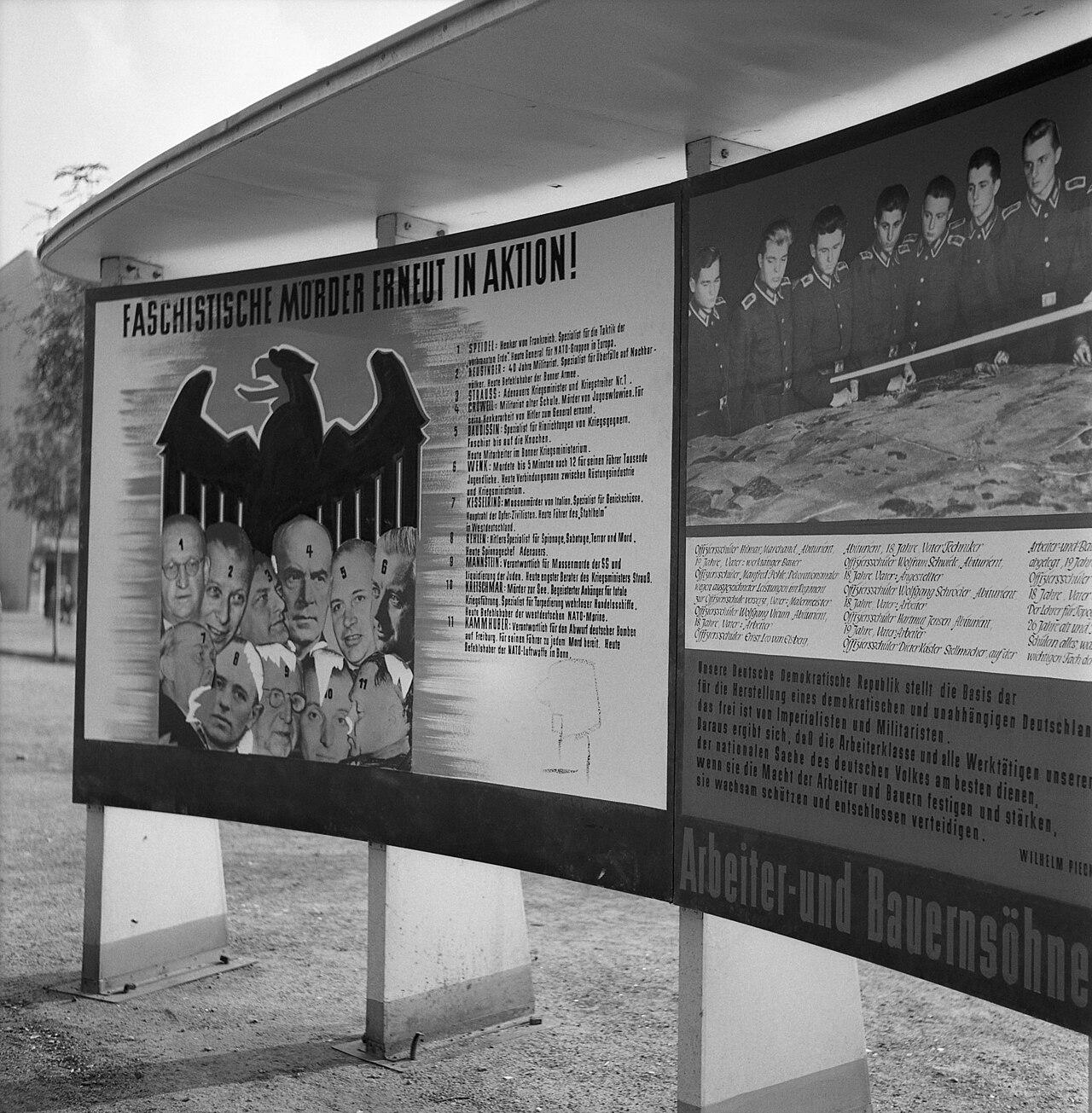
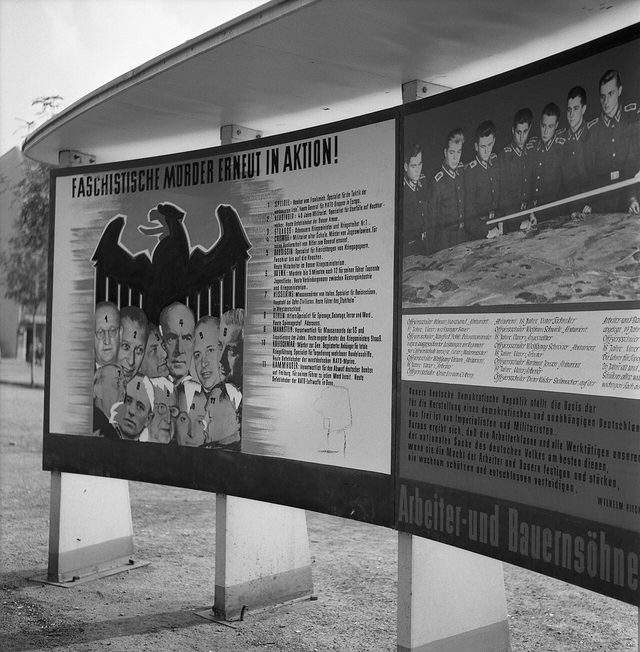
Manfred Niermann photographed this open-air display in East Berlin in 1957; the boards name no issuer. Eleven numbered heads carry one-line epithets and each man's present West German or NATO post. The entry says several of the men held such posts in the 1950s. The eagle and numbering paste wartime guilt onto 1957 office-holders (name-calling, transfer). See the German Democratic Republic.
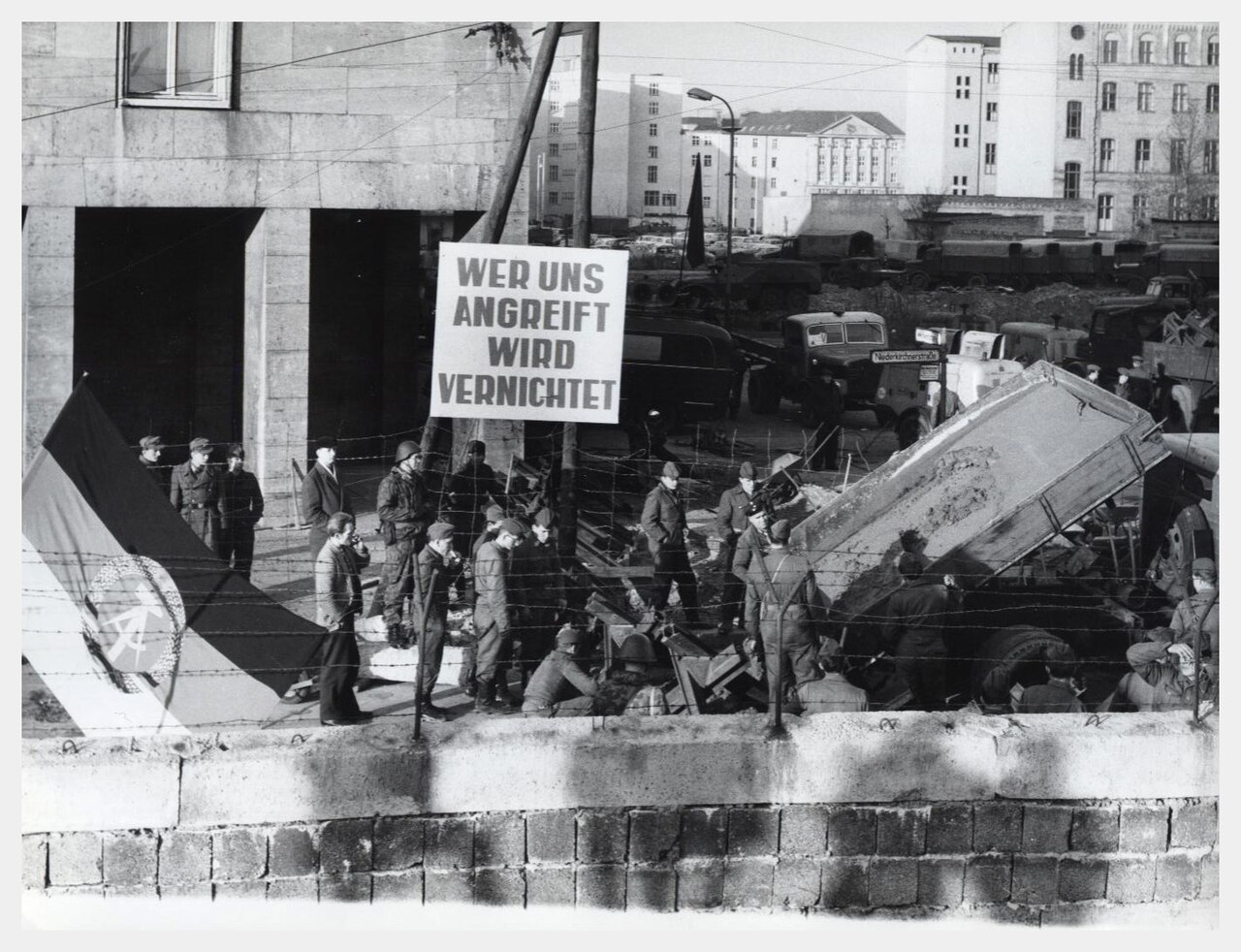
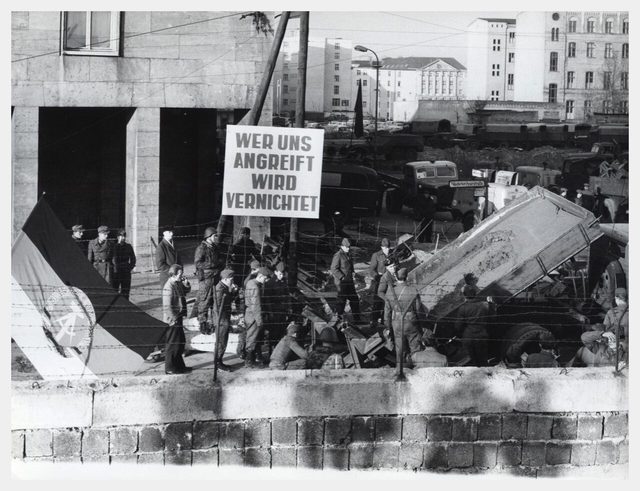
A CIA photographer dated this East Berlin sign 20 November 1961, three months after the border was closed on 13 August. The sign reads "Whoever attacks us will be destroyed". The CIA's caption says it was posted to intimidate the West; the collection quotes that without adopting it. The sign is a bare threat addressed to unnamed attackers. Read the technique: fear appeal.
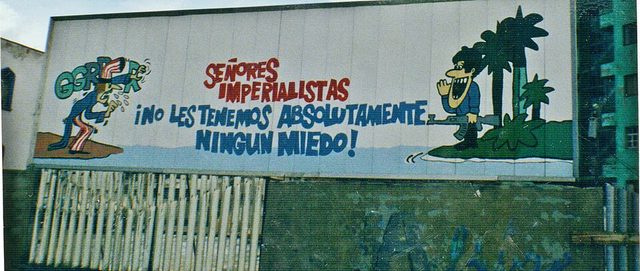
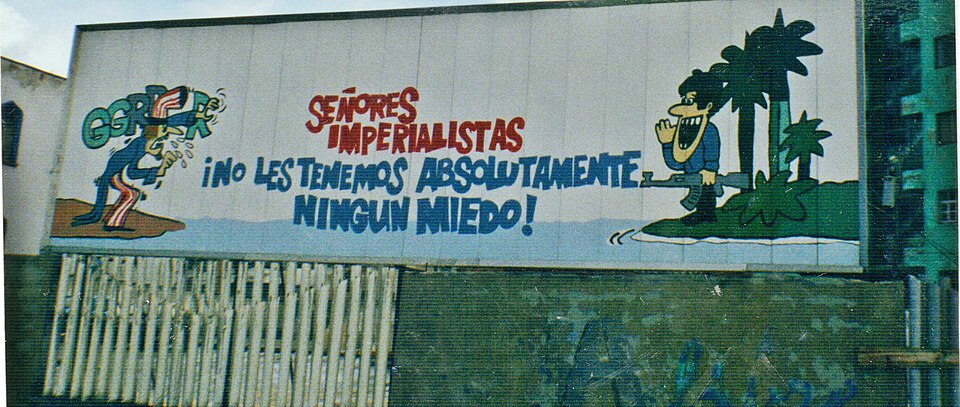
Robert Schediwy photographed this billboard in 2002 in front of the U.S. mission in Havana; the United States had no embassy there between 1961 and 2015. No sponsor is printed on the board. "Imperialistas" is the whole characterisation of the addressee, and the board shows fear in the opponent and none in the in-group. The entry notes that the same definition applies to anti-Communist labels in US material. Read the technique: name-calling.
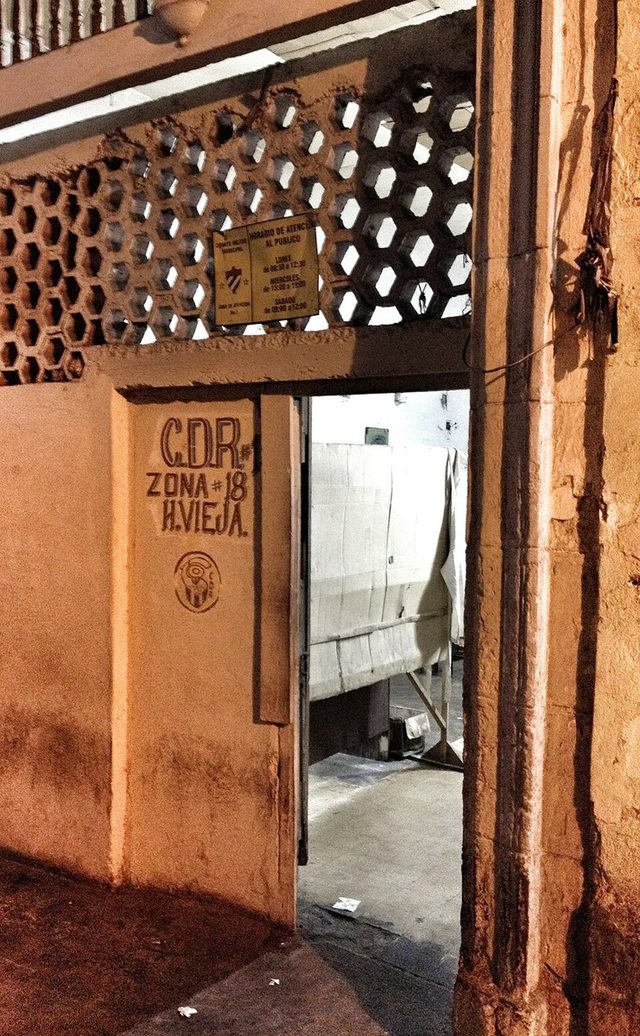
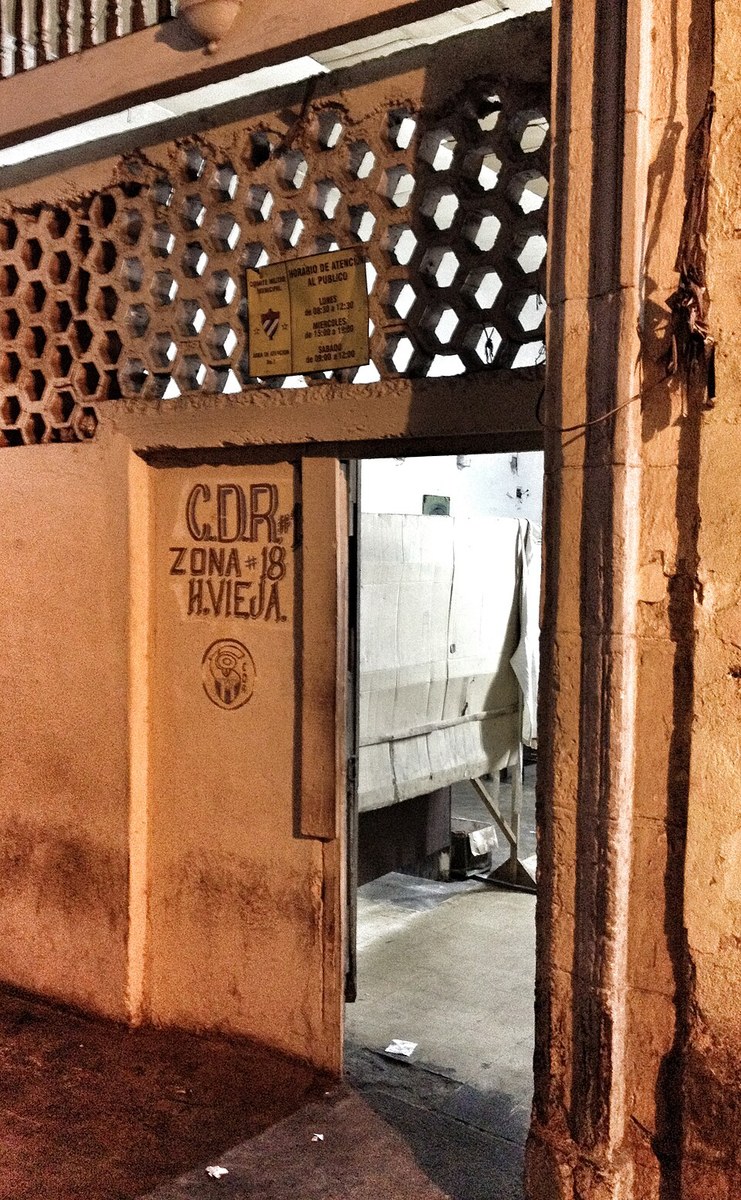
This is the office of a Committee for the Defense of the Revolution, a mass organisation announced on 28 September 1960, photographed on 30 March 2012. The entry says the name joins defending "the Revolution" and keeping watch on the neighbours as one civic task, which is identity fusion. Official and critical accounts of the committees are in the CDR case study. Read the technique: identity fusion.
Is this unique to communist states?
No technique here is unique to them. Name-calling, scapegoating, fear appeals and virtue words appear in American, British and German material under the same definitions: compare the American "All the Ear-Marks of a Sneaky Jap!" (1943, name-calling and scapegoating) in WW2 anti-Japanese posters, the Office of War Information's "This is the enemy" (1943, scapegoating, transfer and fear appeal) on the American propaganda posters page, and the Parliamentary Recruiting Committee sheets on British propaganda posters.
Explain moreShow less
The context differs. Most objects above were issued by a single ruling party that also ran the press and a censorship office (Glavlit, in the Soviet case), while the U.S. and British material was issued within systems that also produced opposition and antiwar posters, which the collection holds. A poster does not show the scale or consequence of the policy behind it; the regime and case-study pages carry that record. The collection also tags cult of personality for non-communist rulers, such as Mussolini and Franco.
Common techniques in communist-state propaganda
- Cult of personality: portraits, statues, honorifics and credit for every success given to a leader (Stalin 1950, Mao 1966 and 1973, Kim Il-sung 2010).
- Scapegoating: a bounded class blamed for hardship, such as wreckers, kulaks and NEPmen in 1930.
- Name-calling: a derogatory tag in place of an argument ("fascist brute", "imperialistas", "anti-Party clique").
Show all 7Show fewer
- Glittering generalities: virtue words such as "Motherland", "Heroes" and "serve the people" standing in for a testable claim.
- Transfer and bandwagon: the leader's authority or a crowd's approval attached to a message.
- Euphemism: invasion described as "measures taken in defense of socialist gains".
- Identity fusion: defending the cause, the Party and the neighbourhood presented as one duty.
What to look for
- Who issued it, and does the sheet say? Many items here name no issuer.
- Is the date on the object, or only on the photograph or catalogue?
- Is the enemy a person or a label?
- Is the object a poster, a photograph of a display in place, or a monitor's transcript?
Browse the collection
The grid below lists the objects discussed here and neighbouring items from the same states. Filter by country, medium and technique on the collection pages.
Sources and further reading
Sources and rights
Every description draws on the entry's caption and notes in examples/entries/ , which cite the holding institution: the U.S.
Every description draws on the entry's caption and notes in examples/entries/, which cite the holding institution: the U.S. National Archives, the Library of Congress, the Marine Corps Archives, the Harry S. Truman Library, the Tartu Art Museum, the CIA's Flickr account, Deutsche Fotothek, Wikimedia Commons photographers and the Swedish museum collection that holds the Chinese posters. Rights vary by object and are stated on each object's page; photographer licences cover the photograph, not the displayed work. Related pages: propaganda posters, recruiting posters, Cold War propaganda and how FRAME defines propaganda.
![Убей фашиста-изувера! [Kill the fascist brute!]](../collection/images/soviet-kill-the-fascist-brute-deni-1942-640.jpg)
![中共中央通知 中发〔1976〕16号 (CCP Central Committee Notice, Zhongfa [1976] No. 16), first page](../collection/images/zhongfa-16-notice-wang-zhang-jiang-yao-clique-1976-640.jpg)