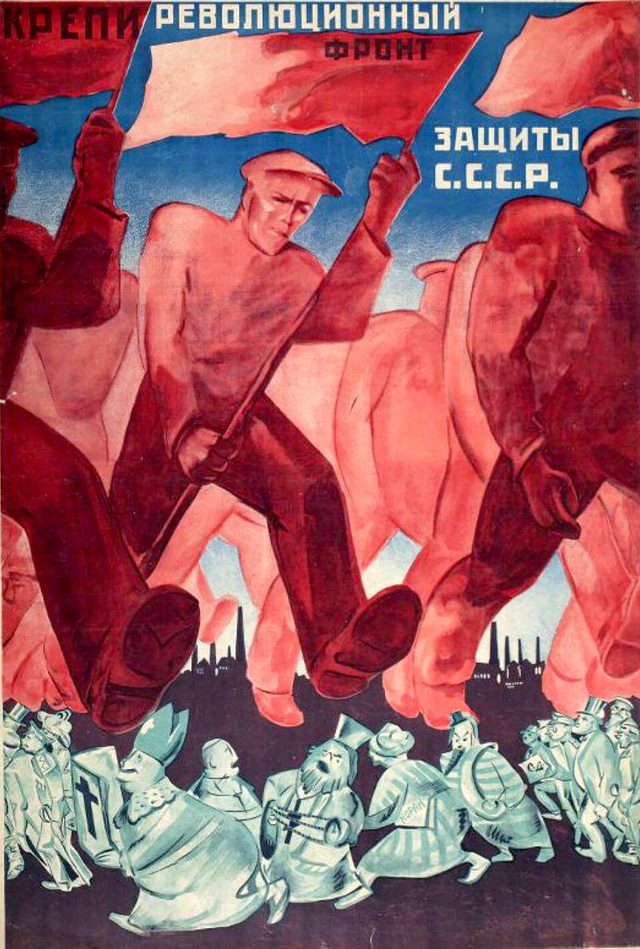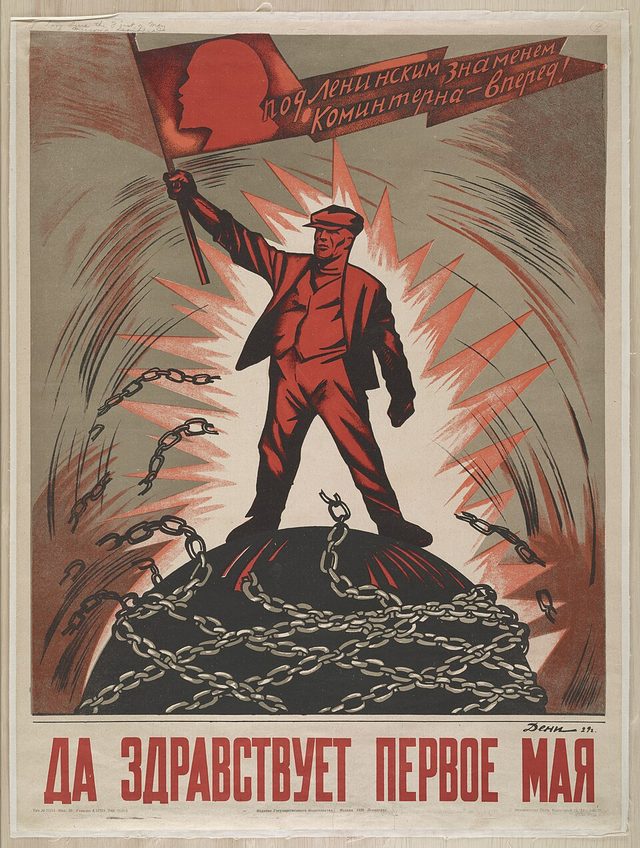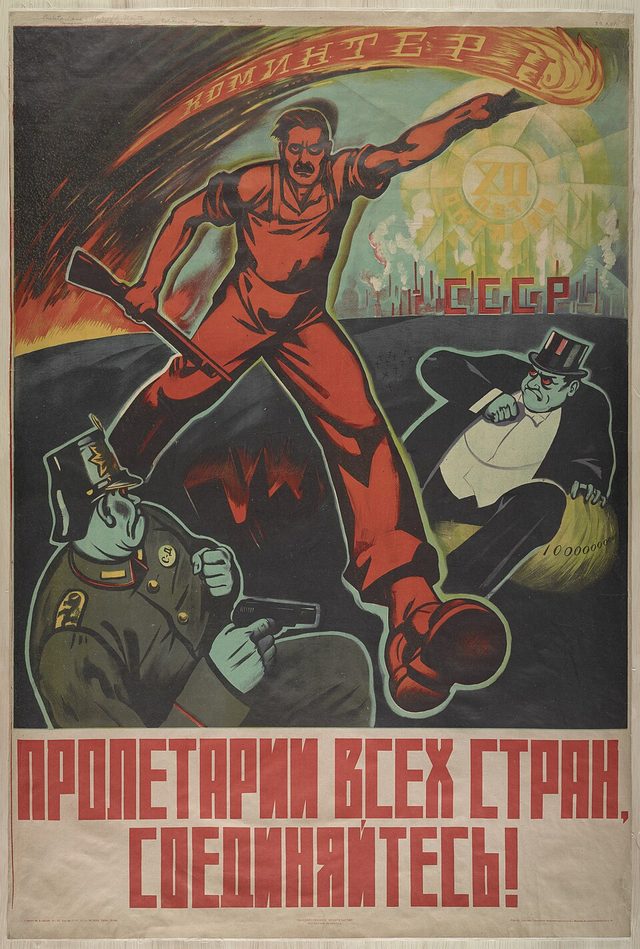
Content note. Soviet posters of the late 1920s and 1930 draw clergy, farmers, "kulaks" and political opponents as animals or small bloated figures, and the collection shows them as printed. Posters from outside the Soviet state's institutions and from present-day Russia appear on the same terms. Showing a poster is not endorsing it.
What this page covers
This page collects posters issued in the Russian Empire's last years, by the Provisional Government of 1917, by the Soviet Union from 1917 to 1991, by movements active inside it, and by the Russian Federation since. The slice is labelled "Soviet and Russian" because the collection's items for the two states overlap in subject and technique, and the Soviet items alone are a narrower set. The page applies the same definition of propaganda used for every country (how FRAME defines propaganda) and the same technique tags used for American, British, German or Chinese posters. For the institutions behind Soviet propaganda, see Soviet agitprop; for posters from every country, see propaganda posters.
Most Soviet items here are state publications, so the issuer is usually plain. The exceptions are labelled below: a Provisional Government loan campaign, a campaign run outside the state's institutions, and posters from the current Russian Ministry of Defence.
1917: the Provisional Government's Liberty Loan
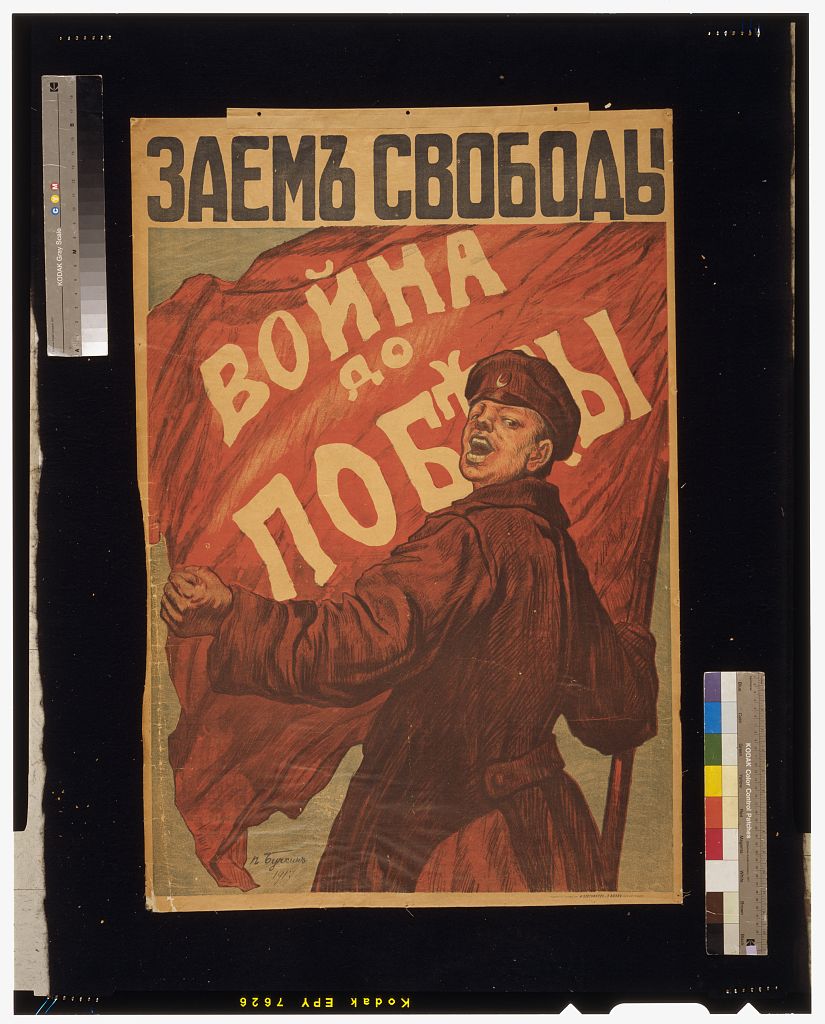
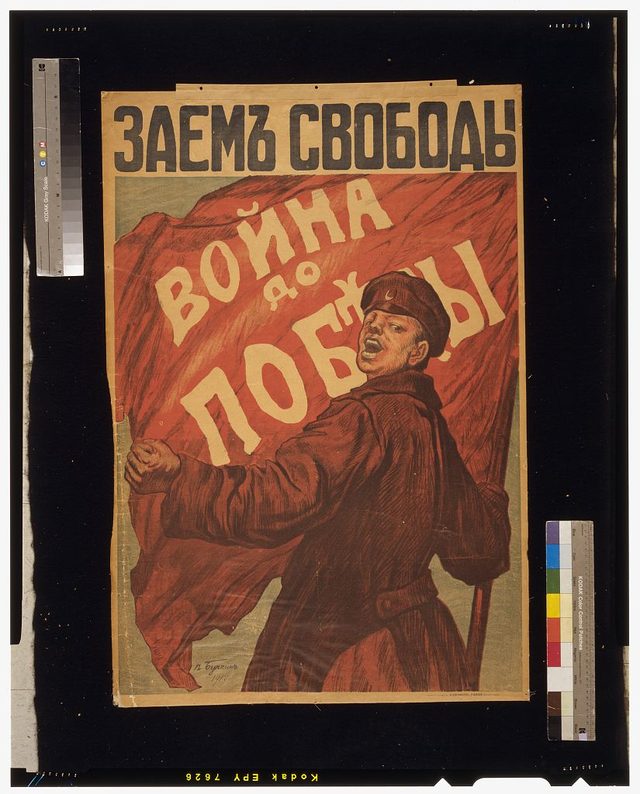
After the February Revolution of 1917 the Provisional Government launched the Liberty Loan to finance the war and commissioned posters that recast war finance in the language of the revolution. A shouting soldier unfurls a red banner reading "War until victory" under the heading "Liberty Loan". The red flag of the new freedom is carried for continuing the war, and the word "liberty" is attached to a government war bond. Earlier tsarist loan posters had used cavalry charges and aircraft; the 1917 campaign swapped in red banners and citizen-soldiers. "War until victory" was the government's position that Russia would keep its commitments to its allies, and the Bolsheviks campaigned against it. The poster is tagged glittering generalities and transfer. Read the technique: glittering generalities.
The 1920s and 1930: showing a better "now"
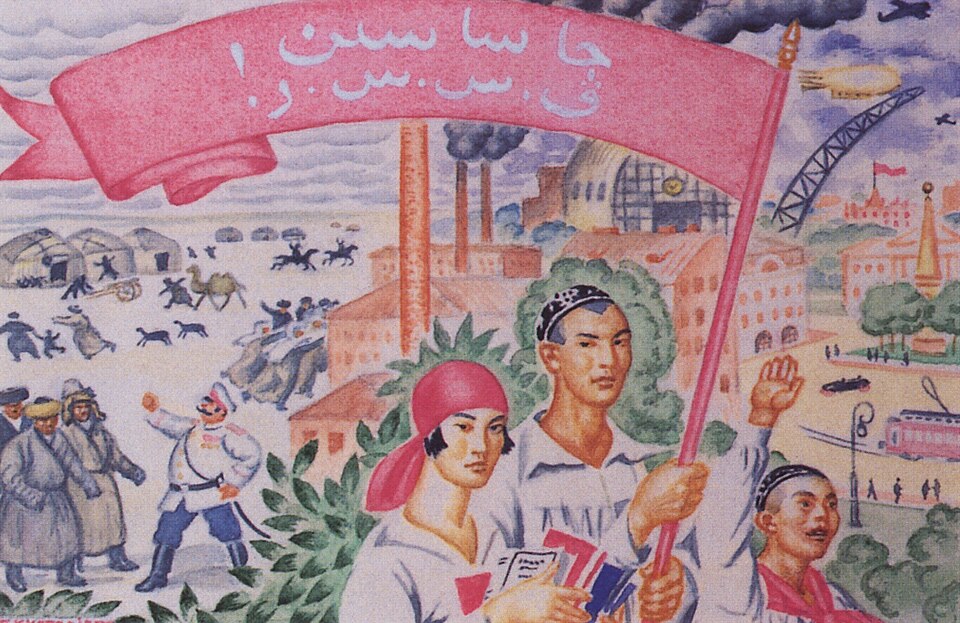
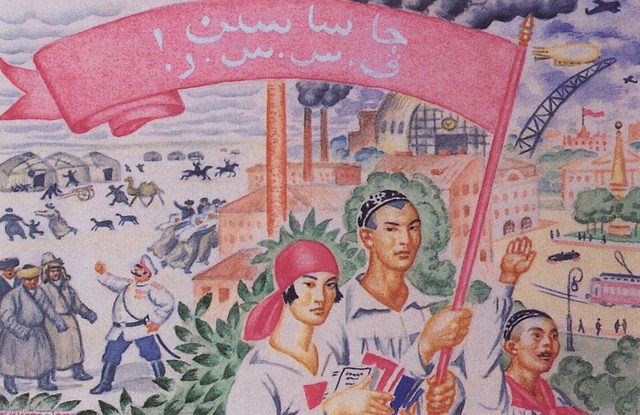
Boris Kustodiev's 1926 poster for the AKhRR publishing house sets two Central Asian scenes side by side. At left are yurts, a camel and riders in padded robes; at right, brick factories, a tram, a street lamp and a young woman and a man carrying a red banner. Only the "before" and the "now" are shown, each with only what flatters its side of the comparison. That is card stacking, and it is the same device used by the 1900 American "McKinley Was Right" poster in the collection. Read the technique: card stacking.
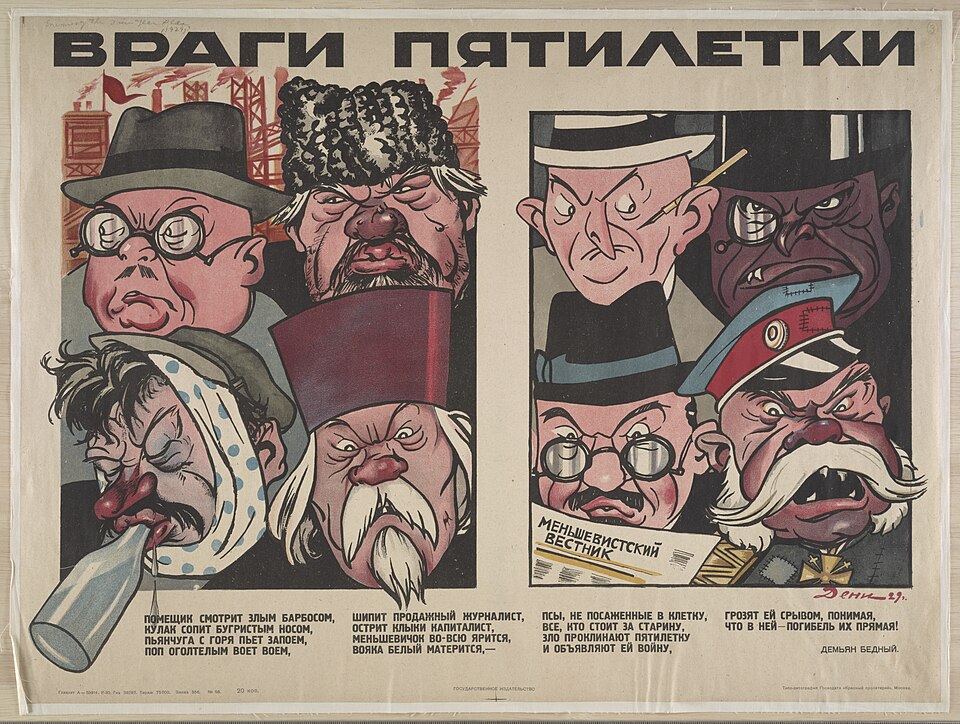
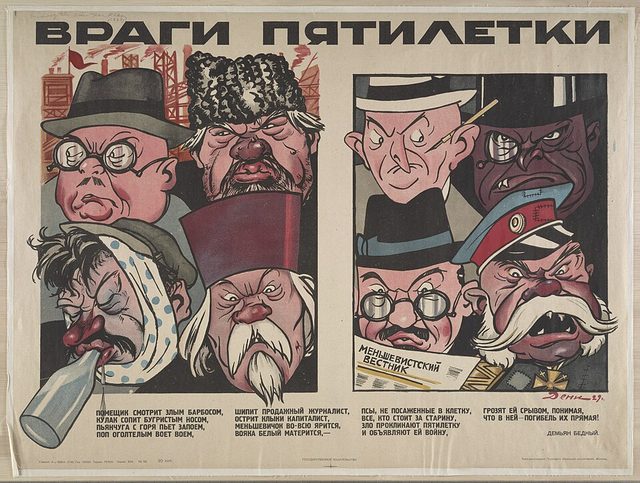
Viktor Deni drew, and Demyan Bedny wrote the verse for, a 1929 State Publishing House poster titled "Enemies of the Five-Year Plan". Eight grimacing caricature heads crowd two panels: a landowner, a kulak, a drunkard, a priest, a journalist, a capitalist, a Menshevik and a White officer. The rhymed caption calls them "dogs not yet put in a cage". A mixed list of old-order groups is named as one pack and blamed for threatening the plan, which is name-calling and scapegoating. Read the technique: scapegoating.
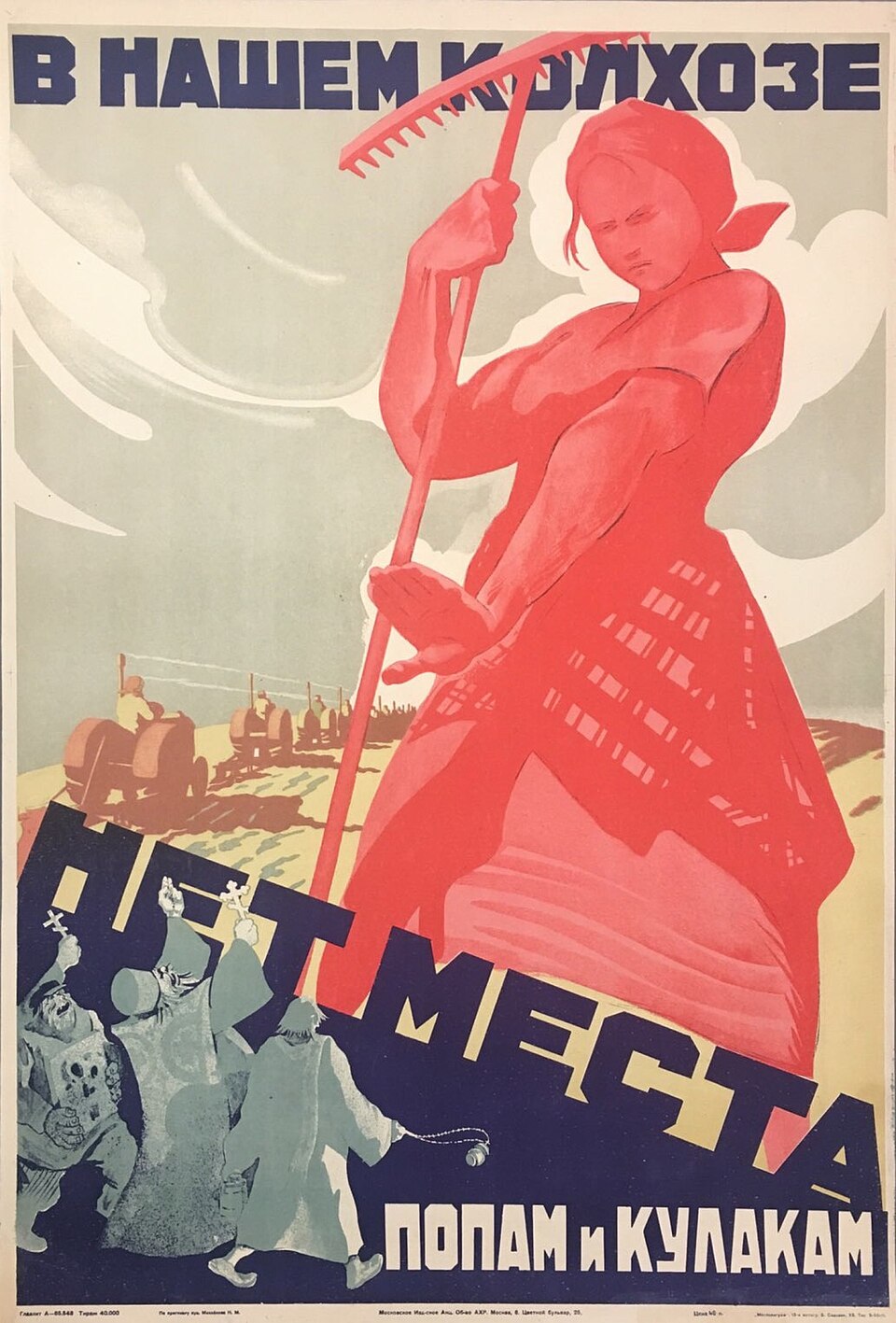
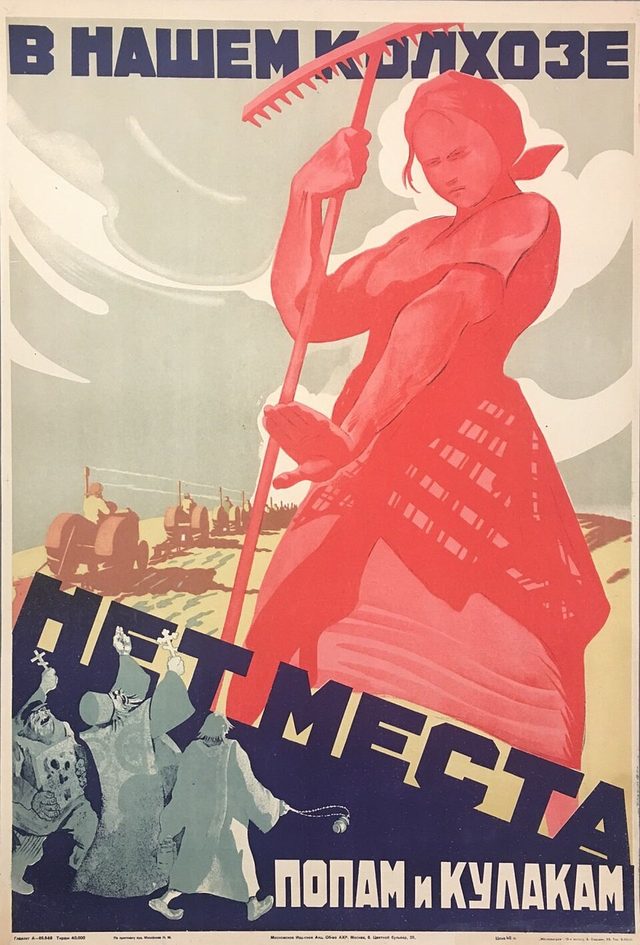
Nikolay Mikhailov's colour lithograph for the Association of Artists of the Revolution, a Moscow publishing house, shows a giant red-tinted peasant woman with a rake holding up a palm over a tractor team. At her feet three small grey-green men, two holding crosses and one a rosary, are pushed out by the words "no place". The title names two groups, priests and kulaks, as people to be excluded from the collective farm. The sheet carries a Glavlit number, the mark of Soviet state censorship, and a print run of 40,000. The exact year is uncertain; the collectivisation theme points to 1929 or 1930. Read the technique: name-calling.
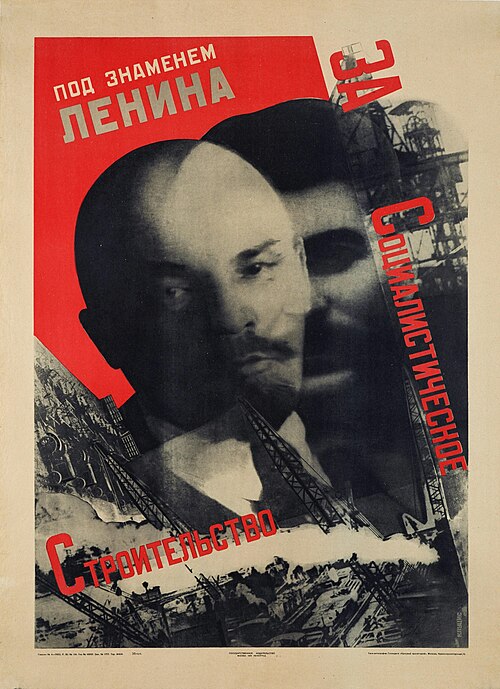
Gustav Klutsis's 1930 photomontage puts Lenin's face in the foreground, a darker, half-hidden portrait of Stalin rising behind his shoulder, over cranes, derricks and a factory yard, under "Under the banner of Lenin, for socialist construction". Placing the living leader inside the dead leader's likeness and slogan is the transfer tell. Klutsis, born in Latvia in 1895, was arrested in January 1938 and shot in Moscow on 26 February 1938, during the Great Terror. Read the technique: transfer.
1950: the leader's portrait
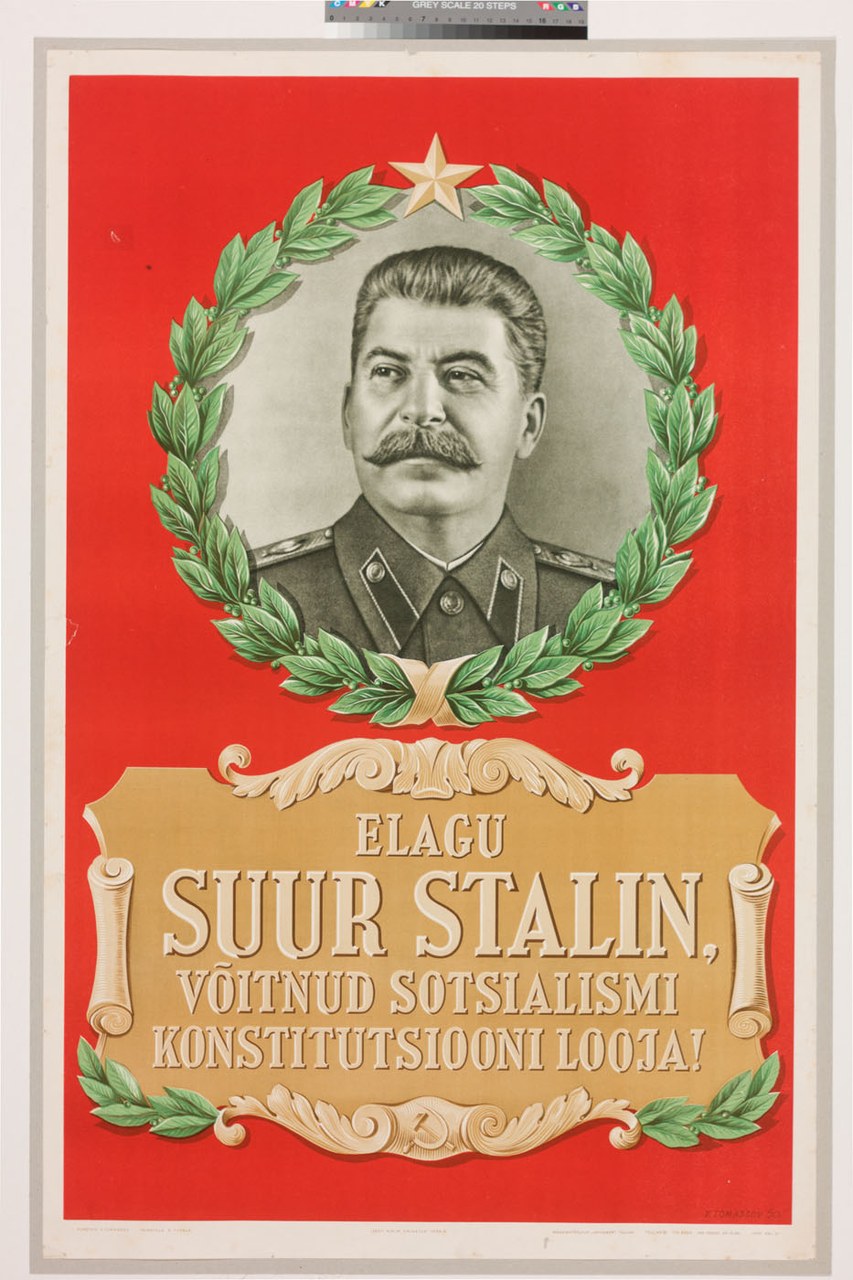
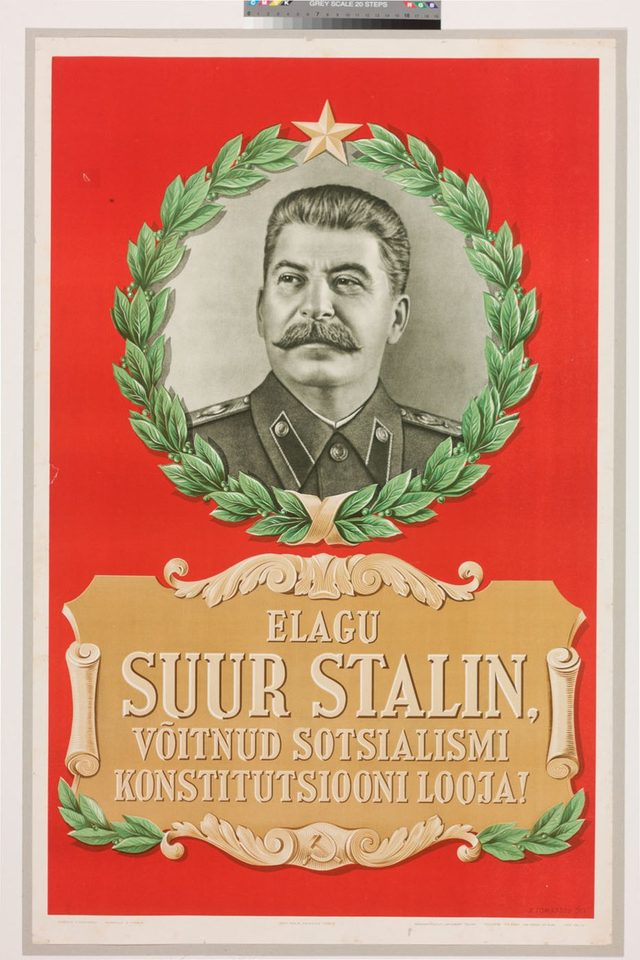
An Estonian-language poster of 1950 by Voldemar Tomassov, from the Tartu Art Museum, sets a retouched photograph of Stalin in uniform inside a laurel wreath topped by a star, above a scroll that reads "Long live great Stalin, creator of the constitution of victorious socialism!" The slogan refers to the 1936 Soviet constitution, officially called the "Stalin Constitution". The tells are the virtue words "great" and "victorious", which stand in for any testable claim, and the wreath and scroll, which lend the portrait ceremonial prestige. The Estonian SSR had been proclaimed in 1940 and was re-established in 1944. Read the technique: glittering generalities. For Soviet posters in the Cold War, see Cold War propaganda posters.
1988 and 1990: late Soviet posters
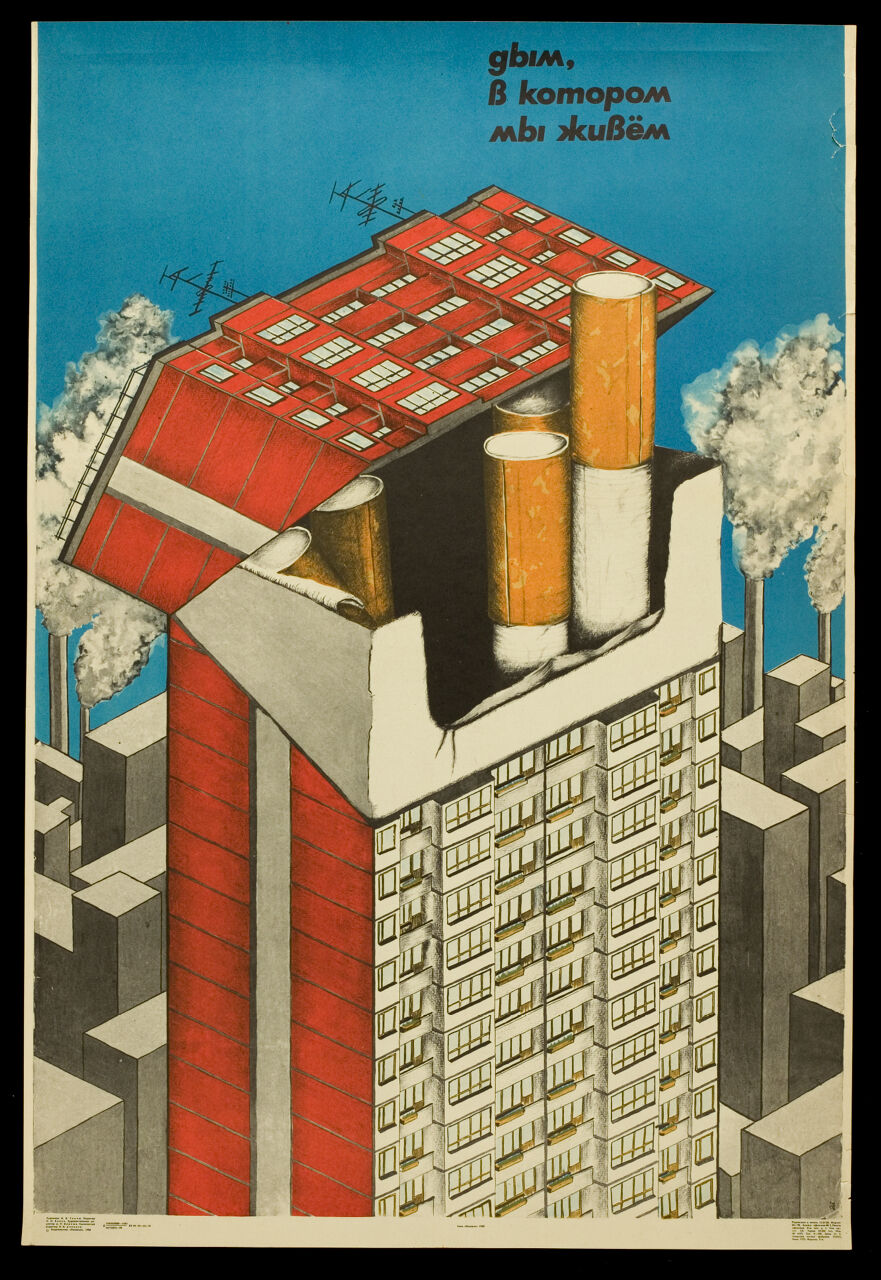
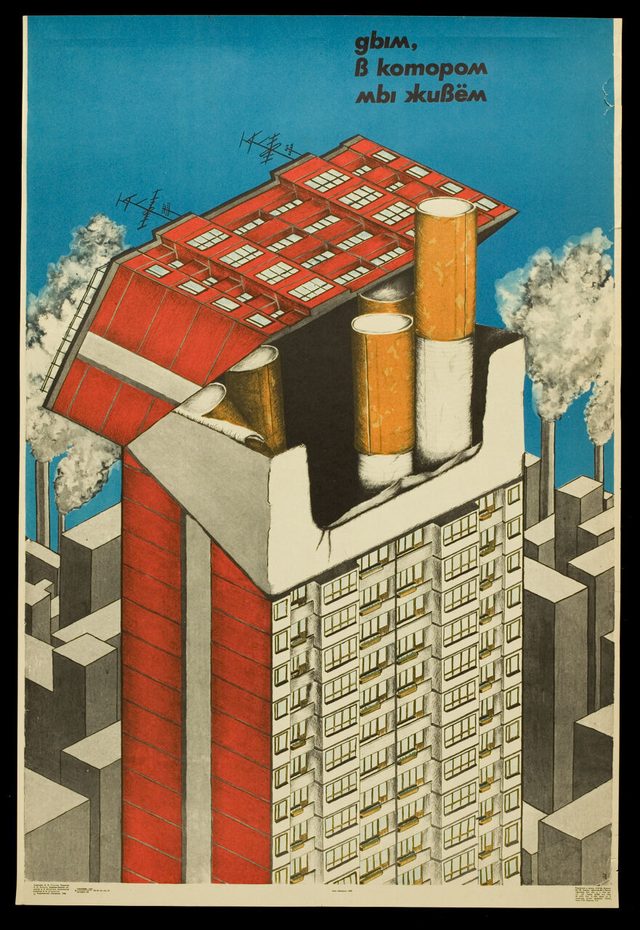
By 1988 a state publishing house in Kiev, Reklama, was issuing public-health posters of a different register. "The Smoke in Which We Live" renders an apartment tower as an open cigarette pack among factory chimneys venting white smoke. The title equates the smoke of tobacco with the smoke the city already breathes: industrial-pollution imagery is used to stigmatise smoking, with no data cited. The sheet names its artist, editors and a print run of 30,000. This is fear appeal and transfer, the same combination found on a 1966 American poster for Thai audiences. Read the technique: fear appeal.
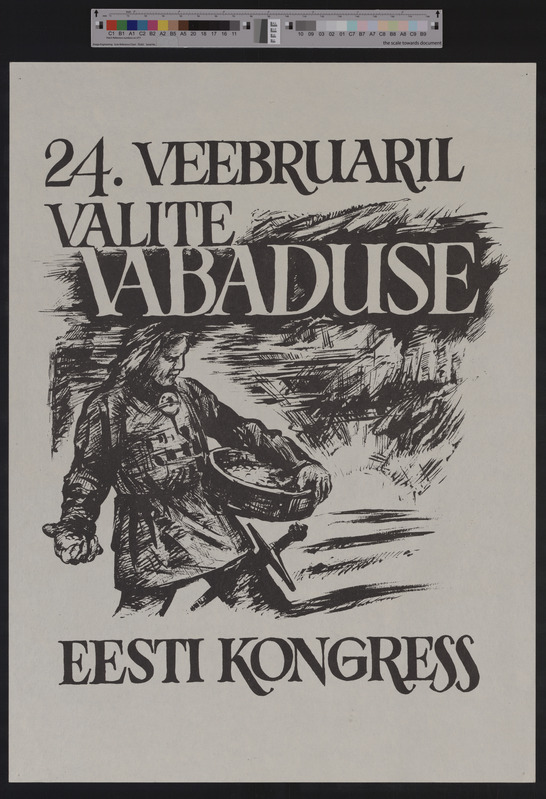
Not every Soviet-era poster came from the state. A February 1990 poster for the Estonian Congress election, organised outside Soviet institutions by the Citizens' Committees movement, shows a woodcut-style figure scattering seed from a basket, a sword at the hip, under a headline that names the date and the word "freedom". The single virtue word carries the whole appeal to turn out and vote. The Saaremaa Museum, which holds the poster, gives no artist or printer. The same tag applies as to the 1950 Stalin portrait: glittering generalities. A poster against a state is held to the same standard as a poster for one.
Russia since 2022: Ministry of Defence posters
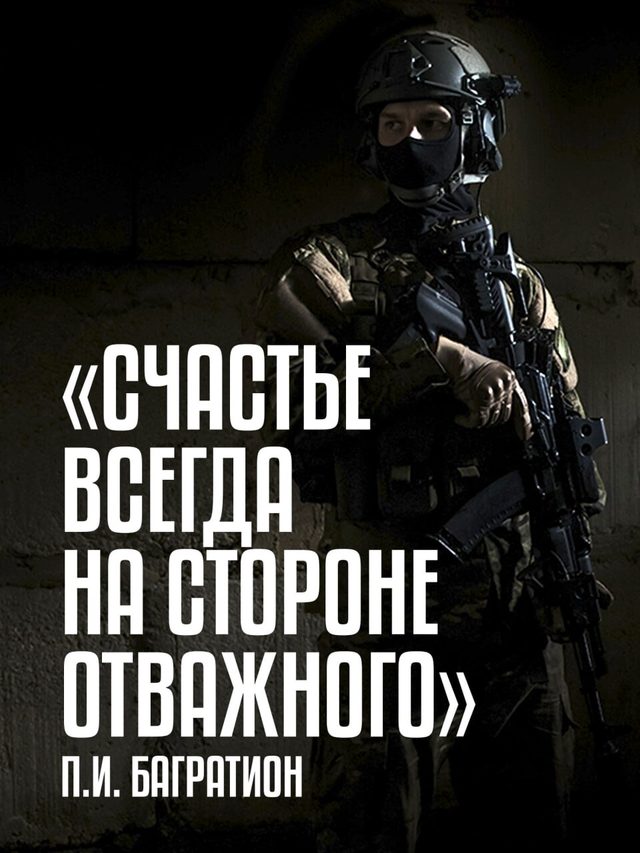
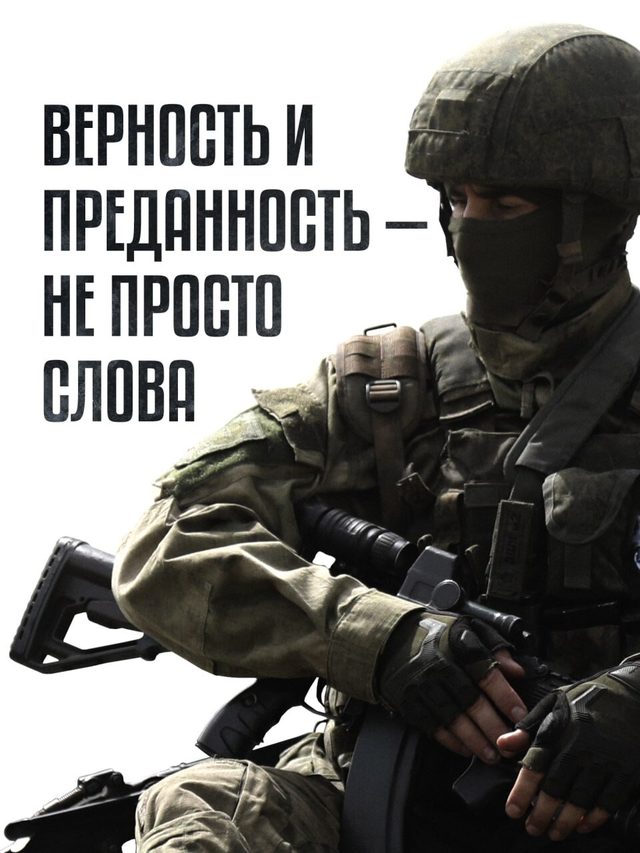
The Russian Ministry of Defence published a numbered series of "agitation posters" in 2022 in the "special military operation" section of its website. Two are held here, as documentary records and not as endorsement.
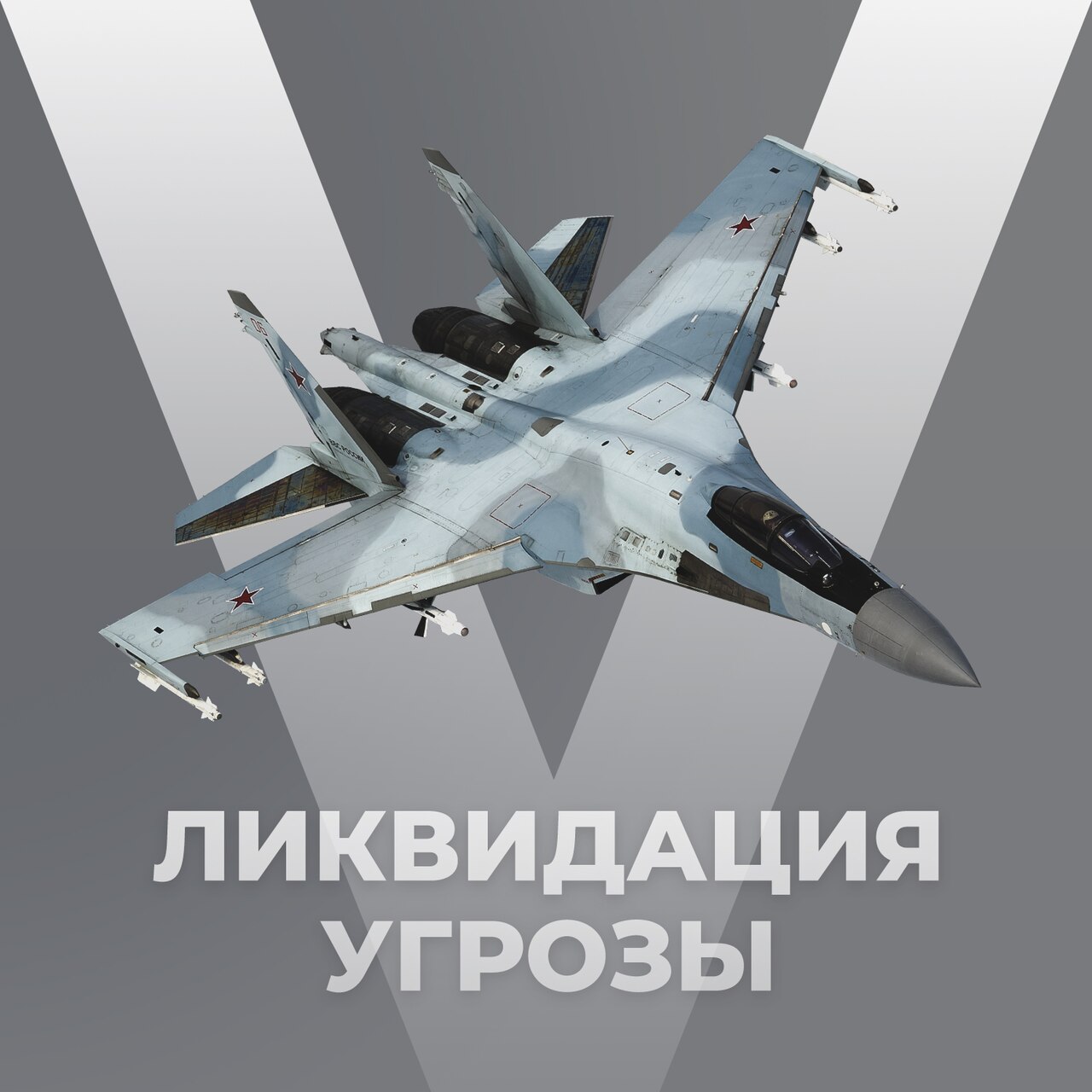
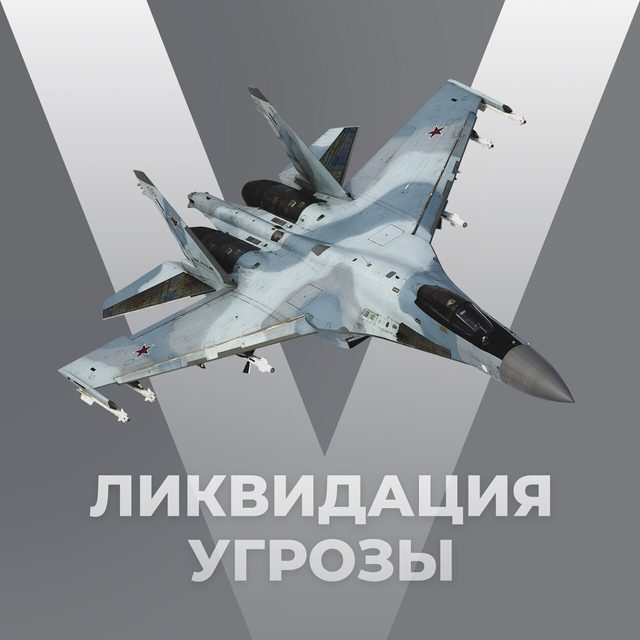
"Liquidation of the threat" shows a Su-35 fighter seen from above against a large letter V. The tell is the noun phrase: "liquidation" and "threat" stand in for air strikes and for whoever or whatever is struck, so the poster names no target, no act and no casualty. That is euphemism. Read the technique: euphemism.
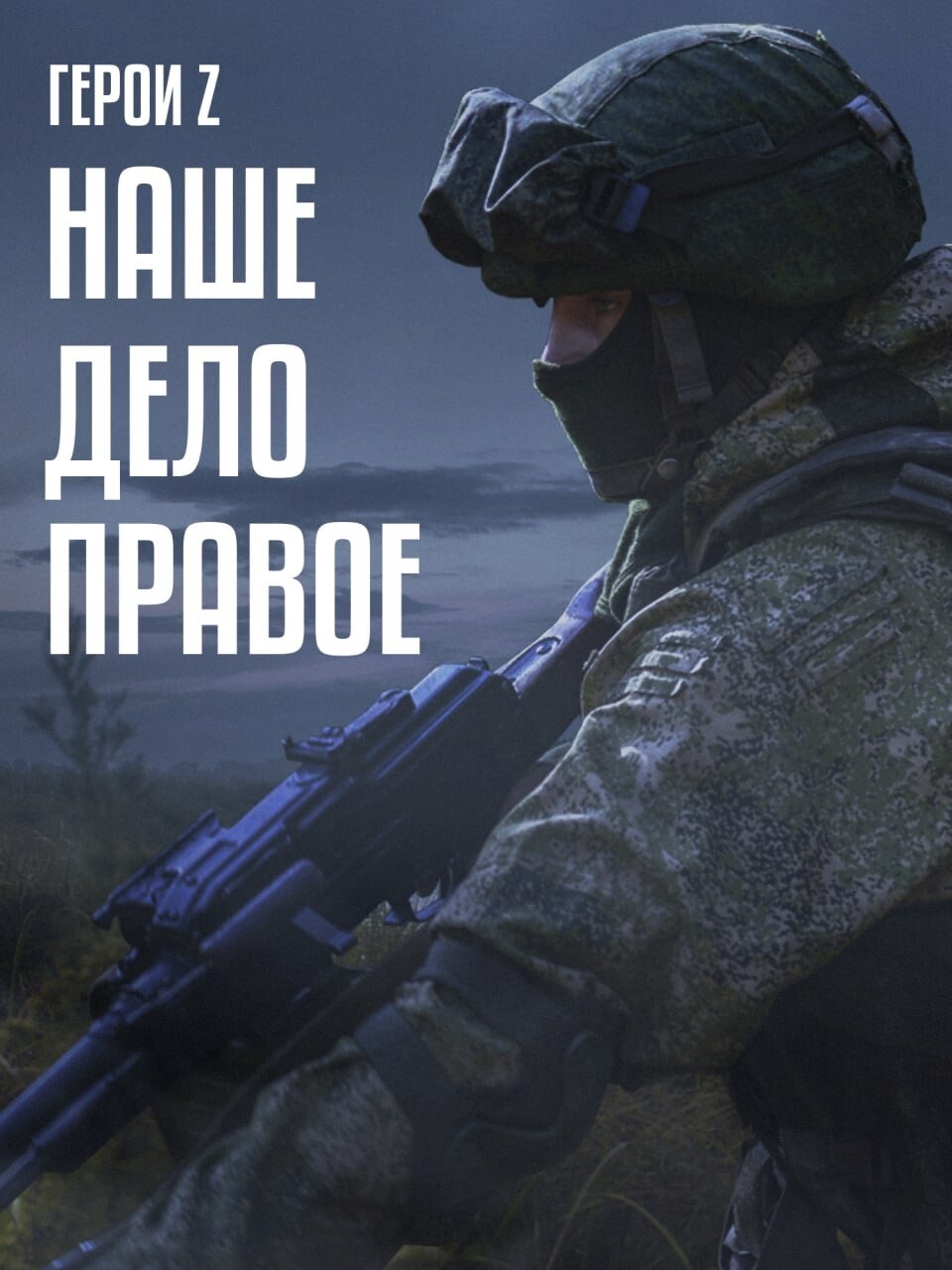
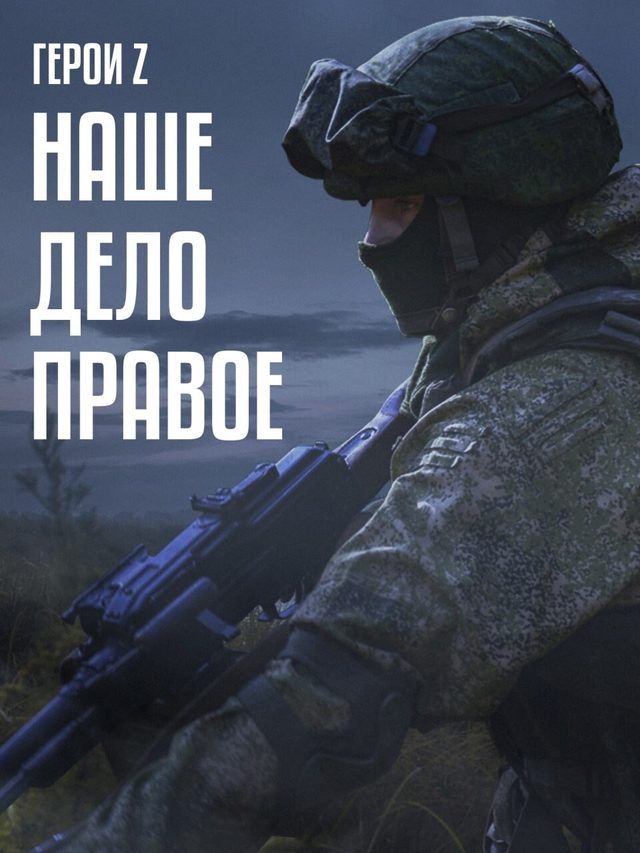
"Heroes of Z: Our cause is just" shows a helmeted, masked soldier in profile with a rifle. The wording is borrowed: "Our cause is just" opens the sentence Foreign Minister Vyacheslav Molotov broadcast on 22 June 1941 after the German invasion of the USSR, and the poster reuses it for the 2022 invasion of Ukraine. The virtue claim is asserted on the poster rather than argued. Read the technique: transfer.
Reading Soviet and Russian posters the same way as any other
The collection holds posters from several systems whose control of information differed in scale and method. In the Soviet period a single state apparatus controlled publishing, and posters carried a censorship number; in the United States and Britain a mix of agencies, parties and private firms issued posters, and dissenting posters could be printed openly (see American propaganda posters). That is a difference of context, recorded where the sources support it, and it does not change how a given poster's technique is tagged. The five questions in propaganda posters (who issued it, who it was for, what it asks, which technique carries it, and what it leaves out) apply here without adjustment.
Browse Soviet and Russian propaganda posters
The grid below lists posters in the collection issued under the Soviet Union or the Russian Federation. Each opens an object page with the holding institution, a link to the original record, a verbatim transcription with a labelled translation and the rights basis for hosting. For every object, not only posters, use the full collection, filtered by technique, era, country and medium.
Sources and rights
Soviet-era posters here come from Wikimedia Commons, Duke University Libraries, the Library of Congress, the Tartu Art Museum, the Saaremaa Museum and Wellcome Collection. Rights bases vary and are stated on each object page: works published before 1931, works whose artists died long ago, museum CC0 or CC BY statements, and the Russian Ministry of Defence's published terms for the 2022 posters.