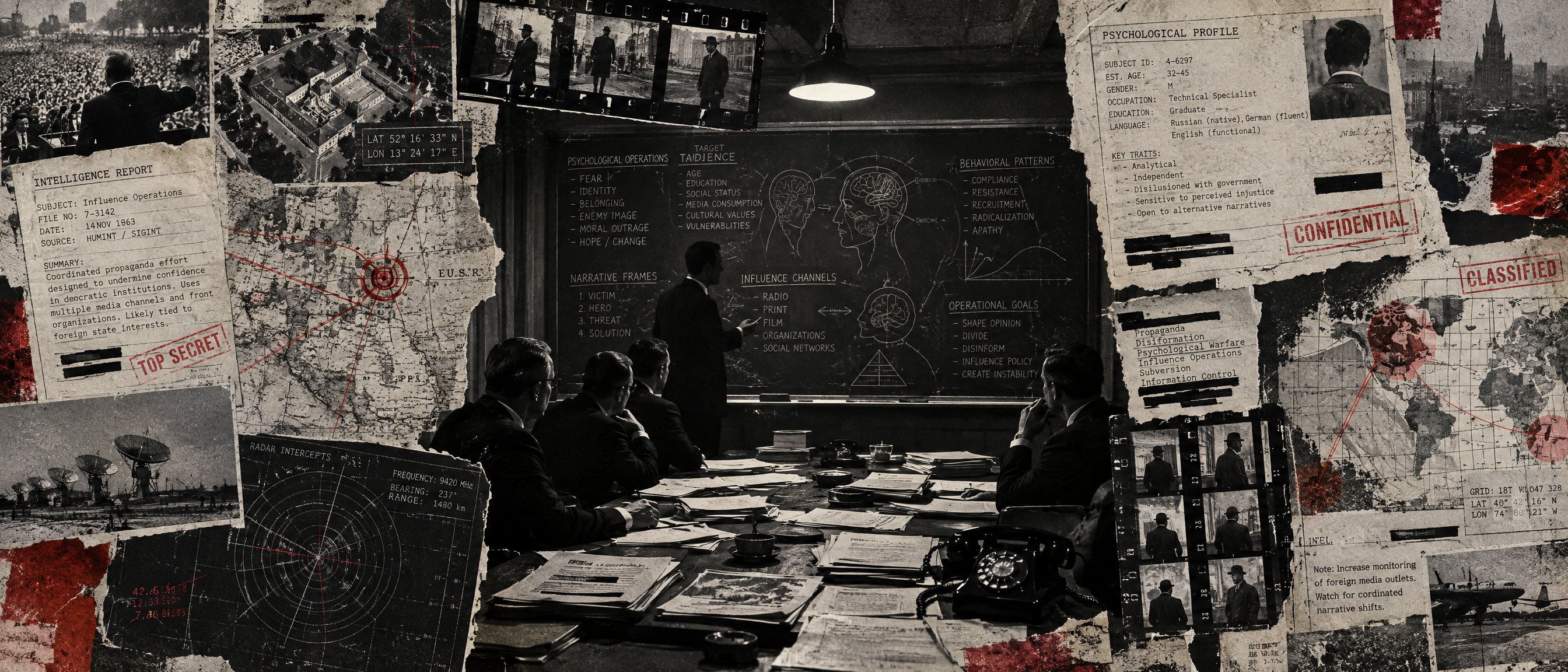
Content note. The Soviet posters on this page include hostile caricature of political enemies and class labels, and one shows a dead officer. They are shown as issued, as evidence of what Soviet audiences were told. Showing a poster is not endorsing it.
What is agitprop?
Agitprop is short for "agitation and propaganda". It began as the name of a Soviet Communist Party department, set up in August 1920, that coordinated persuasion through posters, newspapers, trains, theatre and schools. The word now also names political art and theatre made to move an audience to act, and is often used as a criticism.
The origin: Plekhanov, Lenin and two jobs
The distinction behind the word comes from the Russian Marxist Georgi Plekhanov and was reworked by Lenin in What Is To Be Done? (Stuttgart, 1902), chapter III. Lenin quotes Plekhanov's formula: "A propagandist presents many ideas to one or a few persons; an agitator presents only one or a few ideas, but he presents them to a mass of people." Lenin adds a difference of medium: the propagandist works mainly with the printed word, the agitator with the spoken word.
Explain moreShow less
His example is unemployment. The propagandist explains its capitalist causes in full. The agitator takes one fact the audience already knows, such as a family starving, and uses it to rouse indignation. The two jobs were meant to work together. In "Where to Begin?" (Iskra, May 1901) Lenin also described a party newspaper as "not only a collective propagandist and a collective agitator" but "also a collective organiser", comparable to scaffolding around a building under construction.
In Soviet usage "propaganda" was not a hostile word. Party documents used it for political education, and the departments carried the word openly in their names. That is one reason agitprop counts as white propaganda in the archive's colour scheme: the sender is named (types of propaganda). A summary of the doctrine with sources is on the Soviet agitprop page.
The Soviet Department of Agitation and Propaganda
After October 1917 the Bolsheviks held power in a largely rural, mostly non-literate country during the Civil War (1918-1921). The pre-revolutionary vocabulary became state and party machinery:
Explain moreShow less
- Agitprop department (August 1920). The Central Committee created a Department of Agitation and Propaganda to coordinate the propaganda work of all Soviet institutions, with subsections for agitation and for political education. It merged with the Press Department in 1928. Under successive names it remained a central Party department until it was folded into the Ideological Department in 1988.
- Glavlit (6 June 1922). The Main Administration for Literary and Publishing Affairs combined protection of state secrets with the suppression of printed material judged hostile to the Party. The state that multiplied its own channels also closed others. The historian Peter Kenez, in The Birth of the Propaganda State (1985), identifies this fusion of message and channel control as the Bolsheviks' distinctive achievement, and writes that they "never looked for and did not find devilishly clever methods to influence people's minds, to brainwash them."
Agit-trains and agit-ships
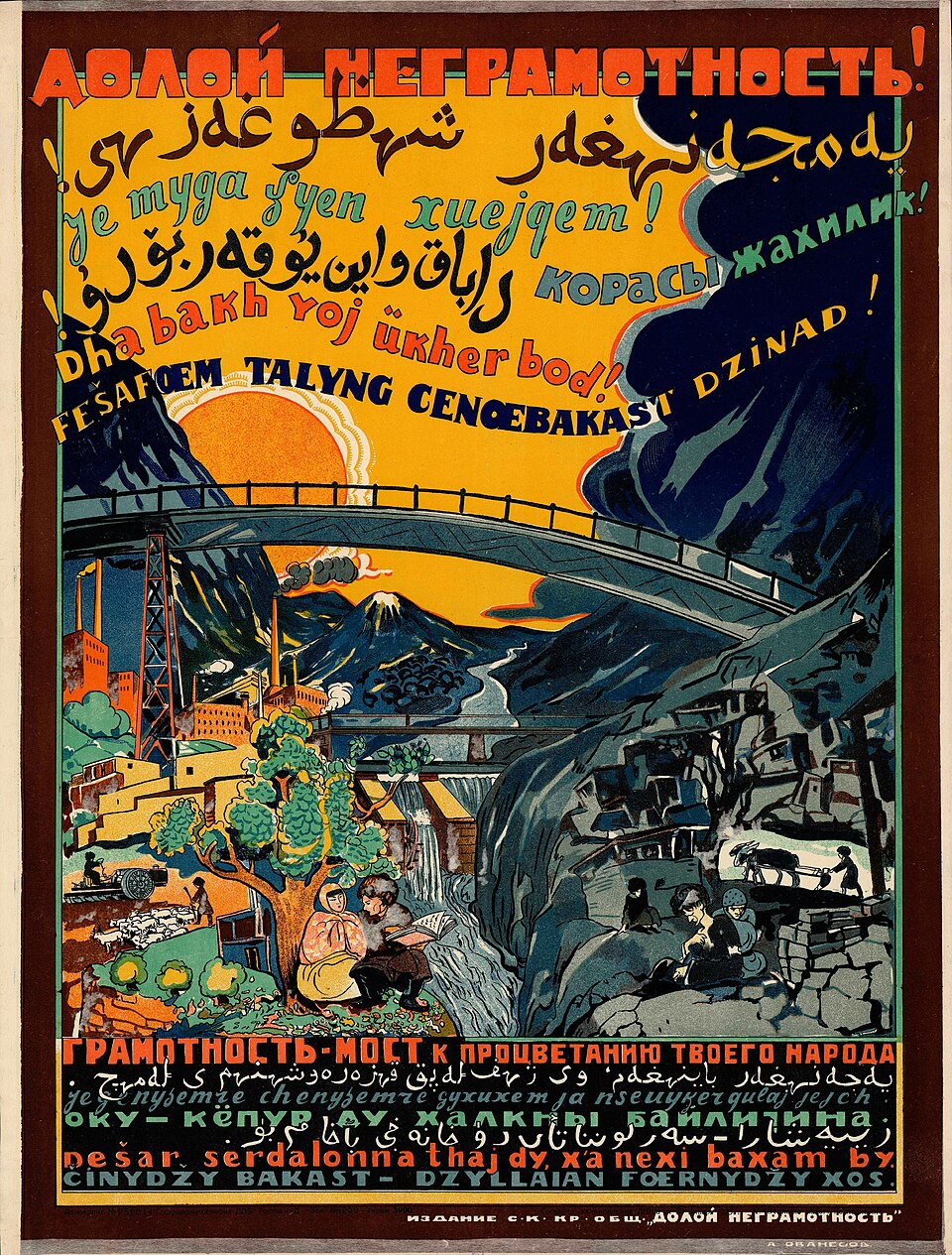
From August 1918 the Bolsheviks sent trains to the Civil War fronts and the provinces. They carried printing presses, film projectors, libraries and offices for receiving complaints, and one was named October Revolution. River steamers such as Red Star worked the Volga. Many of the people these trains and posters were meant for could not read, which is why the Party also ran literacy campaigns. A 1925 literacy poster in the collection shows a stone bridge from a village with oxen to a town with factories, under "Down with Illiteracy! Literacy is the bridge to the prosperity of your people", printed in several languages of the North Caucasus.
Explain moreShow less
"Down with Illiteracy! Literacy is the bridge to the prosperity of your people", poster by A. Ovanesov, North Caucasus Regional Society "Down with Illiteracy", Rostov-on-Don, 1925. Russian State Library scan, via Wikimedia Commons. Public domain (published before 1931).
ROSTA windows
The Russian Telegraph Agency (ROSTA) posted stencilled poster sequences of four to twelve panels in shop windows from 1919 to 1921. They turned the day's news into picture stories with short rhyming captions. The format was developed by Mikhail Cheremnykh with N. K. Ivanov. Vladimir Mayakovsky wrote most of the texts and drew roughly a third of the images. By 1921 there were ROSTA offices in more than fifty cities outside Moscow. Subjects ranged from Red Army supply appeals to smallpox vaccination.
Explain moreShow less
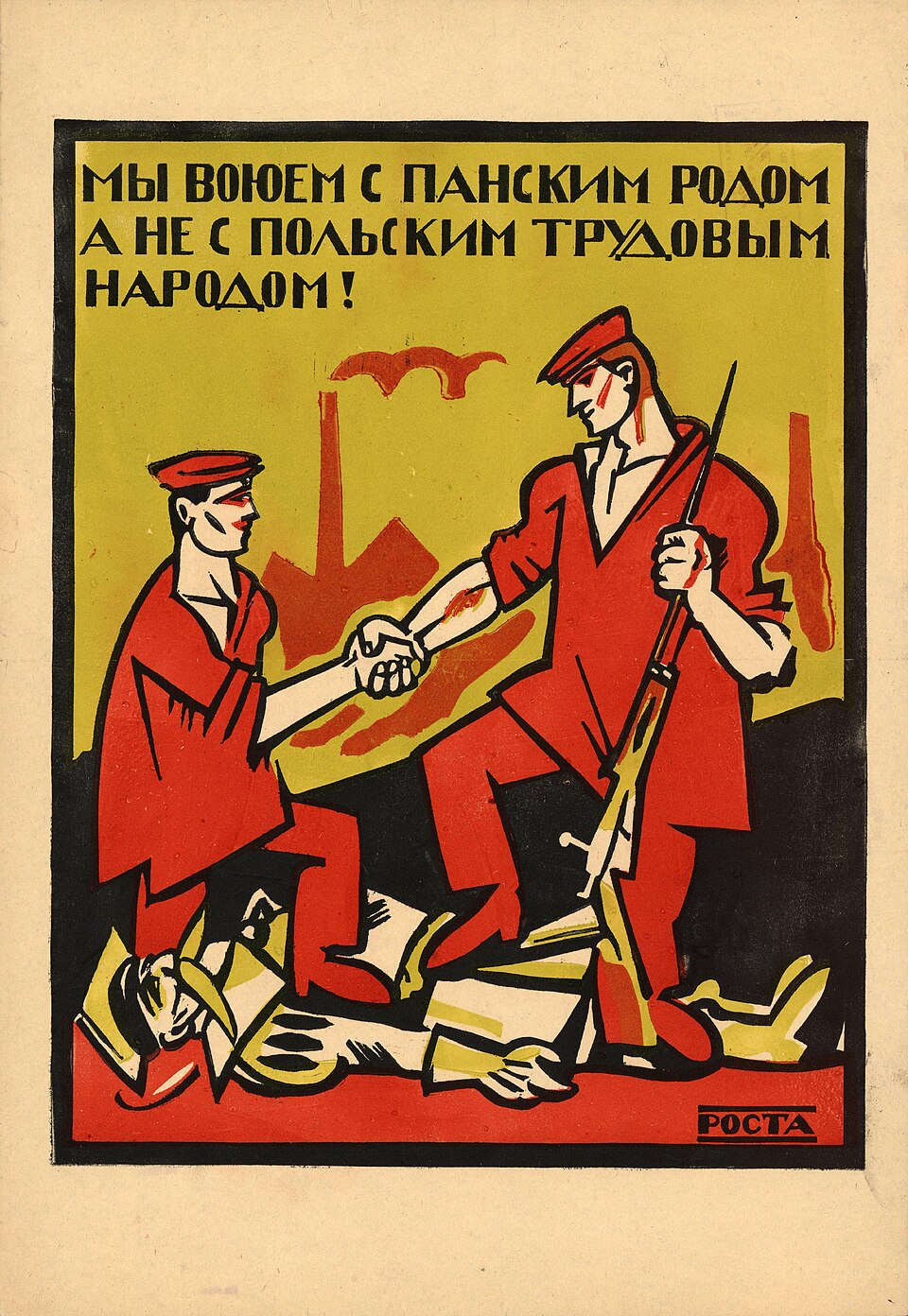
"We are fighting the lordly breed, not the Polish working people", ROSTA poster, 1920. Artist Ivan Malyutin, text by Vladimir Mayakovsky, Moscow. Via Wikimedia Commons. Public domain.
This poster dates from the Polish-Soviet War. It splits the enemy into two groups: a ruling "lordly breed" to fight, and Polish workers to win over. That is Name-calling aimed at the former and an appeal to class solidarity aimed at the latter. The format outlasted the war. In July 1941 the TASS Windows, run from the same shop-window poster model, showed Moscow crowds reading "What Hitler Wants" (a poster by Cheremnykh, photographed by A. V. Ustinov; Moscow Main Archive, CC BY 4.0). The archive holds that photograph: Muscovites at TASS Window No. 5, 'What Hitler Wants' (Chego Gitler khochet).
Agitprop as a poster and photomontage style
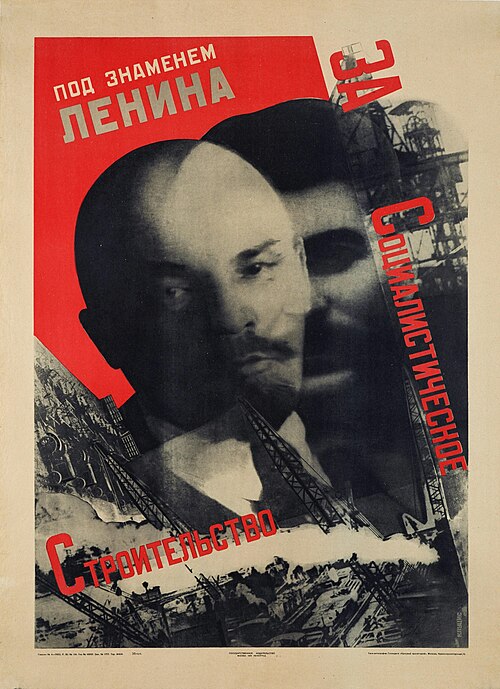
Soviet agitation art in the 1920s and 1930s used bold colour, diagonal composition and, later, photomontage. A 1930 poster by Gustav Klutsis, "Under the Banner of Lenin, for Socialist Construction", fills the frame with Lenin's face over a collage of cranes, derricks and a factory yard, with a darker portrait of Stalin rising behind his shoulder. The leader's image carries the argument, a pattern described on the Cult of personality page.
Explain moreShow less
"Under the Banner of Lenin, for Socialist Construction", poster by Gustav Klutsis, Soviet state poster publishing, 1930. Via Wikimedia Commons (Google Arts & Culture). Public domain (published 1930, before 1931).
More Soviet posters, with their issuers and rights, are on the Soviet propaganda posters page.
Active measures: the same department's covert side
The KGB's First Chief Directorate ran a separate operation, "active measures", that did not carry the Party's name. It used forgeries, planted articles and unwitting intermediaries. The 1980s AIDS story is the best-documented case. On 17 July 1983 the Indian newspaper Patriot ran an item based on an anonymous letter claiming AIDS came from US experiments. On 30 October 1985 Literaturnaya Gazeta cited it, and East German state security joined in. After US Secretary of State George Shultz raised it with Mikhail Gorbachev in October 1987, Izvestiya published an article by two Soviet scientists rejecting the man-made theory. In 1992 Yevgeny Primakov, then head of Russia's Foreign Intelligence Service, acknowledged the KGB's role. Thomas Boghardt, who traced the sequence in Studies in Intelligence (2009), also notes that suspicions of a US origin circulated before any KGB involvement. Open agitprop and covert active measures should be kept apart: one is white propaganda, the other is black. For more, see disinformation.
The word's later use: political art and theatre
After the 1920s the term spread beyond the Soviet Party, with two meanings. One describes political theatre and art made to rouse an audience to act. The other is an insult for any political art the speaker dislikes.
Explain moreShow less
Soviet theatre. The "Blue Blouse" (Sinyaya Bluza) troupes of the 1920s staged "living newspapers", short sketches that dramatised the day's news for factory and club audiences.
Germany. In the Weimar Republic, the German Communist Party and other left groups used small touring "agitprop" troupes. Erwin Piscator's Revue Roter Rummel (1924) was written for a Communist election campaign. Bertolt Brecht drew on the form in his teaching plays (Lehrstücke), such as Die Maßnahme (The Measures Taken, 1930, music by Hanns Eisler), in which a party control chorus judges agitators who killed a young comrade. Critics and scholars treat Brecht's work as more than agitprop, and Brecht himself was concerned with how a stage can teach an audience to examine the performance and not be swept along.
United States. The Federal Theatre Project (1935-1939), a New Deal programme, staged "Living Newspaper" productions, such as Triple-A Plowed Under (1936), which dramatised government farm policy with documentary material. Clifford Odets's Waiting for Lefty (1935), a strike play ending with the audience called to join in, used the agitprop technique of speaking directly to the crowd. Later groups such as the San Francisco Mime Troupe (founded 1959) and El Teatro Campesino (founded 1965, in support of farmworkers' strikes) used short outdoor pieces called actos for the same purpose. This was political theatre in the open, by the speaker's own organisation.
United Kingdom. The Workers' Theatre Movement of the late 1920s and early 1930s, Unity Theatre (London, founded 1936) and later groups such as the 7:84 Company (1971) staged short political pieces for union halls and street audiences.
China. The Chinese Communist Party adopted the Soviet model of propaganda and agitation, with its own departments and cultural work. The archive's summary of that adoption is Maoist thought work.
In the archive's terms, all are open advocacy by a named group, which makes them white propaganda if they are propaganda at all, and the standard is the same for a Federal Theatre production, a Weimar troupe and a Soviet club. Funding and state control are the main differences: the Federal Theatre operated alongside a hostile press and was defunded by Congress in 1939, while Glavlit and the Party department controlled the Soviet stage.
"Agitprop" as an insult
In everyday speech, "that's just agitprop" usually means "this is propaganda I disagree with." It is applied to films, plays, news stories and social media posts on the left and the right. As with "psyop", the word works as a verdict, and the more useful question is who is speaking, what they want done and what evidence they offer. The types of propaganda page lists the tests, and psychological operations covers a related term.
Sources and further reading
Sources
V. I. Lenin, What Is To Be Done?
V. I. Lenin, What Is To Be Done? (Stuttgart: Dietz, 1902), ch. III, and "Where to Begin?", Iskra no. 4, May 1901 (marxists.org). Peter Kenez, The Birth of the Propaganda State (Cambridge University Press, 1985). Thomas Boghardt, "Operation INFEKTION: Soviet Bloc Intelligence and Its AIDS Disinformation Campaign," Studies in Intelligence 53, no. 4 (2009). Alex Inkeles, Public Opinion in Soviet Russia (Harvard University Press, 1950). U.S. Department of State, Soviet Influence Activities: A Report on Active Measures and Propaganda, 1986-87 (August 1987). Theatre histories (Piscator, Brecht, the Federal Theatre Project, Unity Theatre, El Teatro Campesino) are summarised from standard reference accounts.