Content note. This page describes the 1938 Great Terror arrest and execution of the department's own head, Aleksei Stetskii, the 1946 Zhdanov campaign that ended Anna Akhmatova's and Mikhail Zoshchenko's publishing careers, and the 1949 "anti-cosmopolitan" campaign, which used the euphemism "rootless cosmopolitan" for Jewish cultural figures. Described as documented history, not endorsed.
In one line: From its founding as a five-subsection Central Committee bureau in August 1920 to its absorption into a new Ideological Department in 1988 and the CPSU's 1991 dissolution, Agitprop was renamed roughly once a decade but kept the same chain running underneath every name change — a Politburo-level ideology chief set the line, the department turned it into lecture texts and press directives, regional and district party committees relayed it, and an unpaid corps of workplace agitators, study-circle propagandists and Znanie Society lecturers delivered it face to face to a population the party could not simply broadcast at.
What happened
Origins and design (1902-1928)
- 1902. Lenin's pamphlet What Is to Be Done? adopts and defends a distinction the Marxist theorist Georgi Plekhanov had drawn earlier: a propagandist "presents many ideas to one or a few persons," while an agitator "presents only one or a few ideas, but presents them to a mass of people." This theoretical split — one corps for short, repeated, current-events messaging, another for long-form ideological instruction — became the design principle for the institution the party built after taking power, and gave the later department its two-word name.
- August 1920. The Central Committee's Department of Agitation and Propaganda is formally established, consolidating direction of the party's agitators, the Civil War-era agit-trains and the wider network of local propaganda cells under one Secretariat department, with R. Katanian as its first head. FRAME's Bolshevik agitprop, 1917-1921: soviets, decrees, agit-trains and the ROSTA windows covers the 1917-21 period this founding closes out — the agit-trains, ROSTA and the Okna ROSTA windows — in detail and is not repeated here. The new department is organized into five subsections: agitation (directing campaigns and supervising the local press), political education (setting curricula for party schools, run in parallel with Glavpolitprosvet, the Narkompros political-education committee Krupskaya headed from November 1920), publishing Central Committee materials, literature distribution, and propaganda work among the parties of the national minorities.
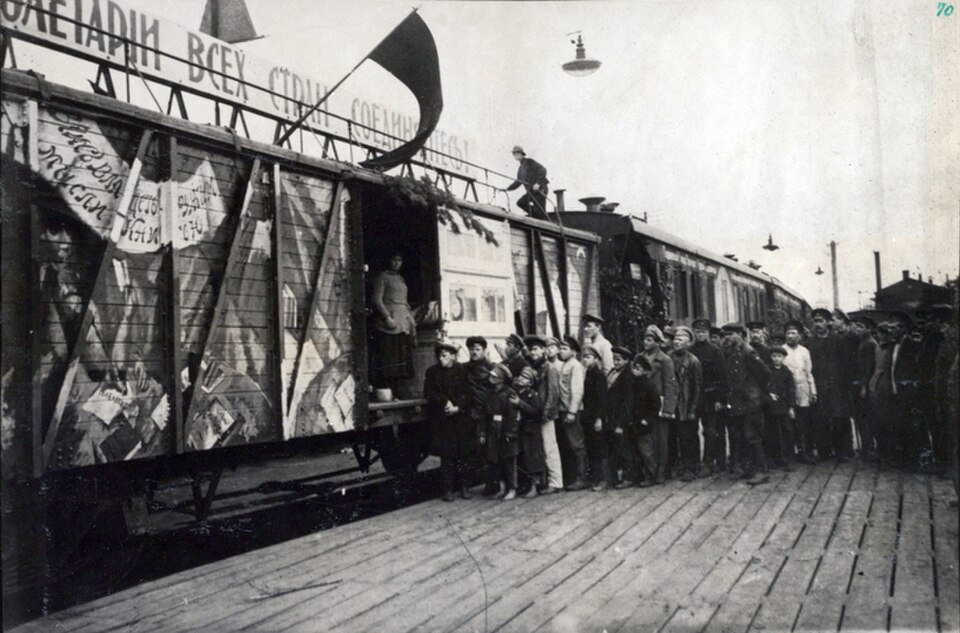
The "Lenin" literature-and-propaganda train at a station, 1923: painted wagons, a flag and a slogan board carrying "Proletarians of all countries, unite", with a crowd of adults and children lined up at the door. Photographer unknown; New York Public Library Digital Collections ("People's house" collection) via Wikimedia Commons; public domain (published before 1931).

- 1928. Agitprop is merged with the Central Committee's Press Department into a single Department of Agitation, Propaganda and Press, headed first by Alexander Krinitsky and then, from May 1930, by Aleksei Stetskii.
- May 1930. The merged department is renamed the Culture and Propaganda Department (Kul'tprop), broadening its formal remit into the arts and sciences alongside political messaging. Stetskii, an Old Bolshevik, remains its head through the 1930s.
Purge, war and the Zhdanov years (1937-1952)
- 1937-38. The Great Terror reaches the department's own leadership: Stetskii is arrested and shot in 1938, one of many mid-level Central Committee officials killed in the purge he had spent the decade helping to justify in print. The department's wartime work under Alexander Shcherbakov (its head from 1938) and its role in the Sovinformburo's daily bulletins during 1941-45 are covered on FRAME's Soviet wartime propaganda, 1939-1945: Sovinformburo, Agitprop and the Red Army press and not repeated here.
- 6 September 1940. Georgy Aleksandrov, a philosopher and journalist who had helped shape the tone of Soviet 1940s newspapers, is made head of the Propaganda and Agitation Department, with Andrei Zhdanov — a Central Committee secretary since the 1930s — retaining overall supervision of Communist propaganda above him.
- 14 August 1946. A Central Committee resolution directed by Zhdanov condemns the literary journals Zvezda and Leningrad for publishing "apolitical" and "bourgeois" work by the satirist Mikhail Zoshchenko and the poet Anna Akhmatova. The campaign that follows — soon called the Zhdanovshchina — is enforced through the department's own new newspaper, Kultura i zhizn ("Culture and Life"), launched in 1946 specifically to carry the line into cultural institutions; both writers lose their ability to publish, and the paper runs until 1951.
- 1947. Aleksandrov is removed from Agitprop's leadership after criticism of his own scholarly work (a history of Western philosophy judged insufficiently party-minded) and is later demoted to Minister of Culture. In September 1947 Mikhail Suslov is appointed Agitprop Secretary — formal political head of what one biographer later called a "bureaucratic empire charged with monitoring and policing the entirety of Soviet art, science, sport, education and culture" — while Dmitri Shepilov, appointed to head the department itself, runs its day-to-day operations under him.
- 31 August 1948. Suslov becomes the Central Committee's Secretary for Ideology, a post he holds without interruption until his death on 25 January 1982 — over 33 years overseeing not only the Propaganda and Agitation Department but, at various points, the Science and Educational Institutions Department, the Culture and Information Department, the Youth and Social Organizations Department, both International Departments and the Soviet Army's Main Political Directorate. He is credited with heading the Propaganda Department itself from 1949 to 1952.
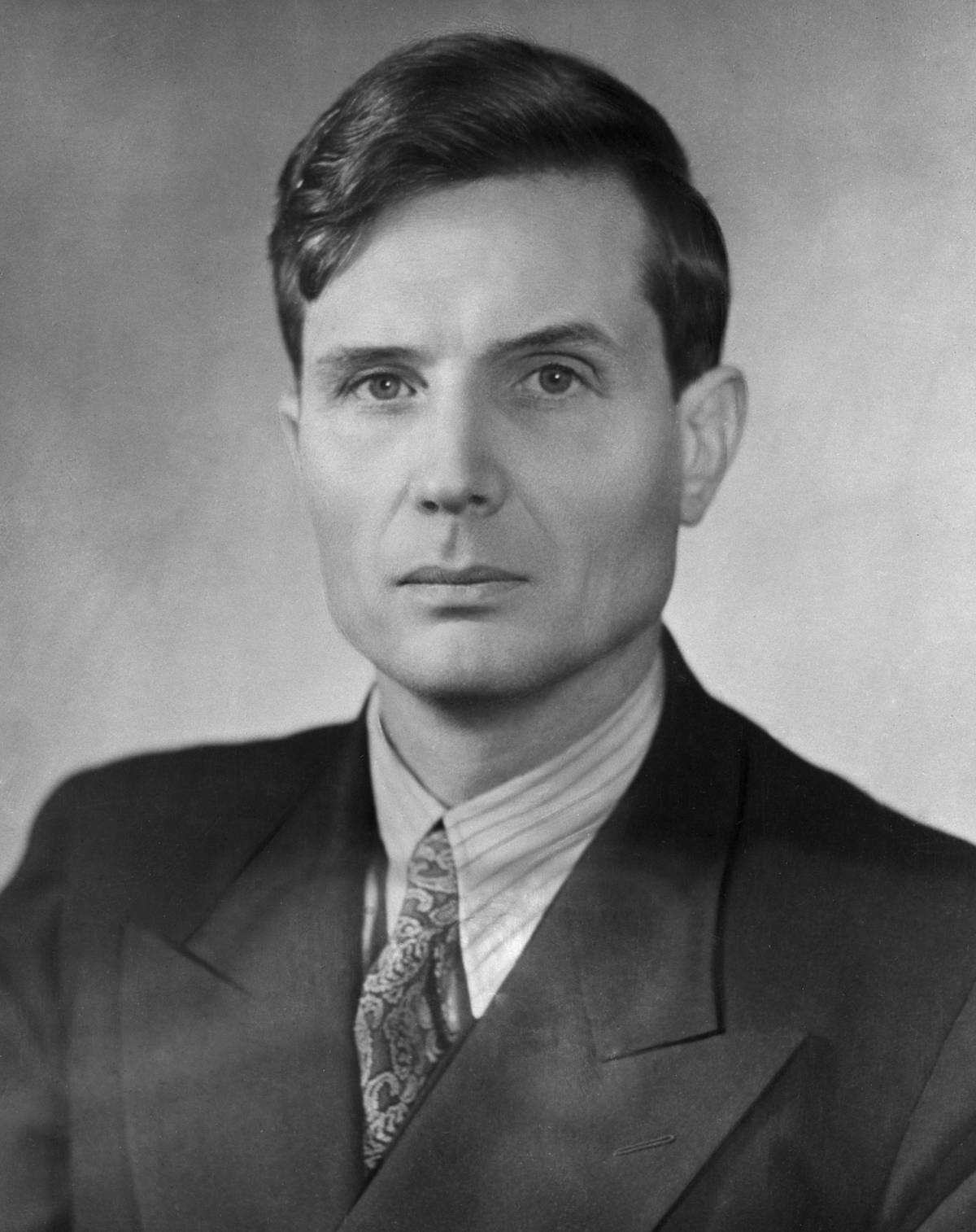
Mikhail Suslov, Central Committee secretary for ideology from 1948; portrait photograph by Vladimir Savostyanov for TASS, February 1948. Wikimedia Commons; PD-Russia (TASS work, 1925-56) and PD-US-no-notice.
.jpg)
- 1947. The All-Union Society "Znanie" ("Knowledge," formally the Society for the Dissemination of Political and Scientific Knowledge) is founded, with the physicist Sergei Vavilov as its first president. Formally a voluntary public organization rather than a party department, Znanie is built and supervised, like every Soviet public organization, under CPSU control, and it supplies a second, parallel corps of credentialed lecturers — the lektorskii aktiv — who carried political and scientific material into public halls, factories and collective farms nationally; its membership skewed toward CPSU and Komsomol members, schoolteachers, doctors and other professionals with local standing.
- 1949. A campaign against "rootless cosmopolitans" — a euphemism understood at the time to mean Soviet citizens of Jewish origin — runs through the same directed press and lecture channels Agitprop and Kultura i zhizn had built for the Zhdanovshchina, part of a broader postwar campaign against Jewish cultural institutions that is documented in detail elsewhere and not covered on this page.
The mature machine: from the Central Committee to the red corner
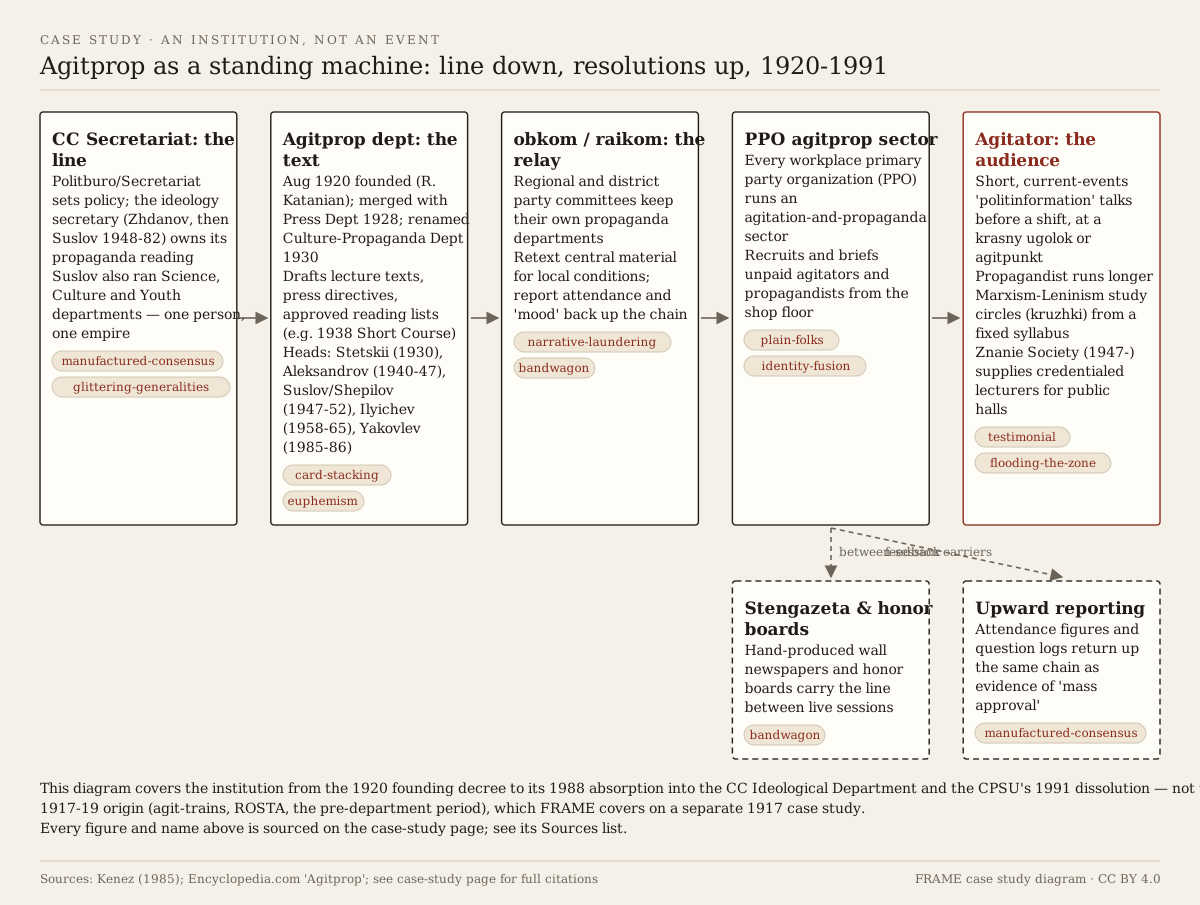
- The regional layer. Every oblast committee (obkom) and district committee (raikom) of the party kept its own propaganda department, mirroring the Central Committee's in miniature: retexting centrally issued material for local conditions and reporting attendance figures and "mood" (nastroenie) back up the same chain.
- The workplace layer. Beneath the regional apparatus, every primary party organization (PPO) — the cell present, by design, in every factory, farm, university department, army unit and government office — ran its own agitation-and-propaganda sector. Political scientists have called the PPO the CPSU's "ultimate device of control and management" precisely because it sat at the center of the working life of every Soviet citizen, whether or not they held a party card.
- Agitators and propagandists. PPOs recruited ordinary party members, and often non-members judged reliable, as unpaid agitators, each typically assigned a small fixed group of co-workers or neighbors. Agitators delivered short, frequent talks — politinformatsiya ("political information") — tying the day's news to the party's current line, often at a krasny ugolok ("red corner"), a room set aside in a factory, dormitory or collective farm for this purpose, or at an election-season agitpunkt ("agitation point"). Propagandists ran longer-running Marxism-Leninism study circles (kruzhki) from centrally approved syllabi and texts — Stalin's 1938 History of the CPSU(Bolsheviks): Short Course was, for two decades, the standard reading for these circles across the entire party and much of the adult population.
- Between-session carriers. Hand-produced wall newspapers (stengazeta) and honor boards (doska pochета) at every workplace kept the line visible between live sessions, extending its reach into the physical space of everyday work without requiring another meeting.
- Reporting upward. Attendance figures, question logs and "mood" summaries from politinformation sessions and study circles flowed back up through the PPO, the raikom and the obkom to the Central Committee department, functioning as institutionalized, routine evidence of mass engagement with the line — the same kind of upward traffic that the 1917-era committee-resolution flood described on FRAME's Bolshevik agitprop, 1917-1921: soviets, decrees, agit-trains and the ROSTA windows had improvised; here it became permanent bureaucratic infrastructure rather than a wartime expedient.
- Ritual and formalism. By the Brezhnev years, scholarship on late-Soviet political culture — notably the anthropologist Alexei Yurchak's study of the period, and academic work specifically on politinformation as ritual practice — describes these sessions as having become highly formulaic: attendance was compulsory and recorded, but the content increasingly followed fixed scripts delivered and received as ritual performance rather than persuasion, a pattern historians trace as the institution's core weakness by its final decades.
Renaming, reform and dissolution (1958-1991)
- 1958-1961. Leonid Ilyichev heads the Department of Propaganda and Agitation under Khrushchev.
- Early 1960s-1965. The department is renamed the Ideological Department of the Central Committee; Ilyichev continues to head it into 1965, when he moves to the Foreign Ministry.
- 5 July 1985 - March 1986. Under Gorbachev, Alexander Yakovlev — later called the "godfather of glasnost" — is made head of the CPSU Propaganda Department, using the post to loosen the press directives the department had issued for six decades and to lay institutional groundwork for glasnost before moving up to the Secretariat itself.
- 8 September 1988. A Politburo meeting on "the reorganization of the party apparatus" dismantles the old departmental structure in favor of new Central Committee commissions. Vadim Medvedev becomes Secretary for Ideology that September and, from November 1988, chairs the new Ideological Commission; Alexander Kapto heads a new Ideological Department, reporting to Medvedev, into which Agitprop's historic functions are absorbed.
- August-November 1991. After the failed August coup, Boris Yeltsin suspends the CPSU's activity on Russian territory; the party is formally banned on 6 November 1991. The department, its regional network and the PPO structure beneath it cease to exist with the party itself.
How it works
- Manufactured consensus: attendance and "mood" reports from politinformation sessions and study circles flowed upward through the same chain that had issued the material, producing a standing internal record of "mass approval" generated by the apparatus reporting on its own reach rather than by any independent measure of belief.
- Card stacking: the Short Course history and the approved lecture texts propagandists worked from selected and arranged real events into a single continuous narrative of party rightness, leaving out the purges, failed campaigns and internal disputes contemporaries knew about but could not raise in a study circle built around one approved text.
- Euphemism / doublespeak: "rootless cosmopolitan" (1949) named a person's presumed Jewish origin without saying so; "mood" (nastroenie) reporting recast political surveillance of what people actually thought as routine bureaucratic feedback.
- Narrative laundering: Znanie's lecturers presented themselves, and were formally organized, as a voluntary scientific and educational society rather than as a Central Committee channel, even though the society operated under the same party control and its lecture corps fed from the same lektorskii aktiv infrastructure as the party's own propagandists.
- Bandwagon: wall newspapers and honor boards displayed identified individuals' compliance and achievement publicly and permanently in the shared space of a workplace, making participation visible to every co-worker in a way a private vote or opinion never was.
- Plain folks: agitators worked their own small, fixed circle of co-workers or neighbors rather than addressing a hall of strangers, so the party's line arrived as something a familiar colleague said, not a directive read out by an outsider.
- Identity fusion: mandatory attendance at PPO-run political education tied ordinary workplace membership to demonstrated ideological participation, so that opting out of the kruzhok or the politinformatsiya session was legible as opting out of the workplace collective itself, not merely as disagreement with a specific claim.
- Testimonial: Znanie recruited working scientists, doctors and teachers — credentialed by their day jobs, not by the party apparatus — to carry political material, lending it the authority of expertise the Central Committee department could not supply on its own.
- Flooding the zone: the layered structure — daily or weekly agitator talks, longer study circles, a directed press, wall newspapers and honor boards, all repeating the same current line through different channels and cadences — meant a Soviet citizen encountered the week's approved framing repeatedly through formats that looked independent of one another but originated from the same department.
- Scapegoating: the 1949 "anti-cosmopolitan" campaign directed blame for cultural and political failings onto a group defined by presumed ethnic origin rather than any documented act.
Colour. The institution itself was white throughout: it never hid that it was the Communist Party's own department, and its name appeared on its own newspaper, its lecture programs and its Central Committee decrees. Individual mechanisms inside it moved toward gray — Znanie's public-organization framing being the clearest example — where the party's hand was real but not stated on the label the audience saw.
Then and now
The chain from a Politburo-level line-setter through a department that drafts material to channels that carry it to mass audiences reappears wherever a state wants message discipline without a formal censor's stamp on every item. Russia's post-Soviet "temniki" system, most closely associated with the Kremlin aide Vladislav Surkov through the 2000s, is the clearest domestic descendant: at weekly meetings, Kremlin officials gave the heads of Russia's main television channels oral "theme sheets" specifying which stories carried "strategic importance," how they should be framed, and which opposition figures should receive airtime and which should be ignored — delivered orally rather than in writing, by one account to preserve "the darkness of deniability," but followed with near-total discipline across the national broadcast landscape.
The differences are structural, not merely cosmetic. Agitprop's chain ran on party membership and workplace organization: a PPO in every factory, an agitator assigned to a fixed small group, mandatory study circles with attendance taken and reported upward — a machine that reached into private time and could compel a citizen's physical presence. The temniki system runs on a much narrower base: control of a handful of federal television channels' ownership and licensing, reinforced by advertiser and regulatory pressure, with no equivalent of the mandatory small-group session or the reporting-upward apparatus that gave Agitprop its person-to-person reach. A Russian in the 2000s could decline to watch state television; a Soviet PPO member could not, without consequence, decline to attend the kruzhok.
Positions on the record
- The institution's own rationale. Agitprop and its successor departments framed their work, in Central Committee decrees and in the party program, as raising the ideological and cultural level of the working population and ensuring party members understood and could explain current policy — education and mobilization, not manipulation, in the apparatus's own terms.
- Contemporary and later criticism. Academic studies of the mature system, notably Thomas Remington's The Truth of Authority: Ideology and Communication in the Soviet Union (1988) and Gayle Durham Hollander's Soviet Political Indoctrination (1972), and later ethnographic work by Alexei Yurchak on late-Soviet discourse, describe a widening gap between the apparatus's formal reach — near-universal, compulsory, continuously reported — and its actual persuasive effect, arguing that by the Brezhnev era compliance with the ritual of political education had become largely decoupled from genuine belief in its content.
- What is documented. The department's founding date and early subsections, its 1928 and 1930 renamings, the identities and tenures of its successive heads from Stetskii through Ilyichev, Yakovlev and Kapto, Suslov's unbroken 1948-1982 tenure as ideology secretary, the 1946 resolution against Zvezda and Leningrad, the 1947 founding of Znanie, and the September 1988 reorganization that folded Agitprop's functions into the new Ideological Department are all corroborated across standard reference works and the academic sources listed below.
- What is contested. How much of the reported "mass participation" in political education reflected genuine engagement, ritual compliance, or simple attendance-taking is argued over by the historians above, who differ on how far to generalize any single period's evidence (Brezhnev-era ethnography, in particular) back across the institution's full seventy-year run.
- Not ruled on here. Whether Soviet citizens' documented support for specific policies, when it existed, was produced by this apparatus, by genuine conviction formed independently of it, by the absence of a visible alternative, or by some mix of the three. This page scores how the message chain was built and run, not the deeper question of what actually shaped Soviet public opinion.
Same-method test
Nazi Germany. The Reich Ministry of Public Enlightenment and Propaganda (The Reich Ministry of Public Enlightenment and Propaganda, 1933-1945, founded 1933) is the direct contemporary counterpart: both were standing state institutions, headed by a figure who also controlled the ruling party's parallel propaganda apparatus (Goebbels for the NSDAP's Reich Propaganda Directorate, Suslov and his predecessors for Agitprop), that set a daily or weekly line, pushed it through a directed press and a regional office network, and built a second delivery layer that put the message in front of people directly — the RMVP's Propagandakompanien and communal radio listening, Agitprop's agitators and Znanie lecturers. The two systems differ sharply in duration and stability: the RMVP ran twelve years under one minister before the regime that built it was destroyed in war, while Agitprop ran for nearly seventy years, survived a leadership purge that killed its own department head, and was reorganized and renamed roughly once a decade without the state itself changing hands — a difference that shows in how each is judged historically, since Agitprop's longevity let historians observe the same mechanism drift, by its final decades, from compulsion that worked to compulsion that was merely performed.
Maoist China. The Chinese Communist Party's Central Propaganda Department (now formally titled, in English, the Publicity Department, a 1990s rebranding meant to soften its political character) was founded in May 1924 — copying the young Bolshevik party's own pre-Agitprop practice, before Agitprop itself existed as a standing department — and has run continuously since, overseeing what specialists call the "Propaganda and Education System": a structure that monitors, instructs and censors newspapers, film, broadcasting, publishing and, later, the internet from the national level down to the smallest local unit. Unlike Agitprop, the CCP's department never had to survive a change of ruling party, so its institutional through-line to the present is unbroken; its early-1930s Jiangxi Soviet-era version, covered on FRAME's Divide the land, label the enemy: propaganda and discipline in the Jiangxi Soviet (1927-1934), was built explicitly on the Soviet model this page describes, and its mobilization of student and activist "agitators" for the Cultural Revolution's mass campaigns, covered on FRAME's Big-character posters: how the opening labels of China's Cultural Revolution did the work of charges (1966-68), pushed the same agitator principle further and more violently than Soviet practice ever did in peacetime.
How to spot it
- Ask whether an organization presenting itself as independent or voluntary — a scientific society, a cultural lecture series, a local newspaper — draws its speakers, editors or texts from the same supervising body as the state's declared propaganda department. Znanie's formal status as a public organization did not mean its line was set anywhere else.
- Look for a second delivery layer behind the official press: a small-group, face-to-face channel (an agitator's circle, a workplace briefing) reaches people a newspaper or broadcast does not, and it is harder to document from outside because it leaves no publication record.
- Treat reported attendance or participation figures as evidence of compulsion and record-keeping before treating them as evidence of belief. An apparatus that both delivers a message and measures its own audience's "mood" is grading its own homework.
- Watch for euphemism doing political work in categories that sound like ordinary bureaucratic language — "mood," "cosmopolitan," "unreliable element" — and ask what specific fact or group each one is standing in for.
- When an institution survives many renamings and reorganizations under the same regime, the renaming itself is not evidence of reform; check whether the reporting chain, the compulsory attendance, and the approved-text requirement changed, or only the department's letterhead.
Images
| Image | Source | Licence |
|---|---|---|
| Mechanism diagram (above) | Drawn for FRAME from this page's sourced facts (make_diagrams_apparatus_agitprop.py) |
CC BY 4.0, FRAME |
| Portrait of Mikhail Suslov, February 1948 | Wikimedia Commons, photo by Vladimir Savostyanov/TASS | PD-Russia (TASS work, 1925-56) and PD-US-no-notice |
| The "Lenin" literature-and-propaganda train, 1923 | Wikimedia Commons, New York Public Library Digital Collections ("People's house" collection); photographer unknown | Public domain (published before 1931) |
Image gaps
- A photograph of a workplace krasny ugolok (red corner) or an agitator briefing a small group. This is the mechanism the page most needs to show, since it is the layer with no equivalent in the Nazi or CCP comparisons. This session could not verify a correctly licensed, clearly identified example on Wikimedia Commons or loc.gov in the time available; a later pass with fuller Commons access should search categories for "Red corner" and "Soviet political education."
- A photograph of a stengazeta (wall newspaper) or doska pochета (honor board) in place at a Soviet workplace. Likely exists on Commons under Soviet workplace or factory categories; not verified this session.
- A portrait of Alexander Yakovlev as CPSU Propaganda Department head (1985-86). Commons categories under his name returned only the unrelated early-20th-century painter Alexandre Iacovleff during this session; the politician's own category was not located before the session's Commons access became rate-limited.
- A Znanie Society lecture hall or lecture poster. Not sourced this session; Znanie material likely survives in Russian digital archives and possibly on Commons under its Russian name (Общество «Знание»).
- The Reich Ministry building and RMVP officials, for a side-by-side with the Same-method test section, are already hosted on FRAME's The Reich Ministry of Public Enlightenment and Propaganda, 1933-1945 page and are not duplicated here.
Sources
- V. I. Lenin, What Is to Be Done? (1902), for the propagandist/agitator distinction adopted from Georgi Plekhanov: marxists.org.
- "Agitprop," Encyclopedia.com (Gale, Dictionary of Russian History, retrieved 2026): encyclopedia.com — for the 1920 founding, its five original subsections, R. Katanian, the 1928 merger with the Press Department, and the 1988 absorption into the Ideological Department.
- Peter Kenez, The Birth of the Propaganda State: Soviet Methods of Mass Mobilization, 1917-1929 (Cambridge University Press, 1985) — the standard institutional history of Agitprop's founding years; FRAME's Bolshevik agitprop, 1917-1921: soviets, decrees, agit-trains and the ROSTA windows draws on it for the pre-1921 period this page does not repeat.
- Thomas F. Remington, The Truth of Authority: Ideology and Communication in the Soviet Union (University of Pittsburgh Press, 1988) — the standard academic study of the mature Agitprop apparatus and its communication practices.
- Gayle Durham Hollander, Soviet Political Indoctrination: Developments in Mass Media and Propaganda since Stalin (Praeger, 1972).
- Alexei Yurchak, Everything Was Forever, Until It Was No More: The Last Soviet Generation (Princeton University Press, 2005), for the ritualization of late-Soviet political education; see also the academic paper "Politinformation as a Ritual Practice of the Soviet Life" (academia.edu, accessed 2026) for the same argument applied specifically to workplace politinformation sessions.
- T. H. Rigby, Communist Party Membership in the U.S.S.R., 1917-1967 (Princeton University Press, 1968), for the structure and role of the primary party organization (PPO).
- Wikipedia, "Mikhail Suslov" (retrieved 2026), for his 1947 appointment as Agitprop Secretary, the description of the department as monitoring and policing Soviet art, science, sport, education and culture, Shepilov's day-to-day role, his 31 August 1948 - 25 January 1982 tenure as ideology secretary, and the departments under his control.
- Wikipedia, "Georgy Aleksandrov" (retrieved 2026), for his 6 September 1940 appointment as head of the Propaganda and Agitation Department under Zhdanov's supervision.
- Wikipedia, "Leonid Ilyichev (politician)" (retrieved 2026), for his 1958-1961 tenure heading the Department of Propaganda and Agitation and his subsequent headship of the renamed Ideological Department into 1965.
- Wikipedia, "Alexander Yakovlev" (retrieved 2026), for his 5 July 1985 - March 1986 tenure as head of the CPSU Propaganda Department and his role as "godfather of glasnost."
- Wikipedia, "Vadim Medvedev" (retrieved 2026), for the September 1988 reorganization, his role as Secretary for Ideology and chairman of the Ideological Commission (November 1988 - July 1990), and Alexander Kapto's headship of the new Ideological Department.
- Wikipedia, "Znanie (educational organization, founded 1947)" (retrieved 2026), for the society's 1947 founding, Sergei Vavilov as first president, and its lecture-corps structure and membership.
- Wikipedia, "Andrei Zhdanov" and "Zhdanov Doctrine" (retrieved 2026), for the 14 August 1946 resolution against Zvezda and Leningrad and the Zhdanovshchina campaign against Zoshchenko and Akhmatova.
- Wikipedia, "Publicity Department of the Chinese Communist Party" (retrieved 2026), for the CCP department's May 1924 founding and its oversight of China's "Propaganda and Education System."
- FRAME case studies Bolshevik agitprop, 1917-1921: soviets, decrees, agit-trains and the ROSTA windows, Soviet wartime propaganda, 1939-1945: Sovinformburo, Agitprop and the Red Army press, The Lenin cult after 1924: an embalmed body, a mausoleum and a doctrine called "Leninism", 'Trotskyism or Leninism': the press campaign that removed Trotsky from Soviet leadership (1924-1929), The Reich Ministry of Public Enlightenment and Propaganda, 1933-1945, Divide the land, label the enemy: propaganda and discipline in the Jiangxi Soviet (1927-1934), Big-character posters: how the opening labels of China's Cultural Revolution did the work of charges (1966-68) and "Liquidate the kulaks as a class": the propaganda campaign for collectivization (1929-1933), for adjoining material this page does not duplicate.