Content note. Some objects here caricature priests, peasants, capitalists and political opponents as grotesque figures, one portrays Stalin as a fanged monster, and Stalin's own 1929 words announcing the "elimination" of the kulaks as a class are quoted. They are shown as issued, as evidence of what audiences were told. Showing a poster is not endorsing it, and nothing here is a verdict on any people or party.
What was Stalin propaganda?
"Stalin propaganda" covers two kinds of material. The first was issued in the Soviet Union and allied states to present Stalin as leader, teacher and benefactor, and to blame named enemy groups for the state's failures. The second was issued against him, by Finland, the United States and others, and portrays him as a villain. This page shows both, labelled by issuer, under the same technique definitions.
Explain moreShow less
The collection has 74 entries whose files mention Stalin. Most do so in passing, so this page uses the 22 where he is pictured or named in the title or caption. Of the 30 entries that name him in a title or caption, 10 are Soviet and 9 are American (counts made from examples/entries/). Soviet posters generally are on Soviet propaganda posters; wider coverage is on communist propaganda.
How was the leader shown in Stalin's lifetime?
Khrushchev's closed speech of 25 February 1956 gave the phenomenon its name, "the cult of the individual". The cult of personality page cites researchers for the scale: a committee prepared Stalin's 70th birthday on 21 December 1949, and a 1949 document counted 23,162 gifts. The objects below show the visual side.
Explain moreShow less
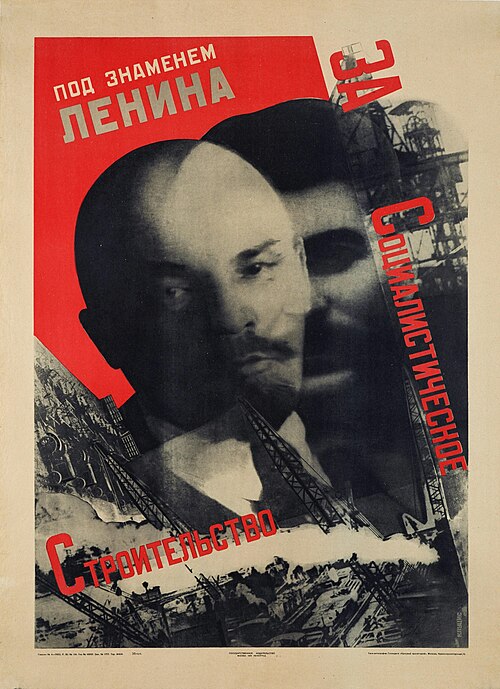
Gustav Klutsis's 1930 photomontage puts Stalin, identified by the Commons record, inside Lenin's likeness and slogan, "Under the banner of Lenin, for socialist construction". The entry tags it transfer: the living leader borrows the dead leader's standing. Klutsis was arrested in January 1938 and shot on 26 February 1938, according to the entry. Read the technique: transfer.
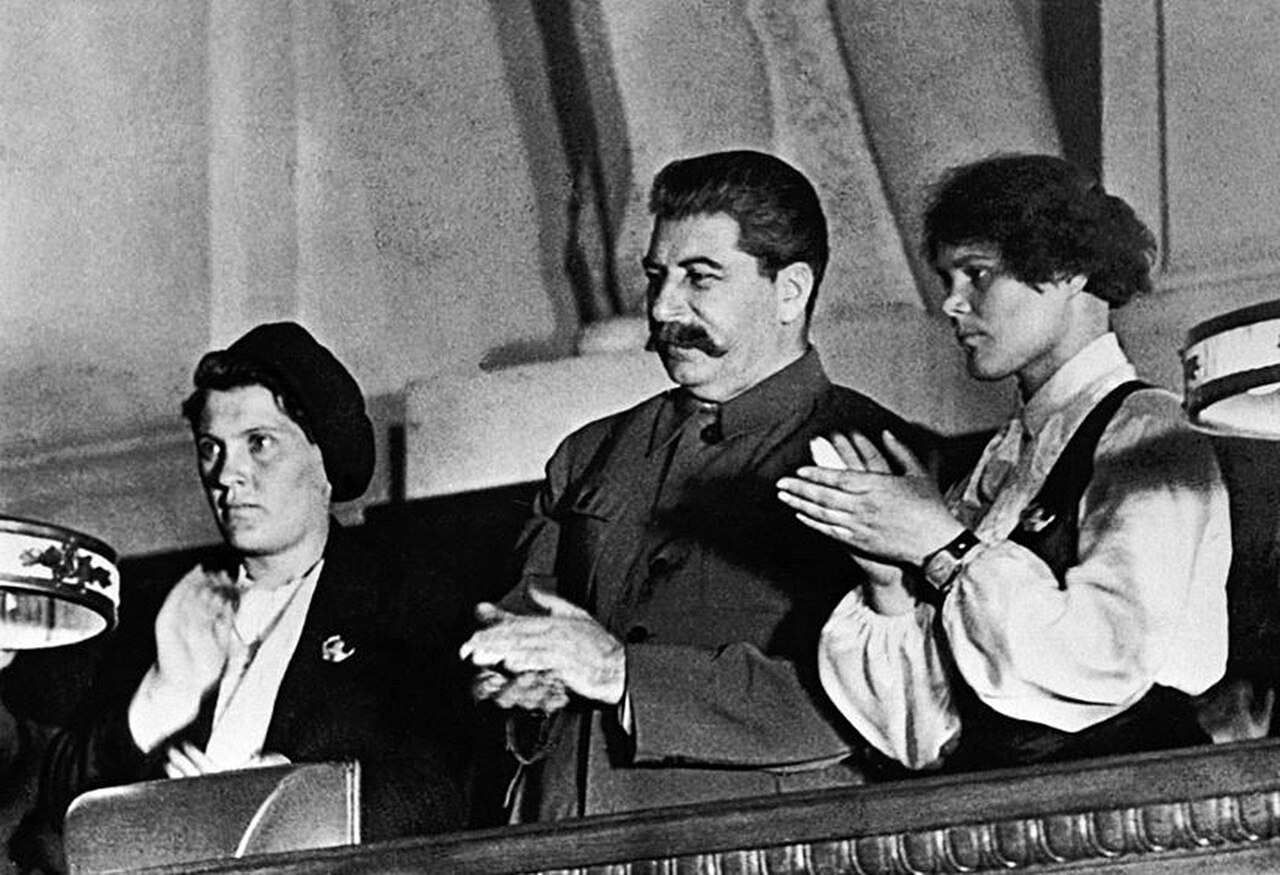
Ivan Shagin photographed Stalin applauding between the collective farmers Praskovya Angelina and Maria Demchenko at the 10th Komsomol Congress in Moscow on 18 April 1936. It is a press photograph, held with the Komsomol case study.
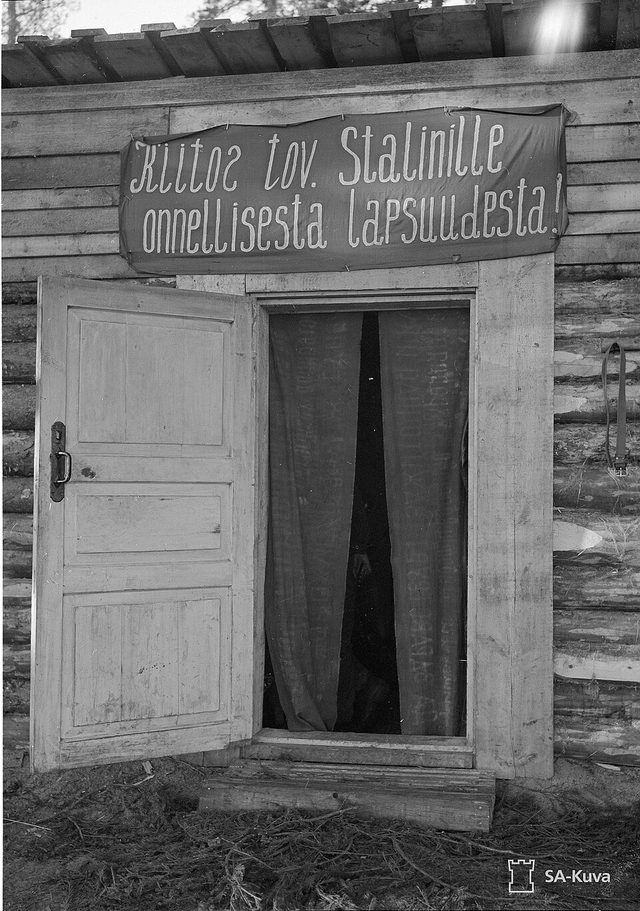
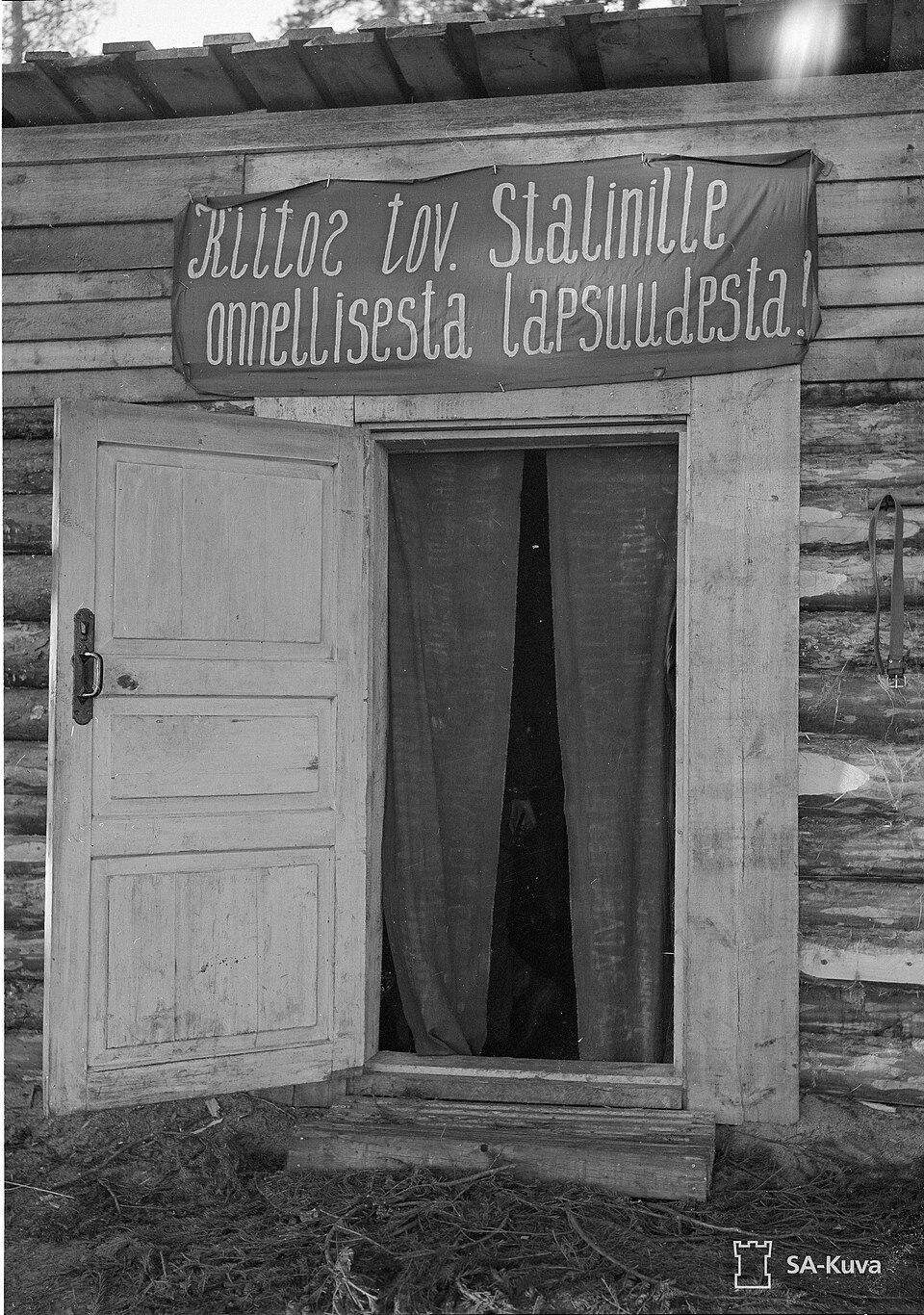
A Finnish military photographer recorded this banner at Vidlitsa on 12 September 1941. The entry says the formula "Thank you, Comrade Stalin, for a happy childhood" was widely used in the Soviet press, posters and children's institutions from the mid-1930s, and that it records one instance, not the conditions of Soviet childhood. Tagged glittering generalities and transfer.
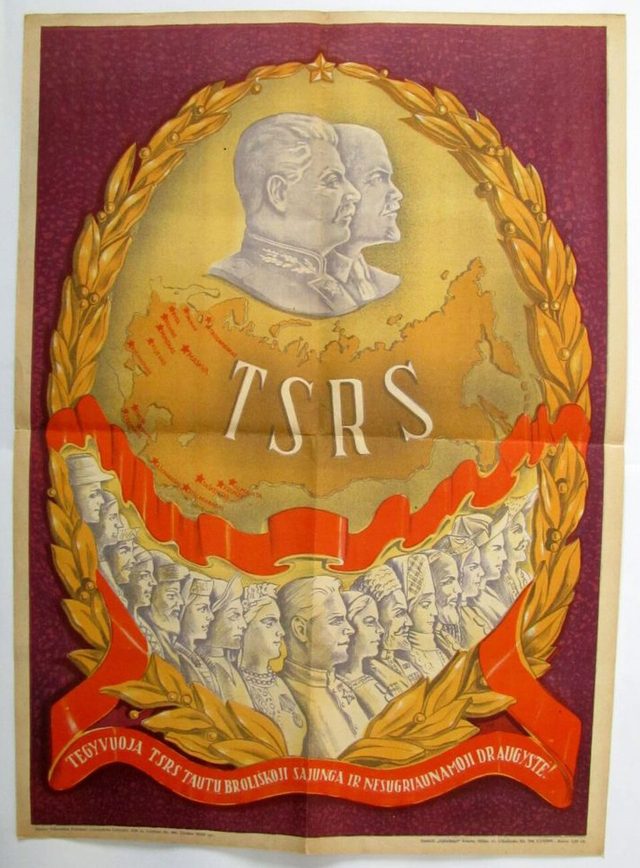
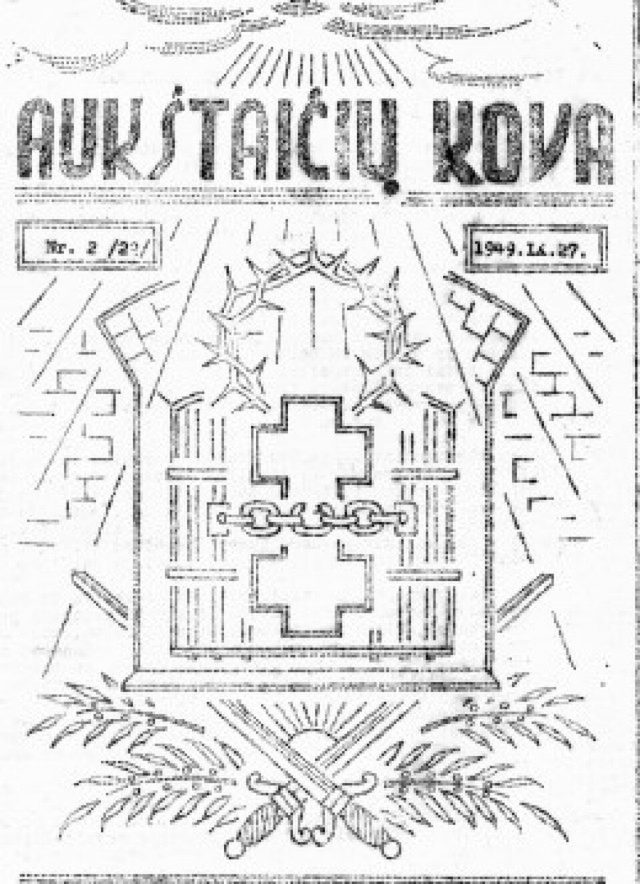
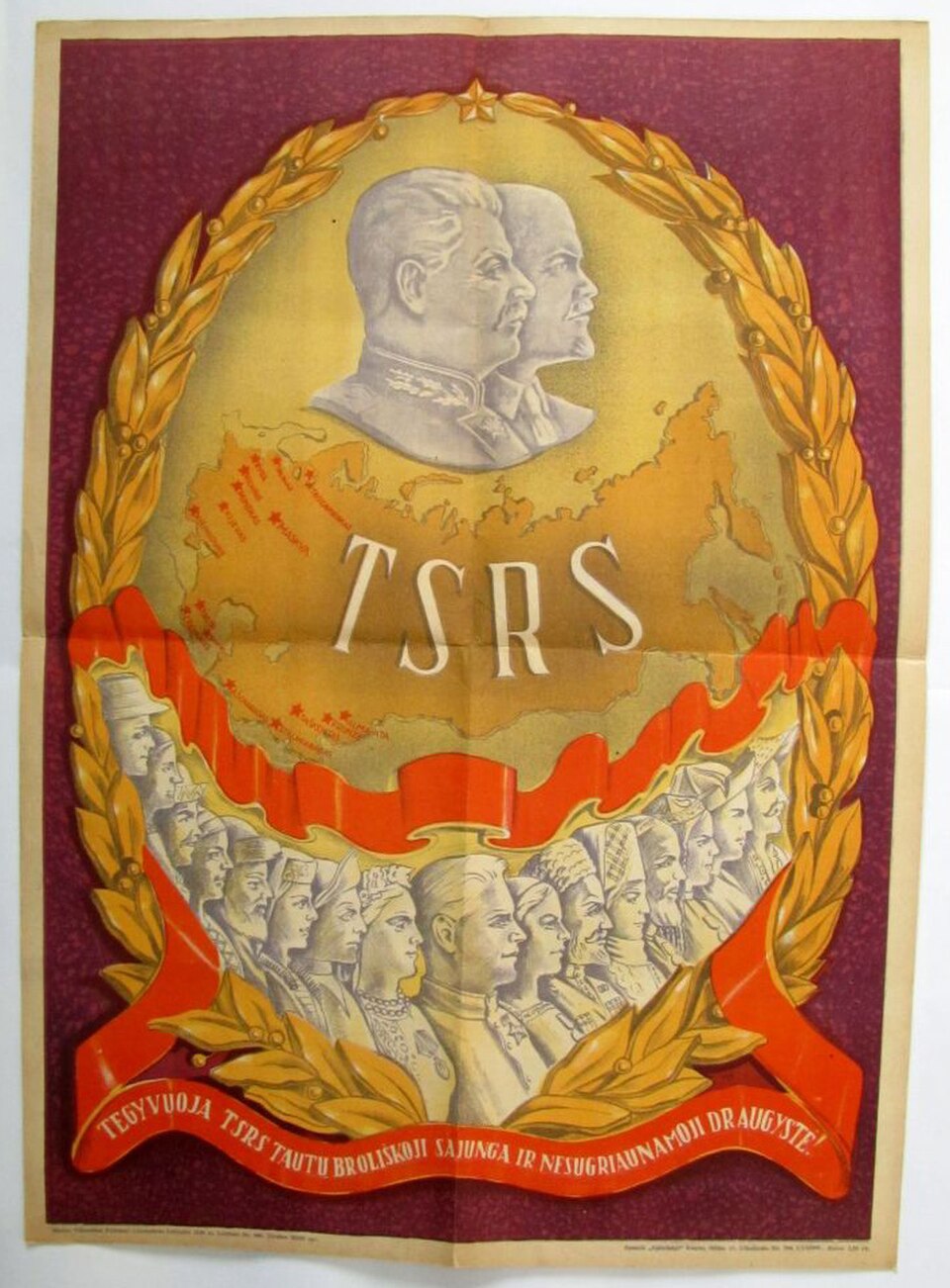
This 1946 Lithuanian-language poster pairs the two leaders over a map of the USSR. Lithuania had been annexed in 1940 and re-occupied in 1944, and the entry places it in the years of armed partisan resistance. The words "fraternal" and "indestructible" are virtue words standing for the union. The partisans' own underground journal of 1949 (entry "aukstaiciu-kova-no2-partisan-1949") is held in the collection under the same definitions.
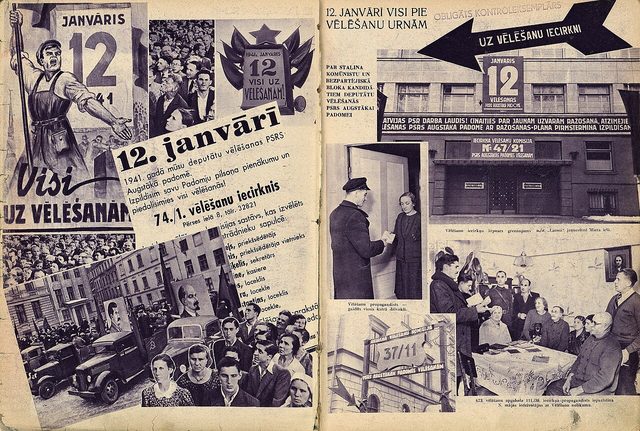
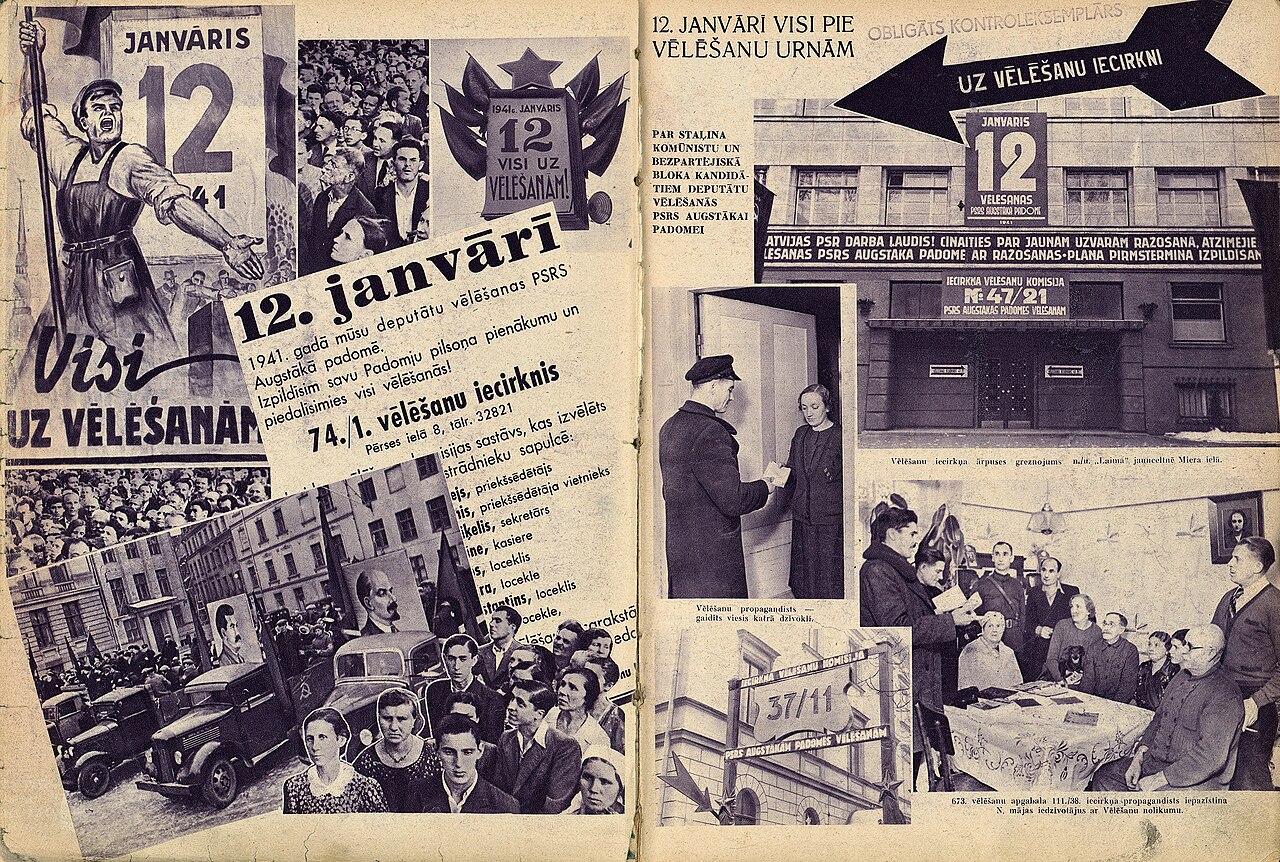
The 12 January 1941 election to the USSR Supreme Soviet was the first held in Latvia, Estonia and Lithuania after the annexations of August 1940. The spread repeats an "everyone to the ballot boxes" refrain, shows crowds (bandwagon) and a procession with Lenin and Stalin portraits. Read the technique: bandwagon.
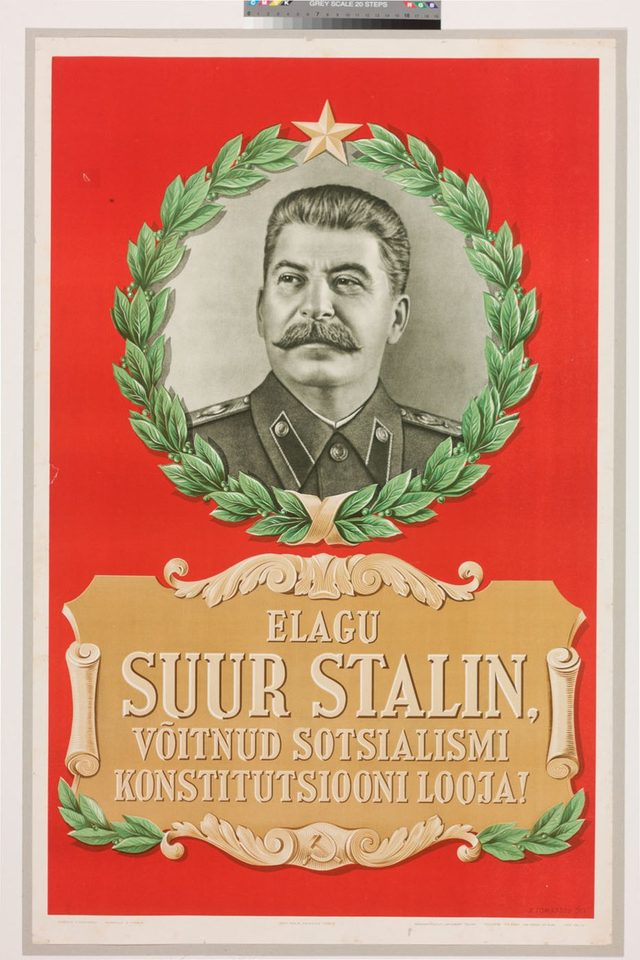
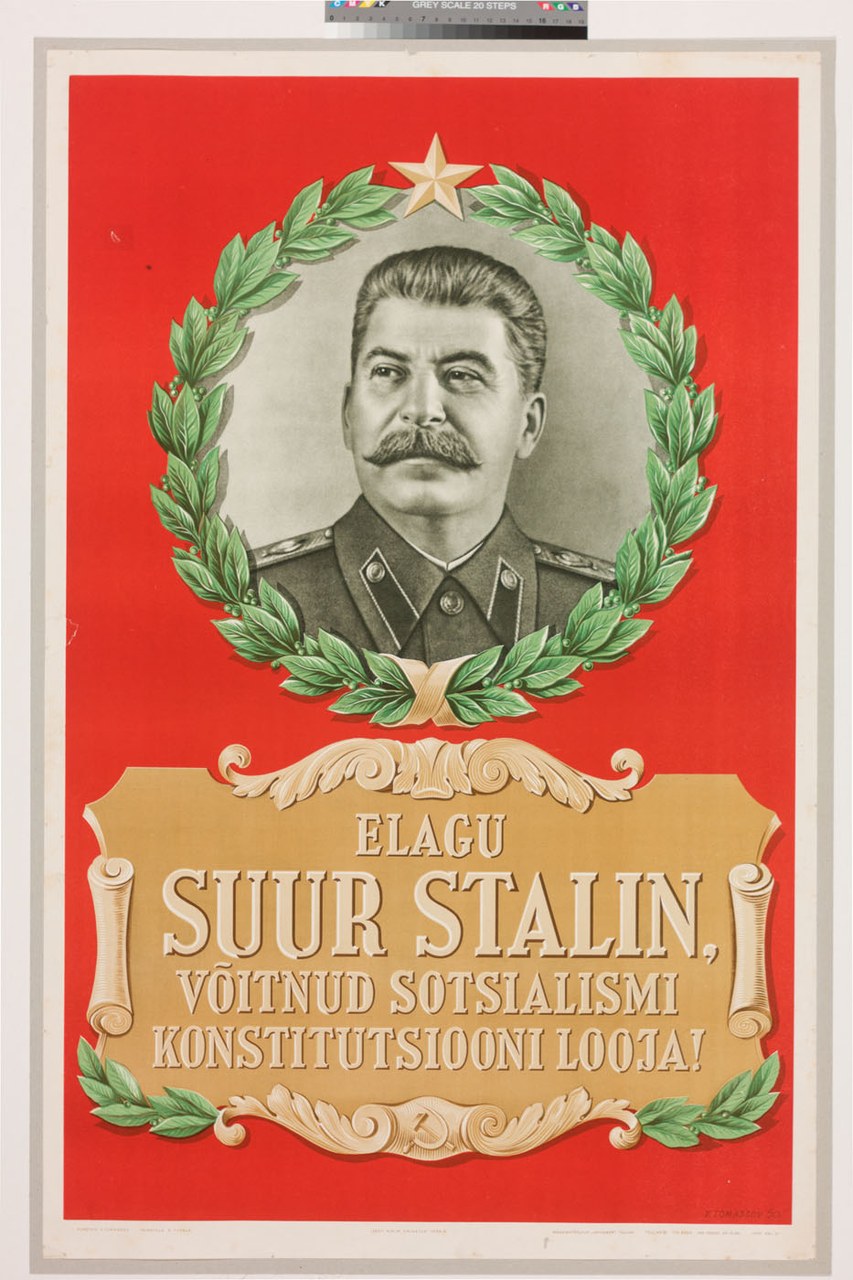
The Tartu Art Museum credits Voldemar Tomassov for this 1950 Estonian poster. Its slogan refers to the 1936 constitution, officially the "Stalin Constitution". "Great" and "victorious" stand in for any testable claim. The collection tags it cult of personality; of the 74 entries that mention Stalin, it is the only one with that tag.
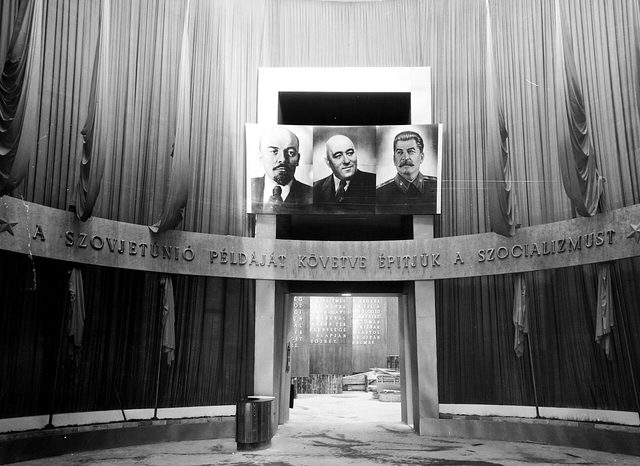
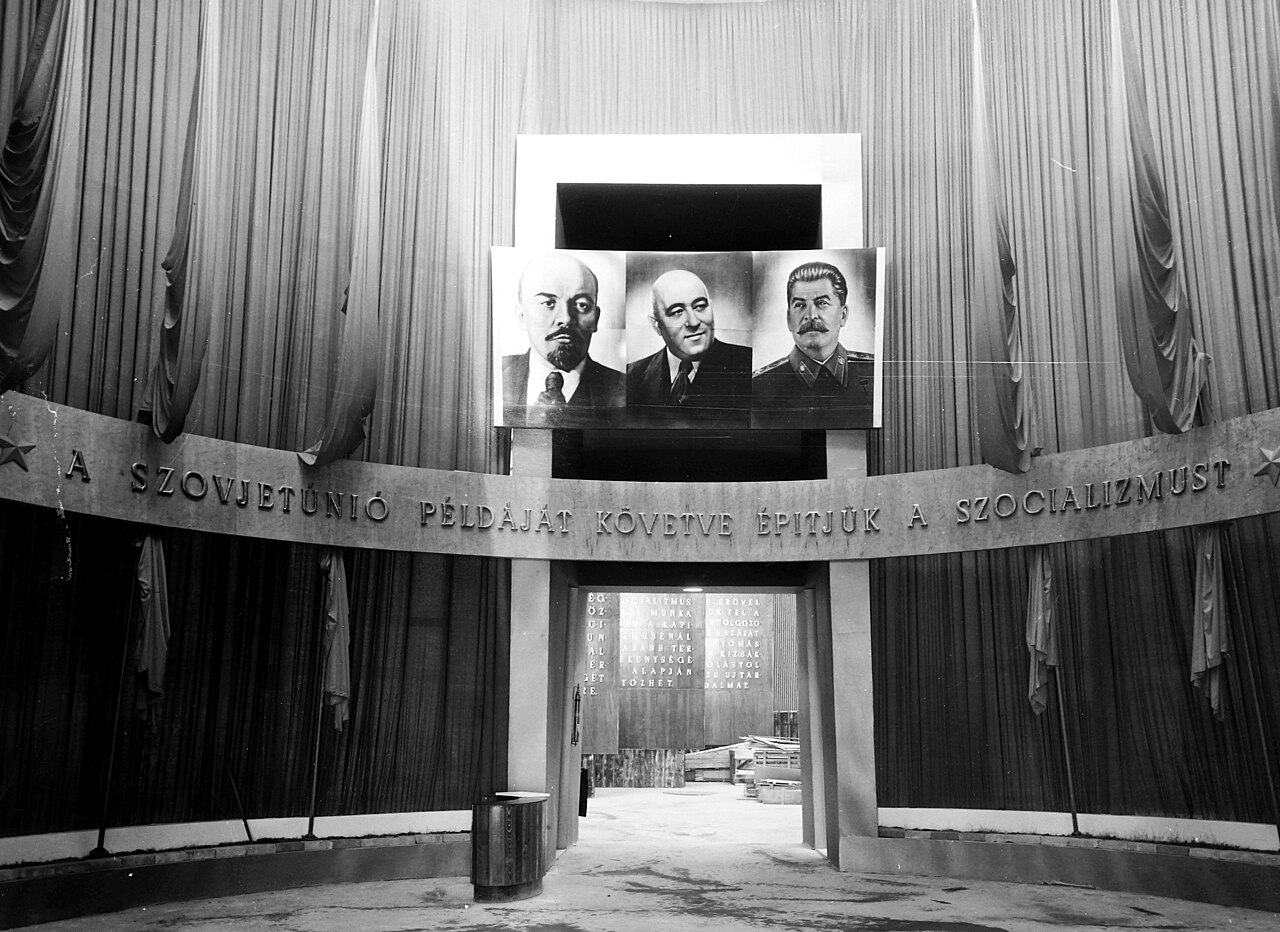
A Fortepan photograph of the Budapest Innovation and Invention Exhibition (1949) shows Mátyás Rákosi hung between Lenin and Stalin, with a frieze reading "Following the example of the Soviet Union we build socialism." The record does not name the organiser. Tagged transfer and glittering generalities.
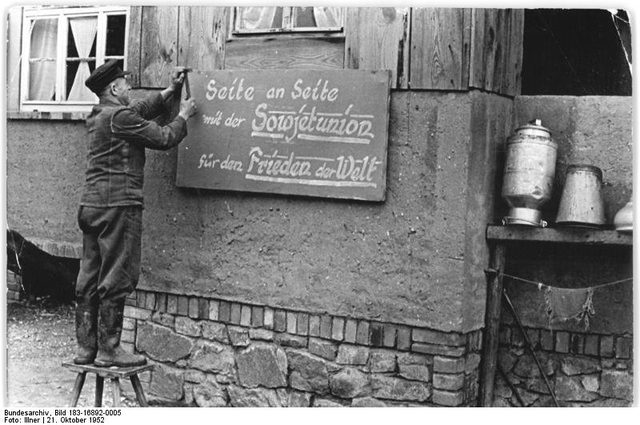
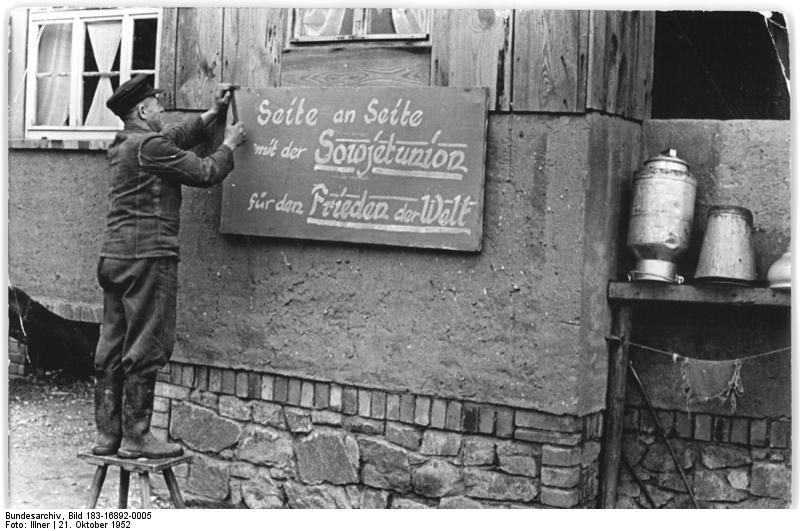
The agency caption of 21 October 1952 says a cooperative in the Month of German-Soviet Friendship planned a cultural event for Stalin's 75th birthday as the high point of a competition. The sign itself carries no Stalin image; it pairs a partner state with "peace" in one phrase (glittering generalities).
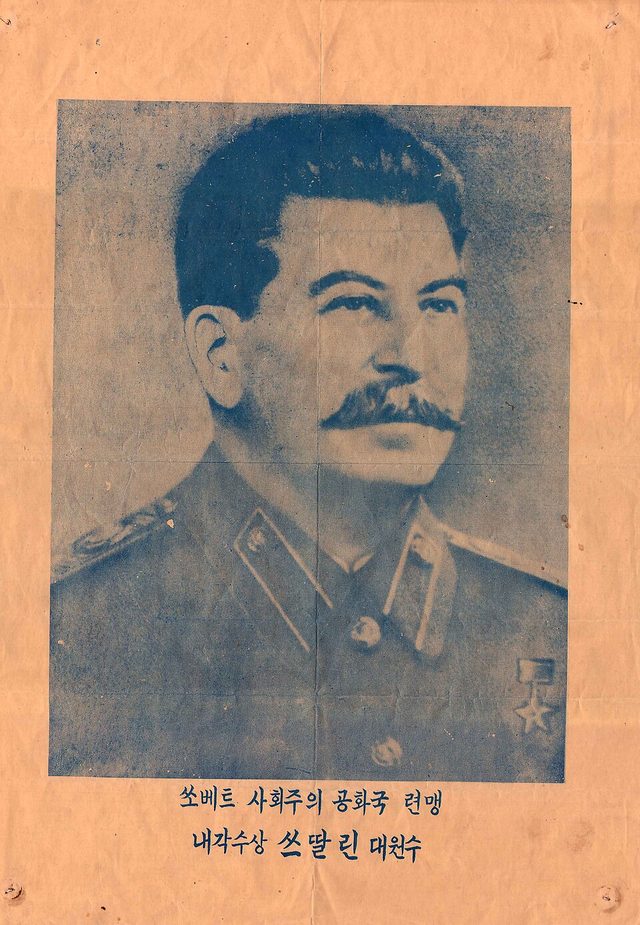
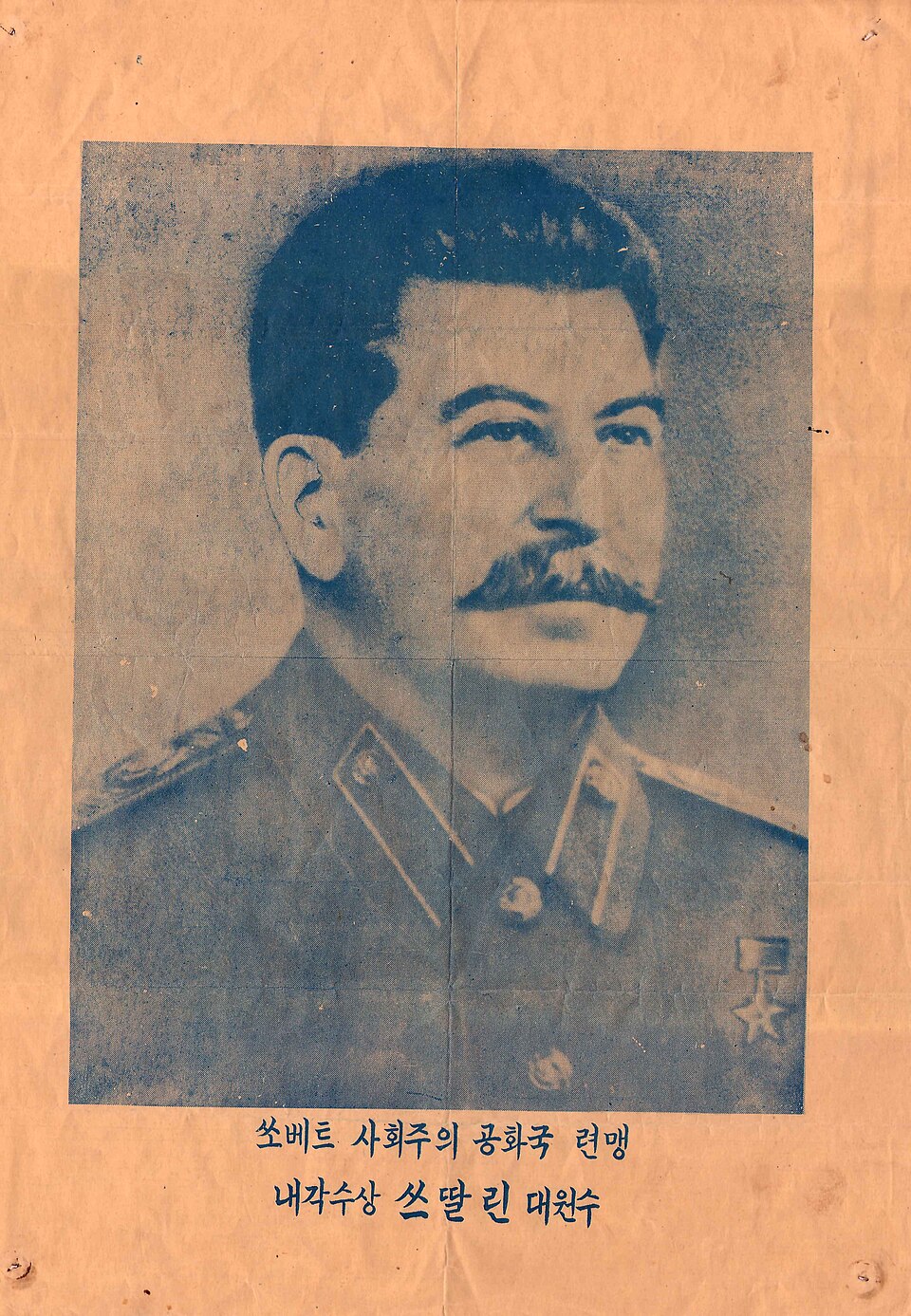
The Marine Corps Archives attributes this broadside to North Korea in about 1951; the sheet carries no issuer or date. Its caption names Stalin as head of the Soviet government and Generalissimo. The entry notes that allies' leaders' portraits were used by both sides in the war.
How were enemies named under Stalin?
Scapegoating in this period used categories, not individuals. The scapegoating page records that the Shakhty trial of 1928 charged mining engineers with sabotage and later trials extended "wrecking" to other specialists, so that accidents and missed targets with many causes were attributed to hidden enemies (sources there: Kuromiya 1988; Fitzpatrick 1999).
Explain moreShow less
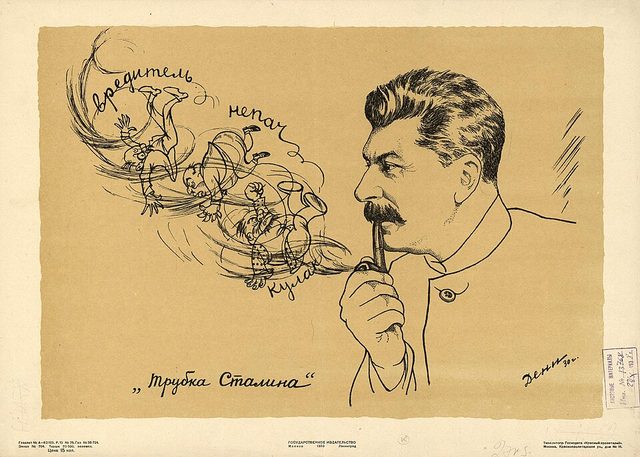
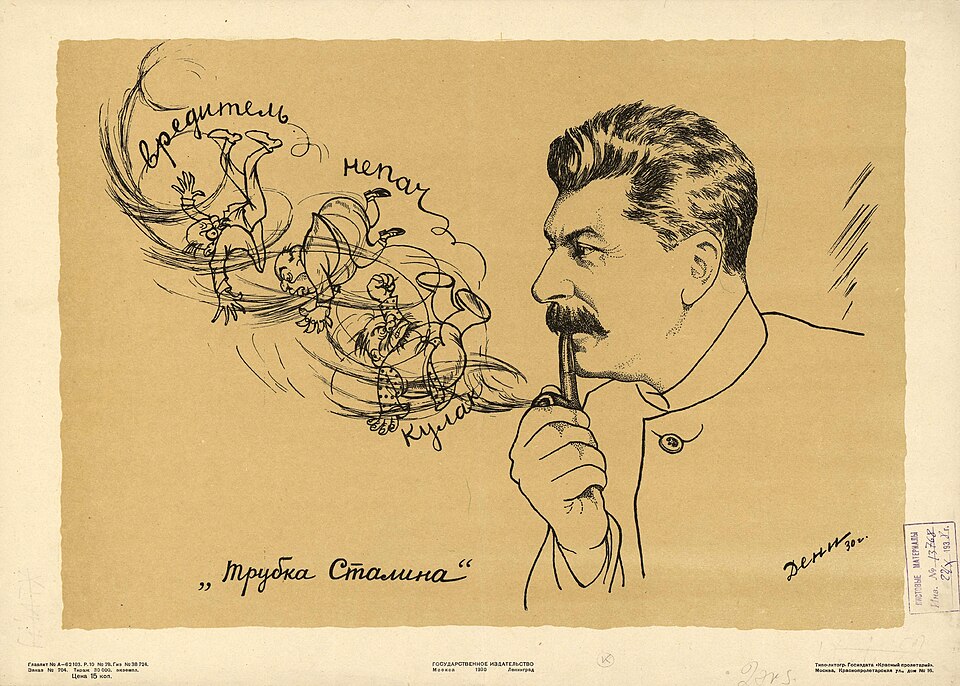
Viktor Deni's 1930 lithograph is the clearest short example: three labels, "wrecker", "NEPman", "kulak", are blown away by one breath. Read the technique: scapegoating.
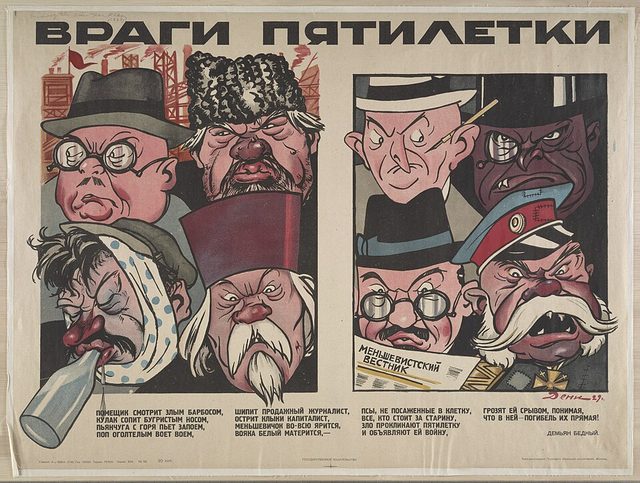
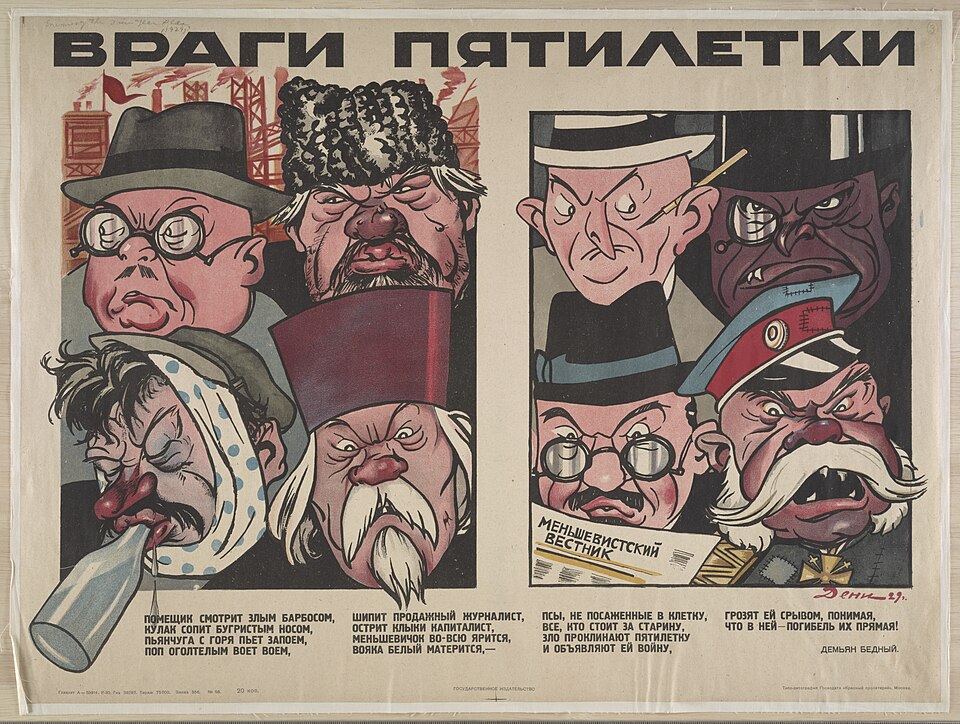
Deni drew and Demyan Bedny wrote the verse for this 1929 sheet, priced at 20 kopecks. Eight heads (landowner, kulak, drunkard, priest, journalist, capitalist, Menshevik, White officer) are called "dogs not yet put in a cage". A mixed list is blamed as one pack for threatening the first Five-Year Plan. Tagged name-calling and scapegoating.
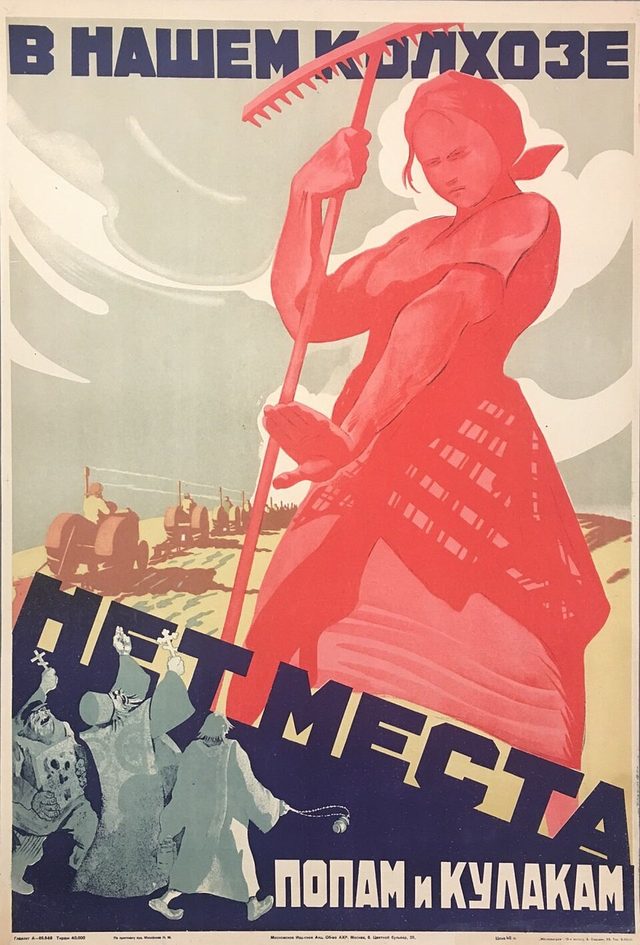
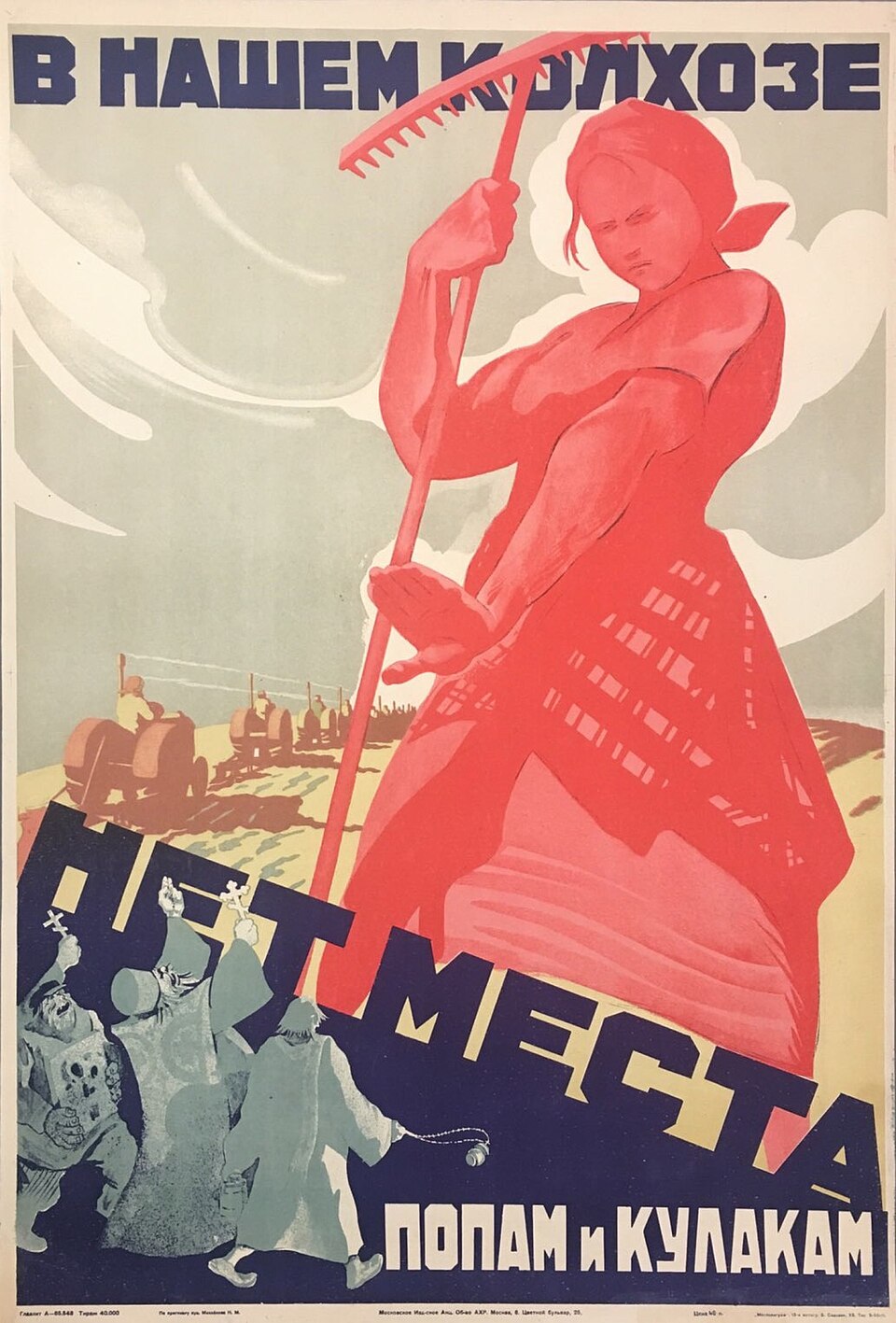
Nikolay Mikhailov's lithograph for the Association of Artists of the Revolution had a print run of 40,000 at 40 kopecks. Its title excludes priests and kulaks from the collective farm. The entry says the exact year is uncertain (1929 to 1930). Stalin's own words of 27 December 1929, per the verified quotes file, were: "It means that we have passed from the policy of restricting the exploiting tendencies of the kulaks to the policy of eliminating the kulaks as a class." The collectivization case study gives the outcome.
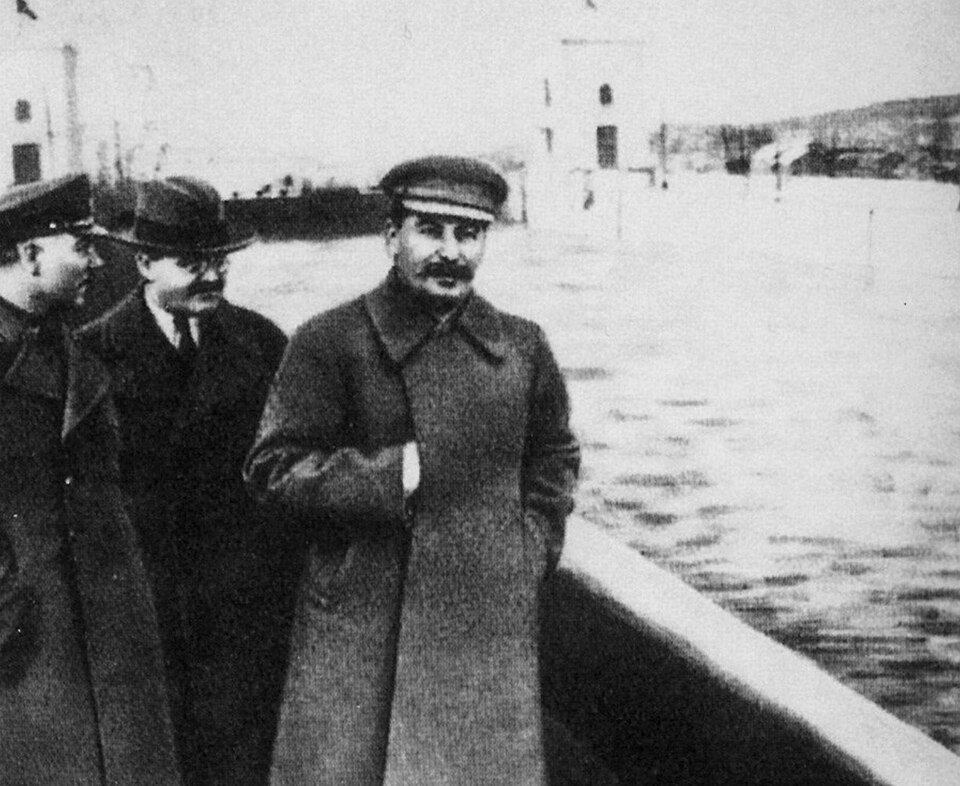
Nikolai Yezhov was photographed with Stalin, Voroshilov and Molotov beside a canal in April 1937. He was arrested on 10 April 1939 and shot on 4 February 1940, and a later version shows the group without him. This is the altered version; the Glavlit case study shows the original beside it and tags the practice card-stacking.
What did Stalin propaganda look like in the war?
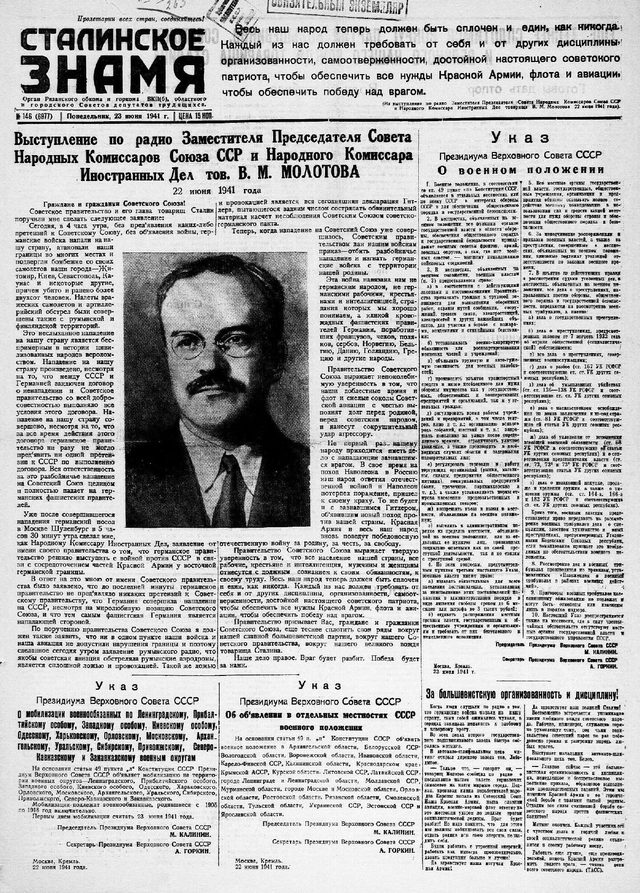
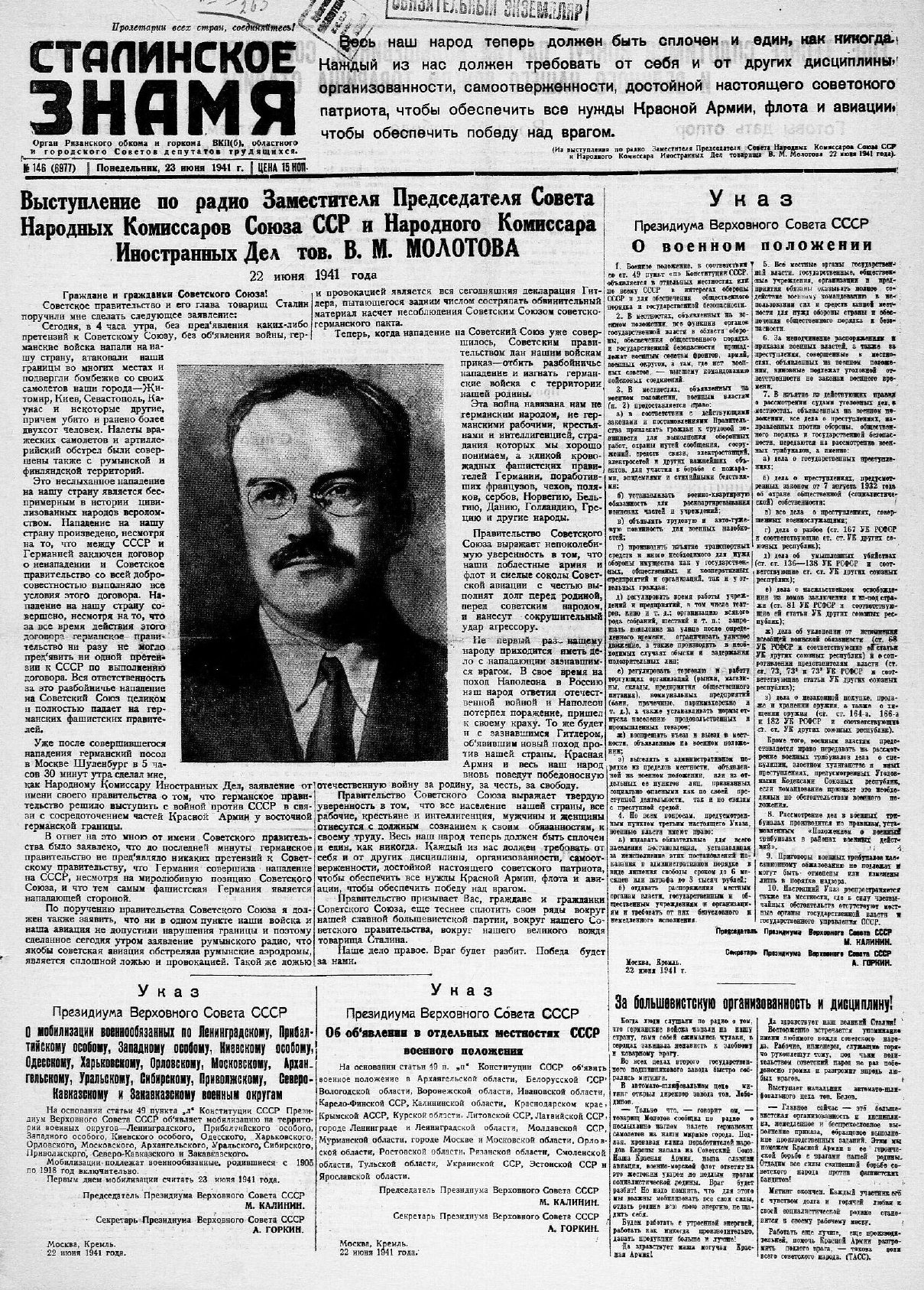
The paper's name means "Stalin's Banner". Its front page of 23 June 1941 prints Molotov's address of 22 June in full, with decrees on martial law and mobilisation. The entry records that Molotov spoke because Stalin did not, and that the page does not mention the secret protocols of the 1939 pact, which the Soviet side did not publish until 1989.
Explain moreShow less
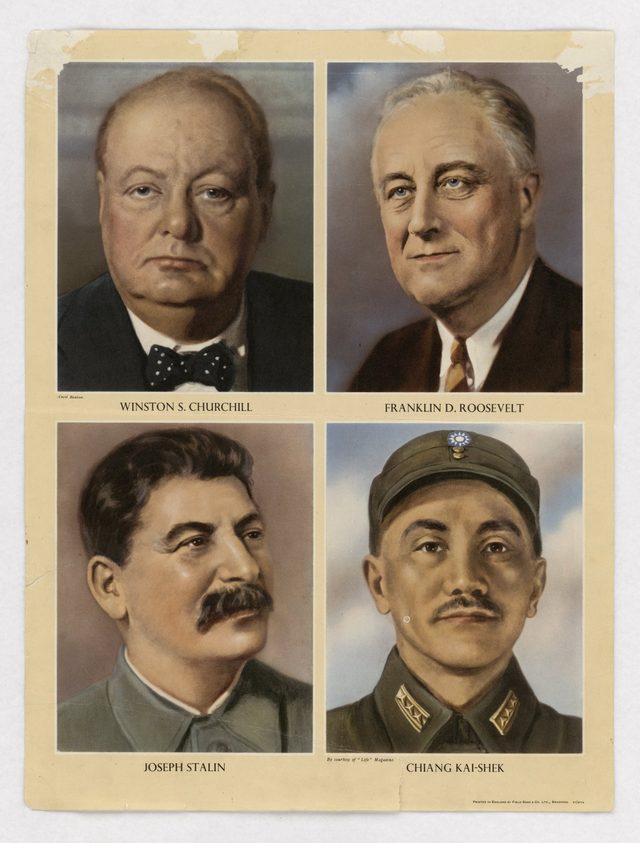
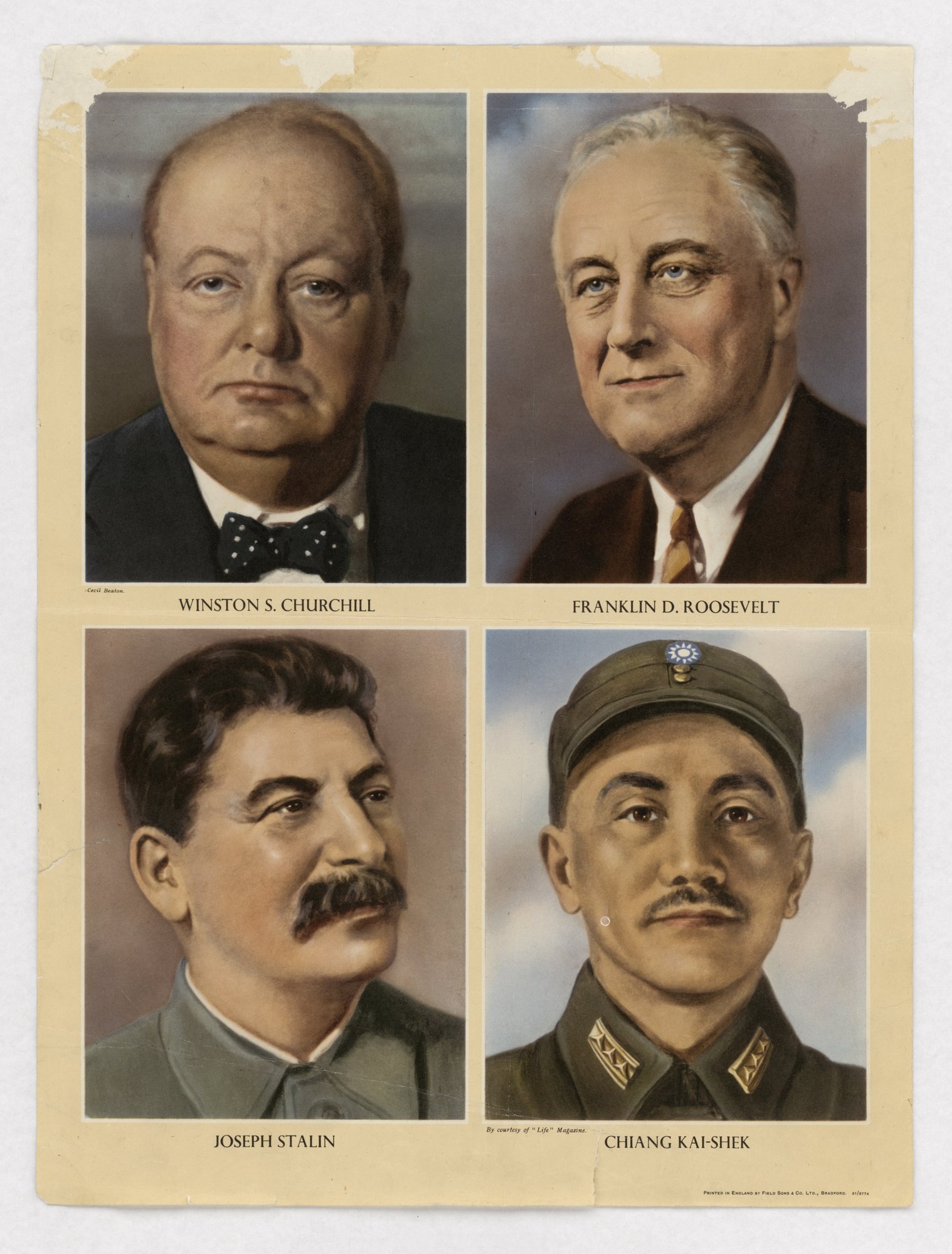
A British-printed sheet groups the four Allied leaders with no slogan. NARA gives only a range, 1939 to 1945. The entry tags it transfer: each leader's standing is lent to the alliance.
How was Stalin portrayed by his opponents?
The same techniques appear on the other side, and the entries record who issued each sheet.
Explain moreShow less
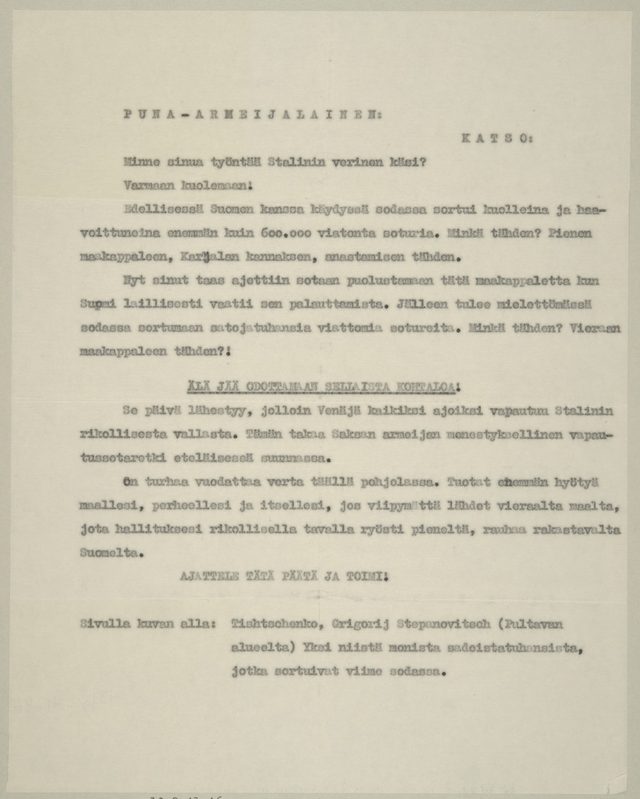
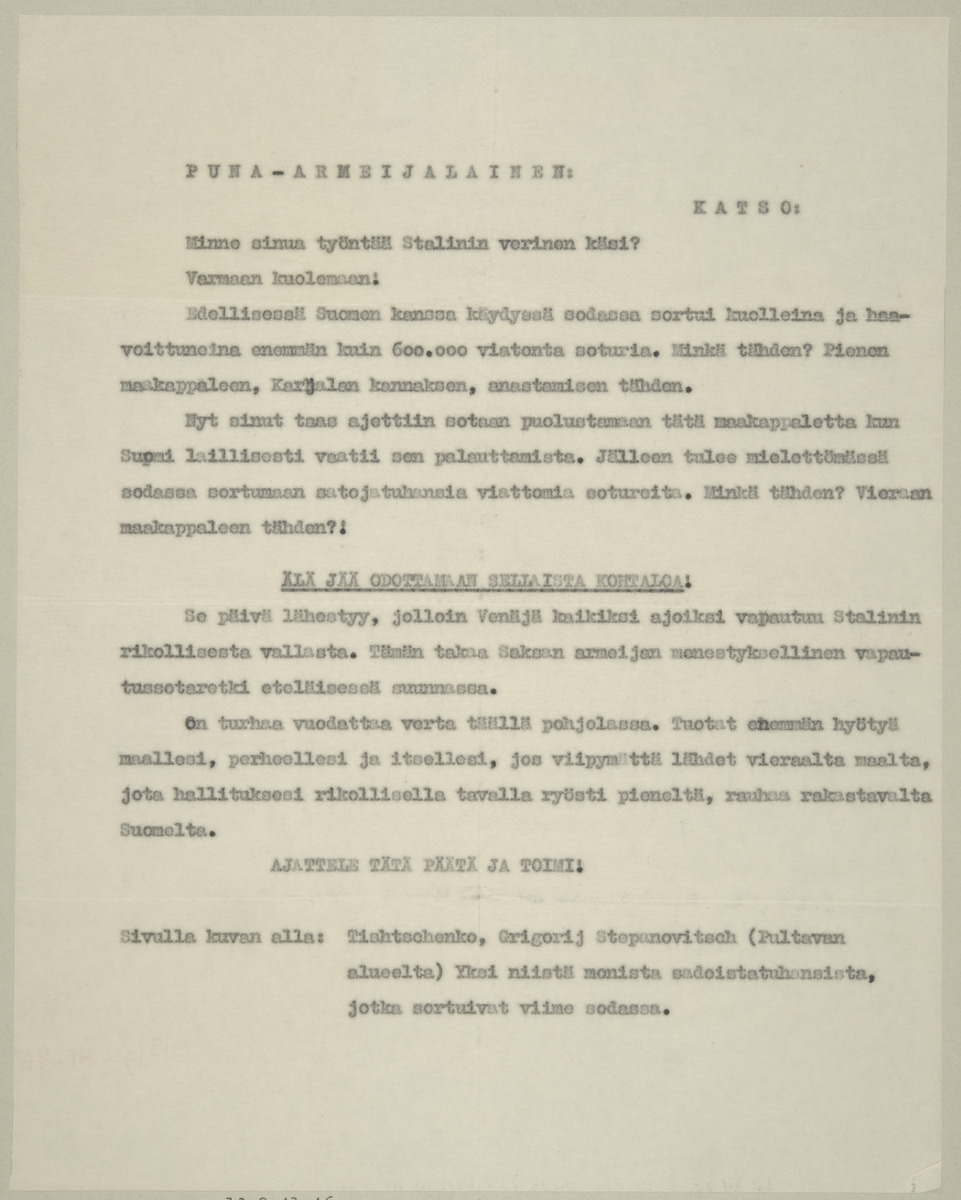
This typescript, from the Finnish Heritage Agency, asks the Red Army soldier where "Stalin's bloody hand" is pushing him and answers "certainly to death". It cites more than 600,000 dead and wounded in the earlier war with Finland, without a source. Tagged fear appeal, name-calling and card-stacking. The issuer is not printed.
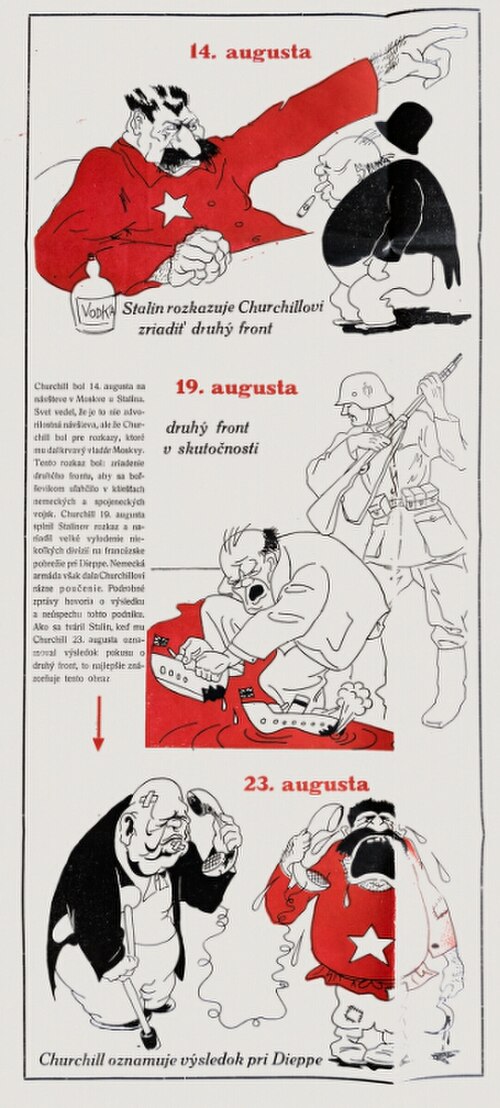
The Slovak newspaper Ľudové noviny printed this strip in August 1942, after the Dieppe raid of 19 August. The text calls Stalin the "bloody ruler of Moscow" and draws both leaders as comic figures. Tagged name-calling.
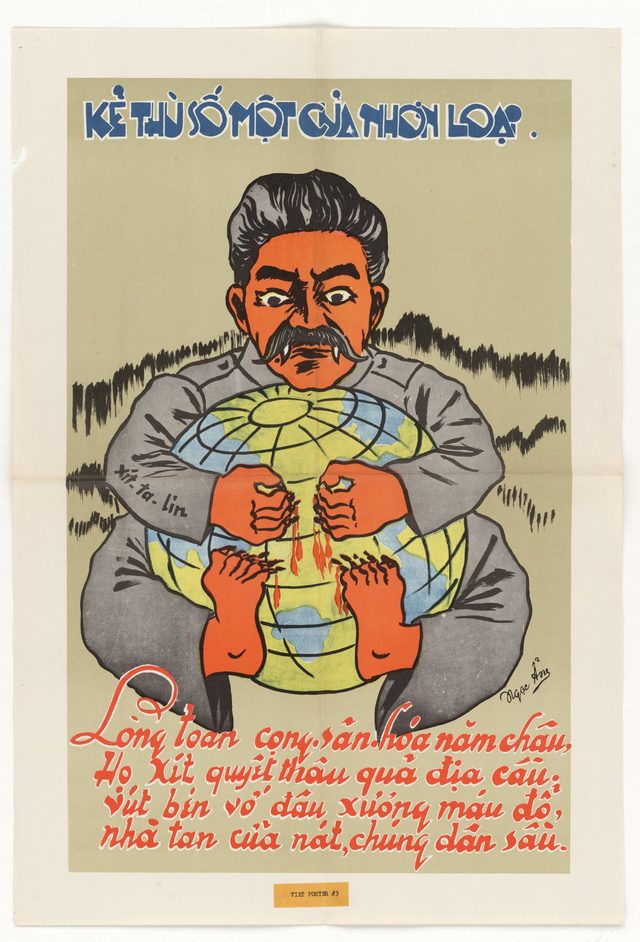
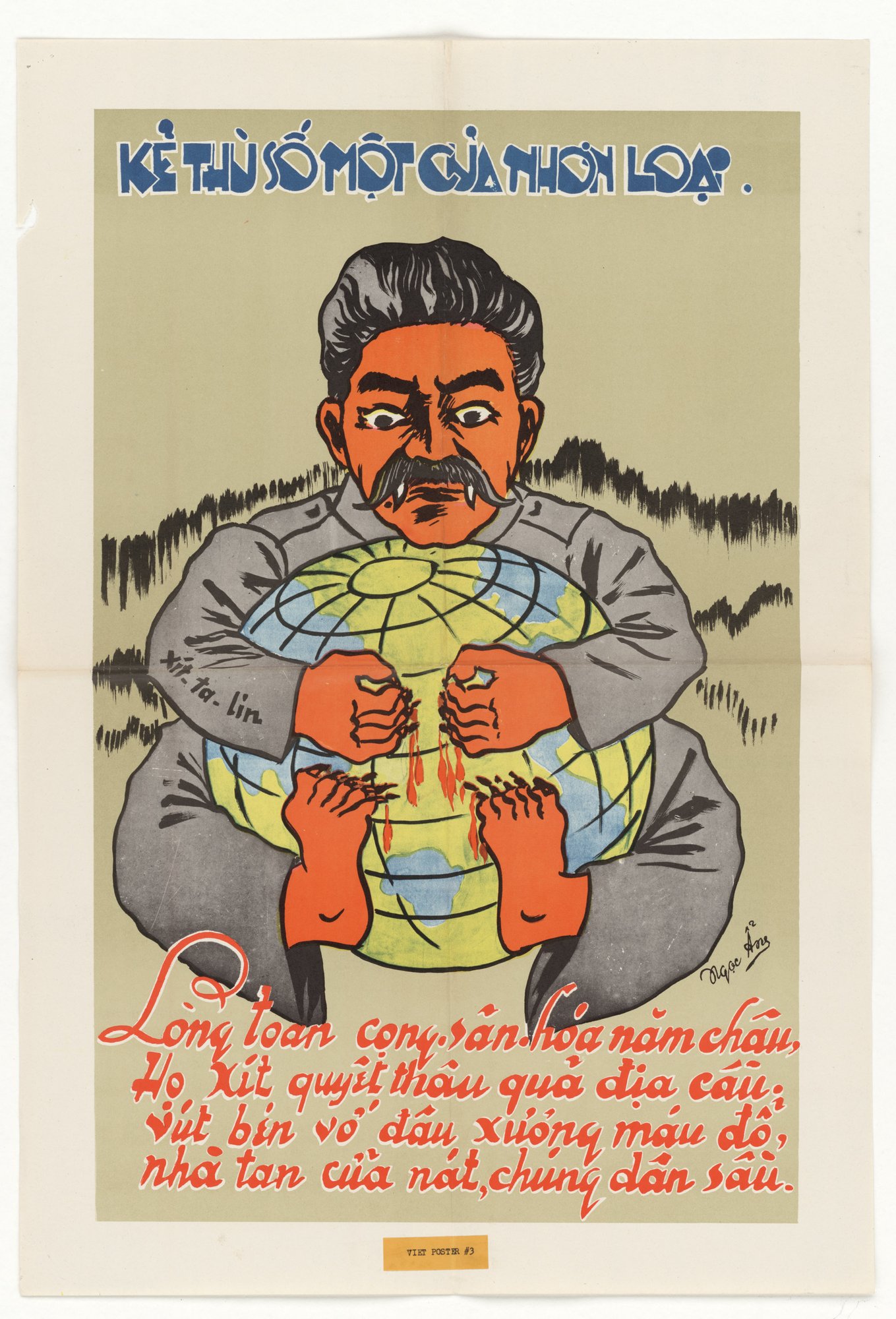
The U.S. Information Agency series Propaganda Posters Distributed in Asia holds this Vietnamese poster of March 1951. The headline calls him "humanity's number-one enemy". The verse says he intends to communise the five continents. The sheet prints no sponsor, so the entry rates its source gray. Read the technique: name-calling.
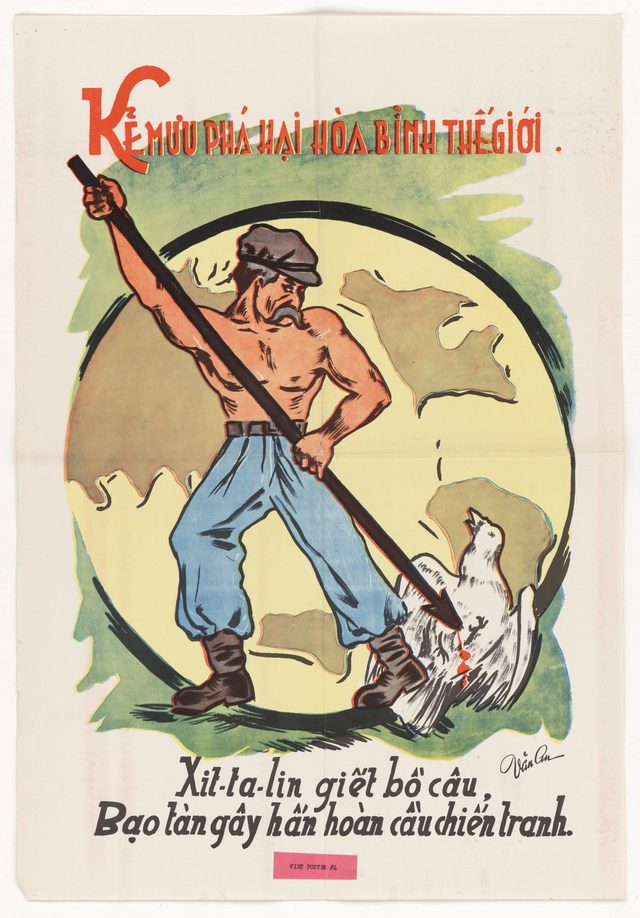
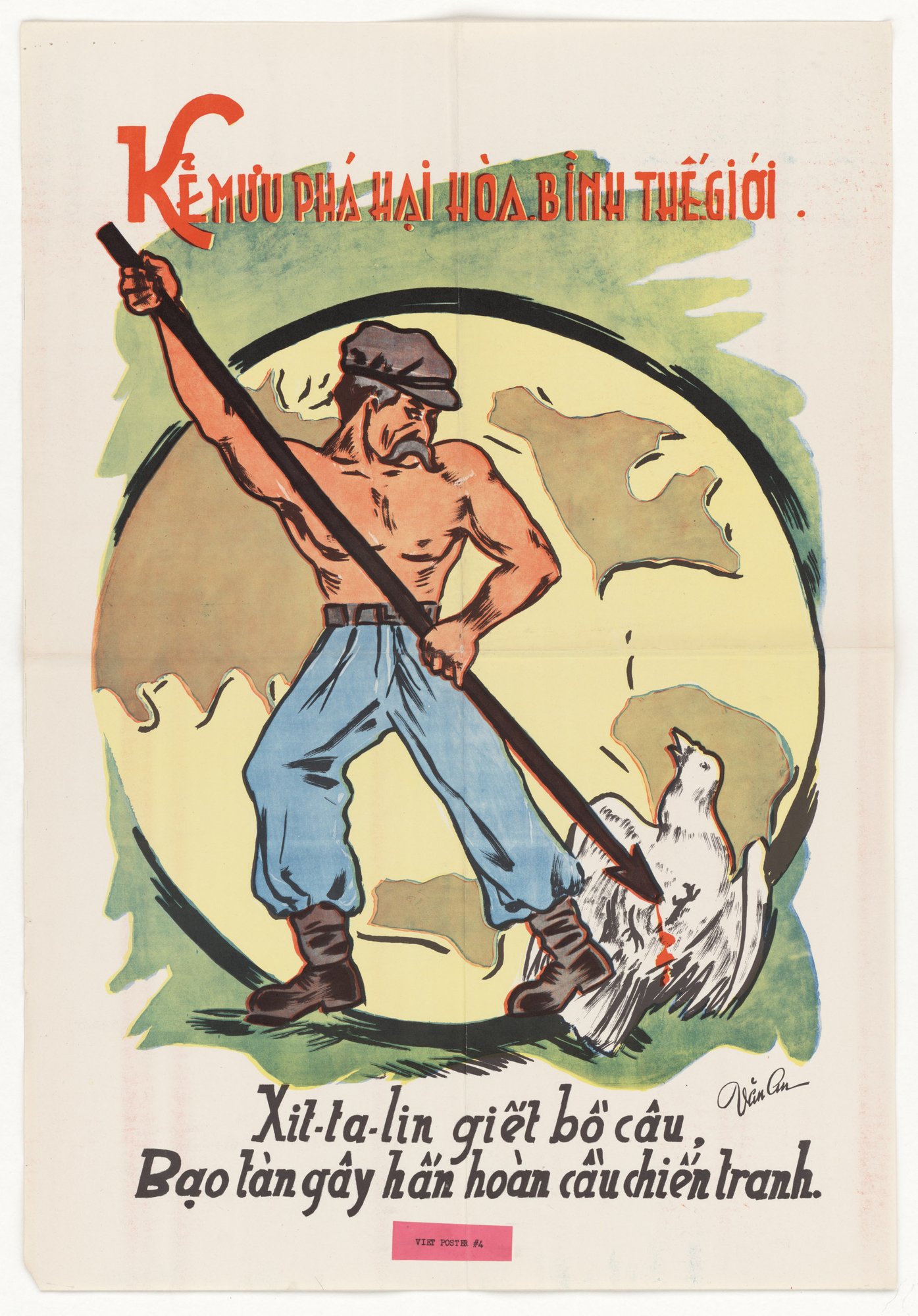
Its companion, also of March 1951, calls him the plotter against world peace and shows the dove, a peace emblem, speared.
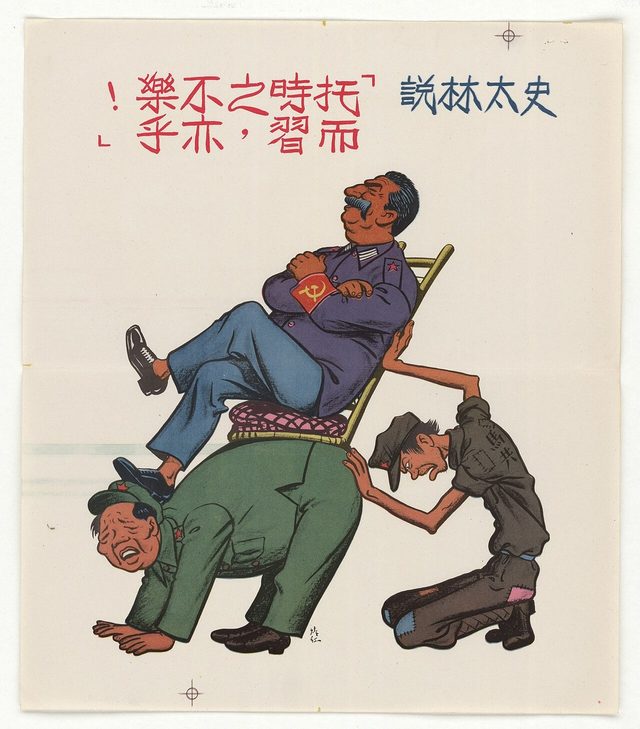
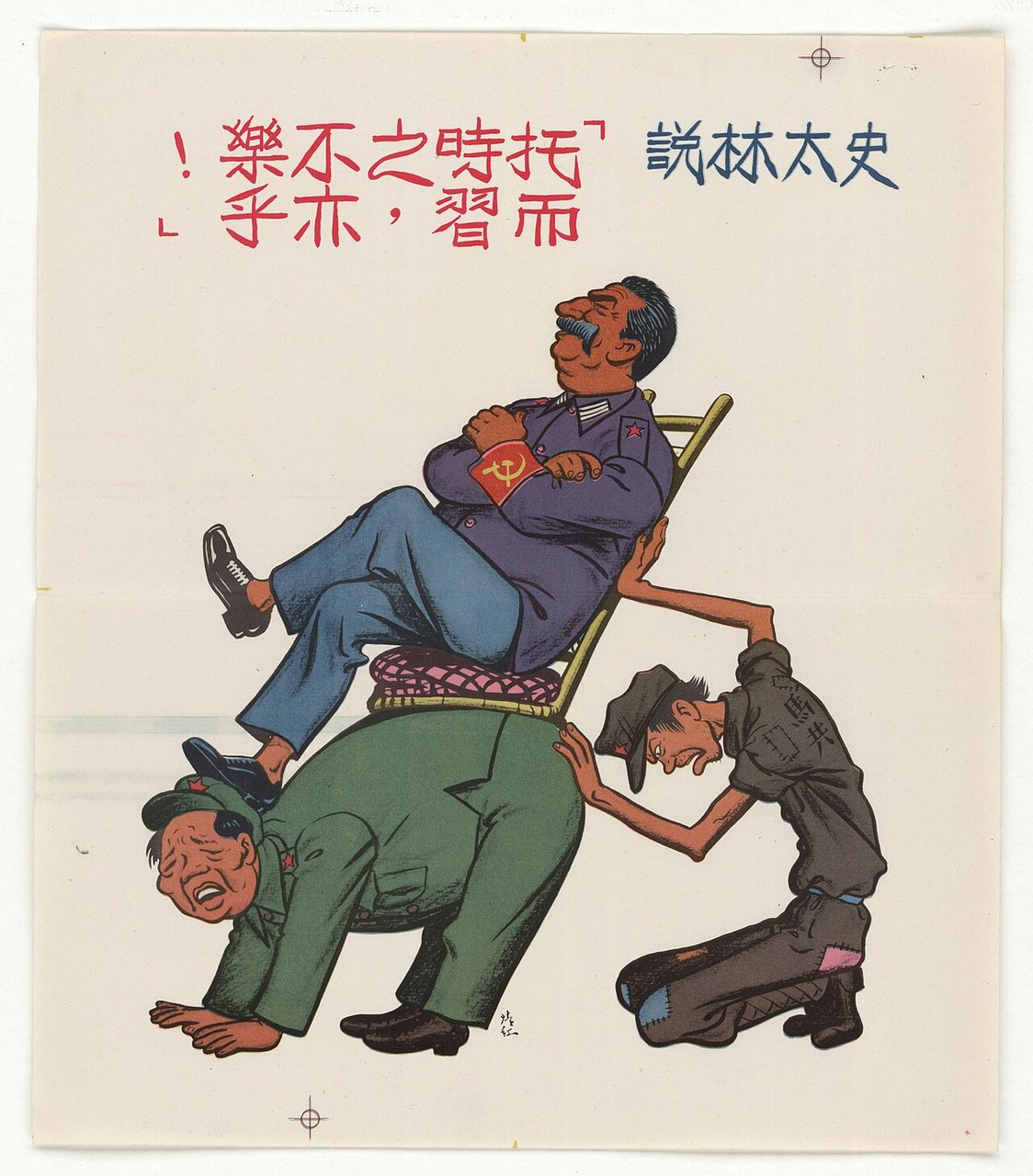
A U.S. State Department cartoon of 5 September 1952 puts the opening of Analects 1.1 in Stalin's mouth as satire. The entry states that no such statement by Stalin is claimed and that the sheet asserts a master-and-servant relationship it does not source.
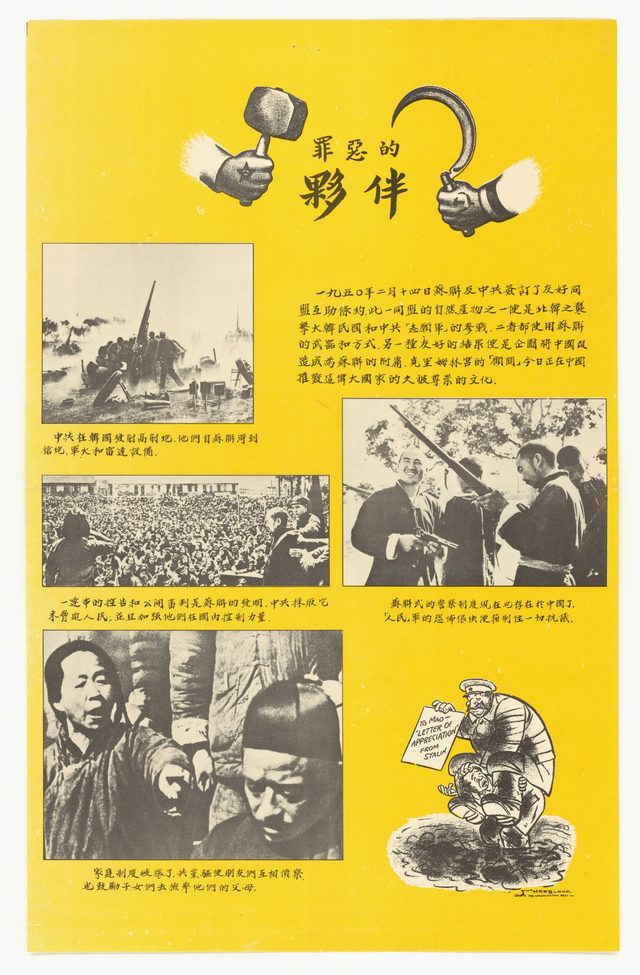
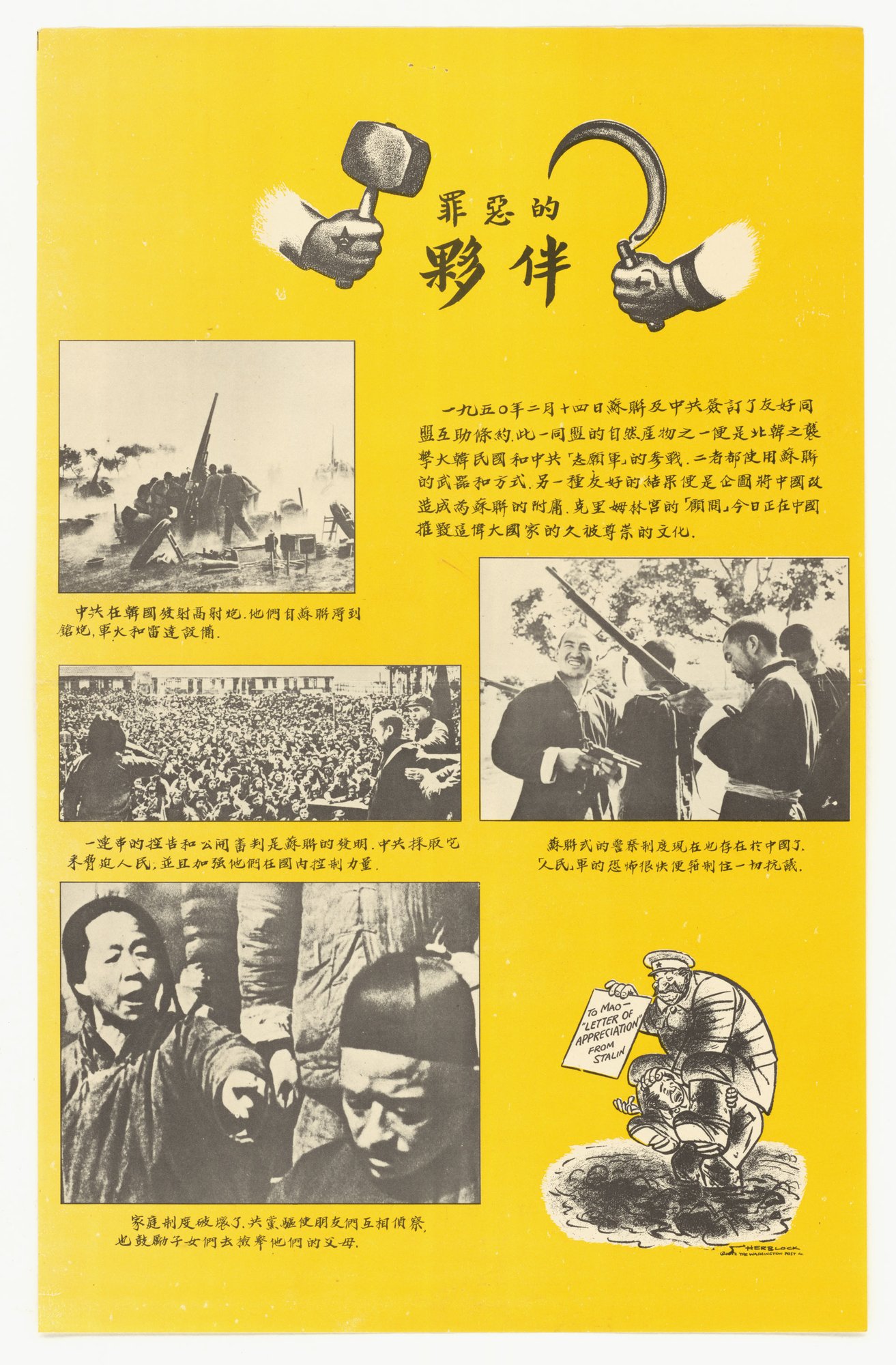
A U.S. sheet of May 1952 labels the Sino-Soviet alliance of February 1950 a criminal partnership, using chosen photographs and a Herblock cartoon of Stalin kneeling on a victim. Tagged name-calling, card-stacking and fear appeal. Two photographs show people held at gunpoint, shown uncropped.
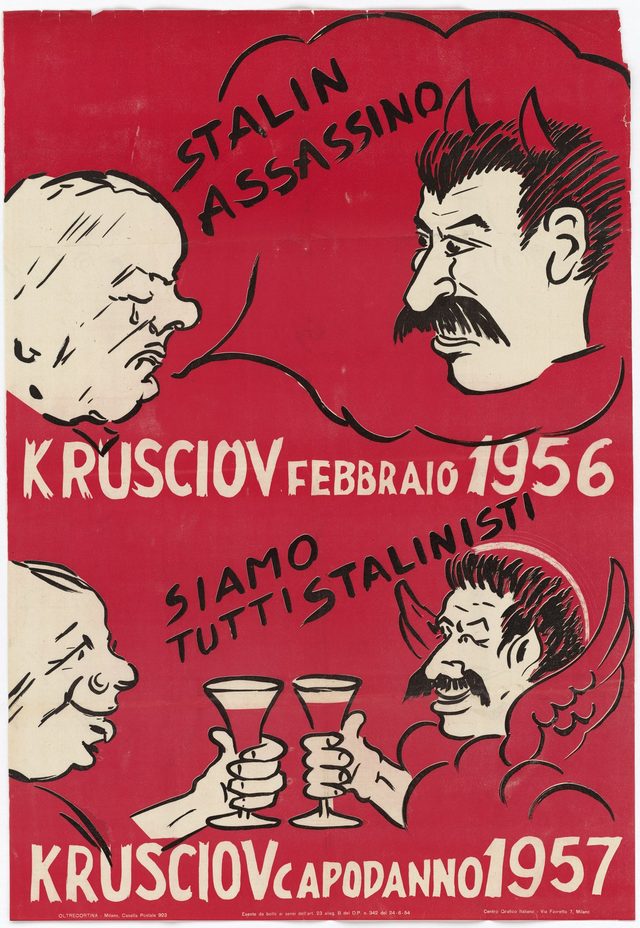
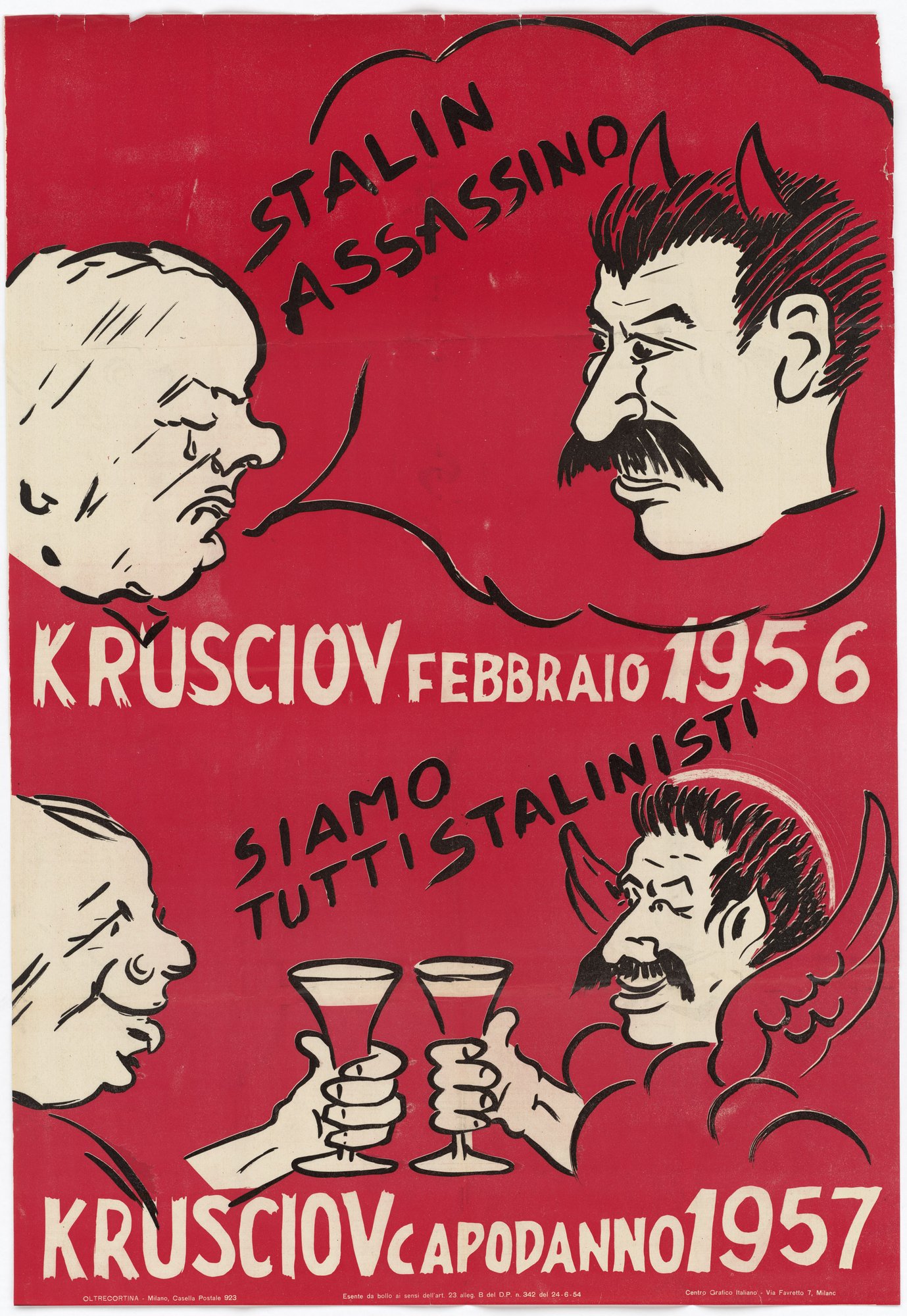
An Oltrecortina (Milan) poster contrasts "February 1956" with "New Year 1957" and the line "Siamo tutti stalinisti". It refers to Khrushchev's 1956 denunciation of Stalin. Distributed through a U.S. series. Tagged name-calling and accusation-in-a-mirror.
Common techniques
- Cult of personality. Portraits, honorifics and gifts around a named leader. Cult of personality.
- Transfer. Lenin, the flag, the map or an ally lends standing to the leader or his deputy. Transfer.
- Scapegoating. Named groups ("wreckers", kulaks, priests) are blamed for failures. Scapegoating.
Show all 6Show fewer
- Identity fusion. The leader or party stands for the nation, so opposing him reads as opposing it. The identity-fusion page lists the "enemy of the people" label of the 1930s. Identity fusion.
- Name-calling. Used by the Soviet state against internal groups and by foreign issuers against Stalin. Name-calling.
- Card-stacking. One side's evidence only, in the Finnish and U.S. sheets and in the retouched photographs.
What to look for
- Issuer. A Soviet publishing house, a Finnish unit, a U.S. series or an unnamed printer.
- Audience. Soviet citizens, annexed Baltic populations, Red Army soldiers or readers in Asia.
- The named enemy. A person, a class or a foreign state.
Show all 4Show fewer
- What is absent. The retouched photograph and the unmentioned 1939 protocols show omission.
Explain moreShow less
Differences of scale are plain: the Soviet items were issued by a state with control of the press and censorship (Glavlit); the foreign items came from other governments and newspapers. The archive scores technique on each and does not rule on the truth of any claim.
Browse Stalin propaganda
The grid below shows these objects from the collection. Each opens an object page with the holding institution, a link to the original record, a transcription of any text and the rights basis for hosting. For the regime and its end, see the Soviet Union under Stalin and how Joseph Stalin died. For related pages, see Soviet propaganda posters, communist propaganda, propaganda posters and agitprop.
Sources and further reading
Sources and rights
Objects come from Duke University Libraries, the U.S.
Objects come from Duke University Libraries, the U.S. National Archives, the Finnish Heritage Agency, the Tartu Art Museum, Fortepan, the Bundesarchiv, the Marine Corps Archives and Wikimedia Commons. Each object page gives its own rights basis. Transcriptions are verbatim.