Also called Association fallacy, Smear by association, Tarred with the same brush, Red-baiting, Reductio ad Hitlerum, Contact guilt
Discredit a person, group or idea by linking it to something already hated or feared, so the audience judges the link and not the evidence.
How to spot Guilt by association: the tell
A connection (membership, a shared word, a photograph, a relative, a donor) is offered as proof of shared guilt, with no evidence of what the target itself did.
What Guilt by association is not
A documented conspiracy, a held office in an organisation that did the wrong, or a security vetting that tests for a specific risk.
History and effect of Guilt by association propaganda
The oldest form is collective liability: a family, village or clan punished for one member. The logic textbooks later separated this from argument. The association fallacy says that if A has a property and B is linked to A, then B has it too. Propaganda uses the fallacy because it is cheap. Proving that a person did something takes evidence; showing that the person stood near someone who did takes a photograph, a membership list or a shared word.
Explain moreShow less
The twentieth century made the form systematic because states built the machinery for it: membership lists, organisation blacklists, family-background files. A label that once passed from mouth to mouth could now be written into law, a hiring rule or a ration card. The emotional effect is contagion. The audience feels disgust or fear toward the hated thing, and that feeling is carried over to the person standing next to it (Disgust). For the target the effect is isolation, because everyone who might help is warned that the stain spreads to them as well. That second effect is why the technique often works even on audiences who doubt the first charge.
Lineage: Informal logic (association fallacy); Cold War loyalty-security law and Soviet and Chinese kin-liability practice
How Guilt by association propaganda works
- Pick an anchor the audience already hates. The enemy state, a banned party, a defeated regime, a criminal.
- Find or make a link. A membership, a meeting, a co-signed letter, a donor, a shared slogan, a surname, a photograph.
- Treat the link as the proof. The target is described by the anchor's worst acts. The question "what did this person do?" is replaced by "who is this person near?"
Show all 5Show fewer
- Widen the net. Anyone linked to the target can be linked in turn. The set grows, and the grouping becomes a "bundle", a "network", a "clique" or a "pack".
- Make distance expensive. Denials are read as proof of concealment; the target is invited to prove the negative by naming others.
Explain moreShow less
It travels with Name-calling, which supplies the label for the bundle, and with Transfer, which moves the anchor's feeling onto the target. The difference from Ad hominem is the route: ad hominem attacks the speaker's own character or position, while this technique attacks through someone else's. Scapegoating often builds on it by grouping unrelated people under one blamed category.
Why Guilt by association propaganda works
People judge by feeling quickly and revise slowly (Affect heuristic). Experimental research on "spontaneous trait transference" found that when a person described another's behaviour, listeners later linked the trait to the describer even when they had no reason to (Skowronski, Carlston, Mae and Crawford, Journal of Personality and Social Psychology 74(4), 1998, pp. 837-848). Out-groups are seen as more alike than they are, which makes it easy to treat one member's act as the group's (Out-group homogeneity). And a charge that has been made lingers even after correction (Continued influence effect).
Guilt by association propaganda examples across eras and sides
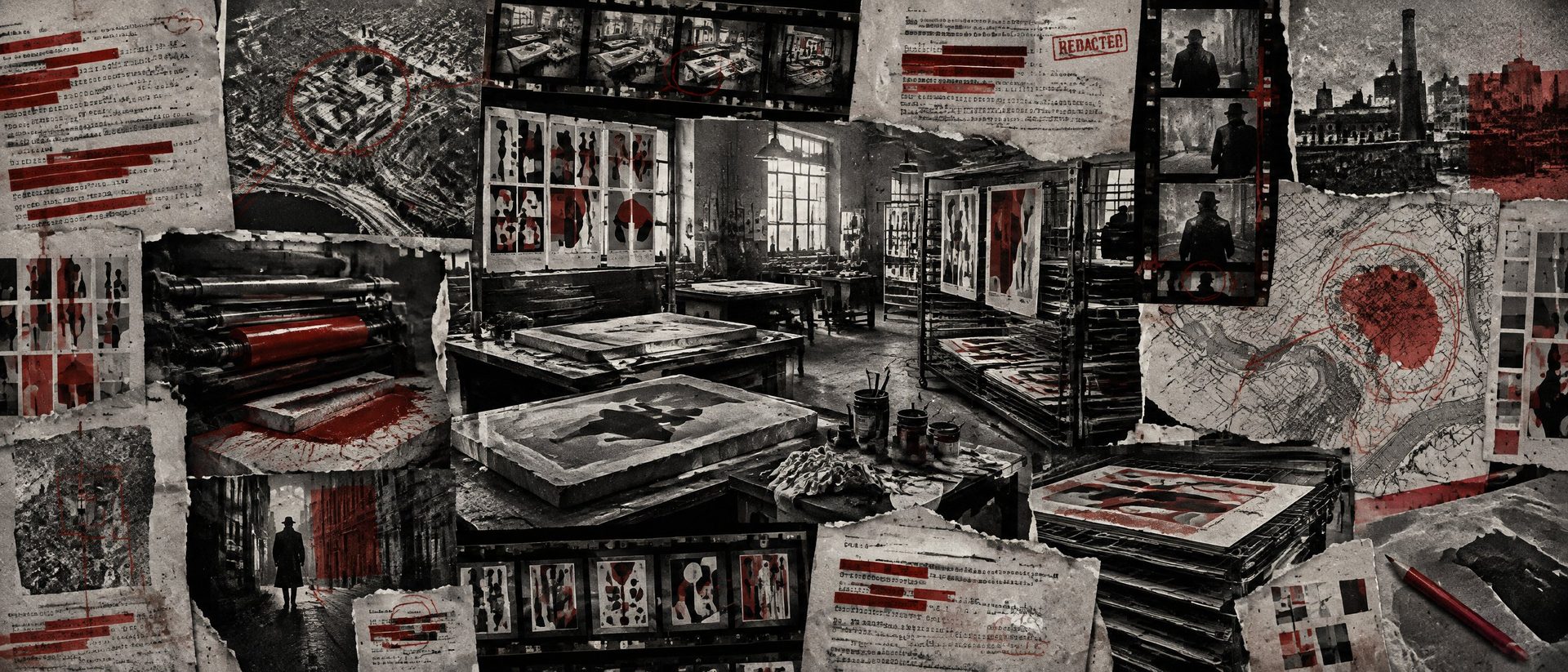
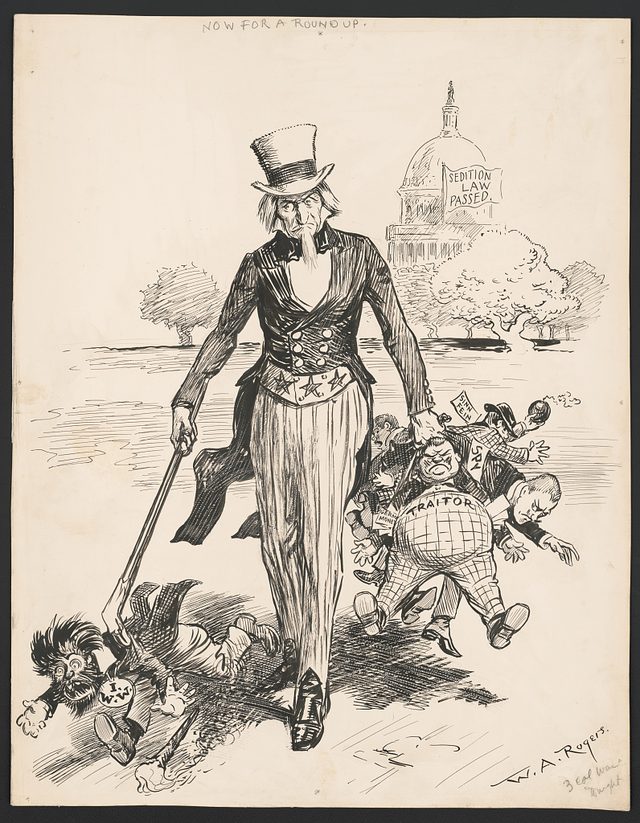
- United States, 1918. A cartoon by W. A. Rogers in the New York Herald of 9 May 1918, published as the Sedition Act of 1918 was passing Congress (it was signed on 16 May), shows Uncle Sam leaving the Capitol, under a banner reading "Sedition law passed", with a bundle of small figures labelled "Spy", "Traitor", "Sinn Fein", "I.W.W." and a tag that appears to read "Germ[an] money". A labour union is filed in one sack with spies and traitors. The Industrial Workers of the World was a real organisation with its own aims, and its leaders were prosecuted that year; the cartoon is evidence of how the war-time labels were bundled, not of what each member did.
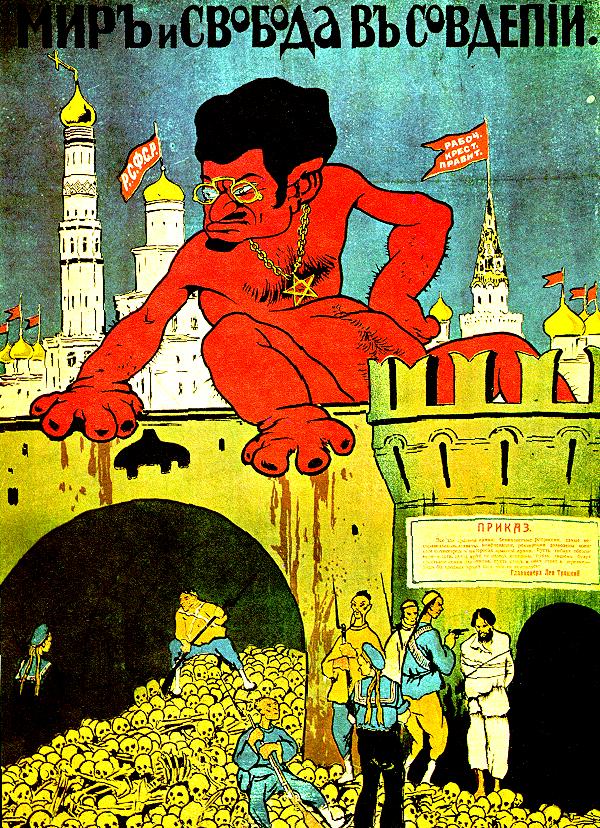
- Russian Civil War, 1919. A White movement poster, "Peace and Freedom in Sovdepia", draws Trotsky as a giant red figure with a Star of David pendant above the Kremlin. The Jewish origin of some Bolshevik leaders was turned into a charge against Jews as a whole. Historians note that most Russian Jews were not Bolsheviks; Jewish socialists were mostly in the Bund or among the Mensheviks. Content note: antisemitic caricature and an execution scene, shown as published.
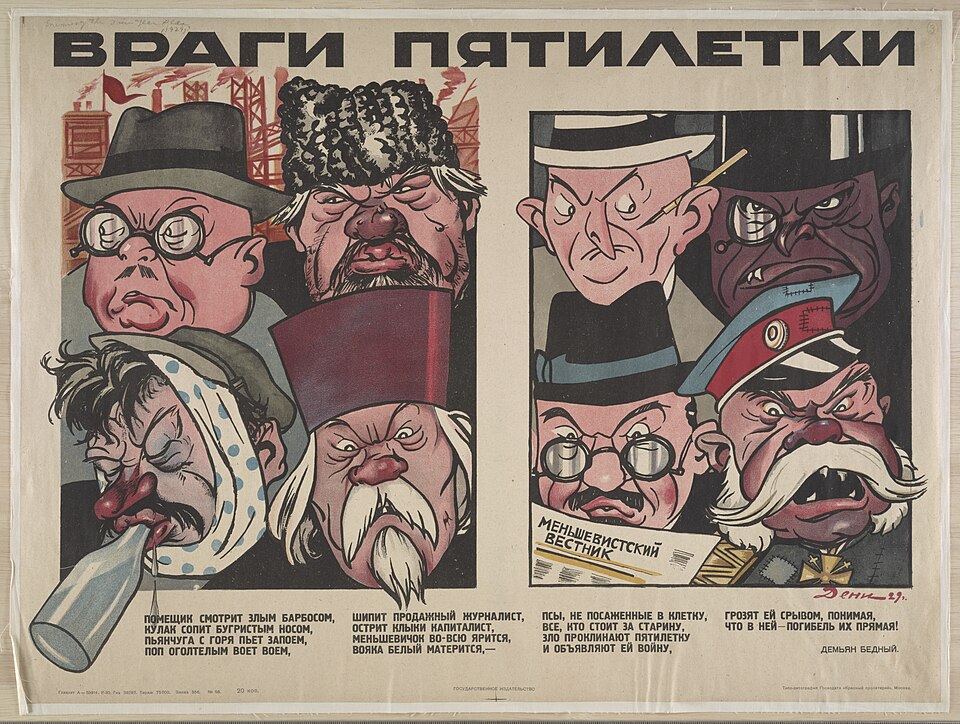
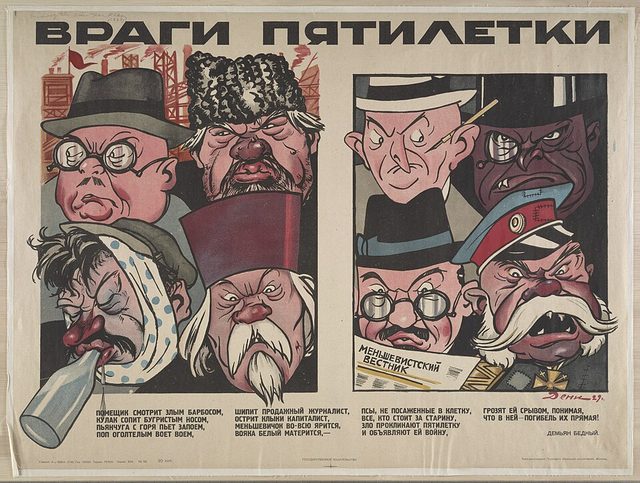
- Soviet Union, 1929. Viktor Deni and Demyan Bedny's poster "Enemies of the Five-Year Plan" crowds a landowner, kulak, priest, journalist, capitalist, Menshevik and White officer into one rhymed pack of "dogs not yet put in a cage". The groups have different histories and interests. The poster ties them together by the one thing they share, which is that the state blames them.
Show all 10Show fewer
- Soviet Union, 1934 to 1937. The law of 8 June 1934 added treason articles to the criminal code, including a provision (58-1c) under which adult relatives of a convicted "traitor to the Motherland" could be exiled for five years even if they had not known of the offence. In December 1935 Stalin said that "the son is not responsible for the father", a remark historians (Golfo Alexopoulos among them) note was not borne out in practice. NKVD Order No. 00486 of 15 August 1937, signed by Nikolai Yezhov, directed the arrest of wives of convicted "traitors" and prescribed camps of five to eight years, with "socially dangerous" children placed in camps or colonies. The state was not using an argument here; it was putting the fallacy into law.
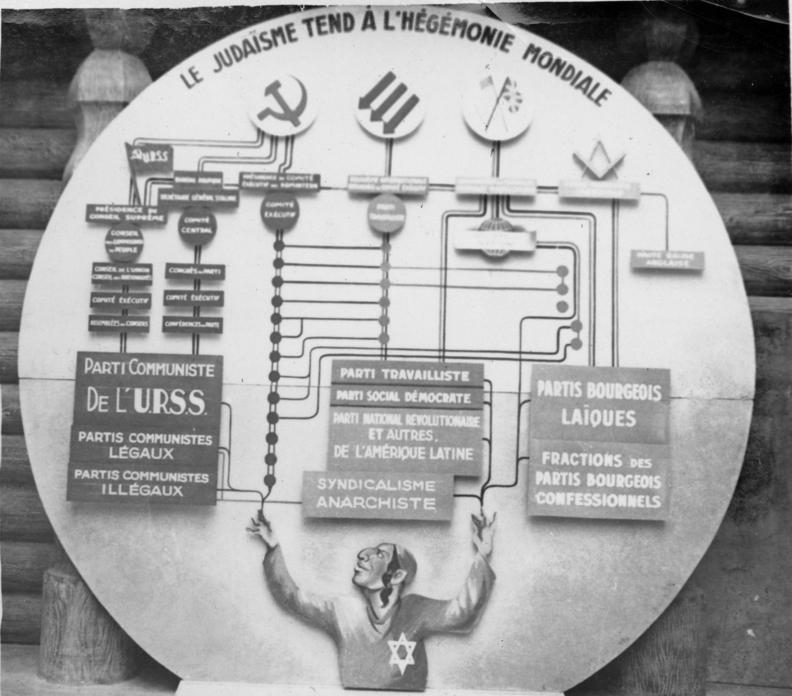
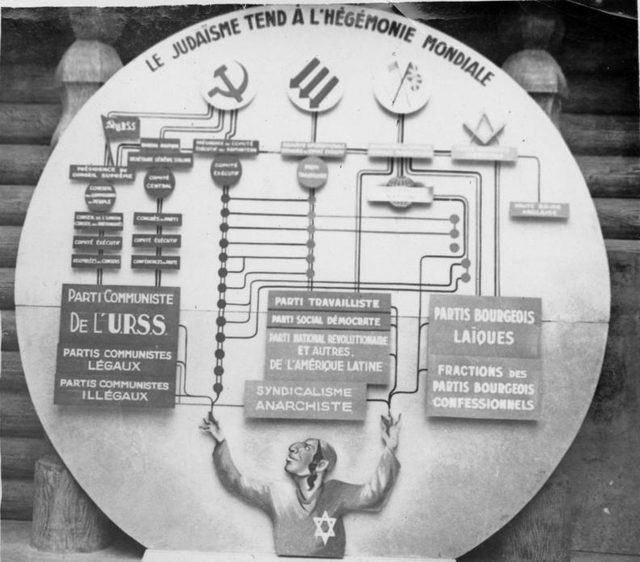
- Nazi-occupied Europe, 1942. A panel at the "Bolshevism against Europe" exhibition in Paris, photographed by the Federal Archive in March 1942, draws a wiring diagram from the Soviet Communist Party, Labour and Social Democratic parties, "bourgeois" parties and English high finance to a figure marked with a Star of David. Unrelated organisations are connected by lines to one group and presented as its creatures. The "Jewish Bolshevism" chain was used in Nazi speeches and army orders; on 12 September 1941 Field Marshal Keitel's OKW order "Jews in the Occupied Eastern Territories" (Nuremberg doc. NOKW-3292) said the struggle against Bolshevism demanded ruthless and energetic action, first of all against the Jews as its main bearers (paraphrased; translations vary). Content note: antisemitic propaganda, shown as exhibited.
- United States, 1947 to 1954. The federal loyalty programme (Executive Order 9835, 21 March 1947) allowed dismissal for "sympathetic association" with organisations the Attorney General listed as totalitarian, fascist, communist or subversive. The list was compiled without notice to the groups on it. When the House Un-American Activities Committee questioned Hollywood figures in October 1947, ten witnesses refused to answer questions about membership of the Screen Writers Guild or the Communist Party; the House voted 346 to 17 on 24 November 1947 to cite them for contempt, and on 25 November studio executives announced at the Waldorf-Astoria that the ten would not be employed until cleared. In June 1950 the journal Counterattack published Red Channels, listing 151 people in broadcasting and entertainment with the groups they had joined, signed or supported; many were blacklisted. Some listed people were Communist Party members and some were not; the list did not distinguish them. In the 1950 Maryland Senate race, a composite distributed by Senator Joseph McCarthy's staff showed Senator Millard Tydings beside Earl Browder, the former Communist Party leader, built from two photographs from 1938 and 1940. Tydings had not met Browder before Browder testified before his committee in 1950. On 9 June 1954, in the Army-McCarthy hearings, McCarthy raised the past membership of a young lawyer, Frederick Fisher, in the National Lawyers Guild; Army counsel Joseph Welch asked, "Have you no sense of decency, sir?" The Senate censured McCarthy 67 to 22 on 2 December 1954. The Supreme Court narrowed the legal use of membership in Scales v. United States (1961): the Smith Act's membership clause required membership that was "substantial and active, not passive or technical".
- China, 1966 to 1976. Under the "black categories" (landlords, rich peasants, counter-revolutionaries, bad elements and rightists, later extended) a person's class label was passed on to children and affected schooling, jobs and marriage. In January 1967 the student Yu Luoke published "On Family Background" against what he called the "blood lineage theory"; he was arrested in 1968 and executed in 1970 and was cleared in 1979. A related use of the collective label is the Central Committee notice of 18 October 1976 (Zhongfa [1976] No. 16), which named Wang Hongwen, Zhang Chunqiao, Jiang Qing and Yao Wenyuan as an "anti-Party clique"; the four were tried and convicted in 1980 to 1981, and the archive entry scores only the notice's wording.
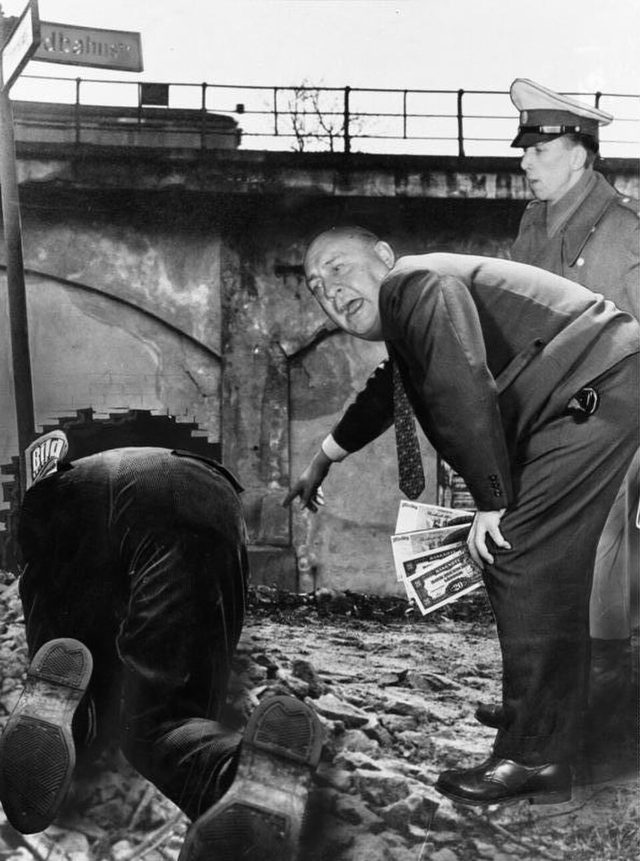
- East Germany, 1962. A press-agency photomontage captioned "The patron saint of the West Berlin espionage organisation Lemmer" shows a figure with the head of West German minister Ernst Lemmer pointing a crawling man to a painted tunnel mouth. The caption ties a named minister to an alleged agent channel with no evidence given. The archive entry does not test whether any such channel existed.
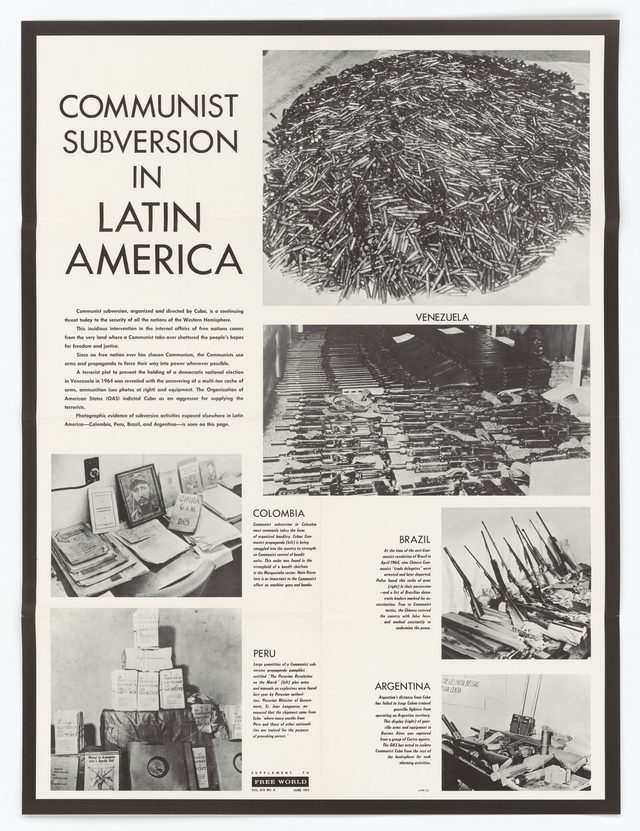
- United States, 1965. A U.S. Information Agency sheet distributed abroad (PPB-334) shows seized arms and pamphlets in Venezuela, Colombia, Peru, Brazil and Argentina under text saying Cuba organises and directs subversion in the hemisphere. Some seizures were real. The tell is the single frame: separate movements in five countries are presented as parts of one Cuban operation, and the sheet cites no source beyond its own captions.
- Online, 2010s to 2020s. The modern forms are the screenshot of who follows whom, the reposted post, the donor list, the shared conference stage, the guest on a podcast, and the list of "people who have platformed" someone. They are used against people of every political position. A pattern worth noting is the speed: the link is posted before anyone asks what the target said or did. Leo Strauss gave the extreme case a name in 1951 and 1953, reductio ad Hitlerum: "A view is not refuted by the fact that it happens to have been shared by Hitler."
Content note: Hostile photomontage of a named West German politician as a spy paymaster; no violence or slurs This object is shown as it was published. Why 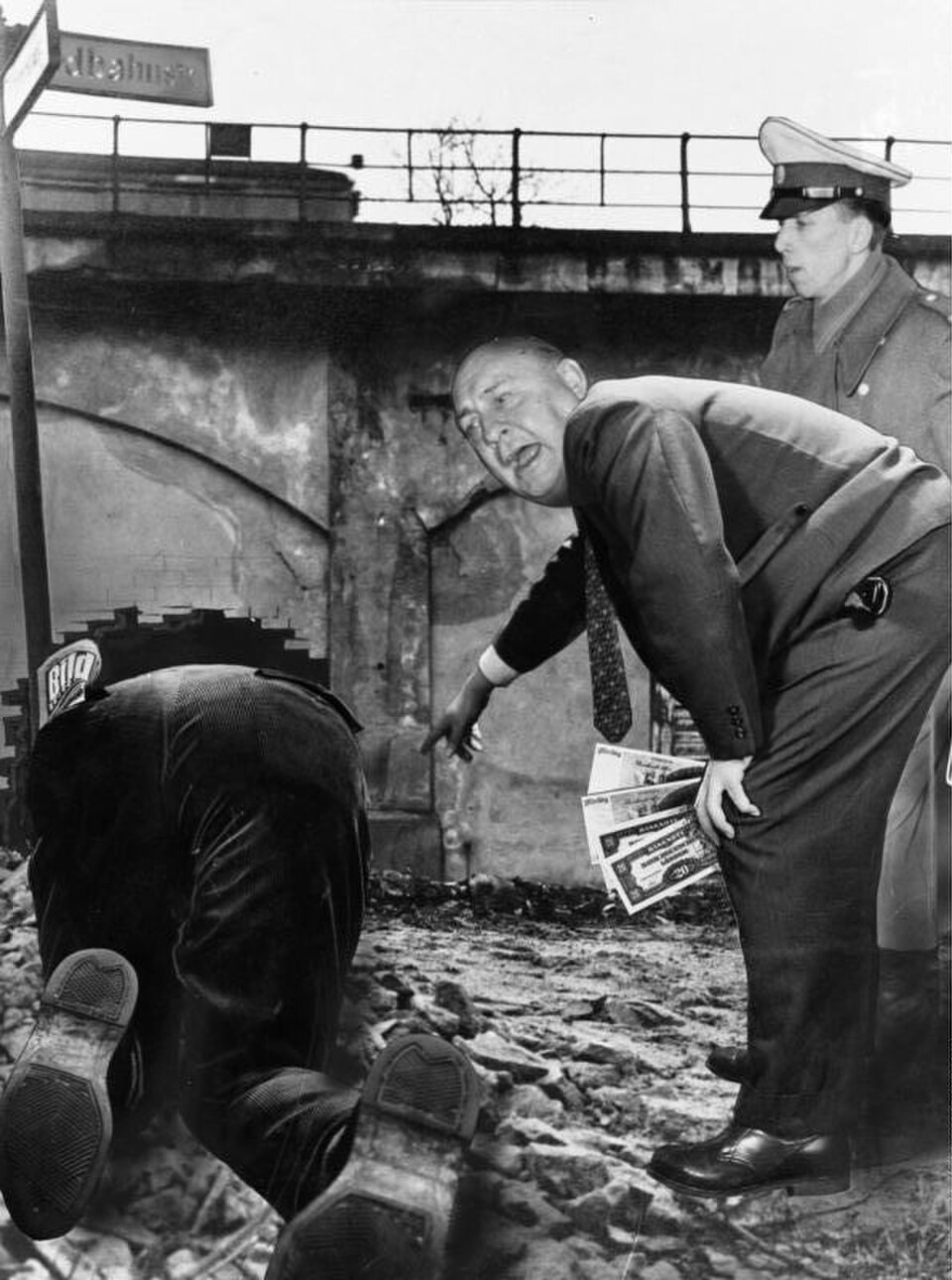
Explain moreShow less
"Now for a round-up", W. A. Rogers, New York Herald, 9 May 1918. Library of Congress, Prints and Photographs Division. Public domain (published before 1931).
"Peace and Freedom in Sovdepia", White movement poster, 1919, via Wikimedia Commons. Public domain. Content note: antisemitic caricature, shown as published.
"Enemies of the Five-Year Plan", Viktor Deni and Demyan Bedny, 1929, Duke University Libraries via Wikimedia Commons. Public domain (published before 1931).
Panel "Le judaïsme tend à l'hégémonie mondiale", exhibition "Le Bolchevisme contre l'Europe", Paris, March 1942. Bundesarchiv, Bild 183-2004-0211-500, CC BY-SA 3.0 DE. Content note: antisemitic propaganda, shown as exhibited.
Photomontage on Ernst Lemmer, Zentralbild (ADN), 9 February 1962. Bundesarchiv, Bild 183-90413-0001, CC BY-SA 3.0 DE.
How to spot Guilt by association propaganda
- Ask what the target itself did. Strip out the link. Is any evidence about the target's own conduct left?
- Test the strength of the link. Membership, attendance, a shared slogan and a surname are very different things. So are a leader, a donor and a signer of a petition.
- Check whether the anchor's guilt is itself shown. The 1918 bundle and the 1929 pack assert the anchor's guilt in a word.
Show all 6Show fewer
- Look for the sack. When unlike groups are placed under one label or diagram, a category is doing the work of an argument.
- Watch for the demand to prove a negative. "Name names" and "denounce X" turn a defence into another association.
- Look at the timing. If the link is published first and the facts later, the order is the technique.
Where it ends: edge cases and legitimate use
Association can be good evidence.
Association can be good evidence. Conspiracy law rests on agreement between persons, and a person who joined a plot, funded it or ran it is judged on that conduct. A documented office in an organisation that carried out the wrong (a commander of a unit, an officer of a party that ran a camp) is evidence of what that person did or allowed. Security vetting and conflict-of-interest rules look at links because some links create real risk, such as access to secrets or financial ties to a party in the case. A reference check asks about the company a person keeps because a track record is information. In all of these the link is tested against what it shows, is disclosed to the person, and can be rebutted.
The technique starts when the link replaces the proof: when passive or technical membership, a name, a photograph, or a relative's act is treated as the offence itself. The Scales standard is a legal version of this line. The difference in scale also matters. Some uses here only damaged reputations; others ended careers; others, such as the Soviet 1937 order and the Chinese class labels, took away liberty or lives for millions of people through state machinery. The page records all of these as cases of the same technique, and does not treat them as the same size.
Sources
- W. A. Rogers, "Now for a round-up", New York Herald, 9 May 1918, Library of Congress: loc.gov/item/2010717793.
- "Peace and Freedom in Sovdepia", White Army poster, 1919, Wikimedia Commons: commons.wikimedia.org. On the "Jewish Bolshevism" myth: Wikipedia, "Jewish Bolshevism": en.wikipedia.org/wiki/Jewish_Bolshevism.
- Viktor Deni and Demyan Bedny, "Enemies of the Five-Year Plan", 1929, Duke University Libraries via Wikimedia Commons (see the archive entry).
- Wikipedia, "Family members of a traitor to the Motherland" (1934 law; Alexopoulos on Stalin's December 1935 remark): en.wikipedia.org. Wikipedia, "NKVD Order No. 00486": en.wikipedia.org. Also communistcrimes.org, "Collective punishment of kin under Stalin": communistcrimes.org.
- Bundesarchiv, Bild 183-2004-0211-500 (Paris exhibition panel, March 1942), via Wikimedia Commons (see the archive entry).
- Executive Order 9835, 21 March 1947, and the Attorney General's List: Wikipedia, "Executive Order 9835": en.wikipedia.org.
- Wikipedia, "Hollywood Ten": en.wikipedia.org. Wikipedia, "Red Channels": en.wikipedia.org. Wikipedia, "Millard Tydings": en.wikipedia.org. Wikipedia, "Army-McCarthy hearings": en.wikipedia.org.
- Scales v. United States, 367 U.S. 203 (1961), decided 5 June 1961: en.wikipedia.org.
- Wikipedia, "Five Black Categories": en.wikipedia.org. Wikipedia, "On Class Origins" (Yu Luoke): en.wikipedia.org.
- Central Committee of the CCP, Zhongfa [1976] No. 16, 18 October 1976, via Wikimedia Commons (see the archive entry).
- Bundesarchiv, Bild 183-90413-0001 (ADN photomontage on Ernst Lemmer, 9 February 1962), via Wikimedia Commons (see the archive entry).
- U.S. Information Agency, "Communist Subversion in Latin America", PPB-334, 1965, National Archives (NAID 6949259): catalog.archives.gov/id/6949259.
- Skowronski, J. J., Carlston, D. E., Mae, L. and Crawford, M. T. (1998), "Spontaneous trait transference", Journal of Personality and Social Psychology 74(4). Leo Strauss, Natural Right and History (1953); see Wikipedia, "Reductio ad Hitlerum": en.wikipedia.org.
Sourcing note (11 October 2026): dates and figures for the Hollywood Ten, Red Channels, the Tydings composite, the Welch exchange, EO 9835, Order 00486, the black categories and Yu Luoke were read from the Wikipedia articles listed and should be checked against primary sources before wider use. The "Scales" quotation is as given on the case article. The Skowronski citation and the Strauss quotation are from memory and the Wikipedia article respectively; check the journal reference. The Keitel order is as reported on the "Jewish Bolshevism" article. A different Scales passage ("guilt is personal") was not verified and is not quoted. The couplet associated with the Red Guards' "blood lineage theory" was not verified and is left out.
Sources and further reading
The science
Research on the psychology this technique relies on, from the Learn library:
Research on the psychology this technique relies on, from the Learn library:
- Disgust — Disgust
- Affect heuristic — Affect heuristic
- Out-group homogeneity — Out-group homogeneity
- Continued influence effect — Continued influence effect
![中共中央通知 中发〔1976〕16号 (CCP Central Committee Notice, Zhongfa [1976] No. 16), first page](../../collection/images/zhongfa-16-notice-wang-zhang-jiang-yao-clique-1976-640.jpg)