Content note. This page describes coerced public denunciation, extrajudicial "re-education through labor" sentences, and deaths from starvation in a labor camp, and it notes suicides among people labeled "rightists," a pattern recorded throughout the memoir and scholarly literature on the campaign without a reliable national count. It quotes political labels used to condemn real people ("rightist," "poisonous weed," "China's number one rightist"). The labels are quoted as evidence of the method, not as this archive's judgment of anyone.
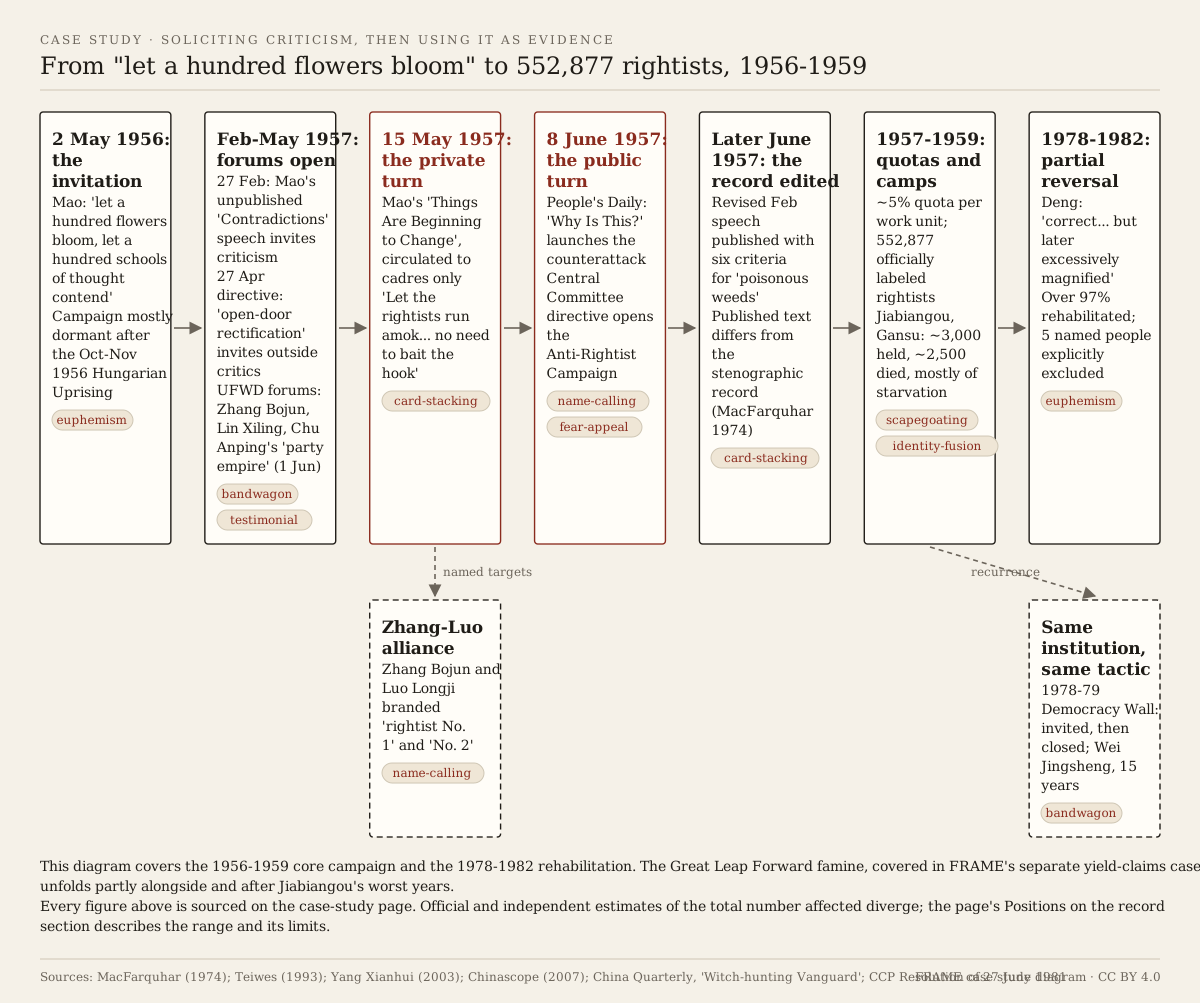
In one line: from May 1956 the Chinese Communist Party invited non-Party intellectuals to criticize it under the slogan "let a hundred flowers bloom, let a hundred schools of thought contend"; when the criticism went further than the leadership wanted, Mao privately described the goal as letting "rightists run amok" until they had "surfaced," and from 8 June 1957 the Party used the same speeches, forum transcripts and newspaper columns it had solicited as the evidence to brand over half a million people "rightists," sending many to labor camps for the rest of the Mao era.
What happened
The invitation (1956 - early 1957)
- 2 May 1956. At the Supreme State Conference, Mao Zedong gives the campaign its lasting slogan: "let a hundred flowers bloom, let a hundred schools of thought contend" (百花齐放,百家争鸣) — a "double hundred" policy inviting debate in the arts and sciences, elaborated soon after by Propaganda Department head Lu Dingyi to Party and non-Party audiences.
- Autumn 1956. The campaign stays largely dormant. The Hungarian Uprising of October-November 1956, following Khrushchev's "Secret Speech" earlier that year, alarms the CCP leadership: intellectual ferment in a Soviet-bloc state had turned into an armed uprising against Communist rule. Standard accounts (MacFarquhar 1974) read the caution of late 1956, and the more forceful invitation that follows in early 1957, as bound up with the leadership's wish to find out — and defuse — dissatisfaction in China before it could take a similar shape.
- 27 February 1957. Mao delivers a lengthy, informal address to the Supreme State Conference, "On the Correct Handling of Contradictions Among the People" (关于正确处理人民内部矛盾的问题), arguing that disagreements between the Party and the people are "non-antagonistic contradictions" to be resolved through "unity — criticism — unity," not suppression. The speech is not published at the time; only a stenographic transcript, circulated to cadres, records what Mao actually said. (See below on the version published four months later.)
- 27 April 1957. The Central Committee issues a "Directive on the Rectification Movement" (关于整风运动的指示), opening a Party-wide rectification against bureaucratism, sectarianism and subjectivism and — departing from the closed, cadres-only rectification FRAME documents at Yan'an in 1942-45 (The Yan'an Rectification Movement: doctrine, self-criticism and the Rescue Campaign (1942-1945)) — explicitly inviting people outside the Party to help "supervise" it. The press calls this "open-door rectification" (开门整风).
The forums (May-early June 1957)
- From early May 1957. The CCP's United Front Work Department, headed by Li Weihan, convenes a series of forums (座谈会) with the leaders of China's eight minor "democratic parties" — non-Communist parties tolerated under the united-front system, such as the China Democratic League and the China Democratic National Construction Association — and with unaffiliated intellectuals. People's Daily and Guangming Daily (the paper nominally run by the democratic parties) print the proceedings.
- Mid-May 1957. At one such forum, Zhang Bojun, a Democratic League leader and the minister of communications, proposes that a "political design institute" review major state decisions alongside the Party and the National People's Congress — read at the time, and denounced soon after, as a challenge to the Party's monopoly on policymaking. Zhang and fellow Democratic League leader Luo Longji, a former NPC standing-committee figure, become identified as the "Zhang-Luo alliance" (章罗联盟); the campaign later brands Zhang "China's number one rightist" and Luo "China's number two rightist."
- May 1957. At Peking University and People's University, the 21-year-old law student Lin Xiling tells successive campus meetings that "our country is undemocratic and not genuinely socialist," that the Party and Communist Youth League "have become a privileged class," and calls for "real socialism." Her speeches circulate as recordings and transcripts among students.
- 1 June 1957. At a Central Committee United Front forum, Chu Anping — a non-Party journalist the CCP had made editor-in-chief of Guangming Daily — delivers a speech arguing that the country under Communist rule had become a "party empire" (党天下), with every appointment at every level requiring Party approval regardless of the individual's ability or loyalty to the state as opposed to the Party. People's Daily and Guangming Daily both publish the full text the next day, with banner headlines.
- Through the same weeks the writer Ding Ling, already a Party member and a Stalin Prize-winning novelist, argues publicly that literature should be guided by writers rather than Party bureaucrats — a position that, within a month, becomes evidence against her.
The reversal (15 May - June 1957)
- 15 May 1957. Mao circulates "Things Are Beginning to Change" (事情正在起变化) to Party cadres only — not published at the time. It reframes the flood of criticism as the moment for hidden enemies to expose themselves: "We shall let the rightists run amok for a time and let them reach their climax... Now that large numbers of fish have come to the surface of themselves, there is no need to bait the hook." The document sets the campaign's internal logic three weeks before any public sign of a turn.
- 8 June 1957. People's Daily publishes the editorial "Why Is This?" (这是为什么), opening the public counterattack: the editorial frames the question of why "a small number of rightists" had "attacked" the Party and socialism as already answered, treating the criticism itself as proof of hostile intent rather than as something to be assessed on its content. The same day, the Central Committee circulates a directive formally launching the Anti-Rightist Campaign (反右派运动). A later People's Daily editorial (1 July 1957) states that from 8 May to 7 June the Party press had, "following the directive of the Central Committee," printed little or no rebuttal of the criticism it was carrying — an acknowledgment that the "blooming" period's one-sidedness had itself been centrally managed.
- Later in June 1957. A revised text of Mao's 27 February speech is published as "On the Correct Handling of Contradictions Among the People," now including six criteria (六条标准) for judging whether a piece of speech is a "fragrant flower" or a "poisonous weed" (香花 / 毒草) — most decisively, whether it helps or harms "the leadership of the Communist Party" and the socialist path. Comparing the published text against the original stenographic transcript, the historian Roderick MacFarquhar (1974) finds substantial differences between what Mao said in February and what the Party now presented as having been said — the test used to condemn the spring's criticism was not fully in circulation when that criticism was invited.
The purge (summer 1957 - 1959)
- Summer-autumn 1957. Work units — universities, ministries, newspapers, factories — are assigned informal targets for how many "rightists" they must identify, generally understood at around 5 percent of staff. Under pressure to meet the target, units resorted to labeling people for complaints made in private or overheard secondhand (mocked at the time as "bathroom rightists") and, in some documented cases, people who volunteered the label under pressure to protect others ("volunteer rightists").
- 1957-58. Chu Anping is denounced by name, stripped of his editorship and Party-adjacent posts, and formally labeled a rightist by January 1958. He disappears during the Cultural Revolution in 1966; his fate has never been officially established. Zhang Bojun and Luo Longji are removed from their government posts and denounced as the "Zhang-Luo alliance," although later scholarship finds no evidence they sought to overthrow Communist rule rather than to change how it was exercised. Lin Xiling is formally labeled a rightist in June 1957, expelled from Renmin University in February 1958, kept on campus as a "negative example" under labor supervision, then arrested in August 1958 and sentenced to 15 years. Ding Ling is denounced daily through June 1957, expelled from the Party, labeled a rightist, and sent to the Great Northern Wilderness (北大荒) for labor; she is imprisoned again during the Cultural Revolution.
- By the campaign's formal end, an official tally used in later Party and scholarly accounting puts the number of people labeled "rightists" at 552,877 — a figure that excludes people given adjacent labels such as "middle rightist" or "anti-socialist element," and excludes family members who lost jobs, schooling or Party membership by association. Because of that undercount, historians' estimates of the total affected run considerably higher, from roughly a million to, by some broader countings that include the later Socialist Education Movement, several million; no single number is authoritative, and this page does not adopt one as fact beyond the official count.
- 1957-1961, Jiabiangou, Gansu. Among the destinations for labeled rightists sentenced to "re-education through labor" (劳动教养, laojiao) — an administrative, non-judicial sentence — was a state farm at Jiabiangou in the Gobi Desert. It held roughly 3,000 people at its peak; by the camp's closure in 1961, as the Great Leap Forward famine (The Great Leap Forward's 'sputnik' harvests and the famine that followed) reached the region, roughly 2,500 of them had died, overwhelmingly of starvation. The writer Yang Xianhui reconstructed the camp's history from more than 100 survivor interviews conducted over three years in the 1990s and early 2000s, published as Chronicles of Jiabiangou (2003; an English-language selection appeared as Woman from Shanghai, 2009); the filmmaker Wang Bing later drew on the same testimony for the documentary Dead Souls (2018) and the dramatized feature The Ditch (2010).

Locator map of the two places the page names: Beijing, where the 1957 forums and editorials were run, and the approximate site of the Jiabiangou labour farm in Gansu. Drawn for FRAME from Natural Earth data (make_cs7_maps.py); Jiabiangou's position is approximate.
The partial reversal (1978-1982)
- December 1978. As the Party reviews Mao-era verdicts under Deng Xiaoping, Deng states that "the anti-rightist struggle in 1957 was correct, but it was later excessively magnified" — accepting the campaign's premise while conceding its scope had gone too far. Deng had himself been the Central Committee's General Secretary in 1957, and the Central Secretariat he headed is documented as having directed much of the campaign's practical conduct at the center.
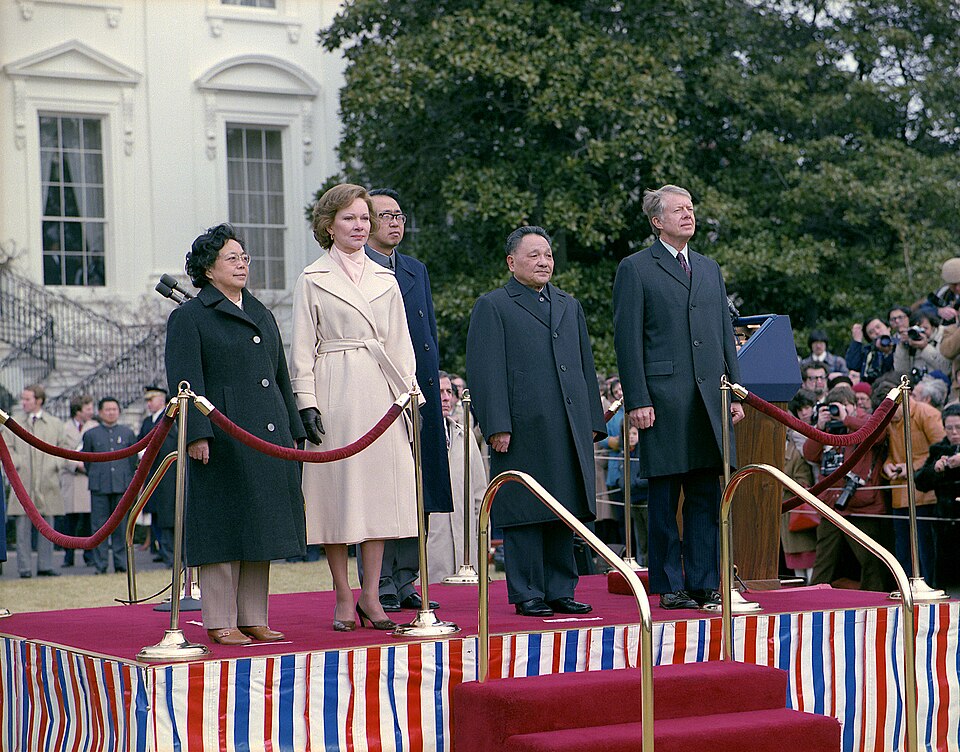
Madame Zhuo Lin, Rosalynn Carter, Deng Xiaoping and Jimmy Carter (left to right) at the White House arrival ceremony for Deng's state visit, 29 January 1979. White House Staff Photographers (Carter administration), U.S. National Archives identifier 183155, via Wikimedia Commons. Public domain (U.S. federal government work). The page names Deng as the Party official directing the campaign at the centre in 1957 and as author of the December 1978 "correct but excessively magnified" formula. - 1978-1980. In a review conducted alongside the broader Boluan Fanzheng ("bringing order out of chaos") process, the Party formally lifts the "rightist" label from the great majority of the 552,877 officially counted — by most later accounts, well over 97 percent of them. The government explicitly declines to reverse the verdicts against a small number of people, including five of the campaign's best-known targets: Zhang Bojun, Luo Longji, Chu Anping, Peng Wenying and Chen Renbing. - 27 June 1981. The Central Committee's "Resolution on Certain Questions in the History of Our Party" states that the anti-rightist struggle "was necessary" in principle but suffered "seriously broadened scope" (严重扩大化), wrongly labeling "a number of intellectuals, patriotic people and Party cadres" who had made well-intentioned criticism. The same term — 扩大化, "excessive broadening" — is the Party's standing euphemism for the campaign's error; it names no specific reversed verdict and gives no death toll.

How it works
- Euphemism / doublespeak: "open-door rectification" (开门整风) presented an invitation to criticize the Party as an act of ordinary Party self-improvement, borrowing the vocabulary of Yan'an's rectification (The Yan'an Rectification Movement: doctrine, self-criticism and the Rescue Campaign (1942-1945)) for a wider, non-Party audience. "Re-education through labor" (劳动教养) named an administrative sentence, decided without trial, that could run for years. The Party's own later verdict — "seriously broadened scope" (严重扩大化) — names an error of degree, not the specific labels it reversed or the people who died under them.
- Card stacking: the version of Mao's 27 February 1957 speech published in June, now carrying the six criteria for "poisonous weeds," differs from the stenographic record of the address as actually delivered — a textual gap first established by MacFarquhar's 1974 comparison of the two texts. A test devised after the criticism was gathered was presented as though it had governed the invitation from the start.
- Bandwagon: Mao's 15 May internal memo described the flood of criticism as proof that hidden rightists were "surfacing" of their own accord ("there is no need to bait the hook"), and the quota system that followed treated a fixed percentage, assigned in advance, as if it measured a real, pre-existing population rather than producing one to order.
- Name-calling: "rightist" (右派) and, in the June criteria, "poisonous weed" functioned as verdicts on a person's speech rather than replies to what it said. Chu Anping's specific argument about appointments went unanswered on its merits; what followed was the label "anti-Party anti-people anti-socialist bourgeois rightist."
- Fear appeal: once the reversal began, a cadre or student who had spoken in the spring, or who now stayed silent about a colleague, faced an open-ended threat with no stated ceiling, while naming others — or offering a fuller self-criticism — held out the only visible way to limit the consequences. This is the same leniency-for-confession, severity-for-silence logic FRAME documents in the Yan'an Rescue Campaign of 1943 (The Yan'an Rectification Movement: doctrine, self-criticism and the Rescue Campaign (1942-1945)), applied nationally, in public, to a much larger population fifteen years later.
- Identity fusion: after 8 June, arguing that a criticism had been offered in good faith, or defending a friend's right to have made it, was itself read as evidence of rightist sympathy. The test in practice was not whether a claim about cadre privilege or bureaucratism was accurate, but whether continuing to hold it after the reversal put the speaker on the wrong side.
- Scapegoating: the campaign assigned blame for the same institutional problems the spring's criticism had named — bureaucratism, cadre privilege, shortages — to a newly bounded population of "hidden bourgeois rightists," rather than to the practices the criticism had described.
- Testimonial: denunciation meetings, such as the daily sessions that "enumerated Ding Ling's crimes" through June 1957, put a target's own extracted self-criticism before an audience as proof of guilt — the same device FRAME's Yan'an page and the Moscow show trials (below) both document, run again on a wider stage.
Colour. This was white propaganda throughout: the People's Daily editorials, the published record of Mao's speeches, and the campaign's own vocabulary all carried the Party's name openly. What was not disclosed at the time was the internal document — "Things Are Beginning to Change" — that set the campaign's actual logic three weeks before the public reversal; readers of the June and July press saw only the finished framing, not the private memo behind it.
Then and now
The direct institutional ancestor of the forum-and-self-criticism machinery used here is the CCP's own Yan'an Rectification Movement of 1942-45, which FRAME documents separately (The Yan'an Rectification Movement: doctrine, self-criticism and the Rescue Campaign (1942-1945)): the small-group study, the repeated self-examination, and the "leniency for confession, severity for resistance" formula all migrate from that closed, cadres-only campaign into 1957's much larger, partly public one.
After, within the same institution. Less than two years after Deng Xiaoping began reviewing 1957's labels, the same Party permitted, then closed, a second bout of invited public criticism. From late 1978, citizens in Beijing posted handwritten essays on a wall on Xidan Street ("Democracy Wall"), initially tolerated — even encouraged, as material Deng's faction used against rivals associated with the Cultural Revolution. In December 1978 the electrician Wei Jingsheng posted "The Fifth Modernization: Democracy," arguing that Deng's programme of Four Modernizations needed democratic rights alongside it. Wei was arrested in March 1979 and, in October 1979, sentenced to 15 years for counterrevolutionary crimes; the wall itself was progressively restricted and effectively closed by December 1979 (Merle Goldman, From Comrade to Citizen, Harvard University Press, 2005, covers the episode in full). The differences from 1957 are real — Democracy Wall's opening was improvised rather than announced as a rectification of the Party itself, and no mass quota-driven labeling campaign followed — but the shape recurs: a channel for public criticism is opened by the leadership, used for a purpose the leadership wanted, and closed once it goes further than that, with the people who went furthest singled out for the heaviest sentences.
A standing modern form. China's petitioning system (信访, xinfang) offers citizens an official channel to report grievances against local officials, a mechanism that has existed continuously since 1951 and remains active today. Legal scholarship on the system, including Carl Minzner's work on xinfang, and human-rights reporting including that of Human Rights Watch have long documented that persistent petitioners, rather than the officials they complain about, are frequently the ones detained — informally, in unofficial "black jails," or subjected to local "stability maintenance" measures — precisely because they used the channel the state provided. The Congressional-Executive Commission on China's annual reports track this pattern across successive years. The scale is different — this is routine, decentralized local repression rather than a named national campaign with a published quota — but the underlying trap is the same one 1957 ran at national scale: inviting a grievance through an official channel, then treating the act of voicing it as the offense.
Positions on the record
- The Party's position in 1957. The 8 June 1957 editorial and the campaign that followed presented the reversal as the unmasking of a pre-existing "bourgeois rightist" attack on socialism and Party leadership, not as a change of policy. Mao's internally circulated writings from the same weeks describe the strategy explicitly as one of letting critics "run amok" so they could be identified — language the Party did not publish at the time.
- The Party's later position. Deng Xiaoping's December 1978 formula — the campaign was "correct" in 1957 but "later excessively magnified" — set the boundary the 1978-1982 rehabilitation worked within: the great majority of individual labels were lifted, but the campaign's necessity in principle was not disavowed, and five named individuals were explicitly excluded. The Central Committee's 27 June 1981 "Resolution on Certain Questions in the History of Our Party" repeats this framing in nearly identical terms, using "seriously broadened scope" for the campaign's error.
- Scholarship. Roderick MacFarquhar's The Origins of the Cultural Revolution, Vol. 1: Contradictions Among the People, 1956-1957 (Columbia University Press, 1974) remains the standard account of the campaign's turn and the textual comparison between Mao's February speech and its June publication; MacFarquhar reads the reversal as substantially a reaction to how far the spring's criticism actually went, rather than a plan fixed from the start. Frederick Teiwes, whose Politics and Purges in China (2nd ed., M. E. Sharpe, 1993) also covers the Yan'an-era rectification pattern cited above, situates 1957 within a longer CCP sequence of soliciting, then punishing, internal criticism. A China Quarterly article, "Witch-hunting Vanguard: The Central Secretariat's Roles and Activities in the Anti-Rightist Campaign," documents the Secretariat's — and so Deng Xiaoping's — operational role in directing the purge at the center. Work in the Journal of Chinese History on "Quota, Class, and Political Violence in Mao's China" analyzes the quota mechanism described above as a general feature of Mao-era campaigns, not unique to 1957.
- What is documented. The dates and content of Mao's public and internal statements; the 8 June 1957 editorial and the Central Committee directive of the same day; the textual difference between the February speech as delivered and as published in June; the official count of 552,877 labeled rightists; the ~5 percent quota reported in contemporary and later accounts; Jiabiangou's roughly 3,000 held and roughly 2,500 dead, as reconstructed from survivor testimony; and the 1978-1982 rehabilitation, including the five names explicitly excluded from it.
- What is contested. How far above the official 552,877 the true number of people affected ran — estimates in the secondary literature range from roughly a million to several million, depending on whether adjacent labels, the Socialist Education Movement, and affected family members are counted, and no figure in that range is independently verifiable. Whether the entrapment was planned from the outset, as Mao's own later boast that he had run an "open conspiracy" (阳谋) suggests, or substantially improvised in response to the scale of criticism, as MacFarquhar's textual analysis leans toward, is argued differently by different historians. No reliable national count exists for deaths, including suicides, among people labeled rightists between 1957 and the Cultural Revolution; Chu Anping's own 1966 disappearance and presumed death is undocumented in its specifics.
- Not ruled on here. Whether the specific policy positions the spring's critics argued for — a stronger role for the minor parties, more legal protection, less cadre privilege — were themselves correct is a separate question from how the campaign identified and punished the people who raised them. This page scores the solicitation-then-punishment mechanism, not that underlying political argument.
Same-method test
The clearest comparison is the Moscow show trials of 1936-1938, which FRAME documents separately (The Moscow show trials: confession, spectacle and consent (1936-1938)): NKVD interrogators produced confessions from Nikolai Bukharin, Grigory Zinoviev, Lev Kamenev and others, which prosecutor Andrei Vyshinsky then read into the record of open, foreign-observed trials as proof of a hidden anti-Soviet bloc. As in 1957, a broad accusatory category was defined from the center first, and membership in it was then established through a target's own produced statements rather than through evidence of a specific act — Khrushchev's 1956 "Secret Speech" and the Soviet Union's own posthumous rehabilitations later confirmed the confessions were false, just as China's own 1978-1982 review found the great majority of 1957's "rightist" labels unsustainable.
A related, less exact parallel is the Night of the Long Knives in Nazi Germany (30 June - 2 July 1934): Hitler ordered the killing of SA leader Ernst Röhm and dozens of others, retroactively described as suppressing an alleged "Röhm Putsch" conspiracy and legalized after the fact by the 3 July 1934 "Law Regarding Measures of State Self-Defense." As with 1957, a loosely defined, broad category of the newly disloyal was announced and struck at simultaneously, with the announcement itself doing much of the work a specific charge would otherwise have to do; unlike 1957, there was no antecedent phase of officially soliciting the eventual victims' own public statements, and no comparable later institutional review reversed any of the verdicts.
The scale and mechanism of correction differ sharply across all three. The Moscow trials' victims were executed, reversed only decades later; the SA leadership's killings were never reversed by the Nazi state at all; 1957's victims were, in the large majority of cases, alive to see their own rehabilitation within a generation, inside the same Party that had labeled them, even as five of the best-known were deliberately left unreversed.
How to spot it
- Ask whether the invitation to criticize came with any stated limit — in time, in subject, or in how the criticism would be used. Where none is given, as in 1957, the absence itself is not neutral: it leaves the inviting party free to decide, after the fact, that a limit was implied all along.
- Check whether the document that justifies a reversal was written and circulated privately before the reversal was announced publicly. Mao's 15 May memo predates the 8 June public break by three weeks; comparing the private and public timelines shows which one was actually driving events.
- Watch for a rule announced after the fact being applied to speech already given. The June "six criteria" for judging a "poisonous weed" were published four months after the speech they were retroactively used to justify.
- Notice a numeric quota assigned to a "problem" category before any count of real cases exists. If a unit must produce a fixed percentage of a named type of offender, the resulting count will match the assignment, not the underlying reality.
- Ask who reviews the labels afterward, how long it takes, and whether the review reaches everyone equally. Here it took two decades, cleared the overwhelming majority quickly once begun, and still left named exceptions on the books.
Images
| Image | Source | Licence |
|---|---|---|
| Mechanism diagram (above) | Drawn for FRAME from this page's sourced facts (make_diagrams_apparatus_antirightist.py) |
CC BY 4.0, FRAME |
| Deng Xiaoping at the White House, 29 January 1979 | Wikimedia Commons; White House Staff Photographers, NARA 183155 | Public domain (U.S. federal government work) |
| Locator map (Beijing, Jiabiangou) | Drawn for FRAME from Natural Earth data (make_cs7_maps.py) |
Public domain data; drawing CC BY 4.0, FRAME |
Image gaps
- Photographs of Mao Zedong delivering the February 1957 speech, or of the June 1957 United Front forums. PRC-origin 1956-57 photographs of this kind exist in Chinese archives and on Wikimedia Commons, but Chinese works still under copyright in China on 1 January 1996 had their U.S. copyright restored under the URAA, so none could be verified as safely U.S. public domain. Not fillable without a documented U.S. public-domain rationale. The one real photograph hosted here (Deng Xiaoping, 1979) comes from a U.S. federal source and shows him twenty-two years after the campaign.
- The People's Daily front pages of 8 June and the later June 1957 issue carrying the revised "Correct Handling of Contradictions" text. Same URAA uncertainty as above; not hosted.
- Photographs of Chu Anping, Zhang Bojun, Luo Longji, Lin Xiling or Ding Ling. No openly licensed, U.S.-public-domain photograph of any of the five was verified. A 1926 photograph of Ding Ling with Hu Yepin exists on Commons but is only 187 by 240 pixels, and its first publication is undocumented, so it was not hosted: commons.wikimedia.org/wiki/File:Hu_Yepin_and_Ding_Ling.jpg. Possibly fillable with further research into post-1996 photographs or U.S.-published editions of their work.
- Jiabiangou labor camp: the site today, or Wang Bing's documentary/dramatized film stills. A Commons search for Jiabiangou returned no image of the site, and Wang Bing's films are not openly licensed. Not fillable on current terms.
- Democracy Wall, 1978-79, and Wei Jingsheng. Referenced in "Then and now" as a comparison. A Commons search for the 1979 Xidan wall returned only Hong Kong university "democracy walls" of 2018-21, not the Beijing wall, so no image is hosted.

Sources
- Mao Zedong, "On the Correct Handling of Contradictions Among the People" (关于正确处理人民内部矛盾的问题), delivered 27 February 1957, published in revised form, People's Daily, June 1957; English translation in Selected Works of Mao Tse-tung, vol. 5 (Peking: Foreign Languages Press, 1977).
- Mao Zedong, "Things Are Beginning to Change" (事情正在起变化), 15 May 1957, in Selected Works, vol. 5: marxists.org.
- Central Committee of the Chinese Communist Party, "Directive on the Rectification Movement" (关于整风运动的指示), 27 April 1957.
- People's Daily (人民日报), editorial "Why Is This?" (这是为什么), 8 June 1957; editorial of 1 July 1957 acknowledging the Central Committee's direction of the preceding weeks' press coverage.
- Roderick MacFarquhar, The Origins of the Cultural Revolution, Vol. 1: Contradictions Among the People, 1956-1957 (New York: Columbia University Press, 1974).
- Frederick C. Teiwes, Politics and Purges in China: Rectification and the Decline of Party Norms, 1950-1965, 2nd ed. (Armonk, NY: M. E. Sharpe, 1993).
- "Witch-hunting Vanguard: The Central Secretariat's Roles and Activities in the Anti-Rightist Campaign," The China Quarterly, Cambridge University Press: cambridge.org.
- "Quota, Class, and Political Violence in Mao's China," Journal of Chinese History, Cambridge University Press: cambridge.org.
- "Luo Longji and the Fate of Chinese Liberalism, 1919-1965," The Historical Journal 68 (2025), Cambridge University Press: cambridge.org.
- China Heritage, "The Party Empire," on Chu Anping's 1 June 1957 speech: chinaheritage.net.
- Chinascope, "Purging One Hundred Flowers — The 50th Anniversary of China's Anti-rightist Campaign" (2007), on the quota system and official rightist count: chinascope.org.
- Laogai Research Foundation, prisoner account of Lin Xiling: laogairesearch.org.
- Yang Xianhui, Chronicles of Jiabiangou (夹边沟记事) (Guangzhou: Guangzhou Publishing House, 2003); English selection published as Woman from Shanghai: Tales of Survival from a Chinese Labor Camp, trans. Wen Huang (New York: Pantheon, 2009).
- Wang Bing (dir.), Dead Souls (死靈魂) (2018) and The Ditch (夾邊溝) (2010), documentary and dramatized treatments of Jiabiangou survivor testimony.
- Chinese Communist Party Central Committee, "Resolution on Certain Questions in the History of Our Party since the Founding of the People's Republic of China" (关于建国以来党的若干历史问题的决议), adopted 27 June 1981: Chinese text, Wikisource; official English translation, marxists.org.
- Merle Goldman, From Comrade to Citizen: The Struggle for Political Rights in China (Cambridge, MA: Harvard University Press, 2005), for the Democracy Wall / Wei Jingsheng comparison.
- Carl Minzner, scholarship on China's petitioning (信访, xinfang) system; Human Rights Watch reporting on unofficial "black jails" used against petitioners; U.S. Congressional-Executive Commission on China, annual reports, for the modern comparison.
- Nikita Khrushchev, "On the Cult of Personality and Its Consequences" (the "Secret Speech"), 25 February 1956, 20th Congress of the Communist Party of the Soviet Union, for the Moscow show trials comparison.
- Law Regarding Measures of State Self-Defense (Gesetz über Maßnahmen der Staatsnotwehr), 3 July 1934, for the Night of the Long Knives comparison.