- When
- March 16, 2014
- Actor
- Supreme Council of Crimea and Sevastopol city council (referendum), a pro-referendum campaign in Crimea, the Russian government, and the UK Foreign and Commonwealth Office
- Target
- Voters in Crimea, and foreign governments and publics after the vote
- Source
- Identified Openly sourced: the speaker is who they say they are
- Confidence
- documented Primary documents, court records, official disclosures
- Techniques
- Card stackingFalse dilemmaTransferBandwagon
In one line: The referendum on Crimea's status was called by Crimea's Supreme Council on 6 March 2014 with a ballot that offered two options, joining Russia or restoring the 1992 constitution, and the record around it contains three items on three sides: the ballot, a campaign billboard in the colours of the Russian flag, and a British infographic that counted states instead of arguing the merits.
What happened
- 6 March 2014. The Supreme Council of Crimea passes the resolution "On holding an all-Crimean referendum". Its annex is a sample ballot in Russian, Ukrainian and Crimean Tatar. The two options are joining Russia as a federal subject, or restoring the 1992 Crimean constitution and Crimea's status as part of Ukraine. A ballot with neither or both marked is invalid. The arrangement then in force was the 1998 constitution of the Autonomous Republic of Crimea within Ukraine; neither option kept it, and there was no way to vote for neither (the ballot).
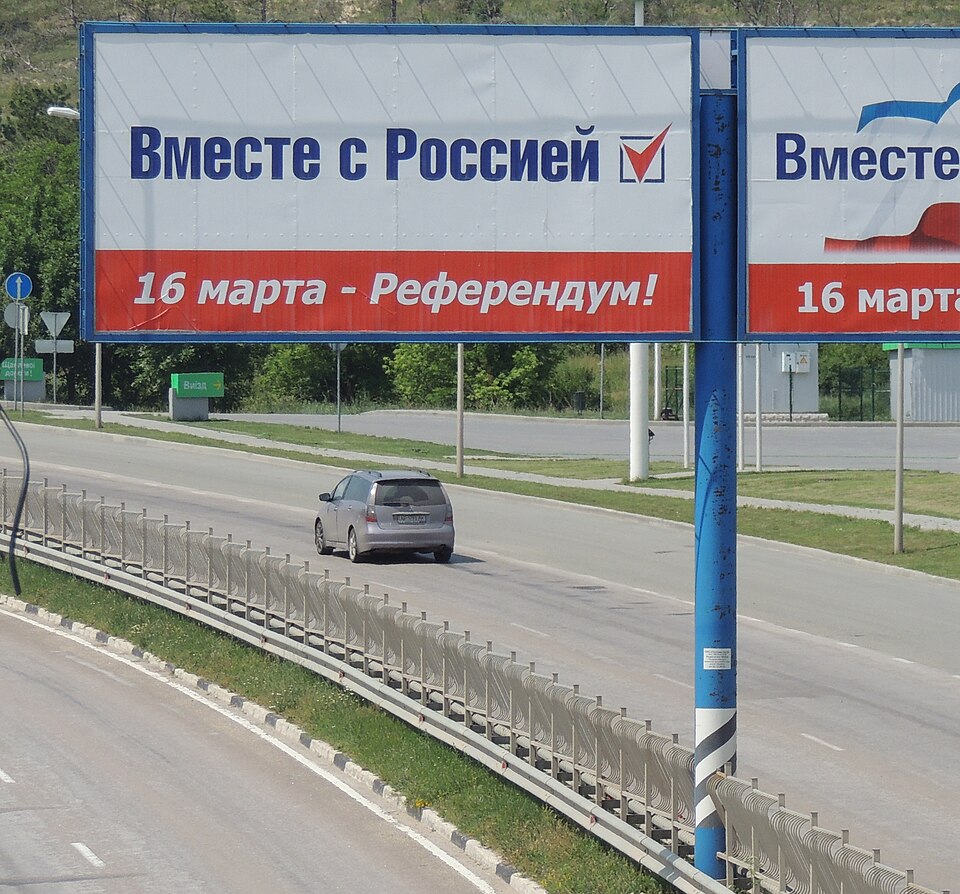
- Before 16 March. Roadside billboards in Simferopol carry the headline "Together with Russia" in blue on white, a red-outlined check-box and a red band reading "16 March: Referendum!". The colours repeat the Russian tricolour, with the check mark beside the one option named (the billboards).
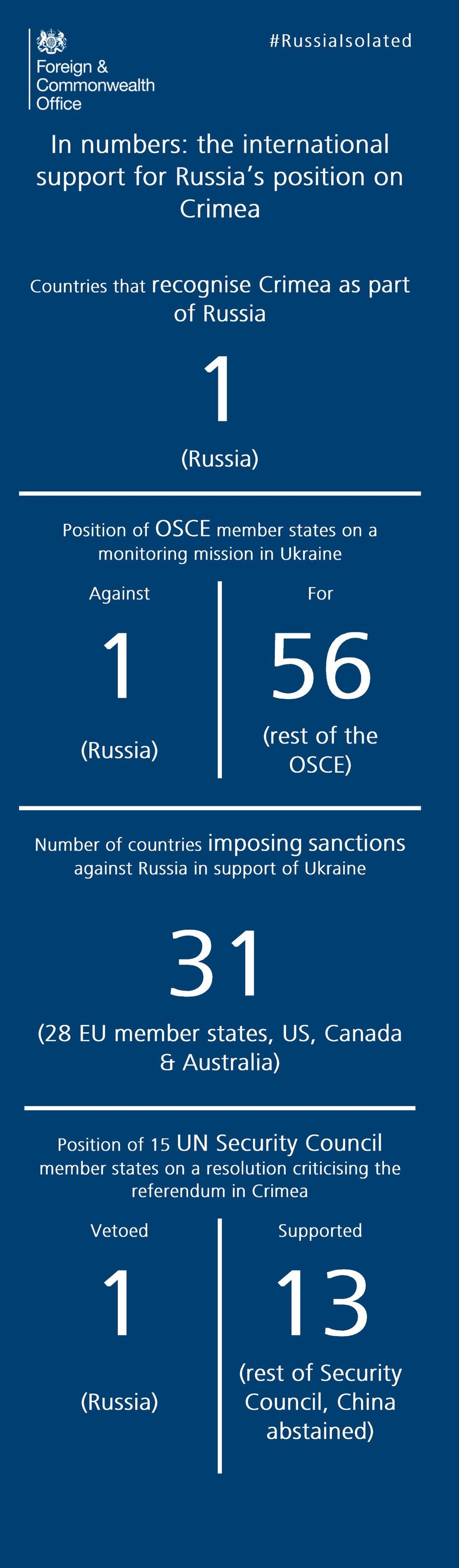
- 15 March 2014. A Security Council draft resolution on the referendum gets 13 votes in favour; Russia vetoes and China abstains (FCO infographic, citing the vote).
- 16 March 2014. The referendum is held. The Crimean authorities report a large majority for joining Russia.
- 21 March 2014. President Putin signs the laws completing Crimea's accession to Russia. The UK Foreign and Commonwealth Office publishes "#RussiaIsolated" on the same day (the infographic).
- 27 March 2014. The UN General Assembly adopts resolution 68/262 affirming Ukraine's territorial integrity and declaring the referendum without validity; Russia and the states that voted against reject it.
- 17 April 2014. Asked on a televised call-in, President Putin says Russian servicemen stood behind Crimea's self-defence units, after earlier statements that the armed men were local volunteers.
How it works
- False dilemma and card stacking: the choice set left out the status then in force. The entry scores the ballot for what it offered, not for how anyone voted.
- Transfer: national colours and the voting mark are attached to a single answer on the billboards.
- Bandwagon and card stacking on the other side: the FCO infographic tallies one country recognising the result against 56 states on an OSCE decision, 31 sanctioning states and a 13 to 1 Security Council vote. Numbers of states stand in for the merits, and states that abstained or took no side are not counted.
Positions on the record
- Crimean and Russian authorities. The referendum expressed the will of the residents of Crimea and the accession followed from it.
- Ukraine and the UN General Assembly majority. The referendum was held under military presence, contrary to the Ukrainian constitution, and did not change Crimea's status.
- What is documented. The ballot text, the dates above, the Security Council vote, resolution 68/262 and the Putin statement of 17 April 2014.
- Not ruled on here. The legal merits. The page scores the three items as messages.
Same-method test
The test is whether a choice set or a tally was built to produce one reading. It applies to the ballot, to the billboards and to the British infographic on the same definitions. They differ in kind: a ballot that decided a territory's status, a campaign sign, and a ministry's counting graphic. The page does not treat them as equivalent.
How to spot it
- Read the options on a ballot and ask which arrangement they leave out.
- Notice when national colours sit beside one answer.
- When a graphic counts states, ask who is not counted.
Sources
- Catalogue entries: sample ballot (Supreme Council of Crimea, rada.crimea.ua), Simferopol billboards, #RussiaIsolated.
- UN General Assembly resolution 68/262, 27 March 2014.
- Direct line with Vladimir Putin, 17 April 2014, transcript on kremlin.ru.