Content note: this page references the Great Leap Forward famine, covered in full in FRAME's dedicated case study, and quotes the bureaucratic labels China and the United States have each used for information-control measures. It does not itself detail casualties.
In one line: founded as a Red Army bulletin in 1931 and renamed Xinhua in Yan'an in 1937, the agency became in 1949 a ministerial-level arm of the state whose wire supplies the national and international copy most Chinese outlets carry, whose 2006 licensing rules extended that gate to foreign news and financial data distributed inside China, and whose separate, confidential "internal reference" channel has told the leadership a different story from the one on the public wire since the 1950s — while, since 2020, the United States has treated Xinhua's own American operation as a state agent that must register and disclose.
What happened
From a base-area bulletin to the state's own agency (1931-1949)
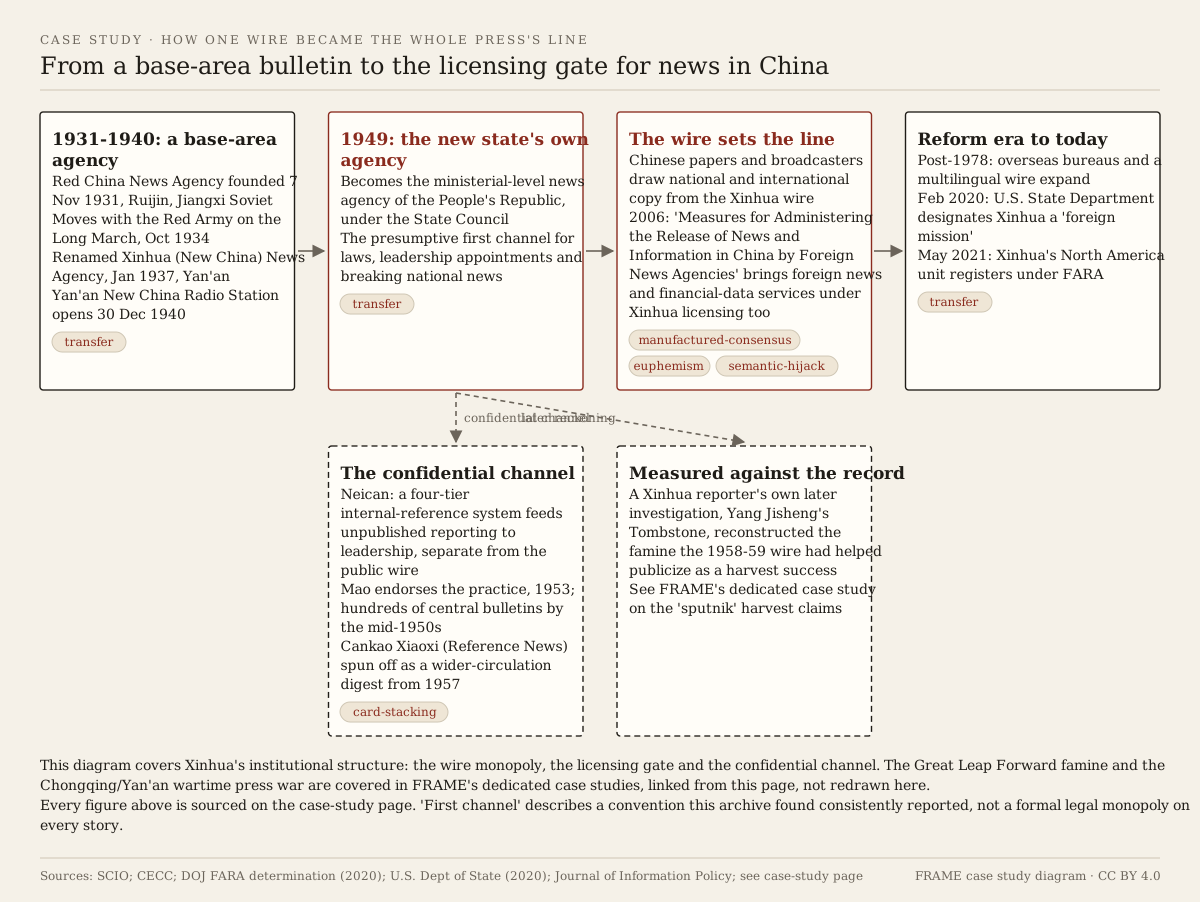
- 7 November 1931: the Red China News Agency. The Chinese Communist Party founded the Red China News Agency (Hongse Zhonghua Tongxunshe) in Ruijin, Jiangxi, the capital of the short-lived Chinese Soviet Republic, to carry the party's own account of events to a movement with almost no other press reach. In October 1934 the agency moved with the Red Army on the Long March.
- January 1937: renamed Xinhua. In the base area of Yan'an the agency took the name it still carries, Xinhua (New China) News Agency. Xinhua and the party organ Liberation Daily (founded 1941; see Chinese wartime propaganda, 1937-1945: Chongqing, Yan'an and Wang Jingwei's Nanjing and The Mao cult before the state: 'Mao Zedong Thought' and 'The East Is Red', 1943-1949 for the wartime press this fed) shared staff and a Yan'an newsroom through the War of Resistance and the civil war that followed.
- 30 December 1940: the radio arm. The party opened Yan'an New China Radio Station under the same organisation; after 1949 it became the Central People's Broadcasting Station, China's national radio service, run separately from Xinhua but sharing its origin and its wartime output.
- 1 October 1949: the People's Republic. With the founding of the People's Republic, Xinhua became the new state's own news agency: a ministerial-level (正部级) public institution reporting to the State Council, the highest rank a Chinese state media organisation holds, rather than a normal ministry-subordinate unit. This is the institutional basis this archive found consistently described for what follows: Xinhua is conventionally the first channel authorised to release national laws and regulations, the appointment or removal of senior officials, and other breaking news the party and government treat as their own to announce.
The wire as the line
- The domestic monopoly. For most of the People's Republic's history, Chinese newspapers, radio and television stations have drawn their national and international news copy from the Xinhua wire rather than reporting or sourcing it independently; a 2006 academic study of the relationship, Xin Xin's "A developing market in news: Xinhua News Agency and Chinese newspapers" (Media, Culture & Society, 2006), traces how this subscription relationship works and how it survived the marketisation of the Chinese press in the 1990s and 2000s. The effect is what this archive elsewhere calls Manufactured consensus: papers with different names, different owners at the margin and different local audiences print the same national judgement because they took it from the same wire, not because they reported it separately.
- 10 September 2006: the foreign-news gate. Xinhua issued "Measures for Administering the Release of News and Information in China by Foreign News Agencies," which the Congressional-Executive Commission on China (CECC) and Reporters Without Borders both analysed at the time. The rules bar foreign news agencies from distributing news and information inside China without official permission and require them to be licensed by Xinhua or a Xinhua-approved distributor. The American Chamber of Commerce in China's 2006 white paper, and press-freedom groups after it, said Xinhua was also using the measures to widen the legal definition of a "wire service" so that it could claim a distribution monopoly over financial and sports data feeds sold by foreign firms operating in China, not only news copy. The United States, Germany and the European Union (through Finland, then holding the EU presidency) raised formal concern with Beijing over the measures the same year.
- What the name covers. "Measures for Administering the Release of News and Information" is the routine, bureaucratic name China gives many regulations; here it names a licensing gate that determines whether a foreign report reaches a Chinese reader at all, and on what terms.
The confidential channel
- Neican: reporting the leadership sees and the public does not. Alongside its public wire, Xinhua (like other Chinese state media) maintains an "internal reference" (内部参考, neican) system: investigative and sensitive reporting submitted not for publication but directly to party and government leaders. Academic accounts of the system (Yuezhi Zhao and others; a fuller reconstruction appears in the Journal of Information Policy article "For Whose Eyes Only? China's Journalistic Internal Reference and Its Legal and Political Implications", 2017) describe roughly four tiers at Xinhua, from a top-level bulletin restricted to Politburo Standing Committee members and reflecting the most urgent situations, down to a weekly digest of less sensitive material circulated to county- and regiment-level cadres. Mao Zedong's endorsement of the practice in 1953, after reading a report compiled from local correspondents' unpublished dispatches, is credited with the system's rapid growth to hundreds of central-level bulletins by the mid-1950s.
- Cankao Xiaoxi (Reference News). A wider-circulation offshoot, Cankao Xiaoxi, began as an internally distributed (neibu) digest of foreign press translations for cadres; its circle of recipients widened sharply from 1957, and by the late 1970s it had become a subscribable, newsstand-sold newspaper. Since 1985 it has carried the label "restricted to distribution within China" (限国内发行) rather than "internal", marking the difference between a document that never reaches the public and one the public may read but the outside world, formally, may not distribute.
The record the wire carried, and the record it did not
- The Great Leap Forward. Xinhua's wire, alongside People's Daily, carried the exaggerated "satellite" (放卫星) harvest reports of 1958-1960 that this archive's dedicated case study, The Great Leap Forward's 'sputnik' harvests and the famine that followed, documents in full: fabricated record-yield claims that masked a collapsing harvest and helped justify grain procurement that deepened the famine that followed. This page does not restate that record; it notes only the institutional point, that the same wire that carried the public claims is the one whose internal-reference channel existed to carry a different account upward.
- A Xinhua journalist's later reckoning. Yang Jisheng, a Xinhua reporter for decades, used the access his position gave him to compile Tombstone (Mubei, 2008; English translation, 2012), the most detailed documented account of the Great Leap Forward famine, drawing partly on provincial archives and internal party statistics rather than on Xinhua's own published wire from the period. His book was itself banned in mainland China. That an insider's post-hoc, independently researched account, not the agency's contemporary reporting, is what historians rely on for the famine's toll is itself evidence of what the public wire did and did not carry at the time.
Going global
- Reform-era expansion. From the 1980s, alongside China's economic opening, Xinhua expanded its network of overseas bureaus and added services in more languages, positioning itself as a global wire alongside agencies such as Reuters, AP and AFP, while remaining a state institution rather than a commercial one.
- 18 February 2020: designated a U.S. "foreign mission". The U.S. Department of State, using its authority under the Foreign Missions Act, designated Xinhua and four other China-based media entities — CGTN, China Radio International, China Daily Distribution Corporation and Hai Tian Development USA — as foreign missions operating in the United States, a status normally reserved for embassies and consulates, requiring them to report staff and property details to the State Department.
- 2018-2021: the FARA determination. On 26 July 2018 the Justice Department's FARA Unit wrote to Xinhua News Agency North America asking it to update its filings and answer questions bearing on whether it was required to register under the Foreign Agents Registration Act. On 18 May 2020 the Department determined that Xinhua North America was obligated to register; its U.S. division registered under FARA in 2021. The Committee to Protect Journalists and several outlets covering the episode noted that Xinhua had for years described itself in the U.S. simply as a news organisation, not as an agent of a foreign government.
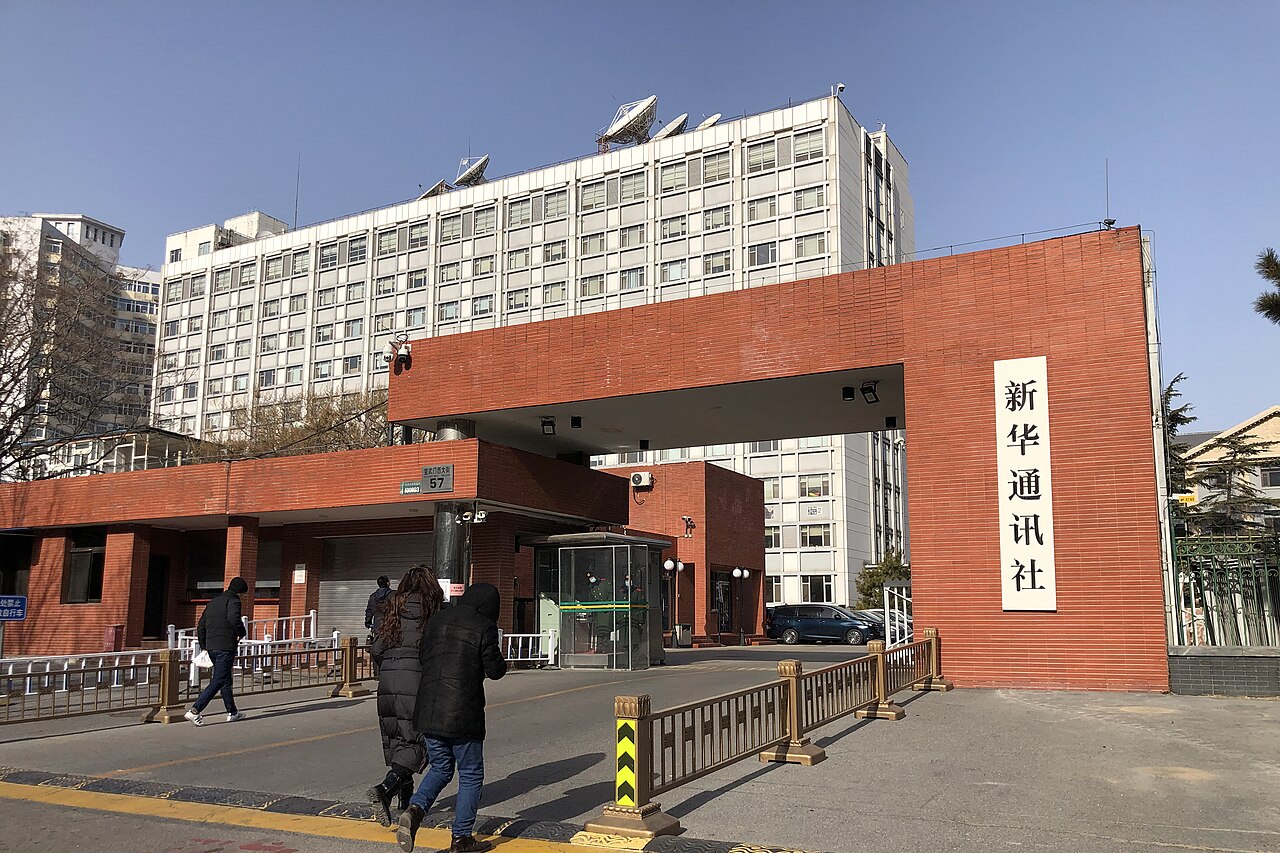
Entrance gate of Xinhua News Agency's headquarters, Beijing, 15 January 2021; the vertical sign reads 新华通讯社 (Xinhua News Agency). Photograph by N509FZ, own work, CC BY-SA 4.0, via Wikimedia Commons. Shown for the institution's present-day premises, not for the 1931-49 history above.

Main building of Xinhua News Agency, Beijing, seen from the east side of the Xuanwumen intersection, 24 January 2023. Photograph by Charlie fong, own work, CC BY-SA 4.0, via Wikimedia Commons; downscaled to 1280 px wide.
How it works
- Manufactured consensus: because most Chinese outlets' national and international copy comes from the Xinhua wire, readers who see the same judgement in newspapers with different names and owners have no way to know, from the copy alone, that it came from one source — the same effect this archive documents for the Reich press conference and the DNB wire in The Reich Ministry of Public Enlightenment and Propaganda, 1933-1945.
- Euphemism / doublespeak: "Measures for Administering the Release of News and Information in China by Foreign News Agencies" is the bureaucratic name for a mechanism that decides, by license, whether a foreign report reaches a Chinese reader at all.
- Semantic hijacking: the same 2006 measures were used, according to the American Chamber of Commerce and press-freedom monitors, to expand the legal meaning of "wire service" to sweep in financial and sports data feeds sold by foreign firms, letting a press regulation double as a commercial monopoly.
- Card stacking: the neican system means the same institution produces two records of the same period — a public wire that, in 1958-60, carried record-harvest claims, and a confidential channel built to carry a different account upward. The fit is documented at the institutional level; this archive is not shown that any specific 1958-60 neican report contradicted the public wire in real time, only that the channel existed for that purpose and that a Xinhua insider's later, independent research is what corrected the record.
- Transfer: the agency renamed itself "Xinhua" — New China — in Yan'an in 1937, twelve years before the People's Republic it is named for existed. Every dispatch the agency has issued since carries that name, so ordinary news copy is stamped, before a reader reads a word of it, with the symbolic weight of "the new nation's own voice".
Colour. Xinhua's routine wire output is white: it is signed as Xinhua's own and Chinese readers know it comes from a state agency, even where they cannot see the instruction behind a given story's framing or omissions. The neican channel is closer to gray: not falsified, but built so its existence and contents are visible only to the officials who receive it, not to the public the same institution also serves.
Then and now
Xinhua's institutional position has not changed in its outline since 1949: a ministerial-rank state agency whose public wire much of the domestic press still draws on, and whose licensing power over "who may release news and information in China" the 2006 measures extended from Chinese outlets to foreign ones. What changed after 2018 is how the United States classifies Xinhua's own presence on American soil. The State Department's February 2020 foreign-mission designation and the Justice Department's 2020 FARA determination did not allege that Xinhua fabricated anything; they held, using a decades-old U.S. disclosure statute, that an outlet directed by a foreign government's information apparatus should say so when operating inside the United States, the same test Xinhua's 2006 measures apply, in reverse and with a criminal penalty rather than a civil-disclosure one, to foreign agencies operating inside China. The throughline is the same idea from both directions: whoever controls the licence controls what counts as a legitimately sourced report. FRAME's case study on China's more recent information-control practice, The Gyirong flood and the official death toll (2026), shows the same domestic licensing logic in a single disaster: an official casualty figure, carried on the state wire, remained the only number visible after posts giving higher counts were removed as "rumour". Xinhua's public wire is the channel such a figure travels on.
Positions on the record
- The Chinese government's and Xinhua's own framing. Chinese media policy states plainly that party-owned media exist to carry the party's line. General Secretary Xi Jinping's February 2016 tour of the leading central newsrooms, including Xinhua, is widely reported in China-media scholarship as the occasion for a formulation, paraphrased here, that party media must embody the party's will, safeguard the party's authority and unity, and keep their reporting aligned with the party centre — since summarised in Chinese media commentary as the media being "surnamed Party" (姓党). Xinhua's own institutional material presents its ministerial rank and its role announcing state decisions as a mark of authority and reliability, not of subordination.
- Foreign governments' and monitors' criticism. The United States, Germany and the EU (through Finland's 2006 presidency) formally objected to the 2006 measures as a restriction on foreign press access to the Chinese market. The U.S. State Department's 2020 foreign-mission designation and the Justice Department's FARA determination the same year treated Xinhua's North American operation as an instrument of Chinese government messaging requiring disclosure, a classification Xinhua did not seek and has not in this archive's research found any public statement accepting.
- Scholarship. Anne-Marie Brady's Marketing Dictatorship: Propaganda and Thought Work in Contemporary China (Rowman & Littlefield, 2008) documents the Central Propaganda Department's coordination of China's state media, Xinhua among them, as a system rather than a set of independent outlets. Academic work specifically on the neican system (cited above, Journal of Information Policy, 2017) and on Xinhua's commercial relationship with the newspapers it supplies (Xin Xin, 2006) is the basis for the institutional description on this page.
- This archive's reading. Documented: the founding dates and renaming; the ministerial rank and State Council subordination; the 2006 measures and the international objections to them; the structure and history of the neican system and Cankao Xiaoxi; the 2020 foreign-mission designation and the 2018-2021 FARA process; Yang Jisheng's authorship of Tombstone and its ban in mainland China. Not shown: the specific content of any confidential neican report; a complete count of Xinhua's current overseas bureaus or staff, which this archive did not find a citable, dated figure for and so has left out rather than estimate; and any claim that Xinhua invents events rather than selecting, timing and licensing what is reported about real ones.
Same-method test
Every twentieth-century one-party state built a news agency that doubled as a licensing chokepoint, and the same ids apply to each.
- Nazi Germany. The Deutsches Nachrichtenbüro (DNB), formed in December 1933 by merging Germany's two largest private news agencies into one state-owned service, gave most German papers their national and foreign news from a single ministry-controlled source, the same Manufactured consensus mechanism as the Xinhua wire. See The Reich Ministry of Public Enlightenment and Propaganda, 1933-1945 for the DNB's founding and its place alongside the daily Reich press conference.
- The Soviet Union. The Telegraph Agency of the Soviet Union (TASS), tracing its lineage to the Bolshevik government's press service after 1917 and formally established under that name in 1925, held the exclusive right to gather and distribute foreign news inside the USSR; Soviet newspapers ran foreign news only as TASS supplied it, and TASS was equally the main channel through which Soviet statements reached the outside world. The pattern — one state wire as both the domestic gate and the international voice — is the same institutional shape as Xinhua's, run for a longer, uninterrupted stretch (TASS operated continuously from 1925 until the Soviet collapse in 1991, later restructured as the Russian Federation's state agency) than the DNB's twelve years.
- Where they differ. The DNB was created by merging existing private agencies under a ministry that also licensed every journalist through the Reich Chamber of Culture; it had no life outside the Nazi state and ended with it in 1945. TASS and Xinhua both began as an insurgent or revolutionary movement's own press organ before their state existed, then continued unbroken once the party took power, which is why both carry a "first voice of the movement, then of the state" history that the DNB, built from someone else's commercial agencies, does not share. Of the three, only Xinhua's founding state is still in power and still operating the same institution: the comparison with DNB and TASS is a comparison with the method under different states, not with an equivalent still running today under either.
How to spot it
- Ask where the copy originated, not just who published it. When outlets with different names carry the same national story in the same words, check the wire credit; a shared credit line is not evidence of a shared instruction, but it removes the outlets' independent judgement from what you are reading.
- Watch what a licensing rule actually licenses. A regulation named for "administering the release of news and information" is worth reading past its title: ask who must apply, who grants the license, and what happens to material that is not licensed.
- Ask whether a public record and a private one might differ. An institution built to report to its own leadership in confidence, separately from what it publishes, is telling you something about how much weight to put on the public version alone — whether or not any specific confidential report is known.
- Notice who calls a channel a "monopoly" and who calls it "administration". The same 2006 measures were "national policy" to their author and a "monopoly" to the American Chamber of Commerce and foreign governments; both descriptions can be checked against the rule's actual text and effect.
- Treat an insider's later account as evidence about the institution, not only about the events it describes. That Tombstone had to be written from archives and after the fact, by someone who had spent a career inside the agency, says something about what the agency's contemporary wire was built to carry.
Images
| Image | Source | Licence |
|---|---|---|
| Mechanism diagram (above) | Drawn for FRAME from this page's sourced facts (make_diagrams_apparatus_xinhua.py) |
CC BY 4.0, FRAME |
| Entrance gate of Xinhua News Agency headquarters, Beijing, 15 January 2021 | Wikimedia Commons, photograph by N509FZ, own work | CC BY-SA 4.0 |
| Main building of Xinhua News Agency, Beijing, 24 January 2023 | Wikimedia Commons, photograph by Charlie fong, own work | CC BY-SA 4.0 |
.jpg)

Image gaps
- Xinhua News Agency headquarters, Beijing. Filled: two photographs are now embedded above (the gate and the main building), both CC BY-SA 4.0. No photograph of the historic pre-1990s premises was located with a clear licence.
- Yan'an-era Xinhua or New China Radio photographs (1937-1949). This archive did not find a Wikimedia Commons or Library of Congress image specifically of the wartime Xinhua newsroom or the Yan'an radio station with a clear, verifiable public-domain or open licence in the time available. Fillable if such an image turns up on Commons under a PD-China or U.S. government rationale.
- The Xinhua Hong Kong Branch building. A Commons category exists for the branch's later premises, but this archive could not verify a clearly licensed image of the historic branch building itself in the time available. Could be filled with further search.
- A photograph of the DOJ FARA determination letter or the State Department's 2020 designation notice. These are public documents, linked in Sources, but this archive hosts document images only when a verified, openly licensed scan is available; none was located. Fillable from a U.S. government scan.
Sources
- SCIO: Xi congratulates Xinhua News Agency on its 90th founding anniversary (founding history, 7 November 1931, Ruijin; renaming, January 1937, Yan'an)
- Xin Xin, "A developing market in news: Xinhua News Agency and Chinese newspapers", Media, Culture & Society (2006) (the wire-subscription relationship between Xinhua and Chinese newspapers)
- CECC: New Measures Increase Xinhua Control Over Foreign News Sources (the 2006 "Measures for Administering the Release of News and Information in China by Foreign News Agencies")
- Reporters Without Borders: New regulations reinforce Xinhua's control over foreign news agencies (2006)
- The Christian Science Monitor: China reins in reach of foreign news (2006, international objections)
- U.S. Department of Justice, FARA Unit: Obligation of Xinhua News Agency North America to Register (18 May 2020 determination letter)
- Committee to Protect Journalists: Several foreign news outlets required to register as foreign agents in US (FARA process, 2018-2019)
- U.S. Department of State (2017-2021 archive): Designation of Additional Chinese Media Entities as Foreign Missions (18 February 2020)
- South China Morning Post: US imposes restrictions on 5 Chinese state media (2020)
- "For Whose Eyes Only? China's Journalistic Internal Reference and Its Legal and Political Implications", Journal of Information Policy 7 (2017) (the neican tier system; Mao's 1953 endorsement)
- Wikipedia: Neican and Reference News (Cankao Xiaoxi's history from internal digest to newsstand publication, 1957 and 1985)
- Yang Jisheng, Tombstone: The Great Chinese Famine, 1958-1962 (Chinese: Mubei, 2008; English translation, Farrar, Straus and Giroux, 2012)
- Anne-Marie Brady, Marketing Dictatorship: Propaganda and Thought Work in Contemporary China (Rowman & Littlefield, 2008)
- FRAME case studies: The Great Leap Forward's 'sputnik' harvests and the famine that followed; Chinese wartime propaganda, 1937-1945: Chongqing, Yan'an and Wang Jingwei's Nanjing; The Mao cult before the state: 'Mao Zedong Thought' and 'The East Is Red', 1943-1949; China's Great Firewall and the June Fourth anniversary; The Gyirong flood and the official death toll; The Reich Ministry of Public Enlightenment and Propaganda, 1933-1945