Content note. This page describes foreign civilians, including children, held at military sites as a deterrent, and a broadcast in which a detained five-year-old was shown with Saddam Hussein.
In one line: after invading Kuwait, Iraq's government held more than a thousand Western and Japanese civilians at military and industrial sites and called them "guests", answered demands to withdraw with a plan to settle "all cases of occupation" in the region at once, and named the coming war after a 7th-century Arab victory; the U.S. President, for his part, framed the crisis through Hitler and the 1930s.
This page covers the Iraqi and U.S. governments' messaging. The Kuwaiti government's campaign in Washington, including the "Nayirah" incubator testimony, is covered separately in The Nayirah testimony: a Kuwaiti government PR campaign at a House human rights caucus.
What happened
Iraq
- 2 August 1990. Iraq invades and occupies Kuwait. Thousands of foreign nationals in Iraq and Kuwait are barred from leaving.
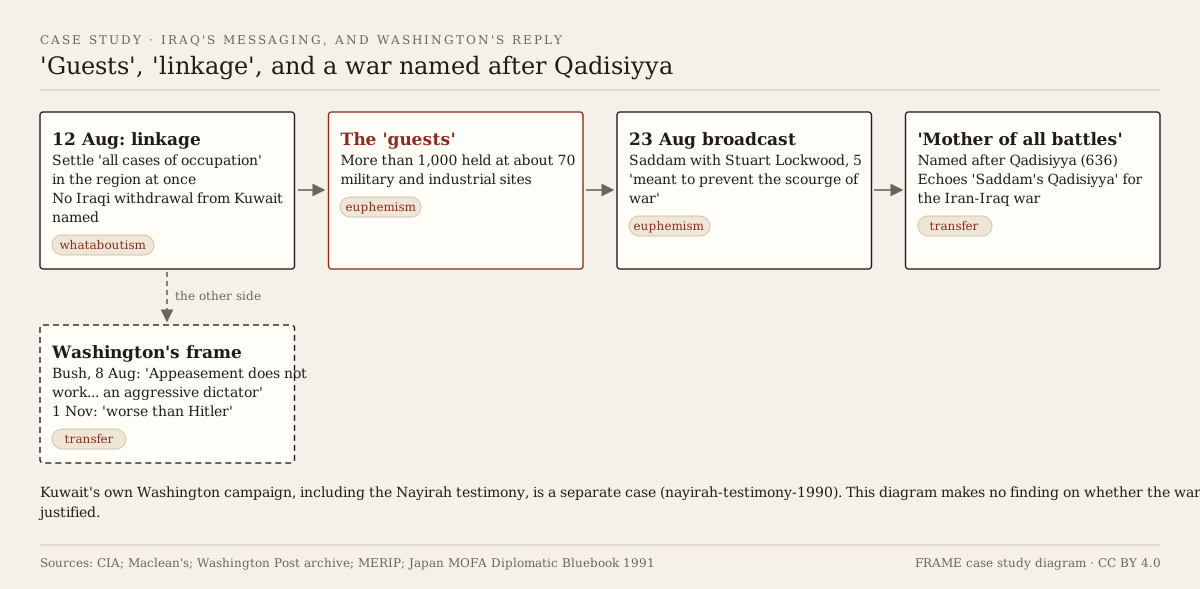
- 12 August. Saddam Hussein proposes that "all cases of occupation, and those cases that have been portrayed as occupation, in the region, be resolved simultaneously": Israeli withdrawal from Palestinian, Syrian and Lebanese territory, Syrian withdrawal from Lebanon, "mutual withdrawals by Iraq and Iran", and then "arrangement for the situation in Kuwait". The proposal does not commit Iraq to leave Kuwait. The United States rejects any linkage.
- 17 to 18 August. The Speaker of Iraq's National Assembly says Iraq will "play host to the citizens of these aggressive nations as long as Iraq remains threatened with an aggressive war". Iraqi officials call the detained foreigners "guests". A CIA assessment later counted more than 1,000 Western and Japanese nationals held at about 70 sites, including air bases, weapons plants and power stations.
- 23 August. Iraqi state television shows Saddam with detained British families. He puts a hand on five-year-old Stuart Lockwood and asks, through an interpreter, whether he is getting his milk. He tells the group: "We hope your presence as guests here will not be for too long. Your presence here, and in other places, is meant to prevent the scourge of war." The British Foreign Office calls the broadcast "a repulsive charade".
- Autumn 1990. Women, children and some nationalities are released in stages, often after visits by foreign politicians.
- 6 December. Saddam asks the National Assembly to lift the travel ban on all foreigners. The remaining detainees leave that month.
- September 1990 to January 1991. A Revolutionary Command Council statement warns that the conflict would become "the mother of all battles" (umm al-ma'arik). Saddam repeats the phrase on 6 January 1991 and on 17 January, as the air war begins. Iraq's external radio service takes the name Mother of Battles Radio.
- The older frame. The phrase echoes the battle of al-Qadisiyya (636), an Arab victory over Sasanian Persia. Iraq's government had already named the Iran-Iraq war (1980-88) Qadisiyyat Saddam, "Saddam's Qadisiyya", on posters, medals, stamps and a state feature film. Bricks in the rebuilt palace at Babylon were stamped: "In the era of Saddam Hussein, son of Nebuchadnezzar, Babylon was revived." Portraits and murals of Saddam were placed in public buildings and captured territory across the country.
- February 1991. As coalition forces advance and Iraqi troops withdraw from Kuwait, they set fire to hundreds of Kuwaiti oil wells; the fires burn for months into 1991.
- The coalition's own psychological operations. Alongside its combat forces, the U.S.-led coalition drops millions of leaflets over Iraqi positions, urging surrender and undermining Saddam's authority; after the war, U.S. troops in northern Iraq photograph defaced portraits and murals of Saddam in areas they entered.
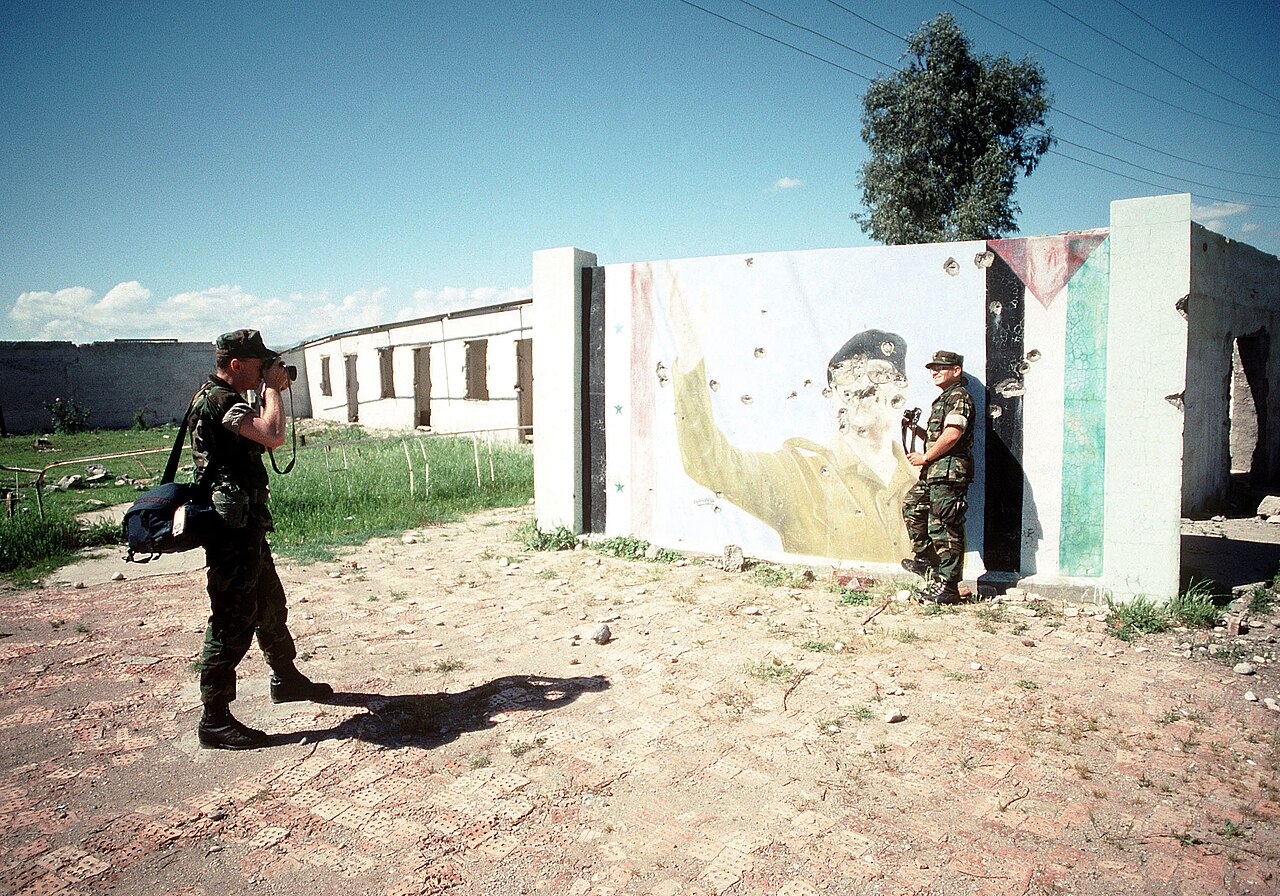
A U.S. Marine beside a defaced portrait of Saddam Hussein, Zakho, northern Iraq, 1991. U.S. Department of Defense photo, public domain.
The United States
- 8 August 1990. Announcing the deployment to Saudi Arabia, President Bush says: "Appeasement does not work. As was the case in the 1930s, we see in Saddam Hussein an aggressive dictator threatening his neighbors."
- 15 October. At a Dallas fundraiser: "Hitler revisited. But remember, when Hitler's war ended, there were the Nuremberg trials."
- 1 November. On the civilians held at strategic sites: "I don't believe Adolf Hitler ever participated in anything of that nature." Rabbi Abraham Cooper of the Simon Wiesenthal Center calls the comparison "an outrage", and other Jewish organisations object.
- 6 December. When Iraq announces the release, the administration says it shows that "diplomatic and military pressure" is working.
How it works
- Euphemism / doublespeak: "guests" and "play host" describe civilians who could not leave and were placed at sites the other side might bomb. The broadcast staged the word: a leader asking a child about his milk, in a room he could not leave.
- Whataboutism: "linkage" answered the demand to leave Kuwait with a list of other occupations in the region. However strong the case about those occupations, the offer meant that the original demand was never answered on its own terms.
- Transfer: Iraq borrowed the prestige of Qadisiyya and Babylon for a living ruler and his wars, so a war with Iran or the coalition became a chapter in a 1,300-year story. Bush borrowed the stigma of Hitler and the lesson of 1930s appeasement, so Iraq's occupation of Kuwait carried the moral weight of the Second World War. The methods ran in opposite directions, prestige for one's own leader and stigma for the other's, but both used history to supply a conclusion the argument had not reached.
Then and now
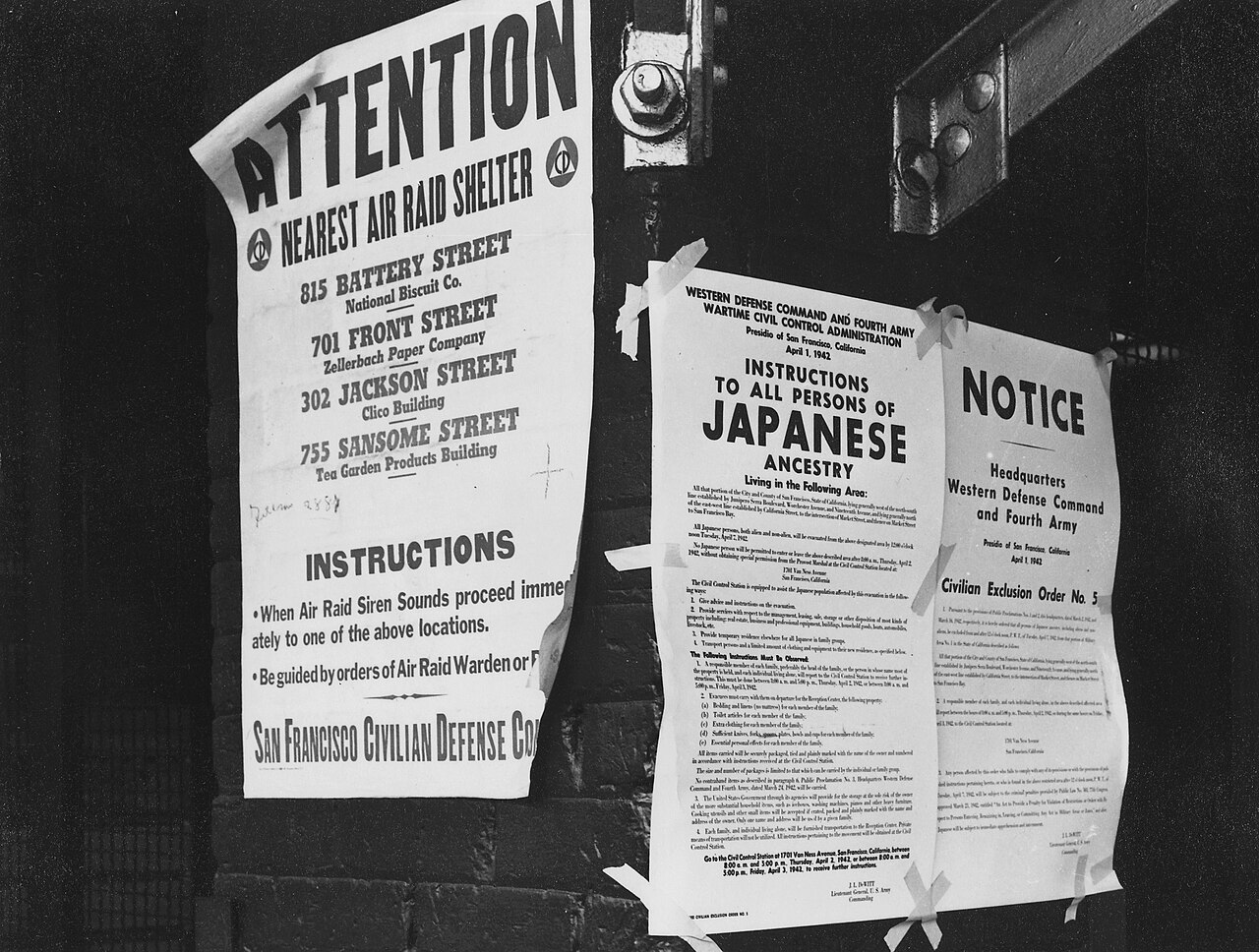
'Instructions to All Persons of Japanese Ancestry' (exclusion order posted in San Francisco), U.S. Army, 1942. Public domain.
In 1942 the U.S. Army ordered "all persons of Japanese ancestry, both alien and non-alien" to report for removal. Forced removal was "evacuation", U.S. citizens were "non-aliens", and the fairgrounds where families were held were "assembly centers". Iraq in 1990 used the same device on foreign civilians: a hospitable word for people who could not leave. The differences are large and should be stated as plainly. The U.S. order removed about 120,000 people, most of them American citizens, for years, on the stated ground of wartime security. Iraq held more than a thousand foreigners for about four months, at military sites, with the stated aim of deterring an attack.
Positions on the record
- Iraq: described the detainees as guests whose presence would "prevent the scourge of war", and presented linkage as a fair regional settlement of all occupations.
- The United States and its coalition partners: called the detainees hostages, demanded unconditional withdrawal from Kuwait, and rejected linkage. Bush defended the Hitler comparison as a warning about aggression.
- Critics of the U.S. framing: Jewish organisations objected to Bush's 1 November 1990 comparison, reported in headlines as "Saddam Worse Than Hitler".
- What is documented: Iraq's statements, the broadcast, the CIA count, the linkage text, the "mother of all battles" statements and the Qadisiyya naming, and the President's remarks.
- What is not shown here: how Iraqi audiences received the Qadisiyya framing, for which this page found no survey or independent measure. This page takes no position on whether the war was justified or on the merits of the other occupations the linkage offer listed.
Same-method test
Any government that called civilians held against their will "guests" would be scored as euphemism here, as the U.S. Army's "assembly centers" are in the gallery. Answering "leave this territory" with "first settle every other dispute" would be scored as whataboutism from any government. A leader compared to Hitler, by any other leader, would be scored as transfer.
How to spot it
- Translate the soft word back into plain terms: can the "guest" leave? Where is he being kept, and why there?
- When a demand is answered with a list of other disputes, ask whether the answer contains a yes or no to the original demand.
- When a leader is compared to Hitler, or a war is named after an ancient victory, separate the comparison from the claim: what does the leader actually control, and what is he actually threatening to do?
Images
| Image | Source | Licence |
|---|---|---|
| Mechanism diagrams (above) | Drawn for FRAME from the sources below (make_diagrams_regions.py) |
CC BY 4.0, FRAME |
| U.S. PSYOP leaflet, Saddam depicted riding a soldier's back (1991) | Wikimedia Commons | Public domain (U.S. military work) |
| U.S. PSYOP leaflet, "This man virtually died..." (1991) | Wikimedia Commons | Public domain (U.S. military work) |
| Defaced Saddam portrait, Zakho (1991) | Wikimedia Commons (U.S. DoD) | Public domain |
| Kuwaiti oil well fires (1991) | Wikimedia Commons | CC BY-SA 4.0 |
| Instructions to All Persons of Japanese Ancestry (1942) | FRAME gallery | Public domain (U.S. government work) |
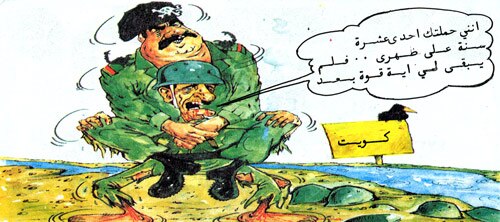
A U.S. psychological-operations leaflet dropped on Iraqi forces during the war, depicting Saddam riding on a soldier's back. U.S. military work, public domain. Covered by the same-method test above: coalition messaging aimed at Iraqi troops is scored on the same terms as Iraq's own.
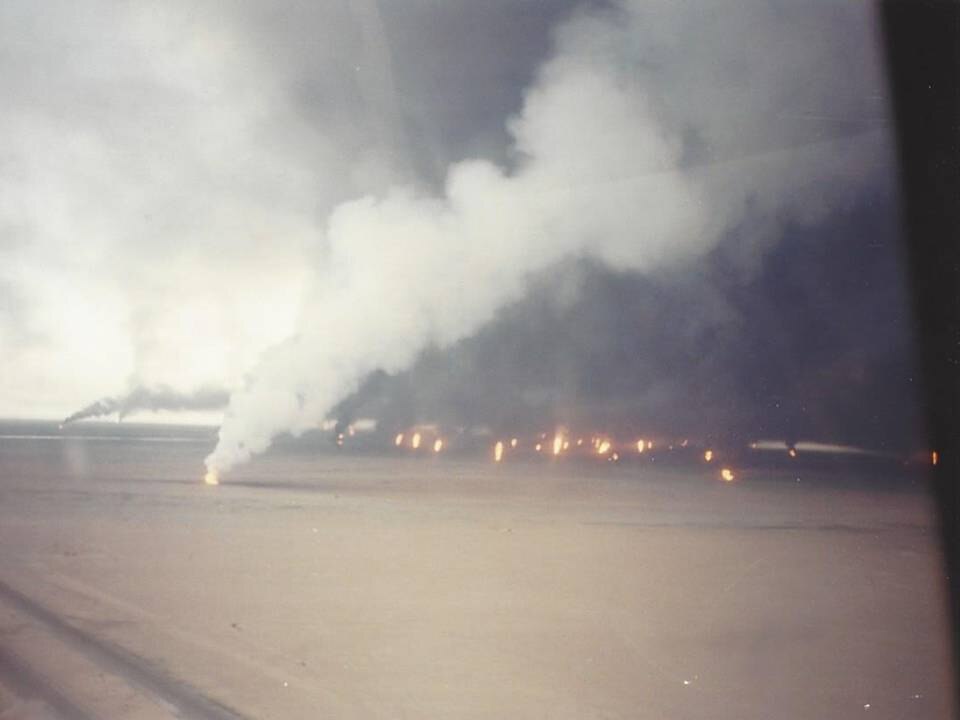
Oil wells burning south of Kuwait City, set alight by withdrawing Iraqi forces, 1991. Photo: EdJF, CC BY-SA 4.0.
Image gaps
- The 23 August 1990 Iraqi television broadcast. No openly licensed copy found.
- Iraqi-produced leaflets or posters from the crisis. None found with a clear open licence; available Iraqi-origin images on Commons are tagged public domain in Iraq only, with unclear U.S. status.
- Images tied directly to the Nayirah testimony or Hill & Knowlton, and of the detained "guests". None found; see The Nayirah testimony: a Kuwaiti government PR campaign at a House human rights caucus for that campaign's own page.
Sources
- CIA, "Putting Noncombatants at Risk: Saddam's Use of 'Human Shields'" (hosted by the Federation of American Scientists).
- U.S. Army 4th Psychological Operations Group, leaflet campaign of the 1991 Gulf War, described by the Department of Defense as the largest since the Second World War.
- Smithsonian Magazine, "The Gulf War Started 30 Years Ago and Cast a Long Shadow on U.S. Military History", on the burning of Kuwaiti oil wells.
- Maclean's, 27 August 1990: the hostages in the Gulf.
- Washington Post, 25 August 1990: British boy in telecast identified.
- UPI, 6 December 1990: Iraq says it will free hostages; Washington Post, 7 December 1990.
- Ministry of Foreign Affairs of Japan, Diplomatic Bluebook 1991, on the 12 August initiative.
- Oxford Reference, "mother of all battles".
- MERIP, "Bending History", and "Monumental Disrespect", on Qadisiyyat Saddam and Babylon.
- W.W. Norton case study: Bush's August 1990 statements.
- Washington Post, 16 October 1990: President warns Iraq of war-crimes trials.
- JTA: Jews deplore Bush's comparison of Saddam Hussein with Hitler.