Content note. Two items on this page are graphic: a coalition leaflet shows a cartoon of recruits fed into a meat grinder, and an Iranian poster uses blood spatter and an antisemitic conspiracy frame. Both appear as issued, as evidence of what each issuer showed its audience. Showing an item is not endorsing it.
What was propaganda in the Syrian civil war?
Propaganda in the Syrian civil war is the organised persuasion that the Syrian government, its opponents, the Kurdish-led Syrian Democratic Forces, the Islamic State, Turkey, Russia, Iran and the US-led coalition issued about the war that began with the protests of 2011 and ended with the fall of the Assad government in December 2024. The collection holds 14 objects from 2006 to 2024, each tagged by issuer, audience and technique, with the same definitions applied to every side.
Explain moreShow less
The page applies the working definition used for every country (how FRAME defines propaganda). Related pages: psychological operations, propaganda leaflets, Iraq War propaganda and the country page Iran, Islamic Republic.
A gap, stated plainly. The collection holds no Syrian state broadcast, newspaper or poster issued by the government's information ministry, and almost nothing of the Islamic State's own output: one coin. Their media could not be cleared for hosting. The government side appears through photographs of portraits and rallies taken by outside photographers, the opposition through one protest photograph, and the Kurdish-led forces through flags in two Voice of America stills. Read the sections with that in mind.
The sections run in date order. Each object is described from its catalogue entry: issuer, audience, the ask and the technique.
How was the Assad family shown before and during the war, 2006 to 2018?
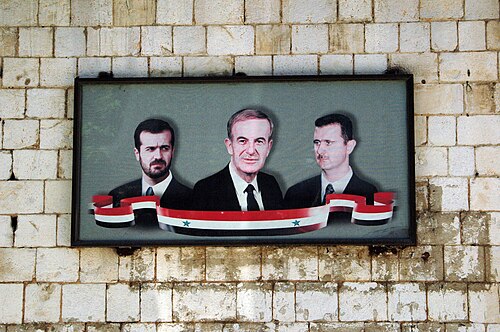
A painted portrait photographed in Damascus on 25 May 2006 shows three men: Hafez al-Assad (president 1971 to 2000), Bashar al-Assad (president from 2000) and Bassel al-Assad, Hafez's eldest son. A ribbon in the colours of the Syrian flag runs under it. The entry tags cult of personality and transfer: the three figures present rule as a family line. Read the technique: cult of personality.
Explain moreShow less
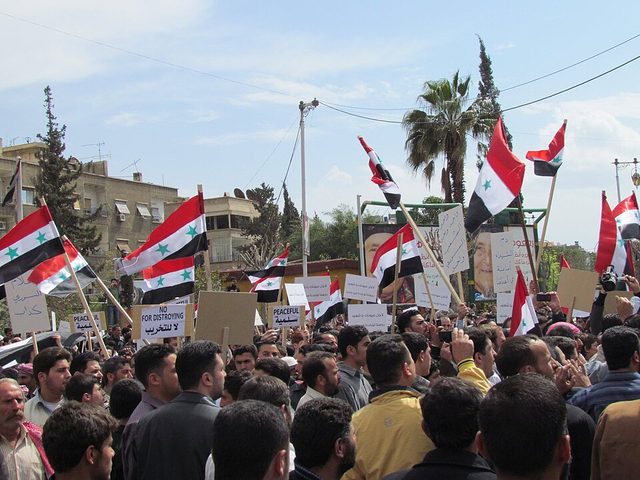
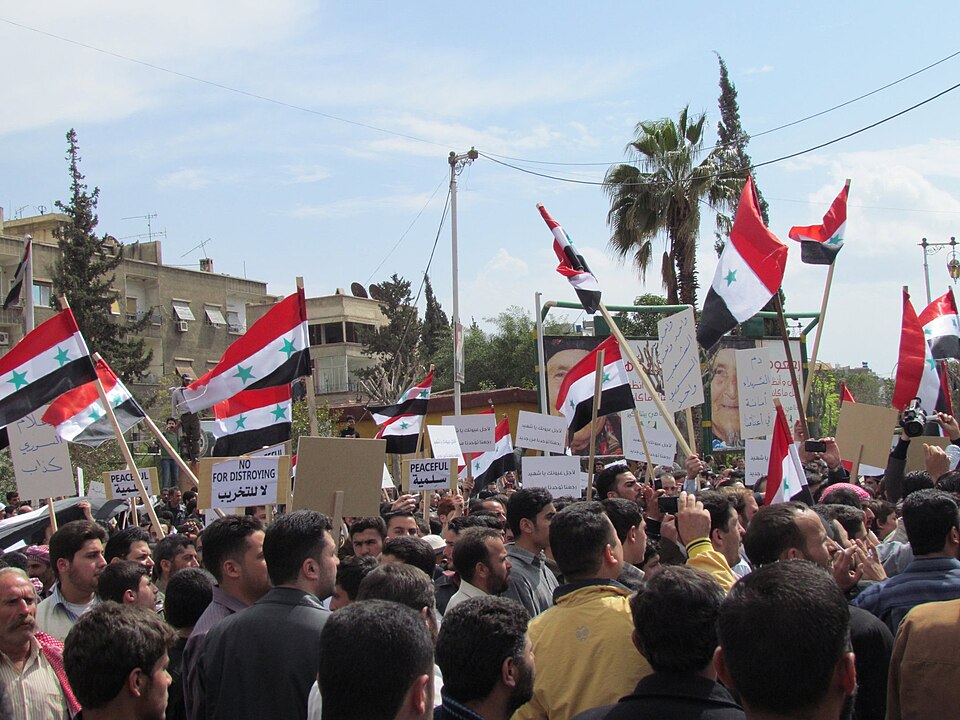
In the first weeks of the uprising, a Douma crowd holds Syrian flags and hand-lettered signs, some bilingual: "PEACEFUL", "NO FOR DISTROYING", and an Arabic sign saying the Syrian media lies. The entry tags transfer: the national flag is carried as the crowd's emblem, and the English signs are written for an outside observer. Read the technique: transfer.
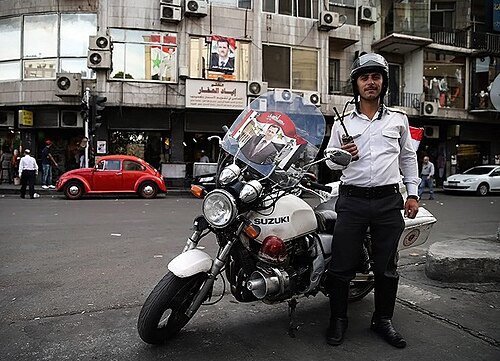
Before the presidential election of 3 June 2014, a portrait of Bashar al-Assad is attached to a police motorcycle and appears in shop windows and on a facade. The election, held only in government-controlled areas, gave an official result of 88.7 percent, and opposition groups and a number of foreign governments rejected it. The entry tags cult of personality and repetition: the same face on a state vehicle, shop windows and a building.
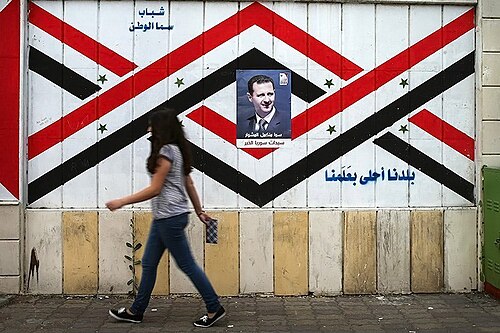
A wall painted in the red, white and black of the Syrian flag, with green stars, frames a printed poster of Assad and a woman beside him. Arabic slogans appear above and below. The entry tags cult of personality and transfer: the flag pattern becomes decoration around the leader's portrait.
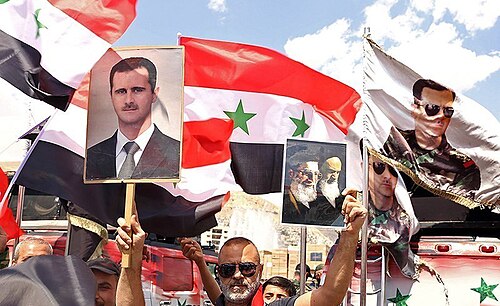
A Tasnim News Agency photograph shows a rally in Damascus the day after strikes by the US, UK and France on Syrian government sites. Marchers hold a framed portrait of Assad, a smaller portrait of two clerics and a large banner of a man in sunglasses. The entry tags cult of personality and transfer.
How did the coalition, Kurdish-led forces and Islamic State appear, 2015 to 2017?
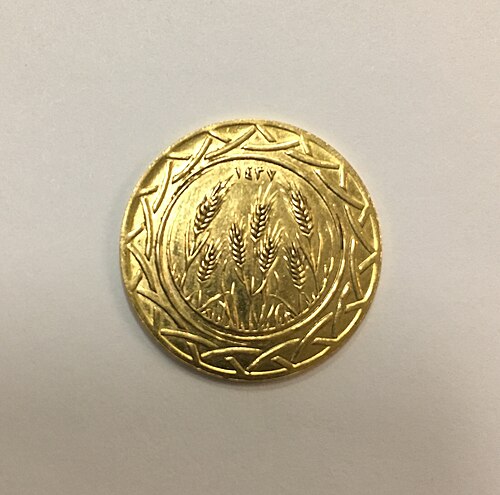
A gold coin shows a ring of wheat ears inside a woven border, with the numerals for 1437. The Islamic State announced gold dinars in 2015 as part of a monetary system modelled, by its own account, on early Islamic coinage. The entry tags transfer: a state-style coinage issued by a non-state armed group.
Explain moreShow less
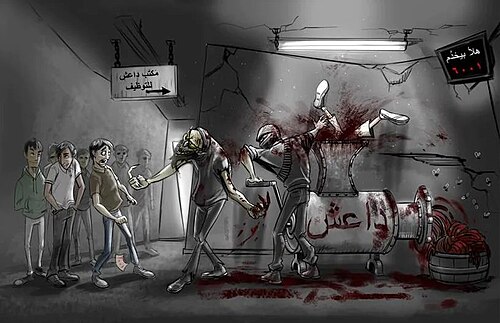
US Central Command released this image from leaflets the United States dropped over Raqqa in March 2015. A cartoon shows a queue of young men beneath a sign for the "Daesh Recruiting Office", while a masked fighter feeds a recruit into a meat grinder. The entry tags fear appeal: enlistment is staged as being ground up. Read the technique: fear appeal.
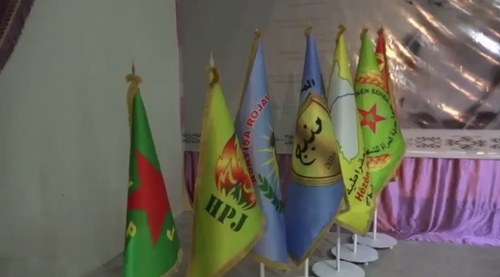
A Voice of America still shows six flags on stands against a wall, which the Commons description identifies as those of Kurdish-led women's units, a security force and other groups at a conference of the Kurdistan Communities Union and Syrian Democratic Forces groups. The entry tags transfer: separate organisations' flags are arranged as one display.
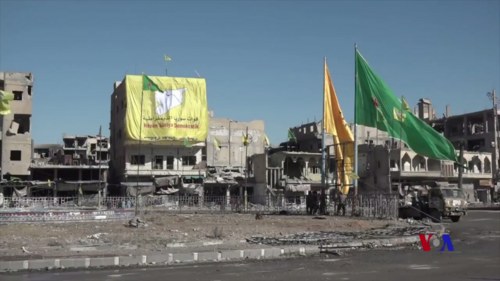
Three days after the Syrian Democratic Forces announced the end of the Raqqa campaign against ISIL, a Voice of America still shows a building-sized banner and two flagpoles in the ruined city centre. The entry tags transfer: flags and a banner are raised where the fighting took place.
How did Russia, Iran, Turkey and diaspora groups speak, 2017 to 2019?
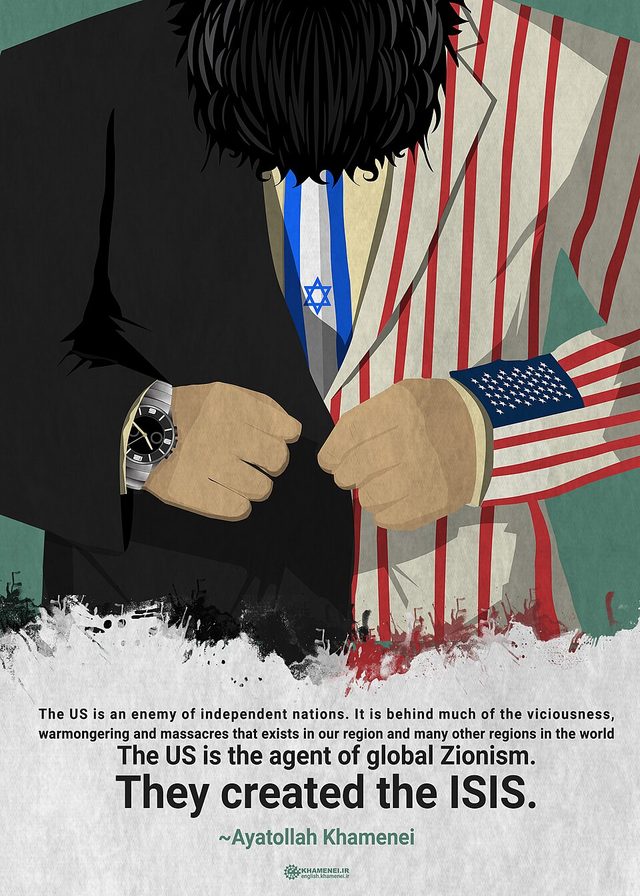
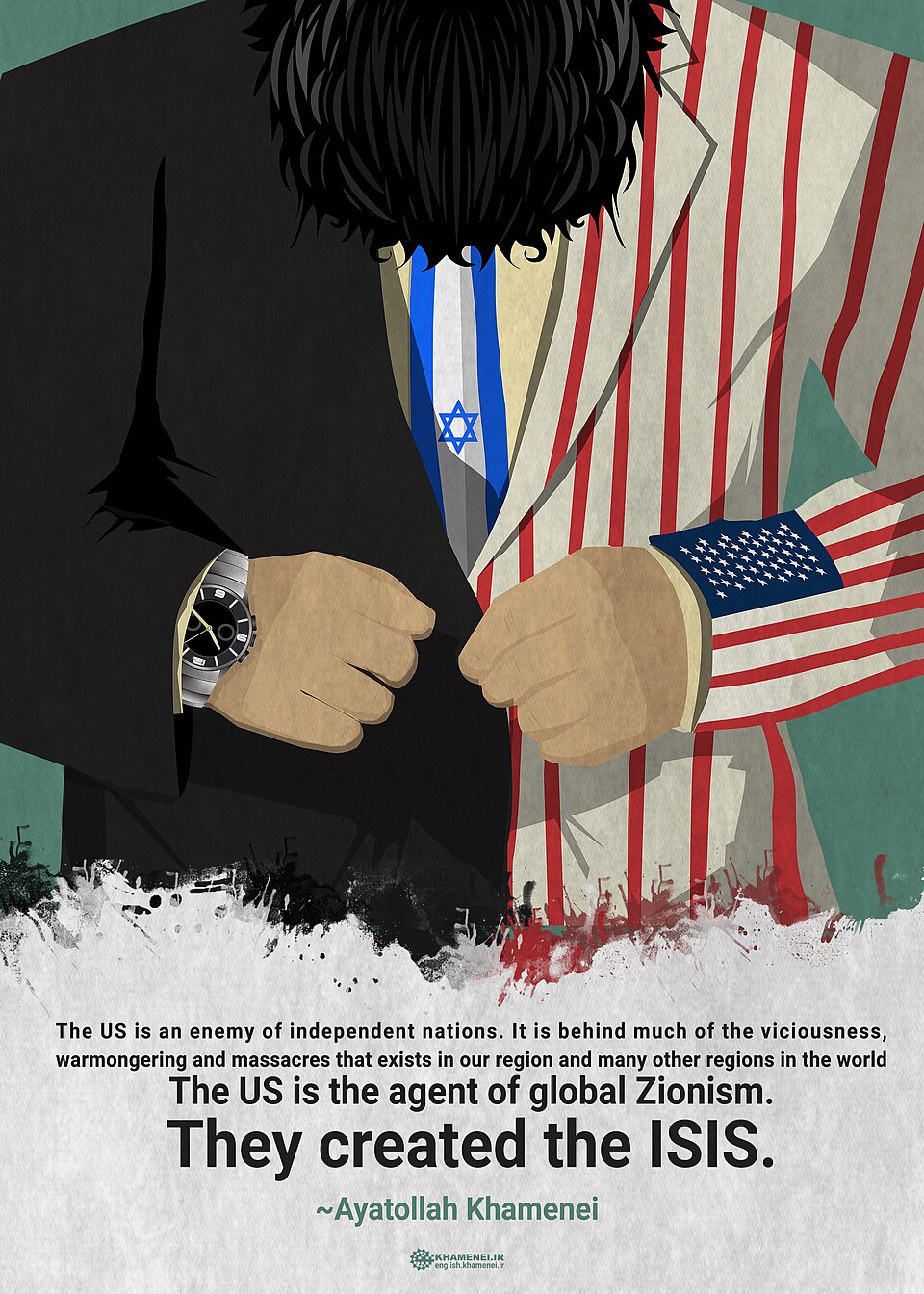
The Office of the Supreme Leader of Iran published this quotation poster on 17 October 2017. A split headless figure in a suit carries a US flag cuff and a tie with the Israeli flag, above a quotation blaming the United States for the region's violence. The entry tags scapegoating and guilt by association: one named power is made the author of a group's rise. Read the technique: scapegoating.
Explain moreShow less
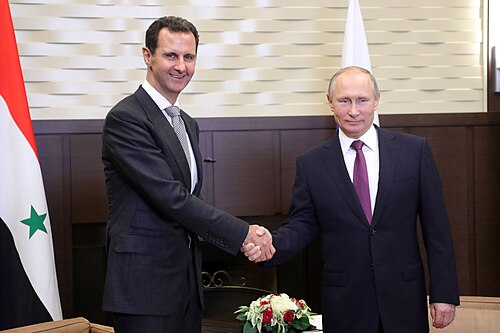
A Kremlin photograph shows the two presidents shaking hands between flags. Russia's air operation in Syria began on 30 September 2015 at the Syrian government's request, and Moscow described it as counter-terrorism support for an allied government, while Western governments and the Syrian opposition called it support for the government's war. The entry tags transfer: the staged handshake presents the Russian president as the Syrian president's ally and guarantor.
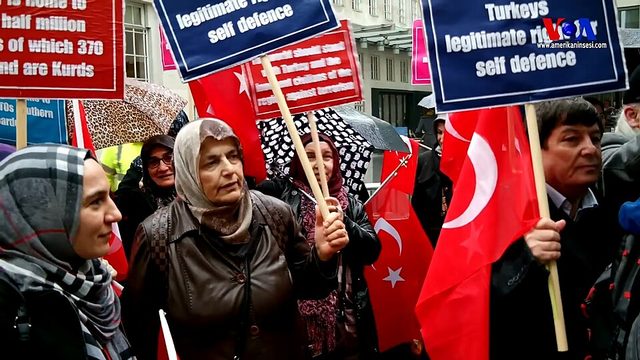
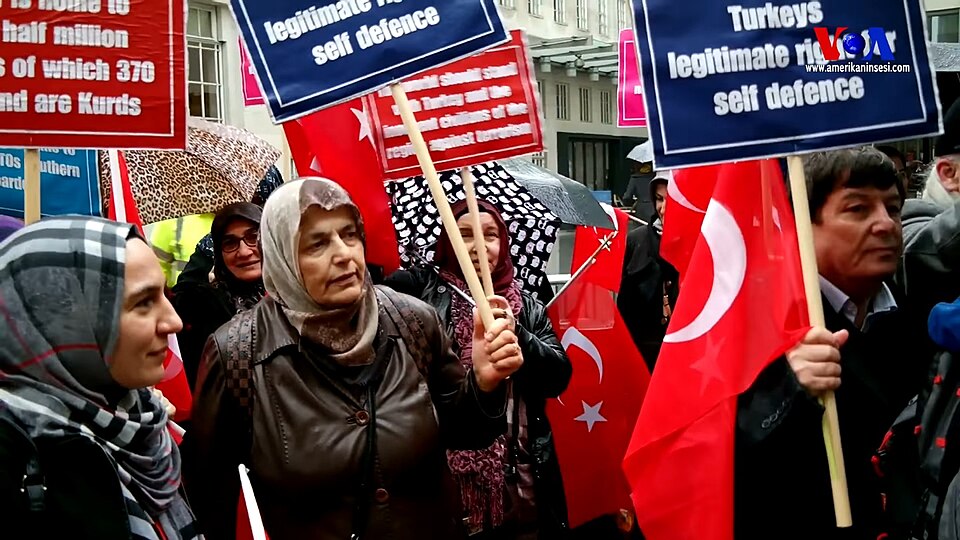
On the fifth day of Turkey's Operation Olive Branch against the Afrin district, a group called European Turkish Democrats gathered outside the BBC building in London. The placards read "Turkeys legitimate right to self defence" and lines about terrorism. The entry tags glittering generalities and transfer: a legal-moral slogan is used in place of a stated case.
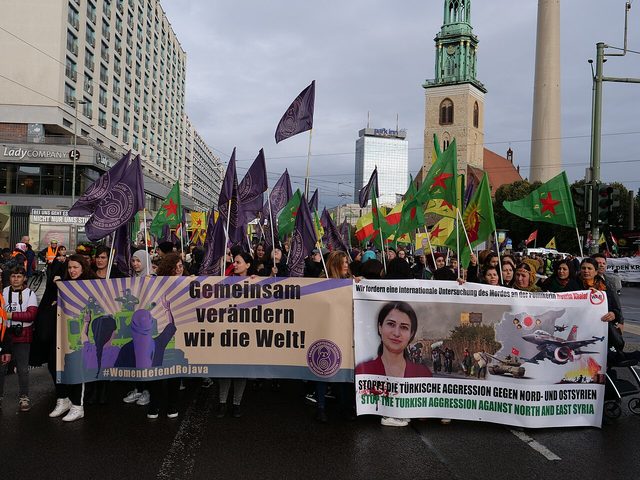
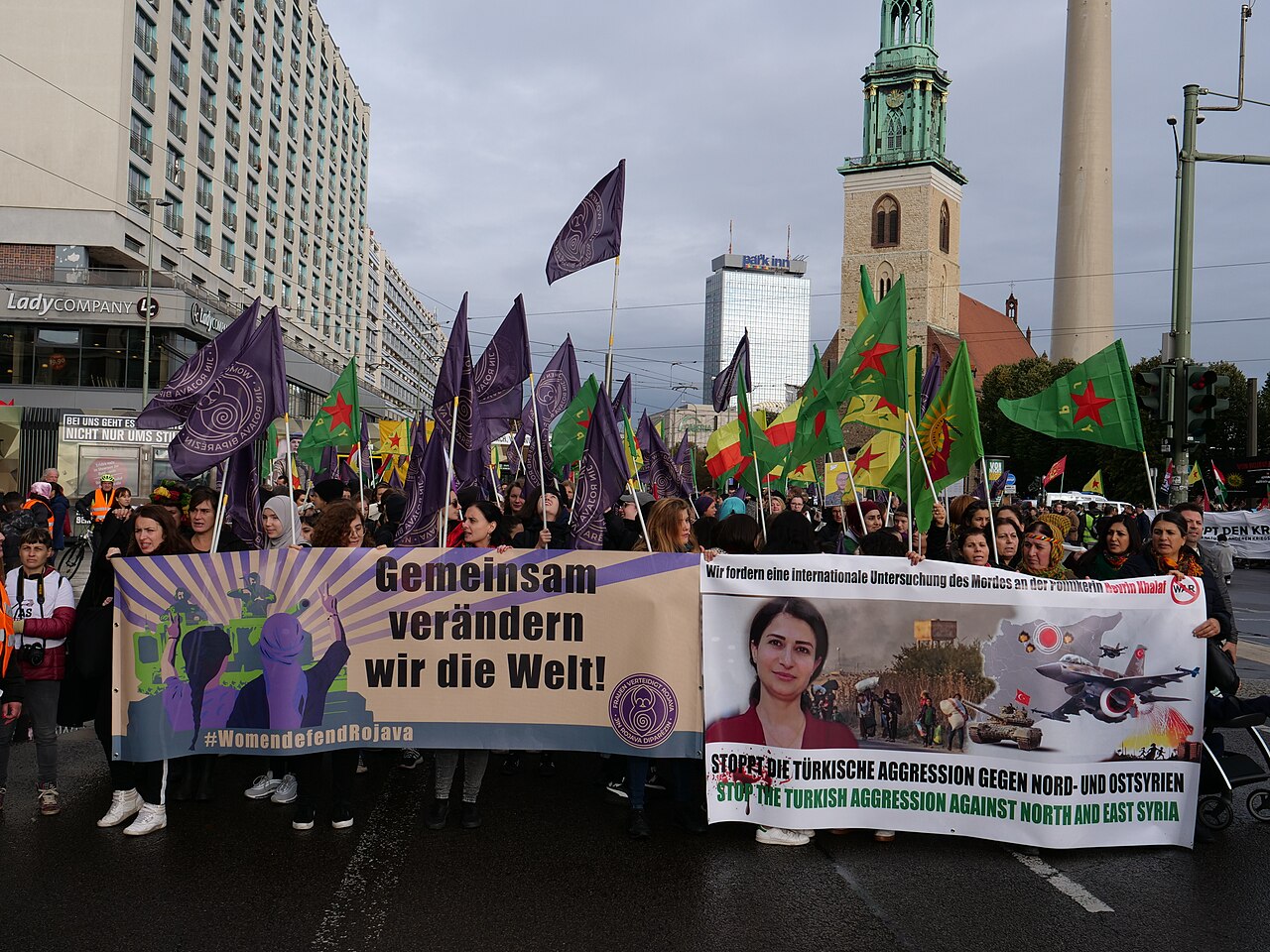
A Berlin march against the Turkish military operation in north-eastern Syria began on 9 October 2019, which Turkey presents as a counter-terrorism operation against the YPG, a force it regards as linked to the PKK. Banners show silhouetted women beside an armoured vehicle and a Turkish fighter jet over civilians. The entry tags appeal to emotion. Read the technique: appeal to emotion.
How did the war end in the record?
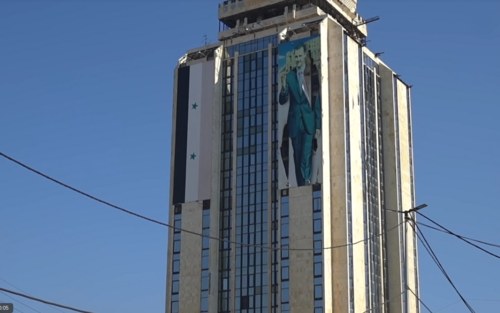
A Voice of America still of Aleppo on 2 December 2024, during the opposition offensive that took the city from government forces, shows a banner of Assad running down an office tower. The entry tags cult of personality: a leader's image sized to the building, shown on the day of the opposition offensive on the city.
Which techniques recur?
The same definitions apply to every issuer. These recur:
Explain moreShow less
- Transfer. Flags, handshakes and national colours lend legitimacy to an issuer. Transfer.
- Cult of personality and repetition. The Assad portraits on bikes, walls and towers. Cult of personality.
- Fear appeal. A cartoon and a poster pair an image of harm with a named enemy. Fear appeal.
- Scapegoating and guilt by association. One state made the author of a group's rise. Scapegoating.
- Appeal to emotion and glittering generalities. Silhouettes of women and slogans of "legitimate right". Appeal to emotion.
Scale, intent and context differ. The Syrian government items are portraits and rallies; on the record cited in the entries, the 2014 vote they promote was held only in government-held areas. The coalition item is a psychological-operations leaflet issued by US Central Command to civilians and potential recruits in Raqqa. The Iranian item comes from the office of a head of state. The diaspora items are demonstrations by groups in Berlin and London, not governments. The page does not treat these as equivalent. It shows what each issuer told its audience, and the entries record which claims the objects themselves do not let a reader check.
What to look for in Syrian civil war propaganda
- Who is speaking. A president's office, a news agency, a diaspora group, a coalition command. The entries name the photographer or agency where one is given.
- Whose camera. Many items are photographs by outside agencies of other people's displays, not the issuers' own products.
- The date against the event. A rally the day after missile strikes, a banner during a city's fall.
Show all 5Show fewer
- Borrowed symbols. Flags in a row, a coin in the style of old coinage, a handshake between flags.
- What is left out. The government's and Islamic State's own media are not in this collection.
Explain moreShow less
See also types of propaganda, propaganda examples and Russian propaganda.
Browse Syrian civil war propaganda
The grid below shows objects from the collection tagged to the Syrian civil war. Each opens an object page with the holding institution, a link to the original record, a transcription of any text and the rights basis for hosting.
Sources and further reading
Sources and rights
Objects on this page come from US Central Command, the Voice of America, the Kremlin (kremlin.ru, CC BY 4.0), khamenei.ir (CC BY…
Objects on this page come from US Central Command, the Voice of America, the Kremlin (kremlin.ru, CC BY 4.0), khamenei.ir (CC BY 4.0), Tasnim News Agency (CC BY 4.0) and Wikimedia Commons. Each object page gives its own rights basis. Transcriptions are verbatim. Counts were made from the entry files in examples/entries/.