Content note. Two Yugoslav Army leaflets from 1991 call Croatian fighters "Ustasha villains" and describe the other side as "resurrected fascism". They are shown as printed. Showing an item is not endorsing it.
What was propaganda in the Yugoslav wars?
Propaganda in the Yugoslav wars is the organised persuasion that governments, armies and outside powers directed at soldiers and civilians during the breakup of Yugoslavia from 1991 to 1999. The collection holds 17 objects, each tagged by issuer, audience and technique, with the same definitions applied to every issuer.
Explain moreShow less
They fall into four groups: Croatian state and city items from 1991, Yugoslav Army and Serb-held local items from 1991 and 1992, US and NATO products from 1994 to 1999 aimed at Bosnian civilians and at Yugoslav soldiers, and two photographs of signing ceremonies. The page applies the working definition used for every country (how FRAME defines propaganda). Related pages: propaganda leaflets, psychological operations and Russian propaganda.
A gap, stated plainly. The collection holds no object issued by the Bosnian government, the Bosnian Serb or Bosnian Croat authorities, the Kosovo Albanian leadership or the Serbian state media of Slobodan Milosevic's government. Such items could not be cleared for hosting. The Serb-side items are two Yugoslav Army leaflets and one local council decision. That reflects what has been found and cleared, not the amount of persuasion produced on those sides. The NATO and US items are the largest group, so the page over-represents the outside powers.
The sections run in date order. Each object is described from its catalogue entry: issuer, audience, the ask and the technique.
How did Croatia present independence in 1991?
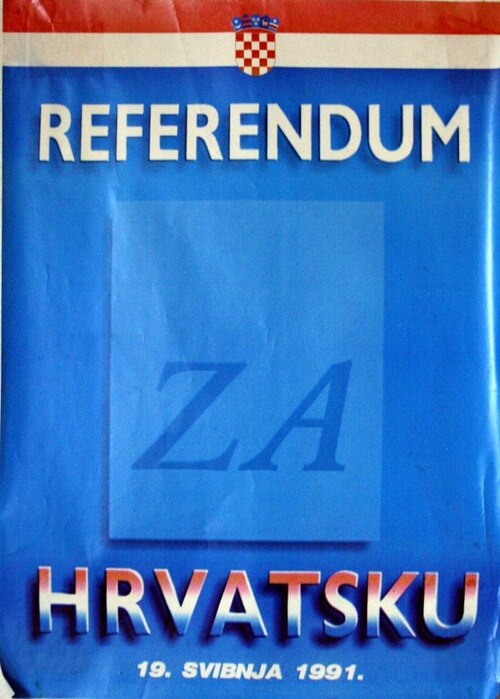
A blue poster carries the Croatian chequerboard shield, the word REFERENDUM and a pale "ZA" (for) joined to HRVATSKU (Croatia) above the date 19 May 1991. The entry tags identity fusion and transfer: the only word of the choice shown is "for", tied by the layout to the country's name. Read the technique: identity fusion.
Explain moreShow less
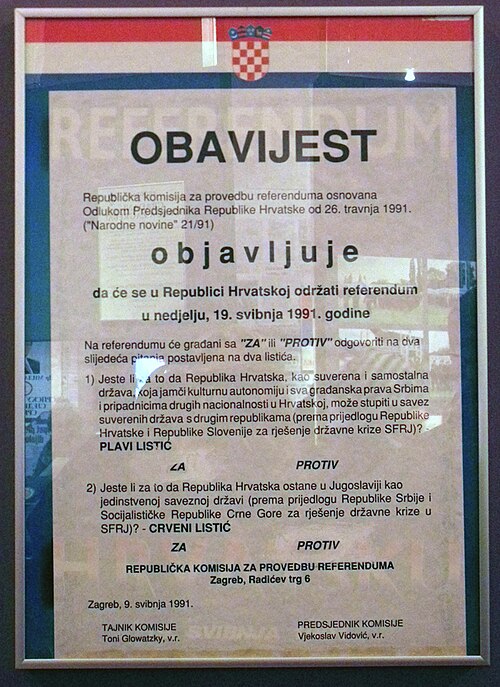
The official notice prints two questions, each answered ZA or PROTIV. The first, on an independent Croatia, includes a guarantee of cultural autonomy and civil rights for Serbs. The entry tags card stacking: what the question bundles into one answer. Read the technique: card stacking.
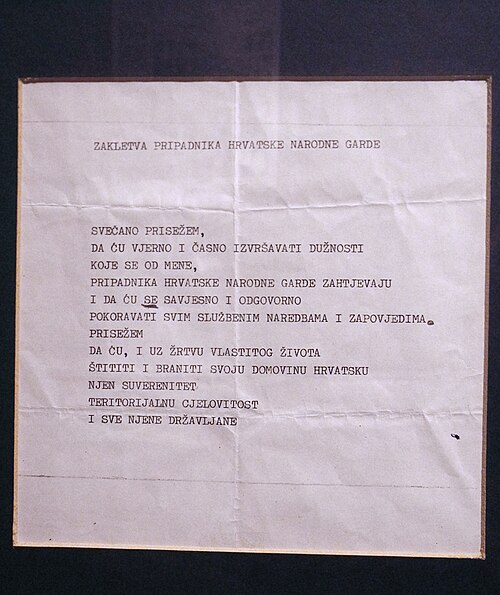
A typewritten oath binds the speaker to obey orders and to defend "my homeland Croatia", its sovereignty and territorial integrity, even at the cost of his life. The entry tags identity fusion.
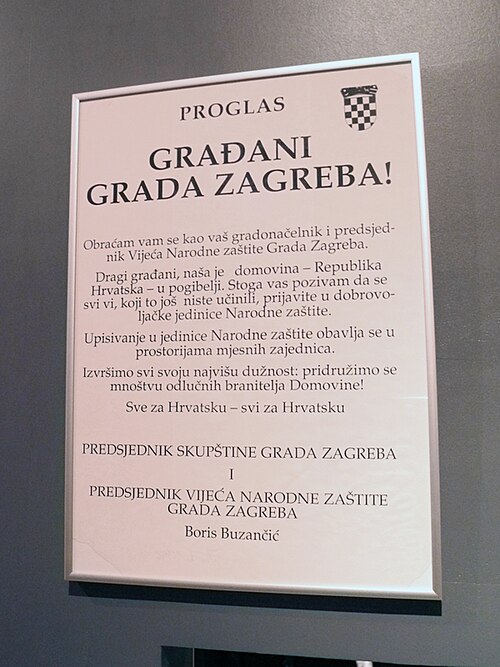
A proclamation tells residents the homeland "is in peril" and asks them to enrol in volunteer National Protection units, ending "All for Croatia - all for Croatia". The entry tags fear appeal and bandwagon. Read the technique: fear appeal.
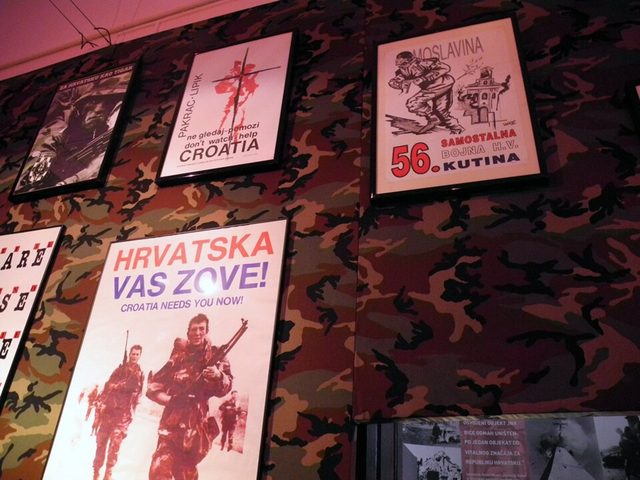
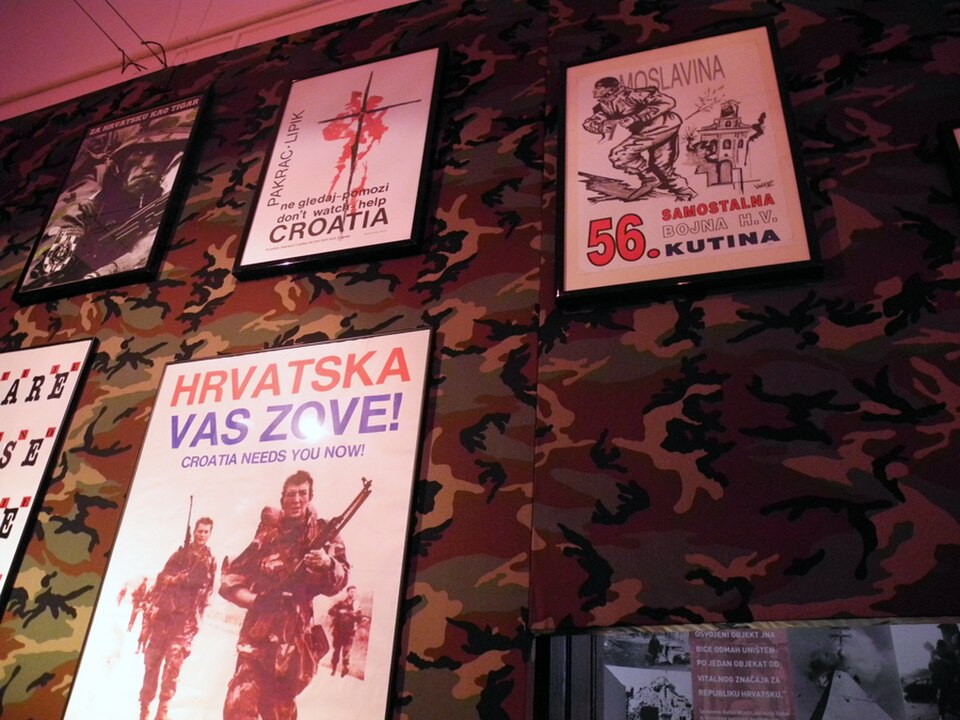
Four framed posters photographed at a 2012 museum exhibit read "Hrvatska vas zove! / Croatia needs you now!", "ne gledaj-pomozi" (don't watch, help) and "Za Hrvatsku kao tigar". The entry tags appeal to emotion and identity fusion. Read the technique: appeal to emotion.
How did the Yugoslav Army and Serb-held authorities address their audiences, 1991 and 1992?
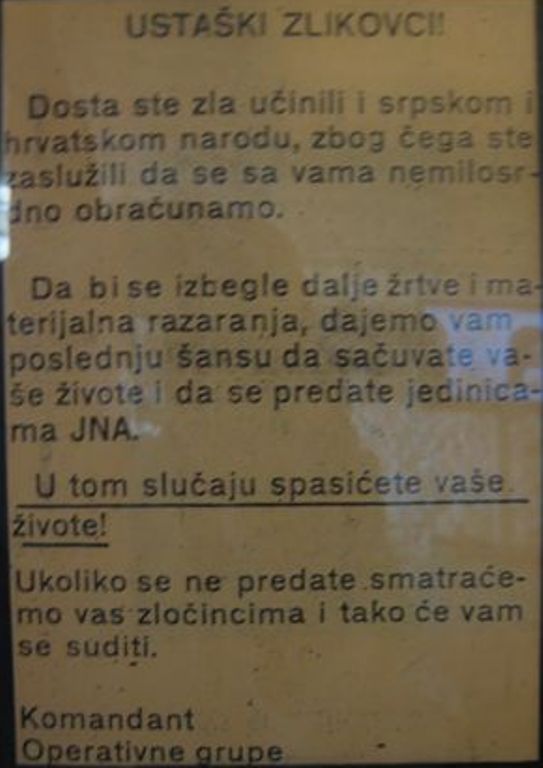
The leaflet opens with the label "Ustasha villains", says the readers deserve to be dealt with without mercy, offers a "last chance" to surrender to Yugoslav Army units and says those who do not will be treated as criminals and tried. The entry tags name-calling and fear appeal. Read the technique: name-calling.
Explain moreShow less
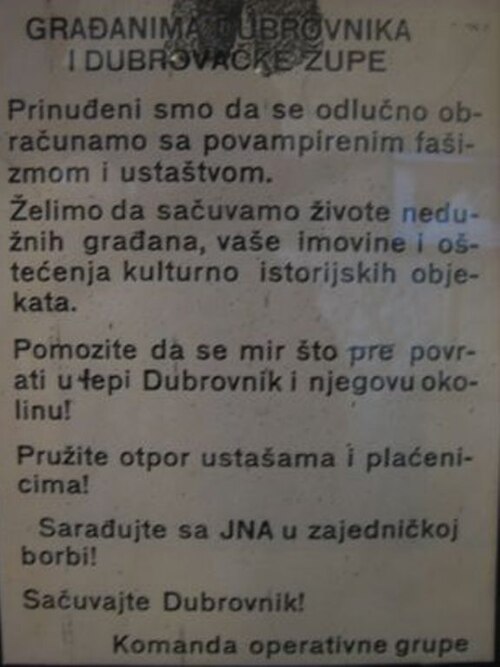
Addressed to the citizens of Dubrovnik and its hinterland, the leaflet says the issuers were "forced" to deal with "resurrected fascism and Ustashism", wishes to protect lives and cultural monuments, and ends with four imperatives, among them "Save Dubrovnik!". The entry tags name-calling and guilt by association. Read the technique: guilt by association.
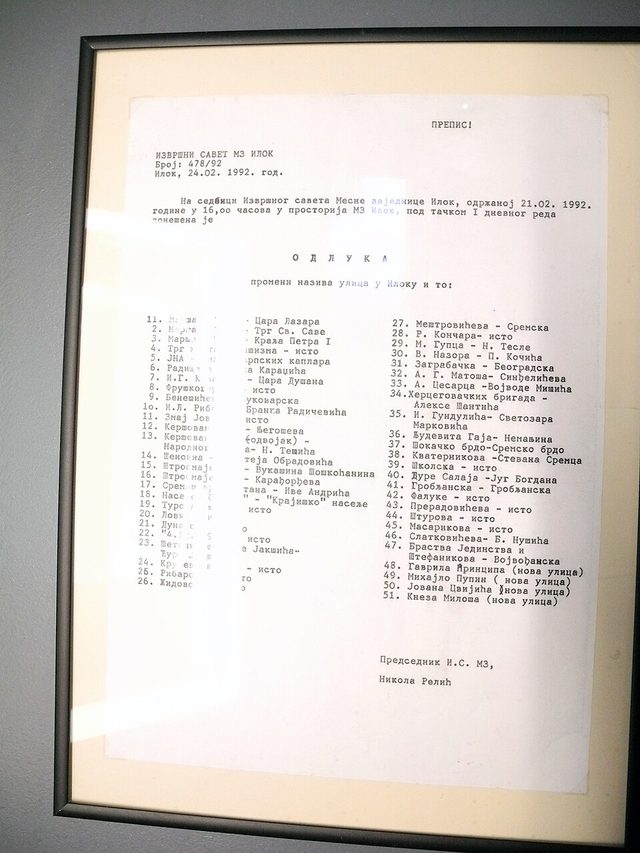
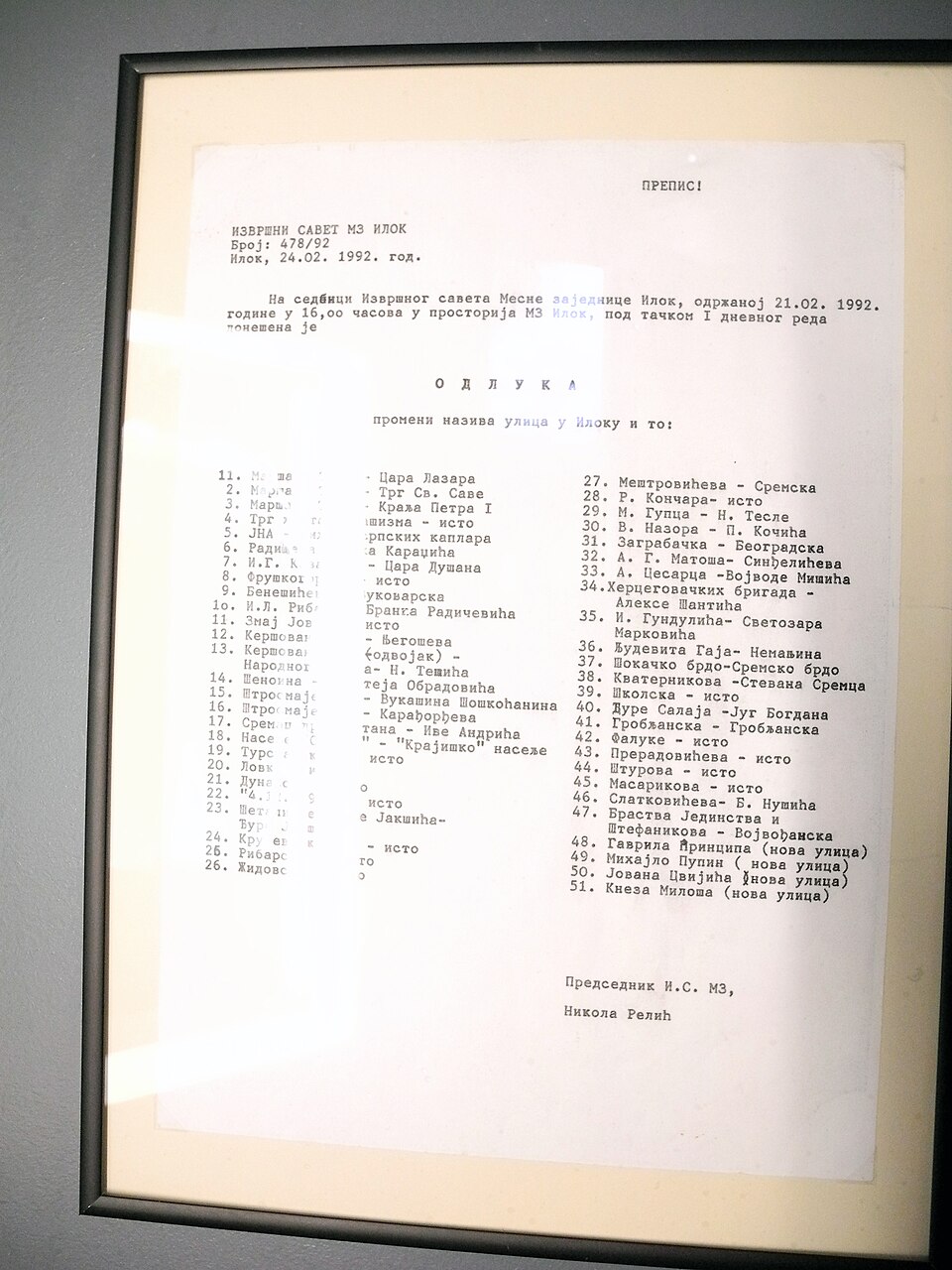
A typewritten Cyrillic decision of the Executive Council of the Ilok local community lists 51 streets: names such as Meštrović, Matoš and Nazor give way to Sremska, Sindjelić and Beogradska, and new streets honour Princip, Pupin and Cvijić. The entry tags transfer: the street map is made to carry a different national story. The issuer is a Serb-held local council, not the government in Belgrade. Read the technique: transfer.
How did the United States and NATO address Bosnians and Yugoslav soldiers, 1994 to 1999?
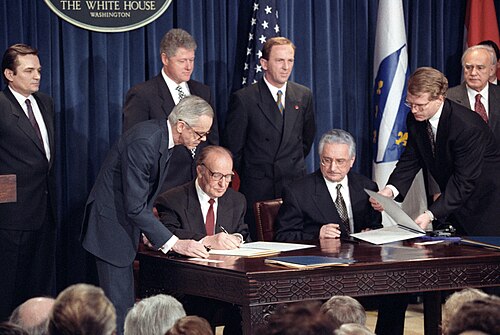
A White House photograph shows the two presidents signing beside a White House seal, a US flag and a Bosnian flag. The entry tags transfer: the host's seal frames the accord as made under US sponsorship.
Explain moreShow less
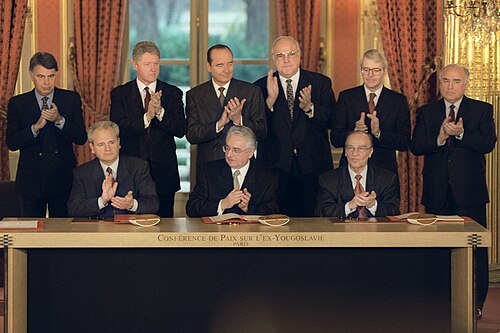
Three signatories sit at a table lettered "Conférence de paix sur l'ex-Yougoslavie, Paris" while six men stand and applaud behind them. The entry tags transfer: the applauding row shows the agreement with an international audience behind the signatories.
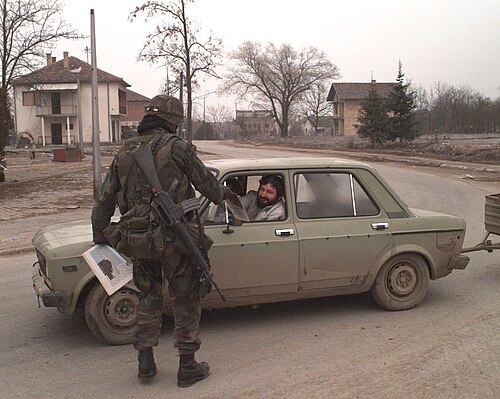
An armed soldier hands a folded newspaper about the implementation force to the smiling driver of a car. The entry tags plain folks: an official product delivered by hand at the roadside. Read the technique: plain folks.
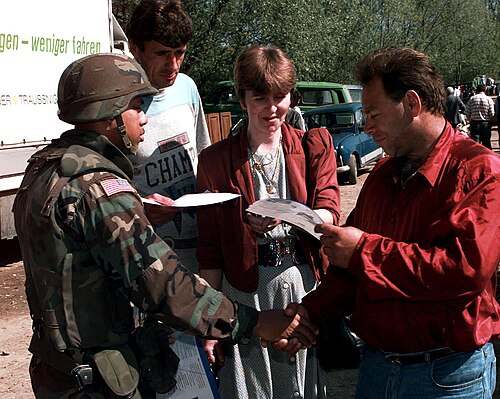
A soldier shakes hands with a man holding a folded leaflet at a market. The entry tags plain folks: an armed soldier of the implementation force delivering an official message face to face.
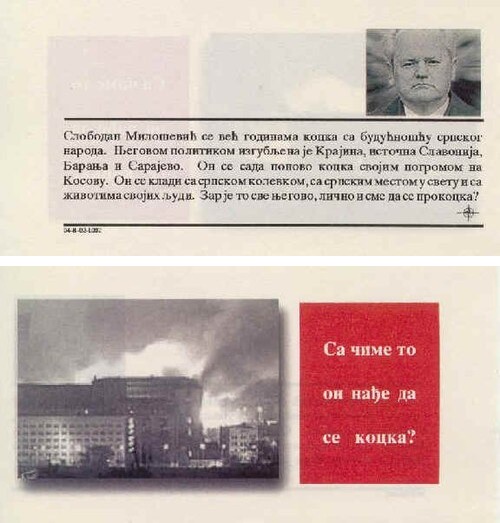
The front pairs a portrait of Slobodan Milosevic with a list of places "lost" under his policies (Krajina, eastern Slavonia, Baranja, Sarajevo) before saying he now gambles "with his pogrom in Kosovo". The entry tags card stacking: a selected list of losses attributed to one man.
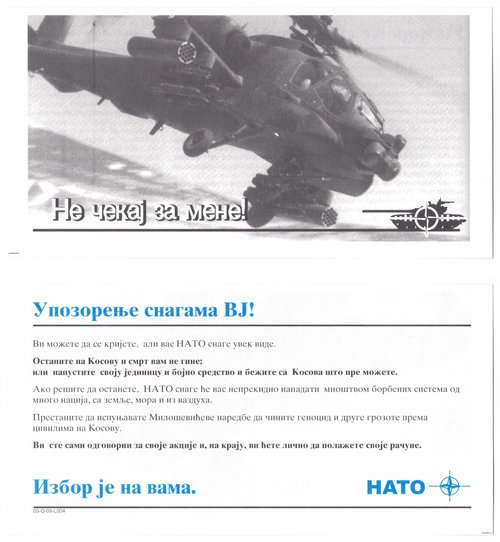
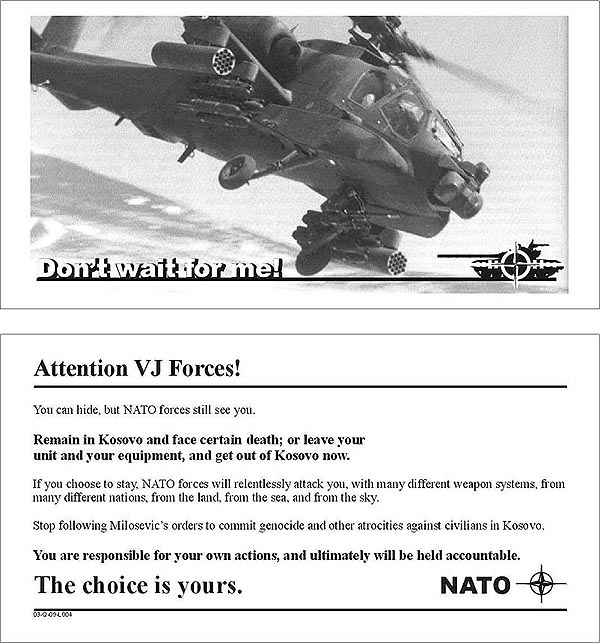
The back warns Yugoslav Army forces that NATO "always sees you", that those who stay in Kosovo will meet death and those who leave their unit and equipment may live. The entry tags fear appeal and false dilemma. Read the technique: false dilemma.
The English-language version shows an AH-64 Apache helicopter above the same slogan and carries the same two-door choice. The entry tags fear appeal and false dilemma.
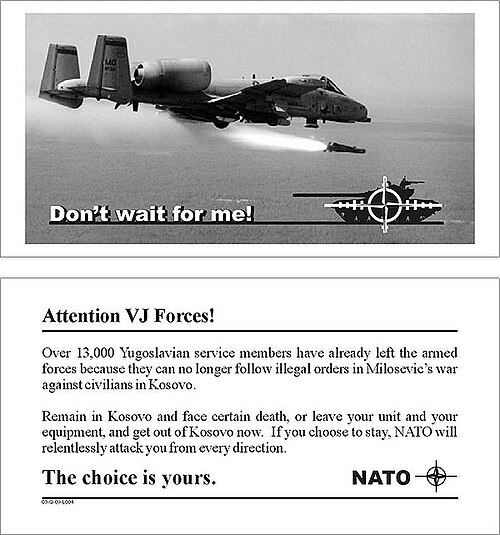
The back says over 13,000 Yugoslav service members have already left the armed forces. The entry tags bandwagon, fear appeal and false dilemma: a head-count with no source printed on the leaflet, presented as a crowd already moving. Read the technique: bandwagon.
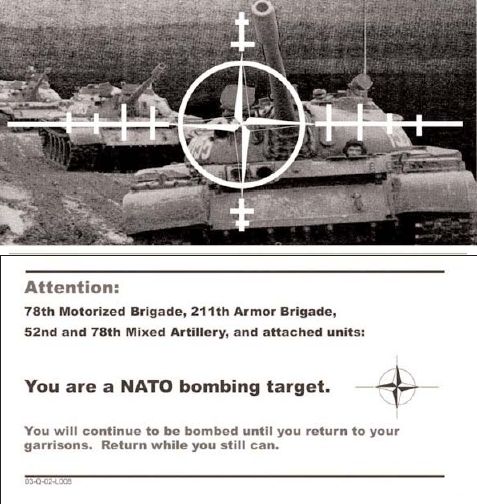
A photograph of Yugoslav Army tanks carries a crosshair with the NATO compass star, and text addressed to four named units says bombing will continue until they return to garrison. The entry tags fear appeal.
Which techniques recur?
The same definitions apply to every issuer. These recur:
Explain moreShow less
- Identity fusion. The country's name, flag and arms stand in for the choice. Identity fusion.
- Name-calling and guilt by association. A label for the opposing side replaces a description. Name-calling.
- Fear appeal and false dilemma. Stay and be killed, or leave. The Croatian proclamation uses peril, the NATO leaflets use targeting. Fear appeal.
- Transfer. Seals, flags and renamed streets lend a sponsor's authority to an outcome. Transfer.
- Plain folks. Soldiers hand out leaflets and papers in person. Plain folks.
Scale, intent and context differ. The Croatian items address citizens of a state declaring independence and, later, recruits for its forces. The Yugoslav Army leaflets address Croatian fighters and the residents of a city under attack. The NATO and US leaflets are military psychological operations aimed at soldiers of a state NATO was bombing, and the US Army items were issued by the NATO-led implementation force (IFOR, later SFOR) in Bosnia. The tagging does not rank these by moral weight; the entries cite the text and note what each object cannot show.
What to look for in Yugoslav wars propaganda
- Who is speaking. A government, an army, a council or a foreign force, and which language it uses.
- The label for the other side. Whether it is a name, a group or a charge.
- The closed choice. Stay and be killed, or surrender, or leave.
- What is left out. Bosnian, Kosovo Albanian and Belgrade state-media messaging is absent from this collection.
See also types of propaganda, propaganda examples and Iraq War propaganda.
Browse Yugoslav wars propaganda
The grid below shows objects from the collection tagged to the Yugoslav wars. Each opens an object page with the holding institution, a link to the original record, a transcription of any text and the rights basis for hosting.
Sources and further reading
Sources and rights
Objects on this page come from Wikimedia Commons (photographs under Creative Commons licences and US government works) and the…
Objects on this page come from Wikimedia Commons (photographs under Creative Commons licences and US government works) and the Internet Archive (Hollen Song leaflet collection). Each object page gives its own rights basis, and for the 1991 and 1992 items the basis is the photographer's licence over the photographed document. Transcriptions are verbatim. Counts were made from the entry files in examples/entries/.