Content note. Some leaflets on this page carry photographs of violence, including a man striking a woman and bodies on open ground. They appear as issued, as evidence of what the issuer showed its audience. Showing an item is not endorsing it.
What is propaganda in the war in Afghanistan?
Propaganda in the war in Afghanistan is the organised persuasion aimed at Afghans and at fighters by the governments and forces involved: Kabul's state radio in 1980, the Taliban government's own emblem in 1997, and coalition leaflets dropped and handed out from 2001. The collection holds 16 objects from 1980 to 2014, each tagged by issuer, audience and technique.
Explain moreShow less
The page applies the working definition used for every country (how FRAME defines propaganda) and the same technique definitions to every issuer. Related pages: propaganda leaflets, psychological operations, Iraq War propaganda and the regime page George W. Bush administration.
A gap, stated plainly. Thirteen of the 16 objects are coalition leaflets, because the US military's leaflets were published and preserved. The collection holds one Taliban object, a flag, and no Taliban leaflets, broadcasts or night letters. That reflects what has been found and cleared for hosting, not the amount of persuasion the Taliban produced. Read the leaflet sections as one side's record.
The sections run in date order. Each object is described from its catalogue entry: issuer, audience, the ask and the technique.
What did propaganda look like before the coalition, 1980 to 1997?
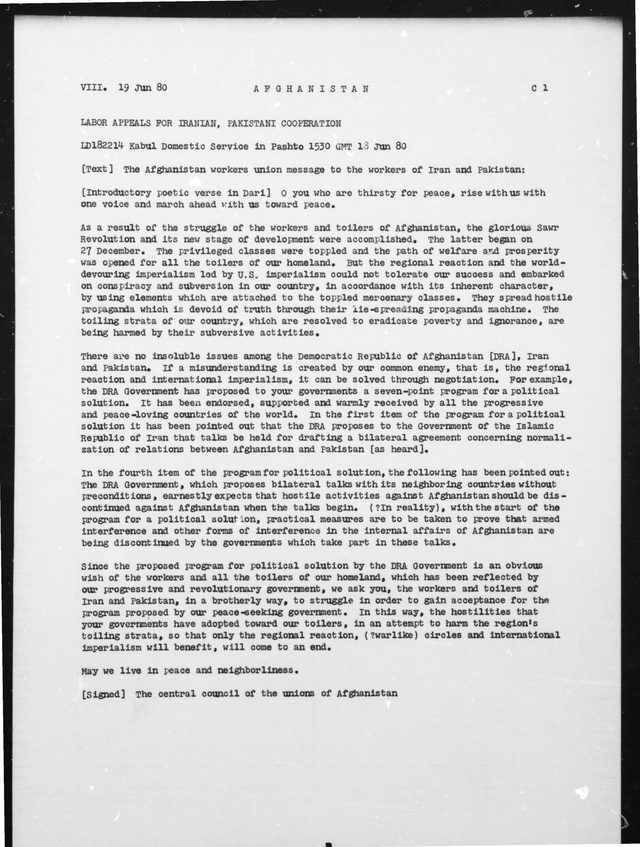
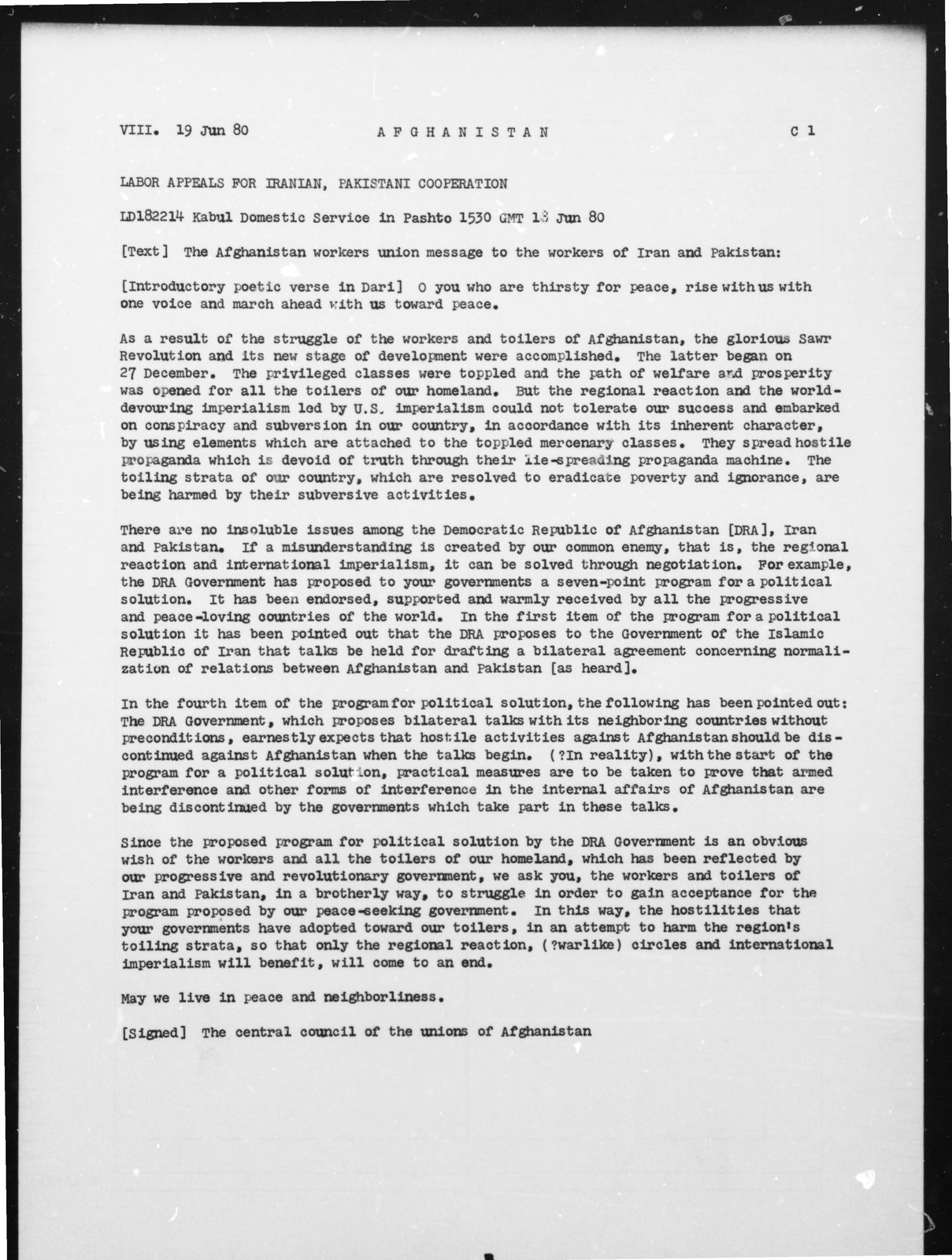
On 19 June 1980 Kabul Domestic Service, in Pashto, read a message from the "central council of the unions of Afghanistan" to the workers of Iran and Pakistan. The US Foreign Broadcast Information Service translated it. The message credits the "Sawr Revolution", blames "regional reaction and the world-devouring imperialism led by U.S. imperialism" for armed opposition, and does not mention Soviet troops, who had entered the country six months earlier. The entry tags it scapegoating, name-calling and card stacking. Read the technique: scapegoating.
Explain moreShow less
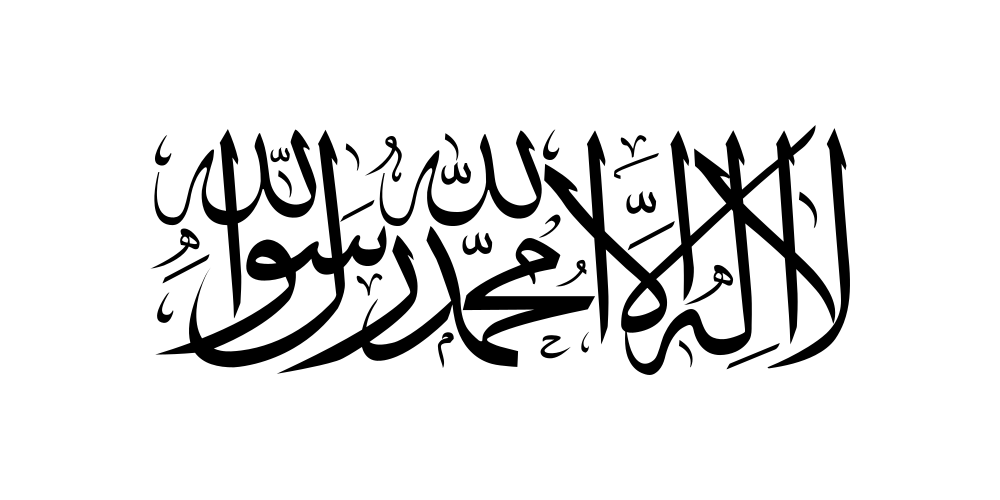
The Taliban government's white flag with the Islamic profession of faith, introduced in the September 1997 amendments to the flag law, is the one Taliban object in the collection. The hosted file is a modern vector redrawing, not a photograph of a flag in use. The entry tags it transfer: a sacred text used as the state's own emblem lends the creed's authority to the government. Whether that is a religious or a political claim is a matter the object does not settle.
How did the coalition address Afghans and Taliban fighters in 2001?
The 2001 leaflets were dropped or handed out in the first months of the campaign. Each pairs a short message with a picture, usually in Dari and Pashto.
Explain moreShow less
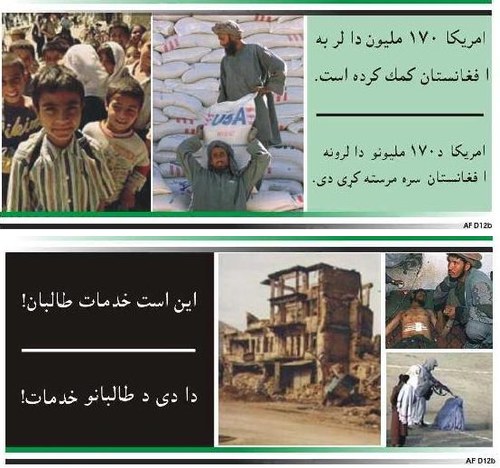
One face of this leaflet shows smiling children and a sack marked "USA" beside a figure for aid; the other shows a ruined building, a man on a stretcher and a woman in a burqa facing a gunman, beside "This is what the Taliban has done!" The entry tags it card stacking: two hand-picked sets of images, with no dates, places or denominators. Read the technique: card stacking.
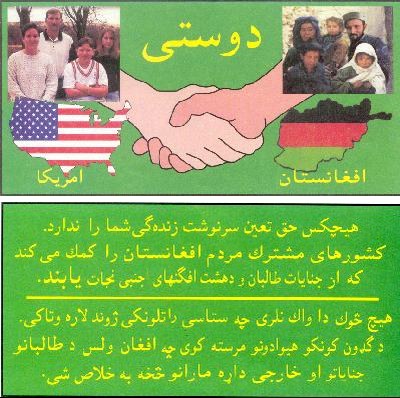
Clasped hands sit between a US-flag map and a map of Afghanistan, over the headline "Friendship". Per the file page, the back says no one should tell Afghans how to live and that a "Partnership of Nations" will rescue them from "Taliban criminals and foreign terrorists". The entry tags it transfer and glittering generalities. Read the technique: glittering generalities.
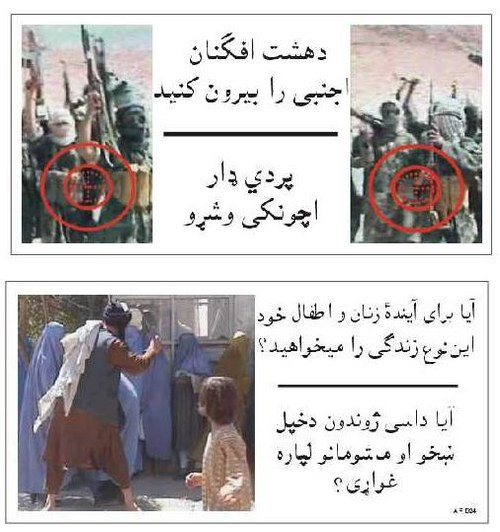
The front reads "Drive out the foreign terrorists". The back is a photograph of a man in Taliban-era dress striking a woman in a blue burqa, beside "Is this the future you want for your women and children?" A Northern Alliance fighter was photographed holding the leaflet on 7 November 2001. The leaflet gives no date, place or name for the scene. The entry tags fear appeal and appeal to emotion. Read the technique: fear appeal.
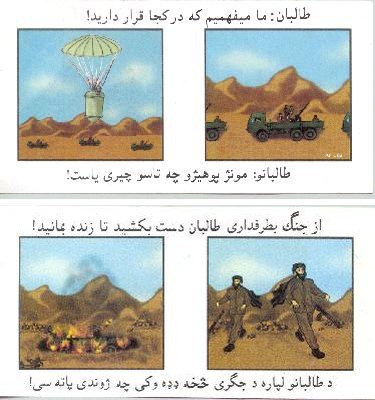
Dated on its file page to 21 November 2001, this leaflet shows a supply canister and a gun truck under "Taliban: we know where you are!" The back shows fighters walking away from a burning crater, with "Give up fighting for the Taliban and live!" The entry tags fear appeal: the threat of an observed position paired with a single exit.
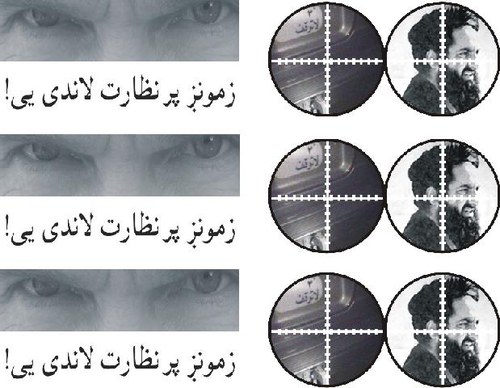
Three rows show a pair of eyes, a line of Pashto and two crosshair circles, one over a licence plate and one over a bearded man's face. The sources say the man "may have been" Mullah Mohammed Omar and that the plate was reportedly photographed by a drone; the leaflet does not confirm either. The entry tags fear appeal.
How did the leaflets change in 2002?
By 2002 an interim Afghan government was in place, and the leaflets began to address Afghans as a national audience as well as fighters.
Explain moreShow less
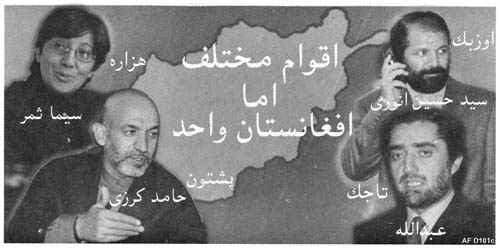
Four portraits surround a map of Afghanistan: Hamid Karzai, Sima Samar, Sayed Hussein Onery (spelling as on the source page) and Abdullah Abdullah, each labelled with an ethnic group, under "Many tribes, but one Afghanistan." The collector Herbert A. Friedman reports 580,000 copies were dropped. The Taliban are not named. The entry tags glittering generalities. Read the technique: glittering generalities.
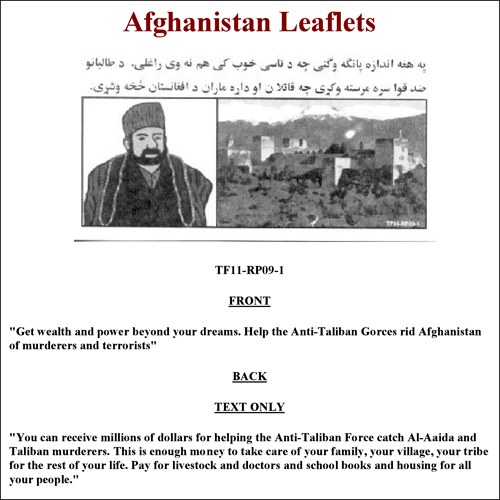
A Task Force 11 leaflet offers "wealth and power beyond your dreams" to anyone who helps the Anti-Taliban Forces "rid Afghanistan of murderers and terrorists". The entry tags loaded language and name-calling: an open-ended promise joined to a label for the enemy. Read the technique: name-calling.
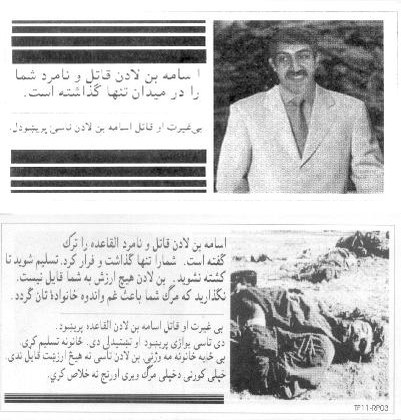
The file page dates this leaflet to January 2002 and says it was meant to demoralise Taliban and al-Qaeda fighters by saying bin Laden deserted them while they were dying. The back is a photograph of bodies on open ground. The entry tags appeal to emotion.
How did the leaflets address Afghans in support of their own government, about 2006 to 2007?
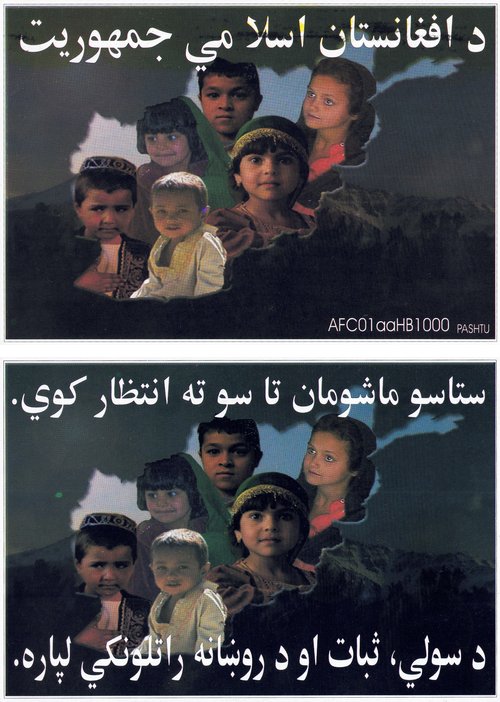
Five leaflets from about 2006 and 2007 come from a collector's archive. They are in Pashto and Dari, and several name the Afghan state or its president, not the coalition. The entries attribute them to the coalition through the leaflet-code series.
Explain moreShow less
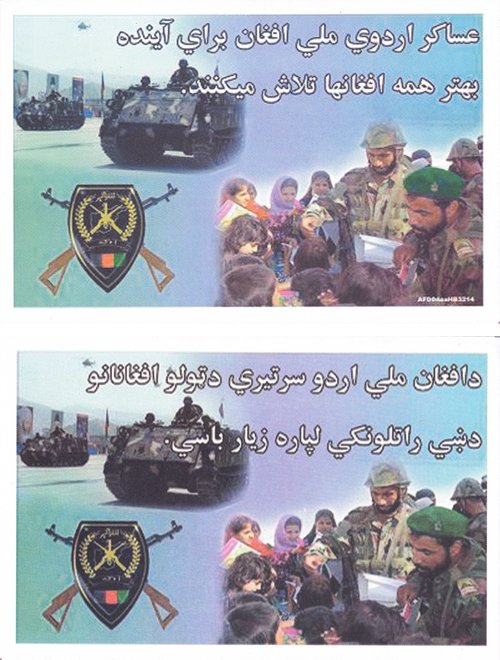
Both sides carry the line, in the description's translation, that Afghan National Army soldiers are striving for "a better future for all Afghans". The entry tags glittering generalities: a virtue phrase with no policy attached.
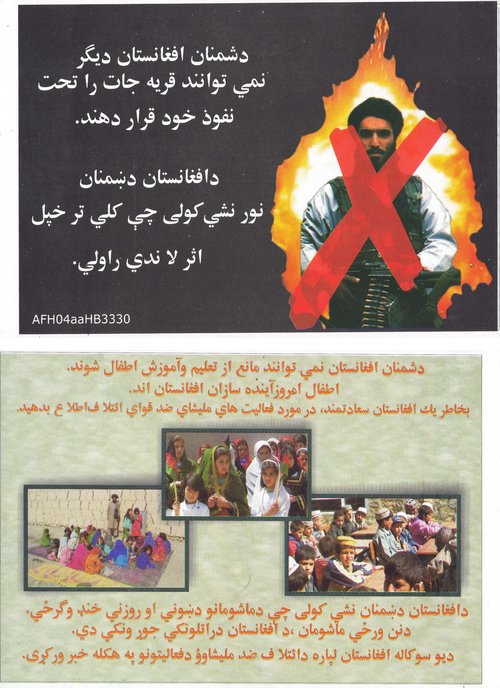
The front claims that "the enemies of Afghanistan" can no longer bring villages under their control; the back says they cannot prevent children's education and asks readers to report anti-coalition militia activity. The claim of control is the leaflet's own and is not tested against any village. The entry tags card stacking and scapegoating.
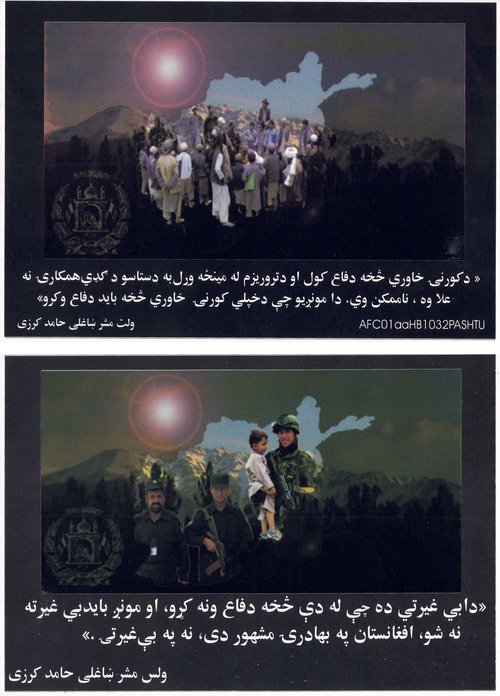
Two quotations attributed to President Hamid Karzai ask for the reader's cooperation and appeal to honour: it is "dishonourable" not to defend the homeland. The leaflet does not say where or when he said them. The entry tags testimonial. Read the technique: testimonial.
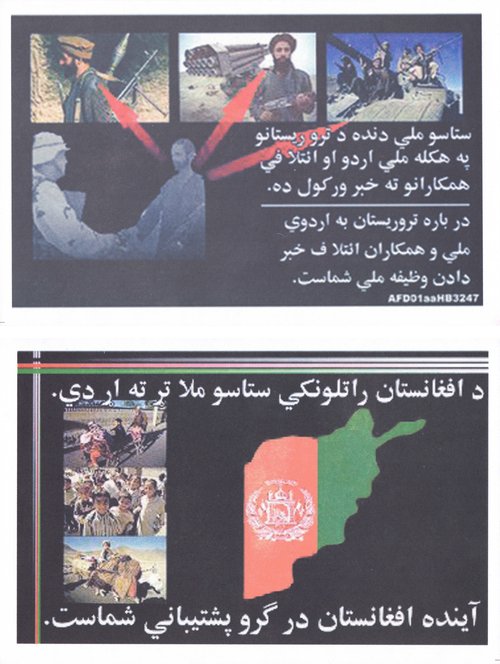
The request for informants uses patriotic language, and the leaflet does not define "terrorists". The entry tags loaded language and glittering generalities.
Aimed at Afghan fighters, the back reads "Your children are waiting for you. For peace, stability and a bright future." It asks for a change of side through feeling and says nothing of terms or consequences. The entry tags appeal to emotion. Read the technique: appeal to emotion.
How did the US government describe the withdrawal in 2014?
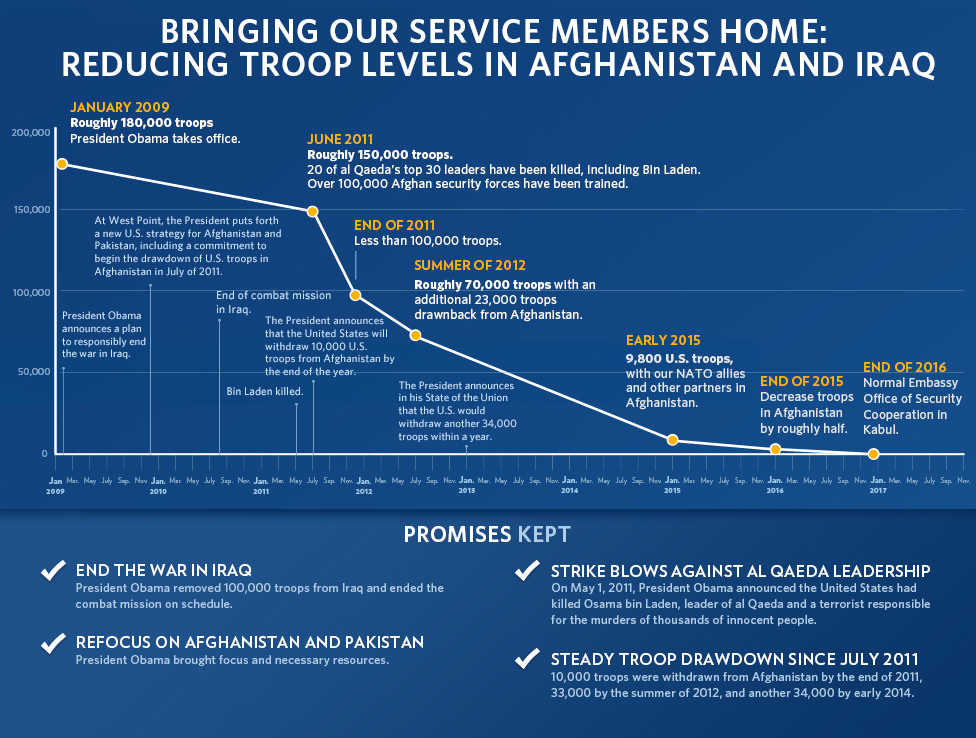
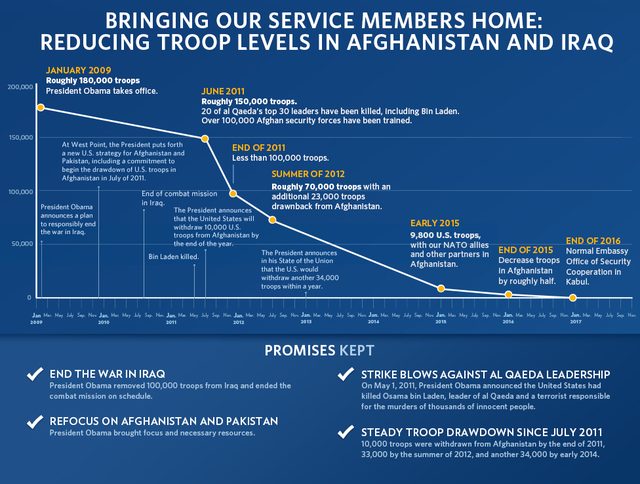
The Obama White House published this infographic on 27 May 2014. A falling line plots US troop levels in Afghanistan and Iraq from about 180,000 in January 2009 to zero at the end of 2016. The entry tags it card stacking: the line after mid-2014 is a plan, not a count. It also appears on the page for Iraq War propaganda.
Which techniques recur in the Afghanistan items?
The same definitions apply to every issuer. These recur:
Explain moreShow less
- Fear appeal. Leaflets pair a picture of harm or surveillance with a stated way out. Fear appeal.
- Appeal to emotion. Family, honour and abandonment replace argument. Appeal to emotion.
- Glittering generalities. "Friendship", "a better future", "one Afghanistan". Glittering generalities.
- Card stacking. Selected images or numbers force one reading: aid on one face and destruction on the other, a falling line that is partly a plan. Card stacking.
- Name-calling and loaded language. "Murderers and terrorists", "foreign terrorists", "enemies of Afghanistan". Name-calling.
- Transfer. National flags, maps and a sacred text lend prestige to an issuer. Transfer.
Scale, intent and context differ. The coalition leaflets were issued by foreign armed forces operating in Afghanistan, aimed at a population and at fighters in a war in which the coalition was a party. The Kabul broadcast of 1980 came from a government supported by Soviet forces, themselves foreign forces operating in Afghanistan. The Taliban flag is a state emblem. The page does not treat these as equivalent. It shows what each issuer told its audience, and the entries record which claims the objects themselves do not let a reader check.
What to look for in Afghanistan war propaganda
- Who is speaking. Some leaflets name the Afghan state or its president while the leaflet code points to a coalition series. The entries say when the issuer is inferred.
- The date against the event. A leaflet dated to November 2001 shows what was said then.
- What the picture proves. A photograph with no date, place or name carries a claim the leaflet does not support.
Show all 5Show fewer
- Borrowed voices. A quotation from a national leader, a shared handshake, a creed on a flag.
- What is left out. Who read a leaflet and how it was received is not established by any object.
Explain moreShow less
See also types of propaganda, propaganda examples and psychological operations.
Browse Afghanistan war propaganda
The grid below shows the objects from the collection tagged to Afghanistan. Each opens an object page with the holding institution, a link to the original record, a transcription of any text and the rights basis for hosting.
Sources and further reading
Sources and rights
Objects on this page come from the US armed forces and the CIA (via Wikimedia Commons and the Internet Archive), the White House,…
Objects on this page come from the US armed forces and the CIA (via Wikimedia Commons and the Internet Archive), the White House, the US Foreign Broadcast Information Service and Wikimedia Commons. Each object page gives its own rights basis. Transcriptions are verbatim. Counts were made from the entry files in examples/entries/.