Content note. Leaflets on this page include wartime appeals built on fear of death, caricature of enemy leaders and hostile labels for opponents. They are shown as issued, from several sides. Showing a leaflet is not endorsing it.
What are psychological operations?
Psychological operations, or psyops, are planned efforts by a government or armed force to influence the emotions, motives and behaviour of a chosen audience, usually foreign. US Army manuals define them as conveying selected information to influence "emotions, motives, objective reasoning, and ultimately the behavior" of that audience. Leaflets, radio and loudspeakers are the classic tools.
Where the term comes from
The vocabulary is American, but the practice is older and international. In the Second World War the Allies ran organised leaflet, radio and newspaper operations under several names. Britain's Political Warfare Executive worked with the US Office of War Information and Office of Strategic Services. In Northwest Europe the combined Psychological Warfare Division of Supreme Headquarters Allied Expeditionary Force, headed by US Brig. Gen. Robert A. McClure, produced Nachrichten für die Truppe, a daily German-language newspaper for German troops first dropped on 25 April 1944. In the Pacific the US Army's Psychological Warfare Branch printed leaflets for Japanese troops. The US Army kept the capability after 1945 and used it in Korea, Vietnam and later conflicts, and the field manuals in the FM 33-1 series codified the work.
Explain moreShow less
The US definition rests on two ideas: a foreign audience and a behavioural goal. The manuals set out a sequence of seven phases, from planning and target-audience analysis through production, approval and evaluation, and they sort products by attribution into white (acknowledged), grey (no source given) and black (credited to a false source). The manuals state that military PSYOP most commonly uses white products by policy and practice. The same three colours appear on the types of propaganda page. A fuller summary, with citations, is in US Army and Joint Staff PSYOP doctrine.
PSYOP, MISO and back to PSYOP
The name has changed several times, and each change was argued about:
Explain moreShow less
- Psychological warfare was the main US and British term in the Second World War and early Cold War.
- PSYOP (psychological operations) became the standard military term in US doctrine.
- MISO (Military Information Support Operations) replaced it in 2010. The Defense Department memo, as quoted by DefenseScoop, said "the term psyop tends to connote propaganda, brainwashing, manipulation, and deceit." Army authors debated the change, and a Joint Publication of December 2011 carried the new name.
- PSYOP again. The Army returned its branch and units to the PSYOP name under US Army Special Operations Command guidance dated 27 October 2017 (Army Times, 6 November 2017). On 2 December 2025 Defense Secretary Pete Hegseth signed a memorandum directing the department to change MISO back to "psychological operations" department-wide by the end of fiscal year 2026 (DefenseScoop, 9 December 2025).
The 2010 memo also said the activities "rely on truthful information, credibly conveyed," and Joint Publication 3-13.2 (2010) states that US PSYOP forces will not target US citizens. Those are the doctrine's own statements; the cases below show what was done.
Examples from the archive's leaflet collection
The archive holds 185 leaflets from more than twenty countries. Leaflets are the physical trace of psyops that can be shown whole. The propaganda leaflets page has the collection. Four examples from different forces and wars:
Content note: Wartime leaflet that alleges German soldiers dishonoured Finnish women and stages children left fatherless This object is shown as it was published. Why 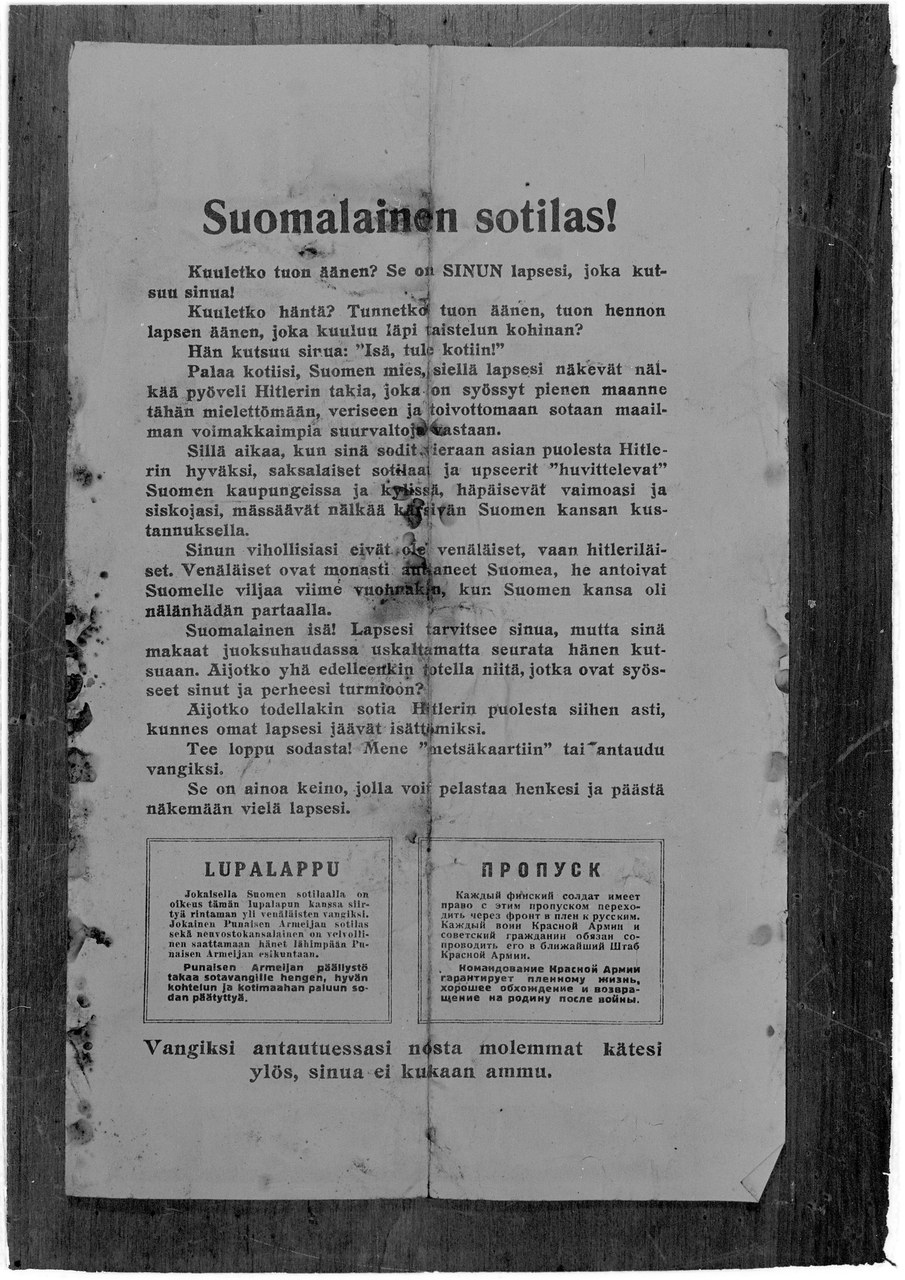
Explain moreShow less
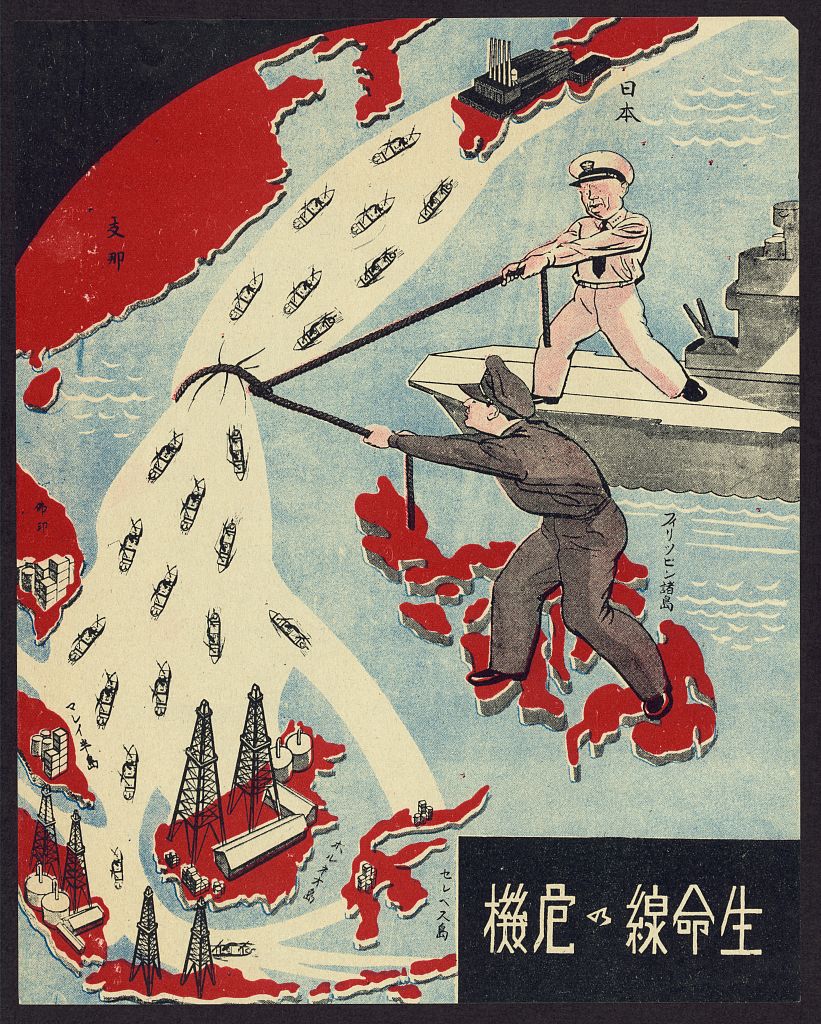
United States, 1944: Pacific. "Japan's Life Line" (leaflet 10-J-1) was printed by the US Army Forces, Pacific, Psychological Warfare Branch for Japanese troops. It shows two American officers cutting a supply line between Southeast Asia and Japan, an argument that the garrison was cut off and should stop fighting. Read the technique: card stacking.
Japan's Life Line, leaflet 10-J-1, 1944. US Army Forces, Pacific, Psychological Warfare Branch. Library of Congress, LOT 8093. Public domain (US government work).
Soviet Union, 1942: Finland. This Red Army safe-conduct leaflet to Finnish troops opens with a child's voice calling "Father, come home!" and says the soldier's real enemies are "the Hitlerites", not the Russians. The appeal uses family feeling and a shifted target of blame. See Appeal to emotion.
Suomalainen sotilas!, Soviet leaflet, Continuation War, 1942. Finnish Wartime Photograph Archive (SA-kuva), via Finna. CC BY 4.0.
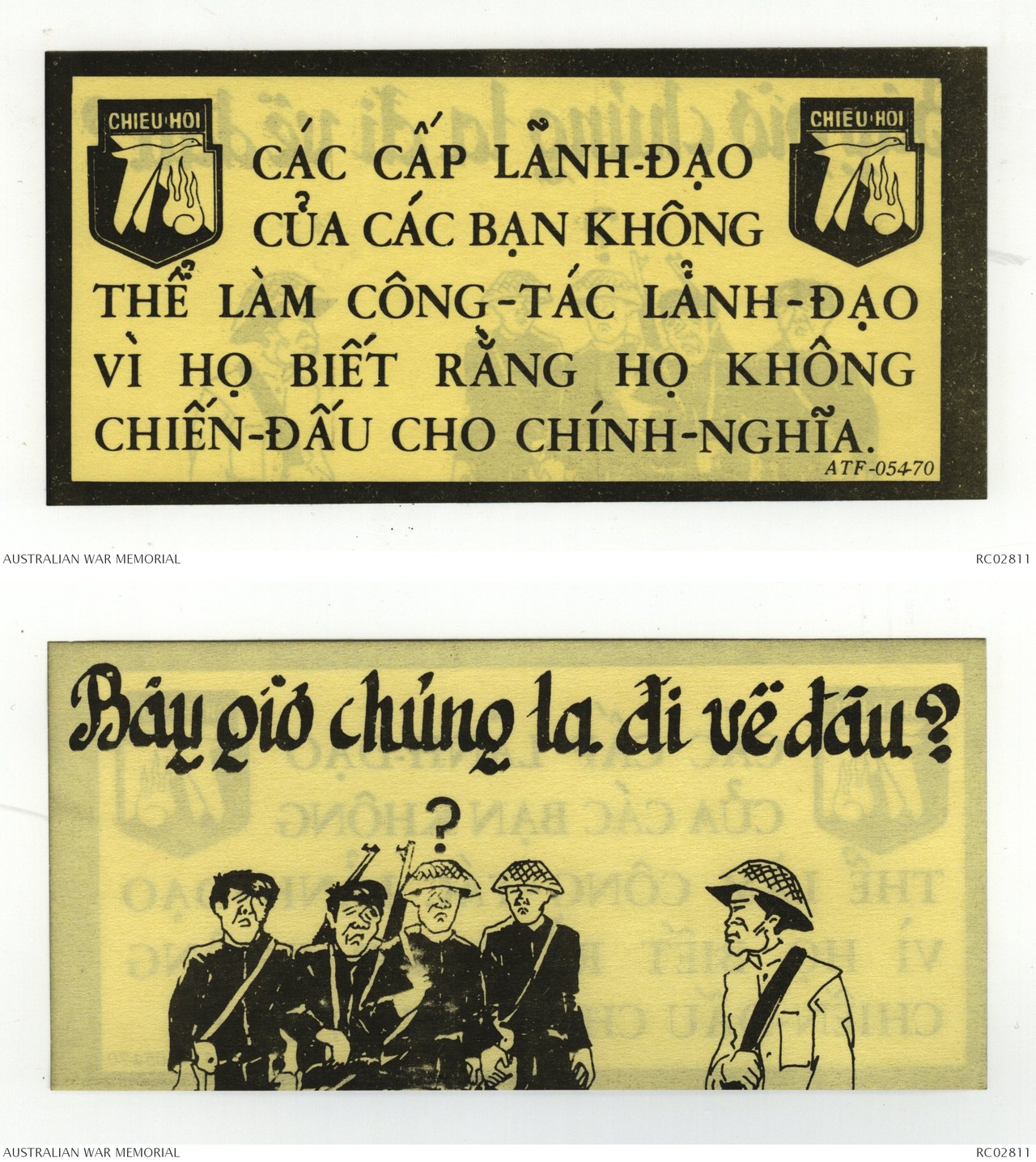
Australia and South Vietnam, 1970: Chieu Hoi. The 1st Psychological Operations Unit of the 1st Australian Task Force produced Vietnamese-language leaflets for the South Vietnamese amnesty program ("Open Arms"), which promised safe conduct and rewards to fighters who rallied. This leaflet, "Where Do We Go Now?", is one of dozens in the archive. The US ran a parallel campaign. Operation Wandering Soul used recordings of a voice presented as a dead soldier, played from helicopters and boats, and the tapes drew on the belief that the unburied dead wander in suffering: Operation Wandering Soul and Ghost Tape Number Ten.
Bây giờ chúng ta đi về đâu?, ATF-054-70, 28 November 1970. 1st Psychological Operations Unit, 1st Australian Task Force. Australian War Memorial. Public domain per holder.
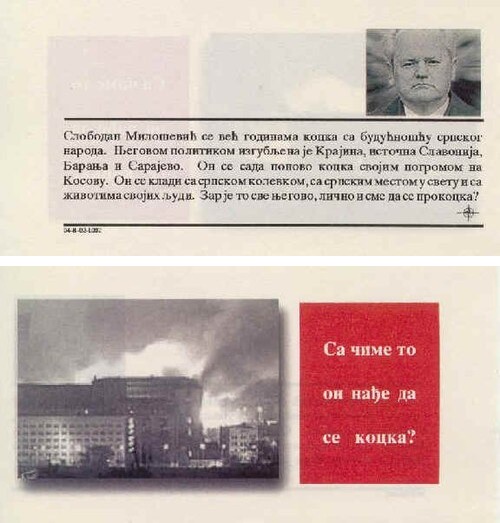
United States and NATO, 1999: Kosovo. During Operation Allied Force, US armed forces dropped Serbian-language leaflets pairing a portrait of Slobodan Milosevic with a list of places Serbs had "lost" under his policies, and the line that he now gambled with the future of the country. The target was the leader, not the soldier. Read the technique: card stacking.
"Is it really his to gamble?", leaflet 04-B-02-L002, Operation Allied Force, 1999. US armed forces psychological operations. Via Wikimedia Commons. Public domain (US government work).
The collection includes leaflets from many other forces. Japanese forces dropped "Stop useless resistance" on the Hong Kong garrison in 1941, and the Iraqi armed forces issued a Persian-language notice to Iranian troops in 1980 (see Payam: Ay Iraniyan (Message: O Iranians): Iraqi armed forces notice with image of Imam Ali). The 1936 leaflets of Manchukuo's Concordia Association told readers "If you do not kill the Communists, the Communists will kill you", an example of Fear appeal and Scapegoating. The same methods appear on every side.
Other national approaches
United Kingdom. The Political Warfare Executive, created in 1941, ran white, grey and black operations. Its best-known black broadcasting project was Sefton Delmer's Soldatensender Calais, a radio station that posed as a German military broadcaster from 14 November 1943 until 30 April 1945. The RAF also dropped Luftpost, a German-language leaflet newspaper, such as issue 16 of 2 September 1941.
Explain moreShow less
Soviet Union and Russia. Soviet doctrine placed this work under party political departments, and the KGB's Service A ran "active measures": forgeries, planted stories and unwitting intermediaries (Soviet agitprop). Russian military theory adds reflexive control, a method, described by Timothy Thomas in 2004, of giving an opponent prepared information "to incline him to voluntarily make the predetermined decision". Russian doctrine calls the wider field "information confrontation" (reflexive control).
China and the "three warfares". The People's Liberation Army's 2003 Political Work Regulations list public opinion warfare, psychological warfare and legal warfare among wartime tasks. The US Defense Department's 2011 report to Congress describes psychological warfare as undermining an enemy's ability to fight by deterring, shocking and demoralising military personnel and supporting civilians. Scholars disagree about how coherent a doctrine the "three warfares" form, and the PRC government describes its legal and media work as the defence of its sovereignty (PLA Three Warfares).
Covert and online psyops
The US doctrine prefers attributed products, but several documented operations did not follow that. On 30 November 2005 the Los Angeles Times reported that articles written by US military information-operations troops were placed in Baghdad newspapers through the Lincoln Group, often as news rather than paid advertising. In August 2022 Graphika and the Stanford Internet Observatory published Unheard Voice, describing accounts across eight platforms, removed by Twitter and Meta, that promoted pro-Western narratives for nearly five years; some of the shared sites carried footers saying they were sponsored by US Central Command, and most posts drew few likes or shares. On 14 June 2024 Reuters reported that the US military ran a covert campaign from 2020 to mid-2021 using fake accounts to cast doubt on China's Sinovac vaccine in the Philippines. A Defense Department paper later made public by a Philippine official said the department had "made some missteps in our COVID related messaging."
Explain moreShow less
These cases involve Astroturfing and Narrative laundering. Other states have run comparable operations, including the Russian Internet Research Agency's Facebook pages ('Russian Ads on Facebook' (House Intelligence Committee exhibit)). Scale, intent and context differ from case to case, and none of the cases should be read as showing that one state does this and another does not.
"Psyop" as slang
Online, "psyop" is often used for any message the speaker suspects of manipulating them, from a viral post to a company's advertising to a government announcement. In that use the word works as a verdict, usually with no sender, order or evidence behind it. In the military sense it names a planned operation with a defined audience, an approval chain and records. A claim that something is a psyop can be tested the same way as any other claim. Is there a documented originator? Is there a stated aim and audience? Is the content false, or only unwelcome? When the answers are missing, "a message I distrust" is the accurate description. When the answers exist, as with the Philippines campaign above, the term fits. The related questions of falsehood and intent are on the disinformation page.
Sources and further reading
Sources
Department of the Army, FM 3-05.30, Psychological Operations (April 2005); FM 3-05.301 (December 2003); FM 3-53, Military…
Department of the Army, FM 3-05.30, Psychological Operations (April 2005); FM 3-05.301 (December 2003); FM 3-53, Military Information Support Operations (2013); Joint Chiefs of Staff, JP 3-13.2 (2010; 2011 reissue). DefenseScoop, "Hegseth issues directive to bring back 'psyop' terminology," 9 December 2025. Army Times, "The Army's psychological operations community is getting its name back," 6 November 2017. Mark Mazzetti and Borzou Daragahi, Los Angeles Times, 30 November 2005. Graphika and Stanford Internet Observatory, Unheard Voice (August 2022). Chris Bing and Joel Schectman, Reuters, 14 June 2024. Timothy L. Thomas, "Russia's Reflexive Control Theory and the Military," Journal of Slavic Military Studies 17, no. 2 (2004). U.S. Department of Defense, Military and Security Developments Involving the People's Republic of China (2011). Herbert A. Friedman, psywarrior.com (Chieu Hoi and Wandering Soul). Wikipedia, Soldatensender Calais (dates).