Content note: this page describes a vote from which Jewish and Roma Austrians were excluded by law, quotes Nazi campaign slogans, and shows swastika-bearing ballot material. The regime's antisemitic persecution itself is covered in FRAME's genocide case studies, not here.
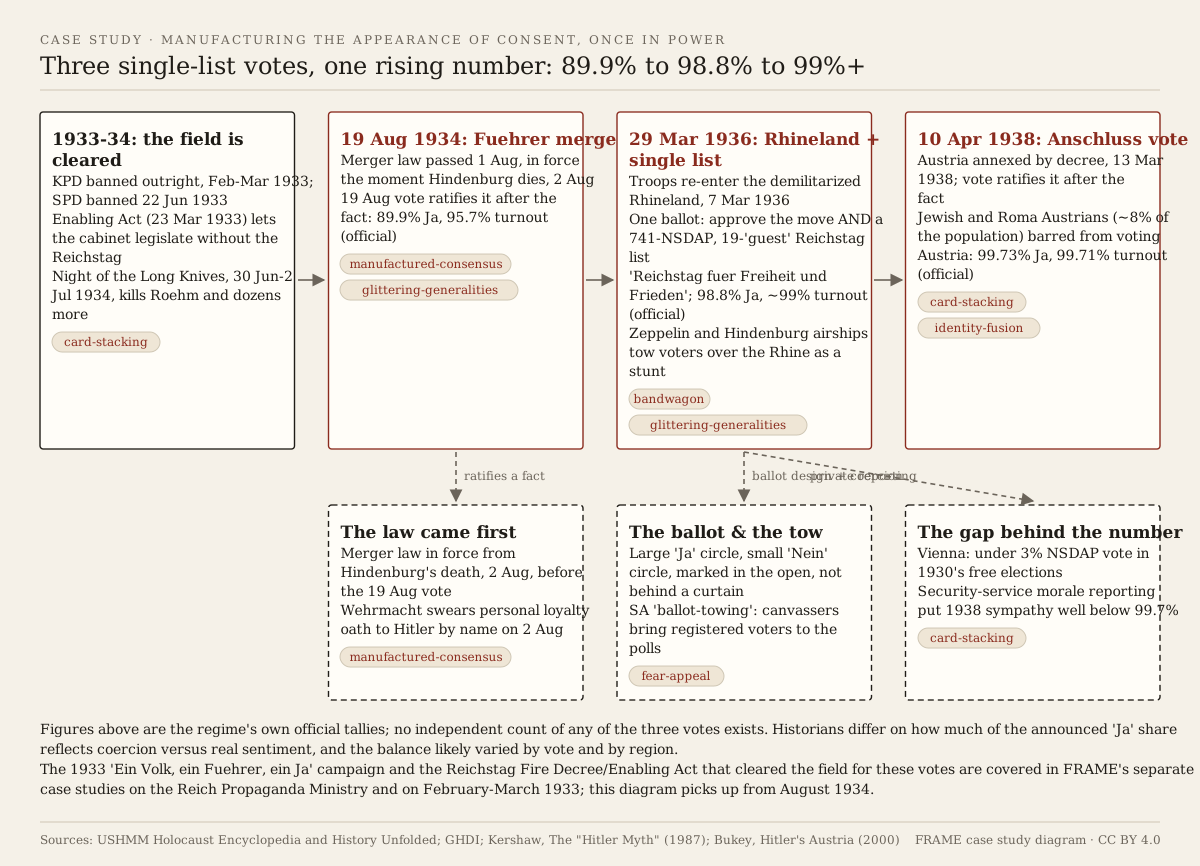
In one line: three times between 1934 and 1938, a government that had already banned every opposition party and jailed or exiled its leaders put a single question to a single-list ballot — merge the presidency into the Führer role, ratify the remilitarized Rhineland and a Nazi-only Reichstag, ratify the annexation of Austria — and each time announced a "Yes" vote above 89%, rising to above 99%, from an electorate whose No option existed on paper but not, for most voters, in practice.
What happened
19 August 1934: merging the presidency into the Führer
- 2 August 1934. President Paul von Hindenburg dies. A law titled "Gesetz über das Staatsoberhaupt des Deutschen Reichs" (Law on the Head of State of the German Reich), which the cabinet had already passed the day before, on 1 August, takes effect the moment Hindenburg dies: it merges the offices of Reich President and Reich Chancellor and transfers all of the presidency's powers, including supreme command of the armed forces, to "the Führer and Reich Chancellor Adolf Hitler." The merger is therefore already German law, in force, before any vote is held.
- 19 August 1934. The regime holds a referendum asking voters to ratify the law after the fact. The ballot reprints the law's text — "the office of the Reich President is merged with that of the Reich Chancellor... he himself names his deputy" — and asks: "Do you, German man and German woman, approve of this regulation provided by this law?" Reported official results: 38,394,848 "Yes" (89.93%), 4,300,370 "No" (10.07%), on a reported turnout of 95.65% of registered voters. The Wehrmacht had already sworn a new personal oath of loyalty to "Adolf Hitler" by name, not to the constitution, on 2 August, the day of Hindenburg's death and 17 days before the public was asked to approve the change.
- The vote came three weeks after the Night of the Long Knives (30 June - 2 July 1934), in which Hitler had SA leader Ernst Röhm and dozens of others killed without trial; the purge was itself retroactively legalized by a one-sentence law the cabinet passed on 3 July. The referendum campaign presented Hitler as the man who had restored order.
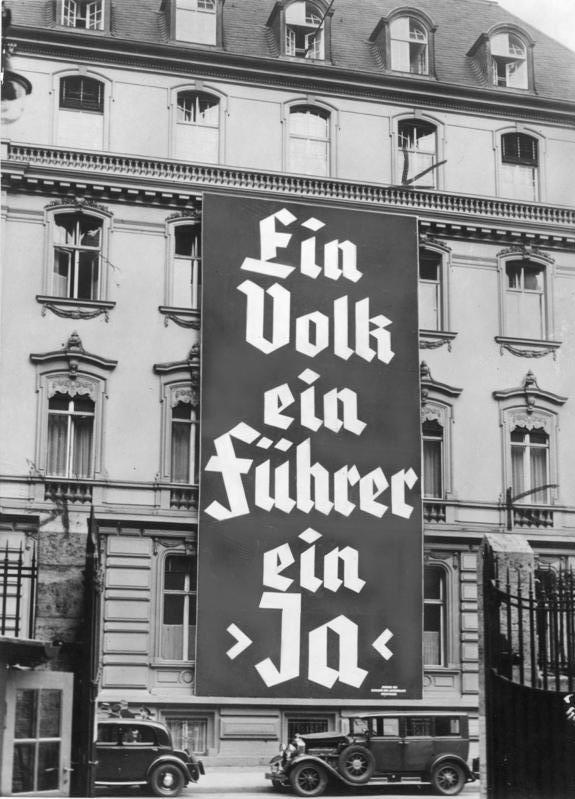
Ein Volk, ein Führer, ein Ja (One People, One Leader, One Yes), banner on Berlin's Voßstraße for the single-list Reichstag election and referendum of 12 November 1933, the vote before the three covered here. Bundesarchiv, Bild 183-K0930-502, CC BY-SA 3.0 DE.
29 March 1936: the Reichstag "election" and the Rhineland referendum
- 7 March 1936. German troops re-enter the Rhineland, demilitarized since Versailles, in violation of both that treaty and the 1925 Locarno treaties Germany had signed voluntarily. Hitler tells the Reichstag the same day that he is dissolving it and calling new elections.
- 29 March 1936. A single ballot combines two questions: approval of the Rhineland remilitarization, and a vote for a single Reichstag list of 741 NSDAP members and 19 non-party "guests" hand-picked by the party — no opposition candidate or list was permitted. Ballots from the vote (a surviving example from the Hessen-Nassau constituency is captioned "Reichstag für Freiheit und Frieden," "Reichstag for Freedom and Peace") carried this slogan over a militarized reoccupation. Official results: turnout reported at about 99%, with 98.8% "Yes" (a small number of sources give 98.9%; the regime's own tabulation is the only source for either figure). As a publicity stunt, the airships Graf Zeppelin and Hindenburg spent the preceding days over the Rhineland dropping leaflets, broadcasting by radio and playing music, and on election day carried voters aloft to cast ballots from the air.
- No opposition party existed to campaign for "No": the KPD had been banned outright since 1933 and the SPD since 22 June 1933 (see From a fire to a vote: the Reichstag Fire Decree and the Enabling Act, February-March 1933); their former deputies and officials were, depending on the individual, imprisoned, in exile, or under surveillance.
Content note: Ballot paper for the 1936 single-list Reichstag election naming the NSDAP and Adolf Hitler. This object is shown as it was published. Why 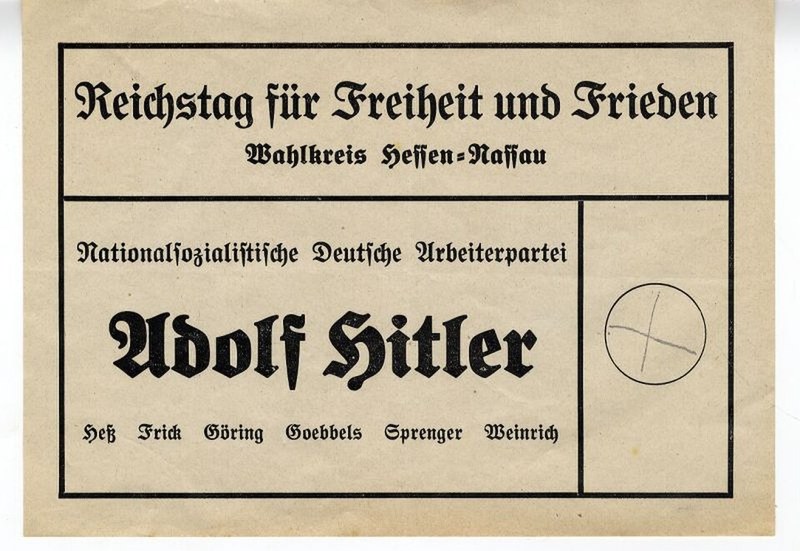
Ballot paper for the 29 March 1936 Reichstag election, Hessen-Nassau constituency: headed "Reichstag für Freiheit und Frieden" ("Reichstag for Freedom and Peace"), with one list, the NSDAP under Adolf Hitler's name, and a single circle, here marked with a cross. Wikimedia Commons (source: historica.biz), public domain.
10 April 1938: the Anschluss plebiscite
- 12-13 March 1938. German troops occupy Austria. On 13 March the Austrian Nazi government, installed under German pressure two days earlier, proclaims Austria "a land of the German Reich"; Hitler's own law the same day confirms the annexation (Anschluss) as accomplished. As in 1934, the vote that follows ratifies a fact already established by decree.
- 10 April 1938. A joint referendum and single-list Reichstag election is held simultaneously in the enlarged Reich, now including Austria. Jewish and Roma residents and other people classified as "non-Aryan," along with people already stripped of civil rights as political opponents — roughly 8% of the pre-Anschluss Austrian population — were barred by the regulations from voting at all. The ballot again carried one question with two circles of unequal size, "Ja" markedly larger than "Nein," under a swastika; a surviving marked example is held by the Imperial War Museum. Reported official results for Austria alone: 99.73% "Yes" on a 99.71% turnout. For the enlarged Reich as a whole (old German borders plus Austria) contemporary and secondary tabulations vary slightly by source — figures for combined "Yes" range from about 99.0% to 99.1% on reported turnout near 99.6% — a spread that is itself a reminder that the regime's Interior Ministry and Reich Statistical Office were the only body that counted these ballots; there was no independent or opposition scrutiny of the count at any of the three votes covered here.
- In Vienna, a city where the NSDAP had won under 3% of the vote in the last competitive elections of 1930, the Nazi security police's own confidential reporting on the mood before the vote put genuine local sympathy far below the eventual official tally, even as compliance and visible enthusiasm on the day were high; Evan Bukey's Hitler's Austria: Popular Sentiment in the Nazi Era, 1938-1945 (University of North Carolina Press, 2000) draws on the security service's own contemporaneous reporting to make this point about the gap between measured sentiment and the announced result.
Content note: Ballot paper for the 1938 Anschluss plebiscite, with a large Ja circle and a small Nein circle and Hitler's name. This object is shown as it was published. Why 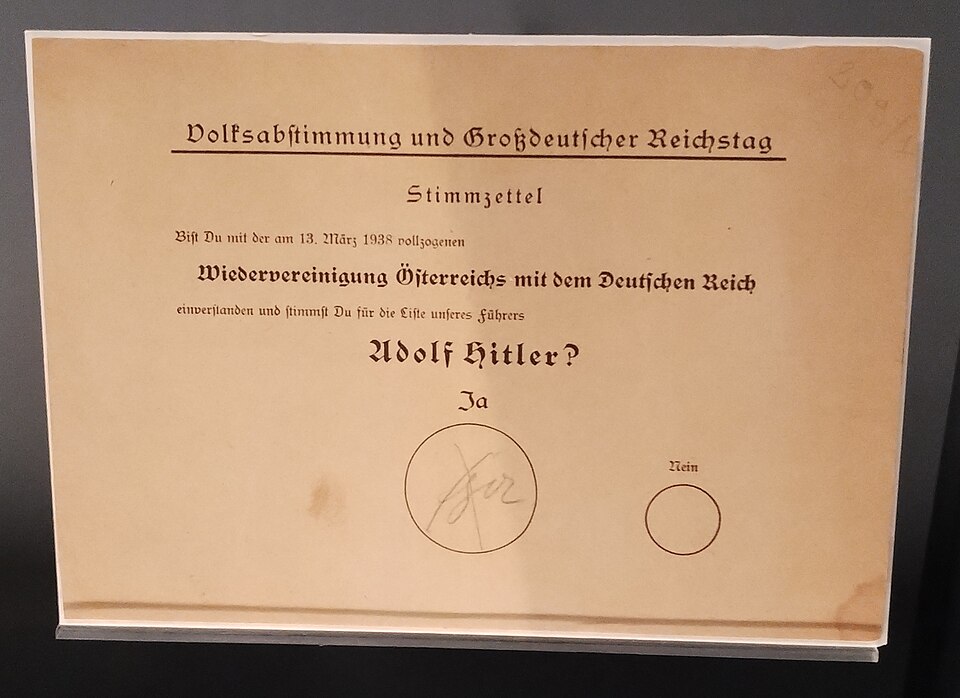
Ballot paper for the 10 April 1938 plebiscite and Reichstag election: one question on the "reunification of Austria with the German Reich" and the "list of our Führer Adolf Hitler", with a large "Ja" circle (marked with a cross on this copy) beside a much smaller "Nein" circle. Copy shown in a museum display (Imperial War Museum); photograph on Wikimedia Commons, public domain as an official German work.
Content note: Photograph of voters queuing at a polling station decorated with swastika flags, with uniformed guards, Vienna, 1938. This object is shown as it was published. Why 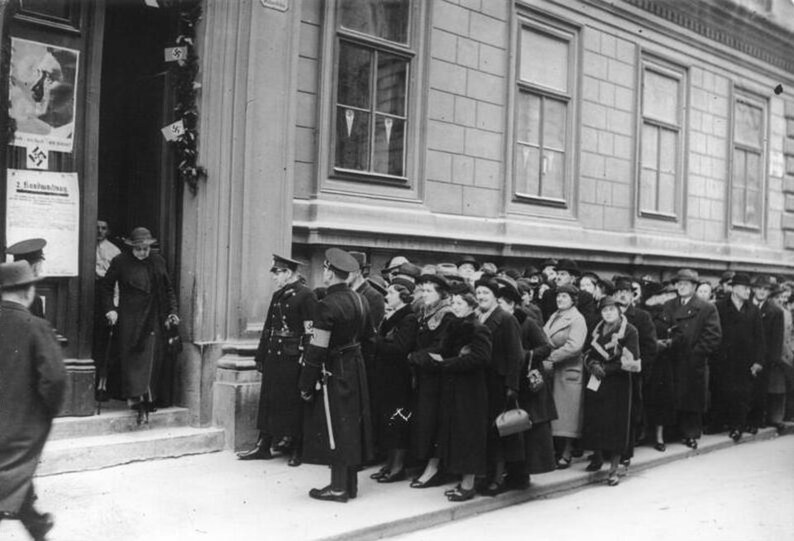
Voters queuing outside a polling station in Vienna on 10 April 1938, the day of the Anschluss plebiscite; uniformed men with armbands stand beside the queue and small swastika flags hang at the doorway. Press photograph (Allgemeiner Deutscher Nachrichtendienst - Zentralbild), Bundesarchiv, Bild 183-2006-1411-500, CC BY-SA 3.0 DE.
How it works
- Manufactured consensus: a single approved list and a single question, repeated across every constituency with the same coordinated campaign, produced a uniform "Yes" that looked like the whole nation reaching the same conclusion independently. A reader outside Germany in 1934-38, or a historian working only from the published tallies, could not see the single source behind the uniformity.
- Bandwagon: slogans like "Reichstag für Freiheit und Frieden" and "Ja zum Führer," communal voting ceremonies, and radio results broadcasts told the individual voter that "everyone" was already voting yes.
- Identity fusion: with the KPD and SPD already banned and their members jailed, exiled or watched, a "No" vote (or abstention, in polling stations staffed by party officials) was not a private policy disagreement but a visible act that could mark the voter as disloyal to the Volksgemeinschaft the campaign said the vote expressed.
- Glittering generalities: "freedom and peace" for a militarized treaty violation; "the people's decision" (Volksentscheid) for a question whose outcome — the merger of the presidency, the legality of the Rhineland move, the annexation of Austria — was already settled in law before voting day in two of the three cases here.
- Card stacking: each vote was run after the removal of the people who might have campaigned against it — the KPD and SPD banned and their members imprisoned or exiled before 1934 and 1936, and roughly 8% of the Austrian population excluded from the electoral roll itself before the 1938 vote on racial and political grounds. Selecting who could vote, and who could campaign, before counting the "Yes" share is a form of stacking the evidence before the question is even asked.
- Fear appeal: contemporary accounts describe an SA "ballot-towing" practice — canvassers visiting registered voters at home to bring them to the polling station — and polling stations where ballots were marked in the open rather than behind a curtain. A voter did not need an explicit threat printed on the ballot to know, in 1936 or 1938, what had already happened to the regime's opponents since 1933: the camps opened that year, the banned parties, the Editors Law's loss of livelihood for the politically "unreliable" (see The Reich Ministry of Public Enlightenment and Propaganda, 1933-1945).
Colour. These were white propaganda: the government ran them openly, in its own name, with the result published under its own ministries' letterhead. What made the "white" source dishonest was not concealment but coercion and pre-selection of who could vote, campaign, or safely say no — categories this archive scores separately from disclosure.
Then and now
The clearest living parallel is not a plebiscite in a settled dictatorship but one run inside a war: Russia's September 2022 "referendums" on annexing occupied Donetsk, Luhansk, Zaporizhzhia and Kherson. Russian-installed officials and armed personnel reportedly went door to door collecting ballots over five days; Ukrainian officials and Human Rights Watch documented residents describing threats when they answered the door, and being told a "No" would be noted by name. Reported results ranged from 87% in Kherson to over 98% in Donetsk and Luhansk — a spread the Nazi votes never showed in public, because by 1936 the regime had learned to keep even the lowest reporting region above 90%. Neither Ukraine nor its Western allies recognized the results. The parallel to the SA's 1936 "ballot-towing service" and to the open, unscreened voting described at Nazi polling stations is close: an occupying or newly consolidated power sends people to the door to convert registration into a counted "Yes," in full view of whoever is watching them do it. The difference is instructive too. The Nazi votes were domestic, ran under a government already in full legal control for one to five years, and never had to contend with an ongoing war on the ground where the ballots were cast; the 2022 votes were held in active combat zones as a legal pretext for annexation claimed mid-war, and were denounced within days by most of the world's governments rather than met with recognition — a difference in the international response the 1938 Anschluss vote, held before the war, did not immediately face.
Positions on the record
- The regime's own rationale. Nazi officials presented these votes as Akklamation — the people's acclamation of decisions the Führer had already made in their name, a concept explicitly distinct from a Weimar-style referendum that could actually change government policy. Goebbels's ministry framed each result as proof that Germany, and later Austria, stood behind Hitler more completely than any democracy's leader could claim (see The Reich Ministry of Public Enlightenment and Propaganda, 1933-1945 for the ministry's general manufactured-consensus method, of which these votes were the largest single instances).
- Contemporaries. Foreign correspondents based in Berlin and Vienna reported the results with open skepticism about how a ballot without real secrecy or a real opposition could be called an election; U.S. newspaper coverage of the 1938 vote, collected in the USHMM's History Unfolded archive, ran headlines such as "Plebiscite Vote 99 Per Cent For Hitler," treating the round number itself as the story.
- Later historians. Ian Kershaw's The "Hitler Myth" (Oxford University Press, 1987) argues from the security service's own internal morale reporting that, irregularities and coercion aside, the 1936 result broadly reflected genuine relief and nationalist pride at the Rhineland move among a population that had absorbed years of revisionist propaganda about Versailles — a case where he judges the coerced vote and real sentiment were not far apart. Evan Bukey's Hitler's Austria (2000) reaches a different balance for Vienna in 1938: drawing on the Nazi security service's own contemporaneous assessments of a city with a strong pre-1938 socialist and Catholic vote, he documents a gap between the near-unanimous announced result and the security service's own lower estimate of genuine sympathy at the time, attributing the difference to fear, social pressure and the absence of any safe way to register dissent.
- This archive's reading. Documented: the dates, the laws each vote ratified (in two of three cases, after the fact), the single-list ballot design, the absence of any legal opposition able to campaign against a "Yes," the exclusion of Jewish, Roma and politically disqualified Austrians from the 1938 electoral roll, and the officially published vote totals themselves. Not shown, and contested among historians: exactly how much of the announced "Yes" share reflects coercion and how much reflects real popular sentiment, which almost certainly varied by vote and by region — Kershaw and Bukey, working from similar categories of internal regime reporting, reach different balances for 1936 and 1938 respectively. No independent count of any of the three votes exists to test the official figures against.
Same-method test
- The Soviet Union. The 12 December 1937 election to the new Supreme Soviet, the first under the 1936 "Stalin Constitution," offers the closest structural parallel: a single bloc list of Communist Party members and vetted "non-party" candidates, no competing list permitted (an initial plan for multiple candidates per seat was abandoned during the year, amid the same purge climate as the show trials — see The Moscow show trials: confession, spectacle and consent (1936-1938)), and an officially reported turnout of 96.8% with approval above 98% for the bloc. The chips used are the same: manufactured-consensus (one list, treated as the people's independent choice), bandwagon (agitators reporting turnout ward by ward before polls closed), and card-stacking (the electorate had already had any organized alternative removed by 1937, just as the KPD and SPD had been removed from German political life before 1934).
- Fascist Italy. The regime's own March 1934 plebiscite asked Italians to approve a single 400-name list chosen by the Fascist Grand Council, decorated nationally with facades reading "SI" at architectural scale (see Fascist Italy's propaganda machine: from the Duce's Press Office to the Ministry of Popular Culture); the same single-list, single-question, no-opposition design as the German votes above, run by a different propaganda ministry two years earlier.
- The differences are real. The Soviet vote followed a constitution that, on paper, promised secret balloting and competitive nomination — promises the leadership itself walked back before the election, which is a distinct method (a written commitment quietly withdrawn) worth distinguishing from the German votes, which never promised competition to begin with. The Italian plebiscite offered a list rather than a single yes/no question on a specific law, closer in form to the March 1936 German vote than to August 1934's constitutional-merger question. All three systems nonetheless share the underlying method this page documents: a list with no real alternative, framed to the electorate and to foreign observers as a genuine expression of national will.
How to spot it
- A "referendum" is not evidence of choice if no legal opposition exists to campaign for the other outcome. Check who was still free to organize a "No" campaign, not just whether "No" was printed on the ballot.
- Ask whether the thing being "approved" was already in force by decree before the vote. A vote that ratifies an existing fact is doing legitimation work, not decision work.
- Look at the ballot itself. Unequal print size for the two options, and voting without a curtain or envelope, are both design choices with a measurable effect on the result, and both are checkable from a surviving physical ballot.
- Compare the announced result with any surviving internal reporting from the same period and place — police, security-service or party morale reports written for the regime's own eyes, not for publication. A gap between the two is evidence, even where it cannot be quantified precisely.
- Distrust round, near-unanimous numbers rising over time in the same system (89.9% in 1934, 98.8% in 1936, above 99% in 1938). A political system moving toward totalizing control tends to produce a trend line like that regardless of what is happening to actual opinion, because each vote further narrows who can safely say no.
Images
| Image | Source | Licence |
|---|---|---|
| Mechanism diagram (above) | Drawn for FRAME from this page's sourced facts (make_diagrams.py) |
CC BY 4.0, FRAME |
| Gallery entry Ein Volk, ein Führer, ein Ja (One People, One Leader, One Yes) (Bundesarchiv, Bild 183-K0930-502) | Archive gallery | CC BY-SA 3.0 DE |
| Stimmzettel Reichstagswahl 1936, Wahlkreis Hessen-Nassau (March 29, 1936) | Wikimedia Commons; Official ballot paper, 29 March 1936; via historica.biz and Wikimedia Commons | Public domain |
| Stimmzettel Volksabstimmung und Großdeutscher Reichstag, 10 April 1938 (April 10, 1938) | Wikimedia Commons; Official ballot paper, 10 April 1938; Imperial War Museum display, photograph on Wikimedia Commons | Public domain |
| Wien, Volksabstimmung zum Anschluß Österreichs (April 10, 1938) | Wikimedia Commons; Bundesarchiv, Bild 183-2006-1411-500 / o.Ang. / CC-BY-SA 3.0 | CC BY-SA 3.0 DE |


Image gaps
- The 19 August 1934 referendum itself. No openly, verifiably licensed photograph or ballot specific to this vote could be confirmed in the time available. The well-known "Ja! Führer wir folgen Dir!" campaign poster is held on English Wikipedia under a non-free/fair-use rationale rather than a verified Commons public-domain or CC licence, so this page does not use it. This gap can likely be filled: Bundesarchiv holdings for this referendum exist and may carry CC BY-SA 3.0 DE licences on Commons; a later pass with more headroom against Commons' rate limits should check the "Volksabstimmung am 19. August 1934" holdings directly.
- The Zeppelin/Hindenburg airship voting stunt, March 1936. Widely described in secondary sources but no Commons or LOC file with a confirmed public-domain or CC licence was located and verified in the time available.
- A crowd or rally photograph for the Rhineland reoccupation itself (7 March 1936). Not sourced here; this page's scope is the plebiscite apparatus rather than the military move, so the gap was not chased further.
Sources
- 1934 German head of state referendum — background and reported results
- Law on the Head of State of the German Reich — Holocaust Encyclopedia, USHMM
- Referendum Confirms Hitler's New Title and Powers — Holocaust Encyclopedia, USHMM
- Hitler Youth on the Occasion of the Referendum for Adolf Hitler, August 19, 1934 — German History in Documents and Images (GHDI)
- 1936 German parliamentary election and referendum — background and reported results
- Remilitarization of the Rhineland (1936) — German History in Documents and Images (GHDI)
- 1938 Austrian Anschluss referendum — background and reported results
- Nazi Territorial Aggression: The Anschluss — Holocaust Encyclopedia, USHMM
- Referendum on the Annexation (Anschluss) of Austria to the German Reich: Advertisement for "Yes" Votes in Hamburg, April 1, 1938 — GHDI
- Plebiscite Vote 99 Per Cent For Hitler — USHMM, History Unfolded newspaper archive
- Germany Annexes Austria — USHMM, History Unfolded
- Ian Kershaw, The "Hitler Myth": Image and Reality in the Third Reich (Oxford University Press, 1987)
- Evan Burr Bukey, Hitler's Austria: Popular Sentiment in the Nazi Era, 1938-1945 (University of North Carolina Press, 2000)
- 1937 Soviet Union legislative election — background and reported results
- Fictitious Annexation Follows 'Voting' at Gunpoint — Human Rights Watch, 30 September 2022
- Sham Russian 'referendums' in Ukraine — Centre for Eastern Studies (OSW), 28 September 2022
- Marked ballot paper, 1938 Anschluss referendum: Wikimedia Commons, File:Anschluss ballot paper.jpg (Imperial War Museum)
- Ballot paper, 1936 Reichstag election, Hessen-Nassau: Wikimedia Commons, File:Stimmzettel RTW 1936 Hessen-Nassau.jpg