Content note: this page describes the arrest, imprisonment and execution of writers under Stalin, including a graphic account of a poet's death in a transit camp, and the 1952 execution of Yiddish writers targeted for their Jewish identity. It also describes a writer's suicide and quotes his suppressed note.
In one line: a 1932 Party decree dissolved every independent literary group and ordered a single state-run Union in their place; its 1934 founding congress made "socialist realism" the only permitted method for Soviet literature and tied membership to a system of privilege and licence; writers who did not conform were expelled, and through the Great Terror, the 1946-53 Zhdanov doctrine and beyond, many were imprisoned, exiled or shot.
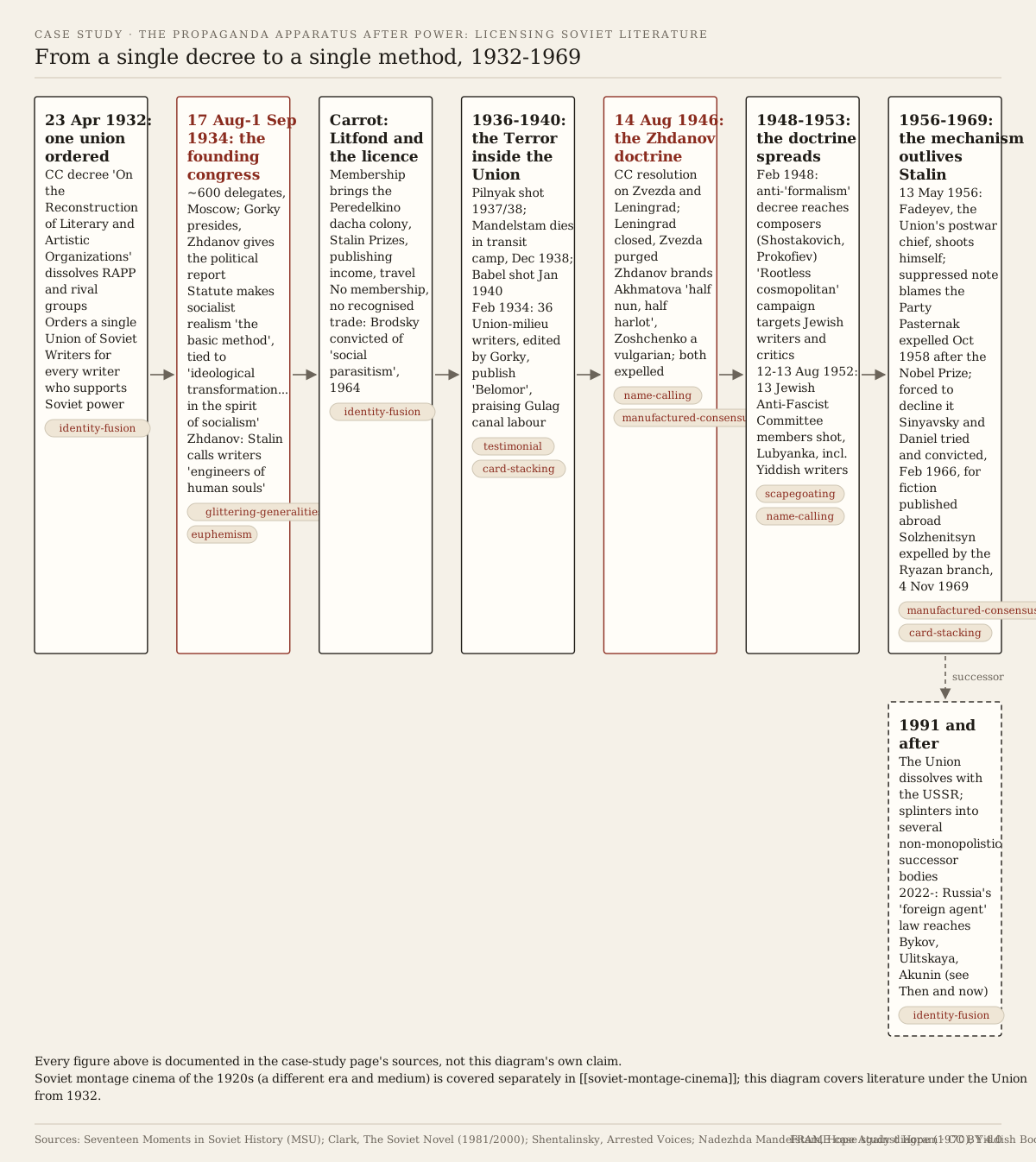
What happened
One union ordered, 1932
- 23 April 1932. The Communist Party Central Committee issues the decree "On the Reconstruction of Literary and Artistic Organizations" (O perestroike literaturno-khudozhestvennykh organizatsiy). It dissolves the Russian Association of Proletarian Writers (RAPP) and every other independent or semi-independent literary and artistic group, and orders that all writers who support Soviet power be united in a single Union of Soviet Writers with a Communist Party faction inside it. RAPP, though itself militantly pro-Soviet, had spent years feuding with "fellow-traveller" writers and claiming autonomy from direct Central Committee control; both its overreach and its independence were cited against it. An Organizing Committee, with the critic and editor Ivan Gronsky prominent in its early work, begins preparing a founding congress.
- February 1934: the Belomor volume. Ahead of the congress, the publisher for the OGPU secret police assembles a "writers' brigade": Maxim Gorky edits a collective volume on the building of the White Sea-Baltic Canal, with contributions credited to 36 writers, including Aleksei Tolstoy, Boris Pilnyak, Ilf and Petrov, Viktor Shklovsky and Mikhail Zoshchenko. Belomorsko-Baltiysky kanal imeni Stalina presents the canal, built substantially with forced convict labour under brutal conditions, as evidence that the camp system could "reforge" criminals into Soviet citizens. It is a state-commissioned work, produced under OGPU supervision, months before the Union that would institutionalise this kind of commission had formally been founded.
The founding congress, August-September 1934
- 17 August - 1 September 1934. The First All-Union Congress of Soviet Writers meets in Moscow, in the Hall of Columns of the House of Unions, with close to 600 delegates and additional non-voting guests from factories, farms and the army. Maxim Gorky presides. Andrei Zhdanov, a Central Committee secretary who oversees cultural policy (and who, several months later, also becomes the Leningrad party boss after Sergei Kirov's assassination in December 1934), delivers the congress's opening political report.
- Zhdanov's report. Zhdanov tells the delegates that "Comrade Stalin has called our writers engineers of human souls" — a phrase Stalin had used privately at a meeting of writers at Gorky's Moscow apartment on 26 October 1932, saying that "the production of souls is more important than the production of tanks." Zhdanov develops this into an argument that literature must show Soviet life "in its revolutionary development," combining truthful depiction with the education of readers "in the spirit of socialism," and that Soviet writers, unlike their counterparts abroad, should be able to "look into our tomorrow" through what he and others called revolutionary romanticism.
- The statute. The congress adopts a statute for the new Union defining socialist realism as "the basic method of Soviet literature and literary criticism," which "demands of the artist the truthful, historically concrete representation of reality in its revolutionary development," a truthfulness that "must be linked with the task of the ideological transformation and education of the working people in the spirit of socialism." The definition is broad enough to cover almost any subject and narrow enough that the Union's leadership can rule any given work in or out of it.
- Gorky is elected chairman of the Union's governing board. The congress elects a Presidium including Konstantin Fedin, Leonid Leonov, Mikhail Sholokhov, Alexander Fadeyev and others; a permanent Secretariat runs the Union's day-to-day affairs between congresses.
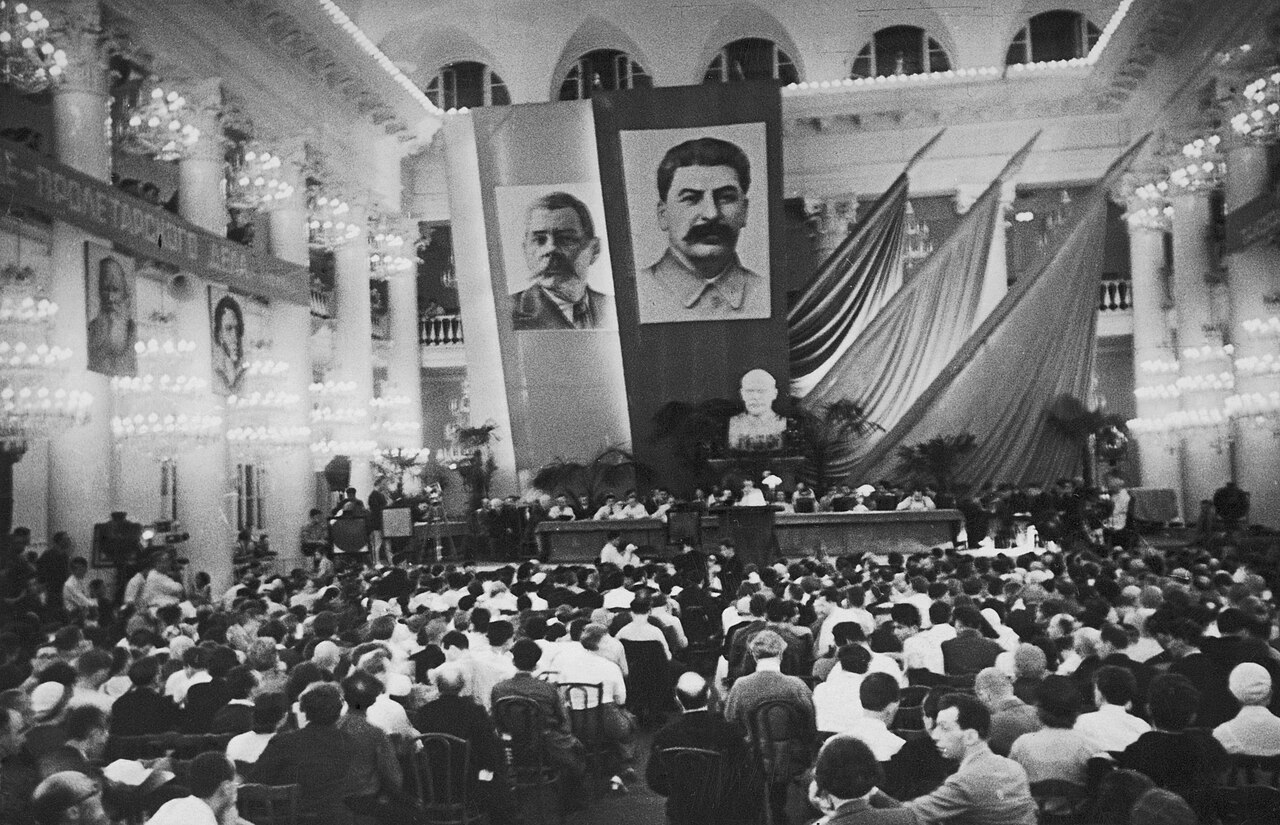
Delegates seated in a columned hall at the First Congress of Soviet Writers, Moscow, 1934, under large portraits of Leo Tolstoy, Alexander Pushkin, Maxim Gorky and Joseph Stalin (the archive records the exact venue as uncertain; the House of the Unions is the likely location). Photograph by Annemarie Schwarzenbach, Swiss National Library, public domain, via Wikimedia Commons.
_-_Annemarie_Schwarzenbach_-_SLA-Schwarzenbach-A-5-04-224.jpg)
Licence and privilege
- Union membership becomes, in practice, a professional licence. Members could publish through the state publishing houses and journals, draw author's fees set by the state, and receive housing, medical care and a pension through the Union's own Literary Fund (Litfond), including access to the writers' colony built at Peredelkino outside Moscow. Being expelled, or never admitted, cut off income, housing and the right to call oneself a professional writer.
- 1964: the flip side. Under Soviet law an adult without a recognised job could be charged with "social parasitism." In February 1964 a Leningrad court tried the poet Joseph Brodsky on this charge; asked by the judge who had enrolled him "in the ranks of poets," Brodsky answered, "Nobody. Who enrolled me in the ranks of mankind?" He was not a member of the Union's writers' section, and the court sentenced him to five years of internal exile, of which he served about eighteen months before international protest helped secure his release. The case became a byword for what Union membership legally protected against.
The Great Terror inside the Union, 1936-1940
- Union members were not shielded from the Great Terror; some of its own officials took part in denunciations that fed it. Writers arrested and killed in this period include:
- Boris Pilnyak, a Belomor contributor, arrested in October 1937 and shot in 1938 on a fabricated charge of plotting to kill Stalin and NKVD chief Nikolai Yezhov.
- Osip Mandelstam, arrested for the second time in May 1937 and sentenced to five years' hard labour; he died on 27 December 1938 in a Vladivostok transit camp on the way to Kolyma.
- Isaac Babel, arrested on 15 May 1939 on fabricated charges of terrorism and espionage, partly on testimony attributed to Pilnyak and the writer and journalist Mikhail Koltsov; he was executed on 27 January 1940.
- The researcher Vitaly Shentalinsky, who in the late 1980s led a Union of Writers commission granted access to KGB archives, found that roughly 2,000 Soviet writers had been arrested under the Stalinist system; his findings are collected in his trilogy of books, published in English as The KGB's Literary Archive and Arrested Voices.
The Zhdanov doctrine, 1946
- 14 August 1946. The Central Committee's Organizational Bureau, acting on a report Zhdanov had prepared, issues the resolution "On the Journals Zvezda and Leningrad." It denounces both Leningrad literary journals for publishing "apolitical" and "ideologically harmful" work by the satirist Mikhail Zoshchenko and the poet Anna Akhmatova. Leningrad is shut down outright; Zvezda is purged of its editors and placed under new, reliable management.
- Zhdanov elaborates the resolution in a speech to Leningrad writers and party activists the following month, branding Akhmatova, in a phrase that became notorious, "half nun, half harlot," and accusing Zoshchenko of depicting Soviet people as "idlers," "monsters" and "primitive." Both are expelled from the Union of Soviet Writers. Zoshchenko, unable to publish, lives afterward largely in poverty; he is readmitted to the Union only in 1953, after Stalin's death.
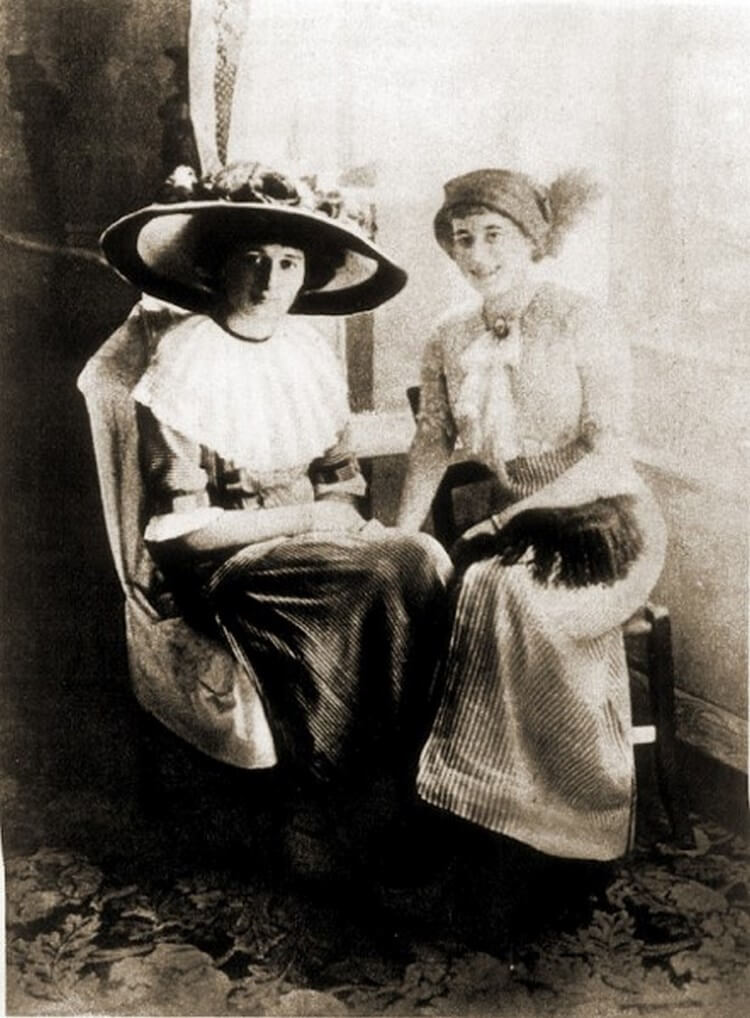
Anna Akhmatova with a friend in Italy, studio photograph, 1912, by an anonymous Russian Empire photographer; taken decades before the 1946 resolution described here. Public domain (published before 1931), via Wikimedia Commons.
.jpg)
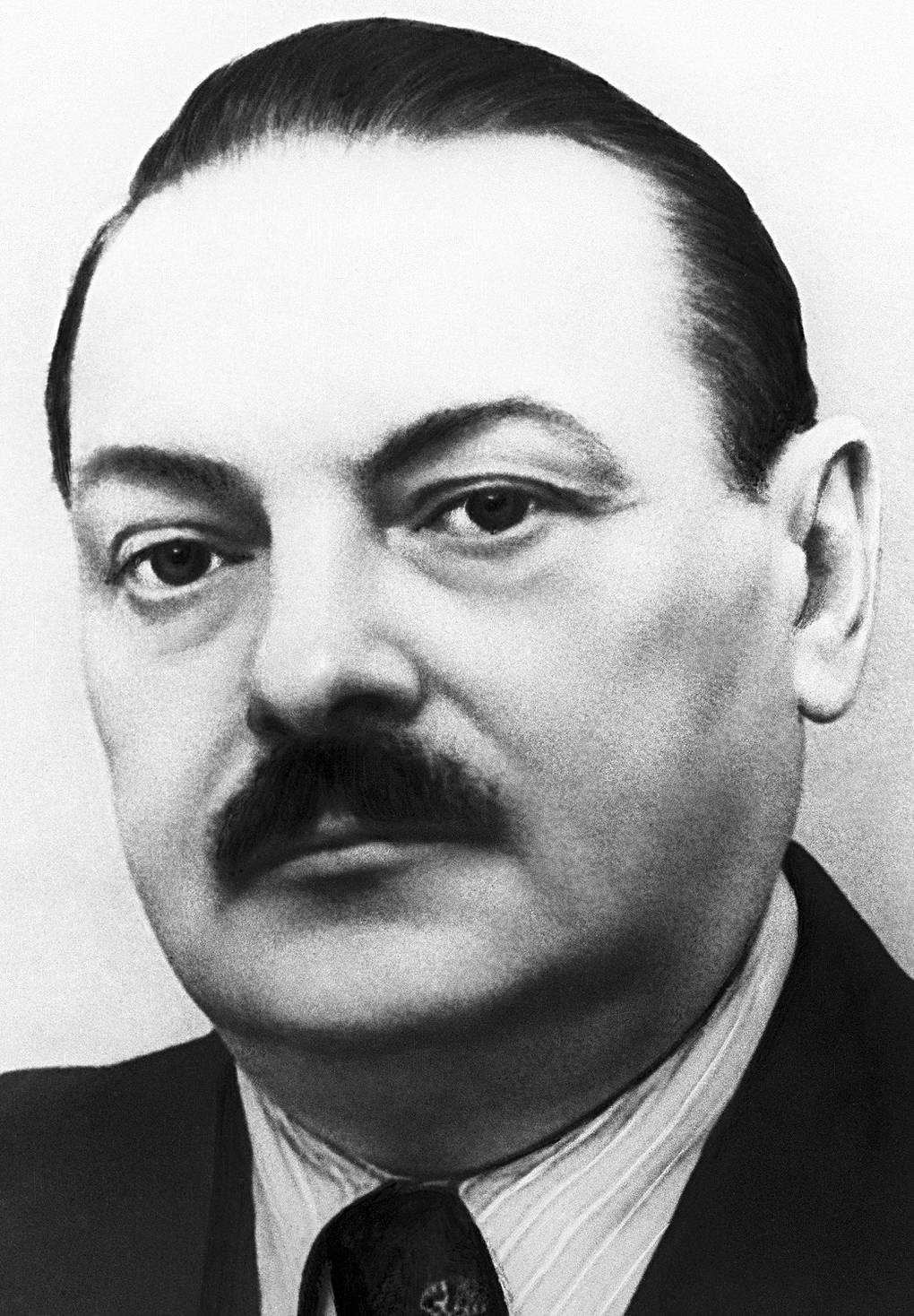
Andrei Zhdanov, Central Committee secretary responsible for cultural policy, portrait distributed by the TASS news agency, 1946. Public domain (Commons: PD-Russia and PD-US-not-renewed), via Wikimedia Commons.

- The Zhdanovshchina spreads. On 10 February 1948 the Central Committee issues a parallel resolution on the composer Vano Muradeli's opera The Great Friendship, opening an "anti-formalism" campaign in music that reaches Dmitri Shostakovich, Sergei Prokofiev, Aram Khachaturian and other leading composers, who are pressed into public self-criticism. From 1948 the campaign broadens into one against "rootless cosmopolitanism," a postwar drive against supposed insufficient patriotism that disproportionately targeted Jewish writers, critics and scholars.
- 12-13 August 1952: the Night of the Murdered Poets. Thirteen members of the wartime Jewish Anti-Fascist Committee, convicted after a secret trial of "nationalist" and espionage charges, are shot at Moscow's Lubyanka prison. Among them are the Yiddish writers Peretz Markish, David Bergelson, David Hofshteyn, Itzik Feffer and Leib Kvitko. Zhdanov himself had died in August 1948, before this final act of the campaign he had set in motion, but the machinery he built continued to be used by his successors.
The mechanism outlives Stalin
- 13 May 1956. Alexander Fadeyev, the Union's general secretary through the Zhdanov years (1946-1954), shoots himself at his dacha in Peredelkino, weeks after Khrushchev's "Secret Speech" denouncing Stalin's crimes. His suicide note to the Central Committee, suppressed for about thirty years, says that the Party's leadership had "physically exterminated" the best of Soviet literature's cadres and had "brought us down to the level of children," calling the terror they had operated under "the Party spirit." (SovLit.net publishes an English translation of the note.)
- October 1958. After Boris Pasternak's novel Doctor Zhivago, rejected by Soviet journals, is published abroad and wins him the Nobel Prize in Literature, Pravda calls the novel "worthless" and Pasternak a "weed," and the Union of Soviet Writers, branding him a "pawn in the Cold War," expels him from membership within days of the Nobel announcement. Pasternak is compelled to decline the prize.
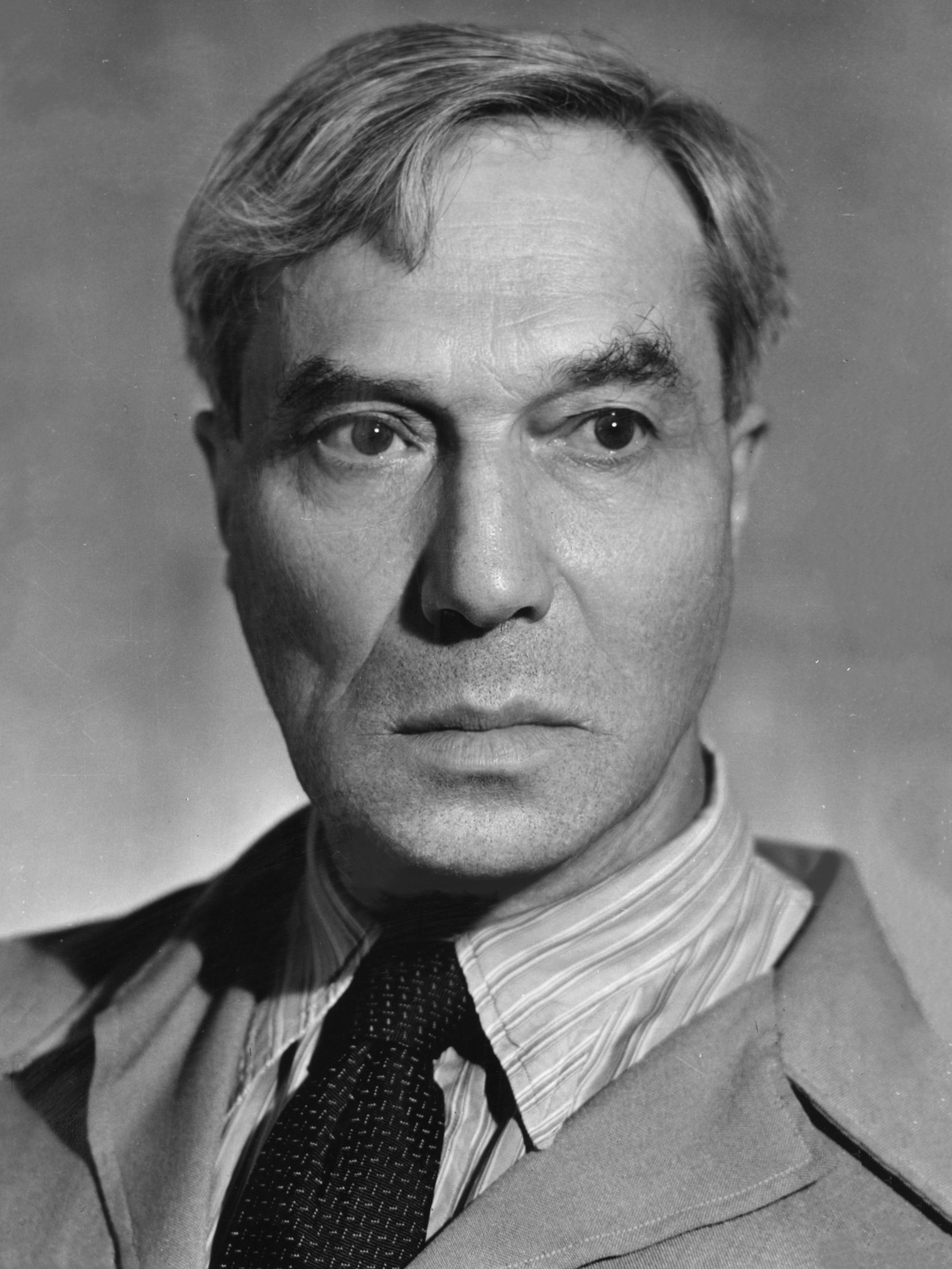
Boris Pasternak, press photograph, February 1958, by Vladimir Savostyanov for TASS. Public domain in the United States (Commons rationale: published 1931-1977 without a copyright notice), via Wikimedia Commons.

- 10-14 February 1966. The writers Andrei Sinyavsky and Yuli Daniel are tried and convicted in Moscow for "anti-Soviet agitation and propaganda," the charge resting on satirical fiction they had each published abroad under pseudonyms; it was the first Soviet trial of writers for the content of their fiction alone, rather than for association with an opposition movement, and is widely read as marking a hardening of policy after the Khrushchev thaw.
- 4 November 1969. Alexander Solzhenitsyn is expelled from the Union of Soviet Writers by its Ryazan branch, after Cancer Ward and The First Circle circulated abroad without state permission. He is deported from the USSR and stripped of citizenship in 1974, after the publication of The Gulag Archipelago in Paris.
- The Union continued to exist, with periodic congresses and a large membership and staff, until it dissolved along with the Soviet Union itself in 1991, splintering into several smaller, non-monopolistic successor bodies in Russia and the other former Soviet republics.
How it works
- Identity fusion: the Union fused the professional identity "Soviet writer" with Party loyalty and conformity to the approved method. Losing membership — Zoshchenko and Akhmatova in 1946, Pasternak in 1958, Solzhenitsyn in 1969 — meant losing the right to publish, and Brodsky's 1964 trial shows the reverse: standing outside the Union at all could be treated as evidence of not having a real trade.
- Glittering generalities: "socialist realism," "engineers of human souls" and "revolutionary romanticism" were high-sounding terms with no fixed content. They said that literature must serve socialism without specifying, in an enforceable way, which particular books did and did not qualify — which is what let the same standard justify praising And Quiet Flows the Don and expelling Zoshchenko.
- Euphemism / doublespeak: the 1932 decree that abolished independent literary groups and placed every writer under one state body was titled a "reconstruction" (perestroika). The forced public confession sessions the Union held for writers under attack, including the composers targeted in 1948, were called "creative self-criticism."
- Name-calling: Zhdanov's "half nun, half harlot" for Akhmatova and his description of Zoshchenko's characters as "idlers" and "primitive" people did not engage with a single text by title; the label did the work the argument would otherwise have had to do. The postwar campaign's "rootless cosmopolitan" functioned the same way.
- Scapegoating: the 1948-53 anti-cosmopolitan campaign blamed a supposed lack of patriotic culture on cosmopolitan, in practice heavily Jewish, writers and critics, and culminated in the August 1952 executions of Jewish Anti-Fascist Committee writers.
- Manufactured consensus: expulsions were framed as the writing community's own judgement, delivered by vote of a professional body, rather than as instructions handed down and then ratified. The congress's "unanimous" resolutions against Pasternak in 1958 are the clearest instance.
- Card stacking: the officially promoted canon — Nikolai Ostrovsky's How the Steel Was Tempered, Mikhail Sholokhov's And Quiet Flows the Don, Stalin Prize winners generally — stood for "Soviet literature" in public, while the arrests, executions and suppressed manuscripts of repressed writers were left out of the public record for decades; Shentalinsky's post-Soviet KGB-archive research is part of how that gap has since been filled.
- Testimonial: the Belomor volume put 36 real writers' names behind the claim that forced labour reformed criminals, and Union members were at times expected to sign public letters endorsing the denunciation of a colleague, such as the campaign against Pasternak in 1958.
Colour. The Union's public output — its statute, its congresses, its journals, its expulsion resolutions — was white: it spoke openly as a state-recognised body under its own name. Some of its internal workings were closer to gray: the Belomor volume did not disclose that the OGPU had commissioned and overseen it, and denunciation letters by Union officials to the secret police, such as those that fed the Terror, were not public acts at all.
Then and now
The clearest living successor to this mechanism is not abroad but in Russia itself. Since the full-scale invasion of Ukraine in February 2022, Russia's Ministry of Justice has designated a series of prominent writers — including Dmitry Bykov, Lyudmila Ulitskaya and, from January 2024, the historical novelist Boris Akunin — as "foreign agents," a status that requires burdensome self-labelling on every public statement and exposes the bearer to criminal liability for supposed violations. Major Russian publishers, including AST, stopped printing and distributing Akunin's and Bykov's books after their designations, and Moscow libraries have withdrawn "foreign agent"-authored titles from their shelves, according to reporting by Meduza and the Moscow Times.
The differences are real. Post-Soviet Russia has no single Union with a legal monopoly on who may publish, no equivalent of Litfond controlling every writer's housing and income, and no capital sentences for literary dissent; targeted writers can still publish abroad, in emigration, and reach Russian readers online in ways closed to a Soviet-era exile. What repeats is the underlying move: a state label, applied to a named writer for their public stance, that follows them into every bookshop and every byline and is enforced through the ordinary machinery of publishing and retail rather than a court verdict alone.
Positions on the record
- The Union's own account. Zhdanov's 1934 report and the congress statute presented the new arrangement as a liberation: ending the factional infighting among proletarian and "fellow-traveller" writers' groups and giving Soviet literature, for the first time, a unifying method fit for a society building socialism. The 1946 resolution presented itself as raising Leningrad's journals to a proper ideological standard after wartime laxity, and Fadeyev, before his own later disillusionment, spent his years as general secretary enforcing that standard.
- Contemporaries' testimony. Nadezhda Mandelstam's memoir Hope Against Hope (1970) records the Union's institutional hand in her husband's second arrest and describes the climate of denunciation inside the Union's ranks. Frida Vigdorova's transcript of Brodsky's 1964 trial, which circulated in samizdat before being published abroad, is one of the most widely read documents of the period precisely because it recorded a state institution's own words. Fadeyev's 1956 suicide note is the fullest first-person indictment of the system by one of its own chief administrators.
- Later historians. Katerina Clark's The Soviet Novel: History as Ritual (1981; rev. ed. 2000) analyses socialist realism as a structured genre with recurring plot rules rather than a vague slogan. Vitaly Shentalinsky's KGB-archive research, conducted under a Union of Writers commission during perestroika, established the scale of arrests among Union members and recovered manuscripts confiscated at the time of arrest. Vera Dunham's In Stalin's Time: Middleclass Values in Soviet Fiction (1976) reads the approved postwar canon for the social bargain it offered conforming writers and readers.
- This archive's reading. Documented: the 1932 decree, the 1934 congress and statute, the Belomor volume's authorship and OGPU sponsorship, the arrests and deaths of Pilnyak, Mandelstam and Babel, the text and effect of the 1946 resolution, the August 1952 executions, and the expulsions of Zoshchenko, Akhmatova, Pasternak and Solzhenitsyn. Not shown: a single, stable definition of what socialist realism forbade in practice — the record shows the standard applied inconsistently, case by case, which is part of how it worked as a control mechanism rather than a literary programme with fixed rules.
Same-method test
Every twentieth-century one-party state that took cultural policy seriously built some version of a licensing body for writers, and the same ids apply.
- Nazi Germany. The Reich Chamber of Culture, created by law on 22 September 1933, included a literature sub-chamber (Reichsschrifttumskammer) whose membership was likewise a condition of publishing, and whose exclusions fell on Jewish writers and others judged politically unreliable; see The Reich Ministry of Public Enlightenment and Propaganda, 1933-1945 for the licensing system as a whole.
- Maoist and post-1949 China. The Chinese Writers Association, founded in July 1949 as the China National Literature Workers Association and renamed in 1953, adopted socialist realism as its own method, explicitly borrowed from the Soviet model. Its vice-chair Ding Ling, a Stalin Prize winner for her 1949 land-reform novel The Sun Shines over the Sanggan River, was denounced as a "rightist" during the 1957 Anti-Rightist Campaign, expelled from the Communist Party, and not rehabilitated until 1978 — the same institutional shape (state-run union, an official method, expulsion as the instrument) applied by a different Communist Party.
The differences matter as much as the shape. The Chamber of Culture operated inside a shorter-lived, racially defined dictatorship that lasted twelve years before its defeat in war; the Union of Soviet Writers and the Chinese Writers Association each operated for decades under a system that, having no external military defeat to end it, relied on internal political shifts (Stalin's death, Mao's death and the end of the Cultural Revolution) to loosen its grip. All three, in their most severe periods, used the same basic move: a state body, not a court applying a published law, deciding who counted as a legitimate writer.
How to spot it
- Ask who licenses the speakers. Where being recognised as a writer, journalist or artist requires membership in a state-approved body, silence about a regime's failures may reflect that licence, not agreement.
- Watch for "self-criticism" rituals. A forced public confession dressed as a colleague's voluntary contrition is a sign that the real speaker is the institution running the meeting.
- When a professional body "unanimously" condemns one of its own, ask who set the agenda, who drafted the resolution, and whether a member could plausibly have voted no.
- A high-sounding standard with no fixed content — "ideologically correct," "healthy," "positive" — can be stretched to justify punishing almost anything. Ask who is applying it in this specific case, and by what visible rule.
- Notice which works are held up as the canon and which are missing from it. The missing ones are often the record of what the institution could not tolerate, not merely of what failed on its own terms.
Images
| Image | Source | Licence |
|---|---|---|
| Mechanism diagram (above) | Drawn for FRAME from this page's sourced facts (make_diagrams_apparatus_socrealism.py) |
CC BY 4.0, FRAME |
| Andrei Zhdanov, TASS portrait, 1946 | Wikimedia Commons, TASS | Public domain (PD-Russia; published in the USSR and the US in 1946 without notice) |
| Boris Pasternak, press photo, February 1958 | Wikimedia Commons, TASS Mediabank, photo: Vladimir Savostyanov | Public domain (published in the US 1931-1977 without copyright notice) |
| Anna Akhmatova, photograph, 1912 (pre-revolutionary; decades before the 1946 denunciation described on this page) | Wikimedia Commons, anonymous photographer, Russian Empire | Public domain (PD-Russia-expired) |
| First Congress of Soviet Writers, Moscow, 1934 | Wikimedia Commons, Annemarie Schwarzenbach | Public domain (Swiss photographer Annemarie Schwarzenbach, died 1942; Commons Public Domain Mark; Swiss National Library) |
Image gaps
- Delegates at the First Congress of Soviet Writers, 1934. The hall is now pictured above (Schwarzenbach, Swiss National Library). A second Commons photograph of delegates (National Library of the Republic of Tatarstan) has an unknown photographer and is tagged only "PD Old" at 450 px, so it is not hosted.
- Mikhail Zoshchenko. This page did not find a photograph on Commons with clearly documented authorship and date; the one candidate found carried only a generic "PD-old" template from a fan site, which this archive's licensing bar does not treat as sufficient. Could be filled with a further, more targeted search.
- The Belomor Canal, 1933, showing forced-labour construction. Not sought within this page's research budget; Bundesarchiv- or TASS-sourced construction photographs may exist with an open licence.
- A 1952 image connected to the Jewish Anti-Fascist Committee or the Night of the Murdered Poets. Not sought within this page's research budget; a portrait of one of the executed writers (e.g. Peretz Markish) may be findable on Commons with a clear licence.
.jpg)
Sources
- "On the Reconstruction of Literary and Artistic Organizations," 23 April 1932 (Seventeen Moments in Soviet History, Michigan State University)
- Andrei Zhdanov, "Soviet Literature — The Richest in Ideas" (First Congress of Soviet Writers, 1934; Seventeen Moments in Soviet History)
- Andrei Zhdanov, speech to the First Congress of Soviet Writers, 1934 (Marxists Internet Archive, Soviet Writers Congress 1934 collection)
- First Congress of Soviet Writers, Wikipedia; Union of Soviet Writers, Wikipedia; Socialist realism, Wikipedia
- Engineers of the human soul, Wikipedia (origin of Stalin's October 1932 remark, via G. M. Boltyansky, Lenin i kino, 1925, and later Gorky-circle recollection)
- Russian Association of Proletarian Writers, Wikipedia; Ivan Gronsky, Wikipedia
- International Institute of Social History, "The White Sea Canal: A Hymn of Praise for Forced Labour"; The I.V. Stalin White Sea-Baltic Sea Canal, Wikipedia
- Zhdanov Doctrine, Wikipedia; "The 'Zvezda' Affair," Seventeen Moments in Soviet History; Mikhail Zoshchenko, Wikipedia
- "'Formalistic Freaks in Music': 'Ilya Golovin,' Shostakovich, and Zhdanovshchina for the Masses," Music and Letters 105(3), 2024 (Royal Holloway repository); Rootless cosmopolitan, Wikipedia
- Yiddish Book Center, "The Night of the Murdered Poets"; Night of the Murdered Poets, Wikipedia; World Jewish Congress, "13 Jewish Intellectuals Executed in 'Night of the Murdered Poets'"
- Isaac Babel, Osip Mandelstam, Boris Pilnyak: Isaac Babel, Wikipedia; Osip Mandelstam, Wikipedia; Boris Pilnyak, Wikipedia
- Nadezhda Mandelstam, Hope Against Hope: A Memoir, trans. Max Hayward (Atheneum, 1970)
- Vitaly Shentalinsky, The KGB's Literary Archive (Harvill, 1995) and Arrested Voices: Resurrecting the Disappeared Writers of the Soviet Regime (Free Press, 1996); Vitaly Shentalinsky, Wikipedia
- "Fadeev Suicide Note," SovLit.net (English translation of the 13 May 1956 note); Alexander Fadeyev, Wikipedia
- History.com, "Boris Pasternak wins Nobel Prize for 'Dr. Zhivago,' later forced to refuse the honor"; Boris Pasternak, Wikipedia
- Sinyavsky-Daniel Trial, Encyclopedia.com; Andrei Sinyavsky, Wikipedia; Yuli Daniel, Wikipedia
- A Chronicle of Current Events, "Writers Union expels Solzhenitsyn, Nov 1969"
- Frida Vigdorova's transcript of the Brodsky trial: A Chronicle of Current Events, "The trial of Joseph Brodsky, 18 February 1964 (excerpt)"; Social parasitism (offense), Wikipedia
- Katerina Clark, The Soviet Novel: History as Ritual (University of Chicago Press, 1981; 3rd ed. Indiana University Press, 2000)
- Vera Dunham, In Stalin's Time: Middleclass Values in Soviet Fiction (Cambridge University Press, 1976)
- China Writers Association, Wikipedia; Ding Ling, Wikipedia; Tricontinental: Institute for Social Research, "Creation is a Political Action, and a Writer is a Politicised Person" (on Ding Ling)
- The Moscow Times, "Renowned Russian Writer Boris Akunin Labeled 'Foreign Agent'," 13 January 2024; Meduza, "Moscow libraries pull LGBT-themed and 'foreign agent' authored books," 4 December 2022; Carnegie Endowment for International Peace, "Weapons of the Weak: Fighting Literary Censorship in Contemporary Russia," July 2024