Content note. This case quotes wartime threats of death aimed at soldiers, a recording made to sound like a dead man's ghost, and statements taken from prisoners of war. It reproduces a poster printing the faces and names of real people. These are quoted and shown as the record.
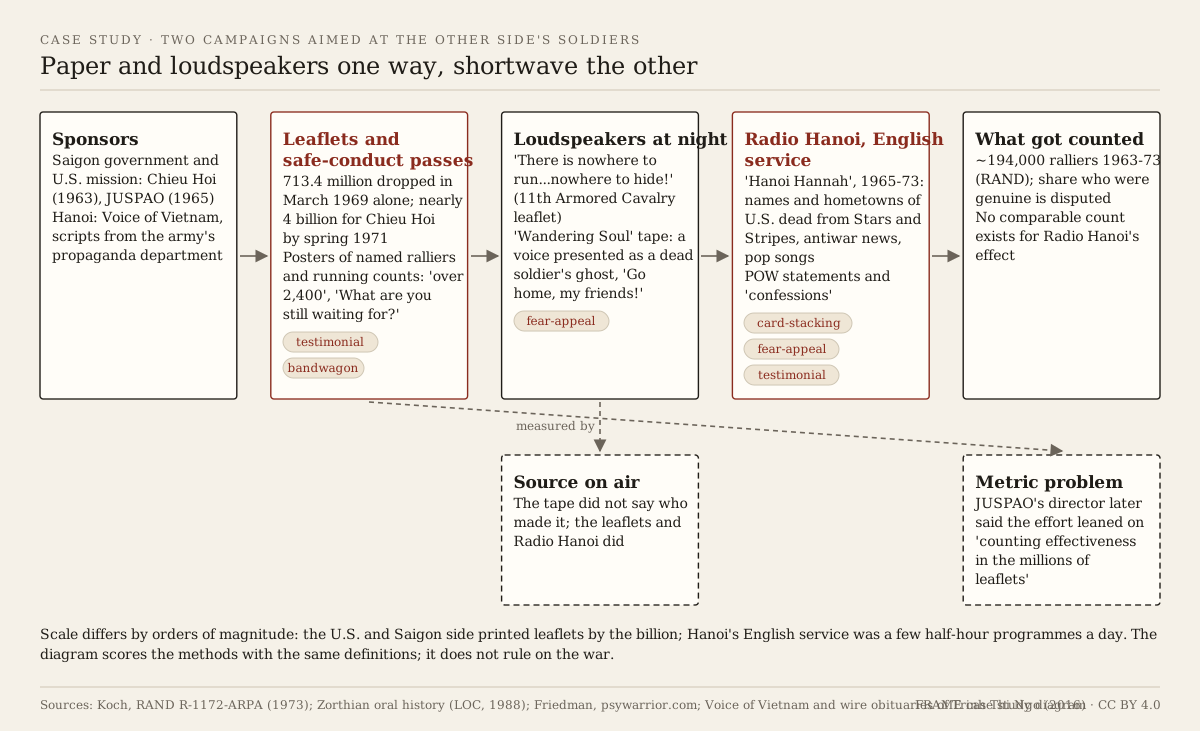
In one line: from 1963 Saigon and Washington tried to talk NLF and North Vietnamese soldiers into changing sides with billions of leaflets, safe-conduct passes, loudspeakers and a "ghost" tape, and counted the defectors; from 1965 Hanoi spoke to American soldiers by radio in English, reading out the names of their dead.
What happened
- 1962-1963. Rufus Phillips, who ran the U.S. aid mission's rural programme, later said he hired Charles Bohannan "to help set up Chieu Hoi, which was a surrender program", modelled on the programme Ramon Magsaysay had used against the Huk rebellion in the Philippines. The South Vietnamese government launched Chiêu Hồi ("Open Arms") in 1963. RAND's history of it says it was begun "at the initiative of the U.S.". Defectors were called hồi chánh ("returnees to the just cause"), usually rendered "ralliers".
- April-July 1965. The Joint U.S. Public Affairs Office (JUSPAO) combines the press, information and psychological-operations work of the Embassy, USIS, AID and the military command (MACV) under Barry Zorthian. By his account it started informally in April 1965 and was formally authorised from 1 July.
- 1965. Radio Hanoi (the Voice of Vietnam) starts an English-language programme for U.S. troops. Its best-known announcer, Trịnh Thị Ngọ, broadcast as Thu Hương ("Autumn Fragrance"). GIs called her "Hanoi Hannah". A broadcast quoted by reporter Tom Tiede in a syndicated Newspaper Enterprise Association (NEA) column of January 1966 opens: "How are you, GI Joe? It seems to me that most of you are poorly informed about the going of the war, to say nothing about a correct explanation of your presence over here. Nothing is more confused than to be ordered into a war to die or to be maimed for life without the faintest idea of what's going on."
- 1966-1967. JUSPAO prints posters for the Chieu Hoi programme. One reports that ralliers in Phu Yen province have "risen to over 2,400". Another prints 96 named ralliers' faces from the 1967 "Reunion Spring" drive (see Images). In May 1966, captured U.S. Navy pilot Jeremiah Denton is made to give a filmed interview for North Vietnamese propaganda. He blinks "T-O-R-T-U-R-E" in Morse code.
- 1967. The seven-flag safe-conduct pass, signed by Nguyễn Cao Kỳ, promises that the bearer will be "Kindly welcomed, Given guaranteed security, Properly treated". It is honoured by the Saigon government and all allied forces.
- March 1969. According to figures from the Vietnam Information Service quoted by Herbert Friedman, 713.4 million leaflets are dropped from aircraft in that one month, plus 3.3 million handed out. By spring 1971, JUSPAO estimates it has distributed nearly four billion leaflets for the Chieu Hoi campaign alone.
- Late 1969 to 1970. The U.S. Army's 6th PSYOP Battalion and the U.S. Navy broadcast "Wandering Soul" tapes, which draw on the Vietnamese belief that the souls of the dead who are not buried at home wander without rest. On "Ghost Tape Number Ten", a voice presented as a dead soldier says, in the usual English translation, "My friends, I come back to let you know that I am dead!", calls the afterlife hell, and urges listeners to go home before it is too late.
- 1973. RAND's report puts the programme's result at the "defection and neutralization of over 194,000 VC/NVA adherents and personnel".
- 30 September 2016. Trịnh Thị Ngọ dies in Ho Chi Minh City. Voice of Vietnam gives her age as 87. Other accounts, based on a 1931 birth year, give 85.
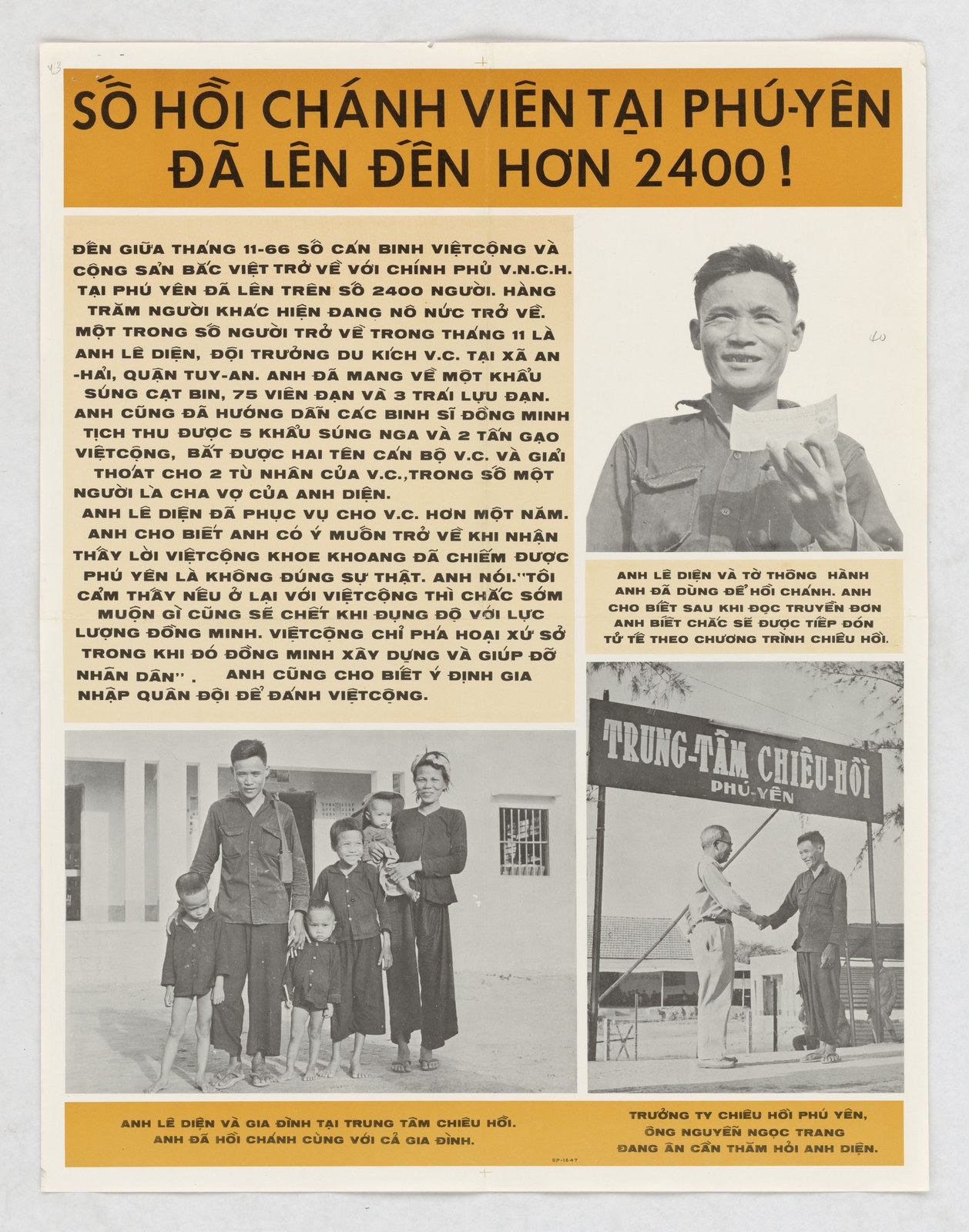
Số hồi chánh viên tại Phú-Yên đã lên đến hơn 2400! (Ralliers in Phu Yen Have Risen to Over 2,400!): JUSPAO poster for the Chieu Hoi programme, 1966. U.S. National Archives. Public domain.
How it works
- Testimonial: the Saigon posters make a named person the proof. Guerrilla squad leader Lê Diện, photographed holding the safe-conduct pass he used, is quoted as saying he knew he would be "welcomed kindly". Radio Hanoi did the same thing the other way round, with statements from captured Americans. The difference in how the statements were obtained is on the record: Denton's interview was given in captivity, and he used it to signal torture.
- Bandwagon: "over 2,400" ralliers, "hundreds of others are now eagerly returning", and 96 faces under the headline "What are you still waiting for?". The running count is offered as the reason to go. Nothing on the poster says how many fighters did not rally, or checks the number.
- Fear appeal: the 11th Armored Cavalry's leaflet says "There is nowhere to run...nowhere to hide!" and calls rallying "your only hope to live!". Wandering Soul adds a ghost's voice to the threat. From the other side, Trịnh's broadcast warns GIs that they have been "ordered into a war to die or to be maimed for life". In each case, death is presented as close and a single way out is offered: rallying, or going home.
- Card stacking: Radio Hanoi read out the names and hometowns of American dead, which, according to her obituaries, Trịnh later said came mainly from the U.S. military newspaper Stars and Stripes. It paired them with news of antiwar protests in the U.S. and American pop songs. Each item was real. The selection is what makes the pile read one way.
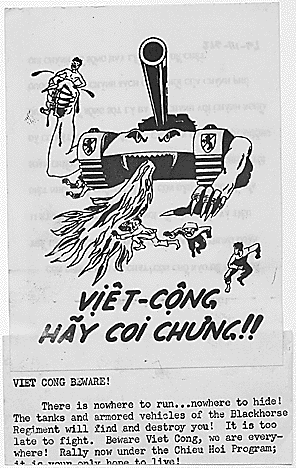
Việt-Cộng hãy coi chừng!! (Viet Cong Beware!): U.S. Army leaflet for the 11th Armored Cavalry, with the Army's typed translation. U.S. National Archives. Public domain.
Colour. The safe-conduct pass, the Blackhorse leaflet and Radio Hanoi all name their sponsor, so they are white. The JUSPAO posters carry no U.S. mark and read as Saigon government material, so they are gray. The ghost tape names no sponsor and presents its voice as a dead man's, which is a false persona at the level of the voice. The page as a whole is rated gray.
Then and now
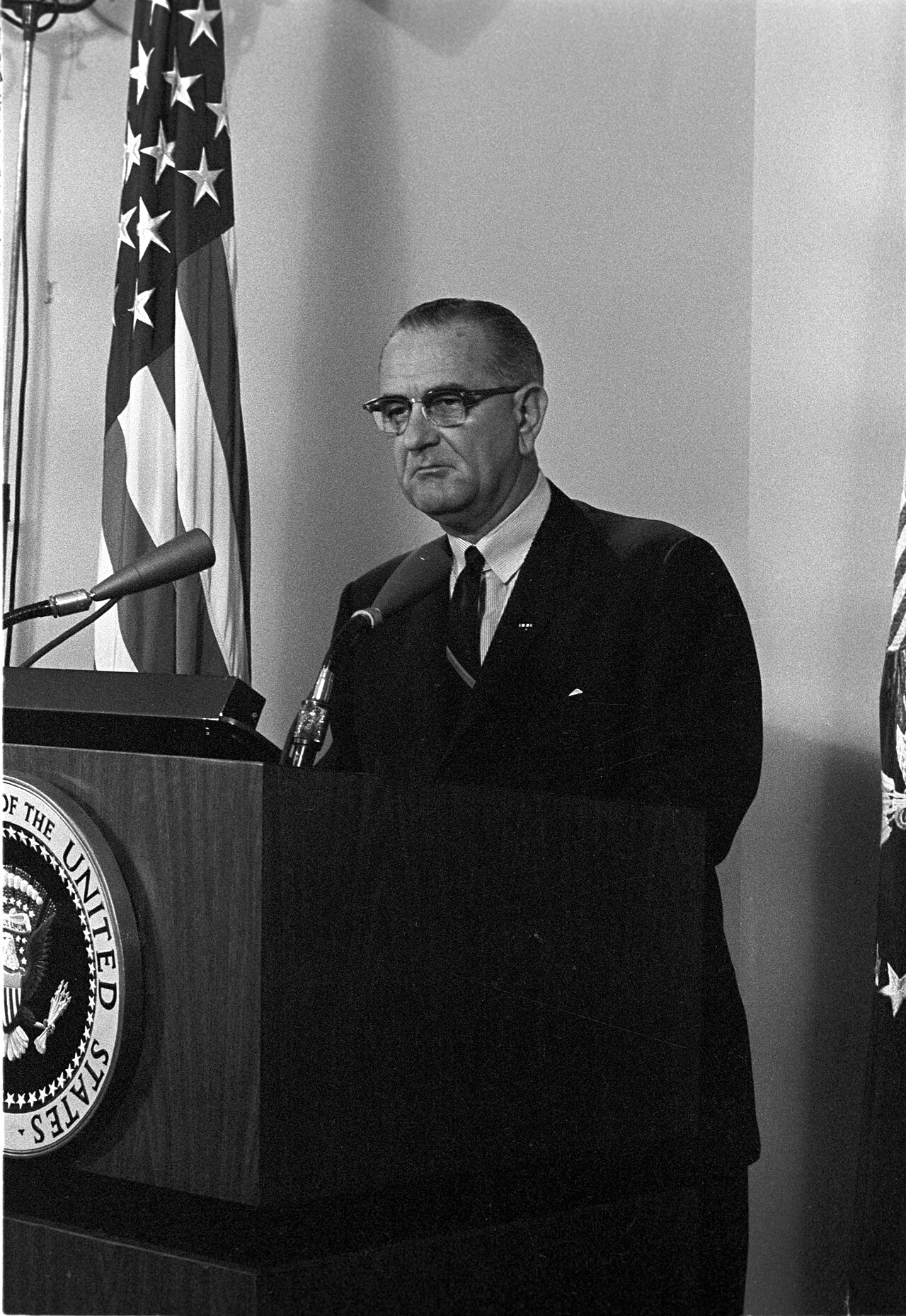
President Johnson's Gulf of Tonkin 'Midnight Address', White House Photo Office, 1964. Public domain.
Card-stacking in the same war, on the other side of the microphone. On 4 August 1964, President Johnson told Americans that a second attack in the Gulf of Tonkin had taken place, backed by intercepts that the National Security Agency's own historian later found had been selected and presented as confirmation. Radio Hanoi's casualty lists aimed the same method at American soldiers instead of American voters. There are differences. Johnson's address announced air strikes and led to a congressional resolution; Hannah's programme could only try to wear down morale. The second Tonkin attack did not happen, while the names Radio Hanoi read belonged to real dead. For testimonial, see also Pershing Says: The S.O.S. Shares the Success With Us, where a commander's name, not a rallier's face, is the proof.
Positions on the record
- U.S. and Saigon officials. RAND's 1973 report calls Chieu Hoi "one of the most cost-effective programs in the pacification effort". JUSPAO rated the multilingual safe-conduct pass the most effective single item, according to the figures and assessments Friedman quotes.
- An inside critic. Zorthian, JUSPAO's director, said in 1988 that there was "probably too much dependence" on "counting effectiveness in the millions of leaflets we dropped rather than the substance". He named "the return of Chieu Hois" as one measurement, and said of counts of leaflets dropped and film showings: "those obviously are just statistics and don't tell you what people are thinking."
- The data-quality debate. The 194,000 figure counts people processed as ralliers, not proven enemy fighters. A U.S. Army Command and General Staff College thesis (DeMure) cites analysts' estimates that in the peak years only about a fifth of recorded defectors were genuine. On this view, the rest were people seeking respite, rewards or cover, and some were infiltrators. Other assessments, including RAND's, count the programme a success. Both positions are on the record; the true share is not established.
- Hanoi's side. Trịnh Thị Ngọ's scripts were written by the army's propaganda department, according to the Washington Post's obituary. Voice of Vietnam, her former station, announced her death. The sources this page could check do not include her own statement of the programme's aims.
- What is not shown. Any measured effect of Radio Hanoi on U.S. morale; how many Wandering Soul broadcasts led to defections (sources describe the results as mixed); and whether the individual claims on the Chieu Hoi posters were true. This page makes no finding on the war itself.
Same-method test
The same definitions were applied to both sides. A named rallier's quote on a Saigon poster and a captured pilot's statement on Hanoi radio are both testimonial. "Nowhere to hide" from the U.S. Army and "die or be maimed" from Radio Hanoi are both fear appeals. A running count of ralliers is bandwagon whoever prints it. If Armed Forces Radio had read out only North Vietnamese dead and Hanoi's internal dissent, it would be card-stacking too.
What differs is scale and conditions. The U.S. and Saigon side printed leaflets by the billion. Hanoi's English service was a few half-hour programmes a day. Ralliers came in at least nominally by choice and were paid allowances, which one poster lists: 24 piastres a day for food, 200 a month, 500 to go home. The POW statements were taken from men in captivity, and one was used to report torture.
How to spot it
- Look for the denominator. "Over 2,400 returned" means little without the size of the force, how many were processed but not fighters, and how many went back.
- A true list can still be a stacked list. Ask what a broadcast of real names leaves out.
- Treat a testimonial from someone in the sponsor's custody, rallier or prisoner, as evidence of the sponsor's message first.
- Watch for a threat paired with a single exit ("your only hope to live"). That pairing is the core of a fear appeal.
Images
| Image | Source | Licence |
|---|---|---|
| Mechanism diagram (above) | Drawn for FRAME from the sources below (make_diagrams.py) |
CC BY 4.0, FRAME |
| Seven-flag safe-conduct pass with U.S. Army translation (below) | U.S. National Archives, RG 472, NAID 305342 | Public domain (U.S. government work) |
| Ralliers in Phu Yen have risen to over 2,400 (1966) | FRAME gallery, from NARA 306-VP-3-1647 | Public domain (U.S. government work) |
| Viet Cong Beware! (1967) | FRAME gallery, from NARA RG 472 | Public domain (U.S. government work) |
| We left the VC ranks... What are you still waiting for? (1967) | FRAME gallery, from NARA 306-VP-3-1805 | Public domain (U.S. government work) |
| Gulf of Tonkin address (1964) | FRAME gallery | Public domain (U.S. government work) |
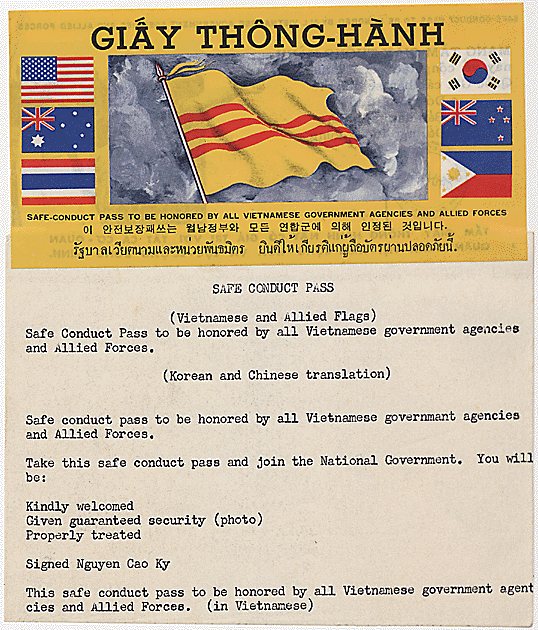
Safe-conduct pass signed by Nguyễn Cao Kỳ, with the typed translation from a U.S. Army file. National Archives. Public domain.
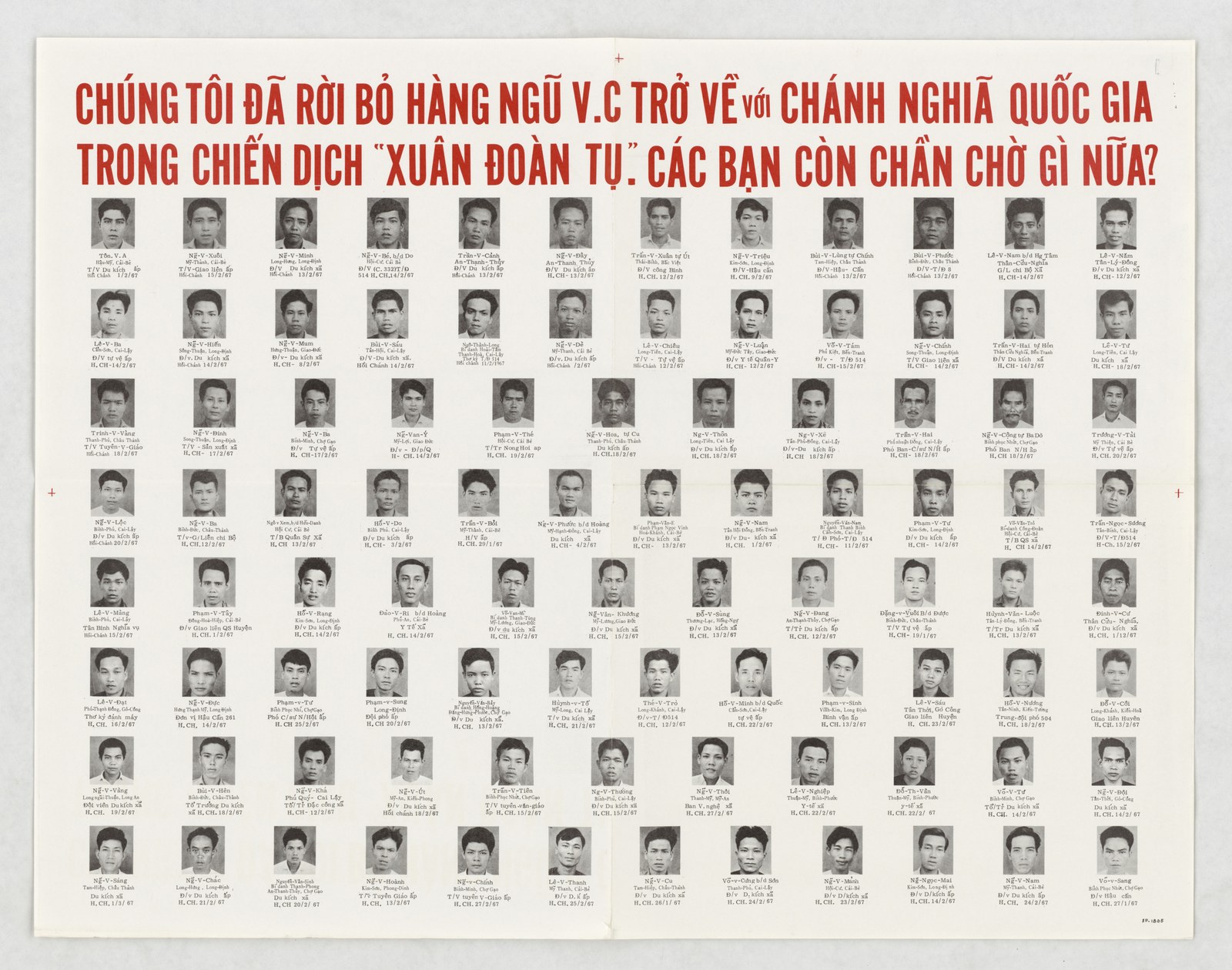
Chúng tôi đã rời bỏ hàng ngũ V.C... Các bạn còn chần chờ gì nữa? (We Left the VC Ranks... What Are You Still Waiting For?): 96 named ralliers from the 1967 "Reunion Spring" drive. National Archives. Public domain.
Image gaps
- NLF leaflets to American soldiers. A U.S. Marine Corps Archives photograph shows one, from about 1968, that asks Americans to stop fighting "Johnson's dirty aggressive war" and wishes them a Merry Christmas. It is not included: the leaflet is a Vietnamese work whose U.S. copyright status is unclear. This is the main balance gap on the page.
- Photographs of Trịnh Thị Ngọ. Commons carries two, tagged under Vietnamese law. They are not included because their U.S. status is unclear.
- Radio Hanoi recordings and the Denton interview footage. No openly licensed copy was found. The footage was made by a Japanese broadcaster.
- Ghost Tape Number Ten audio. A Commons copy is taken from YouTube with an unknown author, so it is not used.
- A 1970 leaflet by Australia's 1st Psychological Operations Unit. It is Australian Crown work, with unclear U.S. status after 1996.
- Friedman's leaflet scans. psywarrior.com could not be reached from the build environment.
Sources
- Jeanette A. Koch, The Chieu Hoi Program in South Vietnam, 1963-1971, RAND R-1172-ARPA, 1973.
- Barry Zorthian oral history, interviewed by Cliff Groce, 20 October 1988, ADST Foreign Affairs Oral History Project, Frontline Diplomacy, Library of Congress.
- Rufus C. Phillips II oral history, interviewed by Charles Stuart Kennedy, 19 July 1995, ADST Foreign Affairs Oral History Project, Frontline Diplomacy, Library of Congress.
- Robert W. Chandler, War of Ideas: The U.S. Propaganda Campaign in Vietnam, Westview Press, 1981 (background on JUSPAO).
- C. J. DeMure, Does Defection Matter? The Impact of the Chieu Hoi Program in Vietnam, U.S. Army Command and General Staff College (DTIC AD1019962).
- Herbert A. Friedman, "Chieu Hoi Program", "The 'Wandering Soul' Tape of Vietnam" and "Hanoi Hannah", psywarrior.com.
- Foreign Policy, 16 September 2023: "The Ghostly Legacies of America's War in Vietnam"
- NPR, 5 October 2016: "Hanoi Hannah," whose broadcasts taunted and entertained American GIs, dies
- Washington Post, 6 October 2016: Trinh Thi Ngo obituary
- Taipei Times (AFP), 5 October 2016: Vietnam War's "Hanoi Hannah" dies aged 87
- NPR, 27 April 2025: Hanoi Hannah revisited
- Tom Tiede, syndicated column on Hanoi Hannah's broadcasts, Newspaper Enterprise Association, January 1966 (quoted from secondary accounts; the original newspaper printing was not reached).
- Robert J. Hanyok, "Skunks, Bogies, Silent Hounds, and the Flying Fish: The Gulf of Tonkin Mystery, 2-4 August 1964", Cryptologic Quarterly 19/20 (2000-2001), National Security Agency, declassified 2005 (the NSA historian's finding on the 4 August intercepts).
- CBS News, 2014: Jeremiah Denton, POW who blinked "torture" in Morse code, dies
- U.S. National Archives: Psychological Warfare Posters Promoting the U.S.-South Vietnamese Cause (series 561393); leaflets urging defection, RG 472 (NAID 305342).
- USMC Archives photograph of a Viet Cong leaflet, c. 1968, on Wikimedia Commons
.jpg)