Content note. This page describes a court built to convict, quotes a judge's recorded courtroom insults toward defendants on trial for their lives, and describes the staged physical humiliation of a condemned man. It references, without describing in detail, executions carried out the same day as sentencing. The quotations are evidence of the method, not this archive's endorsement of it.
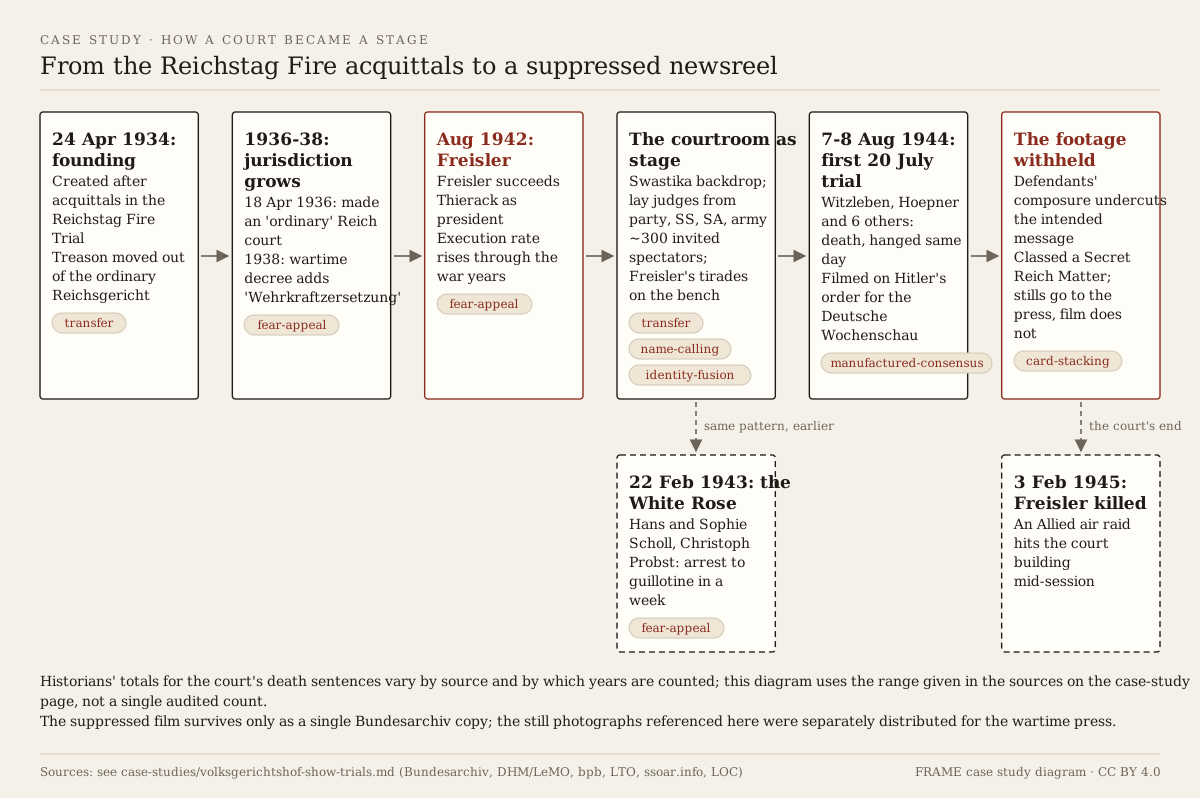
In one line: Created on 24 April 1934 after ordinary judges acquitted most of the Reichstag Fire Trial's defendants, the Volksgerichtshof (People's Court) tried political and military opponents of the regime under party-appointed lay judges and a swastika-draped bench, reached the same-day verdict-and-execution pattern it used against the White Rose in February 1943 and, after Roland Freisler became its president in August 1942, against the 20 July 1944 bomb plotters in trials the regime had cameramen film for the newsreel — only to suppress the footage once the defendants' composure undercut the humiliation it was built to show.
What happened
Founding and structure
- March 1933. The Reichstag Fire Trial, held before the ordinary Reichsgericht (Reich Supreme Court) at Leipzig, convicts only Marinus van der Lubbe of arson; his four co-defendants, including the Bulgarian communist Georgi Dimitrov, are acquitted for lack of evidence of a wider conspiracy (see FRAME's own account of the fire and the acquittal: From a fire to a vote: the Reichstag Fire Decree and the Enabling Act, February-March 1933). The regime treats the acquittals as proof that an independent court could not be trusted to deliver the political verdicts it wanted.
- 24 April 1934. A Reich law ("Gesetz zur Änderung von Vorschriften des Strafrechts und des Strafverfahrens") creates the Volksgerichtshof (VGH, People's Court) as a special court for high treason (Hochverrat) and treason (Landesverrat), removing these charges from the ordinary Reichsgericht's jurisdiction. Its senates are made up of two professional judges and three lay assessors (Beisitzer), a structure that let the state outvote its own trained judges with appointees from the party, the SS, the SA and the armed forces. On 1 January 1943 the court's own personnel records list 47 professional judges alongside 95 honorary lay judges, of whom about 30 were military officers, four were police officers and 48 held SA, SS, NSKK or Hitler Youth rank.
- Early caution. In its first two years the court hands down only four death sentences in 1934 and nine in 1935, a pace the party press criticised at the time as too lenient for a court built to deal with the regime's enemies.
- 18 April 1936. A further law converts the VGH into an "ordentliches Gericht," a regular court of the Reich rather than a temporary special tribunal, and widens its jurisdiction beyond treason to serious damage to military equipment (Wehrmittelbeschädigung), aiding the enemy (Feindbegünstigung) and espionage.
- 26 August 1938. The wartime special penal-law decree (Kriegssonderstrafrechtsverordnung) creates the offence of "Wehrkraftzersetzung," undermining military morale — a charge broad enough to cover defeatist remarks, black-market radio listening or distributing leaflets, and one the VGH uses heavily once the war turns against Germany.
- August 1942. Roland Freisler, previously state secretary in the Reich Ministry of Justice, succeeds Otto Georg Thierack as VGH president when Thierack is promoted to Reich Justice Minister. Freisler, a former prisoner of war in revolutionary Russia and briefly a Communist Party member before joining the NSDAP in 1925, had spent the 1930s drafting National Socialist criminal-law theory around the Führerprinzip. Historians and legal-historical overviews describe the court's execution rate rising sharply under his presidency, from roughly 5 percent of verdicts in the court's early years to something like 46 percent by its last full year of operation, with perhaps 90 percent of cases by then ending in a death sentence or life imprisonment; figures of this kind vary somewhat by source and by which years are counted, since no single audited tally survives. The literature commonly cites a lifetime total of about 5,243 death sentences over the court's 1934-1945 existence, of which Freisler is said to have personally signed roughly 4,951 during his own two-and-a-half years as president — meaning the great majority of the court's death sentences were issued in its final, Freisler-led phase.
The courtroom as stage
- The court's main criminal senate sat in Berlin, its chamber hung with a large swastika banner behind the judges' bench; trials of prominent defendants drew an invited audience of roughly 300 — selected civil servants, party functionaries, military officers and journalists, with senior figures such as Reich Security Main Office chief Ernst Kaltenbrunner known to have attended. Freisler's conduct on the bench — shouting over defendants, cutting off their answers, delivering tirades rather than putting questions — is what later writers mean by calling the VGH a "Terrorgericht" (terror court) rather than a court that tried facts.
- 22 February 1943: the White Rose. Hans Scholl, Sophie Scholl and Christoph Probst, arrested four days earlier for distributing anti-regime leaflets at the University of Munich, are tried before Freisler on charges of high treason and Wehrkraftzersetzung. All three are convicted and guillotined at Munich's Stadelheim prison the same afternoon. The trial's speed — arrest to conviction to execution inside a single week — is the same pattern the court applies eighteen months later to the 20 July plotters, and shows the mechanism was not built only for the officer conspiracy that followed.
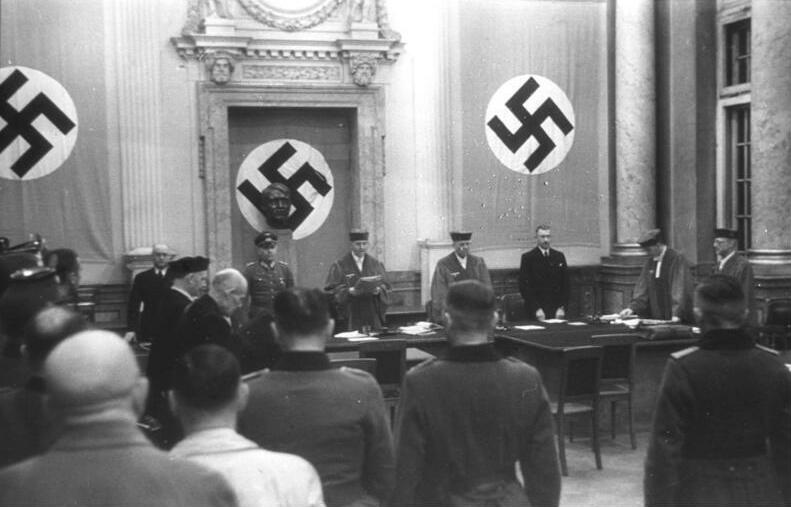
The Volksgerichtshof bench during a 1944 session in Berlin, with swastika banners behind the judges (Reinecke, Freisler and Lautz named in the archive caption). Bundesarchiv, Bild 151-39-21, via Wikimedia Commons. CC BY-SA 3.0 DE.

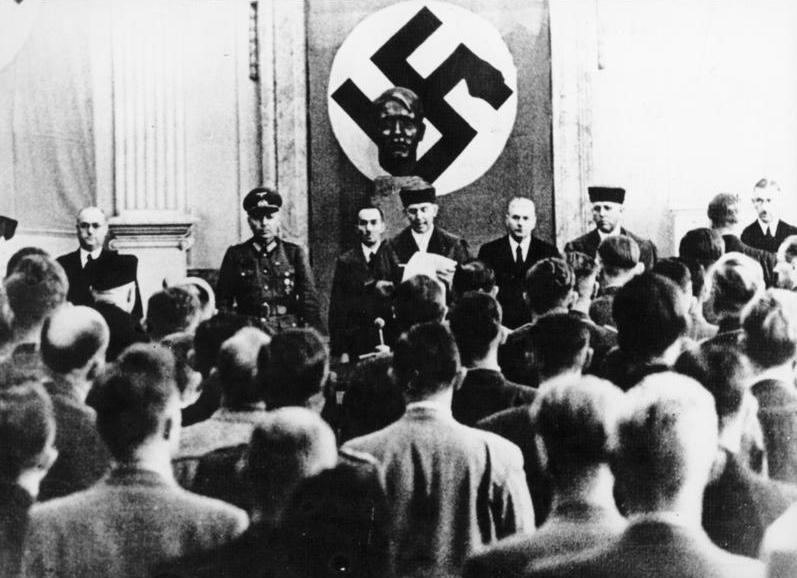
Roland Freisler pronouncing judgment during one of the 20 July 1944 plot trials, Berlin, before an audience of spectators. Bundesarchiv, Bild 183-C0718-0052-001, via Wikimedia Commons. CC BY-SA 3.0 DE.

The 20 July 1944 plot trials
- 7-8 August 1944: the first trial. Eight men are tried together as the first group implicated in the 20 July bomb plot against Hitler: Field Marshal Erwin von Witzleben, General Erich Hoepner, General Paul von Hase, Count Peter Yorck von Wartenburg, General Hellmuth Stieff, Lieutenant Colonel Robert Bernardis, Captain Friedrich Klausing and Albrecht von Hagen. All eight are convicted of treason and sentenced to death; all are hanged the same day, 8 August 1944, at Plötzensee prison.
- Staged humiliation. Multiple postwar accounts describe Witzleben, the senior officer among the accused, brought before the court without a belt or dentures, so that he had to hold up his own trousers in front of the bench and the cameras — a physical degradation of a Field Marshal that observers and later historians read as deliberate. Freisler's own recorded courtroom language toward the defendants was contemptuous rather than legal; toward Witzleben he is widely quoted as saying, "du schmutziger alter Kerl" ("you dirty old man"), one of several such lines preserved in surviving fragments of the trial recording and quoted since in the historical literature on the case.
- Filmed on Hitler's order. Hitler ordered the trial filmed, and cameramen from the Deutsche Wochenschau (the state newsreel) recorded it under the working title "Verräter vor dem Volksgerichtshof" ("Traitors Before the People's Court"), with a camera hidden behind the swastika backdrop behind Freisler's bench. The newsreel's own camera operator, Erich Stoll, later recalled that Freisler shouted so loudly during the first day's filming that the sound technician could not properly balance his voice against the defendants' much quieter responses.
- The footage withheld. Although filmed for the newsreel, the material was never shown in German cinemas. It was instead classified a "Geheime Reichssache" (Secret Reich Matter); accounts of the decision describe the plotters as having appeared too composed and dignified under Freisler's tirades for the footage to deliver the crushed, contrite defendants the regime wanted the public to see. Only one copy is known to survive, held today by the German Federal Archives (Bundesarchiv); an edited compilation reel is separately catalogued by the Imperial War Museum in London. Still photographs of the same proceedings, credited to Heinrich Hoffmann's press agency, were distributed for newspaper use even though the moving footage was not — a set now held partly by the Library of Congress (uncleared for reuse; see "Image gaps" below) and partly, via other Bundesarchiv negatives, on Wikimedia Commons under an open licence (see "Images").
- Further trials. More than a dozen further VGH sessions between August 1944 and early 1945 tried other officers, civil servants, diplomats and clergy linked to the wider conspiracy network around 20 July, among them Ulrich von Hassell, Carl Goerdeler, Julius Leber, Adam von Trott zu Solz and Helmuth James Graf von Moltke; most ended in death sentences and rapid execution. Historians' totals for how many people were executed in connection with the plot, across the VGH and other Nazi proceedings together, commonly run to around 200, though the figure is not uniformly counted across sources.
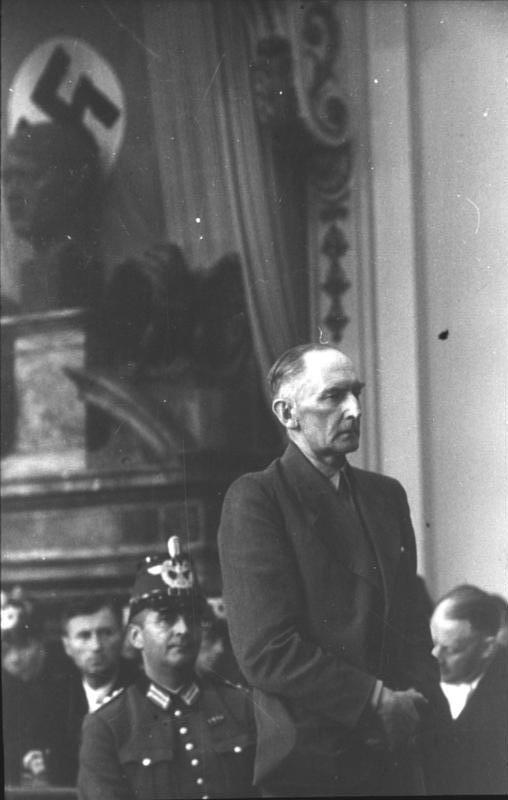
Erwin von Witzleben standing before the Volksgerichtshof, Berlin, August 1944. Bundesarchiv, Bild 151-12-16, via Wikimedia Commons. CC BY-SA 3.0 DE.

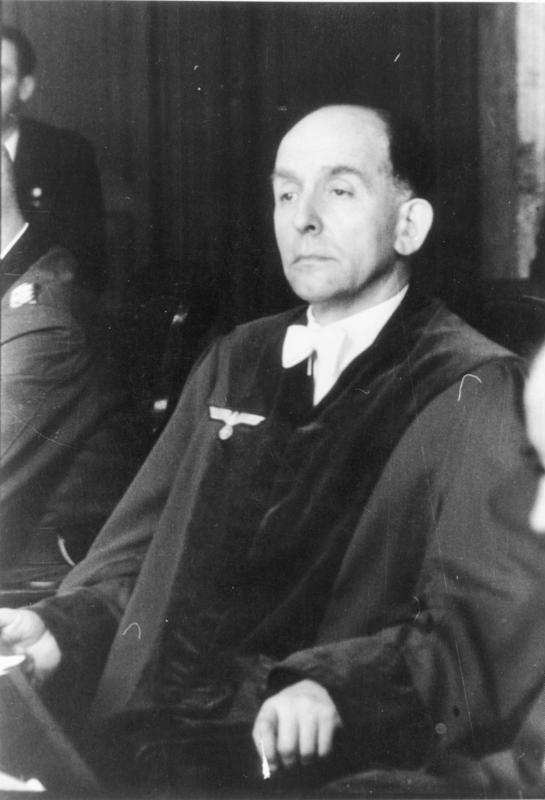
Roland Freisler, president of the Volksgerichtshof from August 1942, in court, 1944. Bundesarchiv, Bild 151-17-15, via Wikimedia Commons. CC BY-SA 3.0 DE.

How it ended
- 3 February 1945. Freisler is killed when a US Army Air Forces daylight raid on Berlin hits the court building during a session; Fabian von Schlabrendorff, on trial before him that day and later a co-founder of the postwar Federal Constitutional Court, records in his own memoir that the raid, which killed Freisler, left him alive. No successor is appointed; the court's caseload and authority collapse with the regime in the following weeks.
- May 1945 onward. VGH judgments carried no legal force after Germany's surrender, and the Allied Control Council's dissolution of Nazi law (1945-46) formally ended the court along with the other institutions of National Socialist "special justice." Few VGH judges or prosecutors were prosecuted after the war; chief prosecutor Ernst Lautz was convicted at the Nuremberg Judges' Trial (the "Justice Case," 1947) but released early, in 1951, and other VGH personnel returned to legal careers in West Germany with little or no accountability. Not until the Federal Act to Annul National Socialist Unjust Judgments in the Administration of Criminal Justice (NS-Aufhebungsgesetz), passed in 1998, did the Bundestag blanket-annul VGH convictions, including those of the 20 July plotters and the White Rose defendants, as void from the outset.
How it works
- Transfer: the court borrowed the form of ordinary justice — robed judges, a formal bench, a published verdict — while replacing trained jurists with party, SS, SA and military appointees as lay judges, and hanging a giant swastika behind the bench for every session. The apparatus of law lent legitimacy to verdicts the regime had already decided.
- Manufactured consensus: the invited audience of some 300 officials, officers and journalists, and the filming intended for national release, were built to present a predetermined political verdict as a judgment the nation itself had witnessed and could stand behind — the same function the Reich propaganda apparatus served for staged rallies and single-list plebiscites (see The Reich Ministry of Public Enlightenment and Propaganda, 1933-1945).
- Name-calling and Identity fusion: Freisler's courtroom language toward the accused — insults rather than questions, contempt rather than cross-examination — collapsed a defendant's specific, documented act (writing a leaflet, joining a conspiracy against a war policy) into a single undifferentiated identity, "traitor to the people," that made the underlying political disagreement disappear from view.
- Fear appeal: funnelling offences as different in scale as printing a leaflet and plotting a head of state's assassination through the same same-day verdict-and-execution machinery, and widening the court's jurisdiction in 1938 to cover loose talk under "Wehrkraftzersetzung," told the public that the range of behaviour that could end in a death sentence was very wide and the process very fast.
- Scapegoating: the wartime expansion into "Wehrkraftzersetzung" let military setbacks and flagging morale be presented as the product of internal betrayal, defeatist talk, "wrecking," rumour, rather than of the regime's own strategic and military decisions; a bounded category of named "traitors" carried blame that would otherwise have fallen on the war's own conduct.
- Card stacking: the regime released what served the intended message and withheld what did not, in the same case. Photographs of the 20 July trial went to the press; the film that showed how the defendants actually looked and sounded under Freisler's tirades did not, because their composure under pressure cut against the humiliation the footage was meant to broadcast. A reader who saw only the published stills and the verdict had no way to know a fuller record existed, let alone why it had been suppressed.
A limit the method ran into. The film's suppression is itself evidence the technique did not fully work as designed: Goebbels's ministry had the apparatus to film a show trial for national release, but the material it produced argued against its own purpose, and the regime chose secrecy over broadcast. This is a documented limit on what the apparatus could make the trial look like on camera, not a claim about how the trial or its verdicts were received among the German public more broadly, which this page does not measure.
Then and now
Filming a court proceeding to display a defendant's humiliation to a wider public, rather than to record a fair hearing, has outlived the Volksgerichtshof. From 2022, Russian and Russian-backed "Donetsk People's Republic" courts tried captured foreign fighters who had served with Ukrainian forces at Mariupol — including the British nationals Aiden Aslin and Shaun Pinner and the Moroccan national Brahim Saadoun — in a proceeding filmed and broadcast by Russian state television, with the defendants held inside the metal cage used as the standard dock in Russian and Russian-controlled courtrooms; all three were sentenced to death in June 2022 before being exchanged in a prisoner swap that September. The cage itself is a routine fixture of Russian courtrooms generally, used for defendants of every kind, not only political or wartime cases; the European Court of Human Rights' Grand Chamber found in Svinarenko and Slyadnev v. Russia (2014) that holding a defendant in a metal cage during trial amounts to degrading treatment under Article 3 of the European Convention on Human Rights, a ruling Russia did not change its practice to follow. Pussy Riot's members were tried in the same style of cage in 2012, and Alexei Navalny was tried and sentenced inside one repeatedly from 2021 until his death in custody in February 2024, each appearance photographed for wide domestic and international circulation.
The differences matter. The 2022 Mariupol trial concerned foreign combatants captured in an active war, judged by a body most governments do not recognise as a legitimate court at all, and ended in a negotiated exchange rather than execution; the cage in ordinary Russian criminal trials is a general feature of the system rather than an instrument built for one political spectacle. The Volksgerichtshof, by contrast, was the Reich's own supreme instrument for treason, its verdicts enforced immediately and without appeal, operating inside a state that had already eliminated every check — a free press, an independent judiciary, a legislature that could object — that might have questioned it. What repeats is the visual grammar: a defendant displayed inside a cage or under a screaming judge, photographed or filmed for an audience the state controls, so that the image itself, not the evidence, carries the verdict.
Positions on the record
- The regime's own framing. Nazi legal theorists, Freisler prominent among them, argued through the 1930s that criminal law should serve the "healthy sentiment of the people" (gesundes Volksempfinden) and the Führerprinzip directly, rather than fixed statute and precedent; the VGH's founding is presented in these terms as a correction, letting political offences be judged by a court answerable to the movement rather than by career jurists the 1933 Reichstag Fire Trial had shown could still acquit. Contemporary party press criticised the court's early sentences (four death sentences in 1934, nine in 1935) as too soft, an internal pressure the literature credits with pushing the court toward the harsher pattern that followed.
- Contemporaries' and defendants' own record. Sophie Scholl reportedly told the court she would do the same again; Fabian von Schlabrendorff's postwar memoir describes Freisler's courtroom manner directly, from the seat of a defendant awaiting a verdict Freisler's death prevented him from delivering. No open domestic criticism of the court was legally possible while the regime stood; what survives from inside Germany is mostly the record of what the court itself said and did.
- What is documented. The founding law and date, the 1936 and 1938 jurisdiction changes, the lay-judge composition, Freisler's tenure and the broad shape of the sentencing statistics (with the hedges given above), the White Rose and 20 July trials and their same-day executions, the filming of the 20 July trial and the decision to withhold it from release, and the 1998 blanket annulment of the court's verdicts.
- What is contested or imprecise. Exact yearly sentencing totals differ across sources, since no single contemporaneous audit survives and postwar reconstructions draw on partial archives; the total executed across the whole 20 July network, as opposed to the VGH's own defendants specifically, is commonly given as roughly 200 but is not uniformly counted the same way by every historian. How far ordinary Germans who read the press coverage, rather than the small invited courtroom audience, understood the verdicts as legitimate justice or as naked terror is not settled by the trial record itself and is not resolved on this page.
- Not ruled on here. The wider historical debate over the German resistance's own political programme, and over how representative the 20 July plotters were of German society at large. This page scores how the court and its trials were built and used, not the resistance's politics.
Same-method test
- The Soviet Union. FRAME's The Moscow show trials: confession, spectacle and consent (1936-1938) documents the same core mechanism at a different scale: senior political defendants tried in a courtroom built to produce a predetermined verdict, confessions substituting for independent evidence, and the state press running the proceedings as proof of a united nation's judgment. The Soviet trials tried and published transcripts of only 54 defendants across three sessions between 1936 and 1938, while a much larger, invisible process of NKVD troikas did the actual mass killing without any courtroom at all; the Volksgerichtshof similarly combined a small number of filmed or photographed "signature" trials with a much larger docket of routine, unphotographed treason and Wehrkraftzersetzung cases that never reached the press.
- Maoist China. Neither the CCP's land-reform "struggle sessions" (Land reform and the struggle session: how the CCP's class labels decided who kept their land, 1946-1952) nor the Cultural Revolution's denunciation rallies (Big-character posters: how the opening labels of China's Cultural Revolution did the work of charges (1966-68)) used a court in the Western or Soviet sense — no judge, no lay assessors, no written verdict — but both staged the same underlying transaction: an accused person displayed before an assembled crowd, labelled in advance (landlord, capitalist roader, class enemy), denounced without a defence that could change the outcome, and punished on the spot while the event itself, not a written judgment, carried the message to everyone who watched. Where the Volksgerichtshof kept the theatre of a court to borrow law's legitimacy, Chinese mass-line practice dispensed with the theatre of law altogether and staged the denunciation directly as a "people's" event; the propaganda mechanism, an unanswerable accusation delivered to a crowd for the crowd's own instruction, is the same.
The scale differs by orders of magnitude in each direction. The Volksgerichtshof's own docket, some 5,243 death sentences across its whole life, is far smaller than the hundreds of thousands the Soviet mass operations of 1937-38 killed without any trial at all, and far smaller again than the death toll historians attach to Chinese land reform and the Cultural Revolution combined. What is comparable across all three is not the body count but the staging: a formal or informal tribunal built to make a punishment look like the people's own verdict rather than the state's decision alone.
How to spot it
- Ask who sits in judgment. Lay judges or "people's assessors" drawn from the ruling party, the security services or the military, rather than from an independent professional judiciary, tell you the court answers to the state, not to the law.
- Watch what gets filmed and what gets shown. A regime that records a trial and then classifies the recording, releasing only stills or a transcript, has decided the full record worked against its own message — that decision is itself evidence.
- Notice when insult replaces cross-examination. A judge, prosecutor or presiding official who labels a defendant rather than puts a checkable question to them ("traitor," "wrecker," "class enemy," "vermin") is asking the audience to convict on the label, not on the facts.
- Check the gap between arrest and execution. A same-day or same-week path from arrest to conviction to death forecloses appeal, further evidence and public reconsideration before the verdict becomes irreversible.
- Look for what happened to the court's own personnel afterward. Wide postwar impunity for a tribunal's judges and prosecutors, as most Volksgerichtshof staff received, is itself part of the record of how seriously the successor state treated the original court's claim to have delivered justice.
Images
| Image | Source | Licence |
|---|---|---|
| Mechanism diagram (above) | Drawn for FRAME from this page's sourced facts (make_diagrams_apparatus_volksgerichtshof.py) |
CC BY 4.0, FRAME |
| Roland Freisler, Volksgerichtshof, 1944 | Wikimedia Commons, Bundesarchiv, Bild 151-17-15 | CC BY-SA 3.0 DE |
| Erwin von Witzleben on trial, August 1944 | Wikimedia Commons, Bundesarchiv, Bild 151-12-16 | CC BY-SA 3.0 DE |
| The bench: Reinecke, Freisler and Lautz, Volksgerichtshof, 1944 | Wikimedia Commons, Bundesarchiv, Bild 151-39-21 | CC BY-SA 3.0 DE |
| Freisler sentencing during a 20 July 1944 plot trial | Wikimedia Commons, Bundesarchiv, Bild 183-C0718-0052-001 | CC BY-SA 3.0 DE |
Image gaps
- The suppressed trial film itself. A single copy is reported held by the Bundesarchiv film archive and an edited compilation is catalogued by the Imperial War Museum, but neither institution's online catalogue confirms an open licence for reuse, and the underlying footage's own wartime classification as a "Secret Reich Matter" makes its postwar rights status unclear. Not hosted here; cite and consult instead: Bundesarchiv-Filmarchiv and the Imperial War Museum's collection record for "The Nazi Supreme Court Trial of the Anti-Hitler Plot."
- The Library of Congress's Presse Hoffmann trial photographs. The Library holds roughly 100 press prints of the 20 July trials (LOC record 2005686273), but its own catalogue states "rights status of individual images not evaluated" and restricts reproduction to its Prints and Photographs Reading Room; not used here for that reason.
- The Volksgerichtshof building itself, in use and in ruins. A 1951 Bundesarchiv photograph of the bombed-out courthouse on Bellevuestraße (Bild B 145 Bild-P054489, CC BY-SA 3.0 DE) exists on Wikimedia Commons, but repeated downloads from this build environment were rate-limited before a clean copy could be retrieved. This gap can be filled on a later pass.
- The White Rose trial, 22 February 1943. No openly licensed photograph specifically of that day's Volksgerichtshof session was located in the time available; Commons hosts portraits of Hans and Sophie Scholl from other contexts, which this page does not use in order to keep the images tied to the courtroom scenes described.
Sources
- "Gesetz zur Änderung von Vorschriften des Strafrechts und des Strafverfahrens," 24 April 1934 (founding law of the Volksgerichtshof).
- Deutsches Historisches Museum, LeMO: Volksgerichtshof, for the court's founding, structure and jurisdiction.
- Bundeszentrale für politische Bildung (bpb): Die Weiße Rose vor dem Volksgerichtshof, for the White Rose trial of 22 February 1943, and Der 20. Juli vor dem Volksgerichtshof, for the filming of the 20 July 1944 trial, its working title "Verräter vor dem Volksgerichtshof," camera operator Erich Stoll's account, and the decision to classify and withhold the footage.
- Legal Tribune Online (LTO): "Roland Freisler: Hitlers williger Vollstrecker," lto.de, for Freisler's career, courtroom conduct and death.
- ssoar.info: research abstract on the Volksgerichtshof's coverage in the Völkischer Beobachter, document/3221, for the selective, propagandistic character of the court's press coverage.
- Zeitklicks: Einrichtung des Volksgerichtshofes, 1934, for the founding date and the Reichstag Fire Trial's role in prompting it.
- Library of Congress, Prints and Photographs Division: Trials of the men and women involved in the attempt on Adolf Hitler's life in July, 1944, Presse Hoffmann / Rehse Collection, for the scale and character of the press photography of the 20 July trials.
- Imperial War Museum Film Collections: "The Nazi Supreme Court Trial of the Anti-Hitler Plot, Sept 1944 - Jan 1945," catalogue record for the surviving edited compilation of trial footage.
- Wikimedia Commons, Category:Volksgerichtshof, and the individual Bundesarchiv file pages cited in the Images table above.
- Fabian von Schlabrendorff, The Secret War Against Hitler (English translation, Pitman, 1965; German original Offiziere gegen Hitler, 1946), for his own account of appearing before Freisler on 3 February 1945.
- Joachim Fest, Plotting Hitler's Death: The Story of the German Resistance, 1933-1945 (Henry Holt, 1996; German original Staatsstreich, 1994), for the 20 July trials, Witzleben's treatment in court and Freisler's courtroom language.
- Peter Hoffmann, The History of the German Resistance, 1933-1945 (3rd ed., McGill-Queen's University Press, 1996), for the wider network of defendants tried after 20 July 1944.
- Helmut Ortner, Der Hinrichter: Roland Freisler — Mörder im Dienste Hitlers (Nomen, 2009; English translation Hitler's Executioner, Arcade, 2018), for Freisler's biography and the court's sentencing pattern under his presidency.
- Lothar Gruchmann, Justiz im Dritten Reich 1933-1940: Anpassung und Unterwerfung in der Ära Gürtner (Oldenbourg, 1988), for the Volksgerichtshof's place within the wider Nazi justice system.
- Bundestag, Gesetz zur Aufhebung nationalsozialistischer Unrechtsurteile in der Strafrechtspflege (NS-Aufhebungsgesetz), 25 August 1998, for the postwar annulment of the court's verdicts.
- For the "Then and now" comparison: European Court of Human Rights (Grand Chamber), Svinarenko and Slyadnev v. Russia, applications 32541/08 and 43441/08, judgment of 17 July 2014; press and human-rights reporting on the June 2022 "Donetsk People's Republic" trial and death sentences of Aiden Aslin, Shaun Pinner and Brahim Saadoun and their September 2022 exchange.