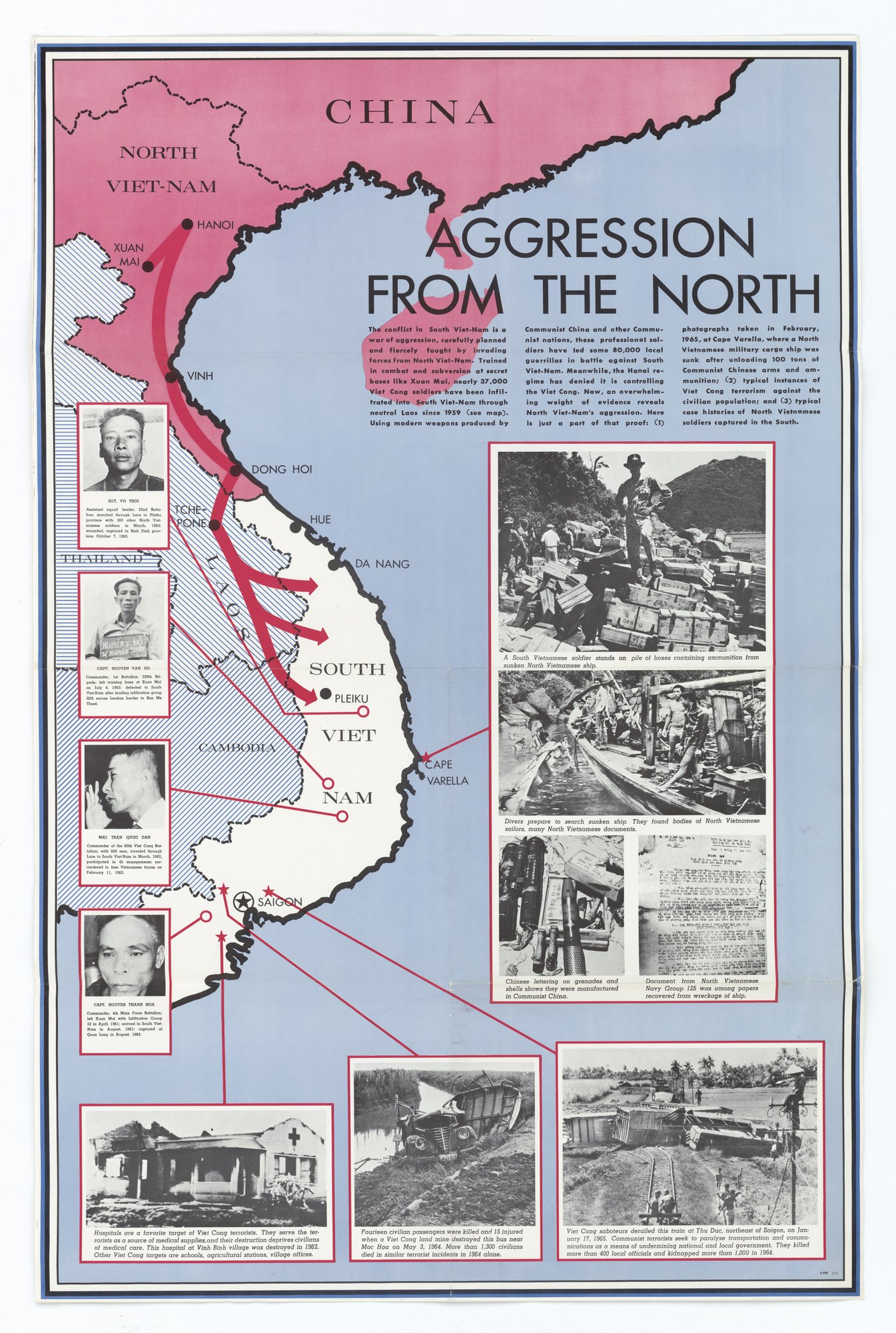
Aggression from the North poster (English, Manila)
An English map-and-photograph poster arguing that the war in South Vietnam is an invasion from the North. A map shows infiltration arrows from Hanoi through Laos, four portrait captions of captured or defected soldiers, photographs of a sunken cargo ship at Cape Varella, and photographs of a burned hospital, a destroyed bus and a derailed train. The tell is card-stacking: selected evidence is offered as proof, with fear-appeal in the civilian casualty figures. The text notes that Hanoi denied controlling the Viet Cong.
Propaganda techniques used in this poster
- Date
- April 13, 1965
- Period
- Cold War
- Made by
- U.S. Information Agency (predecessor: State Department International Information and Educational Exchange Program), Propaganda Posters Distributed in Asia, Latin America and the Middle East series
- Region
- North America
- Country
- United States
- Medium
- Poster
- Issuer type
- State
- Regime
- Johnson Administration
- Leader
- Lyndon B. Johnson
- Audience
- Foreign public
- Purpose
- Persuade or win support
- Themes
- War and the military, Security and surveillance
- Event
- Cold War
- Source
- Unidentified Source blurred: contractors, cutouts, buried disclosure
- Source
- U.S. National Archives (NARA), Record Group 306, Posters in Asia, Latin America, Middle East, retrieved October 4, 2026
- Rights
- Public domain (U.S. government work; NARA RG 306)
U.S. Information Agency / Department of State, April 13, 1965. National Archives, Record Group 306 (NAID 6949268, 306-PPB-343).
Text on the object
CHINA
NORTH VIET-NAM
HANOI
XUAN MAI
VINH
DONG HOI
TCHE-PONE
HUE
DA NANG
LAOS
THAILAND
CAMBODIA
SOUTH VIET NAM
PLEIKU
CAPE VARELLA
SAIGON

AGGRESSION FROM THE NORTH

The conflict in South Viet-Nam is a war of aggression, carefully planned and fiercely fought by invading forces from North Viet-Nam. Trained in combat and subversion at secret bases like Xuan Mai, nearly 37,000 Viet Cong soldiers have been infiltrated into South Viet-Nam through neutral Laos since 1959 (see map). Using modern weapons produced by Communist China and other Communist nations, these professional soldiers have led some 80,000 local guerrillas in battle against South Viet-Nam. Meanwhile, the Hanoi regime has denied it is controlling the Viet Cong. Now, an overwhelming weight of evidence reveals North Viet-Nam's aggression. Here is just a part of that proof: (1) photographs taken in February, 1965, at Cape Varella, where a North Vietnamese military cargo ship was sunk after unloading 100 tons of Communist Chinese arms and ammunition; (2) typical instances of Viet Cong terrorism against the civilian population; and (3) typical case histories of North Vietnamese soldiers captured in the South.

SGT. VO THOI
Assistant squad leader, 22nd Battalion; marched through Laos to Pleiku province with 300 other North Vietnamese soldiers in March, 1963; wounded, captured in Binh Dinh province October 7, 1963.

CAPT. NGUYEN VAN DO
Commander, 1st Battalion, 339th Brigade; left training base at Xuan Mai on July 4, 1963; defected to South Viet-Nam after leading infiltration group H26 across Laotian border to Ban Me Thuot.

MAJ. TRAN QUOC DAN
Commander of the 60th Viet Cong Battalion; with 600 men, traveled through Laos to South Viet-Nam in March, 1962; participated in 45 engagements; surrendered to free Vietnamese forces on February 11, 1963.

CAPT. NGUYEN THANH HOA
Commander, 4th Main Force Battalion; left Xuan Mai with Infiltration Group 52 in April, 1961; arrived in South Viet-Nam in August, 1961; captured at Quan Long in August, 1962.

A South Vietnamese soldier stands on pile of boxes containing ammunition from sunken North Vietnamese ship.

Divers prepare to search sunken ship. They found bodies of North Vietnamese sailors, many North Vietnamese documents.

Chinese lettering on grenades and shells shows they were manufactured in Communist China.

Document from North Vietnamese Navy Group 125 was among papers recovered from wreckage of ship.

Hospitals are a favorite target of Viet Cong terrorists. They serve the terrorists as a source of medical supplies, and their destruction deprives civilians of medical care. This hospital at Vinh Binh village was destroyed in 1962. Other Viet Cong targets are schools, agricultural stations, village offices.

Fourteen civilian passengers were killed and 15 injured when a Viet Cong land mine destroyed this bus near Moc Hoa on May 3, 1964. More than 1,300 civilians died in similar terrorist incidents in 1964 alone.

Viet Cong saboteurs derailed this train at Thu Duc, northeast of Saigon, on January 17, 1965. Communist terrorists seek to paralyze transportation and communications as a means of undermining national and local government. They killed more than 400 local officials and kidnapped more than 1,000 in 1964.

5-599 (24)
Text matches the 65-291 printing; the imprint code differs. The word at Capt. Nguyen Van Do's entry reads 'defected' or 'detected' at this resolution; 'defected' is used.