Notice to All Employees: War Program for Public Eating-Places
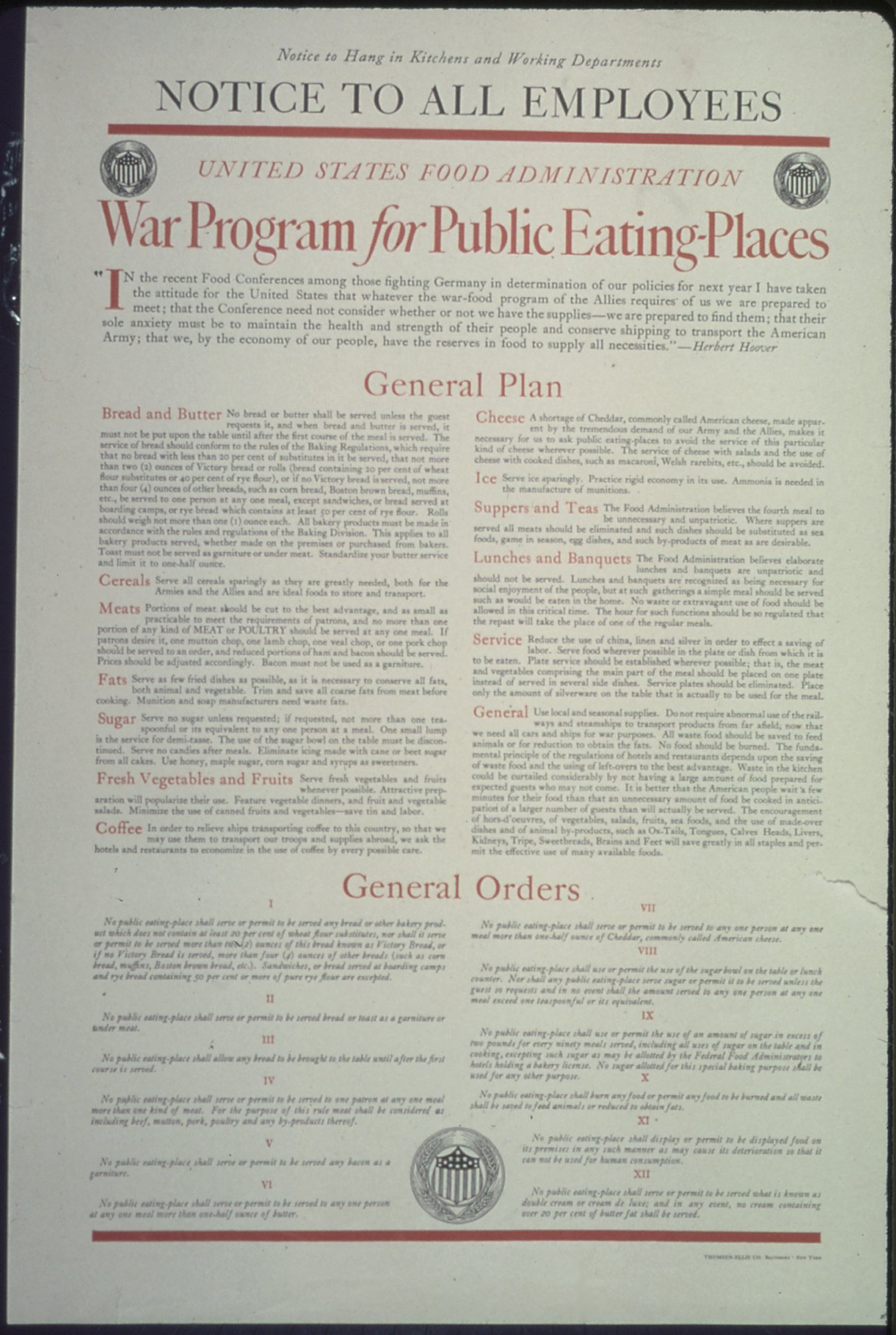
A text-only notice, headed 'Notice to Hang in Kitchens and Working Departments,' sets out a General Plan of rules for bread, meat, sugar, fats and other foods, followed by numbered General Orders for hotels, restaurants and clubs. It opens with a quotation attributed to Herbert Hoover, which places the head of the agency's name behind the rules that follow.
Propaganda techniques used in this poster
- Date
- 1918
- Period
- First World War
- Made by
- U.S. Food Administration
- Region
- North America
- Country
- United States
- Medium
- Poster
- Issuer type
- State
- Regime
- Wilson Administration
- Leader
- Woodrow Wilson
- Audience
- Domestic public
- Purpose
- Mobilize or secure compliance
- Themes
- Home front, Economy and finance, Labor
- Event
- World War I
- Regime
- Wilson administration
- Leader
- Woodrow Wilson
- Source
- Identified Openly sourced: the speaker is who they say they are
- Source
- U.S. National Archives (NARA), RG 4 (U.S. Food Administration), World War I Posters (NAID 512439), retrieved October 3, 2026
- Rights
- NARA Unrestricted; hosted by owner decision
U.S. Food Administration. National Archives and Records Administration, 4-P-153.
Text on the object
Notice to Hang in Kitchens and Working Departments
NOTICE TO ALL EMPLOYEES
UNITED STATES FOOD ADMINISTRATION
War Program for Public Eating-Places

"In the recent Food Conferences among those fighting Germany in determination of our policies for next year I have taken the attitude for the United States that whatever the war-food program of the Allies requires of us we are prepared to meet; that the Conference need not consider whether or not we have the supplies—we are prepared to find them; that their sole anxiety must be to maintain the health and strength of their people and conserve shipping to transport the American Army; that we, by the economy of our people, have the reserves in food to supply all necessities."—Herbert Hoover

General Plan

Bread and Butter No bread or butter shall be served unless the guest requests it, and when bread and butter is served, it must not be put upon the table until after the first course of the meal is served. The service of bread should conform to the rules of the Baking Regulations, which require that no bread with less than 20 per cent of substitutes in it be served, that not more than two (2) ounces of Victory bread or rolls (bread containing 20 per cent of wheat flour substitutes or 40 per cent of rye flour), or if no Victory bread is served, not more than four (4) ounces of other breads, such as corn bread, Boston brown bread, muffins, etc., be served to one person at any one meal, except sandwiches, or bread served at boarding camps, or rye bread which contains at least 50 per cent of rye flour. Rolls should weigh not more than one (1) ounce each. All bakery products must be made in accordance with the rules and regulations of the Baking Division. This applies to all bakery products served, whether made on the premises or purchased from bakers. Toast must not be served as garniture or under meat. Standardize your butter service and limit it to one-half ounce.

Cereals Serve all cereals sparingly as they are greatly needed, both for the Armies and the Allies and are ideal foods to store and transport.

Meats Portions of meat should be cut to the best advantage, and as small as practicable to meet the requirements of patrons, and no more than one portion of any kind of MEAT or POULTRY should be served at any one meal. If patrons desire it, one mutton chop, one lamb chop, one veal chop, or one pork chop should be served to an order, and reduced portions of ham and bacon should be served. Prices should be adjusted accordingly. Bacon must not be used as a garniture.

Fats Serve as few fried dishes as possible, as it is necessary to conserve all fats, both animal and vegetable. Trim and save all coarse fats from meat before cooking. Munition and soap manufacturers need waste fats.

Sugar Serve no sugar unless requested; if requested, not more than one teaspoonful or its equivalent to any one person at a meal. One small lump is the service for demi-tasse. The use of the sugar bowl on the table must be discontinued. Serve no candies after meals. Eliminate icing made with cane or beet sugar from all cakes. Use honey, maple sugar, corn sugar and syrups as sweeteners.

Fresh Vegetables and Fruits Serve fresh vegetables and fruits whenever possible. Attractive preparation will popularize their use. Feature vegetable dinners, and fruit and vegetable salads. Minimize the use of canned fruits and vegetables—save tin and labor.

Coffee In order to relieve ships transporting coffee to this country, so that we may use them to transport our troops and supplies abroad, we ask the hotels and restaurants to economize in the use of coffee by every possible care.

[… remaining text omitted: the right-hand column of the General Plan (Cheese, Ice, Suppers and Teas, Lunches and Banquets, Service, General), the twelve General Orders (I-XII) and the printer's imprint]
Partial by design: the sheet carries more small text than the 4000-character schema limit allows, so the transcription stops at a paragraph boundary after the left-hand column of the General Plan, as marked inline. The omitted text is legible in the scan. The printer's imprint at lower right is in very small type.