Content note. This page quotes an antisemitic passage from Mein Kampf because the term begins there. It is quoted as evidence of what the text says, not endorsed.
Short answer
"The big lie" is an English rendering of die große Lüge. It first appears in print in Adolf Hitler's Mein Kampf (1925), where Hitler uses it as an accusation against others: he says that Jews and Marxists blamed General Erich Ludendorff for Germany's defeat in the First World War by means of a large falsehood that the public would find too big to doubt. The popular later sense, a method that a propagandist adopts on purpose, comes largely from a 1943 U.S. wartime report on Hitler, not from Hitler's own text. A widely repeated quotation credited to Joseph Goebbels has no source that researchers have been able to produce. Since then people of many countries and parties have used it to accuse opponents.
What Hitler wrote (1925)
The passage is in volume 1, chapter 10 ("Ursachen des Zusammenbruchs", "Causes of the collapse"). Hitler argues that Germany's collapse in 1918 had moral rather than military causes. He then says it took "the whole bottomless mendacity of Jewry and its Marxist fighting organisation" to put the blame on Ludendorff, who in his account was the one man able to accuse the "traitors of the fatherland". The method he describes is: "in der Größe der Lüge immer ein gewisser Faktor des Geglaubtwerdens liegt", that is, there is always a certain factor of being believed in the size of a lie. The broad masses, he writes, are more readily victims of a large lie than a small one, because they lie a little themselves but would be ashamed to lie big, and so cannot imagine that others would [1] (translation by FRAME).
The method is assigned to Jews and Marxists, not claimed by Hitler for himself, and the chapter goes on to ascribe it to Jews generally; that ascription is an antisemitic charge, not a finding. The passage says nothing about repetition. Hitler argues elsewhere in the book that propaganda should be one-sided and repeated, a separate point (see Hitler, Goebbels and the Reich Ministry for Public Enlightenment and Propaganda (1925-1945)).
The 1943 U.S. profile
In 1943 the U.S. Office of Strategic Services (OSS), under William J. Donovan, received a secret psychological report on Hitler by the psychoanalyst Walter C. Langer, with contributions from Henry Murray, Ernst Kris and Bertram Lewin, titled A Psychological Analysis of Adolph Hitler: His Life and Legend [2]. In its account of Hitler's propaganda it lists what it calls his primary rules, ending with: "people will believe a big lie sooner than a little one; and if you repeat it frequently enough people will sooner or later believe it" [3]. The words are Langer's summary in his own voice, not a quotation of Hitler. They turn a charge Hitler laid against others into a description of Hitler's own practice, and they add repetition. Langer's book version, The Mind of Adolf Hitler, appeared in 1972 [4]. Wikipedia's summary describes the report as the route by which the phrase was first popularised among English-speaking readers [5].
The Goebbels attribution
The line "If you tell a lie big enough and keep repeating it, people will eventually come to believe it" is very often credited to Joseph Goebbels, Reich Minister of Propaganda from 1933. Randall Bytwerk of Calvin University, who maintains the German Propaganda Archive, describes it as a false attribution and reports that the pages repeating it cite no primary source [6]. The sources support no more than this: the popular wording has not been traced to anything Goebbels wrote or said.
What Goebbels did write is close to the reverse. In "Aus Churchills Lügenfabrik" ("From Churchill's lie factory"), dated 12 January 1941, he accuses Britain: "The English follow the principle that when one lies, one should lie big, and stick to it." [7] Bytwerk's introduction notes that Goebbels generally preferred partial truths in propaganda, and that he "was quite capable of doing what he accuses Churchill of doing when necessary" [7]. Bytwerk adds that Goebbels always maintained in public that propaganda had to be truthful [6]. So both men used "big lie" as a charge against an opponent.
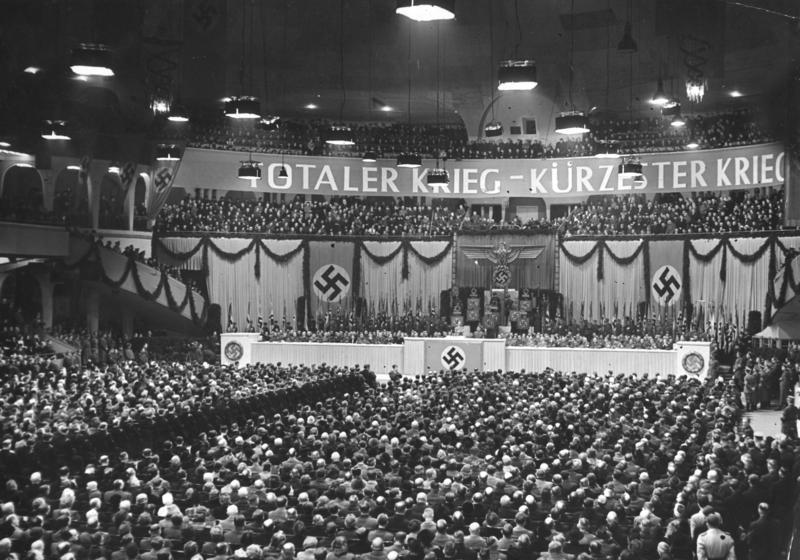
The Berlin Sportpalast during Goebbels's "total war" speech, 18 February 1943; the audience was invited and seated in advance (Bundesarchiv). From the FRAME gallery: Totaler Krieg – kürzester Krieg (Total War – Shortest War): the Sportpalast rally of 18 February 1943
How the term is used now
Since 1945 the phrase has become a general accusation of deliberate, large-scale falsehood. Each item below is a named person's accusation, quoted or paraphrased from a primary record; none is a finding by this archive; the linked pages give the cited record on each underlying claim.
- United States, 2019. Representative Mo Brooks (Republican, Alabama) told the House on 25 March 2019 that Democrats and news organisations had for two years "perpetrated the biggest political lie, con, scam, and fraud in American history" over claims of Trump campaign collusion with Russia, and read a passage of Mein Kampf on the big lie [8].
- United States, 2022. President Joe Biden, speaking in Atlanta on 11 January 2022, said that former President Donald Trump and his supporters were using "the Big Lie about the 2020 election" [9].
- China, 2024. Foreign Minister Wang Yi, at the Munich Security Conference on 17 February 2024, said of allegations of genocide in Xinjiang, "The so-called 'genocide' is such a big lie" [10]. For the record on that subject, see Xinjiang's 'vocational training centres': the government's messaging and its critics'.
- Iran, 2026. Foreign Ministry spokesman Esmaeil Baghaei said on 25 February 2026 that U.S. and Israeli statements about Iran's nuclear programme and missiles were "repetition of big lies". He quoted "Repeat a lie often enough and it becomes the truth" and attributed it to Goebbels [11]. That attribution is the one discussed above.
The four speakers come from three countries and different parties, and each aimed the phrase at an opponent. The list is not exhaustive, and the accusations differ in evidence and scale.
Using the label is itself a rhetorical move
Calling something "the big lie" does three things at once. It asserts that a claim is false, that the person making it knows this, and, through the Nazi association, that the speaker's opponent works as Nazi propaganda did. Each of those is a separate claim that needs its own evidence. The phrase is also used in both directions: the 2019 and 2022 U.S. examples above come from opposite parties, each aimed at the other; the cited record behind the two underlying claims differs. Readers can ask what the primary documents show, whether the accused made the claim knowingly, and whether the label stands in for engaging with the evidence. See Fact-checking and corrections and Name-calling.
On the psychology: repetition raising belief in a statement is well replicated (Illusory truth effect). The claim in Hitler's and Langer's texts that larger falsehoods are believed more readily is a separate one.
What the archive's definition would file
Under Doctrine (working definition), a technique is filed when the method is built to disable checking, not when someone is merely wrong. It files when at least two of four things are true: origin is concealed, the evidence is stacked or flooded, identity or fear is offered instead of a testable claim, or coordination is evidenced. Applying that:
- A false statement alone is not filed, nor is an accusation of falsehood made in the speaker's own name and open to rebuttal.
- The label "big lie" is not a technique. What can be filed is a documented method behind a claim, for example flooding, concealed origin or a stacked evidence pile, whichever side runs it. See Propaganda, misinformation and disinformation: the differences.
- Hitler's chapter and Goebbels's 1941 article are filed on the doctrine page under Accusation in a mirror, whose test is documentary evidence that the accuser ran the method charged. See also Scapegoating and The Reich Ministry of Public Enlightenment and Propaganda, 1933-1945.
- Accusations of lying are made in every era and by every side. A 1952 U.S. State Department poster called Soviet-bloc germ-warfare charges a lie, and a 1916 German poster answered Allied atrocity claims by asking "Are we the barbarians?". The archive files the methods in each (The Korean War germ-warfare charges: commissions, confessions and the 1953 recall).
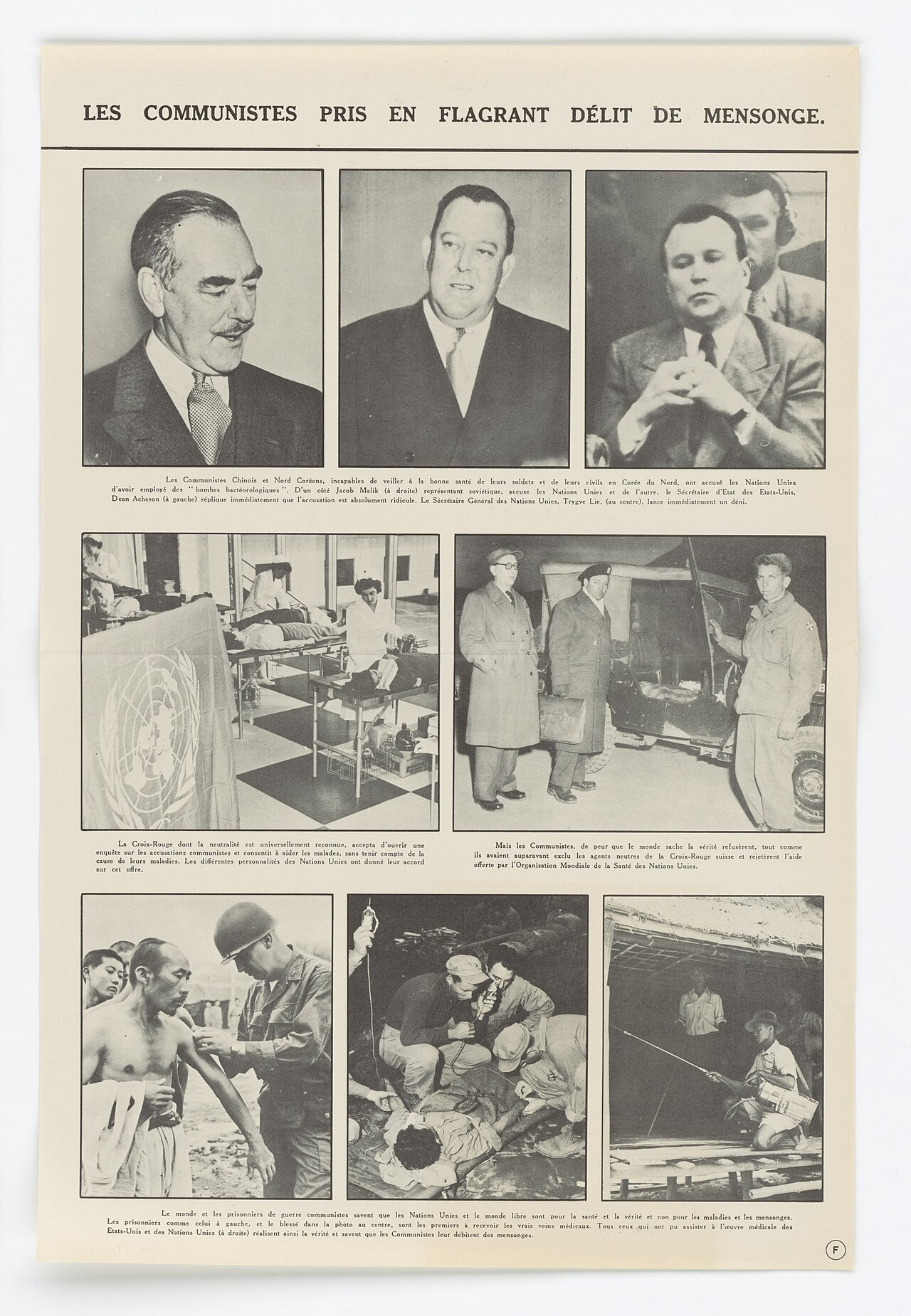
U.S. State Department poster, 1952 (French edition), placing Jacob Malik's germ-warfare accusation beside U.S. and UN denials. From the FRAME gallery: Les communistes pris en flagrant délit de mensonge (The Communists Caught in the Act of Lying)
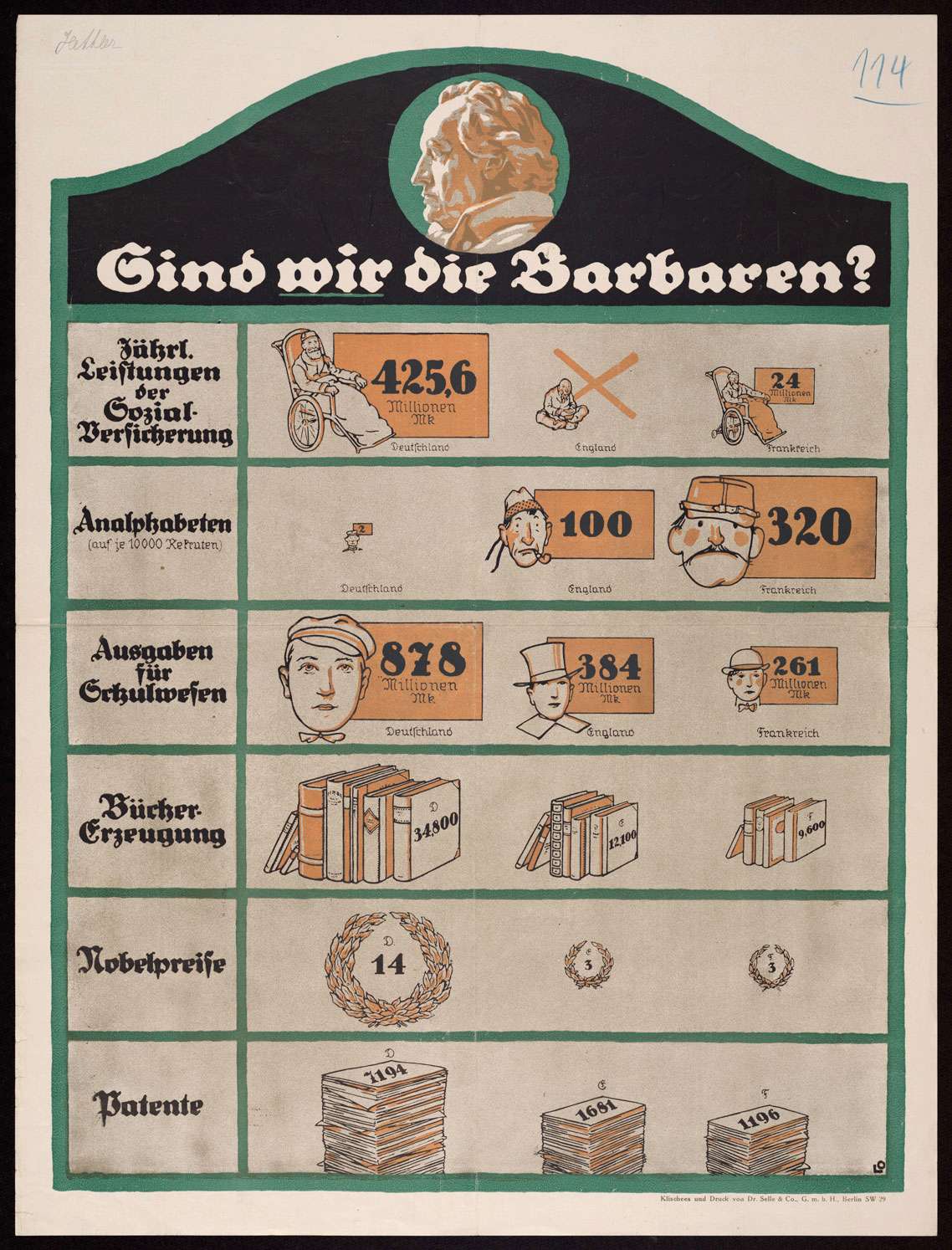
Imperial German poster, 1916, answering Allied atrocity claims with a statistical chart. From the FRAME gallery: Sind wir die Barbaren? (Are We the Barbarians?)
Sources
- Hitler, A. (1925). Mein Kampf, vol. 1, ch. 10, "Ursachen des Zusammenbruchs". Passage checked in the 855th printing (Munich: Zentralverlag der NSDAP., 1943), text at https://archive.org/stream/Mein-Kampf2/HitlerAdolf-MeinKampf-Band1Und2855.Auflage1943818S._djvu.txt. Wording in the first edition was not compared.
- Langer, W. C. (1943). A Psychological Analysis of Adolph Hitler: His Life and Legend. Office of Strategic Services. Cornell University Library, Donovan Nuremberg Trials Collection. https://digital.library.cornell.edu/catalog/nur01134
- Langer (1943), as reproduced by the Jewish Virtual Library, "A Psychological Analysis of Adolph Hitler: His Life and Legend". https://jewishvirtuallibrary.org/a-psychological-analysis-of-adolph-hitler-his-life-and-legend-as-his-associates-know-him
- Langer, W. C. (1972). The Mind of Adolf Hitler: The Secret Wartime Report. New York: Basic Books.
- "The Mind of Adolf Hitler" and "Big lie". Wikipedia (tertiary source, consulted for the report's history and its role in popularising the phrase). https://en.wikipedia.org/wiki/The_Mind_of_Adolf_Hitler and https://en.wikipedia.org/wiki/Big_lie
- Bytwerk, R. "Goebbels Didn't Say It". https://bytwerk.wordpress.com/goebbels-didnt-say-it/ ; and Jewish Virtual Library, "Joseph Goebbels: On the 'Big Lie'", summarising Bytwerk. https://jewishvirtuallibrary.org/joseph-goebbels-on-the-quot-big-lie-quot
- Goebbels, J. (12 January 1941). "Aus Churchills Lügenfabrik". Die Zeit ohne Beispiel (Munich: Zentralverlag der NSDAP., 1941), pp. 364-369, translated with an introduction by Randall Bytwerk, German Propaganda Archive, Calvin University. https://research.calvin.edu/german-propaganda-archive/goeb29.htm
- Brooks, M. (25 March 2019). Remarks in the House of Representatives. Congressional Record 165(51), pp. H2765-H2766. https://www.govinfo.gov/content/pkg/CREC-2019-03-25/html/CREC-2019-03-25-pt1-PgH2765-4.htm
- Biden, J. (11 January 2022). Remarks on election integrity, Atlanta, Georgia. Transcript, Roll Call Factba.se. https://rollcall.com/factbase/biden/transcript/joe-biden-remarks-election-integrity-atlanta-january-11-2022
- Wang Yi (17 February 2024). Remarks at the Munich Security Conference, "Conversation with China". Ministry of Foreign Affairs of the People's Republic of China. https://www.fmprc.gov.cn/eng./wjbzhd/202402/t20240219_11246993.html
- "Iran pushes back against Trump, says US and Israel using Goebbels-like propaganda". The Times of Israel, 25 February 2026. https://www.timesofisrael.com/iran-pushes-back-against-trump-says-us-and-israel-using-goebbels-like-propaganda/
- FRAME. Doctrine (working definition), Doctrine (working definition); and Hitler, Goebbels and the Reich Ministry for Public Enlightenment and Propaganda, Hitler, Goebbels and the Reich Ministry for Public Enlightenment and Propaganda (1925-1945).
Related
- Hitler, Goebbels and the Reich Ministry for Public Enlightenment and Propaganda (1925-1945)
- Doctrine (working definition)
- Accusation in a mirror
- Scapegoating
- Name-calling
- The Reich Ministry of Public Enlightenment and Propaganda, 1933-1945
- Nazi propaganda before and during the Holocaust, 1933-1945
- The Korean War germ-warfare charges: commissions, confessions and the 1953 recall
- Xinjiang's 'vocational training centres': the government's messaging and its critics'
- Illusory truth effect
- What is propaganda? Definition, history and examples
- Propaganda, misinformation and disinformation: the differences
- Fact-checking and corrections