- Actor
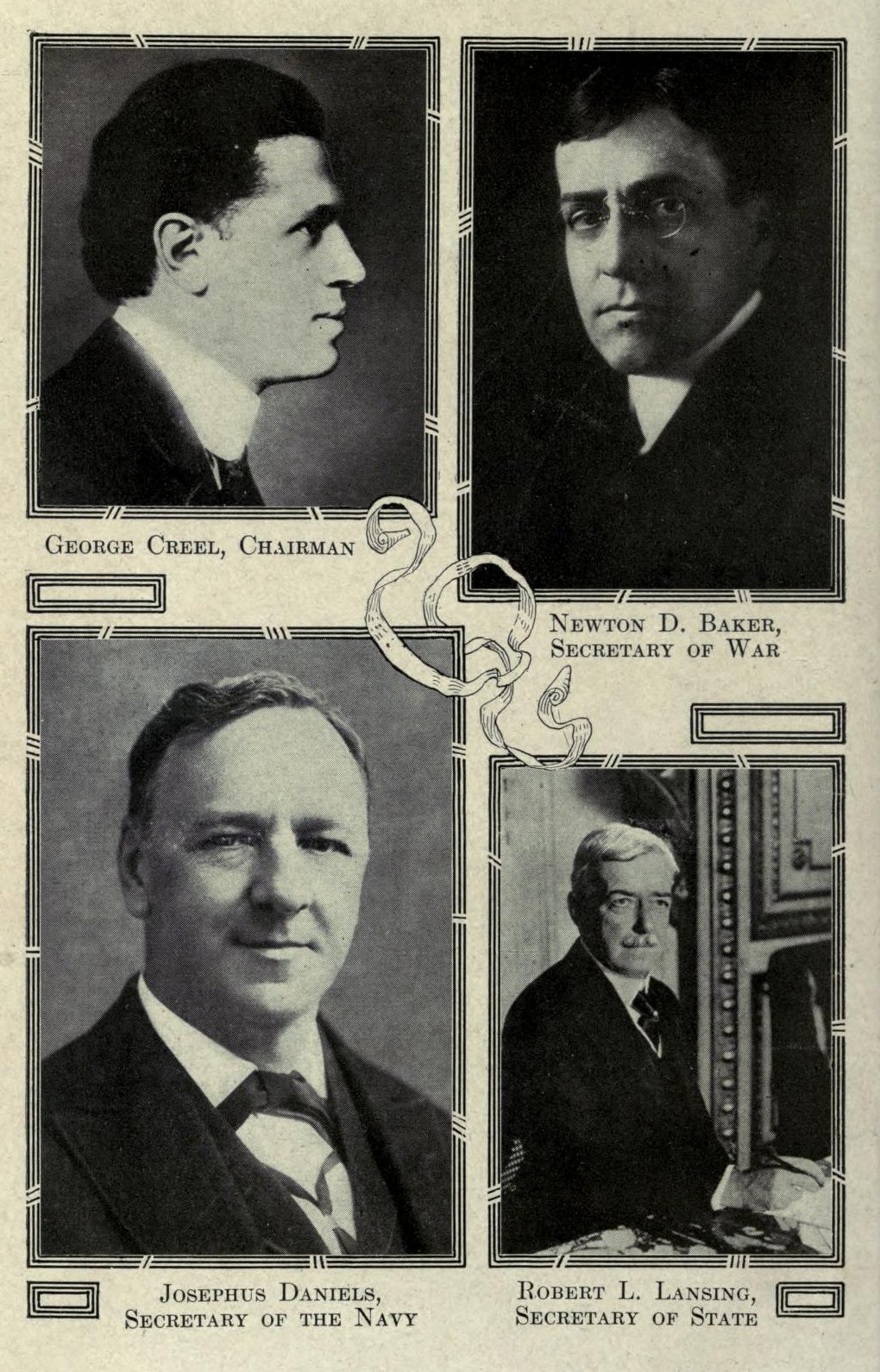
- U.S. government: the Committee on Public Information (CPI), created by executive order of President Woodrow Wilson, with the civilian chair George Creel and the Secretaries of State, War and the Navy as members
- Target
- The U.S. public, including foreign-language and organised-labour audiences; Allied and neutral publics abroad; enemy troops and civilians (by leaflet, with the Military Intelligence Branch)
- Source
- Identified white to gray (white: most output carried the CPI's name or a government credit; gray: the "societies and leagues" and the American Alliance for Labor and Democracy, whose CPI direction was not shown on their face)
- Techniques
- TransferName-callingFear appealTestimonialManufactured consensus
- First seen
- 13 April 1917 (Executive Order 2594); domestic work ran to December 1918 and foreign work to June 1919
- Status
- closed June 30, 1919 (Creel: Congress refused liquidation funds, and the committee ceased to exist); records now in National Archives Record Group 63
- Related briefs
- none
Mechanism
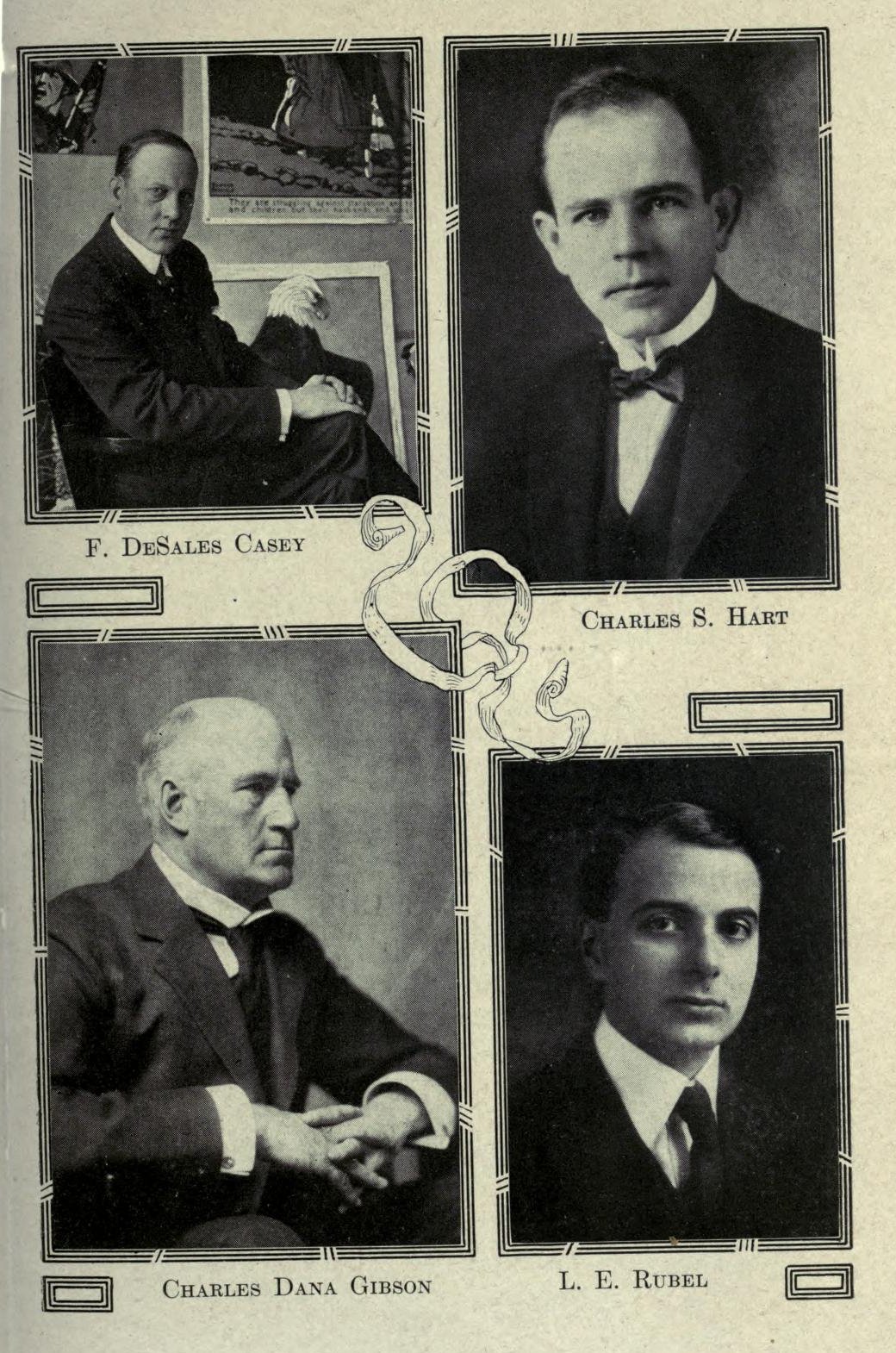
The CPI was an openly declared agency. Its output was organised by medium: a Division of News and a daily Official Bulletin; the Four Minute Men, volunteers who spoke for four minutes in cinemas from bulletins written in Washington; the Division of Pictorial Publicity, in which artists led by Charles Dana Gibson drew posters for other departments; the Division of Films; pamphlet series with named scholars as authors; a foreign-language and labour outreach; and a Foreign Section with offices abroad. The case narrative is in The Committee on Public Information: how the U.S. government sold the First World War at home (1917-1919). This file scores the method across the whole institution.
Frontispiece of George Creel, How We Advertised America (Harper, 1920): the chairman and the three cabinet secretaries who sat on the committee. Public domain; Internet Archive scan.
Transfer is the clearest device. The Four Minute Men name borrowed the 1775 militia (4 Minute Men: A Message from Washington), and the film poster for Pershing's Crusaders borrowed medieval knights (Pershing's Crusaders). Name-calling and Fear appeal sit together in the CPI's "Spies and Lies" advertisement, which tells readers "Do not become a tool of the Hun" and to "Report the man who spreads pessimistic stories, divulges—or seeks—confidential military information, cries for peace, or belittles our efforts to win the war", with the promise that "The fact that you made the report will not become public" (text as reproduced in Mock and Larson, 1939, p. 64). The frame puts dissent in the same sentence as espionage. The historian Frederick Luebke, reviewing Vaughn's institutional history, wrote that "much of the CPI propaganda was immoderate" and that "CPI authors often sought to generate fear of what they understood to be the brutal, depraved nature of the enemy" (Indiana Magazine of History, 1980).
Plate facing p. 118 of How We Advertised America (1920): Gibson and Casey of Pictorial Publicity, Hart of the Division of Films, Rubel of still-picture distribution. Public domain; Internet Archive scan.
Testimonial appears in the pamphlet series, where named professors and public figures vouched for the case, and in the September 1918 release of the Sisson documents with an endorsement by two historians. George Kennan showed in 1956 that they were forgeries (Journal of Modern History 28, pp. 130-154, as cited on Wikipedia's "Sisson Documents" page).
Manufactured consensus applies narrowly. The Complete Report says the CPI "organized and directed 23 societies and leagues" for foreign-language groups. Mock and Larson describe the American Alliance for Labor and Democracy, whose director also headed the CPI's Division of Labor Publications and which shared its New York offices, as "the most important of all the devices of labor control through the apparently spontaneous action of labor itself", and say the CPI's industrial-relations work "is not fully or frankly treated in any published report" because much of it ran through that "technically independent" body. The record does not show that these members were not real.
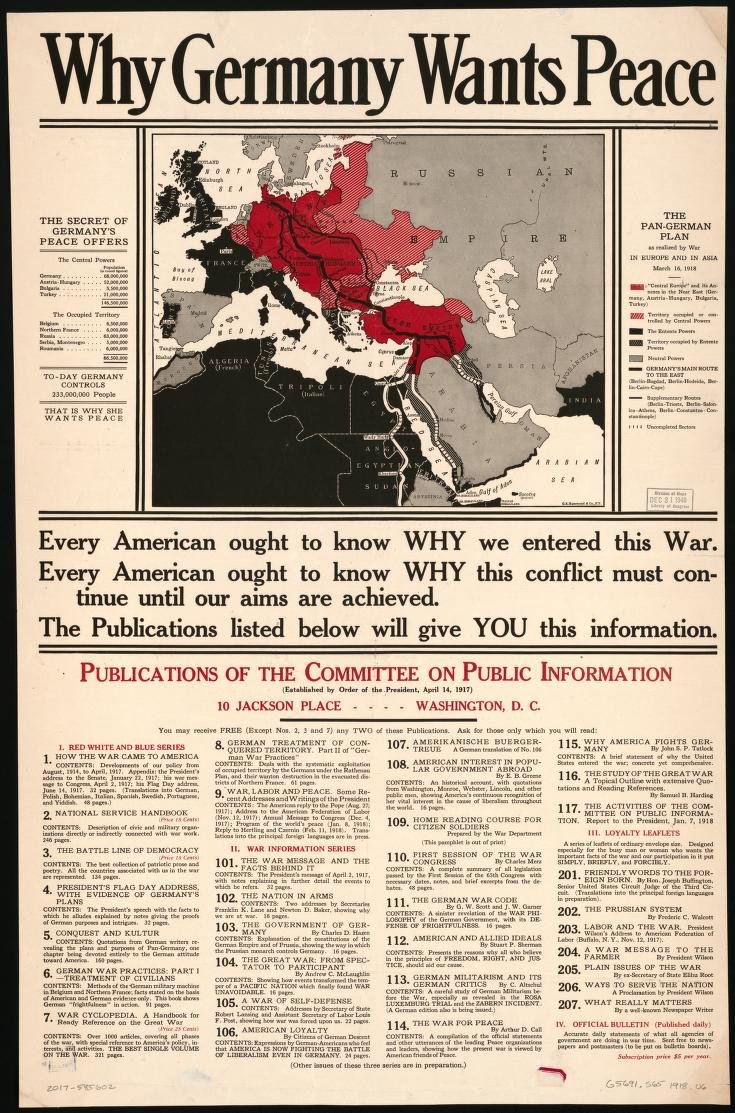
"Why Germany Wants Peace", CPI poster, 1918: map of the "Pan-German plan" and the committee's publication list, credited to the Committee on Public Information, 10 Jackson Place. Library of Congress; public domain.
Sides on the record
- The CPI's account. The Complete Report (signed 1 June 1919) says "our emphasis was ever on expression, not suppression", and that "We did not call it 'propaganda,' for that word, in German hands, had come to be associated with lies and corruptions." Creel's 1920 book calls the work "a plain publicity proposition" and says the committee did not "seek or exercise authorities under those war laws that limited the freedom of speech and press". He also published the press rules openly, saying belligerent countries usually issue them "private and confidential" (quoted in Mock and Larson).
- Historians on the legal line. Mock and Larson agree the CPI "lacked the authority for censorship enforcement", which sat with the Justice and Post Office Departments, but note that Creel sat on the Censorship Board and that the CPI had "censorship power which was tantamount to direct legal force, although this was energetically denied by the Committee during the war."
- Critics at the time. Representative Gillett called it "really an advertising bureau, a propaganda bureau" and "a very dangerous thing in a Republic" if used for partisan ends, while admitting it had not been (Congressional Record, 65th Cong., 2nd sess., p. 7915, as quoted in Lasswell, 1927). Senator Penrose said Creel was "smeared all over with treason" (same source, p. 4827). Creel called the congressional attacks partisan and unfounded. Lasswell records that after a three-day hearing the House Appropriations Committee endorsed a $1.25 million appropriation and commended the bureau's record.
- Civil-liberties critics. Zechariah Chafee's 1919 Harvard Law Review article on wartime free speech counted, in a footnote, at least twelve people sentenced to ten years, five to fifteen and twenty-one to twenty under the Espionage Act, and cites the National Civil Liberties Bureau's list of wartime prosecutions. The CPI did not bring these cases.
Evidence
- 13 April 1917: Executive Order 2594 creates the committee (Secretaries of State, War, Navy, and a civilian chair, George Creel). https://www.presidency.ucsb.edu/documents/executive-order-2594-creating-committee-public-information. The CPI's own report and poster date it 14 April.
- 17 and 22 April 1917: Creel asks the Society of Illustrators for help; Gibson and Creel meet and the Division of Pictorial Publicity begins (Mock and Larson, https://archive.org/details/wordsthatwonwars00mockrich).
- 15 June 1917 and 16 May 1918: Espionage Act, then the Sedition Act adding "disloyal, profane, scurrilous, or abusive language about the form of government of the United States" and penalties up to $10,000 and twenty years. https://en.wikisource.org/wiki/Sedition_Act_of_1918
- 1917-1918: Four Minute Men, 46 bulletins, disbanded 31 December 1918; the Report counts 755,190 speeches. Bulletin titles include "What Our Enemy Really Is" and "Where Did You Get Your Facts?" (Mock and Larson). A November 1917 issue of the Four-Minute Men News criticised a submitted speech that invoked "blood for blood" as out of line with the bulletins.
- 1918: "Spies and Lies" advertisement (see above); The German-Bolshevik Conspiracy pamphlet, 137,375 copies (Creel, appendix).
- 3 and 10 March 1919: Schenck v. United States (clear and present danger) and Debs v. United States (ten-year sentence) uphold Espionage Act convictions. https://www.law.cornell.edu/supremecourt/text/249/47 and https://www.law.cornell.edu/supremecourt/text/249/211
- 1 June 1919: Complete Report gives the net cost to the government as $4,464,602.39 from 14 April 1917 to 1 June 1919, plus $2,825,670.23 in earnings, mostly from films and expositions. https://archive.org/details/completereportof00unit
- 30 June 1919: committee ends. Creel says Congress refused funds for an orderly liquidation and that the report then at the printer was caught in the closure (it was published in 1920) (How We Advertised America, Dedicatory, https://archive.org/details/howweadvertiseda00creeuoft). NARA: domestic activities ended after the Armistice, foreign in June 1919. https://www.archives.gov/research/foreign-policy/related-records/rg-63
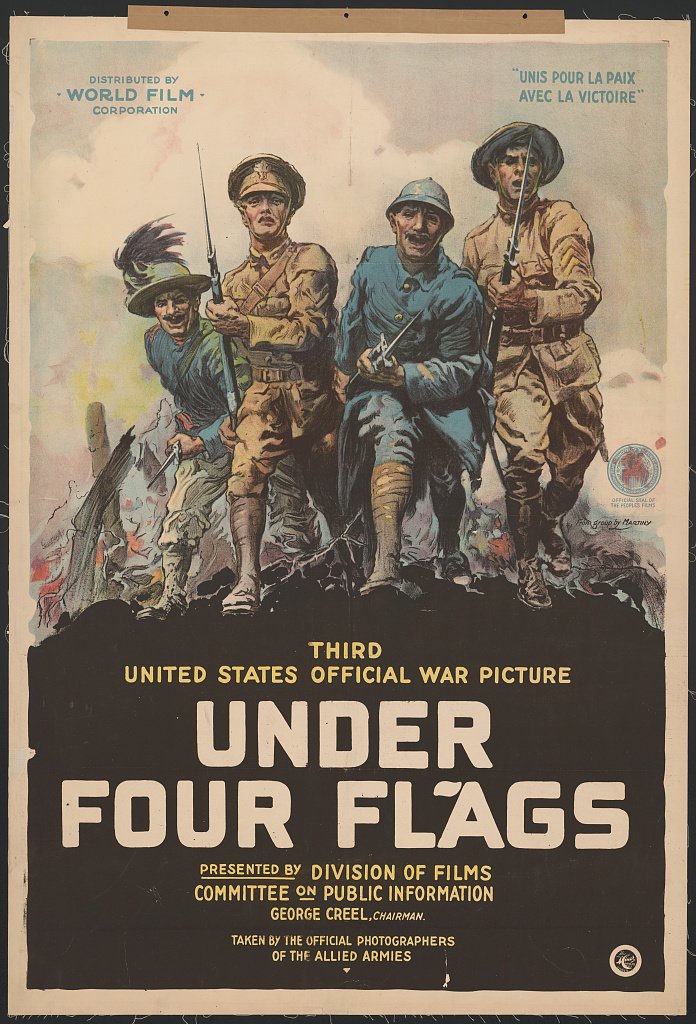
"Under Four Flags", Third United States Official War Picture, 1918, presented by the CPI Division of Films. Library of Congress; public domain.
Same definitions, other bureaus
The scoring is the same for each belligerent. Britain's War Propaganda Bureau (Wellington House, from 5 September 1914) put out most of its material "as though it were a private and not an official agency" (Lasswell); its Crewe House department (1918) worked on the rule that for enemy audiences "its origin should be completely concealed" (Campbell Stuart, Secrets of Crewe House, 1920). Germany set up a Zentralstelle für Auslandsdienst in October 1914 and, on 30 January 1917, a military film and photograph office (BUFA), dissolved 1 April 1919 (Bundesarchiv exhibit). Lasswell describes a running quarrel between military and civil authorities there. The censorship side is in Wartime censorship in the First World War: Britain, Germany, France and the United States; the British atrocity report in Wellington House and the Bryce Report: atrocity evidence, confirmed and unconfirmed (1914-1915); German, British and U.S. posters share technique tags in the gallery (for example Helft uns siegen! Zeichnet die Kriegsanleihe (Help Us Win! Subscribe to the War Loan), Remember Belgium — Enlist To-Day, Halt the Hun! Buy U.S. Government Bonds, Third Liberty Loan). For the later British bureau see Britain's Ministry of Information and Political Warfare Executive: posters at home, black radio abroad.
Differences on the record: the war lasted four years for Britain and Germany and about nineteen months for the United States, and the CPI ran about 26 months. Its imprint was mostly declared; Wellington House's home and neutral output was mostly not. The Report claims "In no other belligerent nation was there any such degree of centralization"; Lasswell agrees the design was "equivalent to appointing a separate cabinet member for propaganda". Comparative budgets were not checked. Creel's Report claims other states spent more in one year than the CPI in its whole life; that claim is his own and is not verified here. The same devices, scored the same way, appear in the output of all three; the scale of each is not measured here.
- Other sources used: Luebke's review of Vaughn, Holding Fast the Inner Lines (UNC Press, 1980), https://scholarworks.iu.edu/journals/index.php/imh/article/download/10277/14265; Lasswell, Propaganda Technique in the World War (1927), https://archive.org/details/PropagandaTechniqueInTheWorldWarHaroldLasswell; Chafee, "Freedom of Speech in War Time," Harvard Law Review 32 (1919), https://archive.org/details/jstor-1327107; Stuart, Secrets of Crewe House (1920), https://www.gutenberg.org/cache/epub/77798/pg77798-images.html; Wellington House, https://en.wikipedia.org/wiki/Wellington_House; Sisson documents, https://en.wikipedia.org/wiki/Sisson_Documents; German BUFA, https://artsandculture.google.com/exhibit/der-krieg-im-bewegtbild-das-bild-und-filmamt/QQKiAfxa
What would falsify this read
That the "Spies and Lies" request produced no reports, or that the Alliance for Labor and Democracy's CPI sponsorship was stated in its own materials, which would move that part of the file to white. Documents showing the CPI's Sisson release was made after a real provenance test would weaken the Testimonial reading. A showing that the CPI wrote or passed prosecutions to the Justice Department would strengthen the historians' concern; the sources used here say only that it could. The audience figures are the CPI's own counts.
Literacy counter
Check who is speaking and whether the label on the message matches the sponsor. Read the list of conduct a reporting appeal names; note whether "cries for peace" appears beside espionage in the same appeal. Treat a vouch by scholars as a claim to test, not a test. Compare an agency's own report with a later archive-based history, as this file does with Creel (1920) and Mock and Larson (1939, using the files). See Media literacy, Walter Lippmann, Public Opinion (1922) and Arthur Ponsonby, Falsehood in War-Time (1928).