Content note: this page describes, without quoting, the obscene and sexual content of a British black radio station that invented sexual crimes by named German officials.
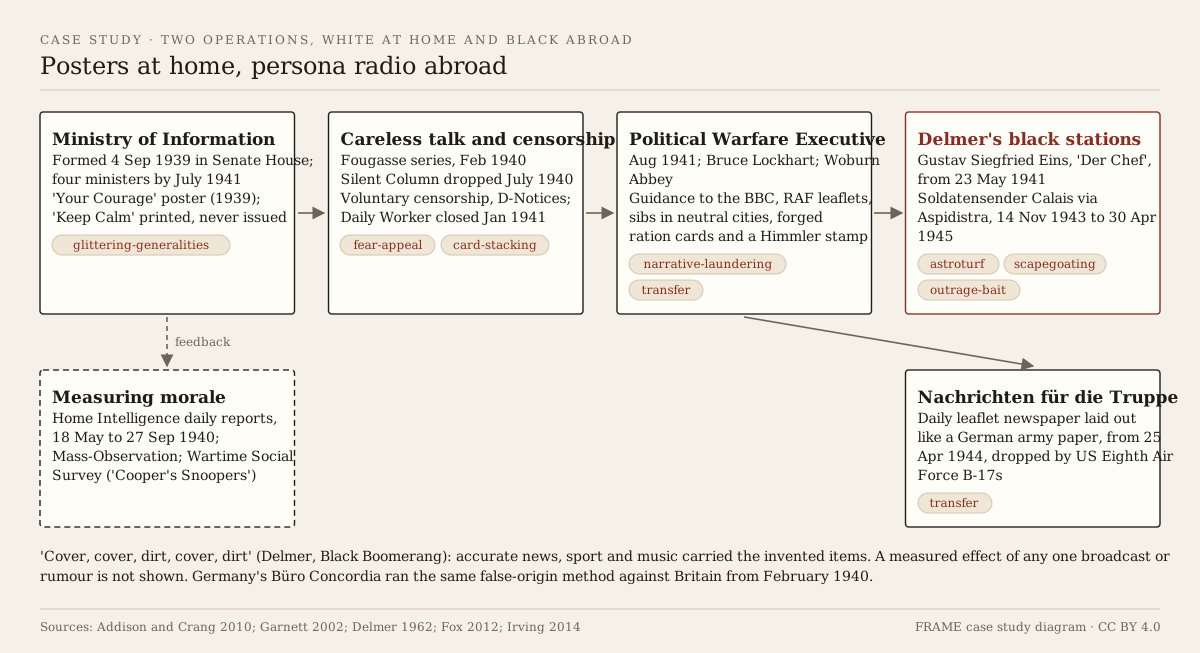
In one line: Britain ran two propaganda operations at once: an openly labelled Ministry of Information that told its own public to be cheerful, stay quiet and not spread rumours while studying how the public felt, and a secret Political Warfare Executive that broadcast to Germany as if from inside the German army and Party, mixing accurate news with invented scandal.
What happened
The Ministry of Information (white, home front and Allied/neutral publicity)
- Summer 1939. A shadow Ministry of Information (MoI) designs three "Home Publicity" posters between 27 June and 6 July 1939: Your Courage, Your Cheerfulness, Your Resolution Will Bring Us Victory; Freedom Is in Peril, Defend It With All Your Might; and Keep Calm and Carry On, to be held back for a crisis such as heavy bombing. Almost 2.5 million copies of Keep Calm are printed in late August and early September 1939 (Irving; IWM).
- 4 September 1939. The MoI is formed the day after Britain declares war, housed in the University of London's Senate House. It has four ministers in under two years: Lord Macmillan, Sir John Reith (January 1940), Duff Cooper (May 1940) and Brendan Bracken (July 1941), who holds the post until 1945. It is wound up in 1946 and replaced by the Central Office of Information.
- Autumn 1939. Your Courage and Freedom Is in Peril go up across the country. Mass-Observation, the independent social-research body founded in 1937, reports a largely negative public response: the slogan was thought too long and was read by some as "your" (the public's) courage winning victory for "us" (the government and the upper classes). The rest of the campaign is dropped in October 1939 after criticism of its cost and impact. Keep Calm and Carry On is never issued for general display (a copy does survive in an album of posters a U.S. vice consul collected in Bradford between September 1939 and May 1941, now in the Library of Congress); it becomes widely known only after a copy turns up at Barter Books in Alnwick in 2000 and the shop sells reprints.
- February 1940. The MoI launches a national campaign against careless talk. Cyril Kenneth Bird, the Punch art editor who signed as "Fougasse", draws a series of eight cartoon posters under the line Careless Talk Costs Lives, in which people chat on buses, over meals and on the telephone while small figures of Hitler, sometimes with Göring, listen from a hiding place in each scene; in the poster in FRAME's gallery, Hitler is the portrait on the wall. Fougasse designed posters for many ministries without charge.
- 1940: measuring morale. Mary Adams, a BBC producer, heads the MoI's re-formed Home Intelligence division (appointed November 1939, working from February 1940). It compiles daily morale reports from 18 May to 27 September 1940 and weekly reports afterwards to the end of 1944, drawing on regional officers, postal censorship, the BBC, and paid commissions to Mass-Observation (Addison and Crang, Listening to Britain, 2010). In April 1940 the MoI also sets up the Wartime Social Survey, run from the London School of Economics, whose interviewers go door to door.
- July 1940: "Cooper's Snoopers" and the Silent Column. After the fall of France the MoI steps up its anti-rumour work. Duff Cooper appeals by radio for the public to join a "Silent Column" that would not repeat gloomy or defeatist talk, at the same time as courts hear prosecutions for spreading alarm and despondency. On 30 July 1940 the Daily Herald runs "Cooper's Snoopers: They Listen-In to Pub Talk Now" about the Wartime Social Survey's interviewers, and much of the press accuses the ministry of copying the methods of the states it was fighting. Churchill announces in the Commons that the Silent Column phrase will be dropped, some ten days after its launch (The Spectator, 26 July 1940). The surveys carry on.
- Censorship. Press censorship is formally voluntary. Editors are not obliged to submit copy, but an article cleared by the MoI's censors is protected from prosecution under the security regulations. "D" (defence) notices, a system dating from the 1912 Admiralty, War Office and Press Committee, tell editors which subjects to avoid. Separate emergency powers are used against opinion: the Communist Daily Worker is closed on 21 January 1941 under Defence Regulation 2D, which covered publications "calculated to foment opposition" to the war.
- Film, briefly. The MoI's Films Division commissions short "trailers" for cinemas and absorbs the GPO Film Unit, renamed the Crown Film Unit in 1940. The films are covered in FRAME's film and radio case studies (Britain's Ministry of Information films and London Can Take It! (1940-1942)).
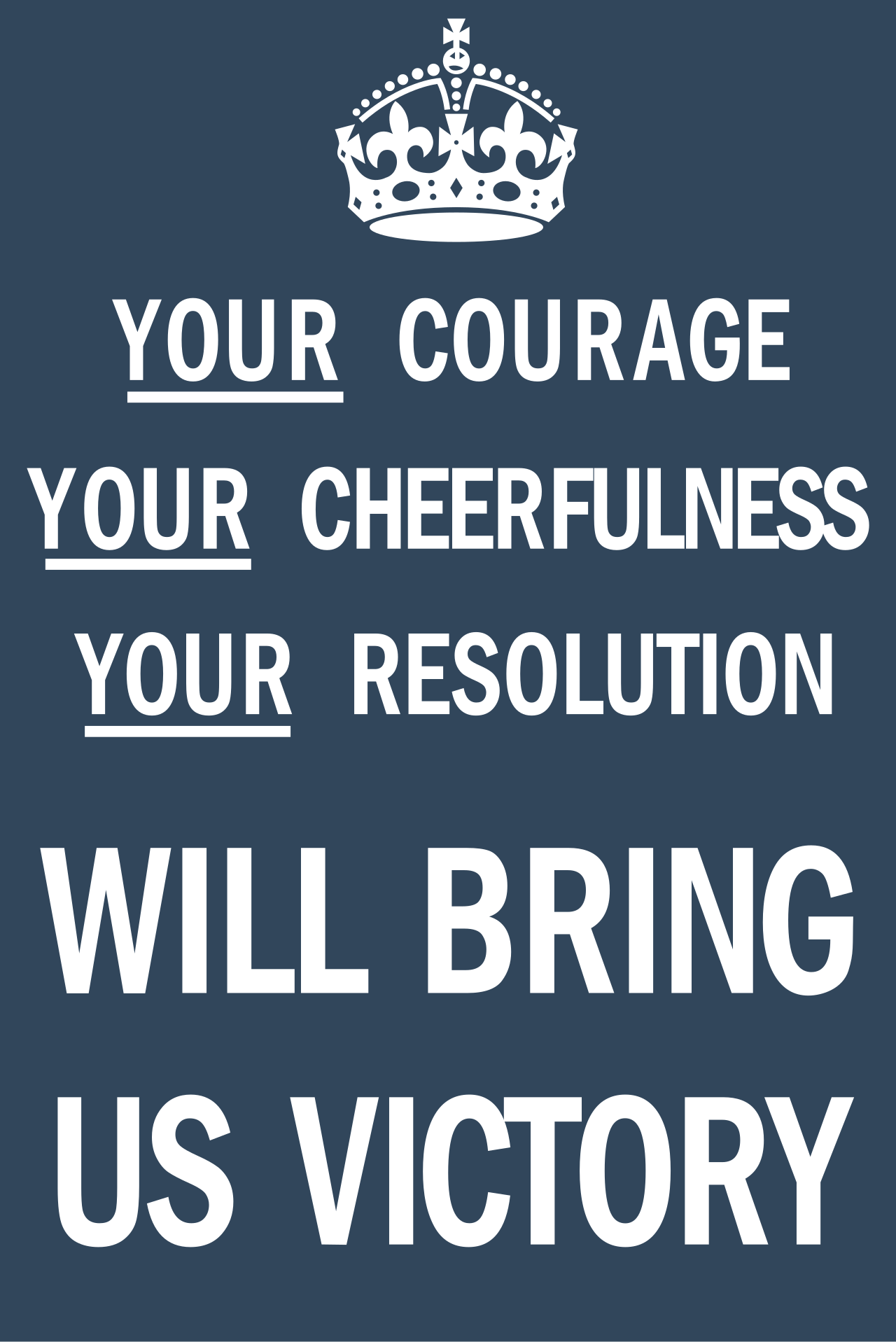
Your Courage, Your Cheerfulness, Your Resolution Will Bring Us Victory: the first MoI mass poster, 1939 (a modern vector redrawing of the design). Public domain.
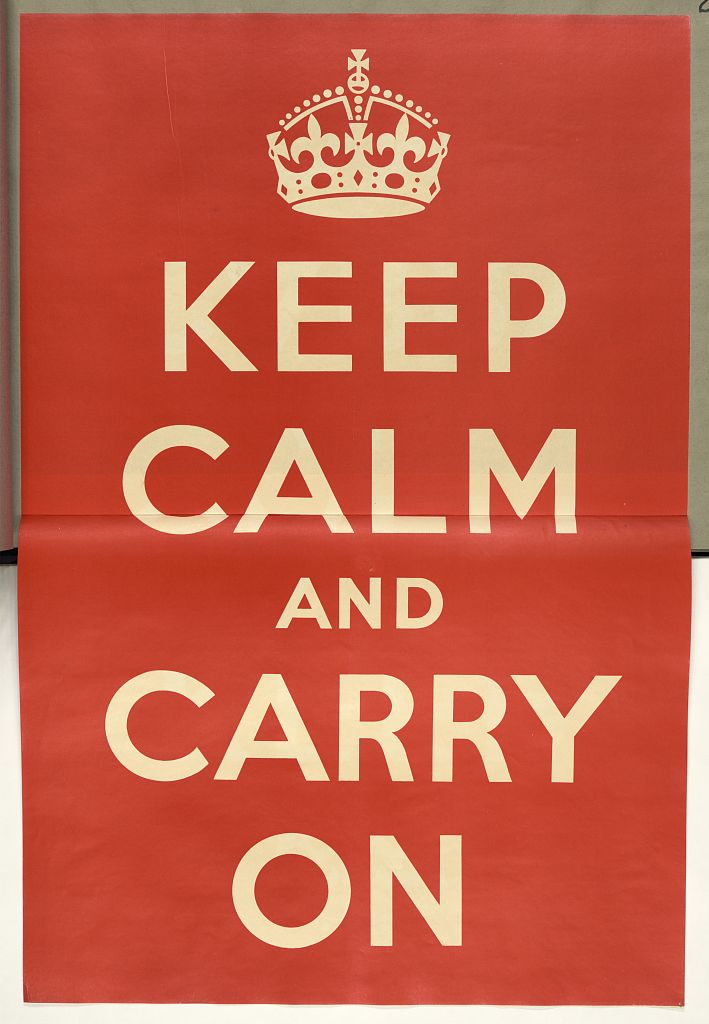
Keep Calm and Carry On: printed in 1939 and held back; this original survives in a U.S. vice consul's album. Public domain.
The Political Warfare Executive (white, grey and black, abroad)
- 1938-1941: precursors. Propaganda to enemy countries starts at Electra House on the Embankment ("Department EH"), which moves its country headquarters to Woburn Abbey in Bedfordshire. In 1940 it becomes SO1, the propaganda half of the new Special Operations Executive (SOE), with the MoI and the BBC also claiming a share. The overlap produces long turf disputes.
- May 1941: Delmer's unit. Sefton Delmer, a Berlin-born British journalist and former Daily Express Berlin correspondent, is brought in to run black radio. His first station, Gustav Siegfried Eins (GS1), goes on air on 23 May 1941 under SO1, claiming to be an illegal transmitter inside Germany. GS1's recordings are made at The Rookery, a house at Aspley Guise near Woburn, with German-speaking émigrés as writers and speakers.
- August 1941. The Political Warfare Executive (PWE) is formed, answerable jointly to the Foreign Secretary, the Minister of Information and the Minister of Economic Warfare. Robert Bruce Lockhart becomes its chairman and later its Director-General. Its country headquarters stays at Woburn Abbey, with London offices at the BBC's Bush House. In public it uses the cover name Political Intelligence Department of the Foreign Office (Garnett, The Secret History of PWE).
- White. PWE sets policy guidance for the BBC's foreign-language services, which broadcast openly under the BBC name, and writes the leaflets the RAF drops over Germany and occupied Europe.
- The V for Victory campaign (1941). Victor de Laveleye, broadcasting to Belgium on the BBC in January 1941, asks listeners to chalk a "V" in public places. The BBC widens it into a campaign across its European services, with "Colonel Britton" (the BBC's Douglas Ritchie) calling on a "V army" and using the Morse V (dot-dot-dot-dash), the rhythm of the opening of Beethoven's Fifth, as a signal, and Churchill adopts the V sign in July 1941. From August 1941 the campaign runs under the political guidance PWE sets for the BBC's European services. Broadcast details are covered in FRAME's wartime radio case study (Wartime radio voices: open and hidden broadcasts aimed at the enemy, 1939-1945).
- Sibs. From 1940 an Underground Propaganda Committee (chaired from August 1941 by David Bowes-Lyon) approves rumours, known as "sibs" from the Latin sibilare, to hiss. They are spread by agents and contacts in neutral cities so that no British source is visible.
- Forgeries. A PWE printing unit, whose work Ellic Howe later described in The Black Game (1982), forges German ration cards and leave passes meant to strain German administration and food control, and in 1942-43 prints a parody of the 6-pfennig Hitler-head stamp with Heinrich Himmler's face, meant to suggest Himmler was preparing to succeed Hitler. A 5 April 1943 memorandum covers sending 400 of the Himmler stamps, with postmarks and censorship strips, to Stockholm.
- 1942-1945: infrastructure. PWE builds a purpose-built studio at Milton Bryan, near Woburn, for live broadcasts, and gets the use of Aspidistra, a very high-power medium-wave transmitter made by RCA for a U.S. station, which the British bought (a reported £165,000) and installed in an underground bunker near Crowborough, Sussex. Its power also let it be used to come up on German stations' own frequencies when they went off the air during Allied raids.
- The black stations, in brief. GS1's "Der Chef" (May 1941 to autumn 1943, closed with a staged Gestapo raid in which he is "shot" on air), the Deutscher Kurzwellensender Atlantik for U-boat crews (1943), and Soldatensender Calais, posing as a German forces station on Aspidistra's medium wave from 14 November 1943 to 30 April 1945. Station-by-station content, voices and the German Concordia stations aimed at Britain are covered in FRAME's wartime radio case study (Wartime radio voices: open and hidden broadcasts aimed at the enemy, 1939-1945).
- 25 April 1944 to May 1945: Nachrichten für die Truppe. A daily leaflet newspaper laid out like a German army paper, written at Milton Bryan by Delmer's unit (under PWE's cover name, the Political Intelligence Department) with the U.S. Office of Strategic Services for SHAEF's Psychological Warfare Division, is first dropped over German positions on 25 April 1944, six weeks before D-Day, and then daily until May 1945. It is flown by the US Eighth Air Force's Special Leaflet Squadron from Cheddington, Buckinghamshire, typically around ten B-17s a night, with print runs reported at 750,000 to one million copies. The RAF had been dropping openly British leaflets over Germany since the first nights of the war.
- 1945-46. PWE is wound up at the end of the war in Europe, and the MoI is closed in 1946. PWE's internal history, written by David Garnett just after the war, stays classified until its publication in 2002.
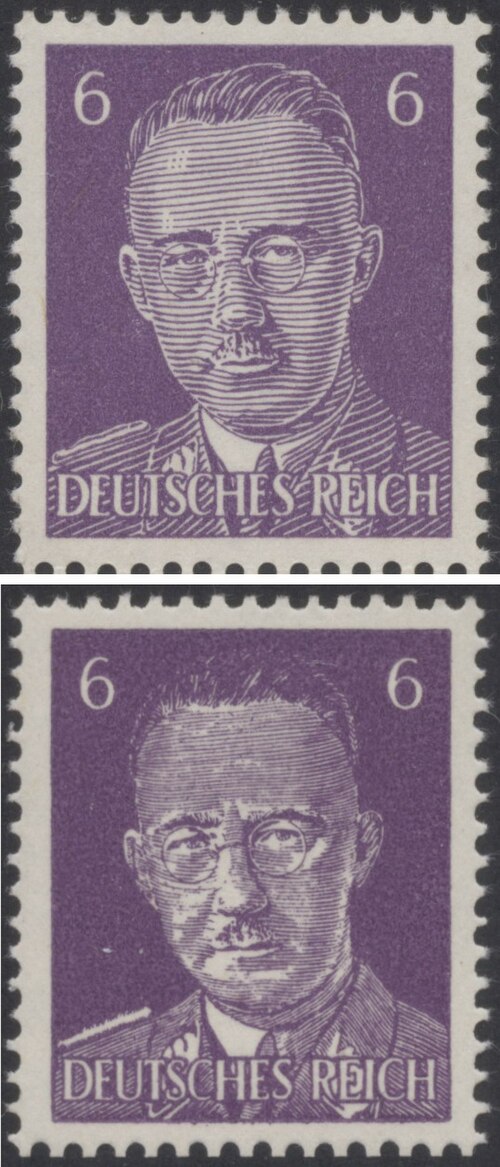
Himmler-head forgery of the 6-pfennig Deutsches Reich stamp: PWE's black forgery of a Reichspost stamp. Public domain.
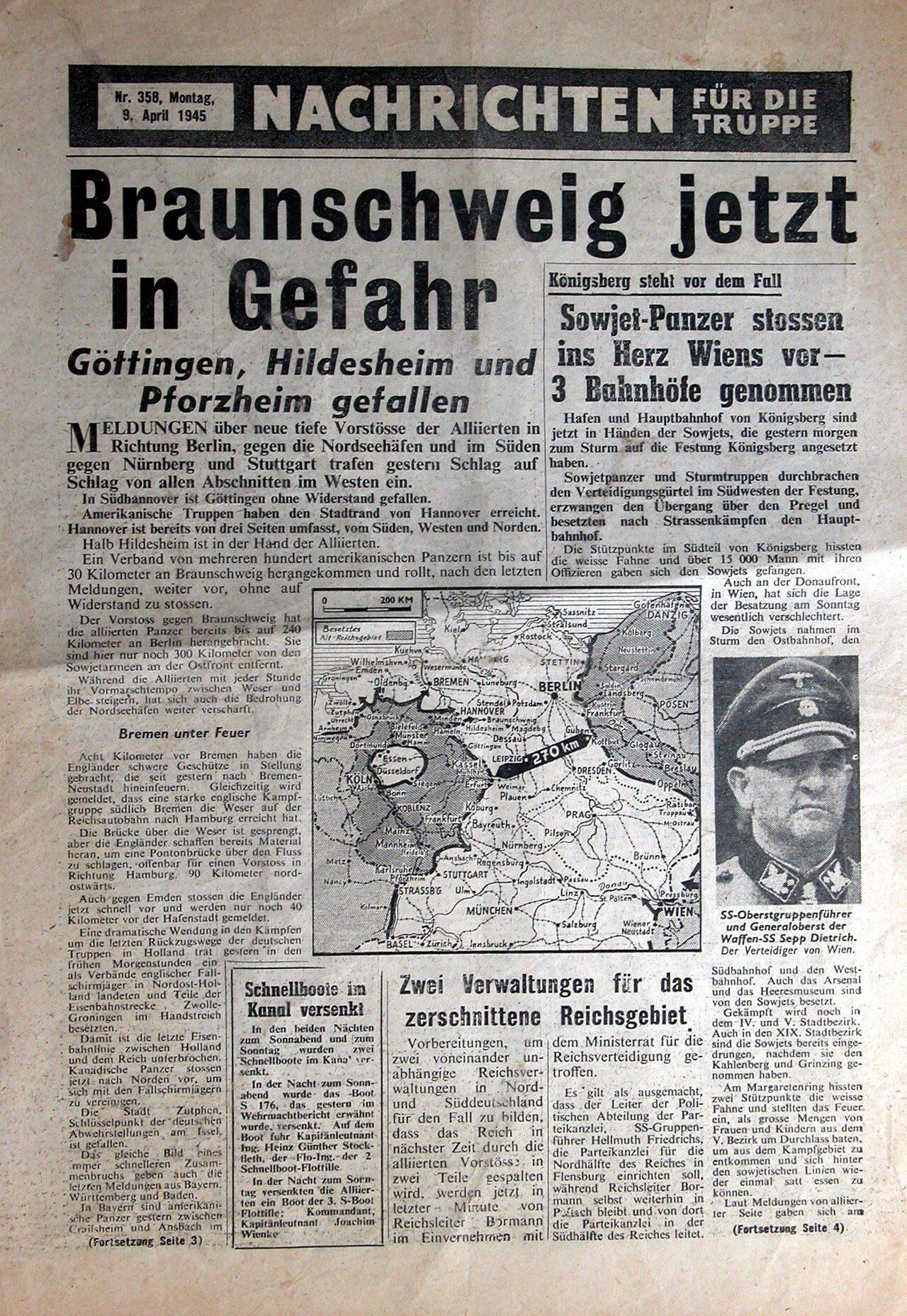
Nachrichten für die Truppe, No. 358, 9 April 1945: the airdropped daily for German soldiers. Public domain.
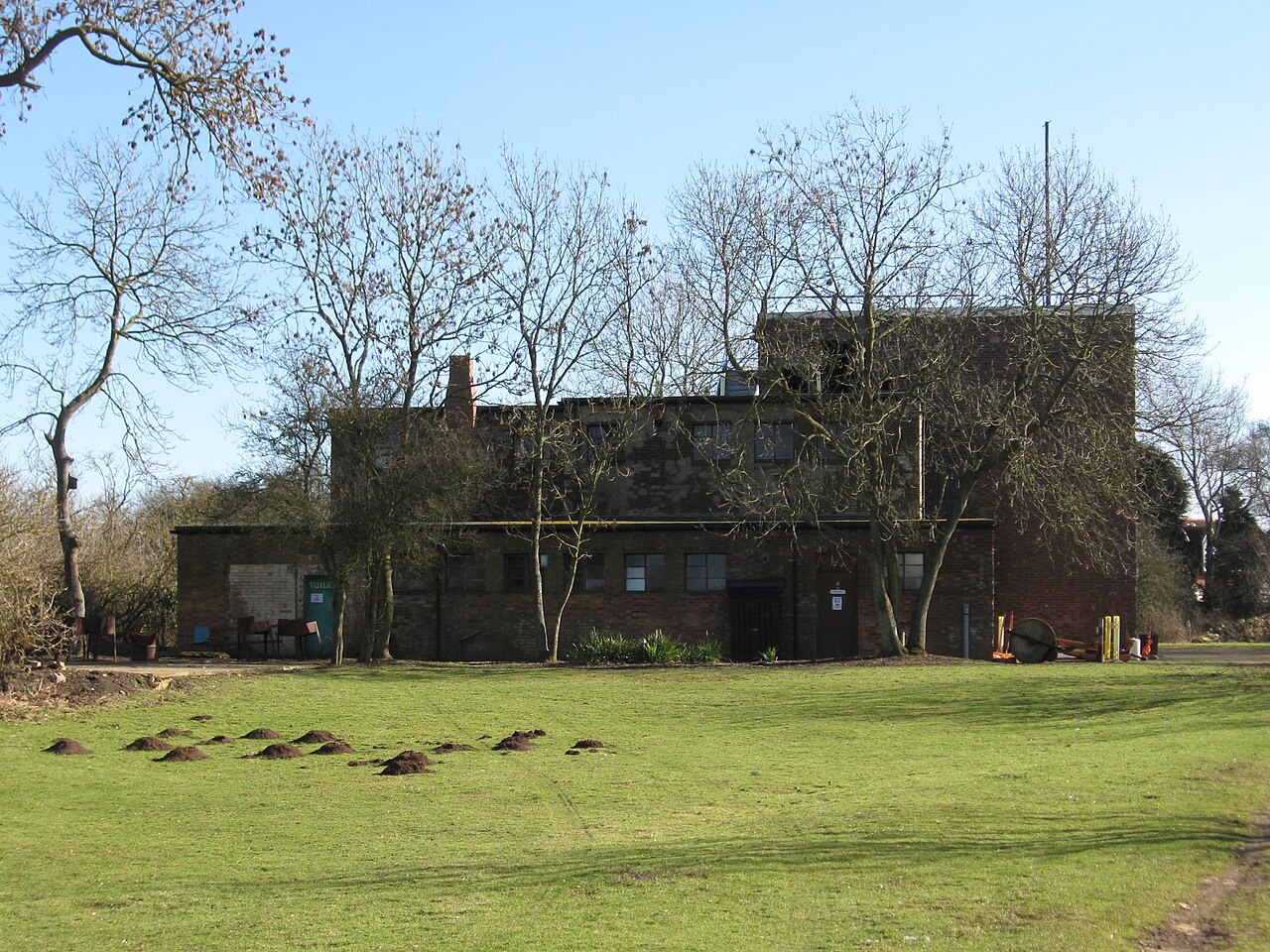
The Milton Bryan studio building, where Delmer's unit broadcast live, in 2009. Photo by Jayembee1969, CC BY-SA 3.0, via Wikimedia Commons.
How it works
- Glittering generalities: Your Courage, Your Cheerfulness, Your Resolution Will Bring Us Victory names three virtues and a promised victory, with no instruction and no fact. Mass-Observation's finding that people read the "your … us" wording as a class division shows how an empty virtue line can be read against its sender.
- Fear appeal: Careless Talk Costs Lives says that ordinary conversation kills. Fougasse's cartoons soften the threat with jokes (Hitler as a portrait on the wall), where the U.S. Wanted! For Murder poster states it outright. The Silent Column went further, asking people to stop other people's gloomy or defeatist talk at a time when such talk was being prosecuted; that is the point at which the press and Parliament objected.
- Card stacking: at home, voluntary censorship and D-Notices keep chosen subjects out of the press, while the MoI publishes its own framing. Abroad, Delmer's formula for his unit's output was "cover, cover, dirt, cover, dirt" (Black Boomerang): accurate news and useful detail built up trust, and damaging items, some invented, were slipped in between. Nachrichten für die Truppe applied it in print, with real front reports and German casualty and home-front news around the subversive items.
- Transfer: Nachrichten für die Truppe copies the look of a Wehrmacht newspaper, Soldatensender Calais copies the sound of German forces radio, and the Himmler stamp copies an official Reichspost stamp. Each borrows the authority of a German institution the audience already trusted.
- Astroturfing (a loose fit): Der Chef was an invented persona presented as speaking for a real faction inside Germany. FRAME's astroturf definition covers personas that are not what they claim, which fits; it was aimed at an enemy audience, not built to fake a domestic grassroots crowd.
- Narrative laundering: sibs are released in neutral capitals by people with no visible British link, so a British invention reaches Germany as café gossip or a neutral newspaper item. The Himmler stamp was meant to travel the same way, posted from Stockholm on letters into Germany.
- Scapegoating: PWE's black line, on air and in print, blamed the war's hardships on Party functionaries, portrayed as corrupt and depraved, and set them against the soldiers freezing on the Eastern Front. The complaint is placed on one bounded group so that the army, the audience it wanted to reach, stays clean.
- Outrage bait: Der Chef's monologues were obscene on purpose: foul-mouthed barrack-room language and graphic, invented accounts of sexual misconduct by named Party officials, ranging, as later accounts summarise them, from rape to the abuse of children, built to be retold by word of mouth. Inside government, Sir Stafford Cripps objected in a letter to Anthony Eden, in the words reported from it: "If this is the sort of thing that is needed to win the war, why, I'd rather lose it." The broadcasts themselves are described in the radio case study.
- Not tagged: synthetic-media. The forged ration cards and stamps are forgeries, but FRAME's synthetic-media definition covers machine-made content, so it does not apply.
Then and now
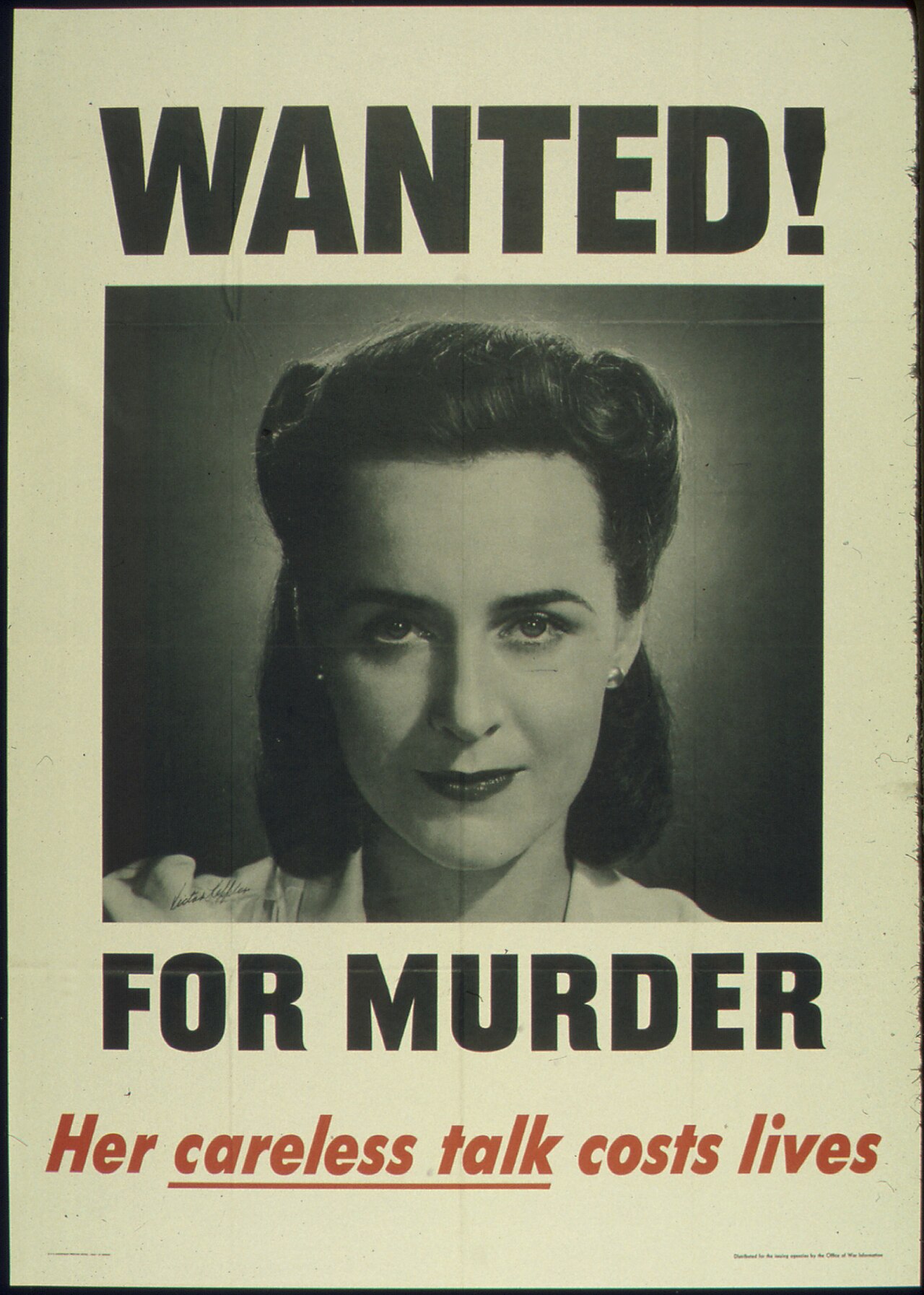
Wanted! For Murder — Her Careless Talk Costs Lives, U.S. government, WWII. Public domain.
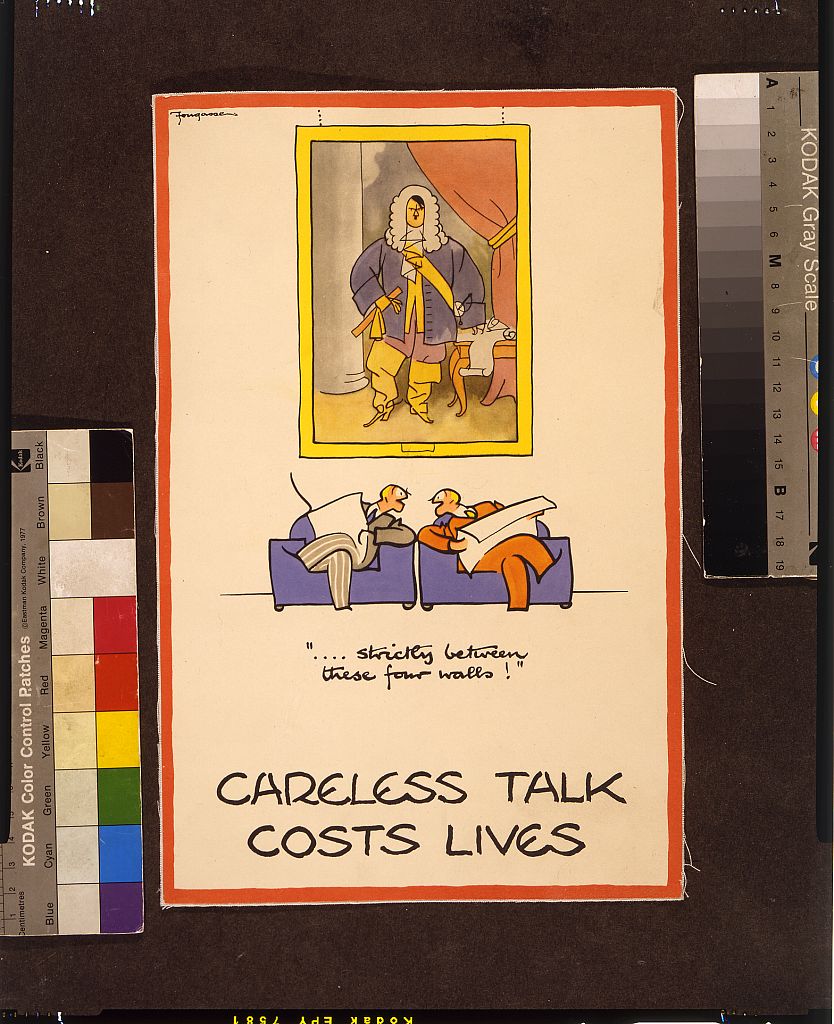
Careless Talk Costs Lives: "...strictly between these four walls!", UK Ministry of Information, 1940. Public domain.
The British and U.S. careless-talk campaigns ran the same warning with different tones: Fougasse drew the eavesdropper as a joke Hitler hidden in the scene, and the U.S. poster made the chatty civilian a murderer. The closer later parallel to PWE's black work is the Russia-aligned network described in Matryoshka's midterm clips: borrowed faces and a borrowed logo, which pasted CNN branding onto recut clips so that its message arrived under someone else's name. That is the same move as Nachrichten für die Truppe passing as a German army paper, or Soldatensender Calais as German forces radio. The differences are as plain: PWE was a secret wartime unit of a belligerent aimed at enemy soldiers and officials in a declared war, run by a small staff with its own printing and one very large transmitter; the 2026 clips were aimed at voters in a country Russia was not at war with, used cloned voices of real people, and its most-seen posts drew dozens of interactions. Nothing in the record shows the two had comparable reach or effect.
Positions on the record
- The organisations' stated rationale. The MoI described its home work as informing the public and sustaining morale, and presented its surveys as a way to find out what people knew and needed to know. PWE's rationale, set out in Garnett's official history and in Delmer's account, was that subversion of the enemy's armed forces and home front was a weapon of war, and that black stations reached listeners who ignored openly British broadcasts. Delmer argued that the damaging items only worked because most of the output was true.
- Contemporaries. The press attacked the 1939 posters as costly and patronising and the 1940 surveys as "snooping". Parliament and the press forced the Silent Column's withdrawal. Inside government, Cripps objected to GS1's obscenity; Garnett's history records long turf disputes between PWE, the BBC, SOE and the Secret Intelligence Service.
- Historians. Ian McLaine (Ministry of Morale, 1979) and others describe the early MoI as out of touch with working-class opinion, and Addison and Crang's edition of the 1940 daily reports makes the ministry's own running view of public morale readable. Jo Fox ("Careless Talk", Journal of British Studies, 2012) examines the tensions between the anti-rumour campaigns and the MoI's aim of keeping the public's trust.
- After the war. Delmer's Black Boomerang (1962) is his own account and the main published source for his unit's work. Later writers, including Ellic Howe (1982), differ on what it achieved. Its title is usually explained as Delmer's own second thoughts: the stations had invented a decent, anti-Party Germany inside the army and the old nationalist right, and after the war former Nazis could claim they had belonged to it. Delmer reports that Otto John, a survivor of the July 1944 plot, told him the stations had encouraged the plotters to think London would support an army move against the Party.
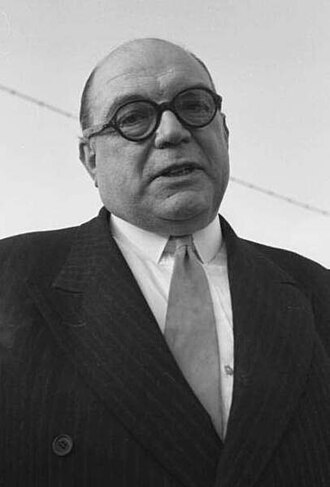
Sefton Delmer at the Friedland transit camp, February 1958, after the war. Photo by Egon Steiner, Bundesarchiv B 145 Bild-F005102-0003 (cropped), CC BY-SA 3.0 DE.
- This archive's reading. Documented: the posters, the slogans and the campaign dates; the existence and methods of Home Intelligence and the Wartime Social Survey; the Silent Column and its withdrawal; the Daily Worker closure; PWE's founding and structure; GS1, Atlantiksender and Soldatensender Calais and their dates; the Himmler stamp and the forged ration documents; Nachrichten für die Truppe. Not shown here: a measured effect of any single black broadcast or sib on German morale or behaviour. Claims of effect come mostly from Delmer's own book and from interrogations he cites, and they are the participants' accounts.
Same-method test
The Luftwaffe did the white half in the other direction. On the night of 1 August 1940 German aircraft dropped over England, in places from Harwich to Weston-super-Mare, a leaflet headed A Last Appeal to Reason by Adolf Hitler, an English translation of his Reichstag speech of 19 July 1940 offering peace terms; copies are held by the Imperial War Museums and The National Archives. It is scored as the RAF's openly British leaflets over Germany are: white, attributed, aimed at the enemy's home front. For the black half, the Reich Propaganda Ministry's Büro Concordia ran false-origin stations aimed at Britain from 25 February 1940, among them the New British Broadcasting Station, Workers' Challenge and Radio Caledonia, each claiming to speak from inside the United Kingdom (Doherty, 1994); they would be tagged Astroturfing and Narrative laundering exactly as PWE's black output is, and are described with Lord Haw-Haw in FRAME's wartime radio case study (Wartime radio voices: open and hidden broadcasts aimed at the enemy, 1939-1945). The differences matter too. The German leaflets and stations came from a ministry that also directed the press, film and radio at home (The Reich Ministry of Public Enlightenment and Propaganda, 1933-1945); the MoI's home censorship was formally voluntary and was challenged in Parliament and the press. No sourced German counterpart to PWE's forged ration cards and stamps is used here: Germany's Operation Bernhard forged British banknotes, but this page found no source for a propaganda use of them. None of this changes the scoring: an openly signed leaflet is white and a false-origin broadcast or forgery is black, whichever side issues it.
How to spot it
- Ask who is speaking, and how you would know. A station or paper that sounds exactly like "one of us" but gives no verifiable address or masthead may be a persona built by the other side.
- Look for the "cover, cover, dirt" pattern: long runs of accurate, useful material with a few high-impact claims that cannot be checked.
- Watch for scandal that is too well placed. Invented sexual or financial scandal about one group of officials, while another group is praised, is steering blame.
- At home, separate a security instruction (don't discuss ships, troops or factories) from an instruction to police other people's opinions (stop gloomy or defeatist talk). The first is what the careless-talk posters asked. The second is what the press rejected in 1940.
- Check whether an official statement of "voluntary" restraint is backed by penalties elsewhere, as D-Notices were by emergency regulations.
Images
| Image | Source | Licence |
|---|---|---|
| Mechanism diagram (above) | Drawn for FRAME from this page's sourced facts (make_diagrams.py) |
CC BY 4.0, FRAME |
| Wanted! For Murder (WWII) | FRAME gallery | Public domain (U.S. government work) |
| Careless Talk Costs Lives (Fougasse, 1940) | FRAME gallery, from the Library of Congress | Public domain (UK Crown copyright expired) |
| Your Courage… (1939, vector redrawing) | FRAME gallery, from Wikimedia Commons | Public domain (PD-UKGov) |
| Keep Calm and Carry On (1939 original) | FRAME gallery, from the Library of Congress | Public domain (PD-UKGov) |
| Himmler stamp forgery (1942-43) | FRAME gallery, from Wikimedia Commons | Public domain (PD-UKGov) |
| Nachrichten für die Truppe No. 358 (1945) | FRAME gallery, from Wikimedia Commons | Public domain (U.S. and UK government work) |
| Milton Bryan studio building (2009) | Wikimedia Commons, Jayembee1969 | CC BY-SA 3.0 |
| Sefton Delmer, 1958 | Wikimedia Commons, Bundesarchiv / Egon Steiner | CC BY-SA 3.0 DE |


.jpg)

.jpg)
Image gaps
- Recordings of GS1, the Atlantiksender and Soldatensender Calais. Held by archives and the psywar.org Delmer archive; no openly licensed copies found. The broadcasts are covered in the radio case study.
- Photographs of Delmer or the Milton Bryan studio in wartime, and of the Aspidistra bunker. None found on Commons with a PD-UKGov tag; IWM photographs are not hosted otherwise.
- A scan of an original Your Courage poster. Only a modern vector redrawing is openly available on Commons; IWM holds originals (object 32270) but not under an open licence reachable here.
- The other seven Fougasse posters, forged ration cards and leave passes, and PWE's RAF leaflets. Not found on Commons or LOC with a verifiable rights statement in this pass; Crown copyright on them has expired, so this gap can be filled from a scan with clear provenance.
- Home Intelligence reports and the Daily Herald "Cooper's Snoopers" page. The reports are in The National Archives (unreachable from the build environment); the newspaper page is still in copyright.
- Büro Concordia material and the German Last Appeal to Reason leaflet. German state works whose U.S. copyright status is unclear; dropped under this archive's rules.
Sources
- Addison, Paul, and Jeremy A. Crang (eds.), Listening to Britain: Home Intelligence Reports on Britain's Finest Hour, May-September 1940, Bodley Head 2010 (Vintage 2011). University of Edinburgh record
- Delmer, Sefton, Black Boomerang, Secker & Warburg / Viking 1962.
- Imperial War Museums, "A Last Appeal to Reason by Adolf Hitler, 1940"; The National Archives, leaflet dropped near Stratford-upon-Avon; Battle of Britain diary, 1 August 1940.
- Doherty, M. A., "Black Propaganda by Radio: the German Concordia broadcasts to Britain 1940-1941", Historical Journal of Film, Radio and Television 14:2 (1994). Taylor & Francis
- Fox, Jo, "Careless Talk: Tensions within British Domestic Propaganda during the Second World War", Journal of British Studies 51:4 (2012), 936-966. Durham repository
- Garnett, David, The Secret History of PWE: The Political Warfare Executive 1939-1945, St Ermin's Press 2002.
- Howe, Ellic, The Black Game: British Subversive Operations against the Germans during the Second World War, Michael Joseph 1982.
- McLaine, Ian, Ministry of Morale: Home Front Morale and the Ministry of Information in World War II, George Allen & Unwin 1979.
- Irving, Henry, "Keep Calm and Carry On: the compromise behind the slogan", History of Government blog, 27 June 2014.
- Imperial War Museums, "The truth behind Keep Calm and Carry On" and "Your Courage, Your Cheerfulness, Your Resolution".
- Library of Congress, "Keep calm and carry on" (LOT 3232, Keogh album) and "Careless talk costs lives" / Fougasse.
- University of London, "Ministry of Information" (Senate House history).
- The Spectator, "The Silent Column", 26 July 1940; Hansard (Lords), "The Silent Column", 1 August 1940.
- Daily Herald, 30 July 1940, p. 1, "Cooper's Snoopers" (as reproduced in The Space Between, USC Scalar).
- History & Policy, "Censorship and National Security: Information Control in the Second World War and Present Day".
- National Army Museum, Fougasse, "Careless Talk Costs Lives", 1940.
- Bedfordshire Virtual Library, "Woburn: The Propaganda War".
- Durham University, Writers and Propaganda project, "John Betjeman's Dublin whispers" (on sibs and the Underground Propaganda Committee).
- IWM, Himmler stamp, 6 Rpf.; GermanStamps.net on the Himmler forgery.
- PsyWar.Org, Sefton Delmer Archive, Kurzwellensender Atlantik / Soldatensender Calais daily transcripts.
- On the V campaign: IWM, "Where does V for Victory come from?"; National WWII Museum.