Content note: this page describes the deaths caused by the 1938 Yellow River flood, the Chongqing air raids and the 1942-43 Henan famine, and shows a U.S. poster that caricatures a Japanese soldier, with a catalogue title containing the wartime slur "Jap".
In one line: in the War of Resistance three Chinese governments competed for the same audiences: Chiang Kai-shek's Nationalists in Wuhan and then Chongqing, who mobilised writers, drama troupes and woodcut artists at home and courted and censored foreign correspondents abroad; Mao Zedong's Communists in Yan'an, who built a party press and a folk-art movement and disciplined their own writers; and Wang Jingwei's Japanese-sponsored government in Nanjing, which sold collaboration as "peace". Each told true stories of Japanese violence, and each also hid or reshaped facts that hurt it, most plainly the Nationalists' own breach of the Yellow River dikes in June 1938.
What happened
Scale and context. Japan's full-scale war on China began with the Marco Polo Bridge incident of 7 July 1937 and ended with Japan's surrender in August 1945. Japan held the coast, the main railways and the big cities; the Nationalist government retreated from Nanjing to Wuhan and, from late 1938, to Chongqing; the Communists governed base areas behind Japanese lines from Yan'an in the north-west. Rana Mitter puts Chinese deaths at at least 14 million (China's War with Japan, 2013). The propaganda below was made inside that war and under a formal Nationalist-Communist "United Front" that grew more hostile from 1939 and broke down in open fighting after the New Fourth Army incident of January 1941.
The Nationalist side (Wuhan and Chongqing).
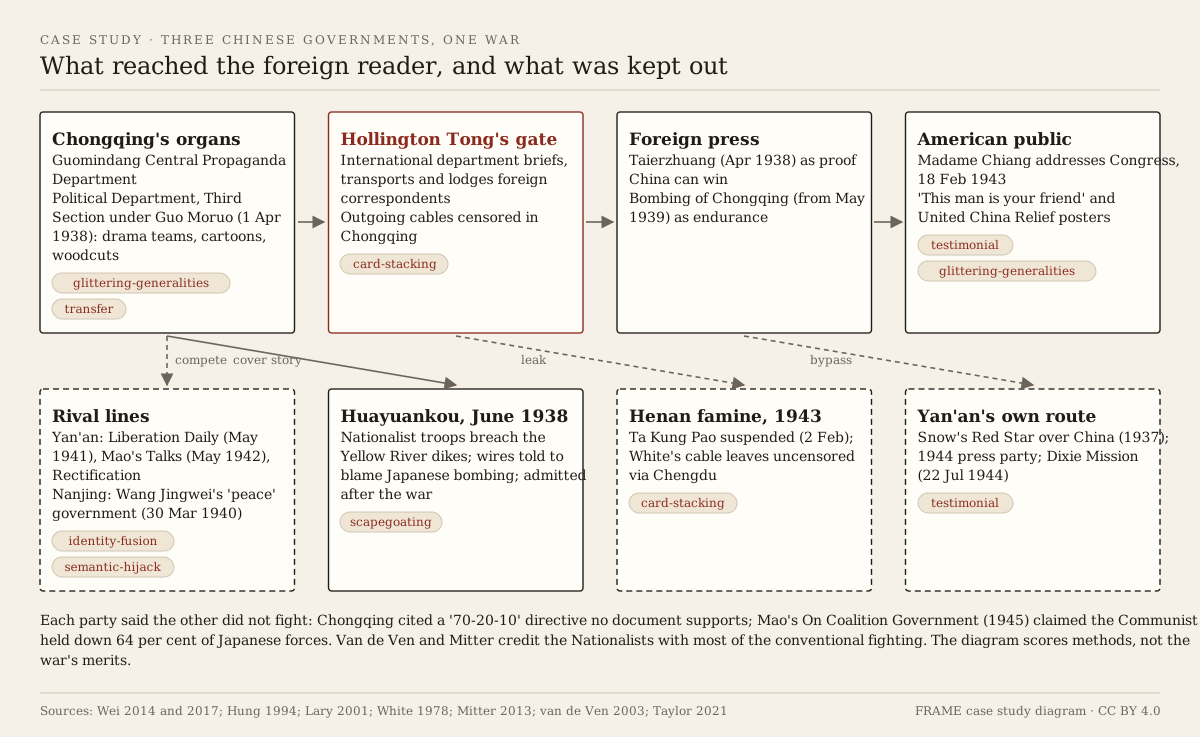
- 1937-1938: a centralised foreign-propaganda system. The Guomindang's Central Propaganda Department and the Military Affairs Commission's propaganda board were reorganised in 1937-38 under the U.S.-trained journalist Hollington Tong (Dong Xianguang), a former editor of the Shanghai China Press and Chiang's authorised biographer. As vice-minister in charge of the international propaganda department (known in English as the Ministry of Information), Tong extended the government's news network to the United States and Britain, gave foreign journalists transport, briefings and lodging, and pursued what the historian Shuge Wei calls a "hands off policy" of co-opting rather than bullying them. Outgoing press cables were still censored in Chongqing before they could leave China (Wei 2014; Wei 2017).
- 1938: What War Means. The Australian correspondent H. J. Timperley compiled Western residents' eyewitness accounts of the Nanjing massacre into What War Means (Gollancz, London; published in New York as The Japanese Terror in China). Zeng Xubai, head of the international department, wrote in his memoir that the department decided to pay Timperley and, through him, Lewis Smythe to write and publish books "as witnesses" to the massacre. Some Japanese historians dispute that reading of Zeng's memoir. The atrocities the book describes are established independently, by the Tokyo and Nanjing war-crimes tribunals and by Western residents' diaries such as John Rabe's.
- 1 April 1938: the Third Section. In Wuhan the Military Affairs Commission's new Political Department, headed by Chen Cheng with the Communist Zhou Enlai as a deputy, set up its Third Section (also translated "Third Department") for mass propaganda under the poet and historian Guo Moruo. It had three divisions: the playwright Tian Han ran the arts division, with sections for drama and music, film, and fine art. An April 1938 "propaganda week" put some 30 troupes on the streets of Wuhan. On 1 August 1938 the refugee troupes from Shanghai were regrouped into ten numbered anti-Japanese drama teams, four propaganda teams and a children's troupe that toured the fronts and the countryside. Cartoonists and woodcut artists worked for the section and its affiliated associations (Hung 1994). After Guo's circle lost the section in 1940 he chaired a Cultural Work Committee in Chongqing.
- 24 March to 7 April 1938: Taierzhuang. Nationalist armies under Li Zongren defeated a Japanese force at Taierzhuang in Shandong, the first major Chinese victory of the war. Wuhan celebrated it as proof that China could win, and foreign correspondents and photographers, among them Robert Capa, went to the battlefield. The victory was real; the publicity was used to carry morale through the retreats that followed within weeks, when Xuzhou fell in May.
- 9-11 June 1938: Huayuankou. To slow the Japanese advance on Zhengzhou and Wuhan, Nationalist troops breached the Yellow River dikes at Huayuankou in Henan. On 11 June, on Chiang's orders, the news agencies reported that Japanese bombing had broken the dikes. The story was carried by the Associated Press and by the Communists' own Chongqing paper, Xinhua Ribao. The flood that followed covered parts of Henan, Anhui and Jiangsu until the river was returned to its bed in 1947; estimates of the dead run from roughly 400,000 to more than 800,000, with millions displaced (Lary 2001; Muscolino 2015). The government acknowledged the deliberate breach only after the war.
- 1939-1941: the bombing of Chongqing. Japanese raids on the wartime capital began in earnest on 3-4 May 1939, when fire raids killed more than 5,000 people in two days by most accounts. Chongqing's publicity made the bombing a symbol of Chinese endurance for foreign readers. On 5 June 1941 a crowd suffocated in the overcrowded Jiaochangkou public shelter tunnel during a raid. The death toll is disputed (figures from about 1,000 to about 4,000), and the city's own residents blamed the government's shelter management as much as the Japanese bombers (Cambridge International Journal of Asian Studies study of the "Great Tunnel Disaster").
- February 1943: the Henan famine and Ta Kung Pao.* Drought, locusts, the war and continued grain requisitioning produced famine in Henan in 1942-43. Death estimates range from Lloyd Eastman's two to three million to Anthony Garnaut's figure of "well under one million", probably around 700,000 (Garnaut 2013). At the start of February 1943 the independent Chongqing daily Ta Kung Pao printed a correspondent's report from Henan and an editorial, "Looking at Chongqing, thinking of the Central Plains", criticising officials; on 2 February the government ordered the paper to suspend publication, usually reported as for three days. The Time* correspondent Theodore White**, who went to Henan with Harrison Forman in March, later wrote that his dispatch reached New York only because it was sent from Luoyang over a commercial radio link through Chengdu without passing the Chongqing censor, and that Madame Chiang asked Henry Luce to dismiss him (White 1978).
- 18 February 1943: Madame Chiang in Washington. Soong Mei-ling (Madame Chiang Kai-shek) became the first Chinese national to address both houses of the U.S. Congress. Her speeches and rallies that spring, including New York's Madison Square Garden and the Hollywood Bowl, carried Chongqing's picture of a united, democratic ally to large American audiences. In the same month, the Ta Kung Pao suspension showed Chinese readers the limits of that picture at home.
The Communist side (Yan'an).
- 1937: Red Star over China. Edgar Snow's account of his 1936 stay in the Communist base area (Gollancz, London, 1937) gave Western readers their first long interviews with Mao and a sympathetic portrait of the Red Army. Snow was an independent journalist; the access, the interviews and the tour were arranged by his hosts.
- April 1938: the Lu Xun Academy of Arts. The party founded the academy in Yan'an to train writers, musicians, dramatists and graphic artists. Its woodcut artists adapted the modern woodcut movement that Lu Xun had promoted in the 1930s to the forms of the rural New Year print (nianhua), with traditional layouts carrying new content such as the army, production and literacy (Hung 1994).
- 20 August to December 1940: the Hundred Regiments Offensive. The Eighth Route Army under Peng Dehuai attacked Japanese-held railways and blockhouses across north China, the Communists' largest conventional operation of the war, and the Communist press publicised it widely at a time when Chongqing was accusing the Communists of avoiding battle. The Japanese North China Area Army answered from 1941 with mopping-up campaigns that Chinese sources call the "Three Alls" (kill all, burn all, loot all), and the base areas shrank. Within the party the offensive was later held against Peng for exposing Communist strength.
- 16 May 1941: Liberation Daily.* Jiefang Ribao** (Liberation Daily*) was founded as the Central Committee's paper. In March 1942 its literary page, edited by Ding Ling, carried essays by Ding Ling ("Thoughts on March 8") and Wang Shiwei ("Wild Lilies") criticising privilege and conditions in Yan'an. From 1 April 1942 the paper was reorganised to speak for the party as a whole rather than as an independent newspaper (Stranahan 1990).
- February 1942 to 1944: the Rectification Movement (zhengfeng). Mao's February 1942 speeches opened a campaign of study, criticism and self-criticism that bound cadres to his line. Wang Shiwei was denounced, expelled and imprisoned (he was executed in 1947). In 1943 the "rescue" campaign run by Kang Sheng extracted mass confessions of spying from cadres, many later retracted and officially rehabilitated (Gao 2018).
- 2 and 23 May 1942: the Yan'an Forum on Literature and Art. Mao's opening and closing speeches (the Talks, first published in Liberation Daily on 19 October 1943) said that literature and art must serve the workers, peasants and soldiers, and that political criteria come first in judging them. The party ordered all members to study them.
- 1943-1945: new yangge and The White-Haired Girl. From the 1943 Spring Festival, Lu Xun Academy troupes staged "new yangge", a north Chinese folk song-and-dance form rewritten around production, the army and land rent; Brother and Sister Open up Wasteland (1943) was the best known. The opera The White-Haired Girl was first performed in April 1945 for the party's Seventh Congress.
- May-July 1944: the press party and the Dixie Mission. After years of refusing, Chongqing allowed a party of Chinese and foreign correspondents (among them Harrison Forman, Israel Epstein, Gunther Stein and Maurice Votaw) to visit Yan'an. On 22 July 1944 the first members of the U.S. Army Observer Group (the "Dixie Mission") under Colonel David Barrett, with the diplomat John S. Service, arrived; Barrett and Service reported favourably on Communist forces. On 1 September 1944 the Xinhua agency sent its first English-language dispatch from Yan'an.
Each side's claims about the other's war.
- Chongqing's claim. Nationalist sources said the Communists "roamed without fighting", used the war to expand, and followed a secret "70-20-10" directive from Mao (70 per cent expansion, 20 per cent dealing with the Nationalists, 10 per cent fighting Japan). No Communist document containing that directive has been produced.
- Yan'an's claim. Mao's report On Coalition Government (April 1945) said that by 1943 the Liberated Areas were pinning down 64 per cent of the Japanese forces in China and 95 per cent of the collaborationist troops, and the Guomindang front only 36 and 5 per cent.
- What historians documented. Hans van de Ven (War and Nationalism in China, 2003) and Rana Mitter (China's War with Japan, 2013) show that the Nationalist armies fought nearly all the war's large conventional battles and took by far the heaviest military losses, and criticise the "Stilwell-White paradigm" of a Chongqing that did not fight. Lloyd Eastman (Seeds of Destruction, 1984) documented the corruption, conscription abuses and famine policy that eroded the Nationalist state. Historians also credit the Communists with sustained guerrilla war and base-building behind Japanese lines, while noting that after 1940 they fought few large battles. Neither side's wartime percentage claims survives as stated.
The Wang Jingwei government (Nanjing, 1940-1945).
- 29 December 1938. Wang Jingwei, a founding leader of the Guomindang and Chiang's rival, who had left Chongqing for Hanoi, issued a telegram (the "Yan telegram") calling for peace talks on the basis of the Japanese prime minister Konoe Fumimaro's terms. It was published in Hong Kong by his associate Lin Baisheng's South China Daily.
- 30 March 1940. Wang inaugurated the Reorganized National Government in Nanjing as a "return of the capital", claiming to be the lawful continuation of the Republic and of Sun Yat-sen's party. It flew the Republic's flag with a yellow pennant reading "Peace, Anti-Communism, National Reconstruction" (和平反共建國), dropped in 1943. Japan recognised it on 30 November 1940. Lin Baisheng ran its propaganda ministry and the Zhonghua Ribao.
- Its line. "Peace" meant accommodation with Japan under Sun Yat-sen's "Greater Asianism"; Chongqing was cast as a one-party dictatorship prolonging a hopeless war, and the Communists as the common enemy. Portraits of Wang placed him as Sun's heir (Taylor 2021).
- May 1941 to 1943: Rural Pacification. A Rural Pacification Committee (qingxiang, literally "clearing the countryside") ran counter-insurgency campaigns against Communist-led guerrillas in the lower Yangtze, with blockades and sweeps alongside plays, woodcuts and lectures; Japanese troops did much of the fighting.
- 9 January 1943 to August 1945. The Nanjing government declared war on Britain and the United States; Wang died in Nagoya in November 1944; the government dissolved at Japan's surrender. Lin Baisheng was executed for collaboration on 8 October 1946.
How it works
- Glittering generalities: all three governments claimed the same virtue words. Chongqing's slogan was "Resist in war, build the nation" (抗戰建國); Yan'an spoke for "the people" and national liberation; Nanjing put "peace" and "national reconstruction" on its flag. The words are identical in kind; what they claimed differed completely.
- Transfer: each government claimed Sun Yat-sen. Chongqing and Nanjing both flew his party's flag and hung his portrait, and Wang presented his government as the return of Sun's Nationalist government to its capital (Taylor 2021). The U.S. China Fights On poster transfers the same Nationalist slogan into an American fundraising appeal.
- Scapegoating: the June 1938 report that Japanese bombing broke the Huayuankou dikes placed on the enemy the blame for a flood the Nationalist army had caused. It is the closest id; the report is also a plain false attribution, and it carried an established fact (Japanese bombing elsewhere) to cover an unestablished one.
- Card stacking: Chongqing's censorship of foreign cables and the suspension of Ta Kung Pao after its famine editorial removed facts from what readers saw while the publicity on Taierzhuang and the bombing of Chongqing kept the heroic record in view. Both parties' percentage claims about who fought Japan select the facts that suit them.
- Testimonial: Madame Chiang's speech to Congress, and Snow's Red Star over China and the 1944 correspondents' reports for Yan'an, put a trusted voice in front of the case. Snow and the 1944 correspondents were independent writers reporting what they saw on tours arranged by their hosts.
- Narrative laundering, as Zeng Xubai's memoir describes it: a government department paying a foreign correspondent to publish witness accounts under his own name. The link is disputed and the atrocities are independently documented, so this is scored on the method (who paid and whether readers were told), not on the truth of the book's content.
- Plain folks: the drama teams, New Year prints, woodcuts and new yangge put the party or government's message into folk forms that villagers already trusted. The U.S. Office of War Information used the same move for Chinese audiences (This American Airman Drives the Jap from China's Skies: Give Him Your Help! (Chinese New Year poster)).
- Identity fusion: in the Rectification Movement, criticising leaders, as Wang Shiwei did, was redefined as a political error and, in the 1943 "rescue" campaign, as possible spying; confession and self-criticism tied loyalty to accepting the line.
- Semantic hijacking and Euphemism / doublespeak: Nanjing's "peace" named collaboration with an occupying army; "Rural Pacification" and "clearing the countryside" named counter-insurgency sweeps.
Then and now
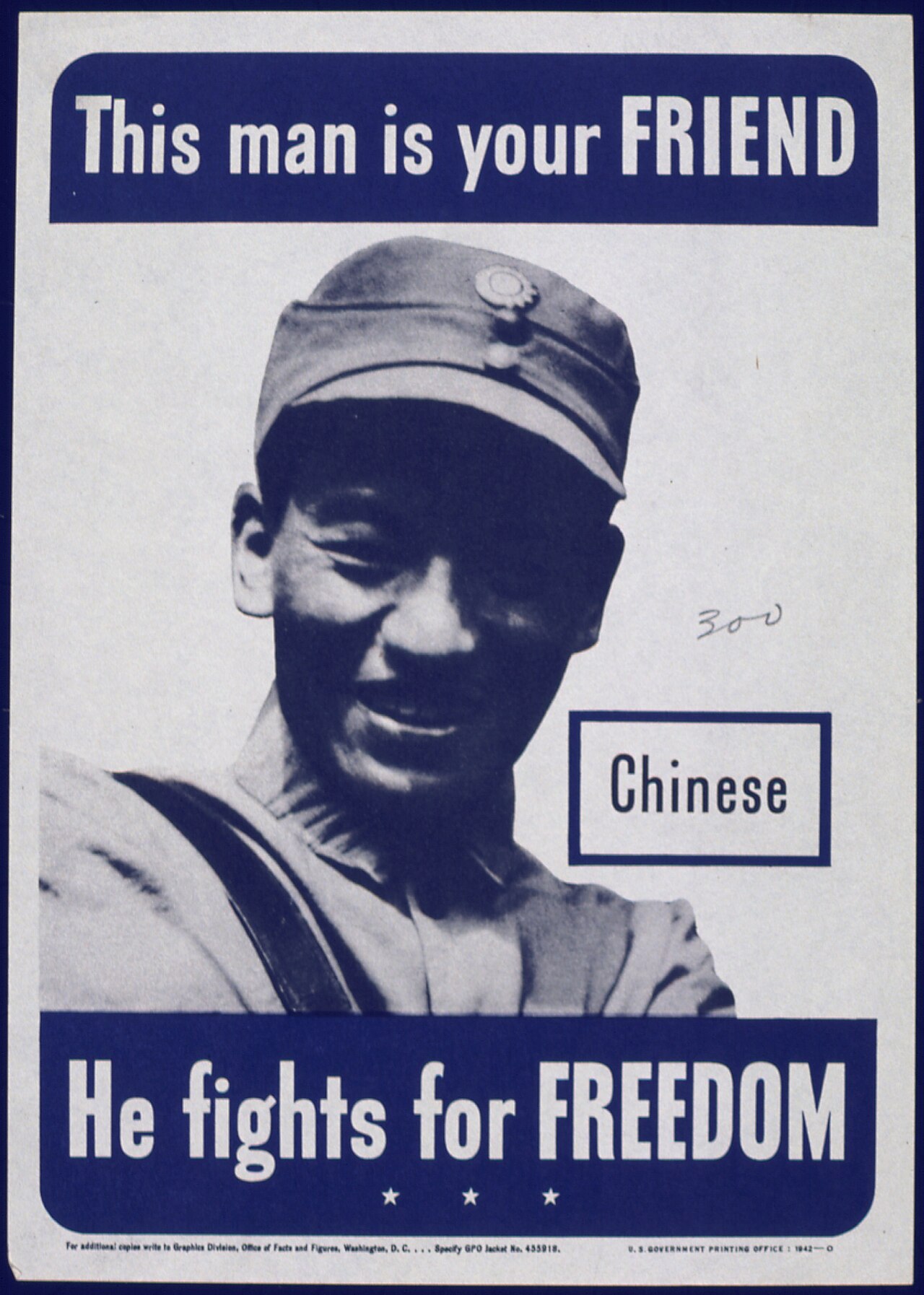
This Man Is Your Friend: Chinese. He Fights for Freedom, Office of Facts and Figures, U.S. Government Printing Office, 1942. Public domain.
This American poster shows the image of China that Hollington Tong's department and Madame Chiang worked to build: a friendly, freedom-fighting ally, with the famine, the dike breach and the censorship out of frame. In 1943 the Nationalist government suspended Ta Kung Pao for reporting the Henan famine; in 2026 Chinese public-security authorities treated posts giving higher death tolls as "rumour" cases than the official count after the Gyirong flood (The Gyirong flood and the official death toll). The move is the same: keep one disaster figure on the record by removing the reports that contradict it. The differences are large. The 1943 government was fighting an invasion, controlled a fraction of its territory and could not stop a foreign reporter's cable from leaving through another city; the 2026 case is a peacetime disaster managed by a state with full control of domestic platforms. The death tolls also differ by orders of magnitude.
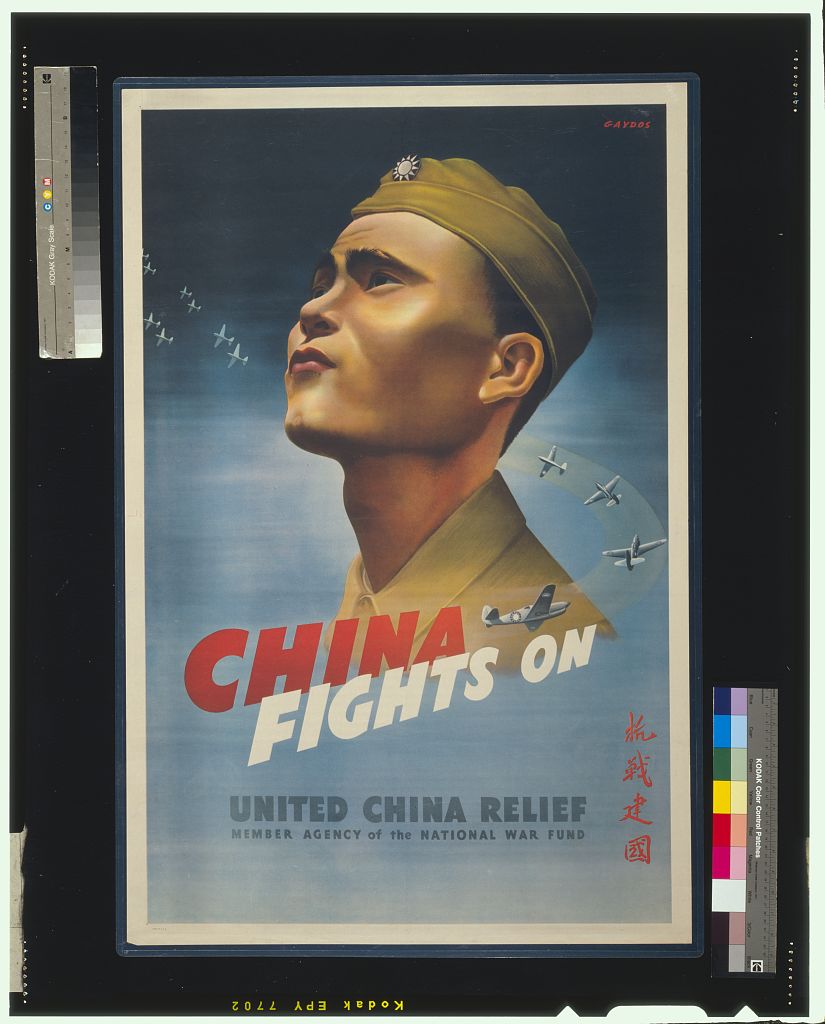
China Fights On, United China Relief, c. 1943. Public domain in the U.S. (published without copyright notice).
Positions on the record
- The Nationalist government's stated rationale. China was fighting for survival against an invader with overwhelming military superiority; propaganda existed to hold morale and win foreign aid, and wartime censorship protected military security and national unity. The dike breach was defended as military necessity that slowed the advance on Wuhan.
- The Communist Party's stated rationale. Mao's Talks state that art and literature should serve the workers, peasants and soldiers and the war of resistance, and that there is no art above class or politics. The Rectification Movement was presented as education to correct subjectivism, sectarianism and "formalism" in the party.
- The Nanjing government's stated rationale. Wang presented "peace" as saving the population of the occupied areas from a war China could not win, and his government as the lawful Nationalist government. His defenders still argue this; Chongqing, Yan'an and the postwar courts treated it as treason.
- Contemporaries. White and Annalee Jacoby's Thunder Out of China (1946) described Chongqing's censorship and the famine; the Dixie Mission's reports and the 1944 correspondents contrasted Yan'an favourably with Chongqing. Nationalist officials called those reports Communist propaganda. Wang Shiwei's essays were an inside criticism of Yan'an, and his fate is part of the record.
- Later historians. Van de Ven and Mitter argue the American wartime picture, shaped by Stilwell and White, understated the Nationalist war effort; Eastman documented its internal failures; Wei documents how professional Tong's foreign-press operation was; Gao Hua documents the coercion in Rectification; Taylor treats Nanjing's visual culture as a propaganda system in its own right rather than a Japanese copy.
- This archive's reading. Documented: the institutions and dates above; the Huayuankou cover story; the Ta Kung Pao suspension; the coercive phase of Rectification; the Nanjing government's dependence on Japanese recognition and arms. Not shown: the "70-20-10" directive; the Communist claim to have held down most Japanese troops; and any claim that the Nanjing massacre was invented because the Nationalists paid for publicity about it. Paying for publicity about a real atrocity is a documented method; it does not make the atrocity untrue.
Same-method test
- Japan. Japan's government called the war the "China Incident" (Shina jihen), a name that kept it officially short of a declared war, and its press presented the Wang government as China's lawful authority. Japanese newspapers showed Japanese soldiers rescuing refugees from the 1938 flood, an image as selective as Chongqing's false bombing report. Japanese nationalists called H. S. Wong's photograph of a crying baby in the bombed Shanghai South Station (28 August 1937), seen by an estimated 136 million people, staged. See Imperial Japan's wartime propaganda at home: the Information Bureau, the neighbourhood associations and the war communiqués for Japan's own system.
- The United States. The Office of War Information presented the Chinese ally through a smiling face and the word "freedom" (This Man Is Your Friend: Chinese. He Fights for Freedom) at a time when the Chinese Exclusion Act still barred Chinese immigrants from naturalisation; Congress repealed it in December 1943, during the alliance. OWI's China posters used a trampled, blue-faced Japanese soldier (This American Airman Drives the Jap from China's Skies: Give Him Your Help! (Chinese New Year poster)). The United States also censored its own correspondents' copy in theatre. See The U.S. Office of War Information and the Writers' War Board: a 'strategy of truth' meets the advertising men.
- Where they differ. Chongqing's false dike report hid a disaster its own army caused to its own people; the U.S. and Japanese examples above are omissions and framing about an ally or an enemy. Nanjing's "peace" line was made under occupation and by a government that could not exist without Japan's army; Chongqing's and Yan'an's were made by governments fighting that army. Yan'an's Rectification was run inside one party and its base areas, not across a national state, but the method of making criticism a loyalty test is scored the same wherever it appears.
How to spot it
- Check who holds the cable office. When foreign reporting must pass one government's censor, ask which stories reached print through another route (White's famine cable) and which never did.
- Ask who breached it. A disaster blamed on the enemy in wartime deserves the same check as any other claim: what physical evidence, who was there, and what the claimant said after the war.
- Compare the percentages. When two allies each claim to be doing most of the fighting, look for battle-by-battle records rather than shares.
- Watch the folk form. New content in a familiar form (a New Year print, a yangge dance) is designed to feel homegrown; ask who wrote the lyrics.
- Read the pennant. When a government puts a virtue word on its flag, check what that word covers in practice ("peace" under occupation, "pacification" for sweeps).
Images
| Image | Source | Licence |
|---|---|---|
| Mechanism diagram (above) | Drawn for FRAME from this page's sourced facts (make_diagrams.py) |
CC BY 4.0, FRAME |
| This Man Is Your Friend: Chinese (1942) | FRAME gallery, from NARA via Wikimedia Commons | Public domain (U.S. government work) |
| China Fights On (United China Relief, c. 1943) | FRAME gallery, from the Library of Congress | Public domain in the U.S. (published without copyright notice) |
| OWI Chinese New Year poster (1945), in the gallery as This American Airman Drives the Jap from China's Skies: Give Him Your Help! (Chinese New Year poster) | FRAME gallery, from the Library of Congress | Public domain (U.S. government work) |

Image gaps
- Chinese wartime woodcuts, Third Section posters, Yan'an New Year prints and Nanjing government posters. Not hosted. Wikimedia Commons could not be searched reliably from the build environment (repeated HTTP 429 rate limits), and many surviving woodcuts are by artists who died after 1945, so their public-domain status cannot be assumed. Fillable with Commons files that carry PD-China or PD-ROC-exempt plus a U.S. rationale.
- The OWI poster "He's a Fighter Too" (China). Not found in the Library of Congress catalogue from the build environment. Fillable if a U.S. government copy is located.
- Photographs of Chongqing under bombing and of the Jiaochangkou tunnel dead. The Library of Congress holds OWI-collection copies (for example a Wide World photograph captioned as the Chongqing shelter disaster, which gives "over 700" dead), but they are agency photographs with no rights statement, and the Chinese Military Pictorial Service photographs at LOC are marked "rights status not evaluated". Not hosted. A Commons copy of Carl Mydans's photograph of the tunnel dead (NARA 535558) is tagged public domain, but Mydans was a Life photographer and the page gives no U.S. government authorship, so it was not hosted.
- Theodore White's and Harrison Forman's famine photographs and Robert Capa's Taierzhuang photographs. Copyrighted. Not hosted.
- Dixie Mission photographs. U.S. Army Signal Corps photographs would be public domain. The Commons photograph of Colonel Barrett with Mao is a scan from Barrett's 1970 memoir with no Signal Corps credit, so its status is unclear and it was not hosted. Fillable with a credited Signal Corps print.
Sources
- S. Wei, "News as a Weapon: Hollington Tong and the Formation of the Guomindang Centralized Foreign Propaganda System, 1937-1938", Twentieth-Century China 39:2 (2014), 28-53.
- S. Wei, News under Fire: China's Propaganda against Japan in the English-Language Press, 1928-1941, Hong Kong University Press 2017.
- Chang-tai Hung, War and Popular Culture: Resistance in Modern China, 1937-1945, University of California Press 1994 (Third Section, drama teams, cartoons, woodcuts, New Year prints).
- R. Mitter, China's War with Japan, 1937-1945: The Struggle for Survival, Allen Lane 2013 (U.S. title Forgotten Ally, Houghton Mifflin Harcourt 2013).
- H. van de Ven, War and Nationalism in China, 1925-1945, RoutledgeCurzon 2003.
- L. E. Eastman, Seeds of Destruction: Nationalist China in War and Revolution, 1937-1949, Stanford University Press 1984.
- D. Lary, "Drowned Earth: The Strategic Breaching of the Yellow River Dyke, 1938", War in History 8:2 (2001).
- M. S. Muscolino, The Ecology of War in China: Henan Province, the Yellow River, and Beyond, 1938-1950, Cambridge University Press 2015.
- A. Garnaut, "A Quantitative Description of the Henan Famine of 1942", Modern Asian Studies 47:6 (2013).
- "A Wartime Stampede: Renewing a Social Contract after the Great Tunnel Disaster of Chongqing", International Journal of Asian Studies.
- T. H. White, In Search of History: A Personal Adventure, Harper & Row 1978; T. H. White and A. Jacoby, Thunder Out of China, William Sloane 1946; The China Project, "Theodore White's reporting of famine in Henan saved lives", 2022 (the Ta Kung Pao suspension of 2 February 1943).
- U.S. House of Representatives, History, Art & Archives, "Madame Chiang Kai-Shek of China addressed the House of Representatives" (18 February 1943).
- E. Snow, Red Star over China, Gollancz 1937.
- P. Stranahan, Molding the Medium: The Chinese Communist Party and the Liberation Daily, M. E. Sharpe 1990.
- Gao Hua, How the Red Sun Rose: The Origins and Development of the Yan'an Rectification Movement, 1930-1945, Chinese University Press 2018 (Chinese original 2000).
- Mao Zedong, "Talks at the Yan'an Forum on Literature and Art" (May 1942, published 19 October 1943) and "On Coalition Government" (24 April 1945), in Selected Works, Foreign Languages Press.
- DVIDS, "Dixie Mission Arrives in Yan'an (22 JUL 1944)".
- J. E. Taylor, Iconographies of Occupation: Visual Cultures in Wang Jingwei's China, 1939-1945, University of Hawai'i Press 2021; J. E. Taylor, "'To Cleanse the Countryside We Must First Cleanse Hearts': The Culture of Rural Pacification in Japanese-occupied China", Cultural and Social History (2022).
- M. D. Johnson, "Propaganda and Sovereignty in Wartime China: Morale Operations and Psychological Warfare under the Office of War Information", Modern Asian Studies 45:2 (2011).
- B. Kushner, The Thought War: Japanese Imperial Propaganda, University of Hawai'i Press 2006.
- Library of Congress Prints and Photographs Division: China Fights On; OWI poster for China, 1945; OWI-collection photograph of the Chongqing shelter disaster.