Content note. Several items on this page are shown as issued and use hostile language or imagery: a comic postcard that attaches vermin to Serbs, a children's alphabet that casts Belgium's soldier as a caricature, a poster showing an African soldier guarding German labourers, and Allied sheets that use the epithet "Hun" or an ape-like ogre for Germans. Showing them is not endorsing them.
What did German propaganda in World War 1 look like?
German propaganda in World War 1 was mostly paid for and printed as war-loan posters, aimed at German savers. The collection also holds appeals for colonial veterans, answers to Allied atrocity charges, proclamations to occupied peoples, newspaper pages and postcards. It holds 31 items tagged German Empire and dated 1914 to 1918, of which 17 are posters.
Explain moreShow less
This page goes deeper than the German section of WW1 propaganda posters by country. It asks the same four questions of every item, as set out in the working definition: who issued it, who it was for, what it asked, and which technique carried the ask. For the wider era see WWI propaganda posters: who made them and how they worked and propaganda posters.
What did the German war-loan posters ask for?
According to the German National Library, Germany issued nine war bonds between 1915 and 1918, raising 98 billion marks. The same page says the sixth loan, in spring 1917, used more than 1.4 million posters. The audience was the domestic public and the ask was always to subscribe. The collection holds nine war-loan posters, and the ones below print no terms.
Explain moreShow less
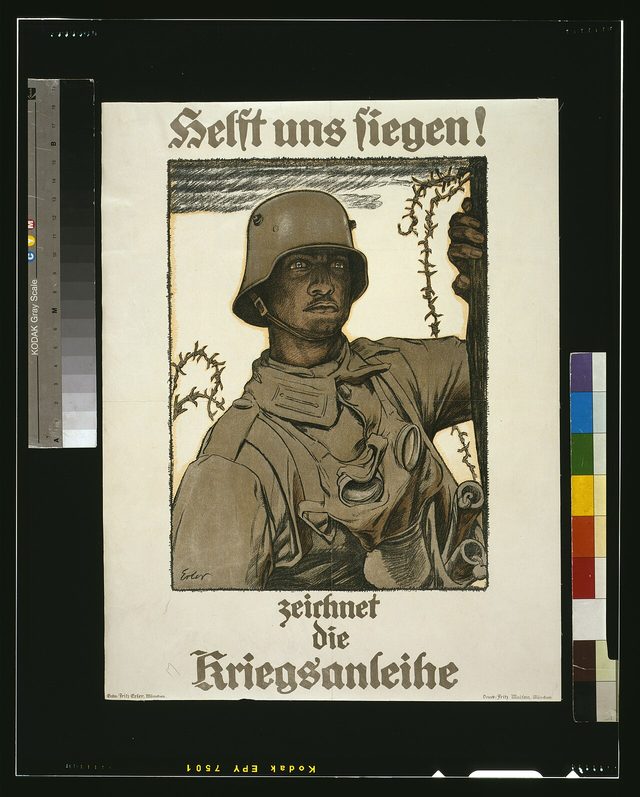
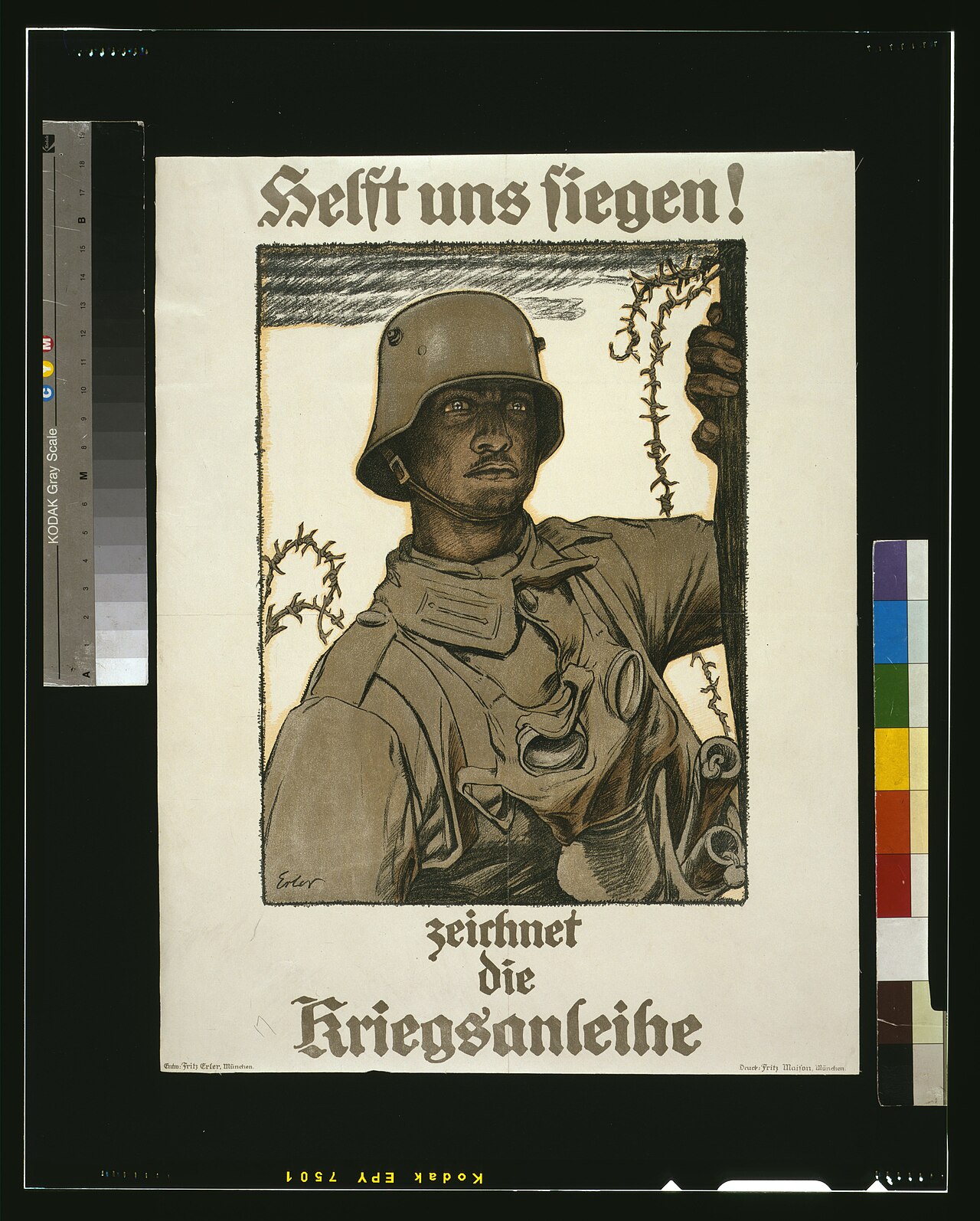
Fritz Erler's 1917 sheet for the government's bond campaign puts a steel-helmeted infantryman above "Help us win! Subscribe to the war loan". The soldier's weariness is moved onto the purchase, and "win" is an undefined virtue word. Read the technique: transfer.
Erler's 1918 sheet shows an airman and asks "And you? Subscribe to war loan". It addresses the viewer as someone who has not yet done his part, and the airman lends his prestige to a bond with no terms printed. Read the technique: transfer.
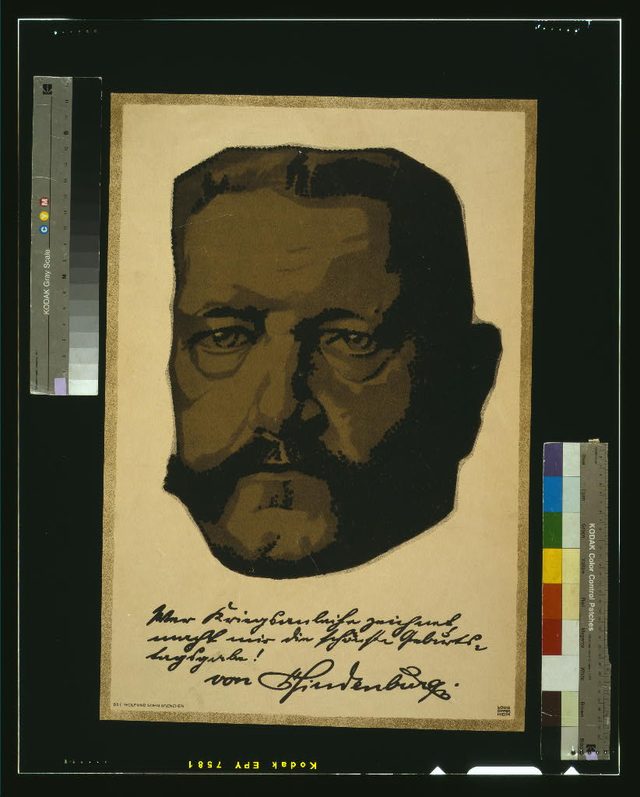
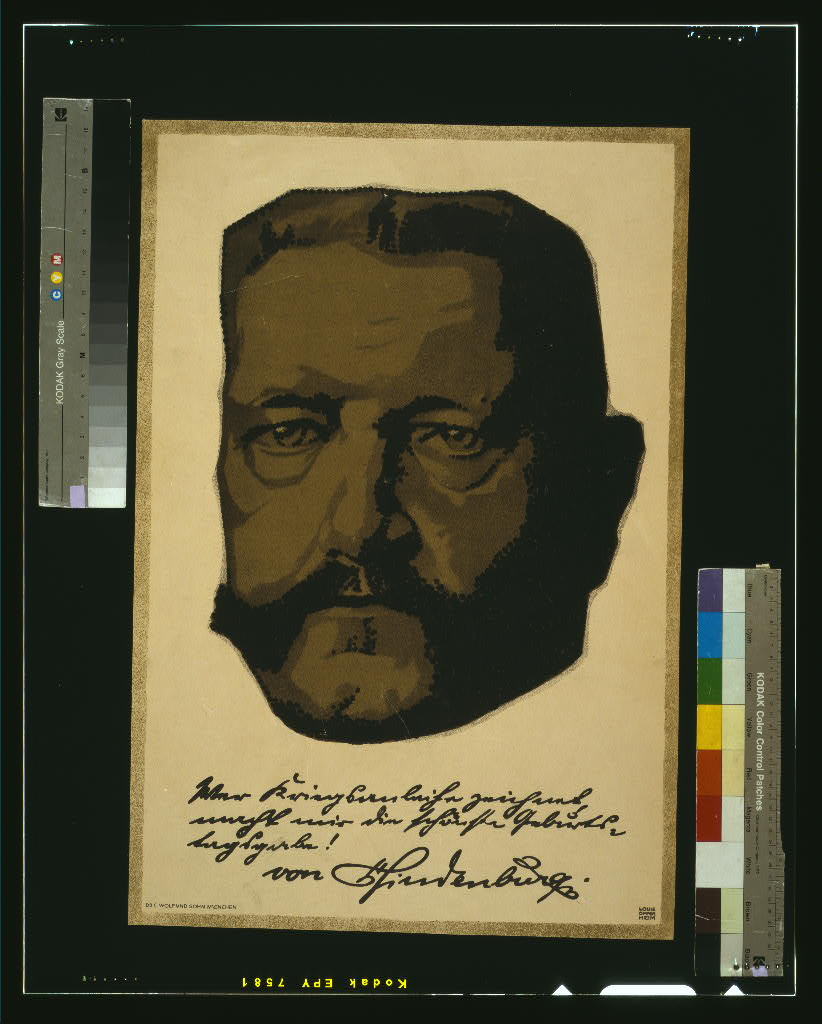
Louis Oppenheim's poster for the seventh loan, autumn 1917, prints a facsimile line in Field Marshal Hindenburg's hand: "Whoever subscribes to the war loan gives me the finest birthday present!" He turned 70 on 2 October 1917. His name is the whole argument, and the entry notes that the poster gives no figures about the loan. Read the technique: testimonial.
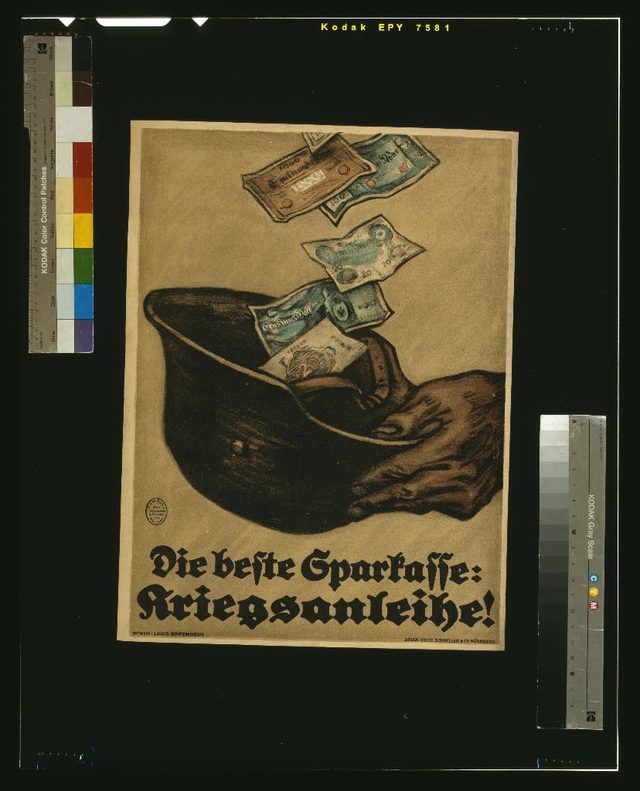
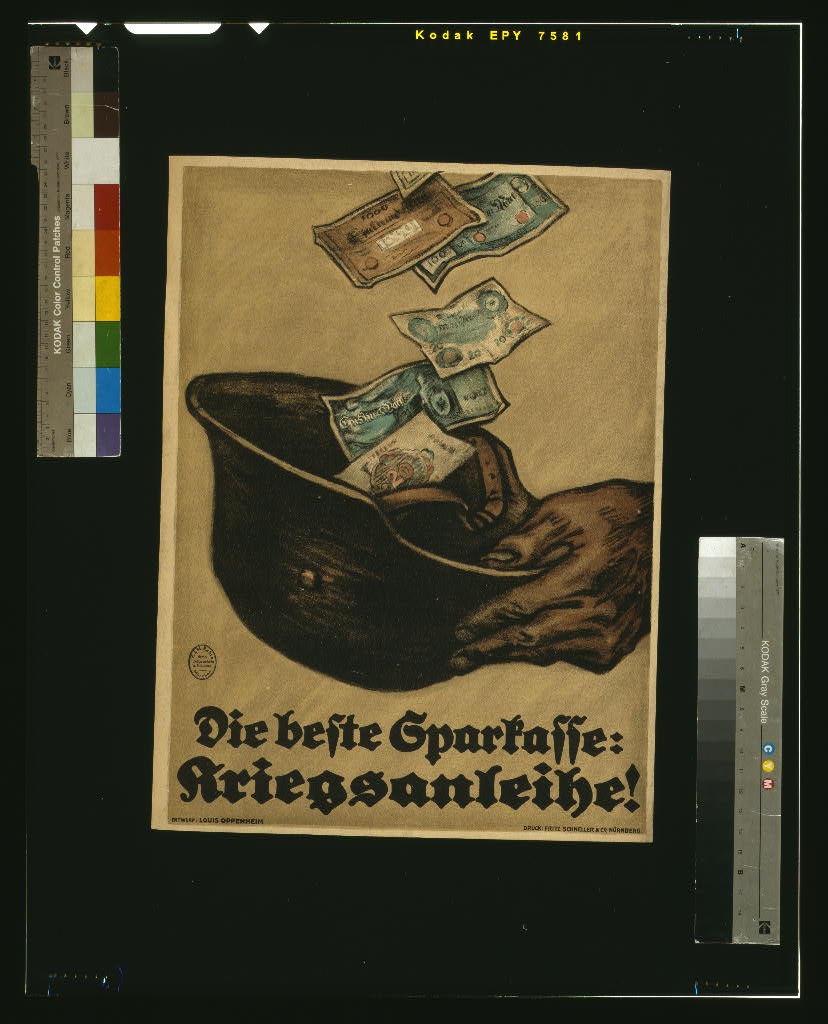
Oppenheim's "The best savings bank: war loan!" labels a bond as a savings account. The entry notes that repayment depended on the state's finances after the war, and that after defeat and the hyperinflation of 1922 to 1923 the bonds were worth almost nothing. The poster states none of this, which is the omission the entry tags. Read the technique: card stacking.
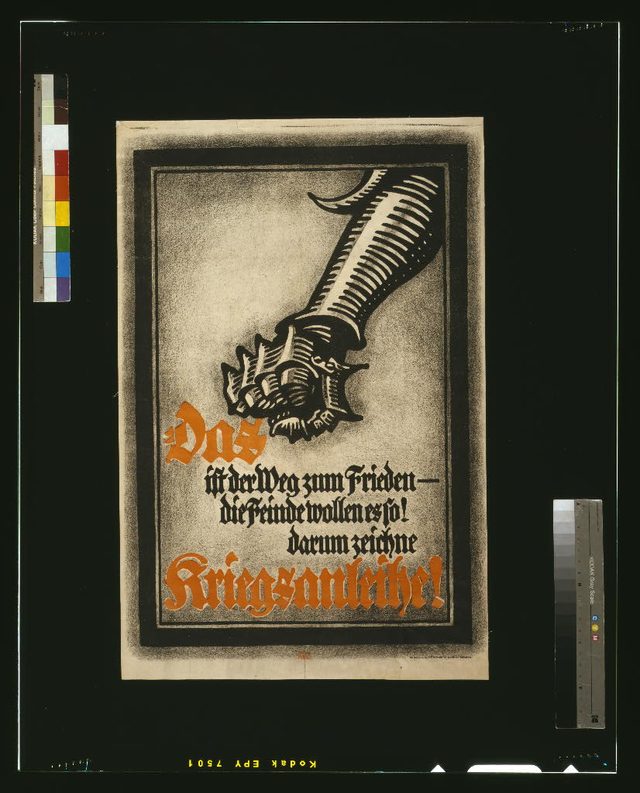
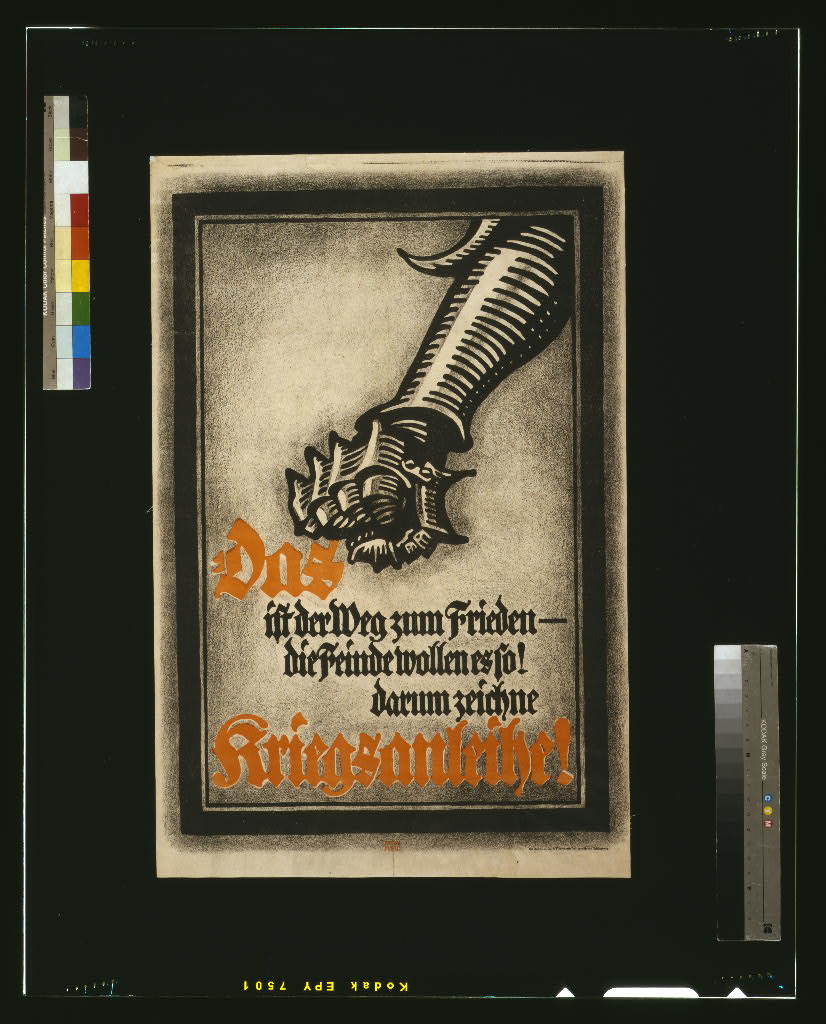
Lucian Bernhard's armoured fist carries the line "That is the way to peace, the enemies want it so! Therefore subscribe to the war loan!" Peace is the goal with no terms, and the enemy is made responsible for the war continuing. The entry tags it glittering generalities and scapegoating. Read the technique: scapegoating.
The ninth and last loan was offered in September and October 1918, and the war ended on 11 November. This sheet is a private bank's own order, drawn by Otto Ubbelohde for the Bankhaus Baruch Strauss. Its rhyme says Germany "has eternal existence" and is "thoroughly sound", a virtue claim in place of any figure. Read the technique: glittering generalities.
How did German posters present the U-boat campaign?
The submarine appears in two different items: a state war-loan poster and a private satirical medal.
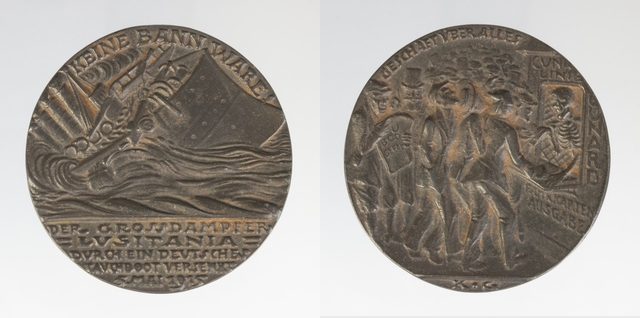
Content note: German satirical medal showing a sinking passenger liner and Death selling tickets, made after the 1915 sinking that killed over 1,100 people. This object is shown as it was published. Why 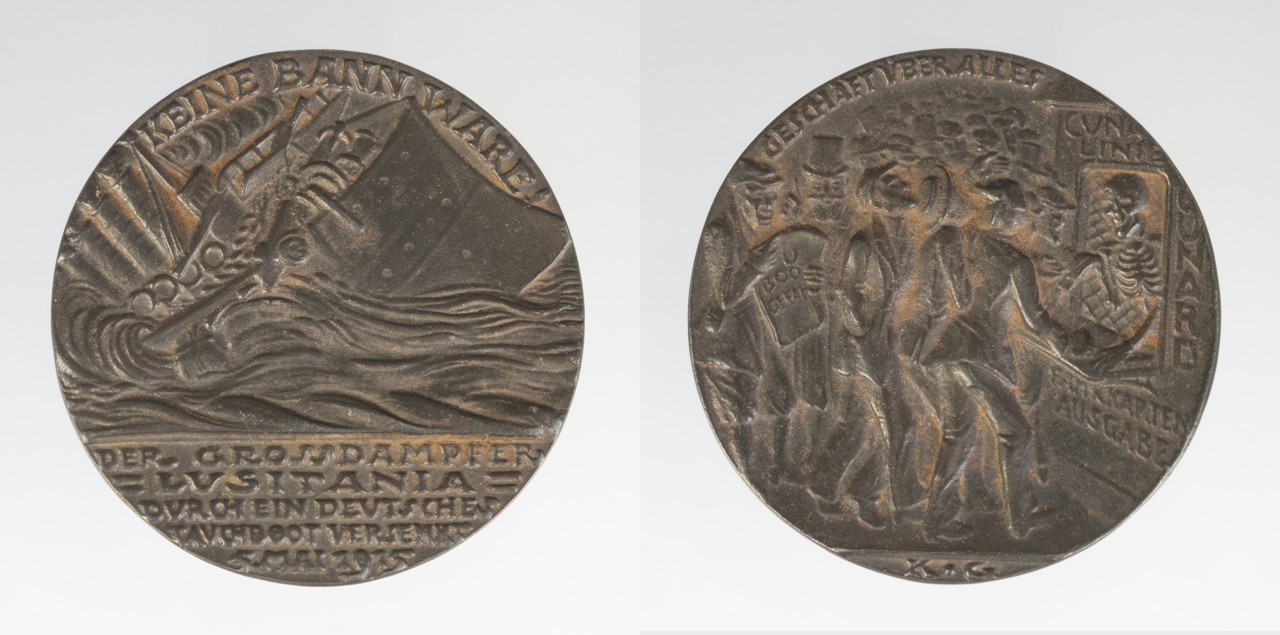
Explain moreShow less
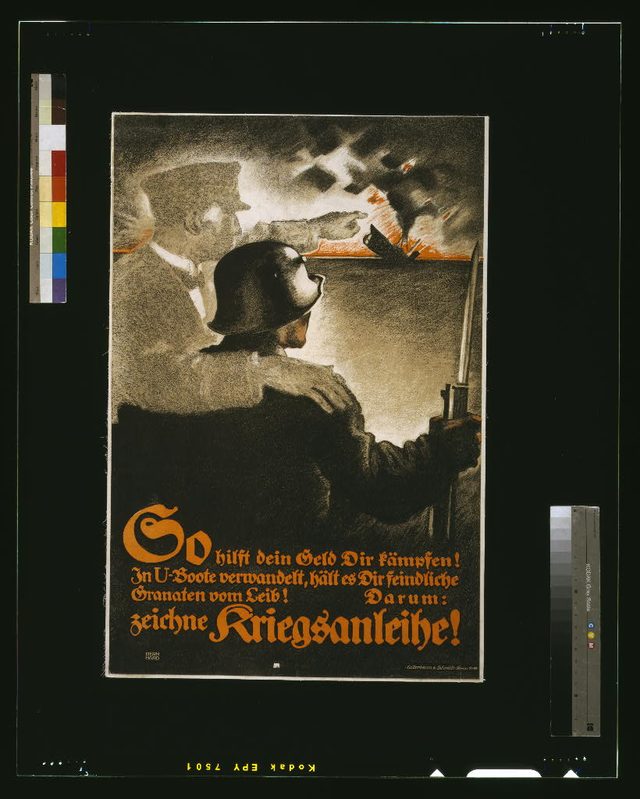
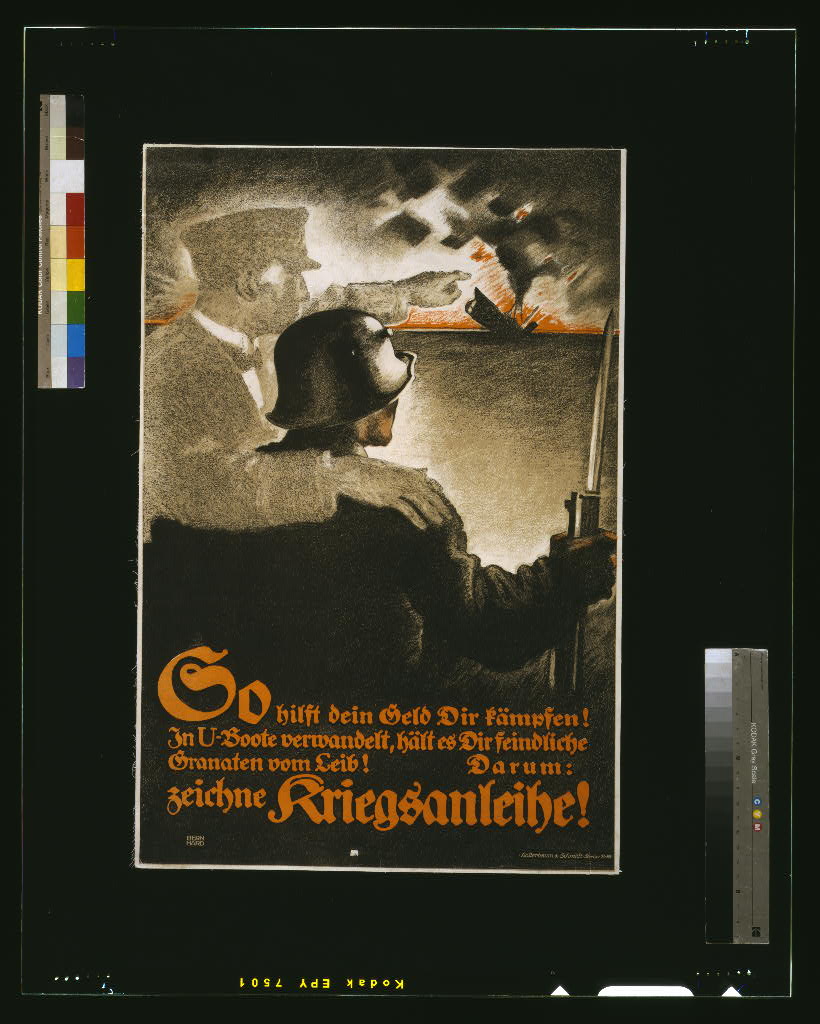
Bernhard's poster for the home front reads "This is how your money helps you fight! Turned into U-boats, it keeps enemy shells off your body!" The entry notes that Germany resumed unrestricted submarine warfare on 1 February 1917, and the United States cited it when it declared war in April. The poster shows only the benefit, with no figures on ships sunk or submarines lost. Read the technique: card stacking.
Karl Goetz of Munich made his Lusitania medal privately, as one of a series of satirical medals, according to the Imperial War Museums as cited in the entry. The obverse says the liner was sunk by a German submarine on "5 May 1915", two days before the actual sinking. The reverse shows Death at a Cunard ticket window. The entry records that British makers copied and sold the design in 1915 as anti-German propaganda, arguing that the wrong date proved premeditation. Read the technique: transfer.
The archive does not hold Willy Stöwer's better-known "U-Boote heraus!" (1917), because no verified open licence was found. This is a gap, and the U-boat section above is correspondingly thin.
What did the colonial and home-front appeals say?
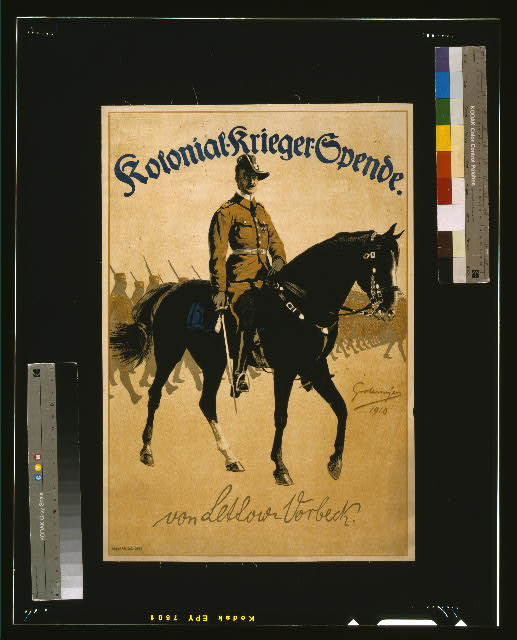
Fritz Grotemeyer's 1918 poster for a Colonial Servicemen's Fund shows General Paul von Lettow-Vorbeck on horseback over his signature. The entry notes that his force in German East Africa was mostly African soldiers under German officers, and that it did not surrender until 25 November 1918. In the picture the African troops are pale unnamed silhouettes and the commander is the only named figure. The fund's sponsor is not named on the sheet. Read the technique: transfer.
Explain moreShow less
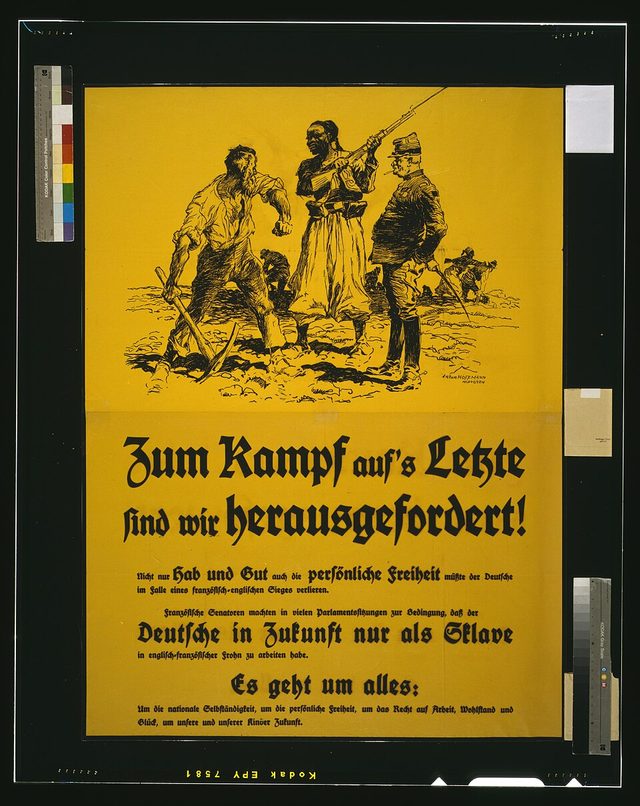
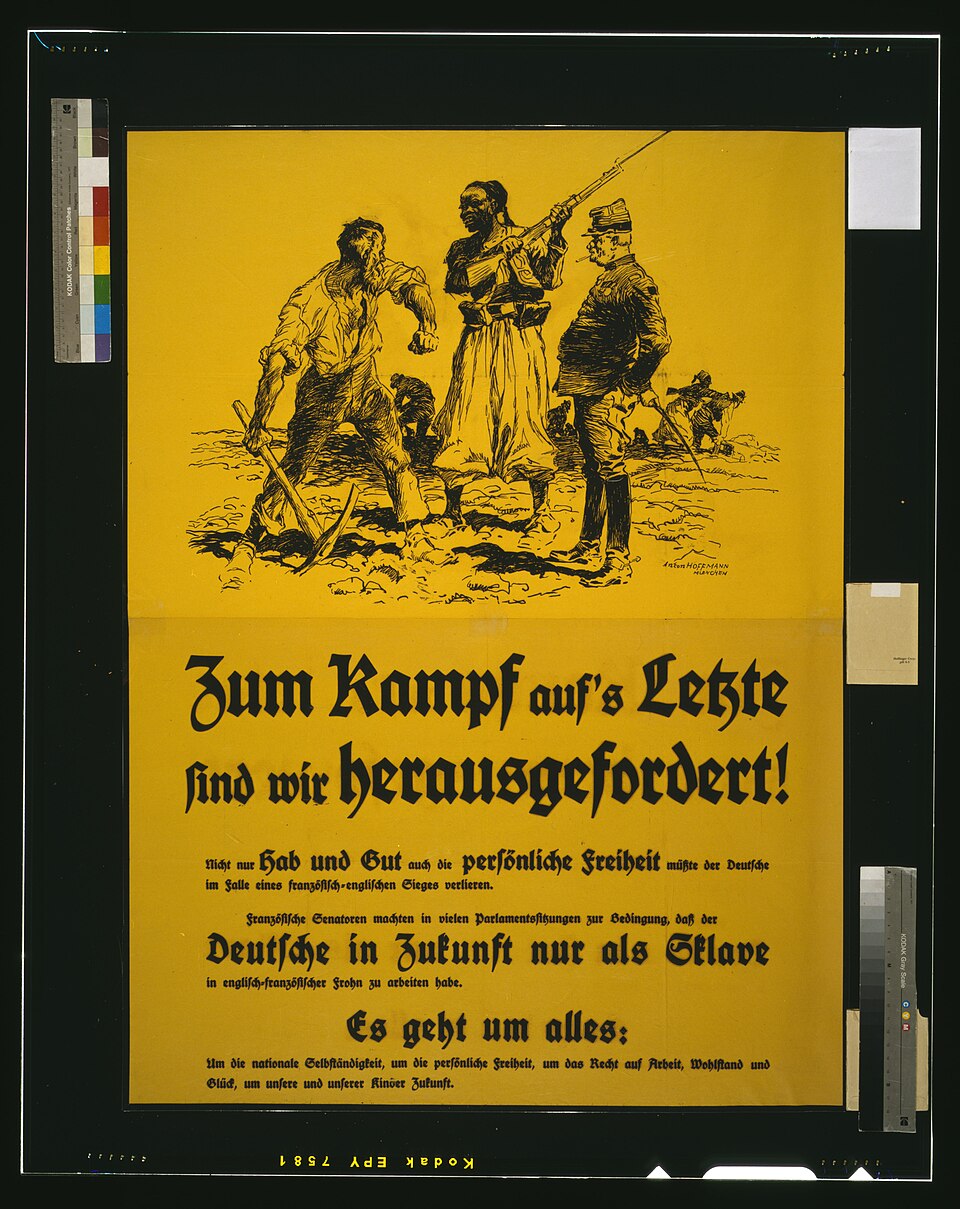
This 1917 sheet, drawn by Anton Hoffmann, warns that after a French-English victory Germans would work "only as slaves", citing unnamed "French senators". The entry notes that the claim is made without a citation and that no issuer is printed. Every side used images of the enemy's colonial troops, and the entry says French posters presented them as allies. Read the technique: fear appeal.
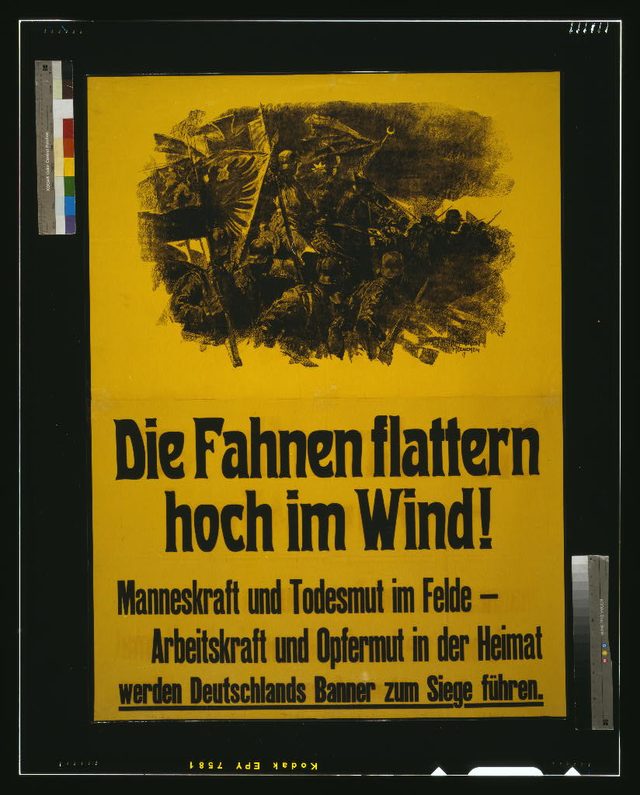
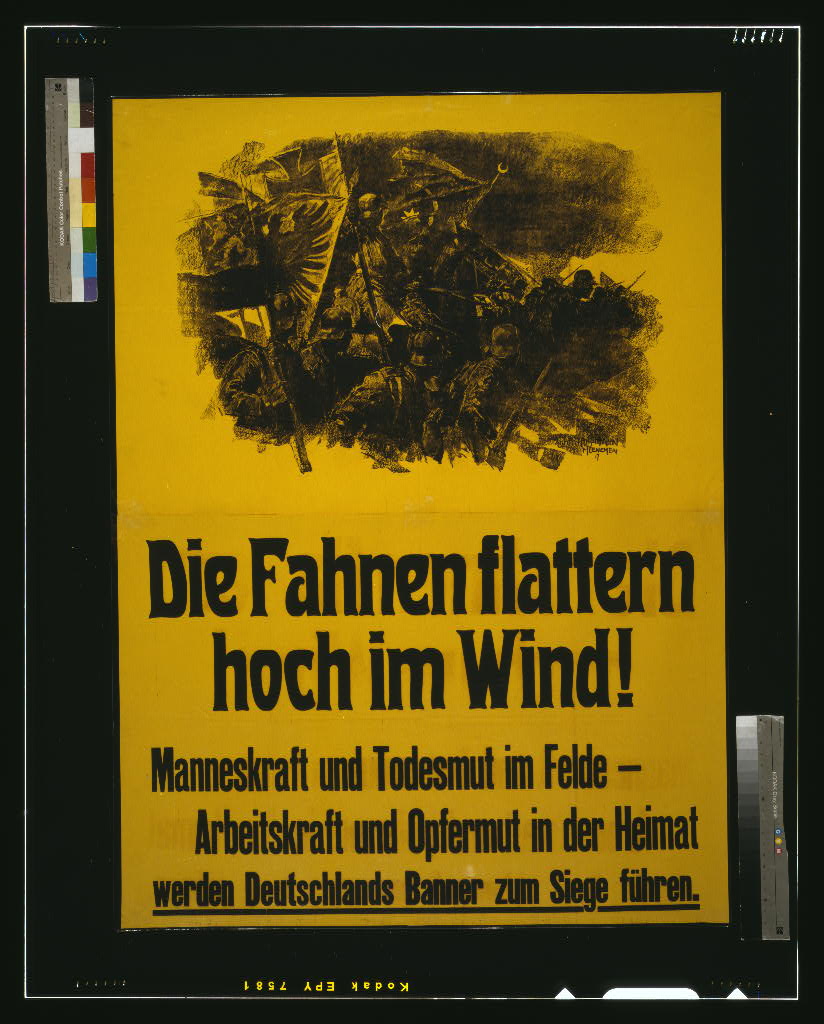
The same artist's "The flags flutter high in the wind!" promises that "manly strength and contempt for death in the field" and "working strength and readiness for sacrifice at home" will lead Germany's banners to victory. The entry notes one flag may be Ottoman, a detail used in the Ottoman holy war case study. Read the technique: glittering generalities.
How did Germany answer Allied charges and justify the invasion?
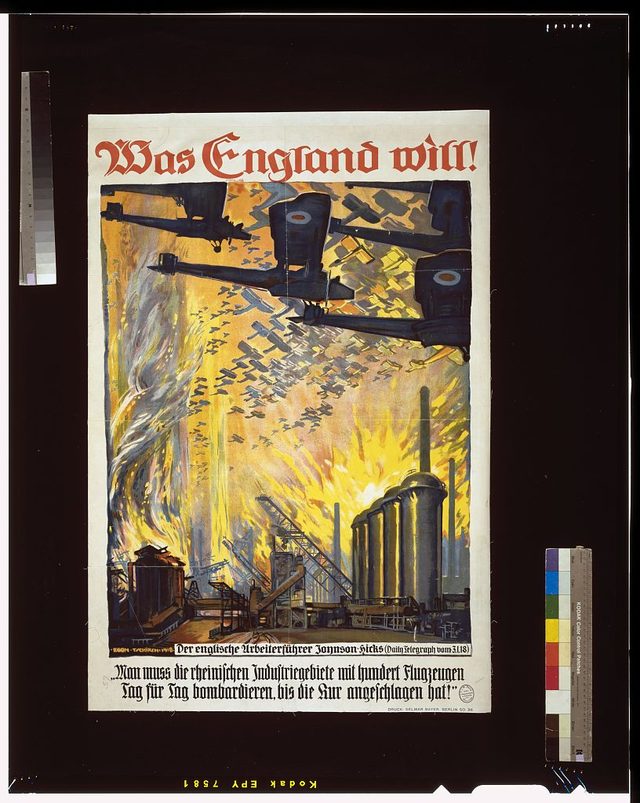
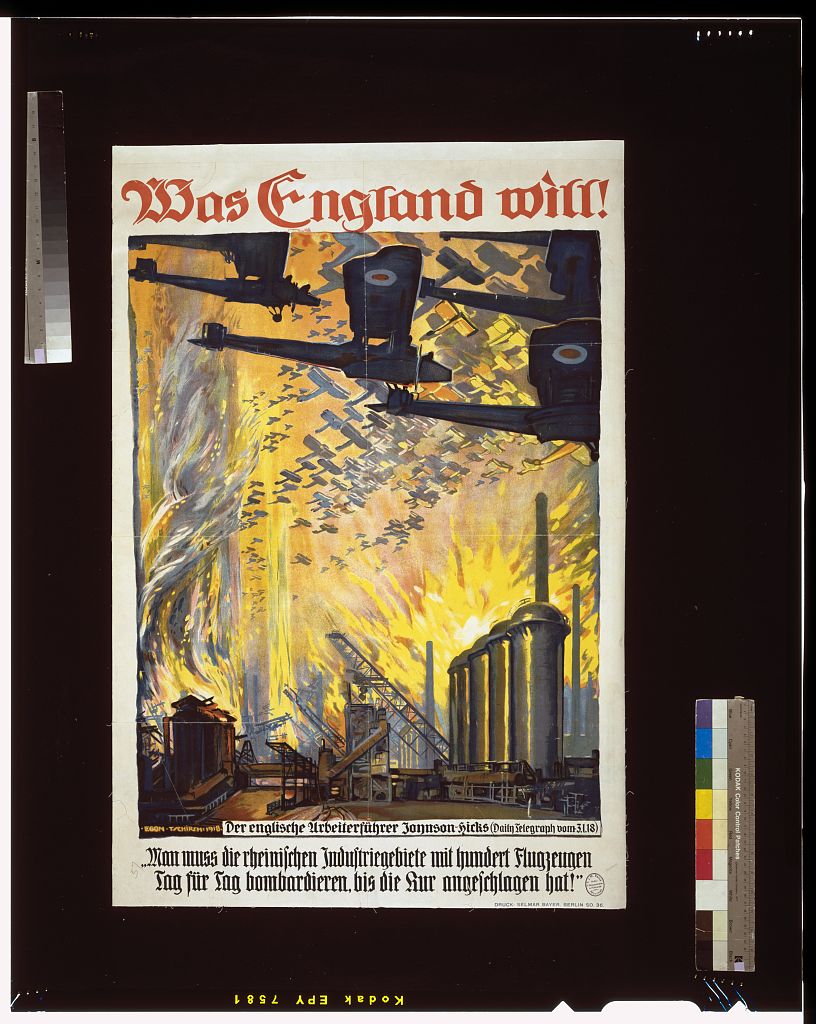
"What England wants!" (1918, artist Egon Tschirch) quotes William Joynson-Hicks on bombing the Rhineland and labels him "the English labour leader". The entry says he was a Conservative MP and that the Daily Telegraph quotation was not checked. It also records that British aircraft did bomb western German towns from June 1918, as German airships and Gothas had bombed Britain from 1915. The tell is one speaker standing in for a nation. Read the technique: fear appeal.
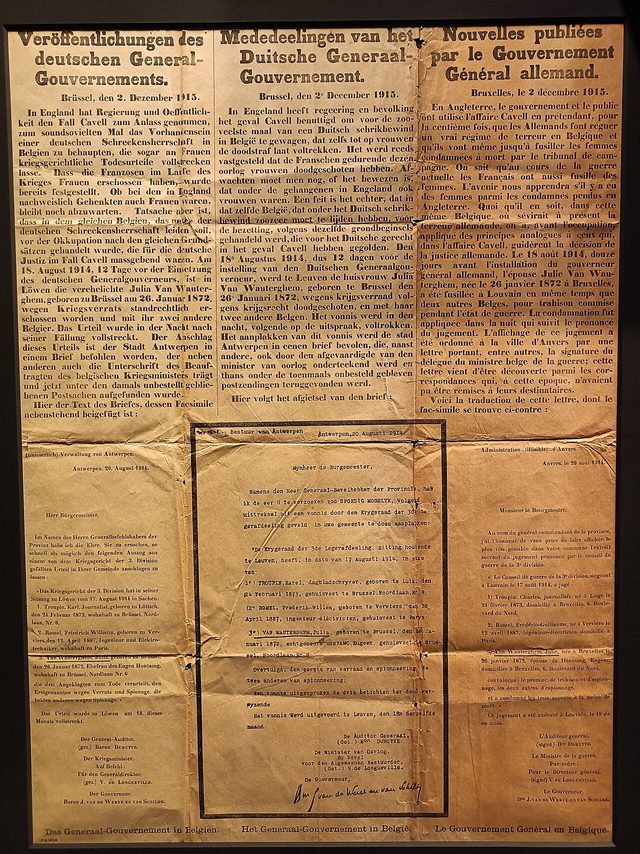
Content note: Text notice about the execution of women (Edith Cavell and a Belgian woman shot in 1914) and the wartime 'reign of terror' accusation; no images of violence This object is shown as it was published. Why 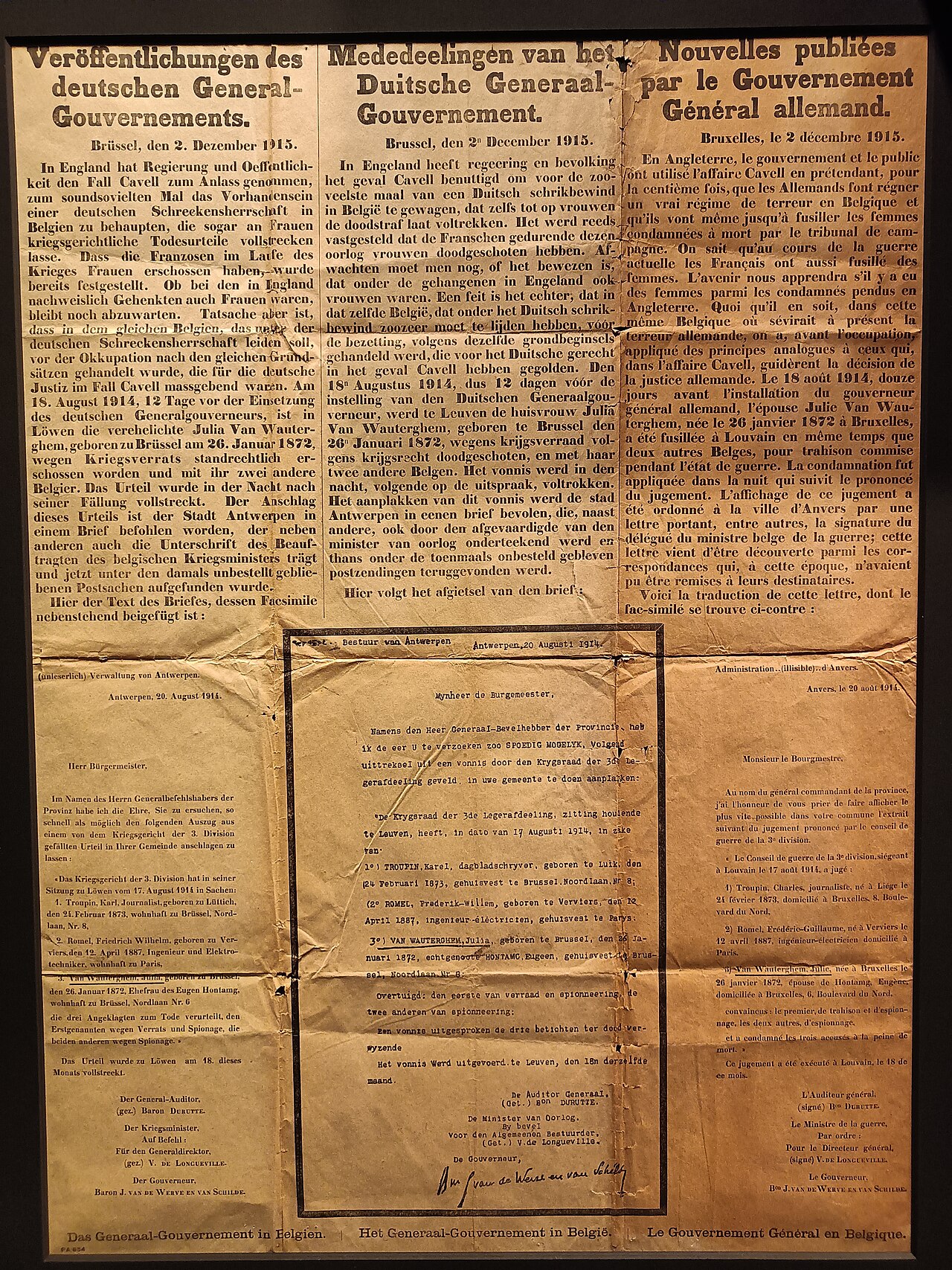
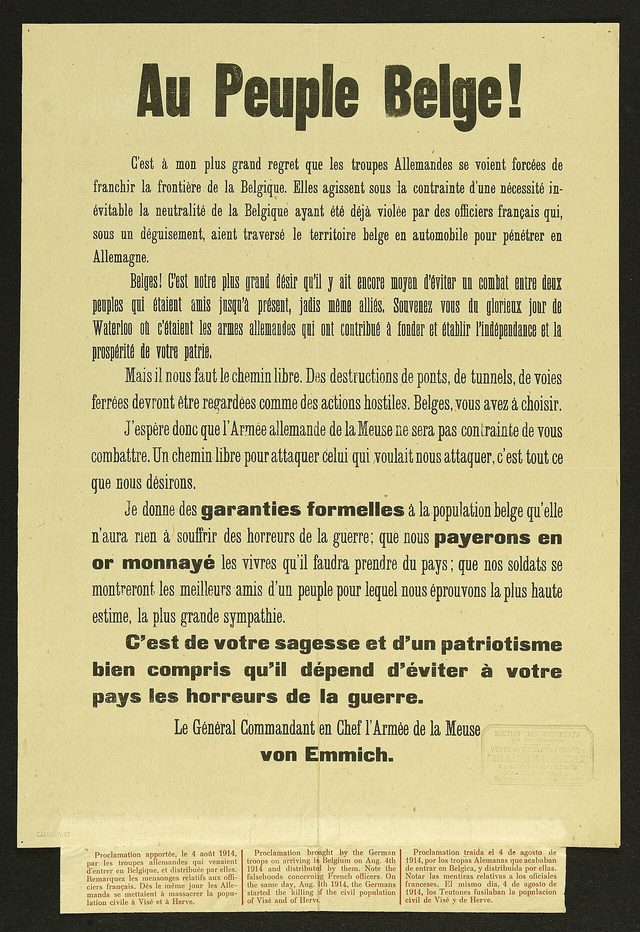
Content note: Contains a printed Allied-side strip alleging German massacres of civilians at Vise and Herve; describes atrocity claims and the German proclamation's own contested justification, neutral text only This object is shown as it was published. Why 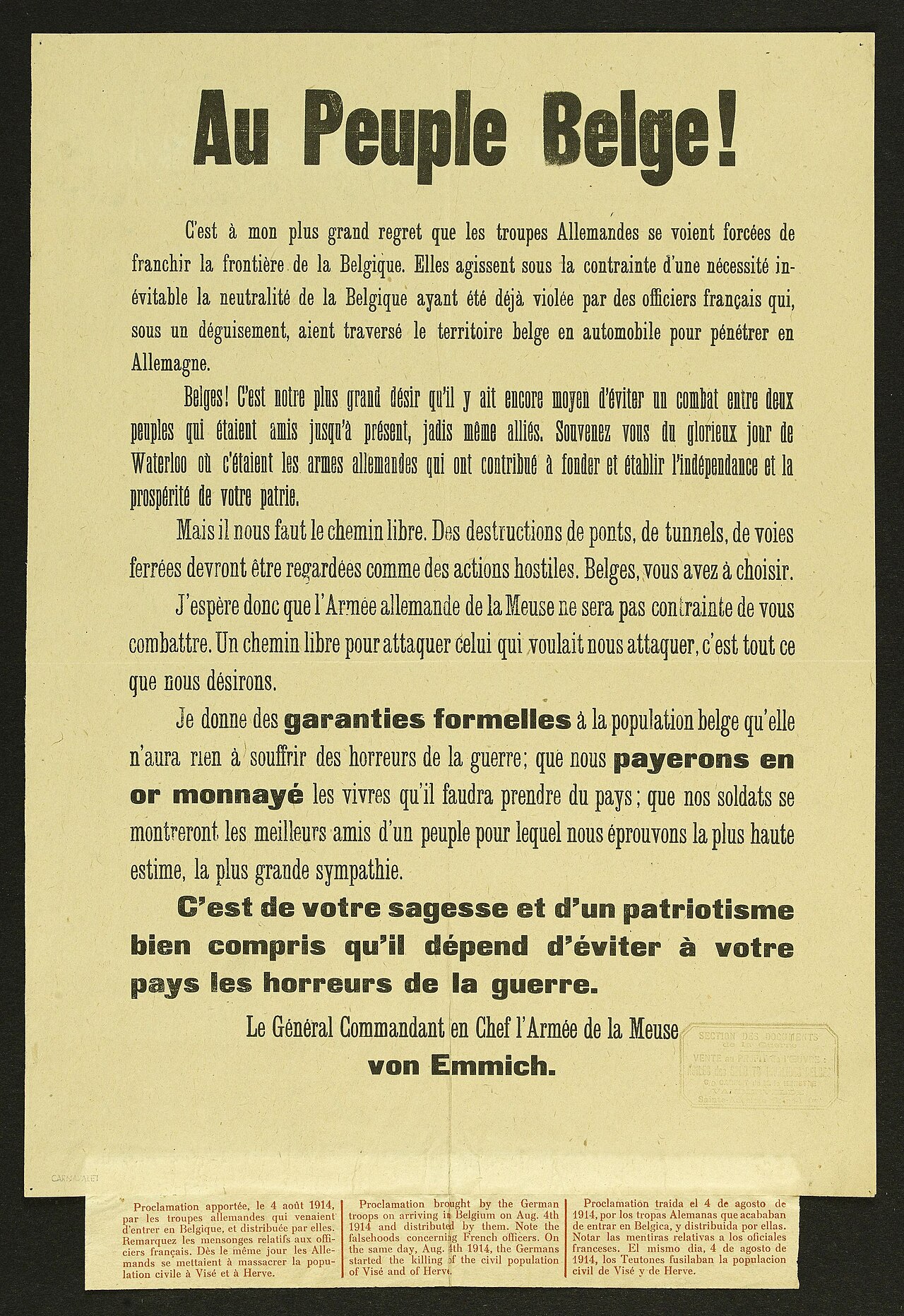
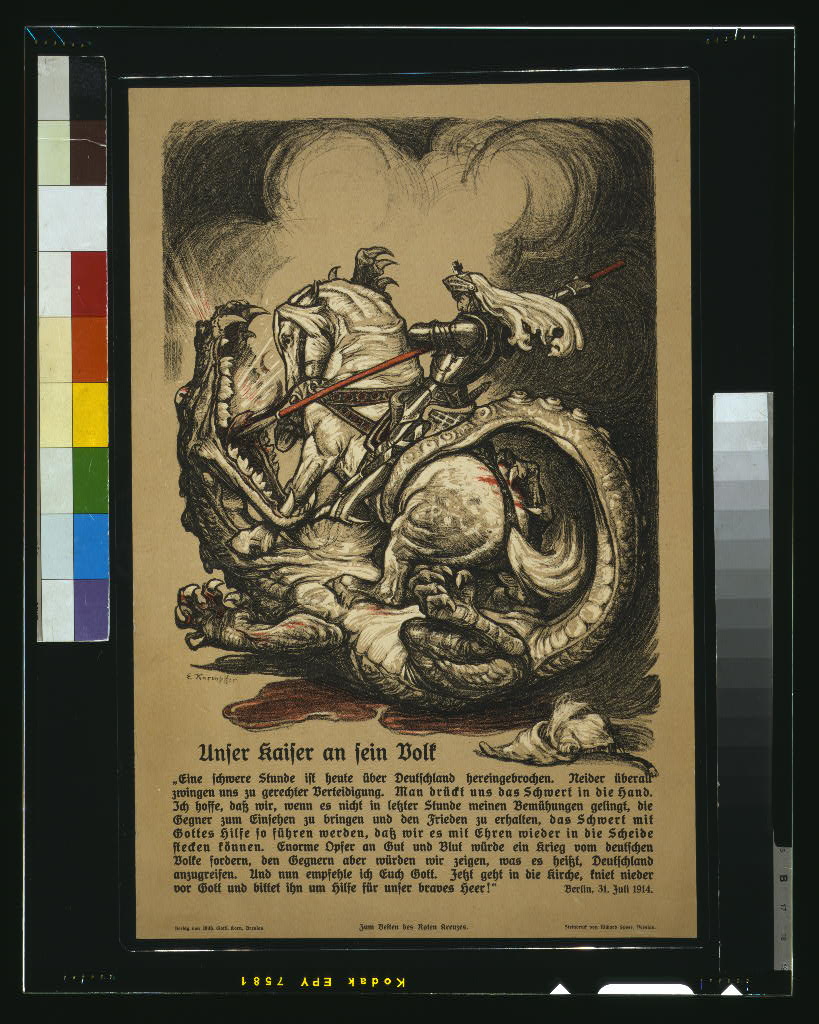
Explain moreShow less
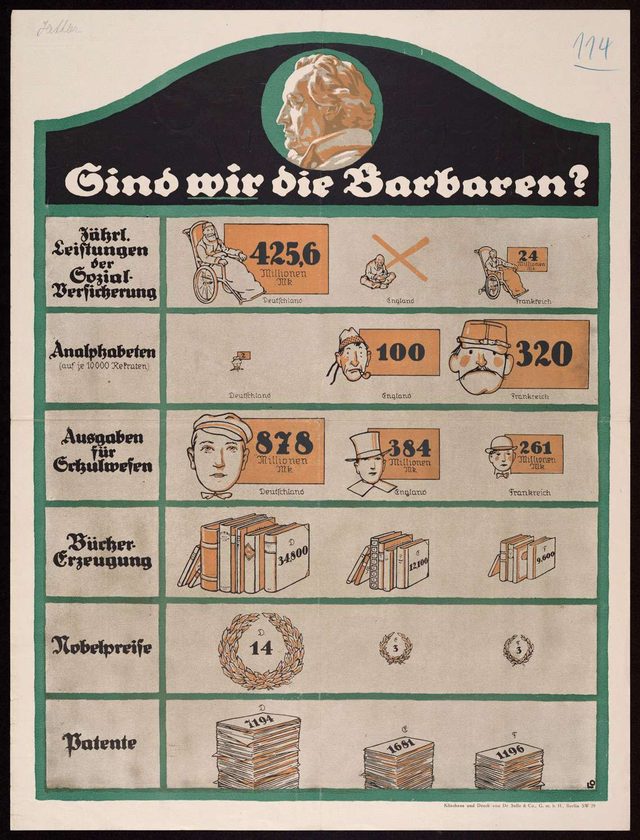
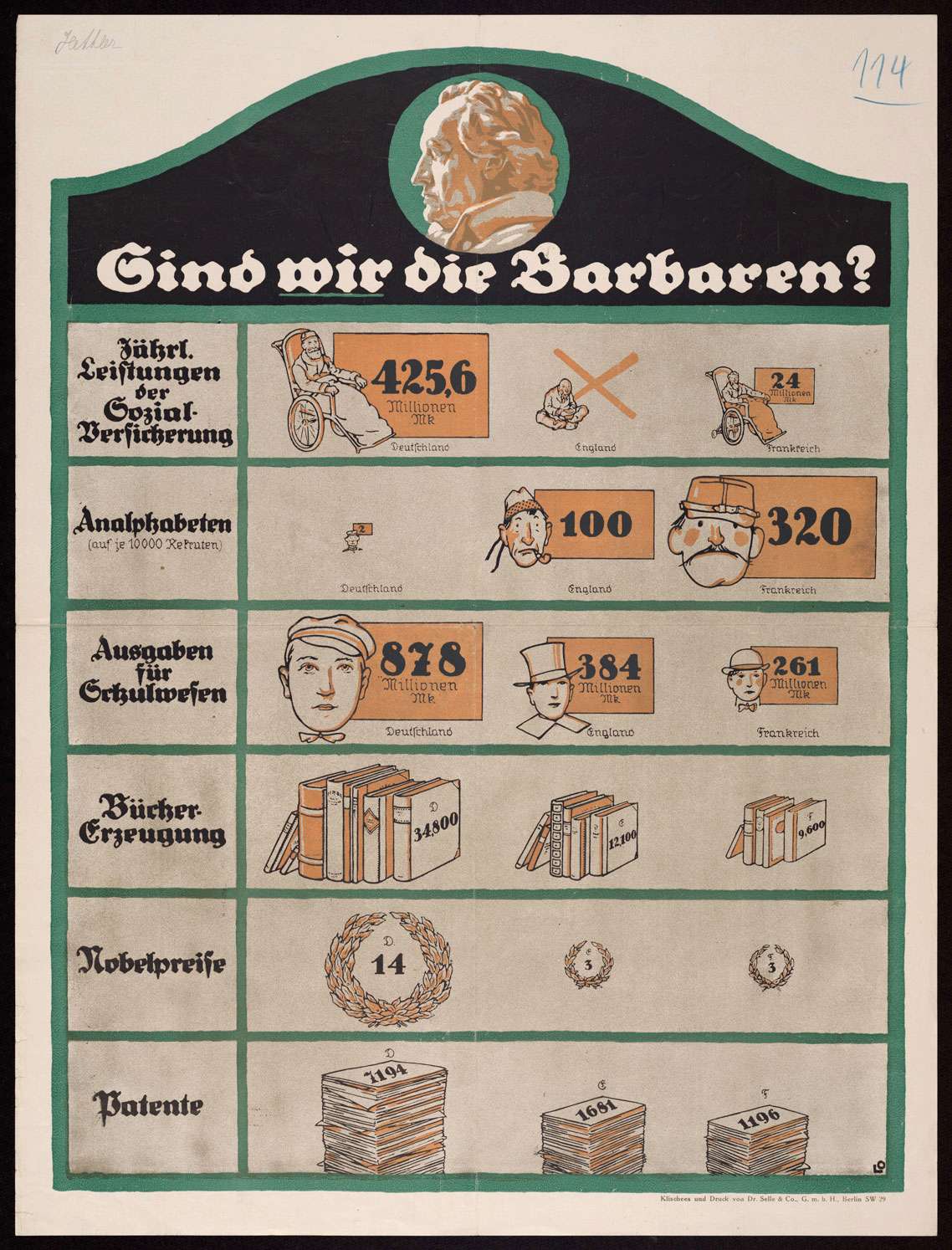
The Imperial government's "Are We the Barbarians?" answers atrocity charges with a chart of illiteracy, school spending, books, Nobel prizes and patents. The transcription lists 14 Nobel prizes for Germany against 3 each for England and France. See the Manifesto of the 93 and the Bryce Report for the exchange it belongs to. Read the technique: whataboutism.
On 2 December 1915 the German General Government in Belgium posted a three-language notice replying to British use of Edith Cavell's execution. The entry says it meets the charge by citing other cases, including French shootings of women, and does not discuss the grounds of her conviction. Its claims are not independently verified by the archive. Read the technique: whataboutism.
General von Emmich's proclamation of 4 August 1914, as German troops crossed into Belgium, says French officers had already violated Belgian neutrality. Belgium and France denied this, and the entry notes that standard histories do not treat it as established. The red strip at the foot was added by a later seller for Belgian war-invalid charities, so the sheet carries both sides. Read the technique: fear appeal.
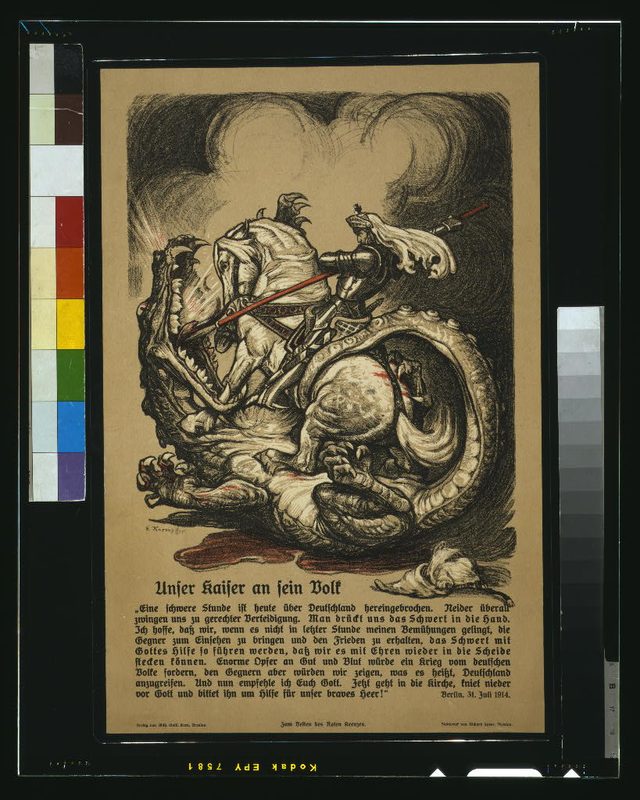
A Red Cross benefit print of Wilhelm II's address of 31 July 1914 says that "envious rivals everywhere" force Germany into "just defence", beneath Saint George and the dragon. The entry tags the religious framing, not the position on war guilt, which it notes historians have disputed since 1914. Read the technique: transfer.
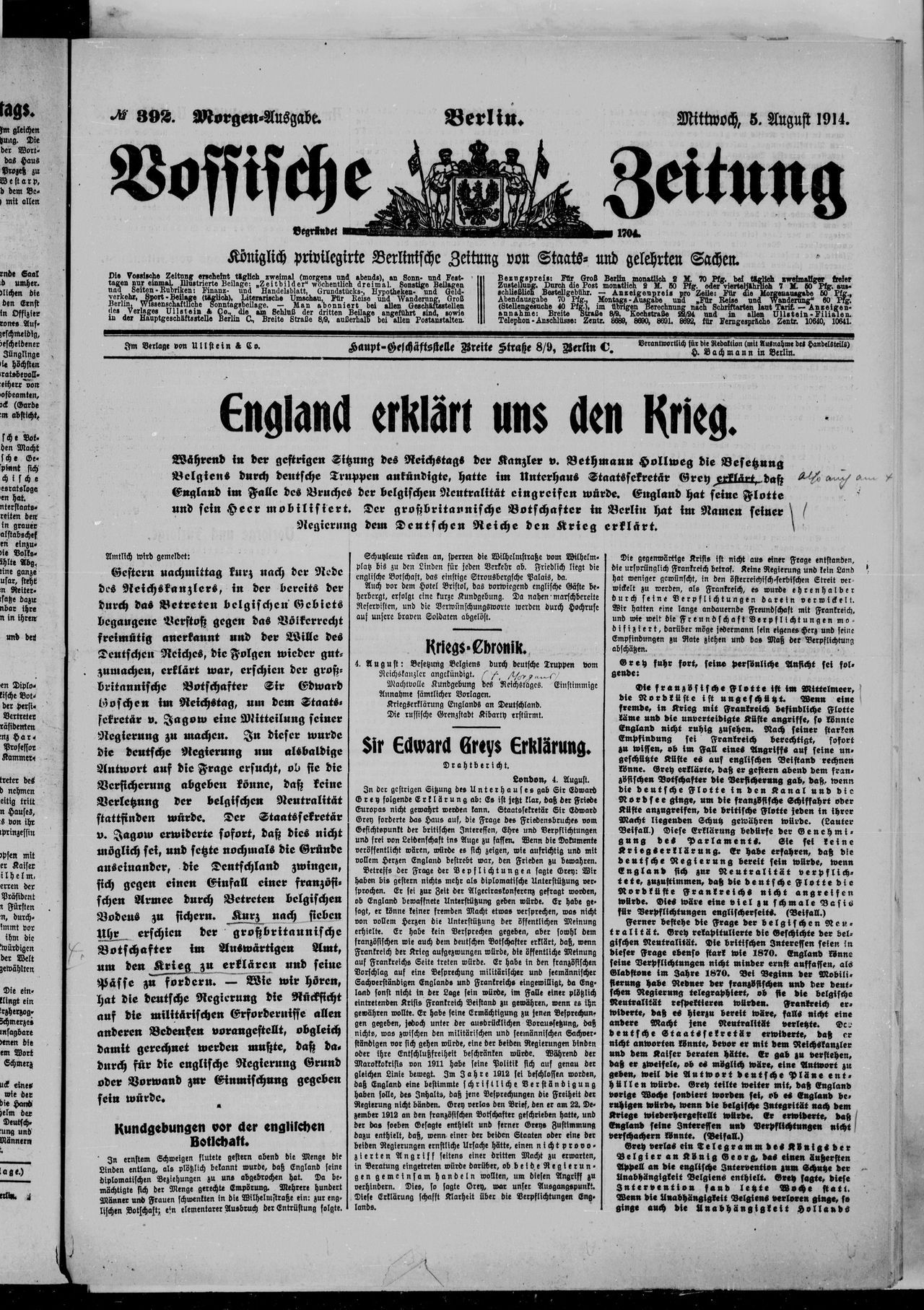
What did the German press and children's books show?
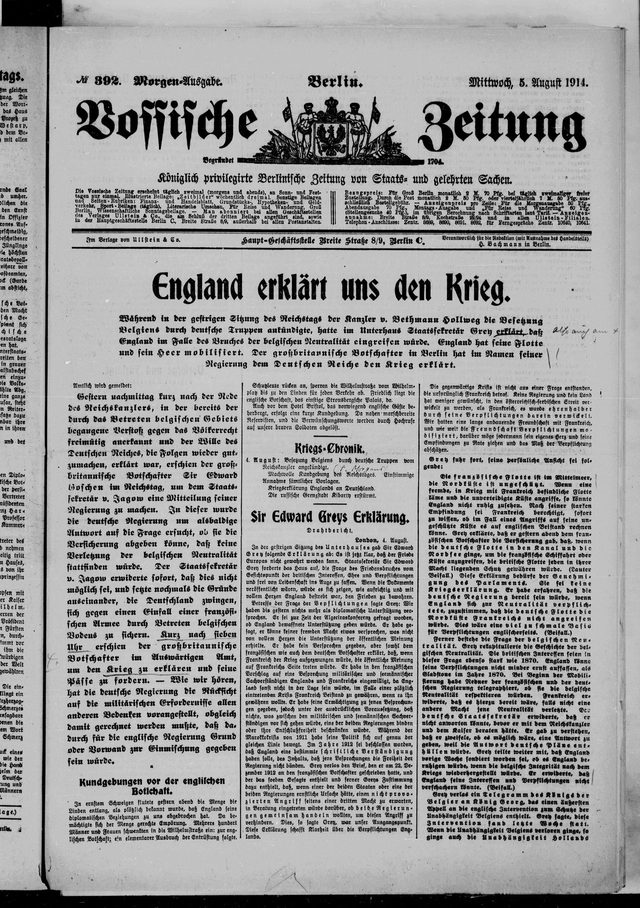
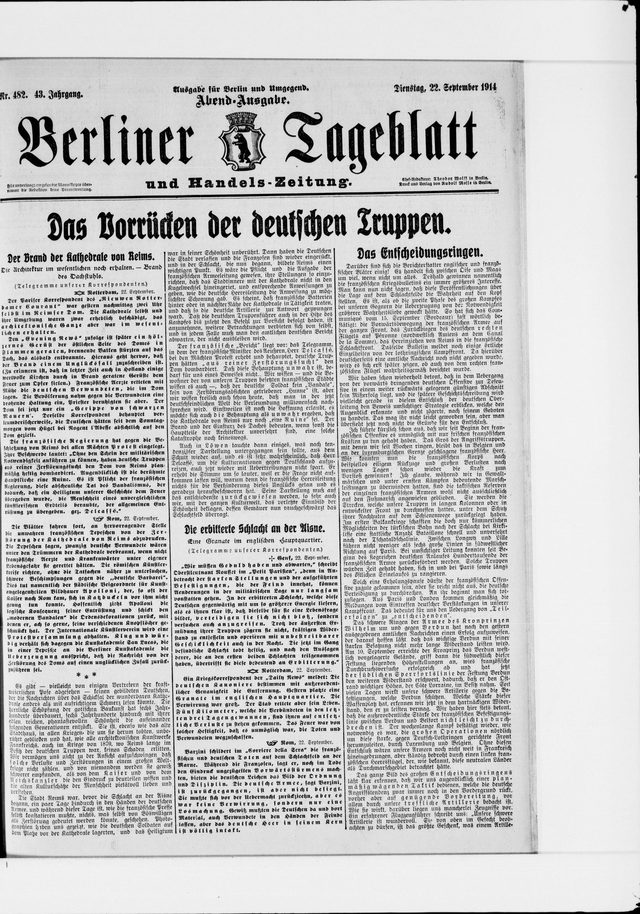
The Vossische Zeitung of 5 August 1914 leads with "England declares war on us". The entry says the German entry into Belgium sits in a subordinate clause, though the same page prints the Chancellor's acknowledgement of a breach of international law. German papers were then under military censorship, and the entry makes no claim about how far this page reflects it. Read the technique: card stacking.
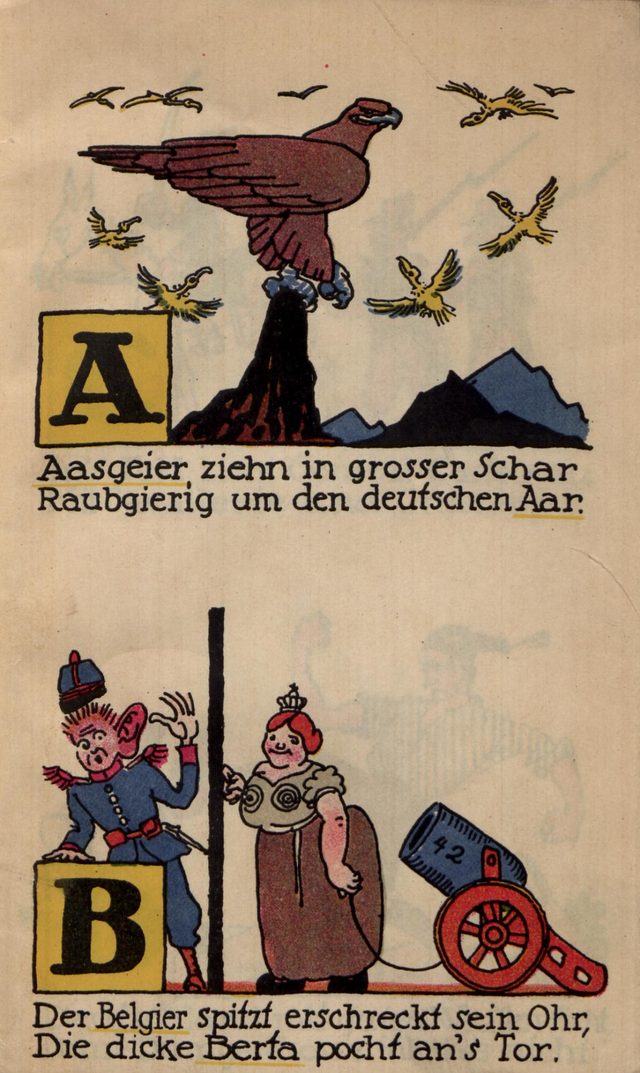
Content note: German children's war alphabet of 1915 with enemies shown as scavenger birds and a caricatured Belgian soldier, shown as printed. This object is shown as it was published. Why 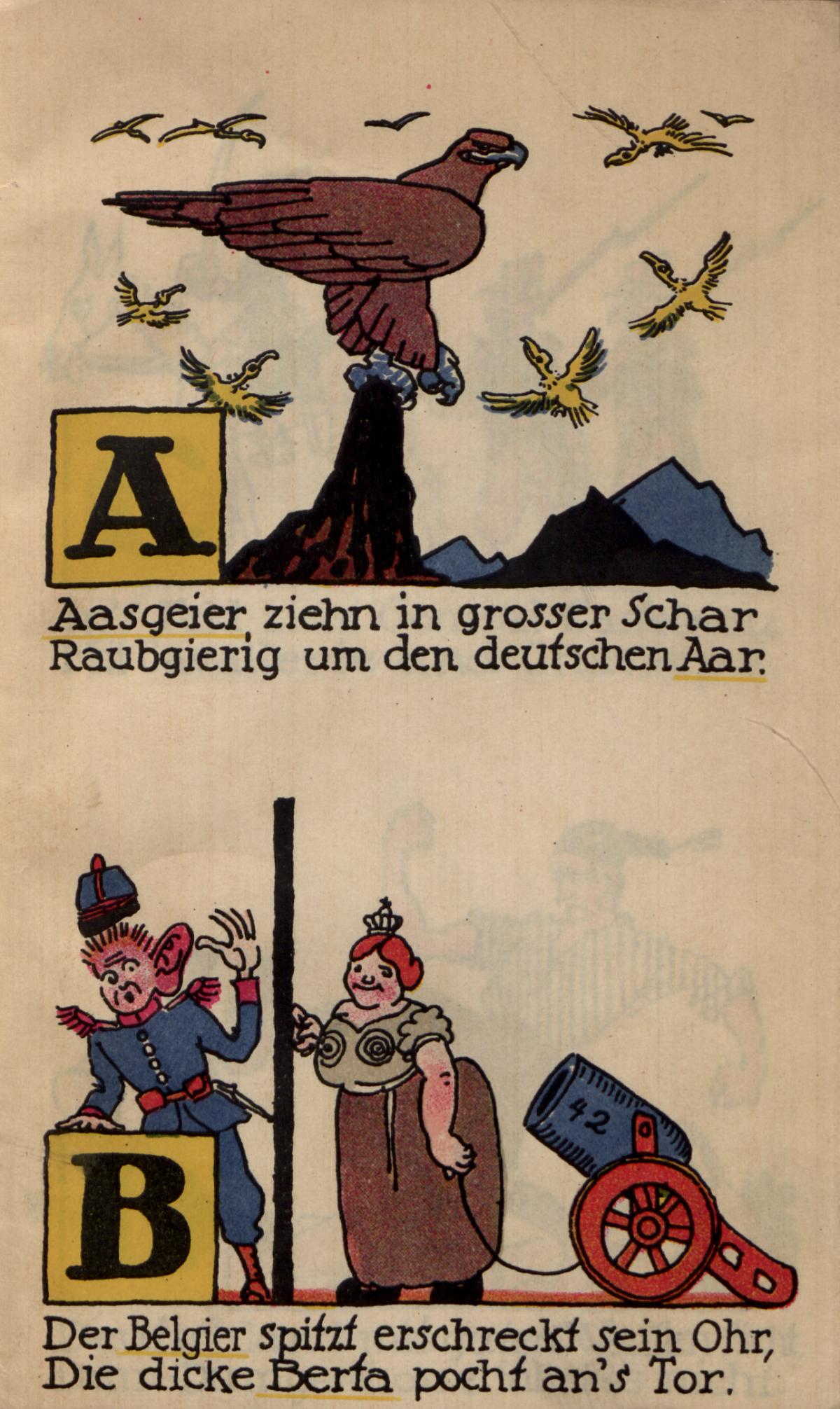
Explain moreShow less
A Berlin picture alphabet for children (1915) rhymes "A" with vultures circling the German eagle "greedy for plunder", and "B" with the Belgian starting back as "Fat Bertha knocks at the gate". Enemies appear as scavenger birds and a comic figure, and the verse supplies the label. The entry notes that alphabet books for children were produced in several belligerent countries. Read the technique: name-calling.
How did Allied posters picture Germans?
Three posters from the Allied side address Germany directly. They are shown to compare the same techniques, not to rank the sides. The archive holds far more American than German posters, so counts here say nothing about relative output.
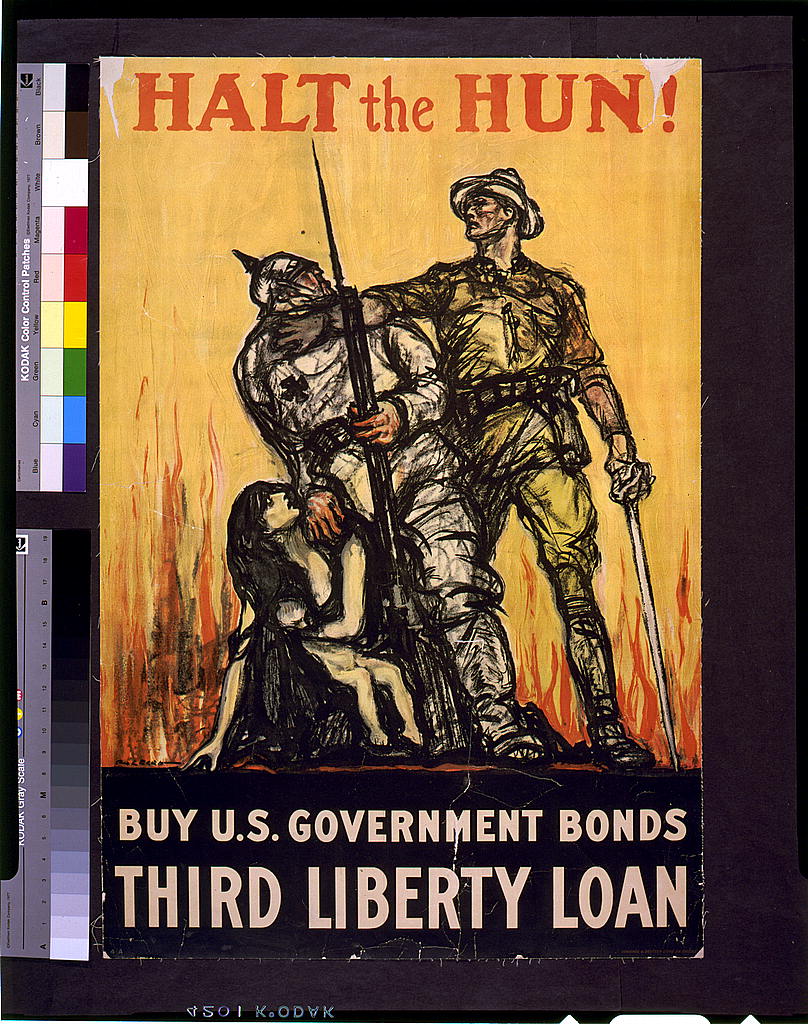
Content note: Dehumanising caricature of Germans as a blood-covered ape-like ogre. This object is shown as it was published. Why 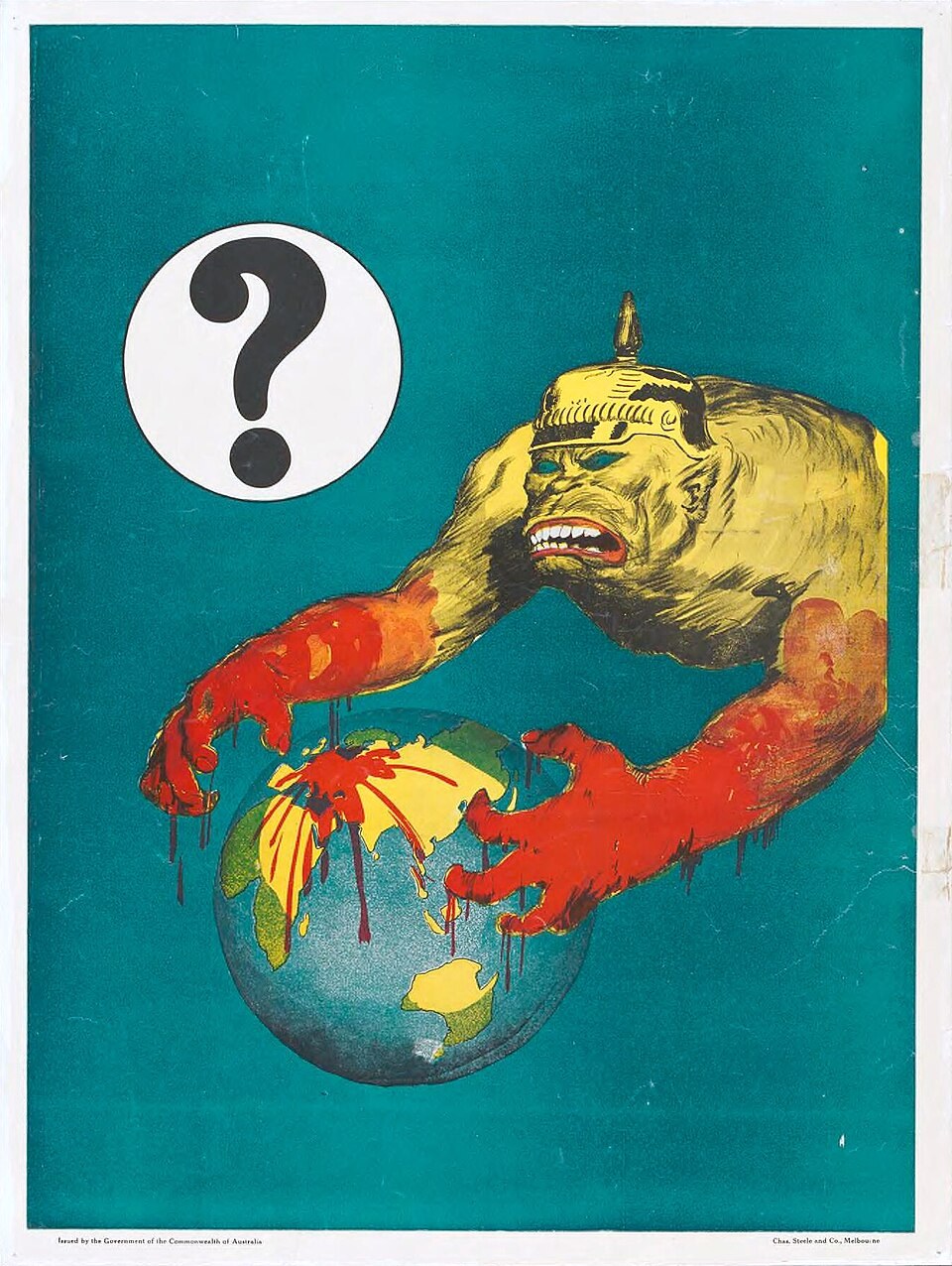
Explain moreShow less
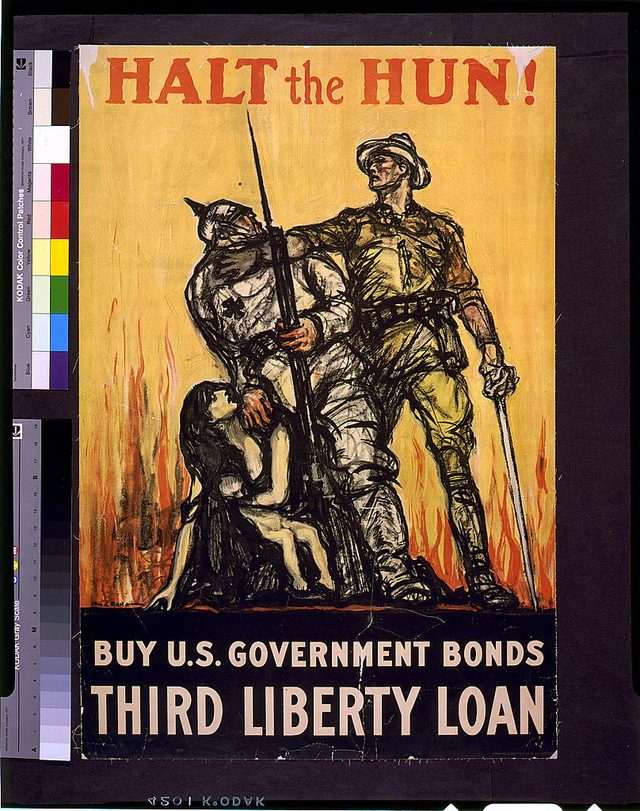
The U.S. Treasury issued Henry Raleigh's "Halt the Hun!" for the Third Liberty Loan in 1918. The word "Hun" is the label, and a staged assault on a mother and child sits above one remedy, buying bonds. The entry notes that the "Rape of Belgium" imagery rested partly on stories later shown to be false and partly on documented killings of about 6,500 civilians in 1914. Read the technique: name-calling.
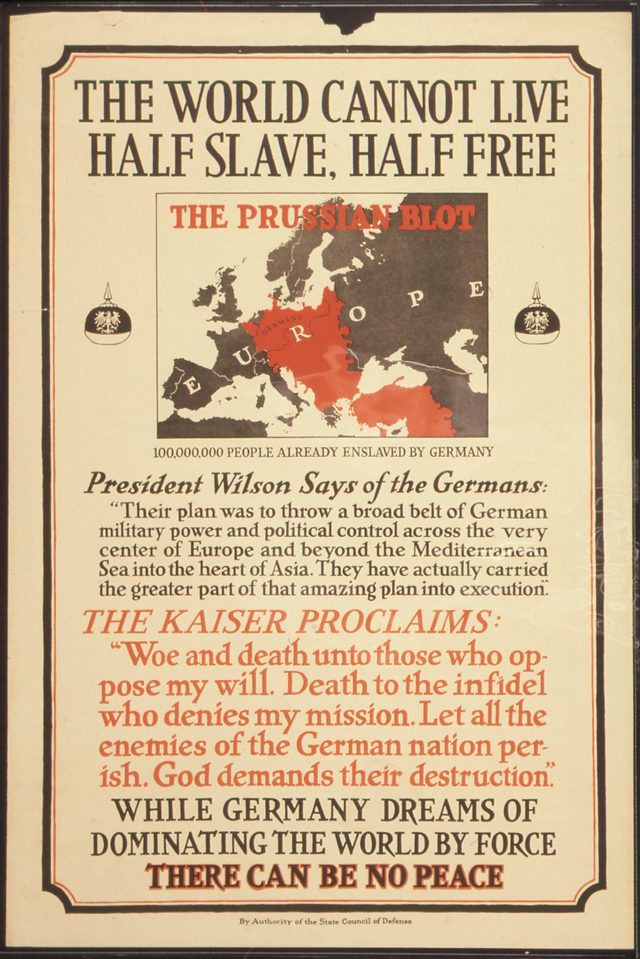
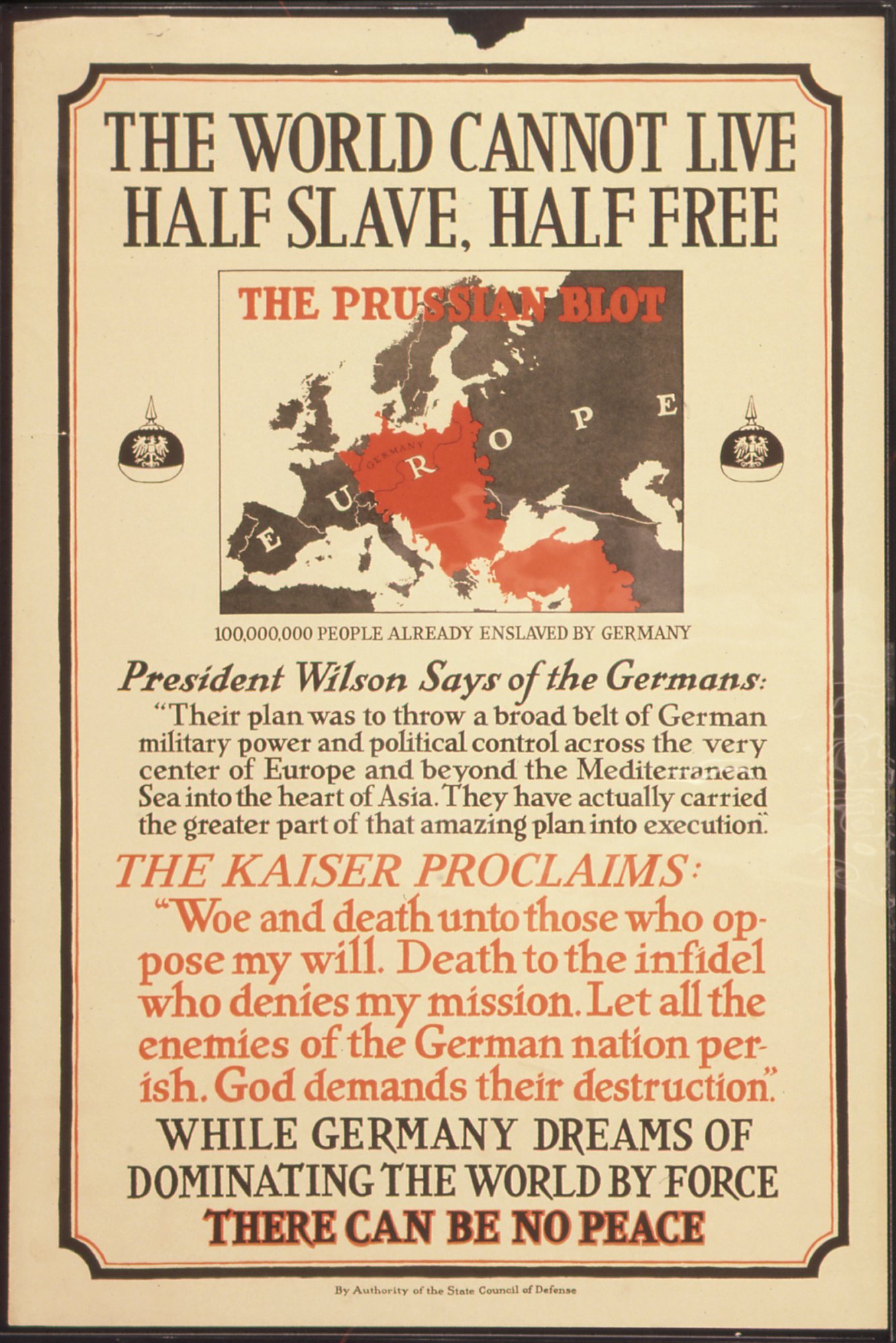
A State Council of Defense poster in the United States maps "100,000,000 people already enslaved by Germany". It sets a quotation attributed to the Kaiser beside one attributed to President Wilson and ends "There can be no peace". The entry says the archive has not verified either quotation. Read the technique: fear appeal.
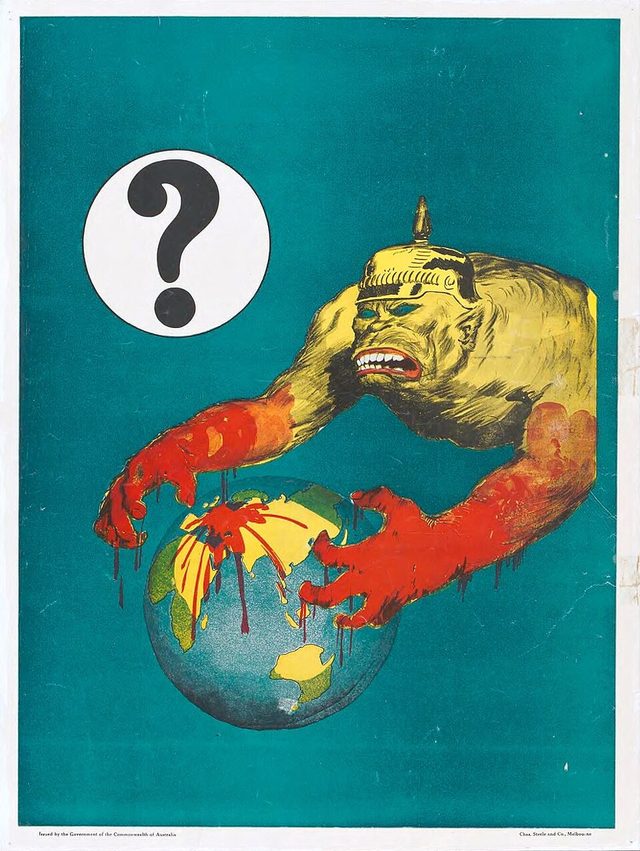
Norman Lindsay's 1918 poster for the Australian Commonwealth Government's last recruiting campaign carries a question mark and no slogan. The entry says Parliament protested it and the minister considered withdrawing it. It labels the enemy a monster, a case of dehumanization. Read the technique: name-calling.
These Allied sheets and the German ones above use the same tools: a soldier's courage lent to a bond, an enemy named by a label, and an accusation answered by changing the subject. The archive's record supports that similarity in method. It does not measure the scale of any country's output or the effect of any poster. For British and American recruiting see recruiting posters, British propaganda posters and American propaganda posters.
What is and is not in the archive?
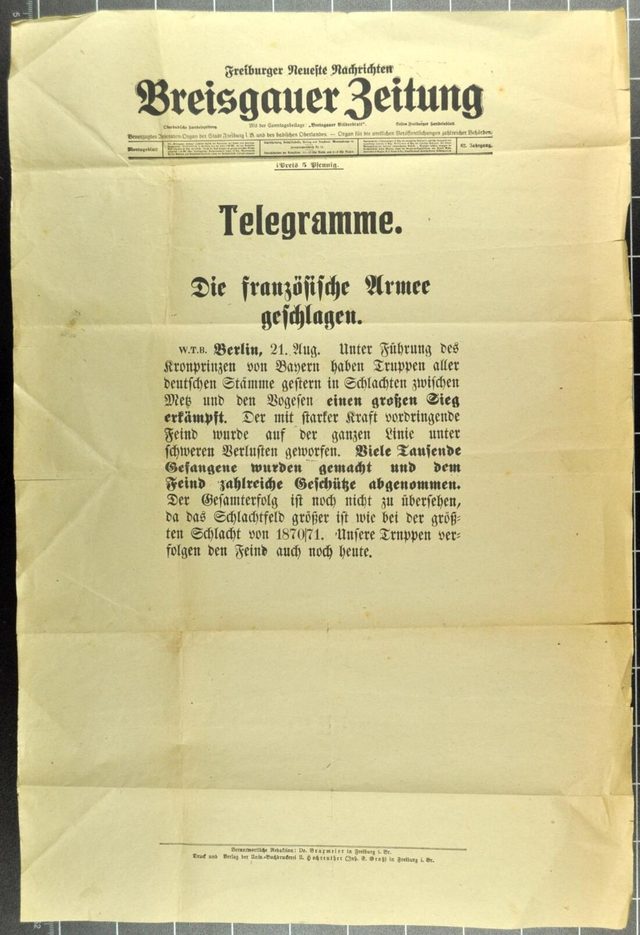
The archive holds no poster by Stöwer, and this page uses one German newspaper front page, from 1914, out of the German-issued items held. Nothing here shows how many Germans subscribed to a given loan or how a poster changed behaviour.