Content note. This page shows wartime material as issued. Several sheets use hostile labels such as "Communist aggressors", "Red China", "Soviet imperialism", "U.S. imperialists", "traitors", "robbers" and the Korean word "wonssu" (mortal enemy). One Chinese leaflet uses an insulting idiom about soldiers' wives. Some drawings are racial or ethnic caricatures, and some Korea Exhibit sheets (not all shown) carry photographs of dead bodies. Showing a sheet is not endorsing it.
What was Korean War propaganda?
Korean War propaganda was the leaflets, posters, broadcasts and cartoons that the United Nations Command (UNC), North Korea and China issued between June 1950 and the armistice of 27 July 1953, per Britannica. It aimed at enemy soldiers, civilians and third countries, mostly in Asia, and asked them to surrender, desert, trust a broadcast or condemn the other side.
Explain moreShow less
The archive holds 67 entries tagged to the war. The same questions are asked of every item (how FRAME defines propaganda): who issued it, who it was for, what it asked, and which technique carried the ask. For the wider conflict see the Cold War propaganda hub, propaganda posters and psychological operations.
Where is the archive thin or one-sided?
The holdings lean one way. Of the 67 entries, 7 come from North Korea or China, 10 are cartoons by Jim Berryman of the Washington Evening Star, and the other 50 come from the United States or the UNC. Most of the 50 are National Archives posters made for Asian audiences, plus leaflets and a few official photographs. That reflects what the archive has found and can host, not the size of either side's output. Where a North Korean or Chinese item is missing, this page says so rather than filling the gap with a US item. Translations of Korean and Chinese text are the entry notes' own; where an entry says its rendering is FRAME's literal, machine-assisted reading, it has not been checked by a fluent reader.
How did the US and UN side argue to Asian audiences?
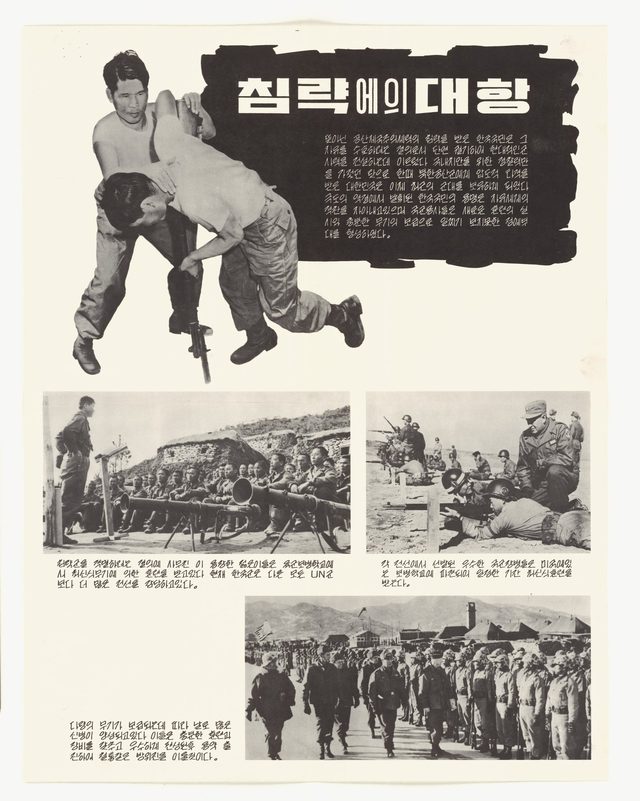
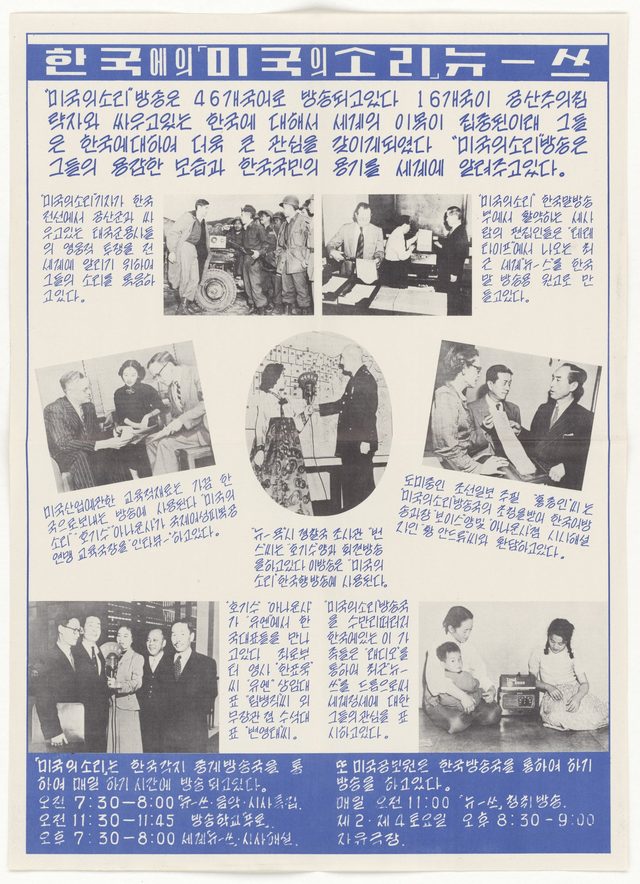
The State Department's information program, later the U.S. Information Agency, produced the "Propaganda Posters Distributed in Asia" series now held by the National Archives. Few sheets name a sponsor.
Explain moreShow less
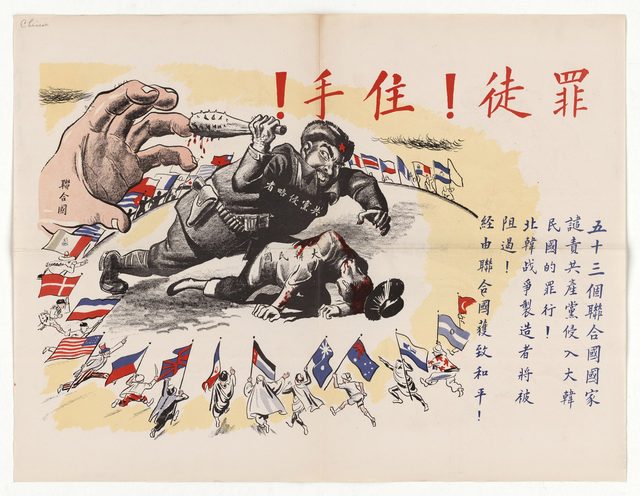
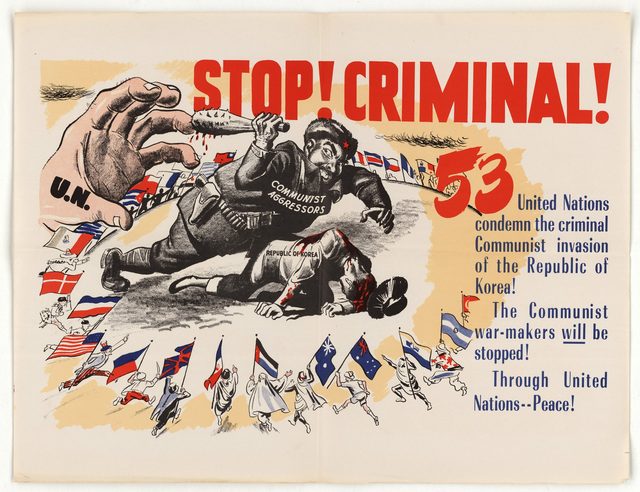
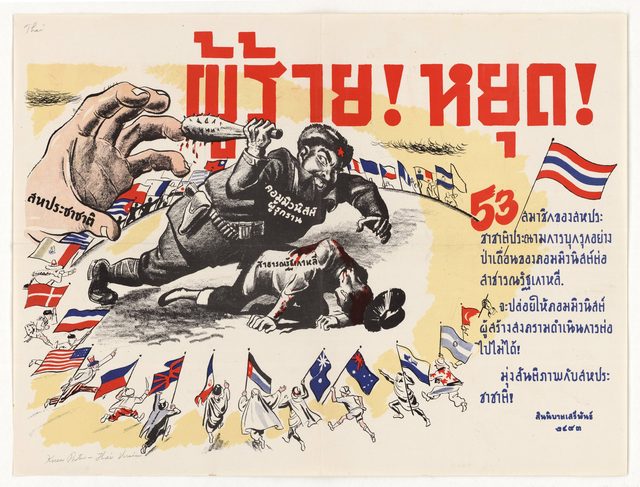
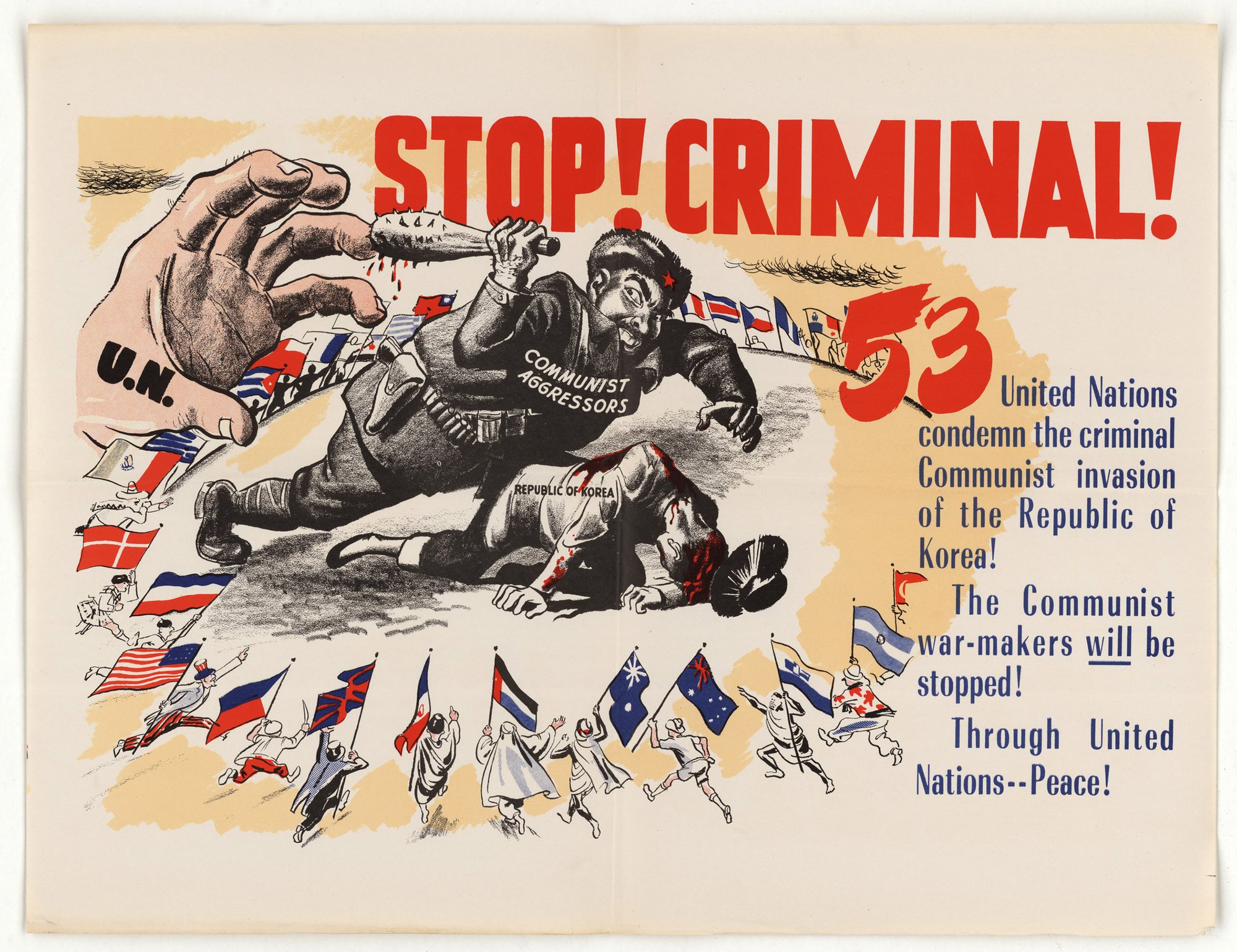
"Stop! Criminal!" exists in at least seven language editions; this is the English one. The series is dated 1950 to 1955. It says 53 United Nations "condemn the criminal Communist invasion of the Republic of Korea". The enemy is a caricature with a label, and a count of nations stands in for argument. Read the technique: name-calling.
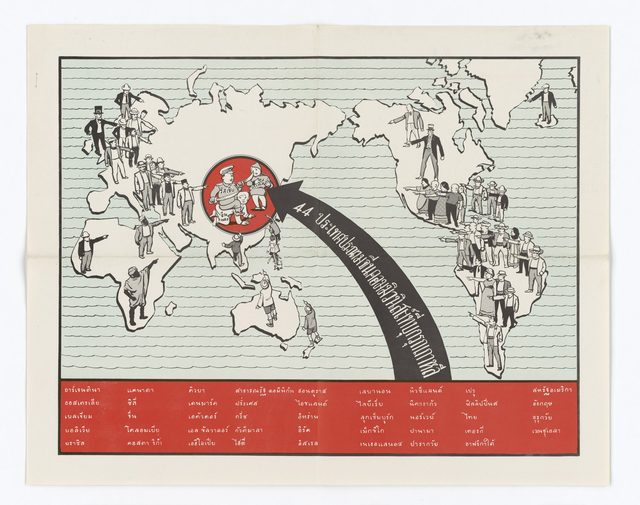
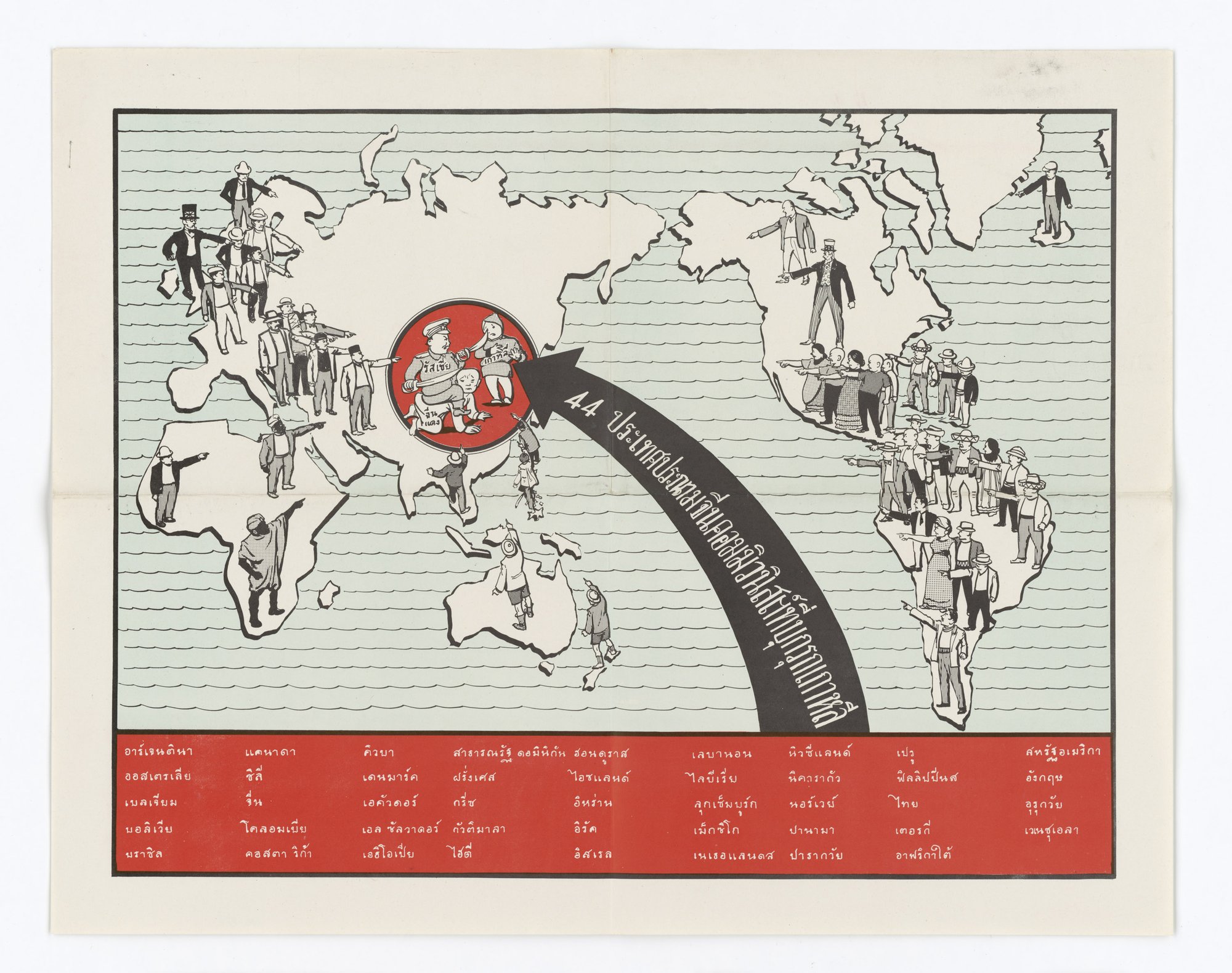
This Thai poster is dated 3 May 1951. Dozens of figures point at a figure labelled Russia holding a sword over one labelled Red China, with Korea beside them. A red band lists 44 country names, and the number is the whole argument. Read the technique: bandwagon.
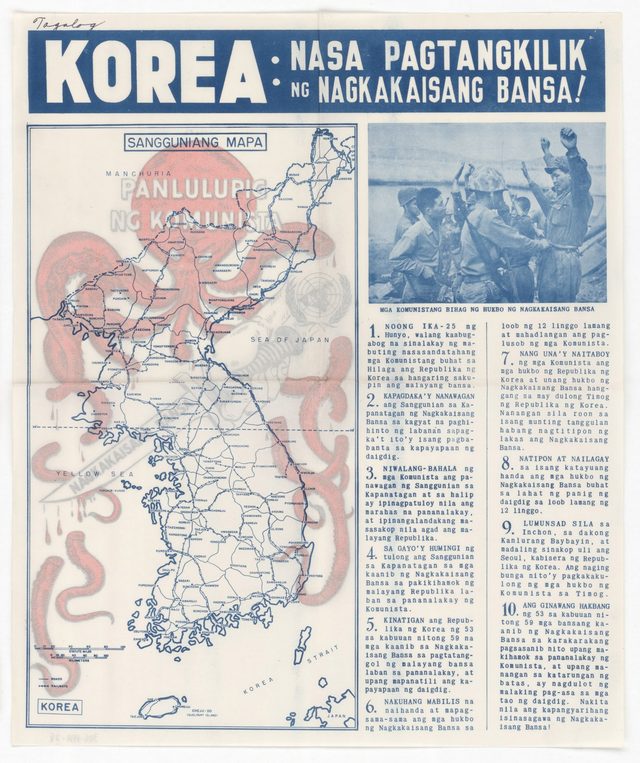
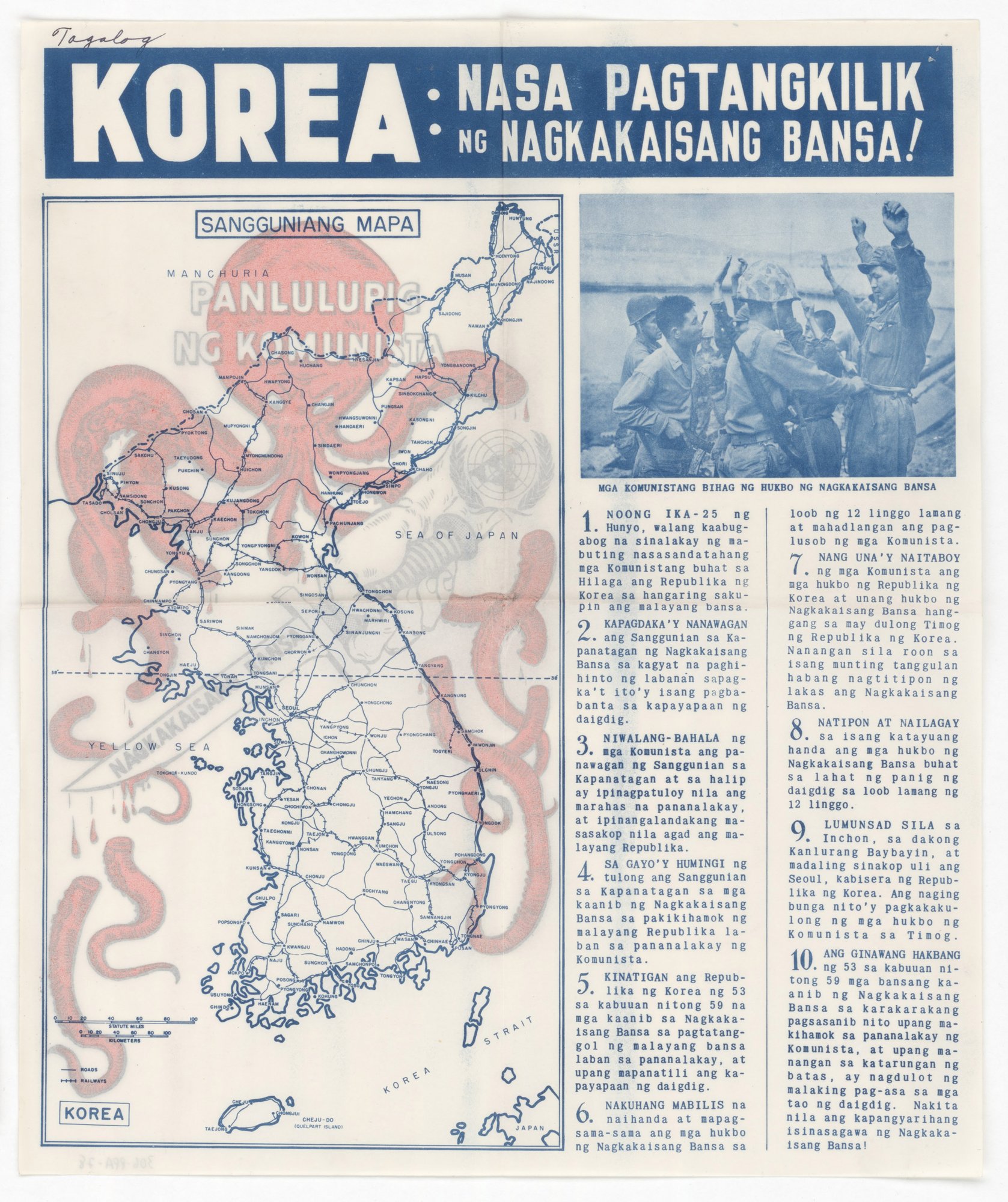
A Tagalog sheet from the 1950 end of the series gives a ten-point account of the UN response and says 53 of 59 UN members backed the Republic of Korea. The octopus attaches a stigma image to one side, and only UN actions are listed. Read the technique: transfer.
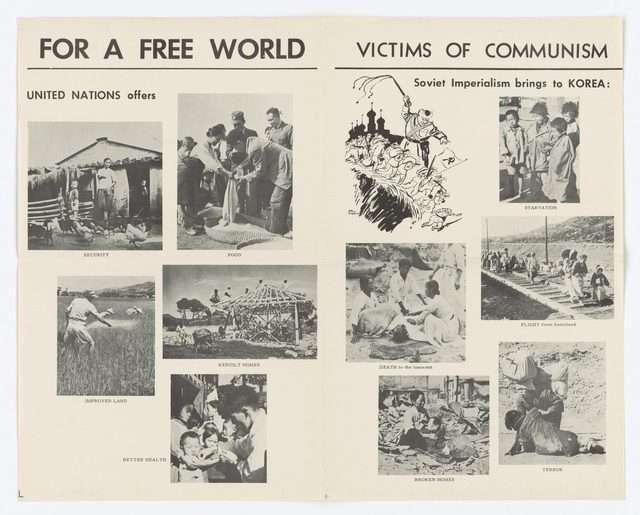
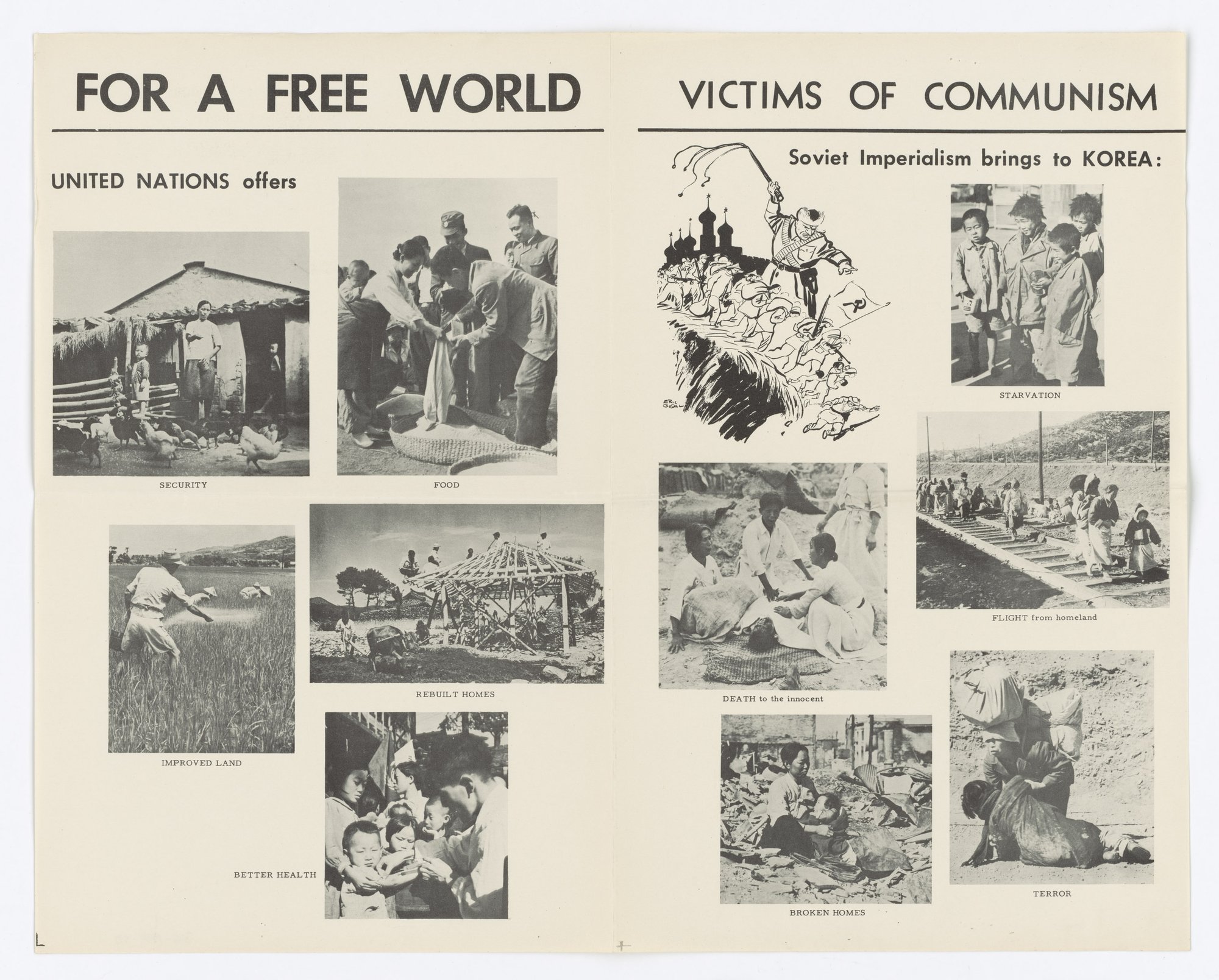
Dated 12 September 1951, this sheet sets photographs of security, food and rebuilt homes beside photographs of starvation, flight and death under "Soviet Imperialism brings to Korea". The right-hand photographs show civilians in wartime Korea, and the sheet attributes the suffering to one party. Read the technique: card-stacking.
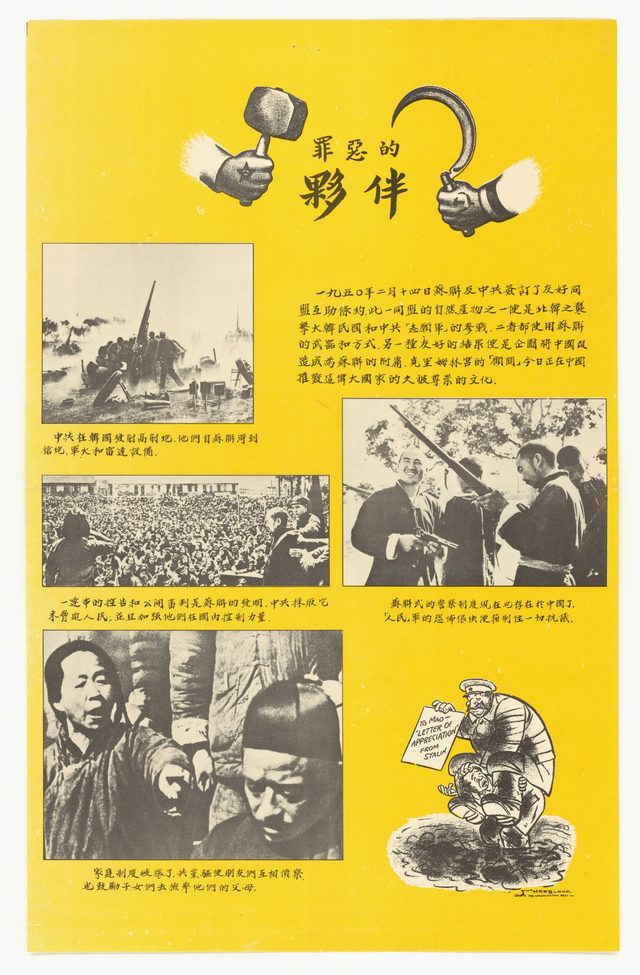
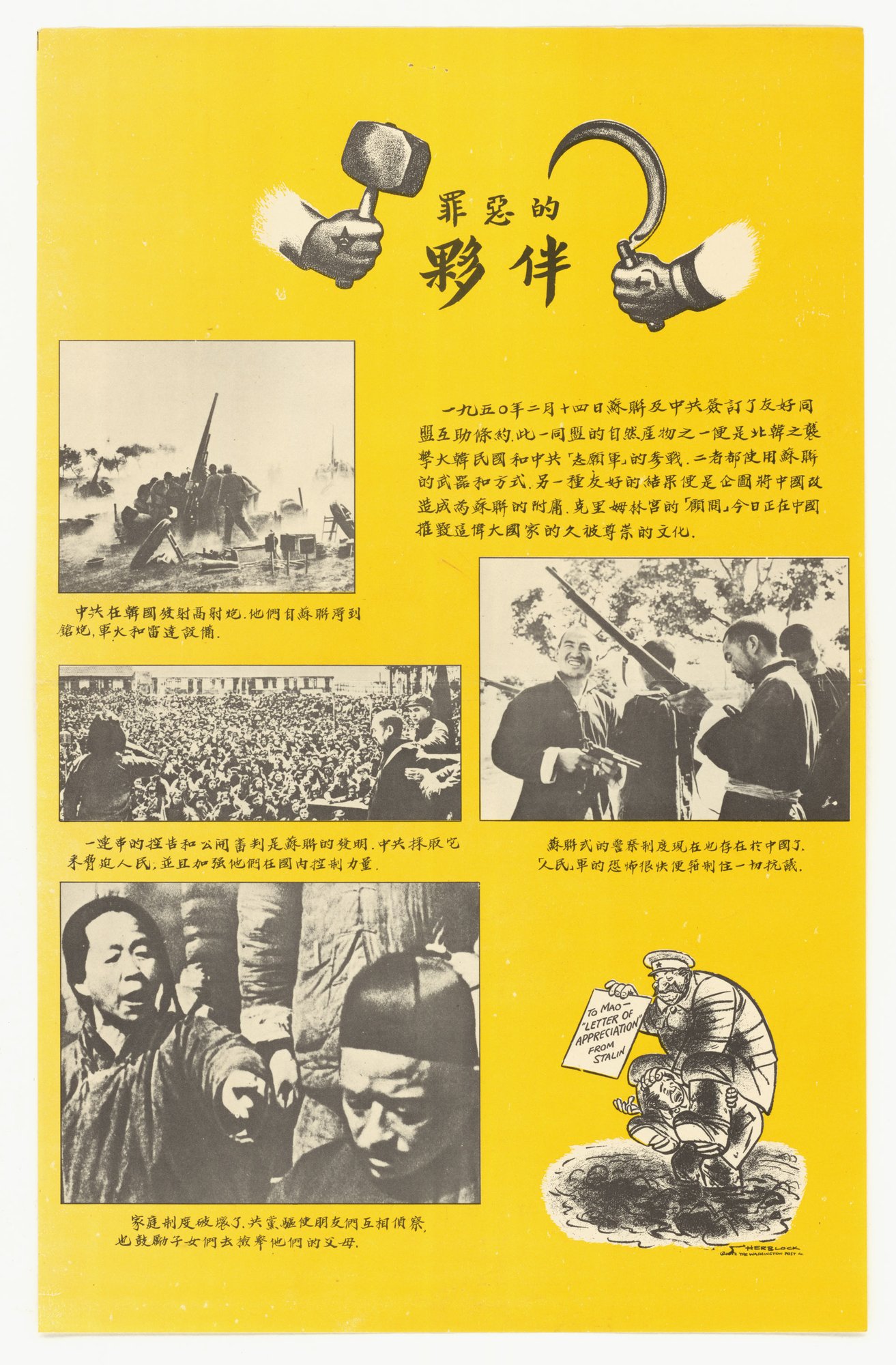
The 26 May 1952 sheet calls the Sino-Soviet alliance a criminal partnership and ties it to North Korea's attack. The photographs are not individually sourced on the sheet. Read the technique: name-calling.
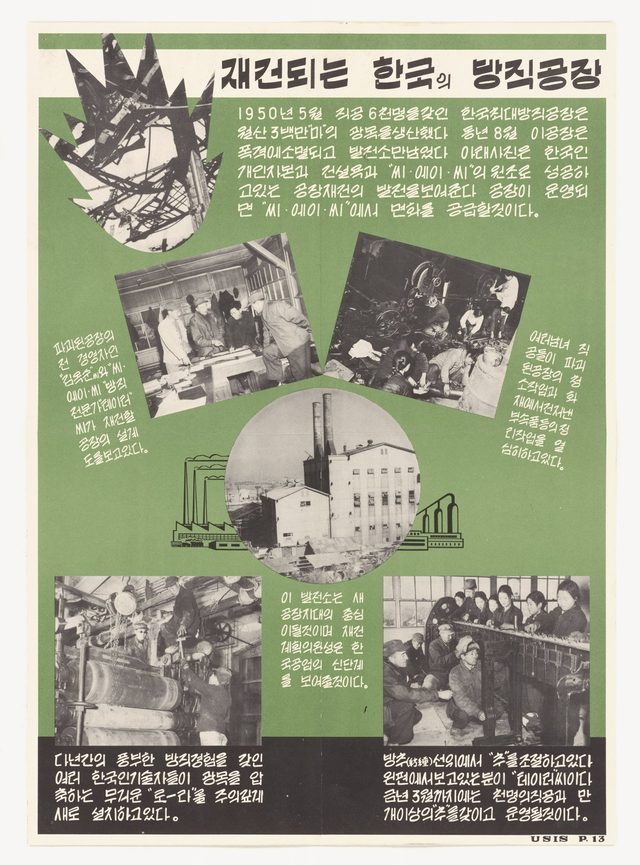
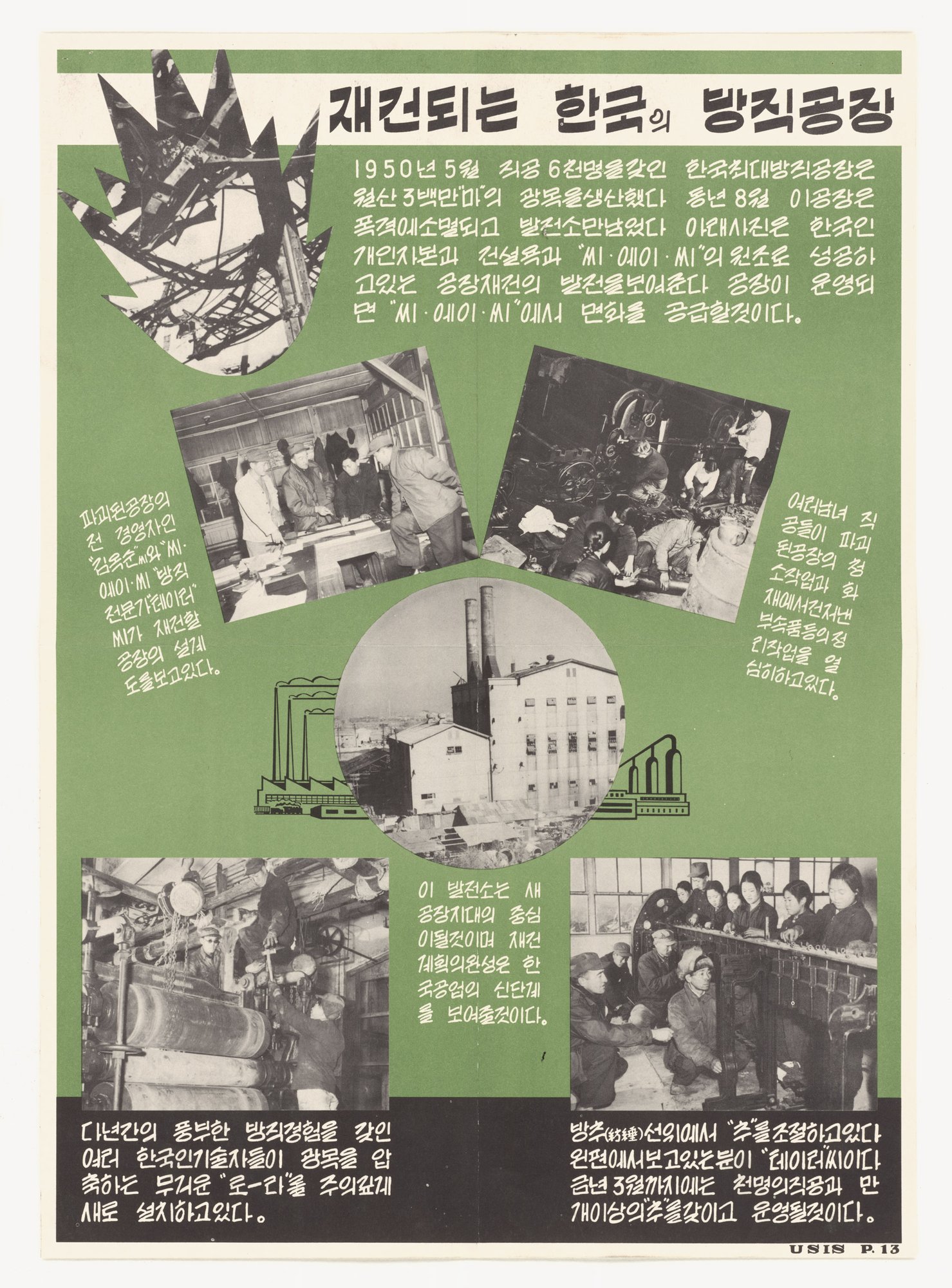
Not every sheet is about the enemy. This 27 February 1953 poster carries a "USIS" footer and tells Korean readers that a plant destroyed in August 1950 is being rebuilt with Korean private capital and outside aid. Named ordinary workers carry the message. Read the technique: plain folks.
What did the germ-warfare allegation and the US rebuttal say?
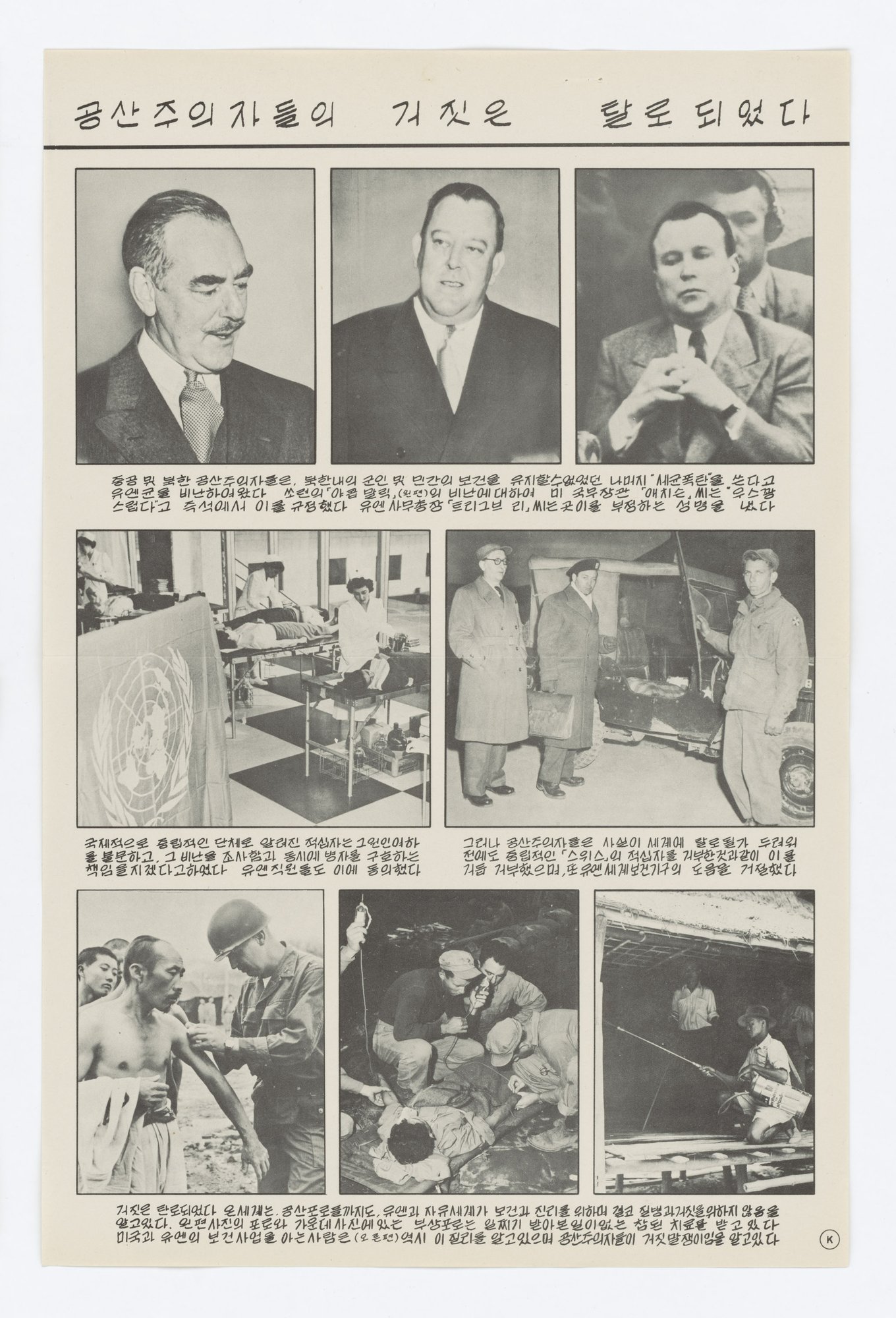
In 1952 the Chinese and North Korean governments, with Soviet backing, accused UN forces of using bacteriological weapons in Korea. The entries record the US answer, a photo poster issued in French and at least eight Asian languages.
Explain moreShow less
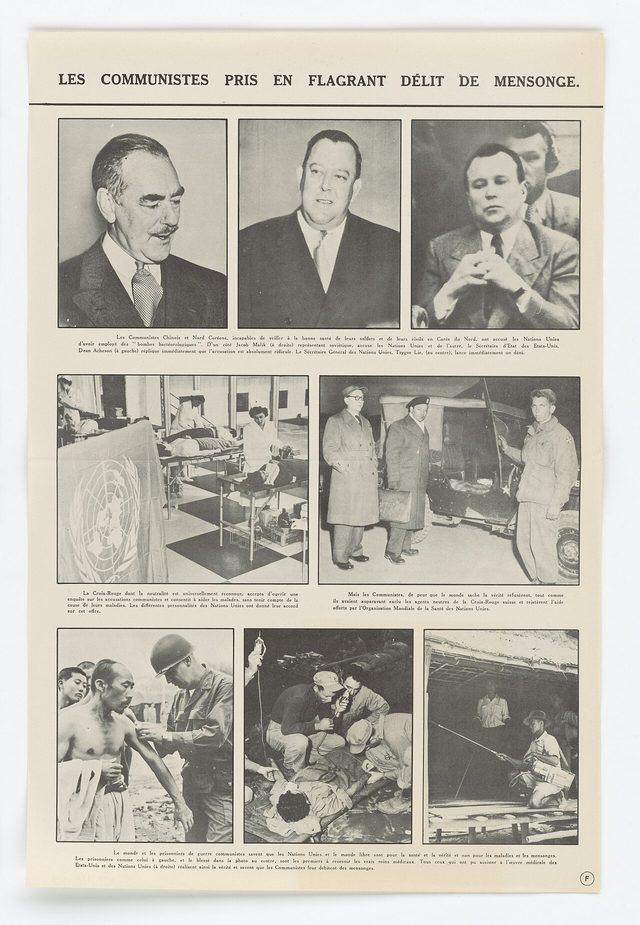
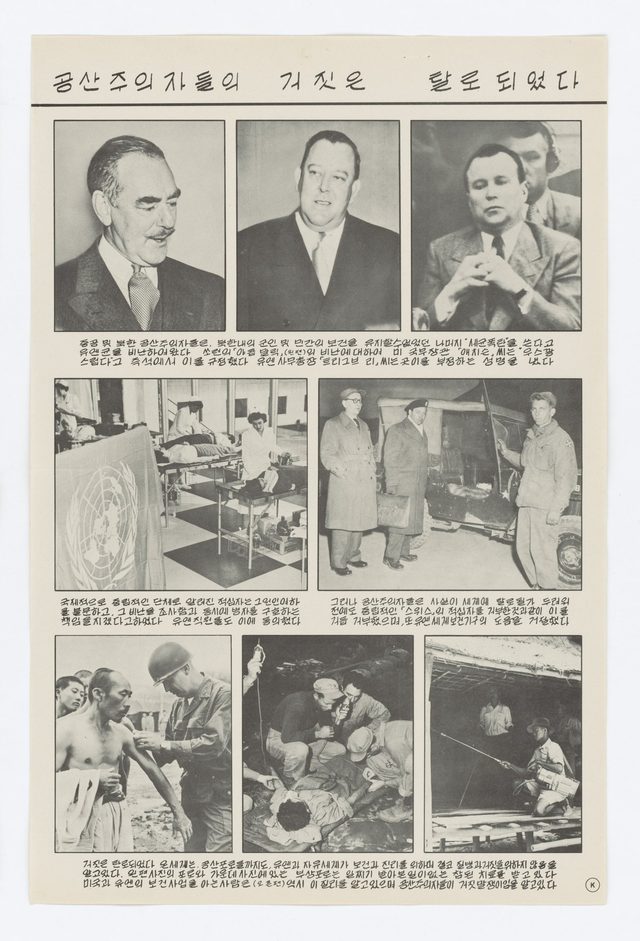
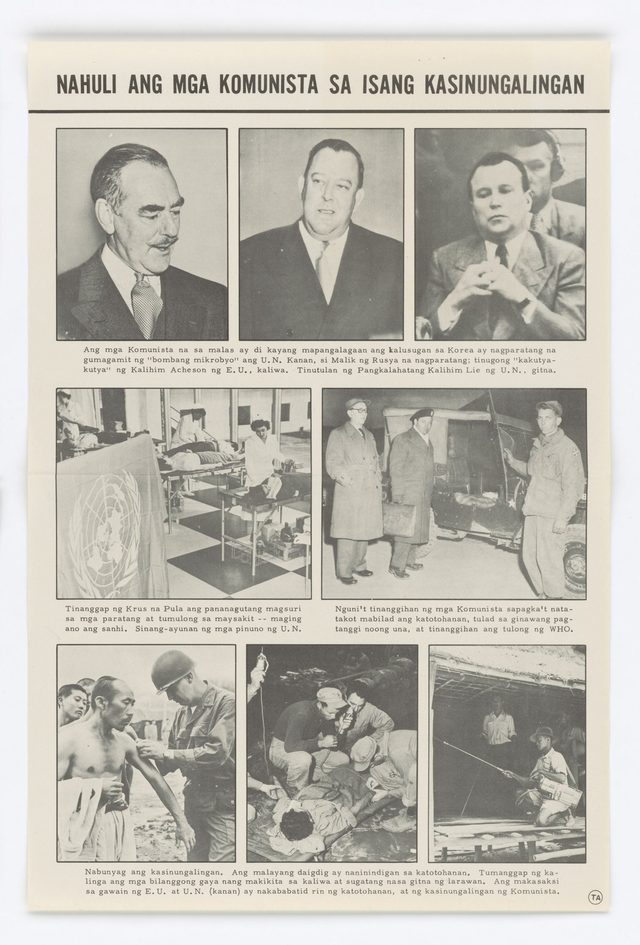
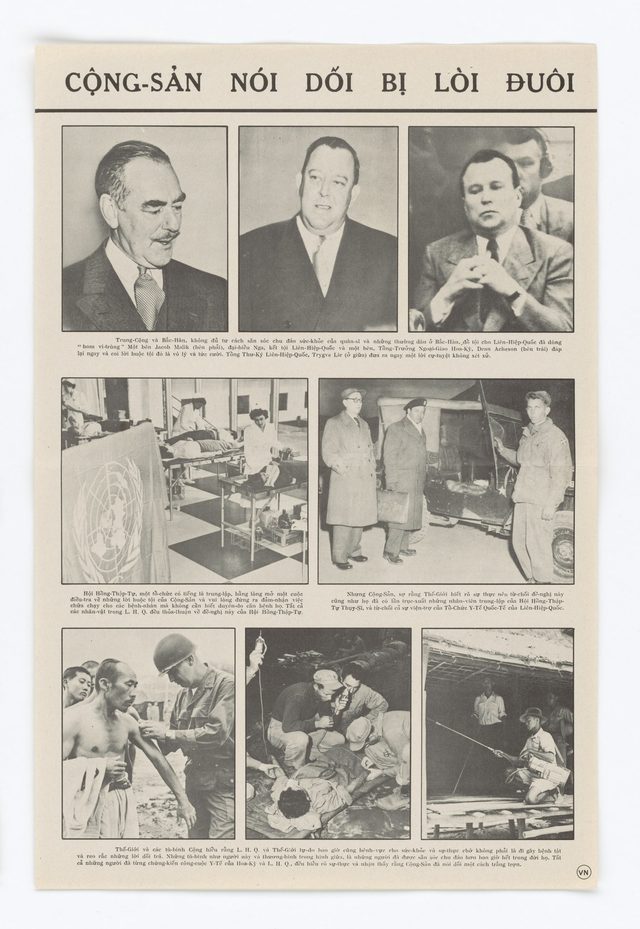
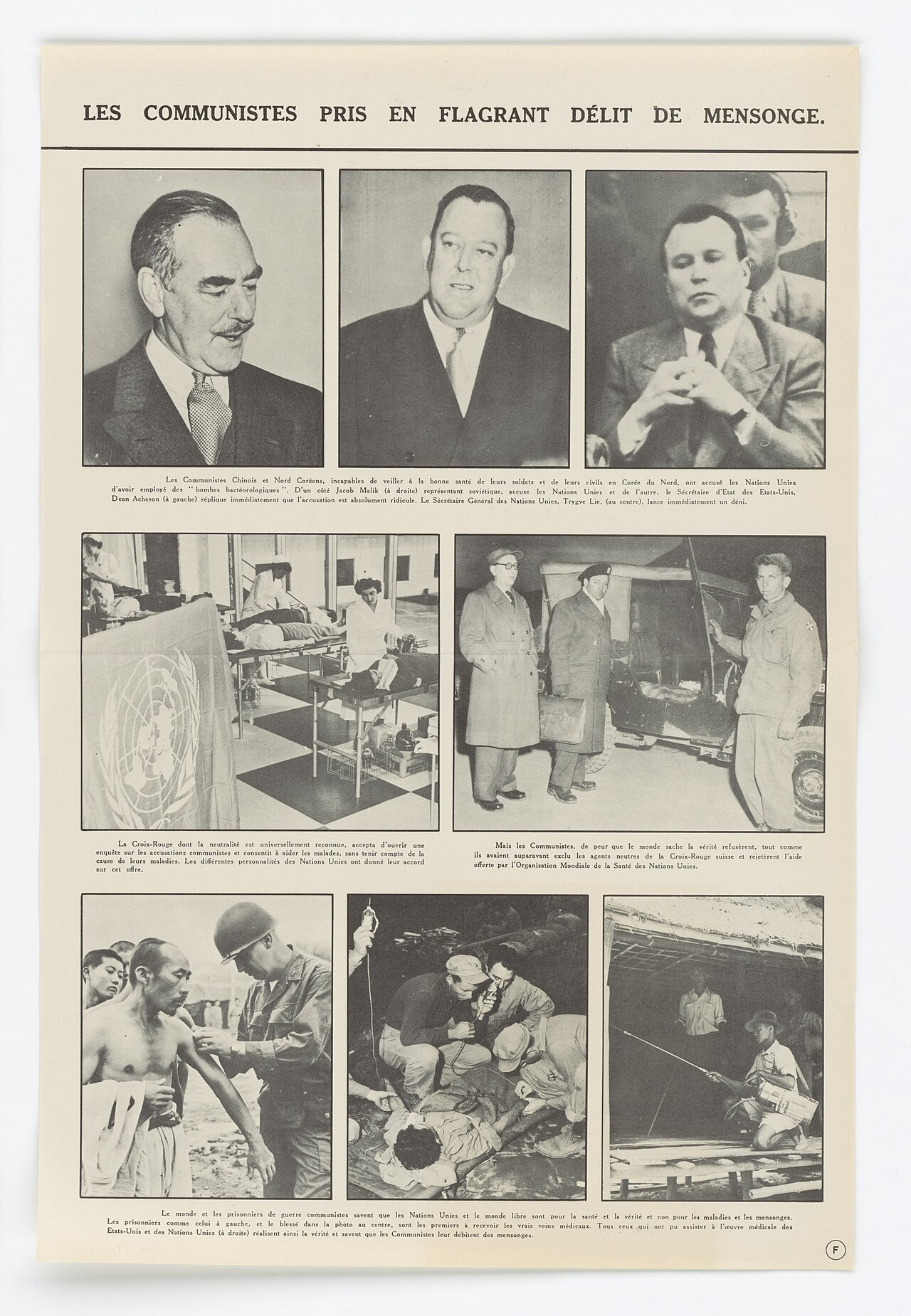
The poster, dated 8 May 1952, sets Jacob Malik's accusation beside Dean Acheson's and Trygve Lie's denials. It says the Red Cross offered to inquire and the Communists refused. The entry notes that the refusal of Red Cross and World Health Organization involvement is documented, and that a US draft resolution asking the Red Cross to investigate was vetoed by the USSR on 3 July 1952. The poster's explanation of the epidemics and of the refusal is asserted, not sourced. Its medical photographs do not bear on whether germ weapons were used. Read the technique: transfer.
The same layout exists in Hiligaynon, Chinese, Lao, Vietnamese, Korean, Khmer, Tagalog and Jawi Malay. In every edition the denials of officials serve as the rebuttal. Read the technique: testimonial.
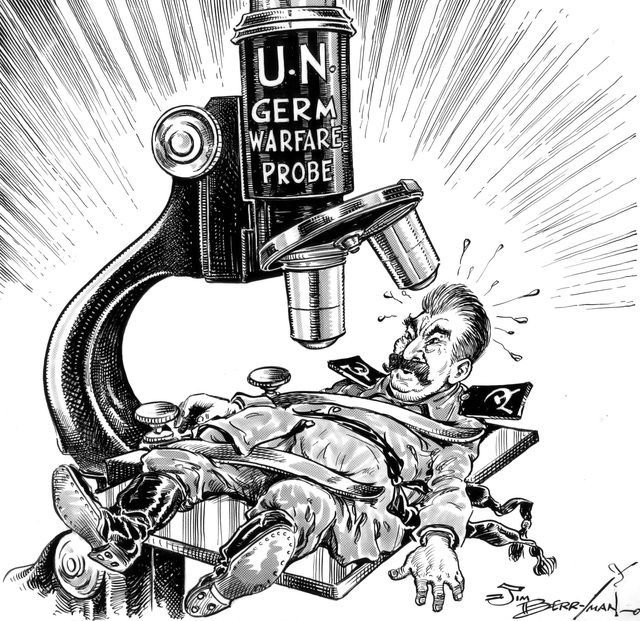
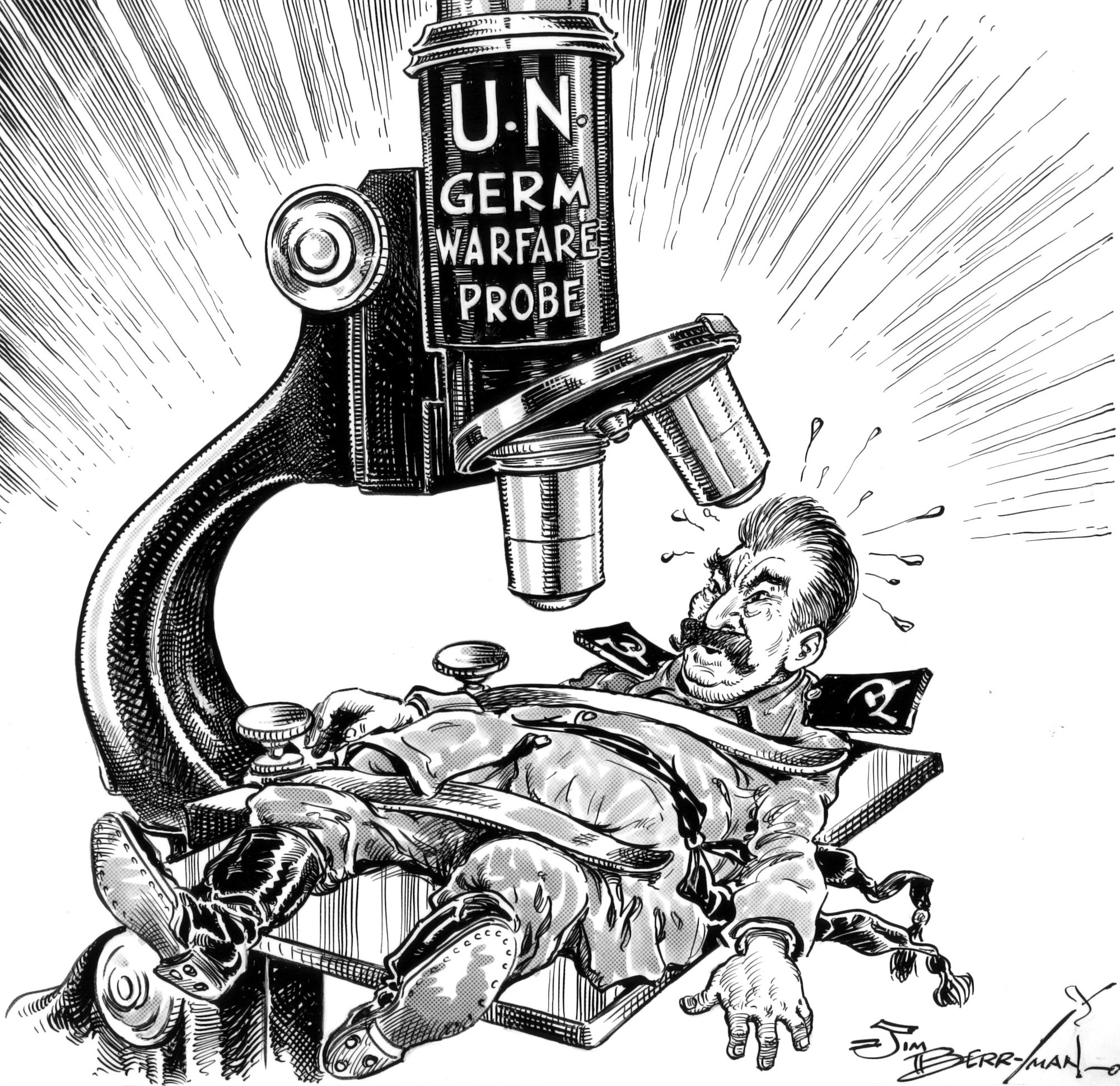
Berryman's cartoon of 22 June 1952 casts a man in a tunic with hammer-and-sickle tabs as the specimen under a UN probe. The entry identifies him as Stalin only by inference. It is a US cartoonist's view, not a finding. Read the technique: name-calling.
What the record shows is limited. The entries do not decide whether germ weapons were used and neither does this page. The entry for the French poster records that Soviet documents released in 1998 indicate evidence shown to foreign commissions was prepared, and that Endicott and Hagerman dispute that reading. The documents were published with analysis by Weathersby and Leitenberg in Cold War International History Project Bulletin 11. The full chronology is in the germ-warfare case study, which holds both positions and applies the same test to both posters.
What did North Korean and Chinese sheets say?
Seven held items come from the North Korean or Chinese side. Several name no issuer, and their attribution rests on the holding archive's records, as each entry says.
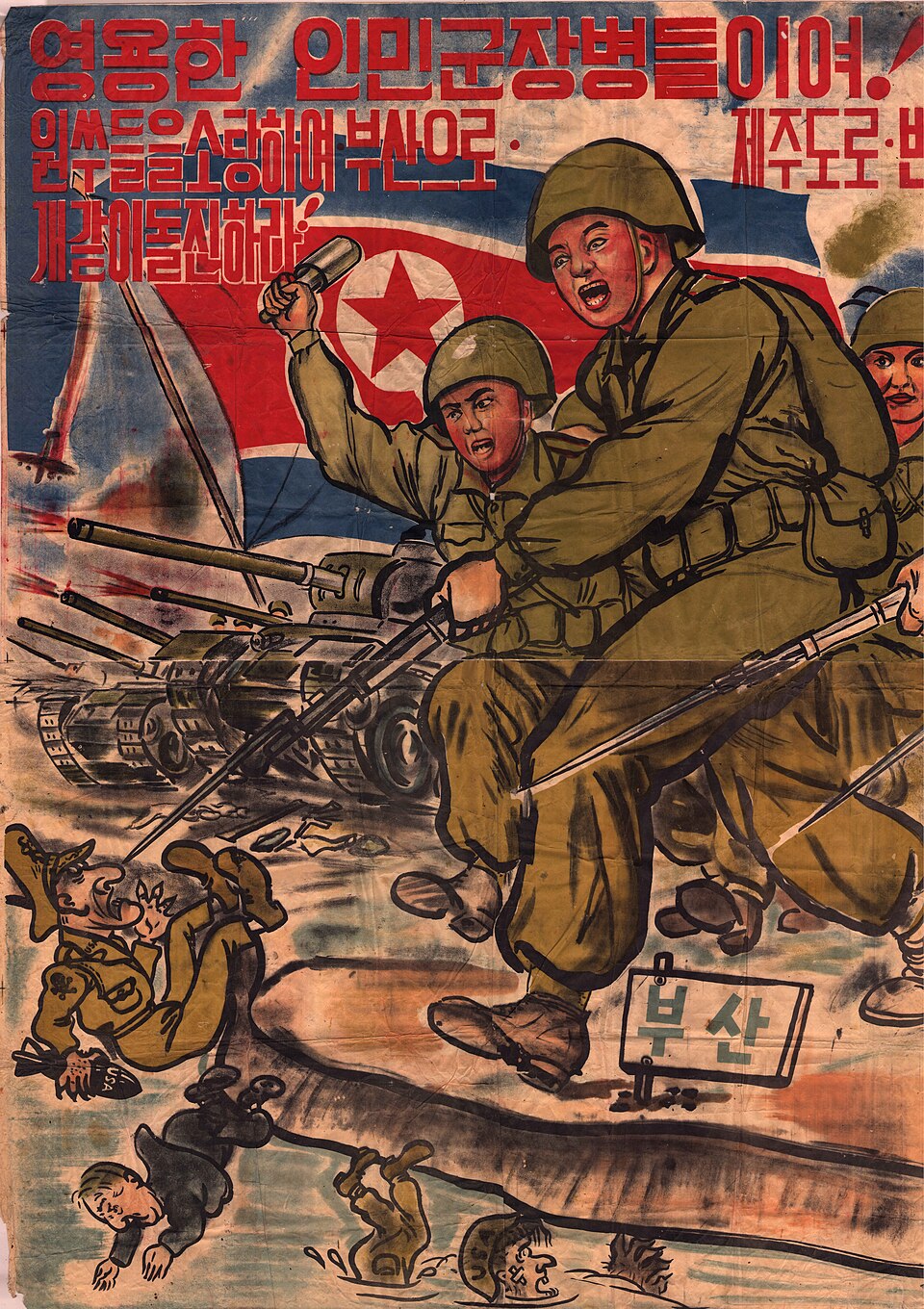
Content note: Wartime caricature of a U.S. soldier and a top-hatted figure as national enemies, with Korean War hunger and death imagery. This object is shown as it was published. Why 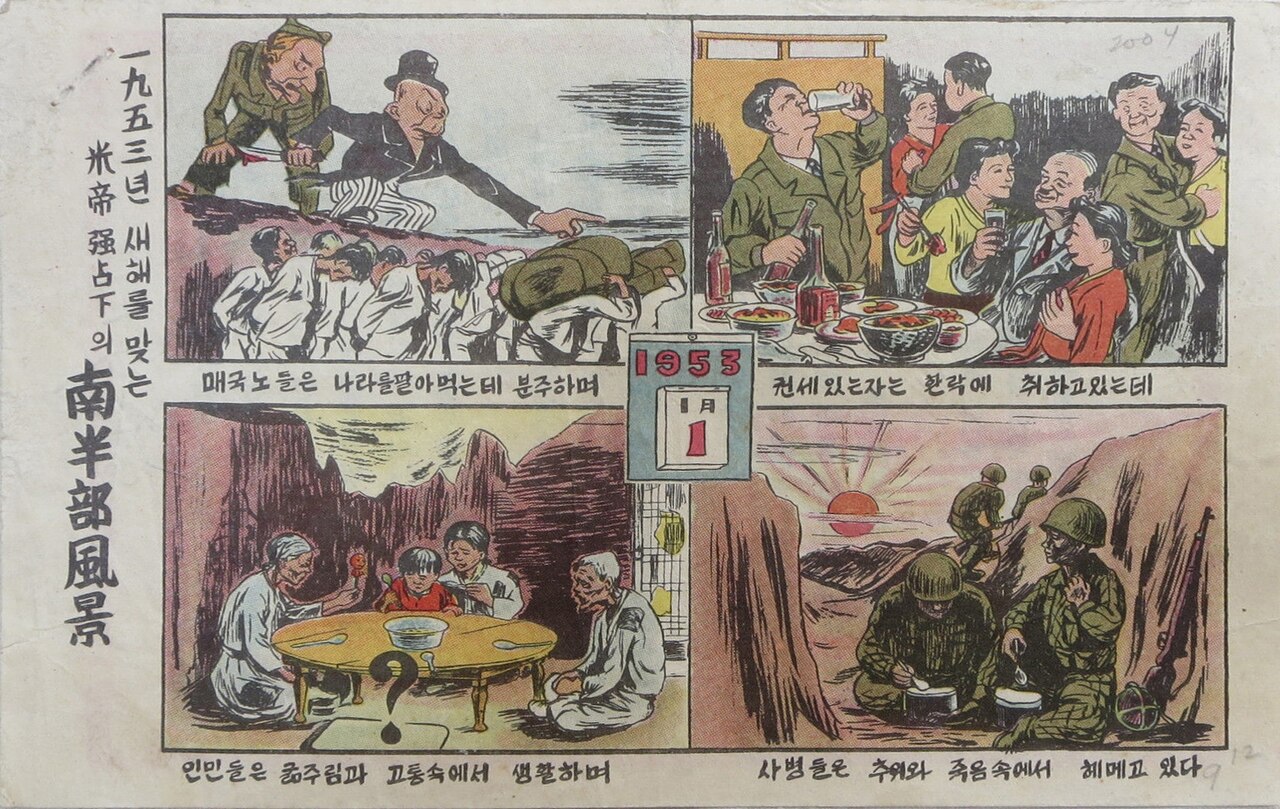
Explain moreShow less
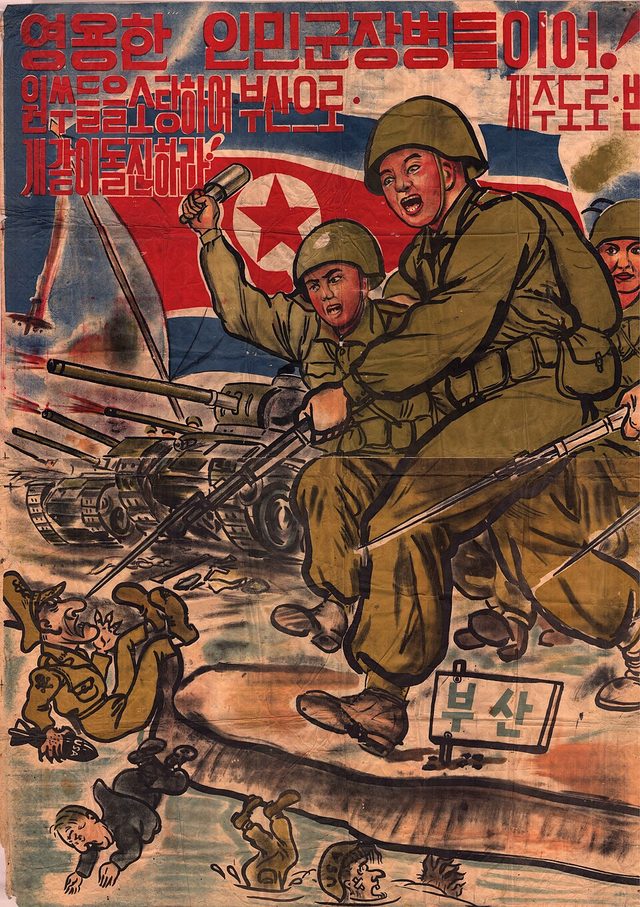
A hand-painted poster, filed under 1951 by the Marine Corps Archives, orders People's Army soldiers to wipe out the "wonssu" and charge to Busan and Jeju. Enemy soldiers lie bayoneted in the foreground, one holding a bomb marked "USA". The opponent is a label and a caricature. The entry's translation is FRAME's own, machine-assisted and unchecked by a fluent reader. Read the technique: name-calling.
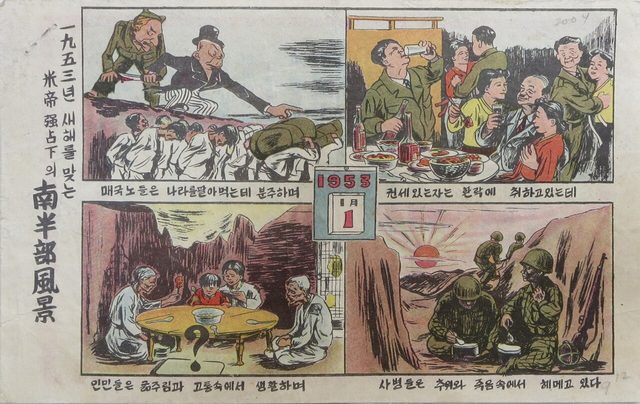
This Korean People's Army card, from the turn of 1952 to 1953, shows four chosen scenes of the South: "traitors busy selling the country", a banquet, a bare table and soldiers in a cold trench. The entry notes that hunger, conscription and displacement in the South are documented elsewhere, and that the leaflet's move is to attribute all of it to one party. Read the technique: card-stacking.
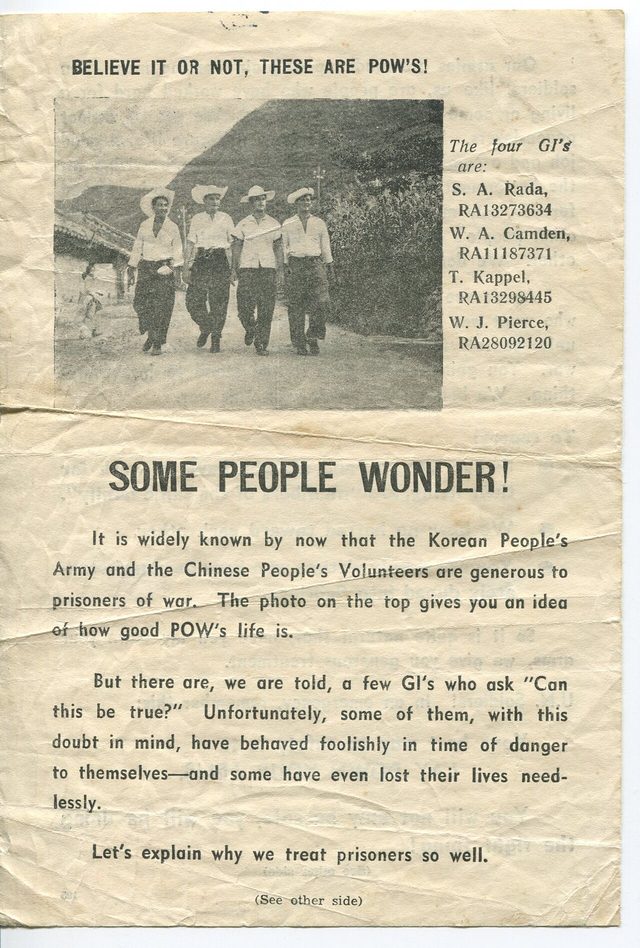
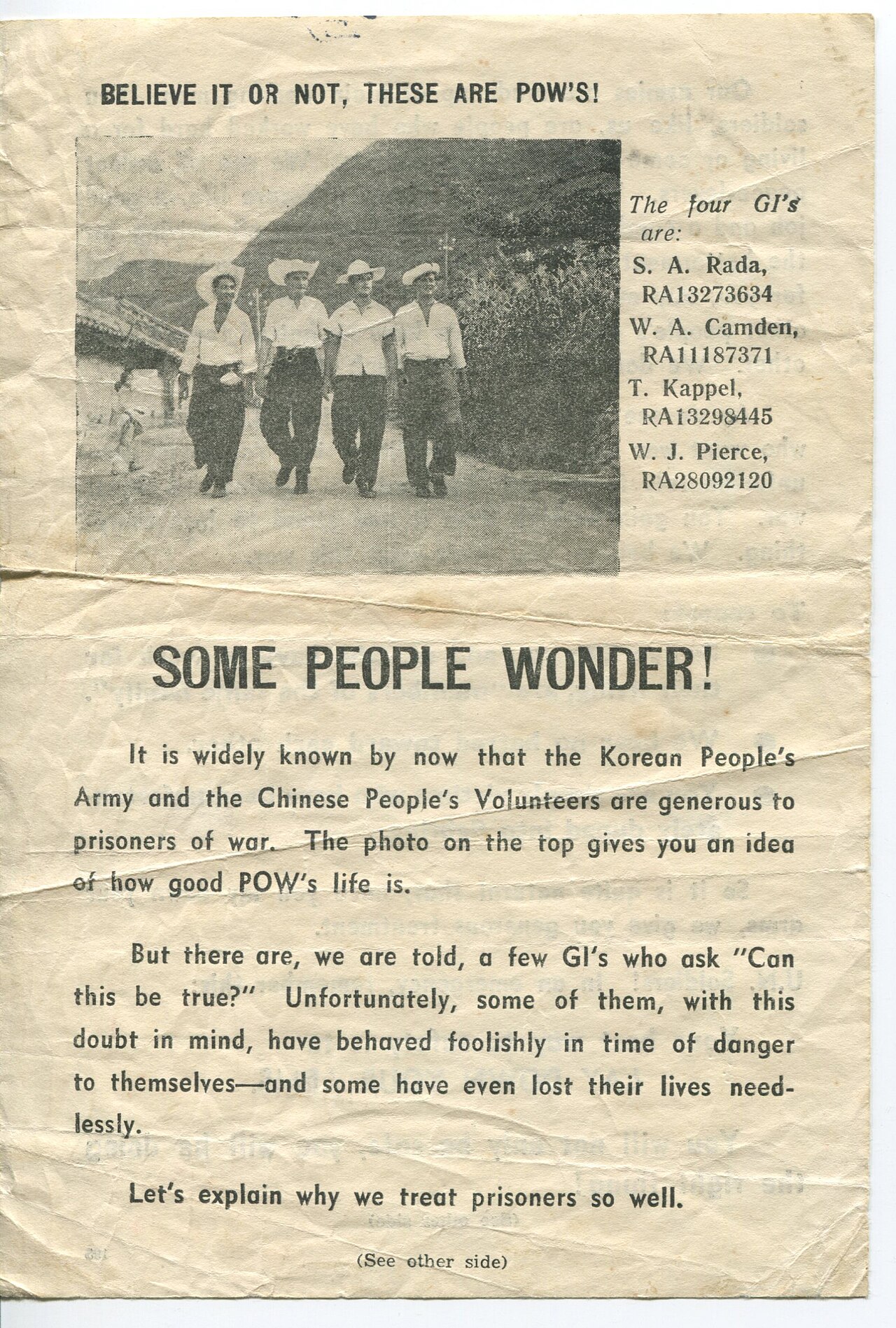
Issued in the names of the Korean People's Army and the Chinese People's Volunteers, this English leaflet prints four captured GIs' names and service numbers as proof of good treatment and blames "a few U.S. billionaires" for the war. The claims are the issuer's, not findings. Read the technique: scapegoating.
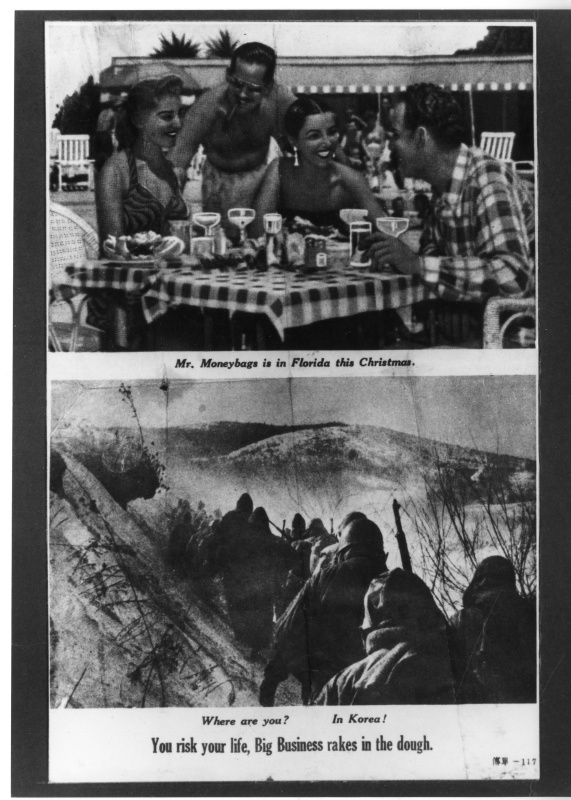
The Truman Library holds this leaflet, catalogued about December 1951 and described as from the Communist forces. Its issuer is unnamed, and a small Chinese mark is the only basis for the Chinese tag. The pairing of home comfort and front-line risk assigns the war's costs to two groups. Read the technique: scapegoating.
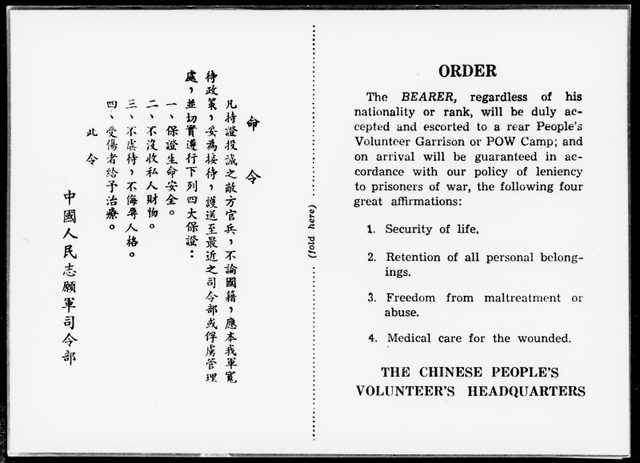
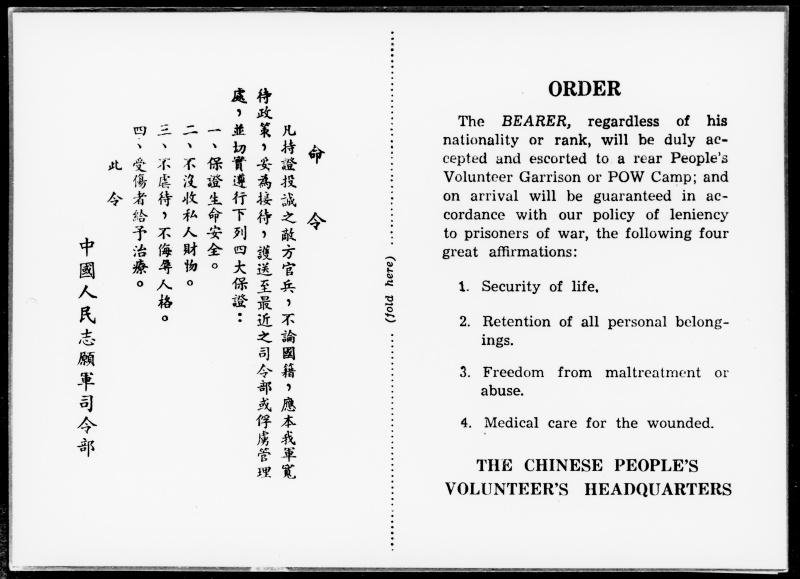
The pass promises security of life, retention of belongings, no maltreatment and medical care for the wounded. The entry says the pass scores only what it states, and that treatment of UN prisoners is documented from other sources. Both sides issued passes. Read the technique: card-stacking.
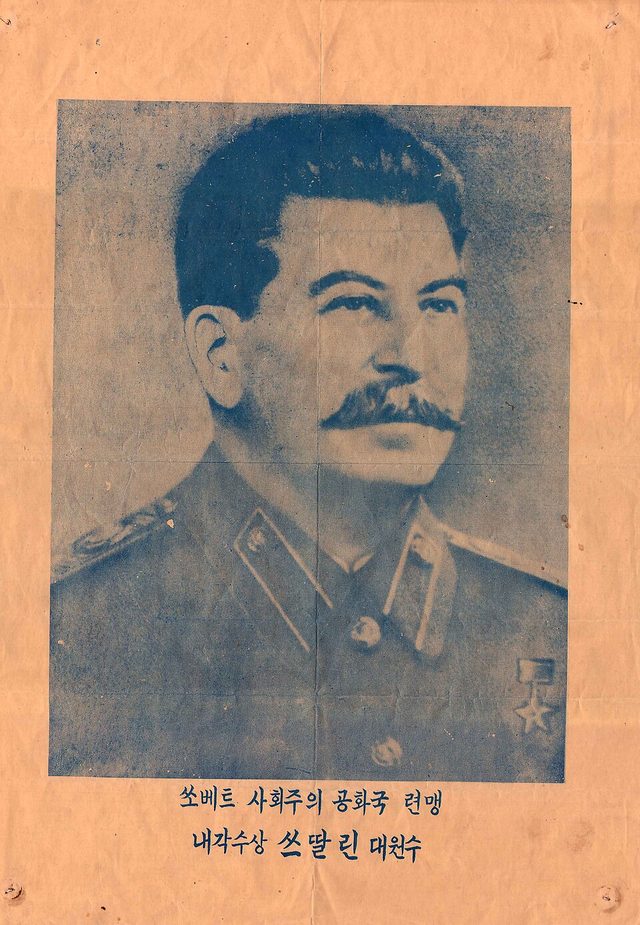
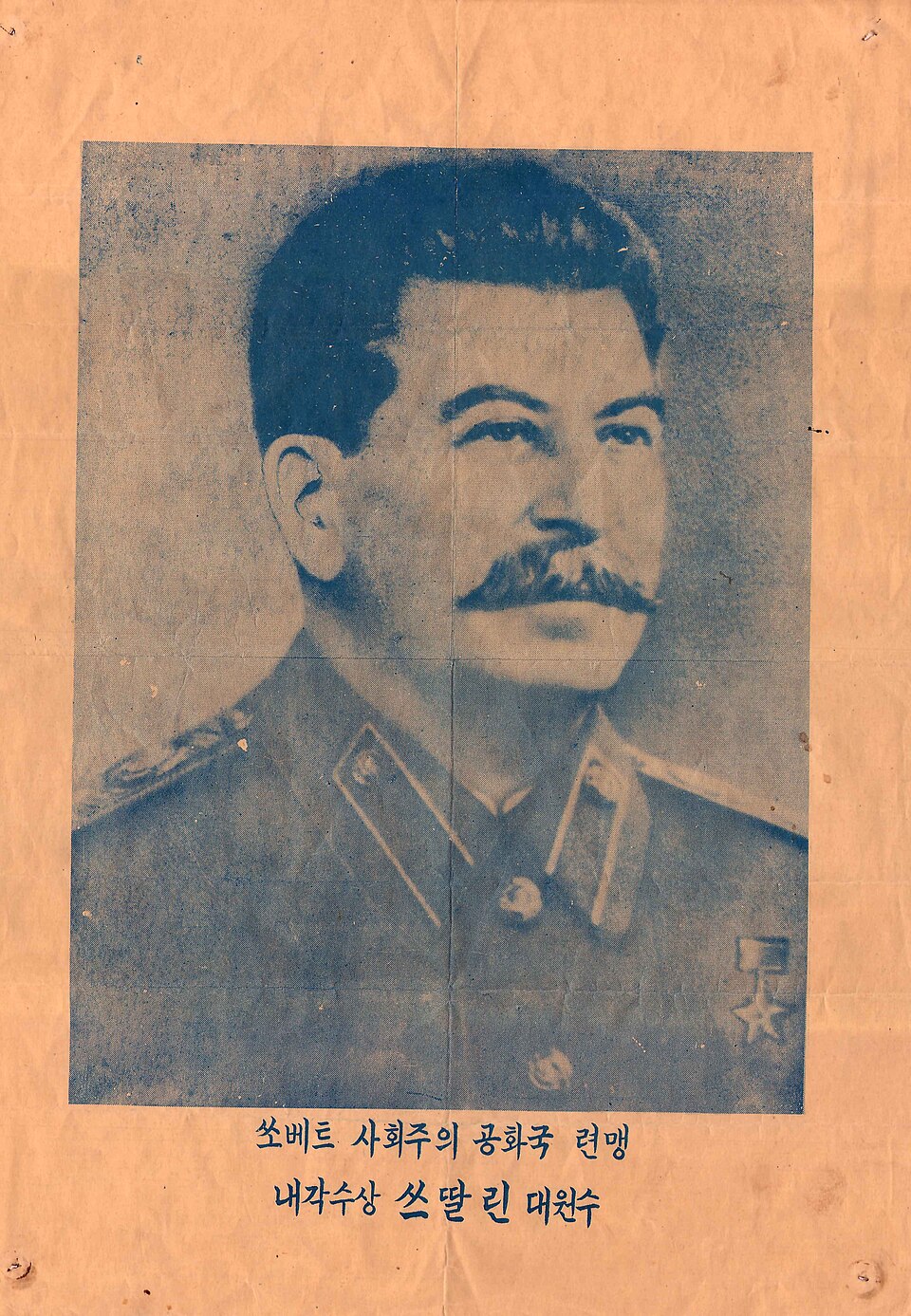
The sheet is a portrait and a rank, with no slogan, issuer or date, filed as North Korean on the Marine Corps Archives' attribution. Its caption translation is machine-assisted. The entry notes that portraits of allied leaders were used by both sides. Read the technique: transfer.
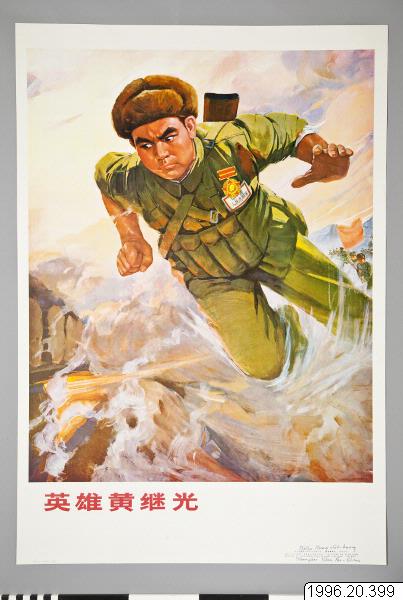
A Shanghai poster of 1973, twenty years after the war. In the Chinese official account, Huang Jiguang was killed in October 1952 at Triangle Hill. The only text is his name. One martyr's image carries the message. Read the technique: transfer.
What did UN Command leaflets ask enemy soldiers and civilians to do?
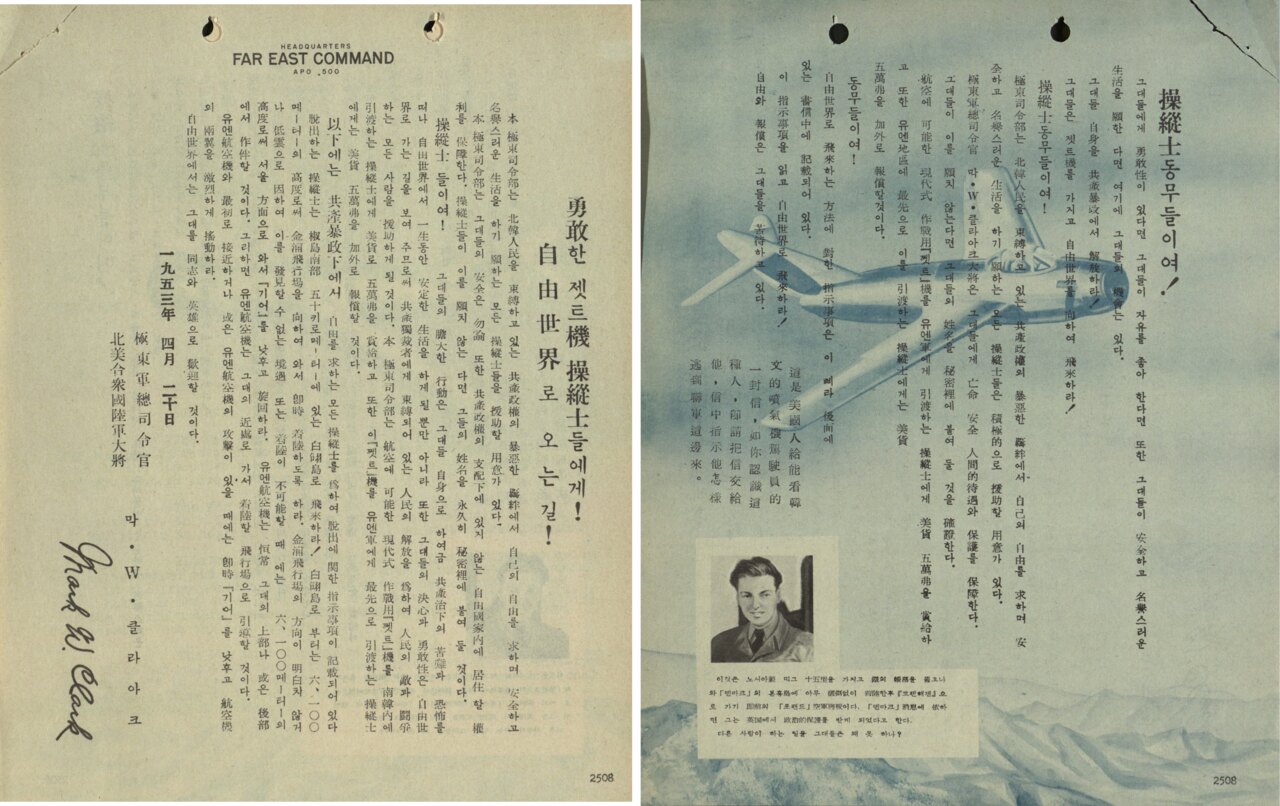
UNC leaflets were printed by Far East Command and the Eighth U.S. Army and dropped on North Korean and Chinese lines. Many carry only a serial number.
Explain moreShow less
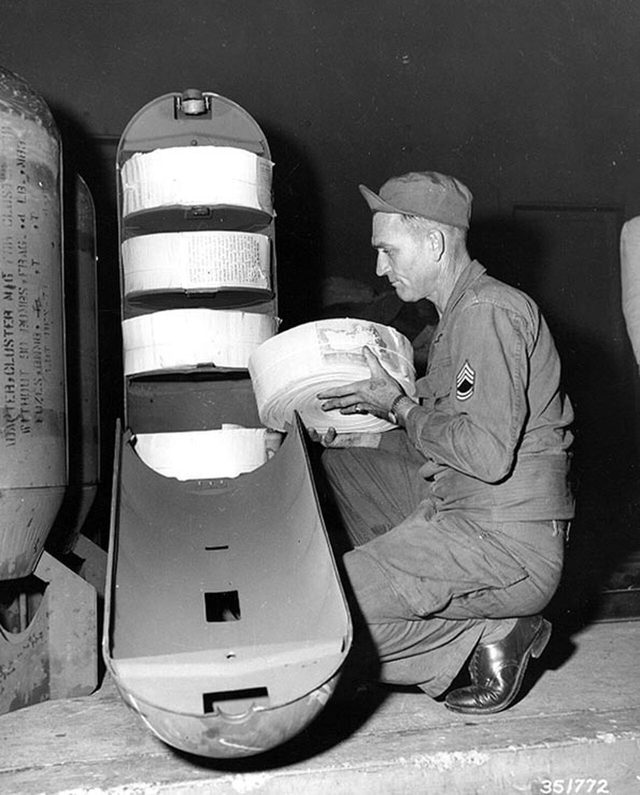
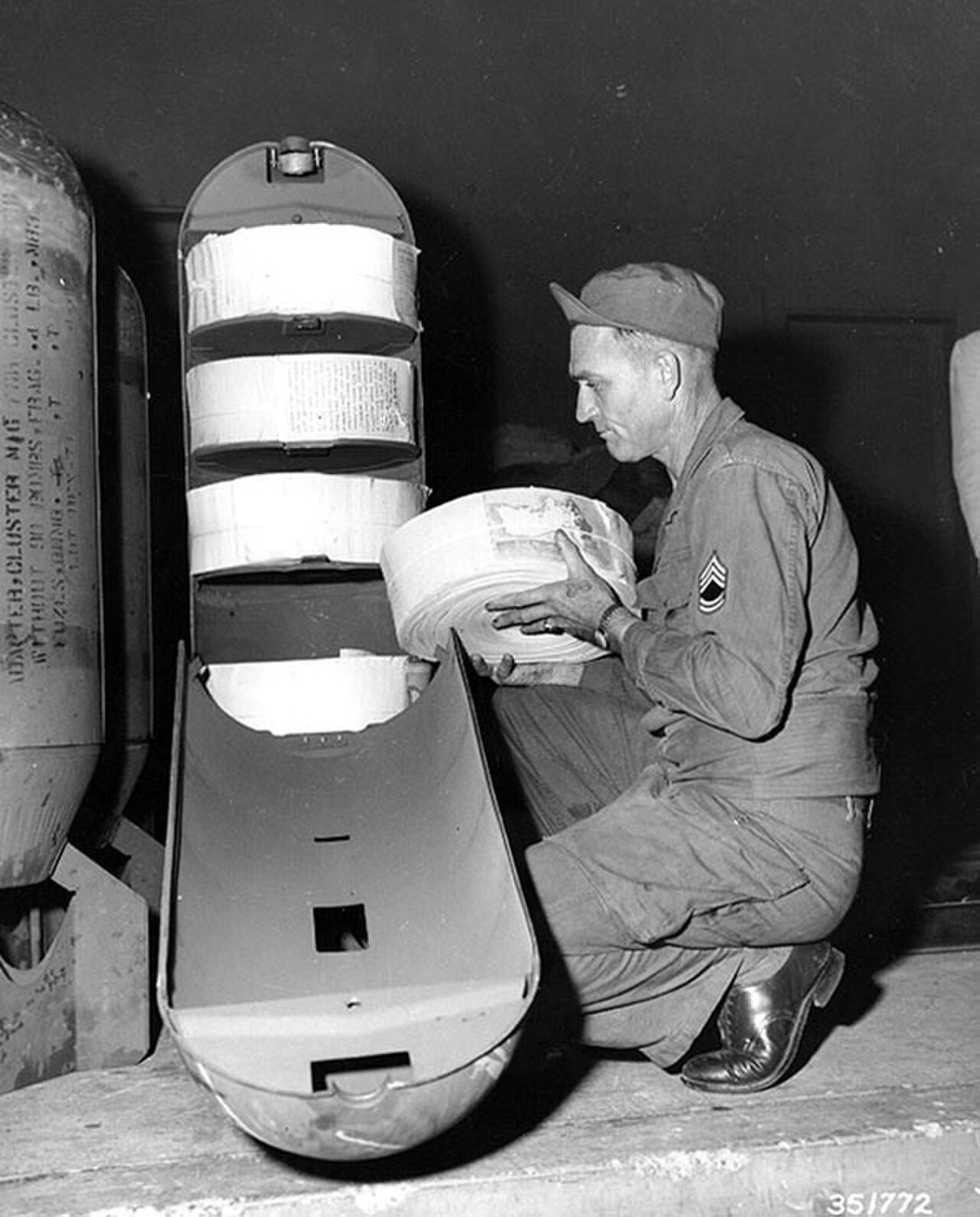
This official photograph shows an adapter that holds 22,500 leaflets of 5 by 8 inches. It records delivery by volume. Read the technique: flooding the zone.
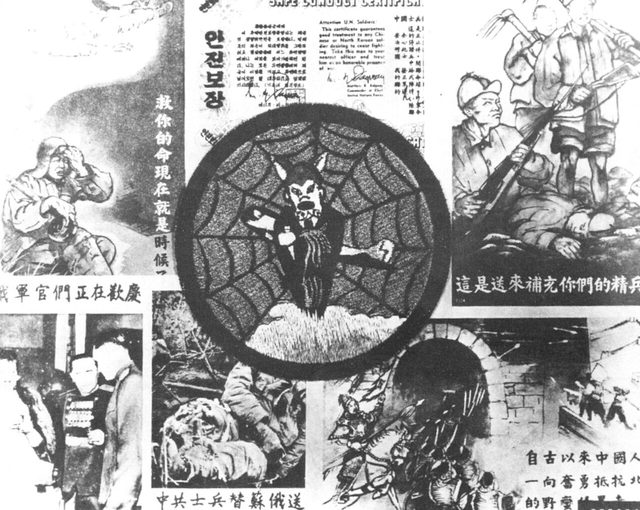
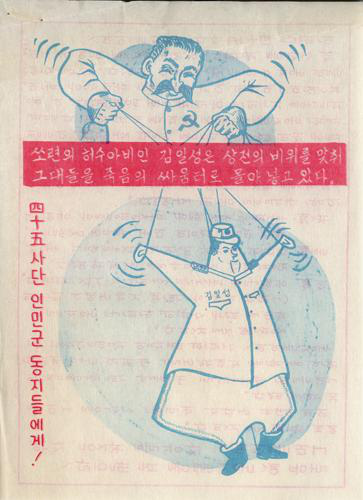
An Eighth Army leaflet calls Kim Il Sung "the Soviet Union's scarecrow" who is "driving you into a battlefield of death". A loaded label and a death warning replace evidence about the battle. Read the technique: name-calling.
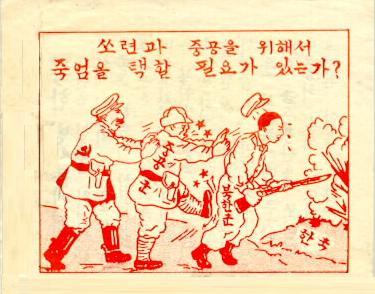
The 1951 cartoon recasts the war as a foreign errand. The entry notes it omits that Chinese forces entered the war at North Korea's side in October 1950. Read the technique: fear appeal.
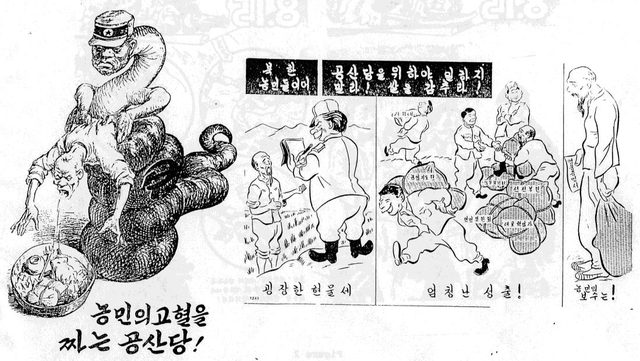
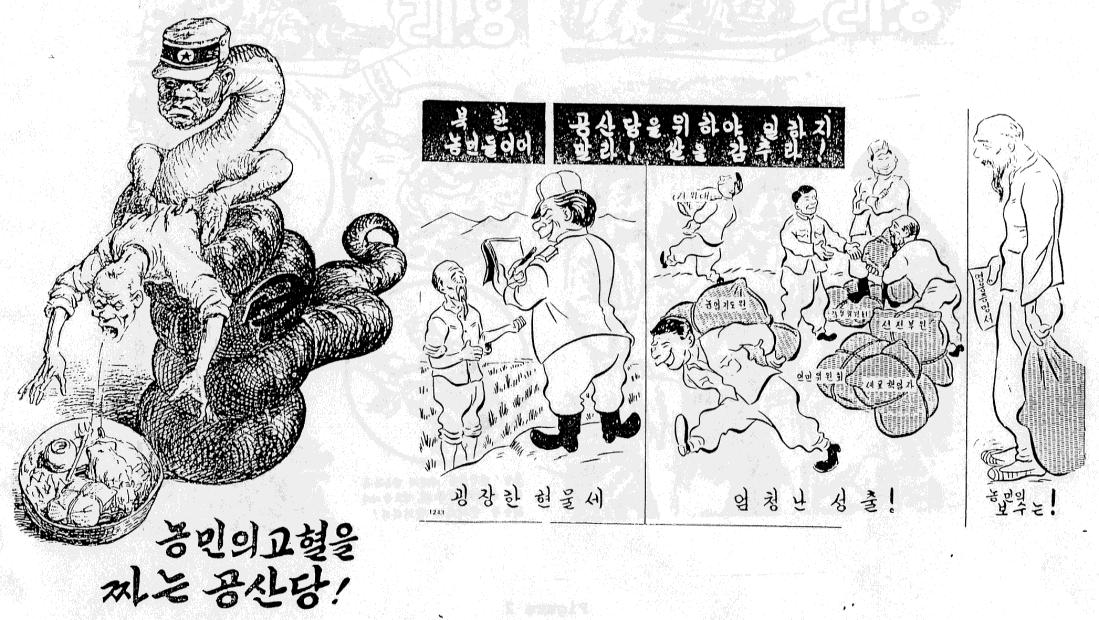
Leaflet 1243, dated 18 November 1952 in a cited paper, lists only the burdens of the tax in kind and tells farmers to hide their rice. The land received under reform is not mentioned. Read the technique: card-stacking.
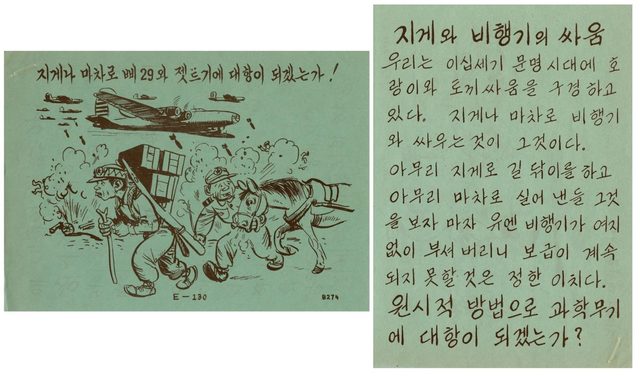
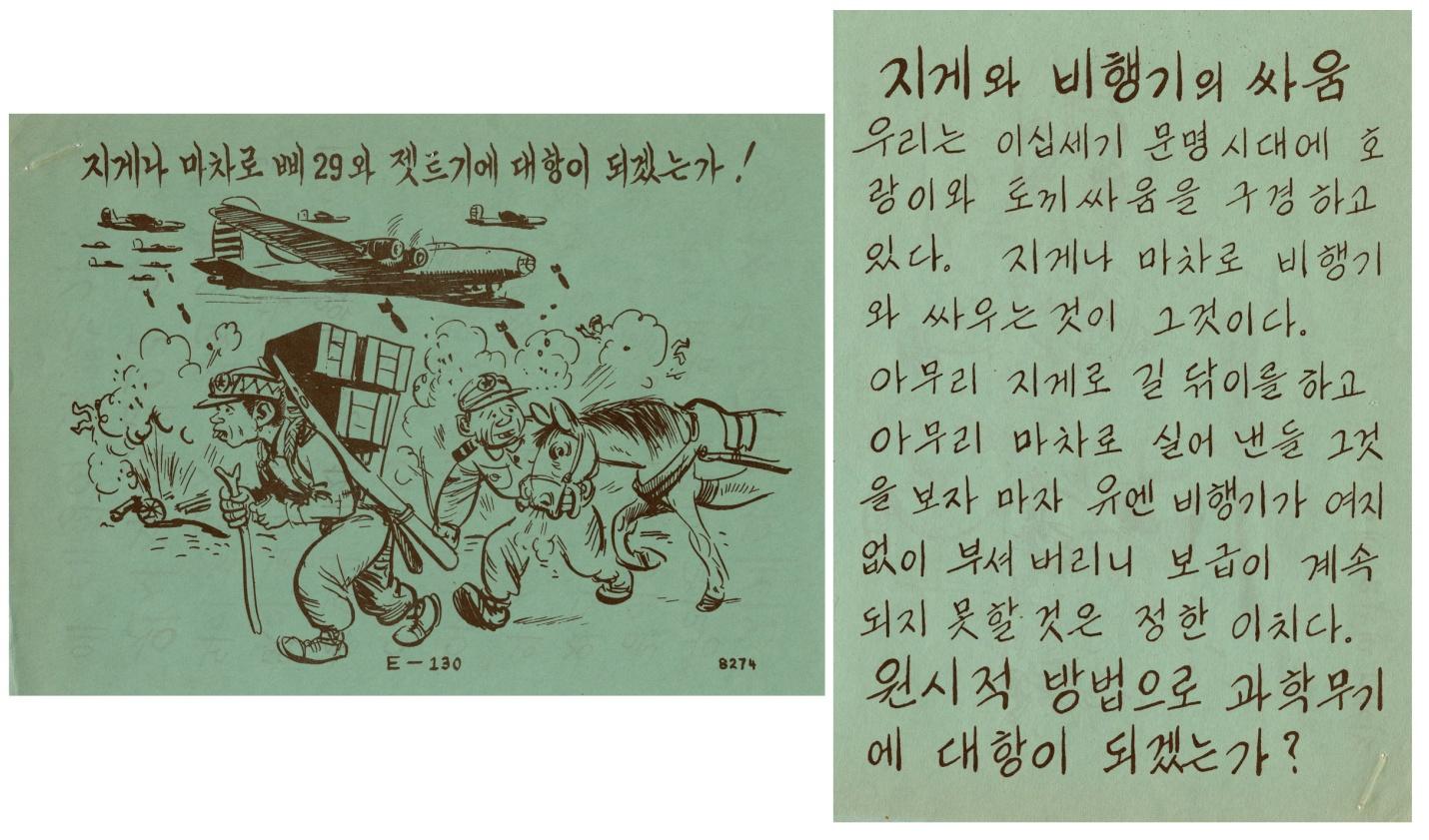
Leaflet 8274 turns a real gap in air power into a prediction about the reader's own fate. Read the technique: fear appeal.
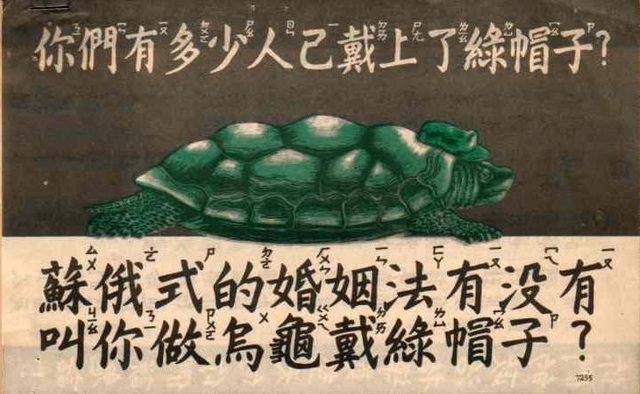
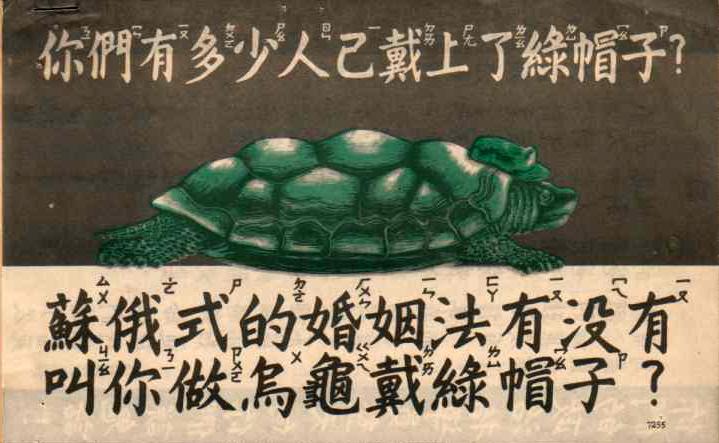
Leaflet 7255 uses a Chinese idiom for a cuckold to ask whether the "Soviet-Russian-style marriage law" has made readers one. The entry says it states no fact about any soldier's household. Read the technique: name-calling.
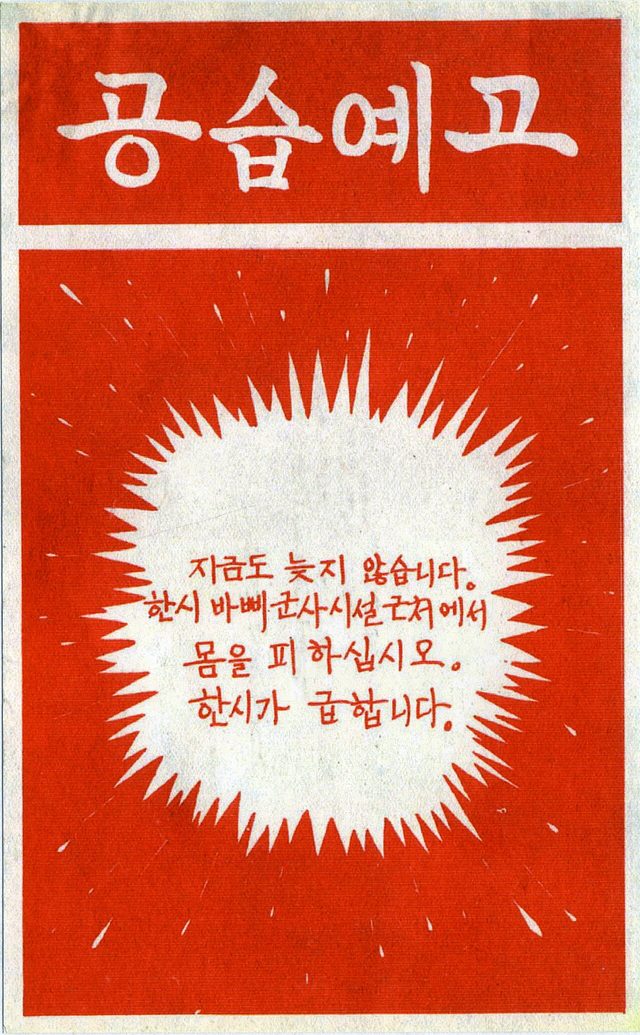
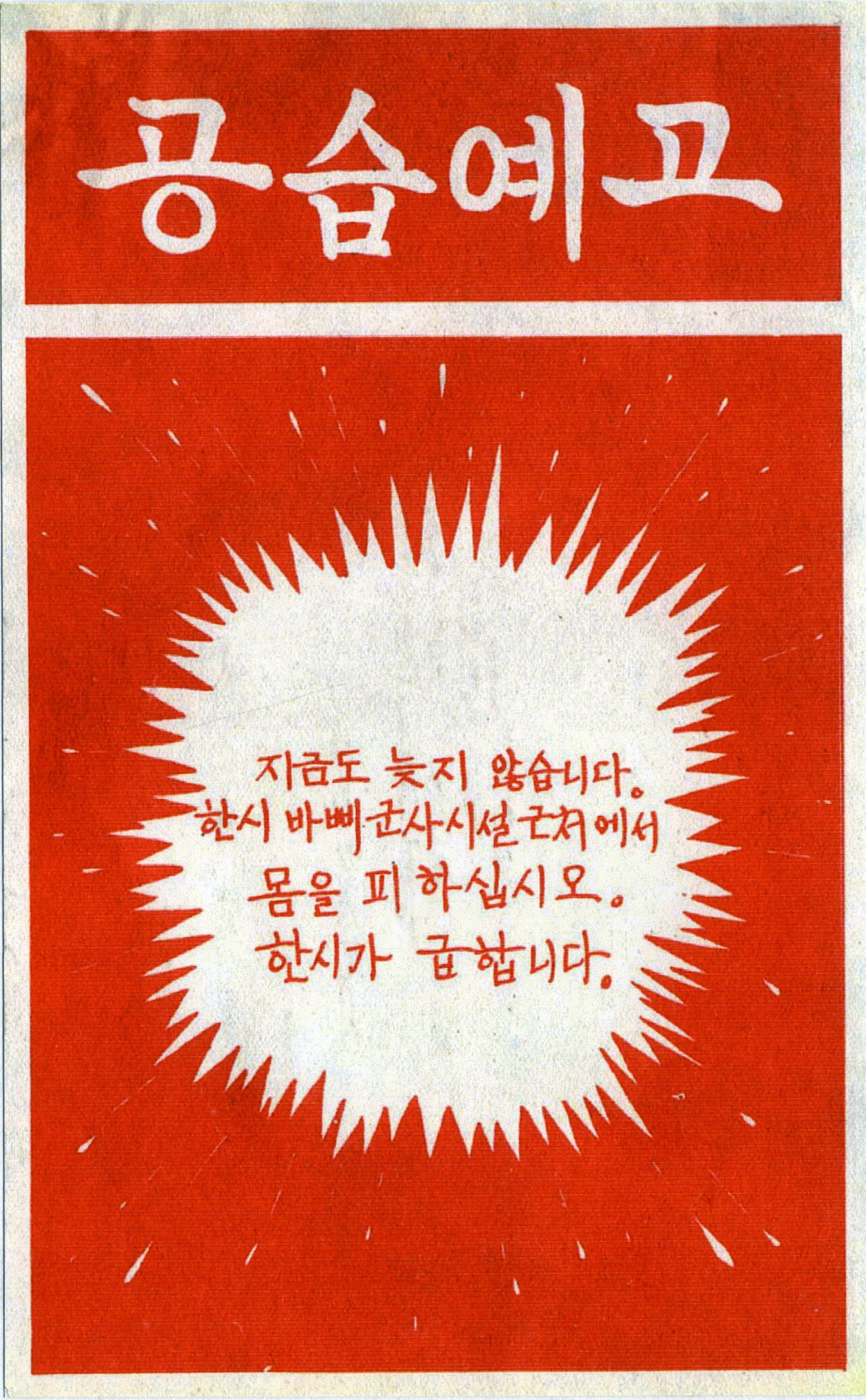
The reverse says military targets in Pyongyang will be bombed within 48 hours and that the United Nations hopes to spare civilians. It is a deadline framed as protection. Read the technique: fear appeal.
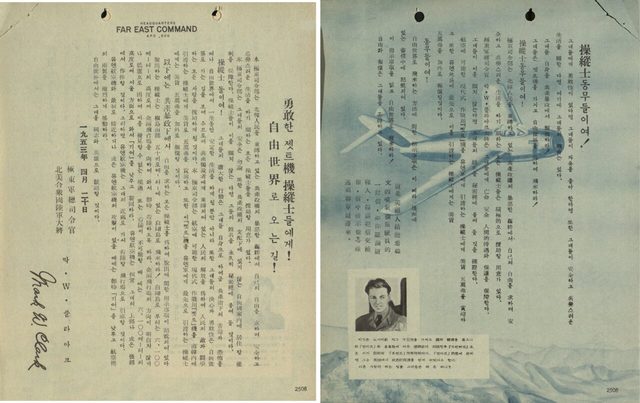
Far East Command offered US$50,000 for a flyable jet and US$50,000 more to the first pilot. The entry says the reward was a real offer and that No Kum-sok claimed it in September 1953, after the armistice. Read the technique: bandwagon.
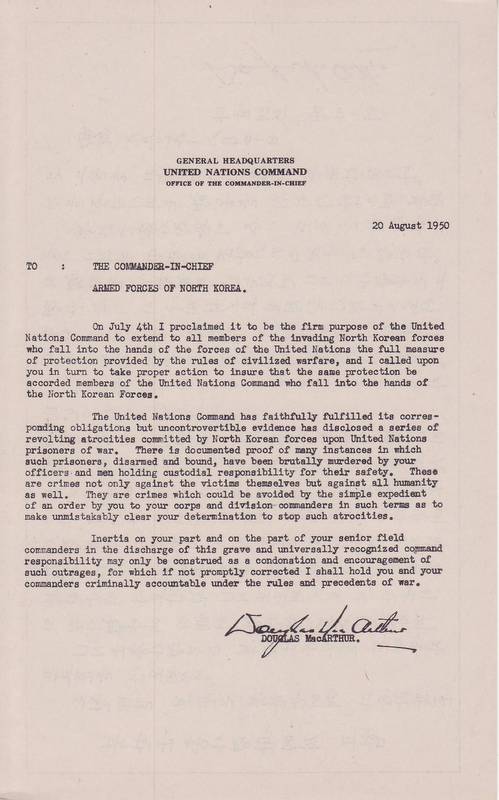
MacArthur charges that UN prisoners were murdered while bound and warns he will hold the commander accountable. The entry says the charge was documented, including the Hill 303 killings of 17 August 1950, and that killings by South Korean and US-led forces are also documented. Read the technique: fear appeal.
What did the UN exhibit of 1954 argue?
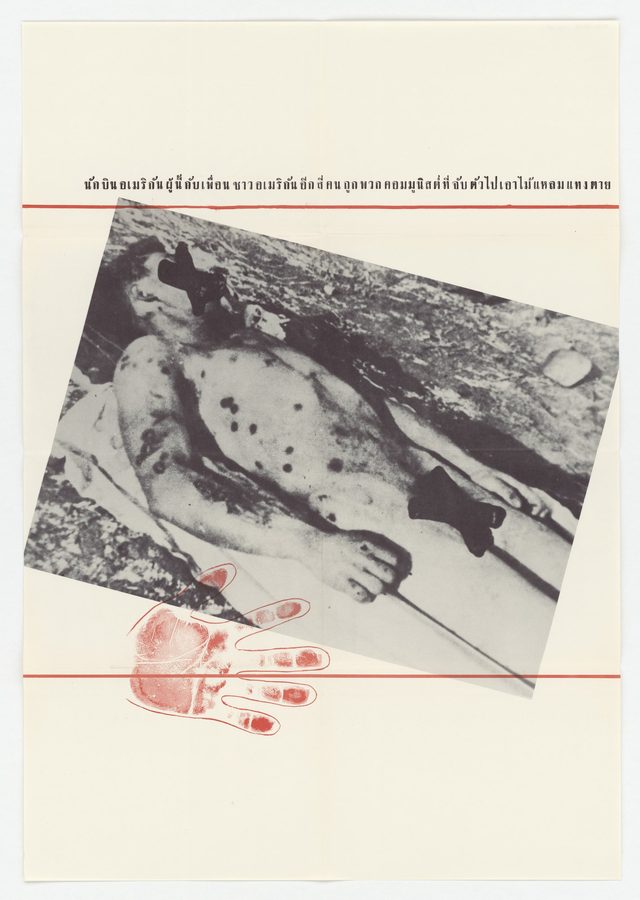
The 1954 "Korea Exhibit" sheets were distributed through USIS Bangkok.
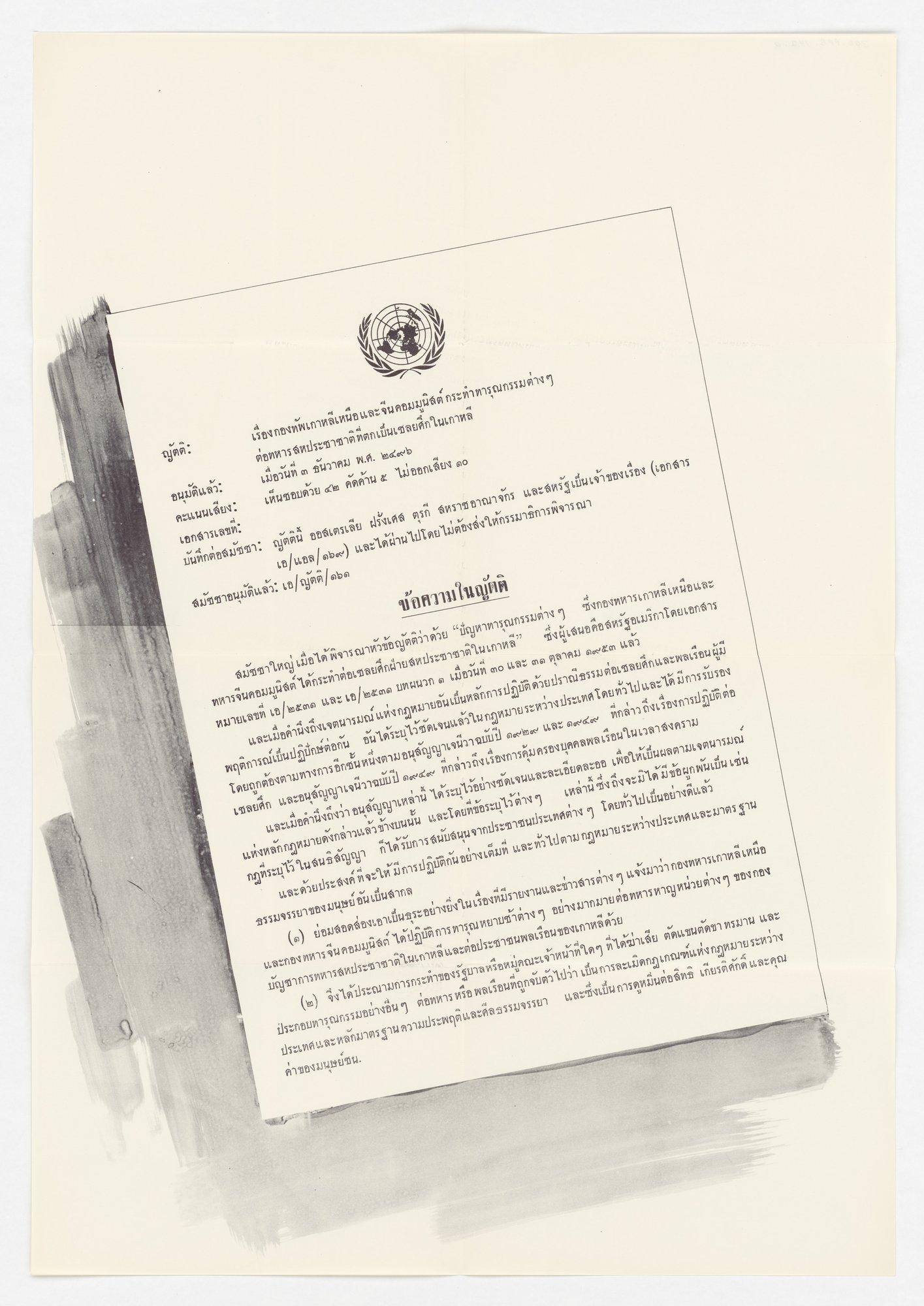
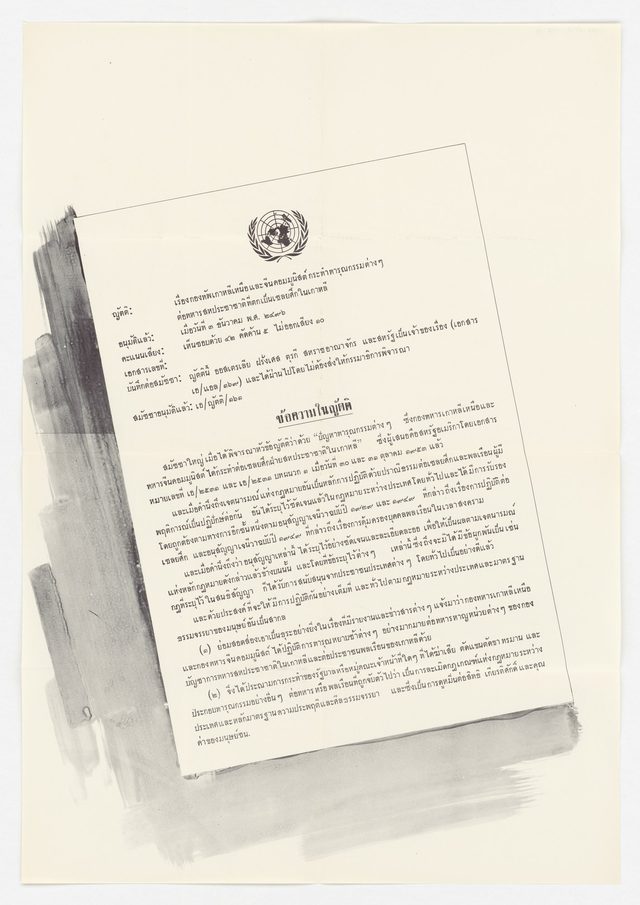
Sheet 2a reproduces the resolution under the UN emblem. The emblem lends institutional authority. Read the technique: transfer.
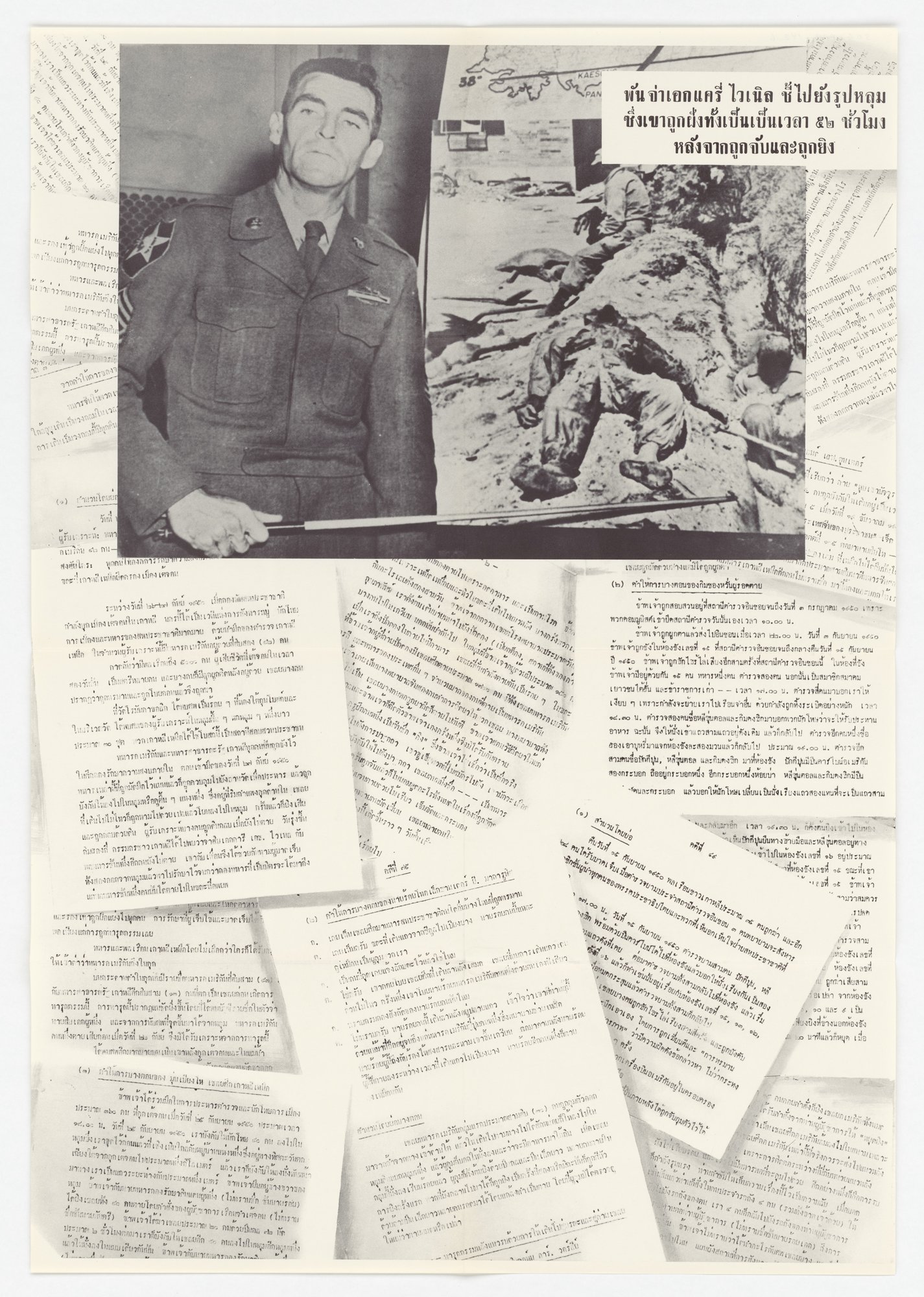
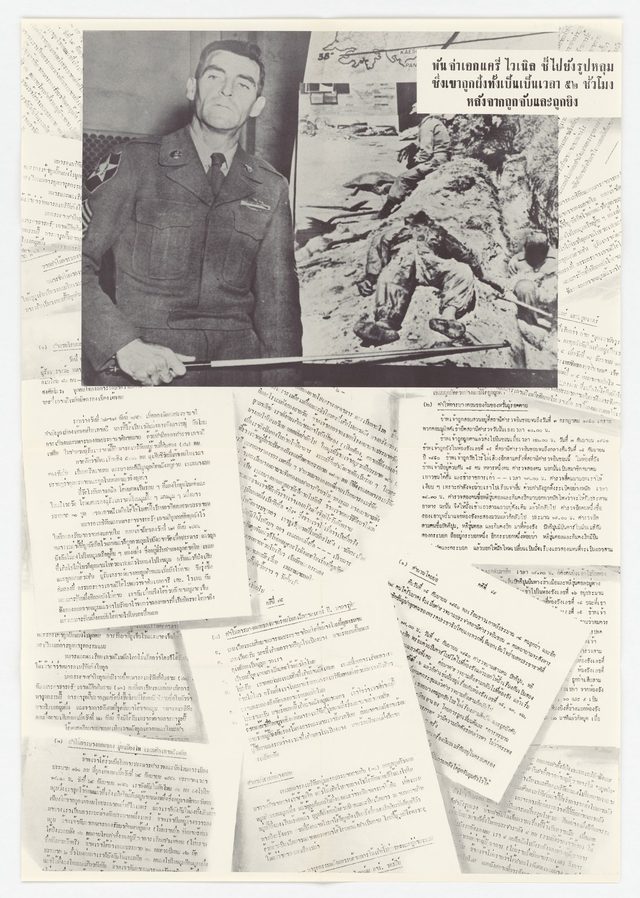
Sheet 2b offers a named survivor's account in place of independent proof. Read the technique: testimonial.
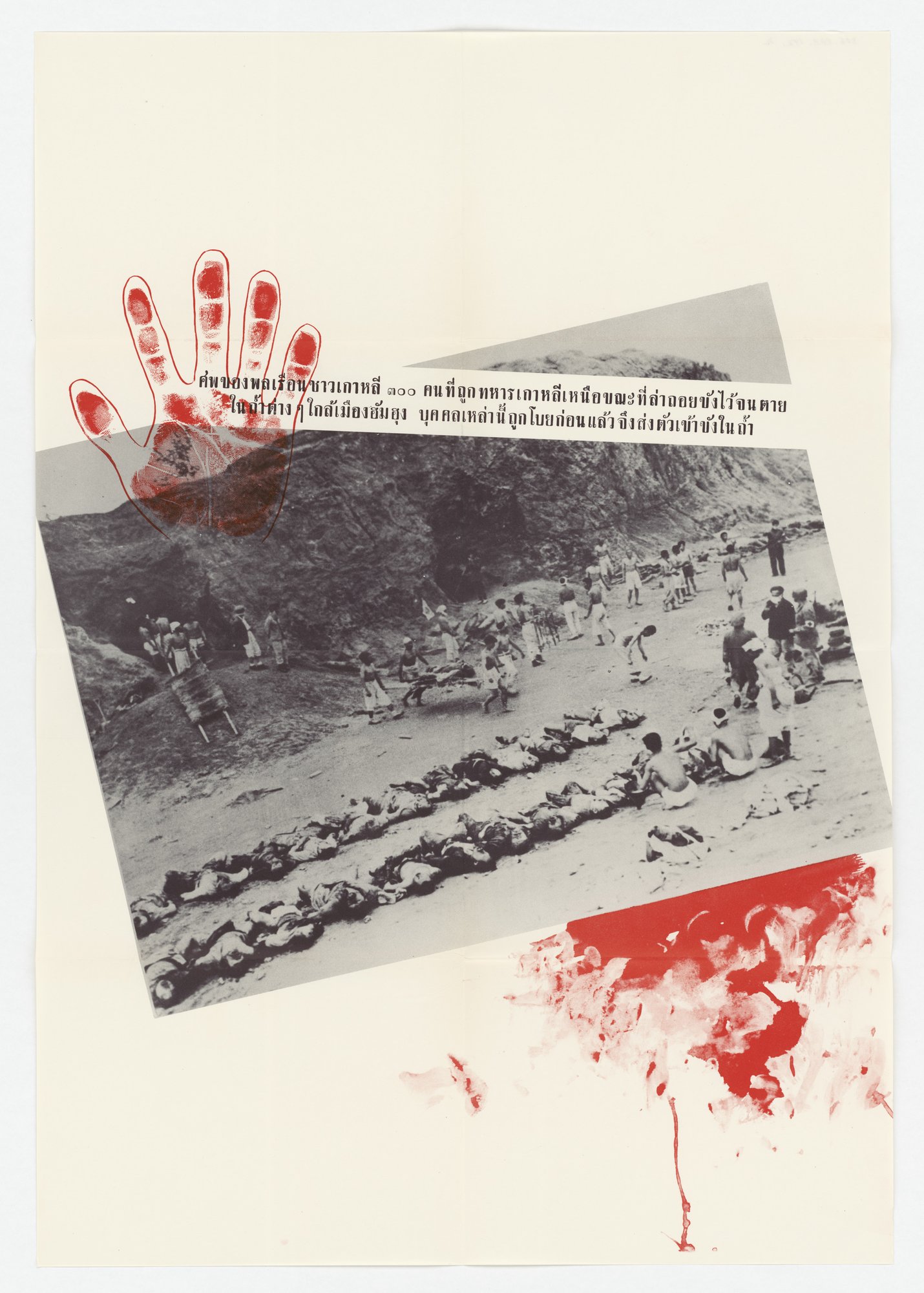
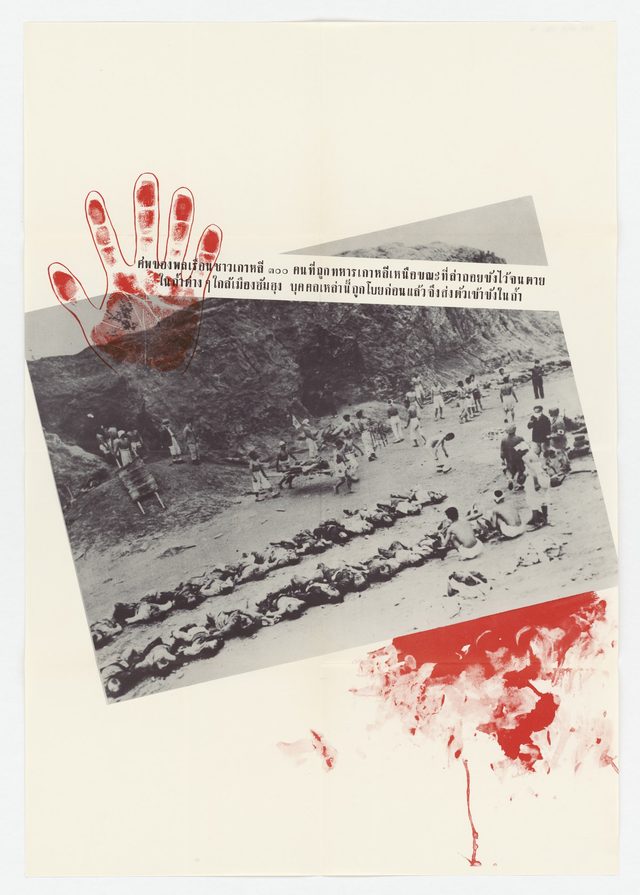
Sheet h says 300 Korean civilians were confined to death in caves near Hamhung. The entry notes the sheet gives no source for its photograph or figures. Read the technique: outrage bait.
How did the war look in US cartoons?
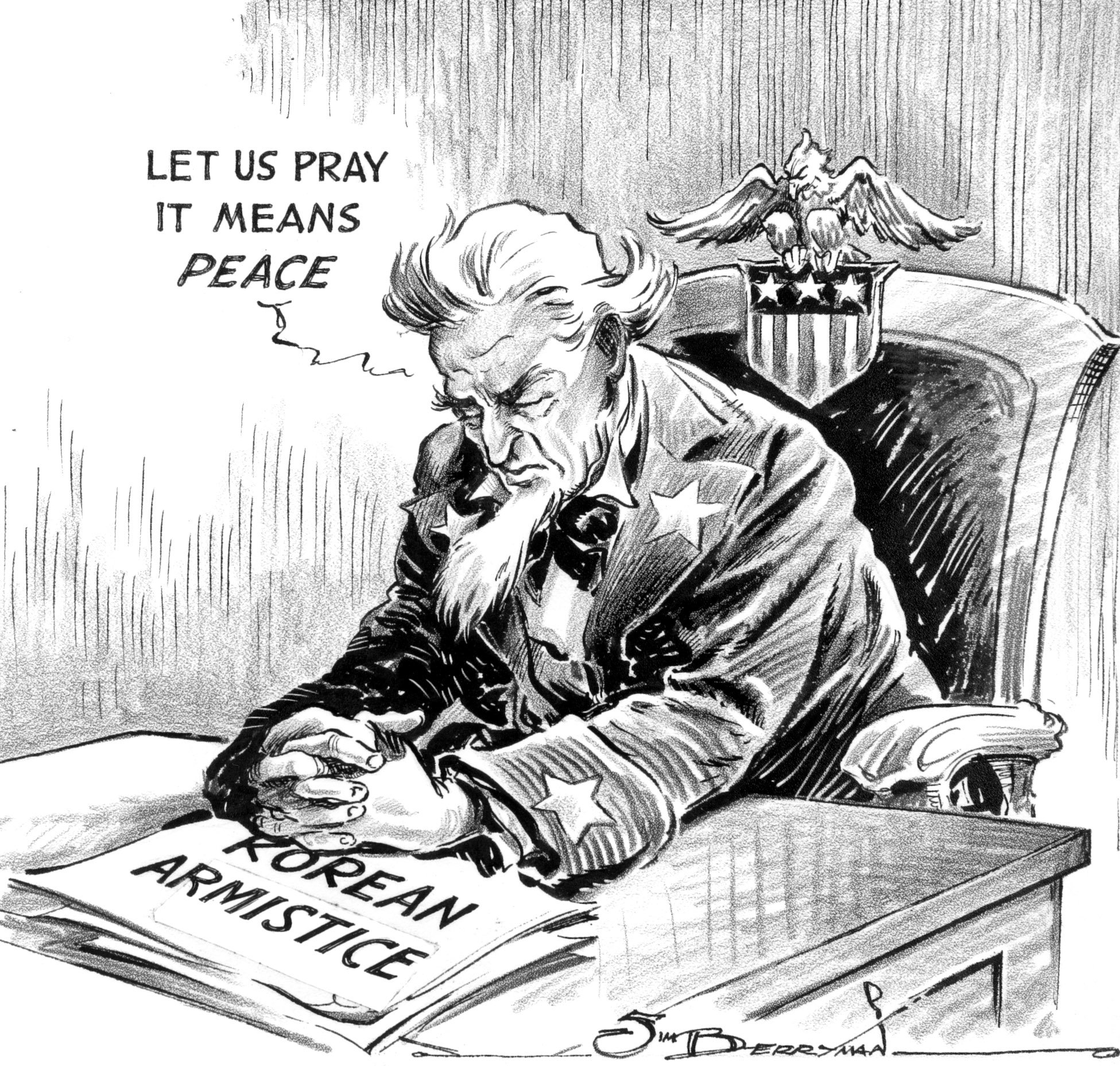
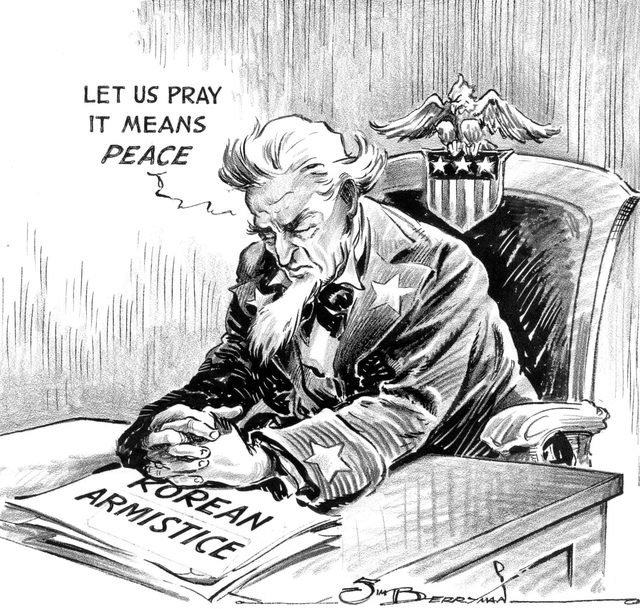
Jim Berryman's cartoon of 27 July 1953, the day the armistice was signed, voices a hope for lasting peace and names no policy. The archive holds nine more of his cartoons on the war's politics and casualties. Read the technique: glittering generalities.
How do the two sides compare?
The methods match: labels for the enemy, selected evidence, borrowed authority, and fear with a deadline. The differences are in context. UNC sheets leaned on UN endorsement and on counts of nations, while North Korean and Chinese sheets leaned on named heroes, leaders and the claim of good treatment. Both made accusations about prisoners, and the entries record that treatment on each side is documented elsewhere. See also propaganda leaflets and Vietnam War propaganda.