Content note: this page quotes 1915 newspaper headlines that call Germans "savages" and "Huns", shows a poster of a drowning mother and infant, and describes the deaths of about 1,200 civilians, many of them children.
In one line: on 7 May 1915 a German submarine sank a British liner carrying about 1,960 people and a cargo that included rifle ammunition; within days the dead were turned into recruiting posters, newspaper banners and a slogan, while the German side answered with a prior warning, a claim that the ship was a legitimate target, and a satirical medal that Britain later reissued as proof of German callousness. What is documented in the sinking is large; what each side's propaganda added to it can be separated.
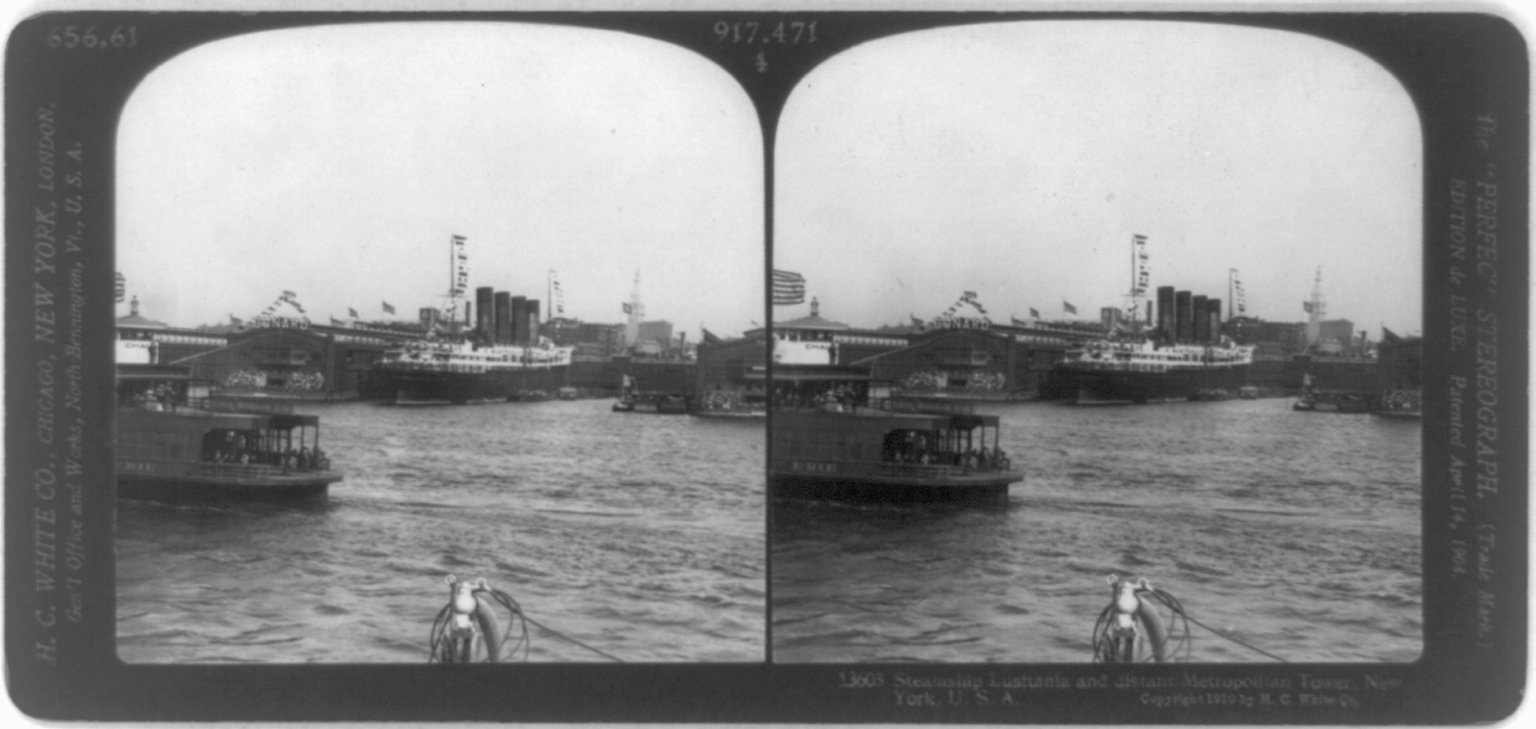
"Steamship Lusitania and distant Metropolitan Tower, New York, U.S.A.", H. C. White Co. stereograph, 1910. Library of Congress. Public domain.
What happened
- 4 February 1915. Germany declares the waters around the British Isles a war zone from 18 February, in which enemy merchant ships found would be destroyed and neutral ships might be endangered by mistake. It gives as its reason the British blockade of Germany (the British declaration of a North Sea military area in November 1914, and its March 1915 Order in Council on trade with Germany).
- 1 May 1915. The Lusitania sails from New York for Liverpool. The same morning New York papers print a notice from the German Embassy, dated 22 April, warning travellers that British-flag ships "are liable to destruction" in the war zone. In The Sun it sits above Cunard's advertisement for the sailing. The notice and the German side's use of it are covered in Germany answers back: the Manifesto of the 93 and the Lusitania medal (1914-1916).
- 7 May 1915, about 2:10 p.m. U-20 torpedoes the ship off the Old Head of Kinsale, Ireland. A second explosion follows and she sinks in under 20 minutes. About 1,960 people were aboard; 1,198 die, 128 of them Americans, among them the millionaire Alfred Vanderbilt and the theatre producer Charles Frohman.
Show all 4Show fewer
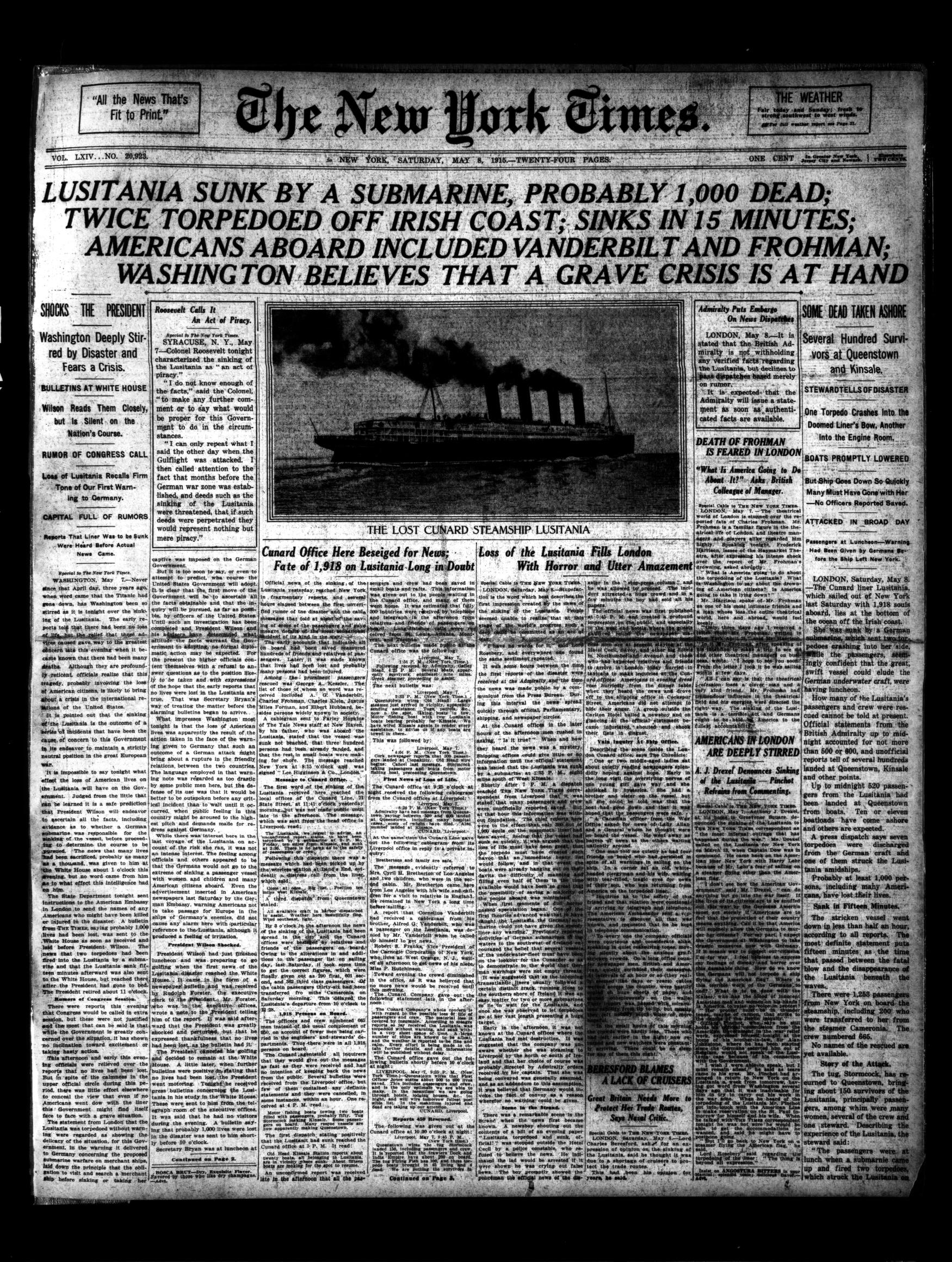
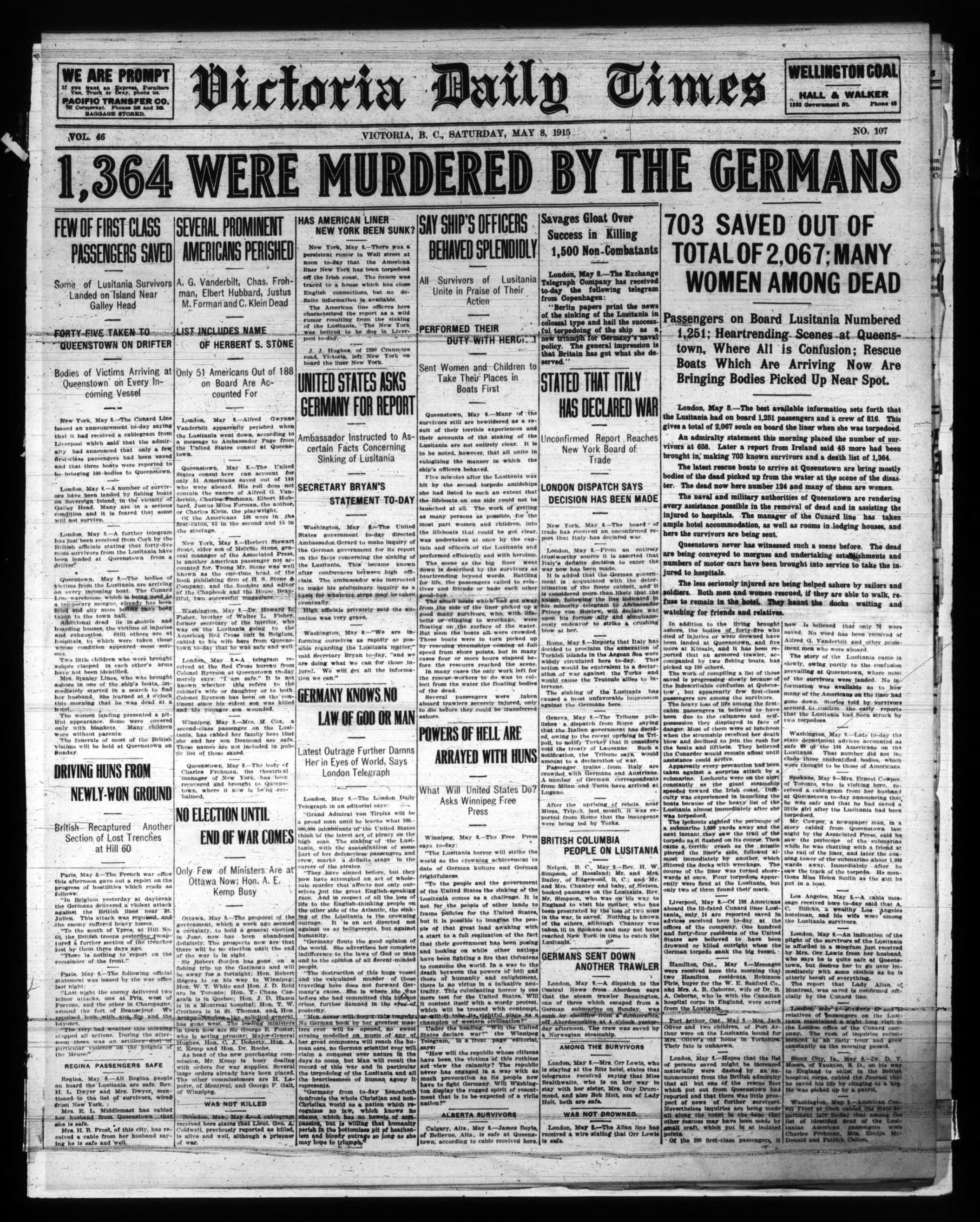
- 7-8 May. Newspapers carry the story worldwide. The Admiralty puts an embargo on dispatches. The New York Times leads with "LUSITANIA SUNK BY A SUBMARINE, PROBABLY 1,000 DEAD" and "Washington believes that a grave crisis is at hand", and prints Theodore Roosevelt calling it "an act of piracy". The Victoria Daily Times (British Columbia) runs the banner "1,364 WERE MURDERED BY THE GERMANS", a casualty figure from early reports that was later revised.
Explain moreShow less
The New York Times, daily edition, front page (New York, May 8, 1915), The New York Times, 8 May 1915. The lead names a submarine, not a state; the loaded wording is attributed to named speakers. Internet Archive scan. Public domain.
Victoria Daily Times, daily edition, front page (Victoria, B.C., May 8, 1915), Victoria Daily Times, 8 May 1915. Canada was at war and under press censorship; the page's other headlines include "Germany knows no law of God or man" and "Powers of Hell are arrayed with Huns". Internet Archive scan. Public domain.
- 7 May onward. Riots against Germans and people with German names break out in Liverpool that evening and spread to Manchester, London and other British cities (documented by Panikos Panayi in The Enemy in Our Midst, 1991). On 8-9 May a crowd of soldiers and civilians wrecks German-owned businesses in Victoria, B.C.
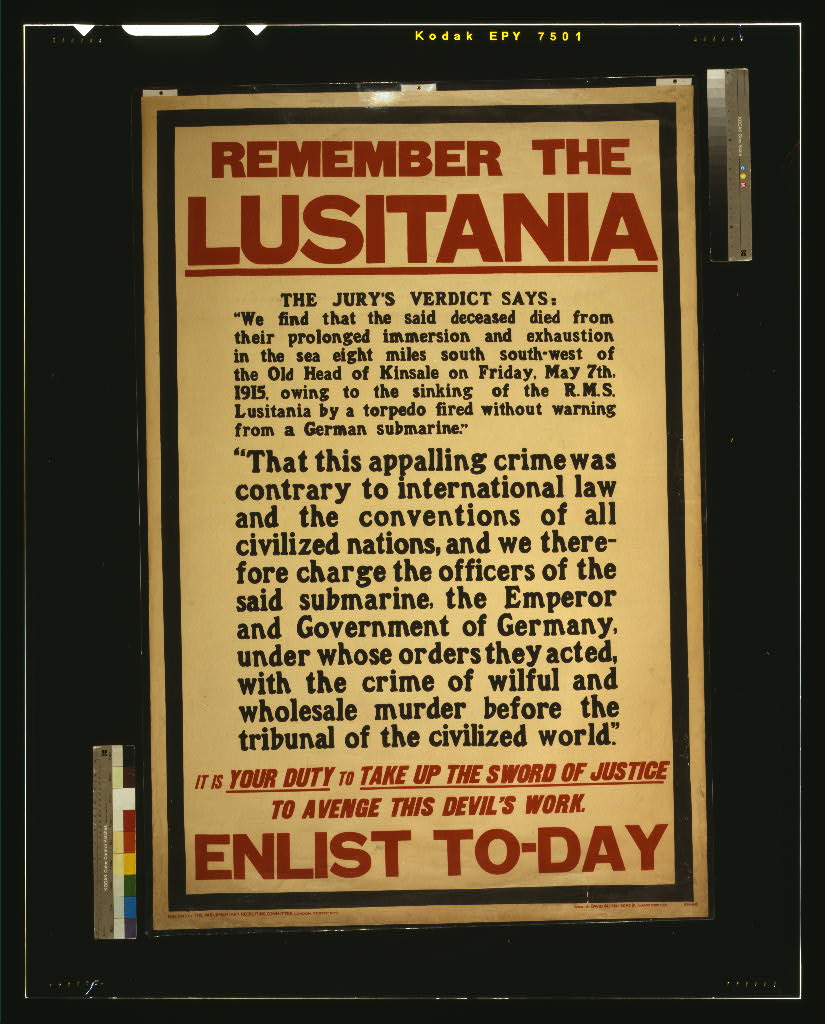
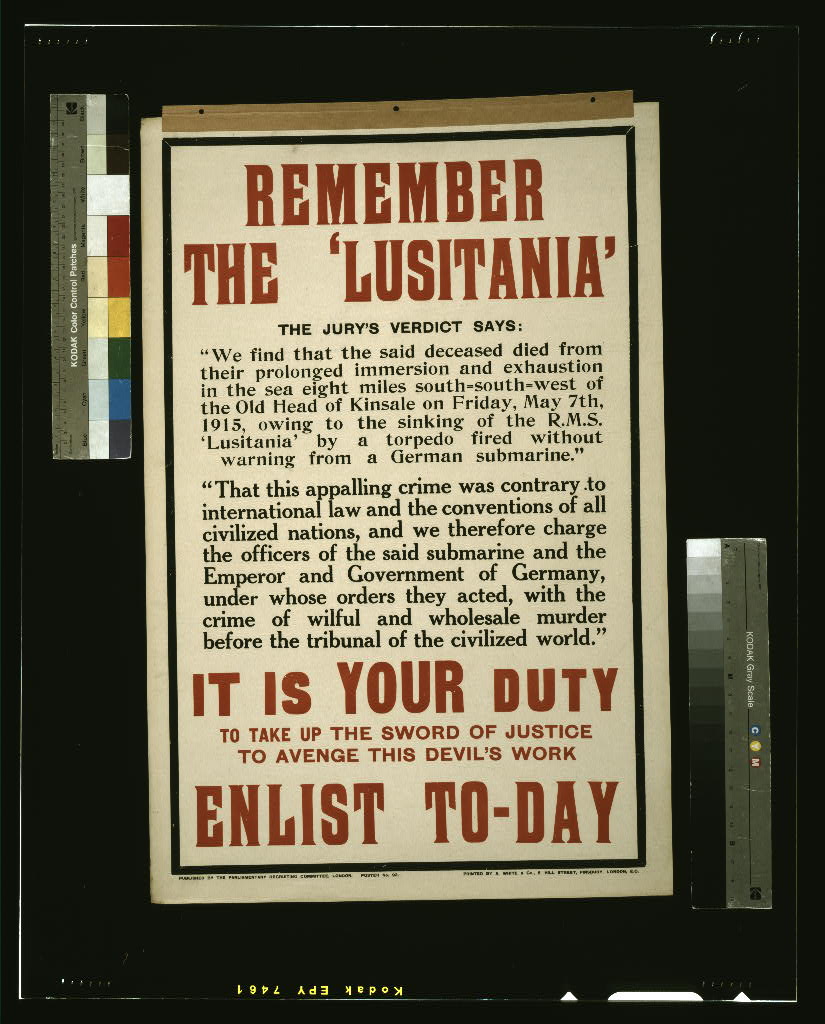
- Within days (sources differ on the date). The coroner John Horgan's jury at Kinsale finds that the dead died "owing to the sinking of the R.M.S. Lusitania by a torpedo fired without warning from a German submarine", and charges "the officers of the said submarine, the Emperor and Government of Germany" with "wilful and wholesale murder". A coroner's inquest rules on cause of death; it is not a trial.
- 10-13 May. In Philadelphia on 10 May, President Wilson says "there is such a thing as a man being too proud to fight". On 13 May the U.S. note to Berlin demands that Germany disavow the attack, make reparation and prevent a repeat, and affirms the right of Americans to travel on merchant ships. The Bryce Report on Belgium appears the same week (Wellington House and the Bryce Report: atrocity evidence, confirmed and unconfirmed (1914-1915)).
- 28 May. Germany's reply (Foreign Minister von Jagow) says the ship "undoubtedly had guns on board which were mounted under decks and masked", "had Canadian troops and munitions on board, including no less than 5,400 cases of ammunition", was "constructed with Government funds as auxiliary cruisers", and that the loss "was primarily due to the explosion of the cargo of ammunition caused by the torpedo".
- 4 June. Dudley Field Malone, Collector of Customs at New York, tells the Treasury the ship's cargo included 4,200 cases of metallic cartridges, 18 cases of fuses and 1,250 cases of shrapnel, that the shrapnel held "no explosives of any description whatsoever", and that she "carried no explosives of any kind or character".
- 8-9 June. Secretary of State William Jennings Bryan resigns, convinced the second U.S. note risks war. Wilson's second note follows on 9 June.
- 15 June to 17 July. Lord Mersey's British inquiry sits. He places the blame on the German government, finds Captain William Turner exercised his judgment "for the best", and clears Turner, Cunard and the Navy of negligence. Part of the hearings, on navigation and Admiralty orders, are held in camera.
- August-September 1915. Germany sinks the liner Arabic (19 August) and, after U.S. protests, pledges not to sink liners without warning (1 September). Germany announces unrestricted submarine warfare on 31 January 1917, effective 1 February, and the United States declares war on 6 April 1917.
How it works
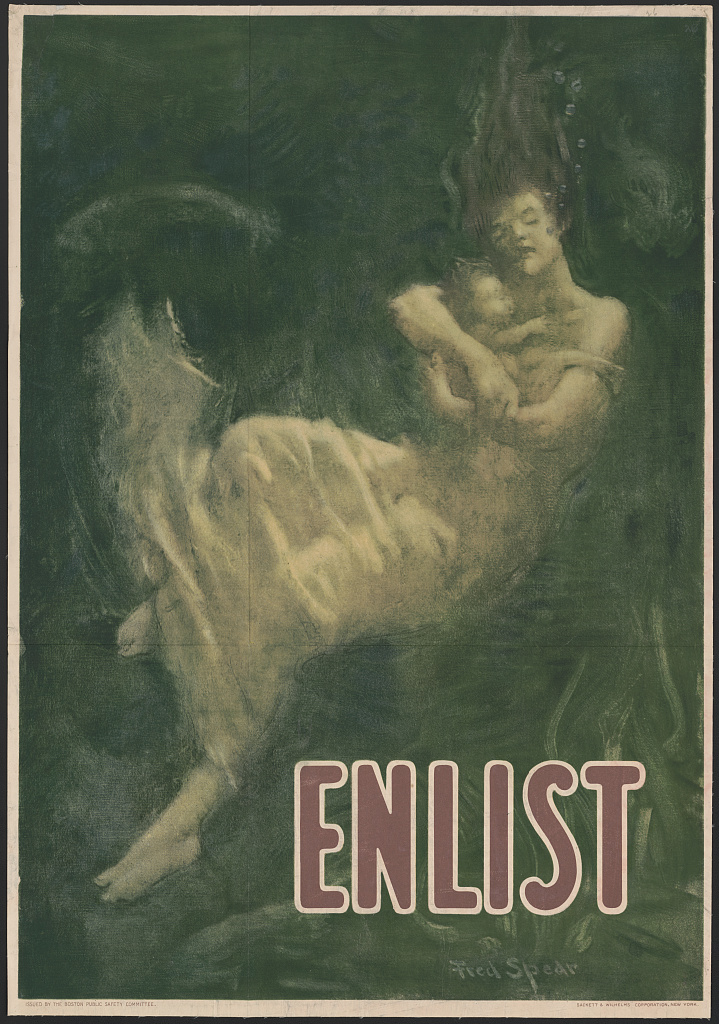
- Fear appeal: the recruiting use is the clearest case. Fred Spear's Enlist for the Boston Public Safety Committee shows a mother and infant sinking, eyes closed, above one word. It names no enemy and no terms, and it dates from a country still at peace (LoC dates it 1915 or 1916), so it belongs to the American preparedness campaign, not to a state recruiting for war.
Content note: German satirical medal showing a sinking passenger liner and Death selling tickets, made after the 1915 sinking that killed over 1,100 people. This object is shown as it was published. Why 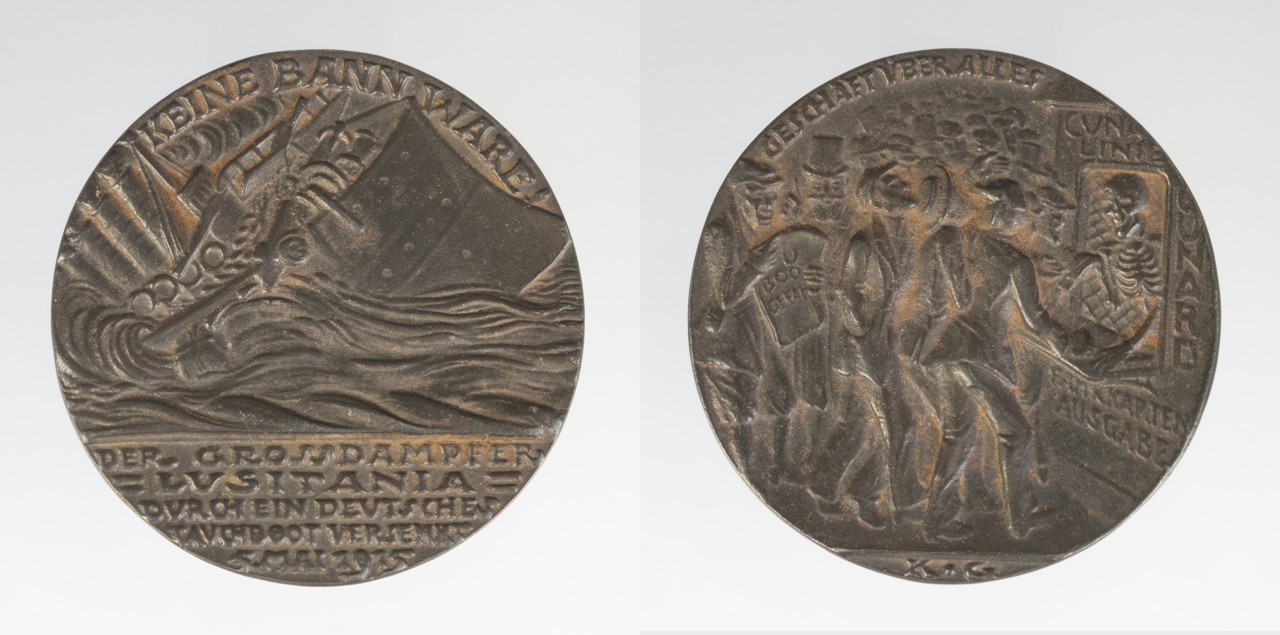
Explain moreShow less
Enlist, Fred Spear for the Boston Public Safety Committee, 1915 or 1916. Library of Congress. Public domain in the U.S.
- Testimonial and Name-calling: the British Parliamentary Recruiting Committee's text posters quote the Kinsale verdict in full, then add their own sentence: "It is your duty to take up the sword of justice to avenge this devil's work. Enlist to-day." The quotation is real and accurate; the poster prints the jury's charge against the Emperor and his government in full and does not say what a coroner's inquest can decide.
"Remember the Lusitania ... Enlist to-day", Parliamentary Recruiting Committee (printed by David Allen & Sons, Harrow), 1915. The verdict is quoted in full under a large "LUSITANIA". Library of Congress. Public domain.
"Remember the 'Lusitania'", Parliamentary Recruiting Committee (printed by A. White & Co., London), 1915. The same verdict text in a different layout. Library of Congress. Public domain.
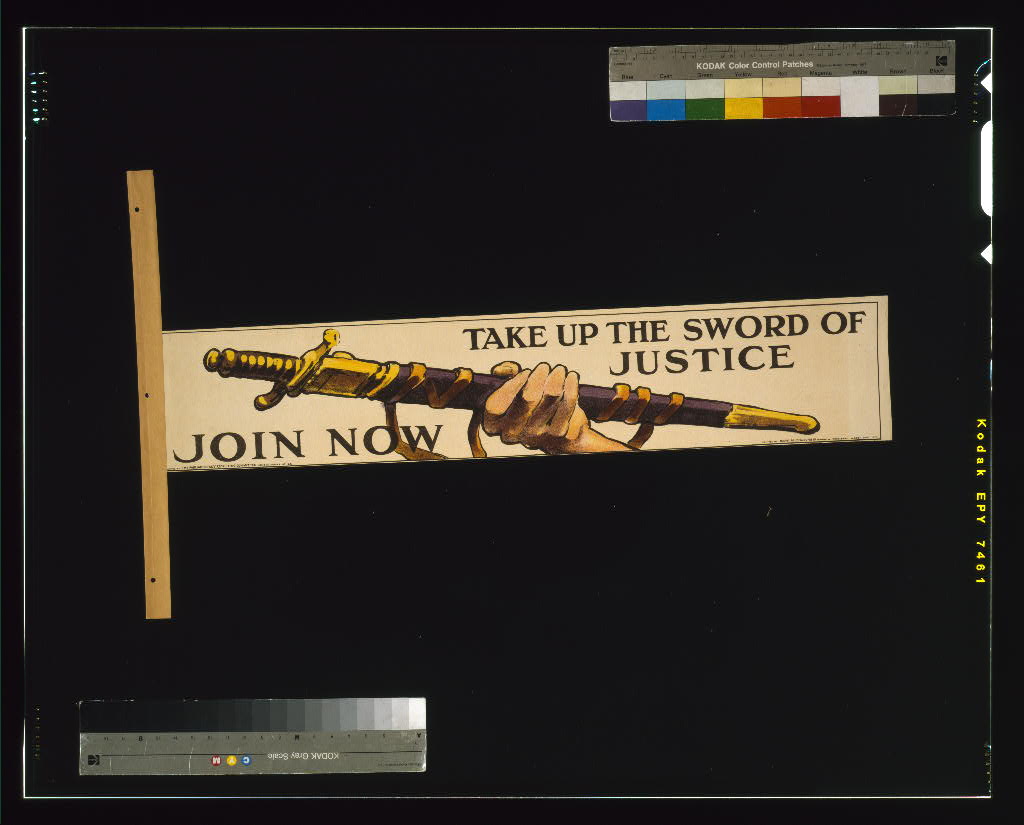
- Transfer: the sword of justice is an inherited emblem lent to recruitment. A strip poster from the same committee keeps only the sword and "Join now", with no mention of the ship (Take Up the Sword of Justice. Join Now).
Take Up the Sword of Justice. Join Now, Parliamentary Recruiting Committee, 1915. Library of Congress. Public domain.
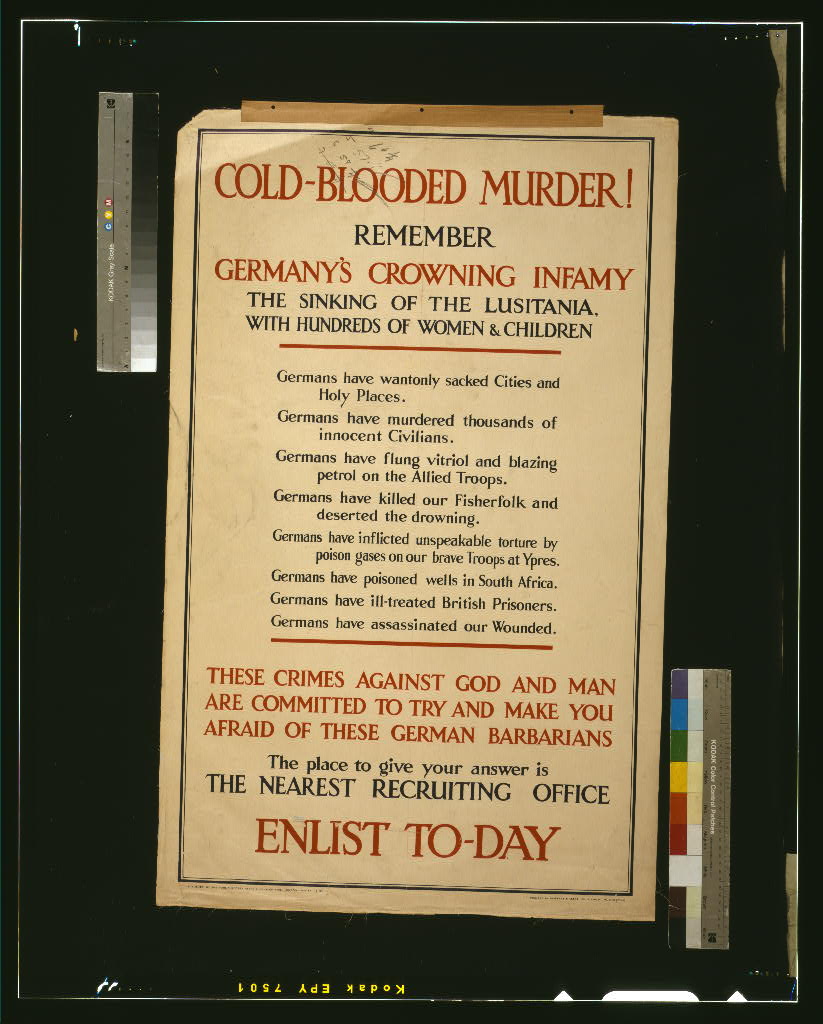
- Card stacking: the recruiting poster Cold-Blooded Murder! puts the sinking at the head of eight charges in one typeface, confirmed items beside unverified ones, with no dates or sources (Cold-Blooded Murder! Remember Germany's Crowning Infamy, and the full treatment in Wellington House and the Bryce Report: atrocity evidence, confirmed and unconfirmed (1914-1915)). The sinking and the killings in Belgium are documented; the list gives them the same weight as the poisoned-well charge. The German side selected the other way. The 28 May note puts the cargo and the claim of concealed guns at the centre and says the loss was "primarily due to the explosion of the cargo of ammunition", a cause the witnesses at the Mersey inquiry rejected; it does not say that the Embassy's warning was a general notice, not one addressed to this sailing.
Cold-Blooded Murder! Remember Germany's Crowning Infamy, Parliamentary Recruiting Committee poster no. 97 per the Library of Congress record, 1915. Library of Congress. Public domain.
- Name-calling again: the Victoria Daily Times page calls the Germans "Savages" and "Huns", and British poster stamps by Winox sold the slogan for ordinary letters (Winox anti-German poster stamps: Zeppelin, Edith Cavell, "Kultur", Lusitania (Britain, 1915)). In Germany, the Goetz medal's reverse shows Death selling Cunard tickets under "Geschäft über alles" ("Business above all"); it blames the shipowner and the passengers, not the submarine. How a private satire became, in British hands, "an exact replica of the medal ... distributed to commemorate the sinking" is told in Germany answers back: the Manifesto of the 93 and the Lusitania medal (1914-1916); this page does not repeat it. The Imperial War Museum reads the British reissue as turning satire into an apparent official German celebration.
Karl Goetz "Lusitania" medal (Germany, 1915), Karl Goetz, Munich, 1915. Museum photographs, CC BY-SA 4.0, National Museum of Romanian History.
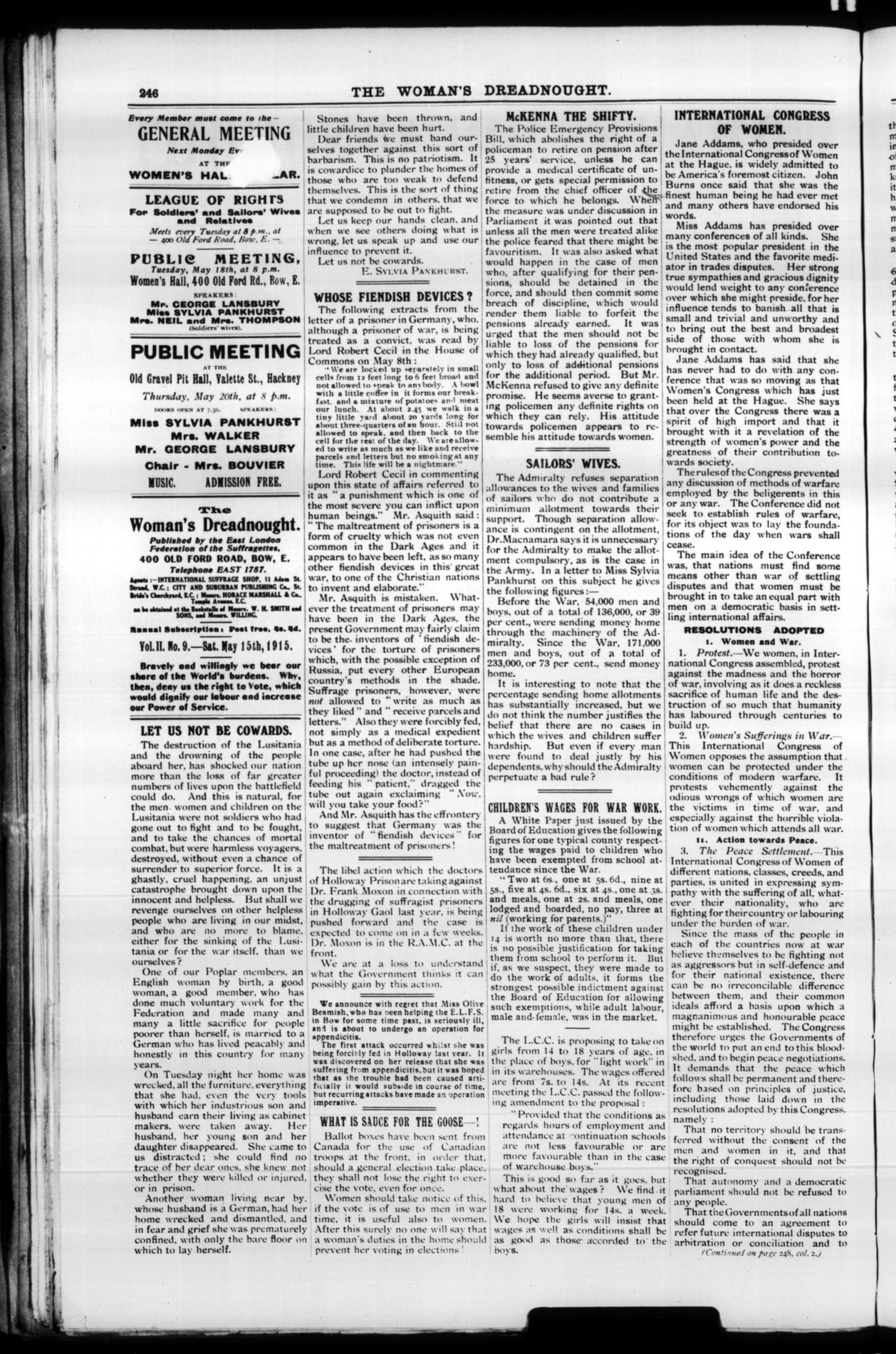
- Whataboutism: on the dissenting British side, The Woman's Dreadnought (15 May 1915) calls the sinking "a ghastly, cruel happening" and opposes the attacks on German homes in Poplar, then answers the Prime Minister's remark on German treatment of prisoners by citing the forcible feeding of suffragette prisoners (The Woman's Dreadnought, 15 May 1915, p. 246: "Let Us Not Be Cowards" and "Whose Fiendish Devices?"). The first column is a protest against a mob; the second is the whataboutism move: it answers a charge with a different charge.
The Woman's Dreadnought, 15 May 1915, p. 246: "Let Us Not Be Cowards" and "Whose Fiendish Devices?", The Woman's Dreadnought, 15 May 1915, p. 246. Internet Archive scan. Public domain.
Then and now
President Johnson's Gulf of Tonkin 'Midnight Address' , White House photo, 1964.
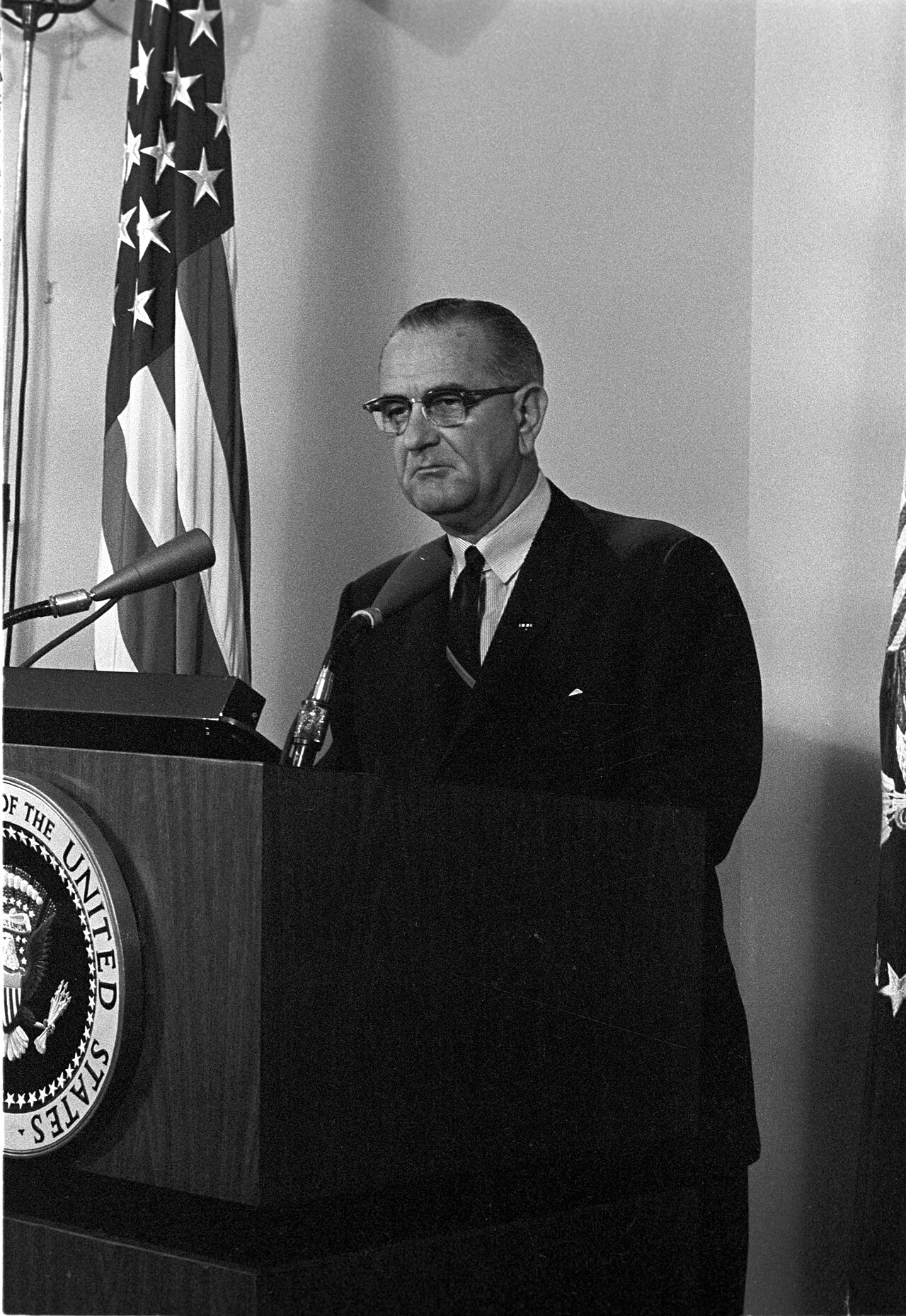
President Johnson's Gulf of Tonkin 'Midnight Address', White House photo, 1964. Public domain.
Remember the Maine in 1898 and Remember the Lusitania in 1915 share a slogan form: an incident, an emotional word and an imperative (Remember the Maine: the yellow press and Spain, 1895-1898). Differences: in 1898 the cause of the explosion was uncertain and the blame came first from private newspapers; in 1915 the sinking by a German torpedo was admitted by Germany, and the arguments were over lawfulness, warning and cargo. The Gulf of Tonkin address is the third case: a governmental account of a naval incident given in the hours after it, the second attack it described did not happen.
Positions on the record
7 items · Britain and Cunard: the ship was a passenger liner carrying passengers and some…
- Britain and Cunard: the ship was a passenger liner carrying passengers and some munitions, unarmed, and was sunk without a warning to her. The Mersey inquiry blamed Germany.
- Germany: declared the war zone, warned travellers on 22 April and again in print on 1 May, held the ship to be a legitimate target because of her cargo and her place on the Admiralty's list of auxiliary cruisers, and claimed she carried concealed guns and Canadian troops. It described the loss of neutral lives as deeply regretted and, in the 28 May note, offered a different reading of the law of cruiser warfare, in which armed British merchantmen were no longer "undefended".
- The United States (Wilson): insisted on the right of Americans to travel and on prior warning and safety for passengers, rejecting the German claim that a general notice released Germany from that duty.
- The cargo: the manifest lists rifle ammunition and shrapnel cases. U.S. customs said the shrapnel held no explosives. A 2006 dive reported up to 15,000 .303 rounds in the bow; later diver accounts give larger numbers that conflict, and have not been verified here.
- The second explosion: Mersey's witnesses held that the ammunition could not have caused it. Robert Ballard (1993) suggested coal dust; Gregg Bemis, the wreck's owner, argued for munitions; Lawrence Livermore tests favoured a boiler explosion but the lead scientist did not call them proof. The cause remains disputed.
- A British plot to expose the ship: raised in later books and articles, with the Admiralty under Winston Churchill as the claimed author. Erik Larson (Dead Wake, 2015) does not conclude there was a cover-up; this page does not endorse the claim and treats the Admiralty's decisions that day, and its pressing of the case against Captain Turner, as separate questions from any plot.
- This archive's reading: documented are the sinking, the toll, the Embassy notice, the 22 April date, the jury verdict, the customs letter, the German note, the posters and the Goetz medal. Not shown: that the ship carried masked guns, that a British conspiracy sank her, and that Germany officially struck the medal to commemorate the sinking. This page found no measured effect of the posters on enlistment, only their stated purpose.
Same-method test
Had a German newspaper put the sinking of a German liner by a British ship on its front page with "murdered" and "savages", and a…
Had a German newspaper put the sinking of a German liner by a British ship on its front page with "murdered" and "savages", and a German committee issued a poster quoting a local jury's charge against the British Admiralty, they would score the same: Name-calling, Fear appeal and Testimonial. The German note's cargo-first framing is scored under Card stacking just as the British list poster is. Goetz's "Geschäft über alles", which mocks the shipowner and passengers, and a British poster stamp that sells the slogan are scored by the same definitions.
How to spot it
- Note what a slogan leaves out. "Remember the Lusitania" fixes on one event and names no cargo, no warning, and no law.
- Check what an authority's quotation can and cannot decide. A coroner's jury names cause of death; it does not settle contested law.
- Look for the claim that would deflate the story on each side: for the posters, the ammunition cargo; for the German note, the missing specific warning.
Show all 5Show fewer
- Treat a date and a body count in a first-day headline as an early figure (the Victoria banner's 1,364 was revised).
- Ask who reissued an object, and with what caption. The medal's story turns on the box and leaflet, not on the medal.
Sources and further reading
Images
4 items · Winsor McCay's The Sinking of the Lusitania (1918 film). The animated film is thought to…
| Image | Source | Licence |
|---|---|---|
| Steamship Lusitania, H. C. White Co., 1910 | Library of Congress | Public domain (no known restrictions) |
| "Remember the 'Lusitania'", Parliamentary Recruiting Committee (A. White & Co.), 1915 | Library of Congress | Public domain (no known restrictions) |
| "Remember the Lusitania ... Enlist to-day", Parliamentary Recruiting Committee (David Allen & Sons), 1915 | Library of Congress | Public domain (no known restrictions) |
| Enlist, Fred Spear, 1915 | Library of Congress | Public domain |
| New York Times, 8 May 1915; Victoria Daily Times, 8 May 1915; The Woman's Dreadnought, 15 May 1915 | Internet Archive | Public domain (published before 1931) |
| Take Up the Sword of Justice; Cold-Blooded Murder!; Goetz medal; Gulf of Tonkin address | FRAME gallery | See each entry |
Image gaps
- Winsor McCay's The Sinking of the Lusitania (1918 film). The animated film is thought to be in the public domain, but no still with a verified record could be fetched (Commons rate-limited). Fillable.
- A German newspaper front page of 8 May 1915. Not found with a clear licence in the searches run. Fillable from Europeana or a national library.
- Goetz's original medal and the Selfridge/Wellington House reissue. The British copy is shown on Germany answers back: the Manifesto of the 93 and the Lusitania medal (1914-1916); who commissioned the copies is reported differently by sources (the Imperial War Museum names Lord Newton's department and Selfridge's), and this page has not checked it.
- Photographs of the dead. Photographs of victims exist; none was hosted because a verified licence and context could not be confirmed in time. Held.
Sources
12 items · Diana Preston, Lusitania: An Epic Tragedy (New York: Walker, 2002).
- Diana Preston, Lusitania: An Epic Tragedy (New York: Walker, 2002).
- Erik Larson, Dead Wake: The Last Crossing of the Lusitania (New York: Crown, 2015).
- Panikos Panayi, The Enemy in Our Midst: Germans in Britain during the First World War (Oxford: Berg, 1991).
- Dudley Field Malone to W. G. McAdoo, 4 June 1915, Papers Relating to the Foreign Relations of the United States, 1915 Supplement (history.state.gov).
- Von Jagow to Gerard, 28 May 1915, in New York Times Current History, vol. 2 no. 4 (July 1915) (Project Gutenberg).
- Wilson's first Lusitania note, 13 May 1915 (World War I Document Archive).
- British Wreck Commissioner's inquiry (Lord Mersey), June-July 1915 (summary).
- The Kinsale inquest (lusitania.net).
- Wreck findings: Irish Examiner on the ammunition find; NPR, 2008.
- Capital Daily on the Victoria riot.
- National Geographic on the cover-up question.
- Gallery: Enlist, Karl Goetz "Lusitania" medal (Germany, 1915), The New York Times, daily edition, front page (New York, May 8, 1915), Victoria Daily Times, daily edition, front page (Victoria, B.C., May 8, 1915), The Woman's Dreadnought, 15 May 1915, p. 246: "Let Us Not Be Cowards" and "Whose Fiendish Devices?", Cold-Blooded Murder! Remember Germany's Crowning Infamy, Take Up the Sword of Justice. Join Now, Winox anti-German poster stamps: Zeppelin, Edith Cavell, "Kultur", Lusitania (Britain, 1915).