Content note. This page describes a system built to select children as young as ten for military and ideological training, and quotes the regime's own language for that selection, including racial-fitness criteria. It also describes the conscription of teenage students into combat in 1945. One image below shows a Nazi-era regional insignia, kept as documentary evidence of the schools' own heraldry, not as endorsement.
In one line: From 1933 the state's Napolas (Nationalpolitische Erziehungsanstalten) and, from 1937, the NSDAP's rival Adolf Hitler Schools ran two separate, competing boarding-school pipelines that pulled boys out of ordinary education as young as ten to breed a future elite by physical, "racial" and political selection — one feeding the Wehrmacht and SS officer corps under growing SS control, the other feeding the party's own Gauleiters under Robert Ley and Baldur von Schirach — and both ended with their teenage students conscripted into the last-ditch defence of a collapsing Reich in 1945.
What happened
The Napolas: a state system, then an SS one
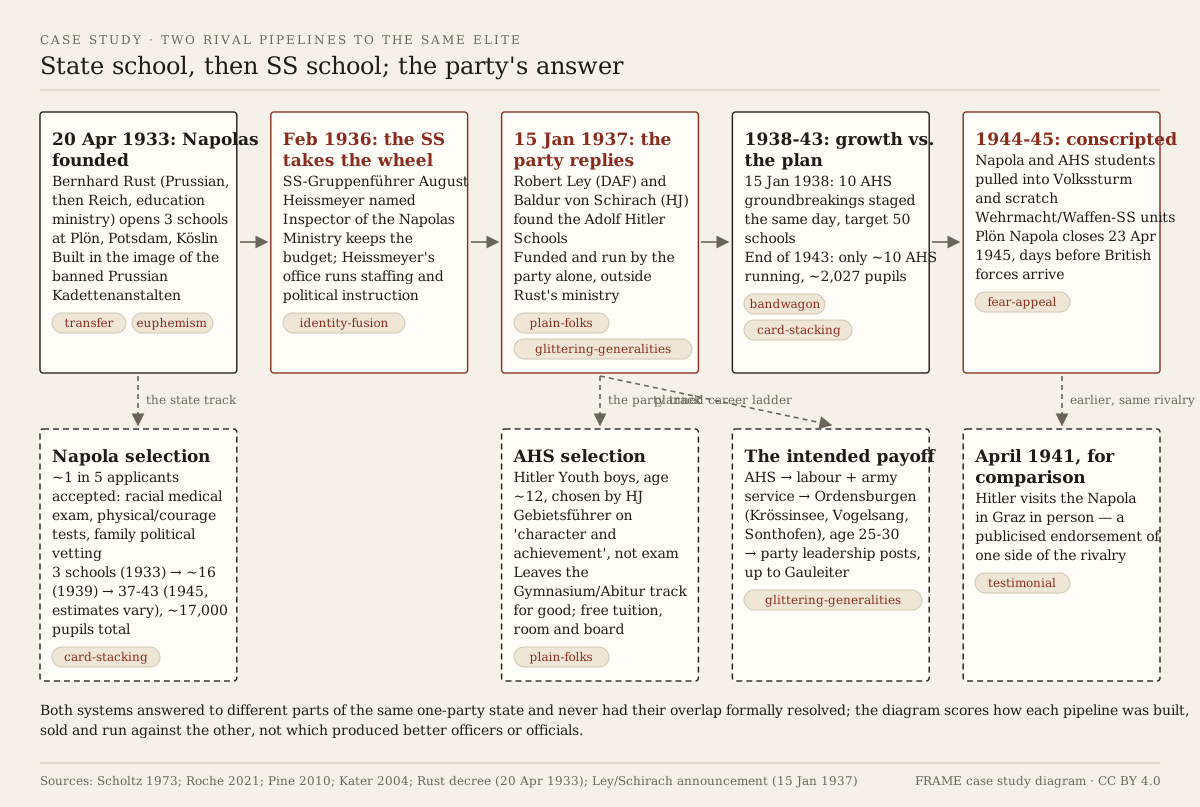
- 20 April 1933 (Hitler's 44th birthday). Bernhard Rust, Prussian Minister of Science, Art and Public Education, decrees the founding of the first three Nationalpolitische Erziehungsanstalten (National Political Education Institutes, "Napola" or "NPEA" for short), at Plön, Potsdam and Köslin, converting existing Prussian boarding-school buildings. Rust becomes Reich Minister of Science, Education and National Culture in 1934 and keeps the Napolas under his ministry's budget for the whole life of the system.
- The borrowed tradition. The Napolas are explicitly built in the image of the old Prussian Kadettenanstalten (cadet corps schools), the officer-training boarding schools the Treaty of Versailles had forced Germany to close. Reusing their buildings, their boarding-school discipline and their claim to produce the state's future officers gives a three-week-old Nazi institution the borrowed prestige of a nineteenth-century military tradition.
- Growth. From 3 schools in 1933 to about 16 by 1939, and to a wartime peak historians place at somewhere between 37 and 43 (the discrepancy is about which annexed-territory and short-lived wartime schools are counted; compare Harald Scholtz's 1973 count with Helen Roche's 2021 study), educating an estimated 17,000 pupils in total between 1933 and 1945. Nearly all were for boys; only three (Hubertendorf-Türnitz in annexed Austria from 1938/39, Colmar-Berg in occupied Luxembourg from 1941, and Achern) were Napolas für Mädchen, training a small number of girls, drawn from the The Bund Deutscher Mädel: raising Nazi Germany's girls for the Volk rather than the Hitler Youth proper, as the future wives of the elite rather than as officers.
- Selection. Only around a fifth of applicants were accepted. Candidates, generally boys around age ten upward, went through days-long assessment camps combining a medical "racial" examination for Aryan descent and physical type, athletic and courage tests (climbing, swimming, mock combat drills), and an assessment of "character," alongside a check on their family's political reliability. The exam load was heaviest on the body and the file, not the transcript.
- Curriculum. The schools kept the standard secondary syllabus but loaded it with sport, paramilitary drill and "racial science," with some accounts putting close to half of instructional time in physical and military training; students lived under military discipline in uniformed cohorts called Jungmannen.
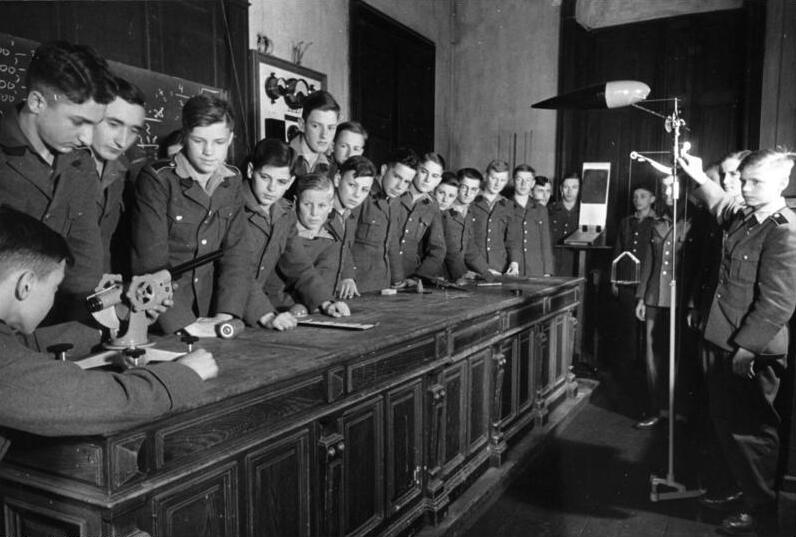
A Napola physics lesson. The Bundesarchiv's own original caption, which the archive keeps for documentary purposes even where "erroneous, biased, obsolete or politically extreme," notes that instruction was largely equivalent to an ordinary secondary school but with greater emphasis on military-oriented thinking. Bundesarchiv, Bild 146-1978-013-07, CC BY-SA 3.0 DE.
- February 1936. SS-Gruppenführer (later Obergruppenführer) August Heissmeyer, married to Reich Women's Leader Gertrud Scholtz-Klink, is appointed Inspector of the Napolas, a post he holds to the end of the war. The schools never formally leave Rust's ministry, but Heissmeyer's SS office steadily takes over staff appointments, political instruction and much day-to-day direction, so that by the early 1940s the system that had opened as a state education project runs, in practice, as an SS training pipeline feeding the Wehrmacht and the Waffen-SS officer corps.
- April 1941. Hitler personally visits the Napola in Graz, in annexed Austria — a publicised event that put his own presence behind the school's claim to produce the Reich's next leaders.
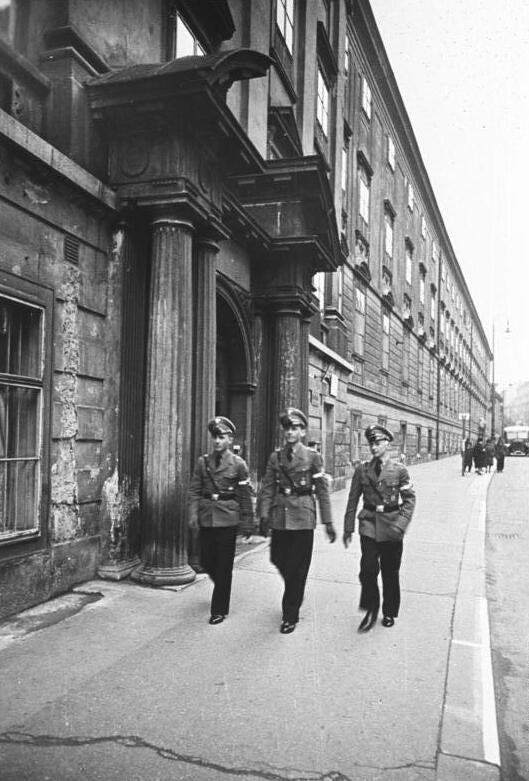
The Napola in Vienna's Theresianum building, photographed on 13 March 1940, the first anniversary of its opening after the 1938 Anschluss folded Austria into the Reich and its school system into the Napola network. Bundesarchiv, Bild 146-1978-013-10, CC BY-SA 3.0 DE.
- The end. By 1944 Napola students as young as 15 or 16 were being pulled into home-defence and scratch Wehrmacht and Waffen-SS units alongside the wider The Hitler Youth: from a party wing to a legal duty, 1926-1945 call-up; several schools were evacuated west ahead of the advancing Red Army in the war's last months. The first Napola, at Schloss Plön, closed on 23 April 1945, days before British forces reached the town — the school that had opened the whole system twelve years earlier shutting its doors in the same week the system's students were dying to defend what remained of it.
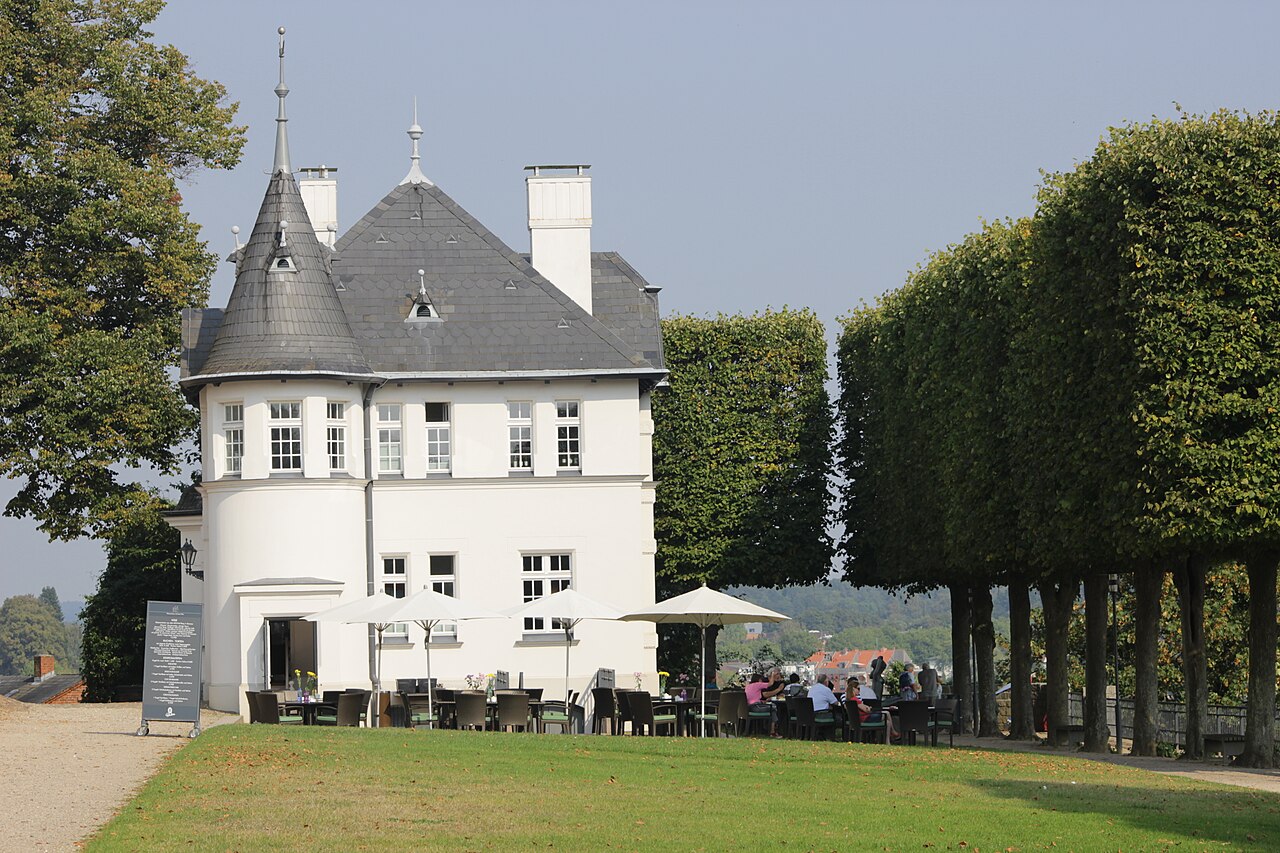
Schloss Plön today. The castle reopened as an ordinary boarding school in 1946 and has been the Fielmann Akademie, a training centre for opticians, since 2002; nothing in its current use refers to its 1933-45 history. Photo by Freddy Fehmarn, 2014, via Wikimedia Commons, CC BY 2.0.
The Adolf Hitler Schools: the party's answer
- 15 January 1937. Robert Ley, head of the Deutsche Arbeitsfront (German Labour Front, DAF), and Baldur von Schirach, Reich Youth Leader, jointly announce the founding of the Adolf Hitler Schools (Adolf-Hitler-Schulen, AHS). Unlike the Napolas, the AHS are financed and run entirely by the NSDAP and the DAF, kept explicitly outside Bernhard Rust's education ministry so that political instruction stays in party, not civil-service, hands. Multiple accounts of the decision describe it as a direct reply to the SS's growing grip on the Napolas under Heissmeyer: if the SS was going to run the state's elite school, the party would build its own.
- 20 April 1937 (Hitler's 48th birthday). The first AHS opens at Crössinsee in Pomerania, near the site of one of the NSDAP's own postgraduate "Ordensburgen" (order-castles) at Krössinsee.
- Selection. Candidates were drawn exclusively from the The Hitler Youth: from a party wing to a legal duty, 1926-1945's Jungvolk at around age 12, chosen not by any academic examination but by an evaluation from regional Hitler Youth leaders (Gebietsführer) on "character and achievement" (Charakter und Leistung). Boys who entered left the ordinary school system for good after the fourth year of Volksschule, giving up the Gymnasium and Abitur track entirely; the AHS was pitched as a purely merit-and-will-based ladder open to a worker's or farmer's son on exactly the same terms as an officer's, a populist promise the Napolas' medical-and-pedigree gate could not make in the same way.
- Curriculum and funding. Tuition, room and board were free, funded by the party and the DAF rather than a ministry budget line. Political education was delivered only by party functionaries, and academic subjects were subordinated to that instruction and to physical training.
- 15 January 1938. Ley and Schirach stage a simultaneous groundbreaking ceremony for ten new AHS buildings across ten of the NSDAP's regional Gaue on the same day, a staged display of scale for a system Ley wanted eventually built out to one school, a "Gauburg," in every one of the party's roughly thirty-two Gaue, educating over 15,000 pupils.
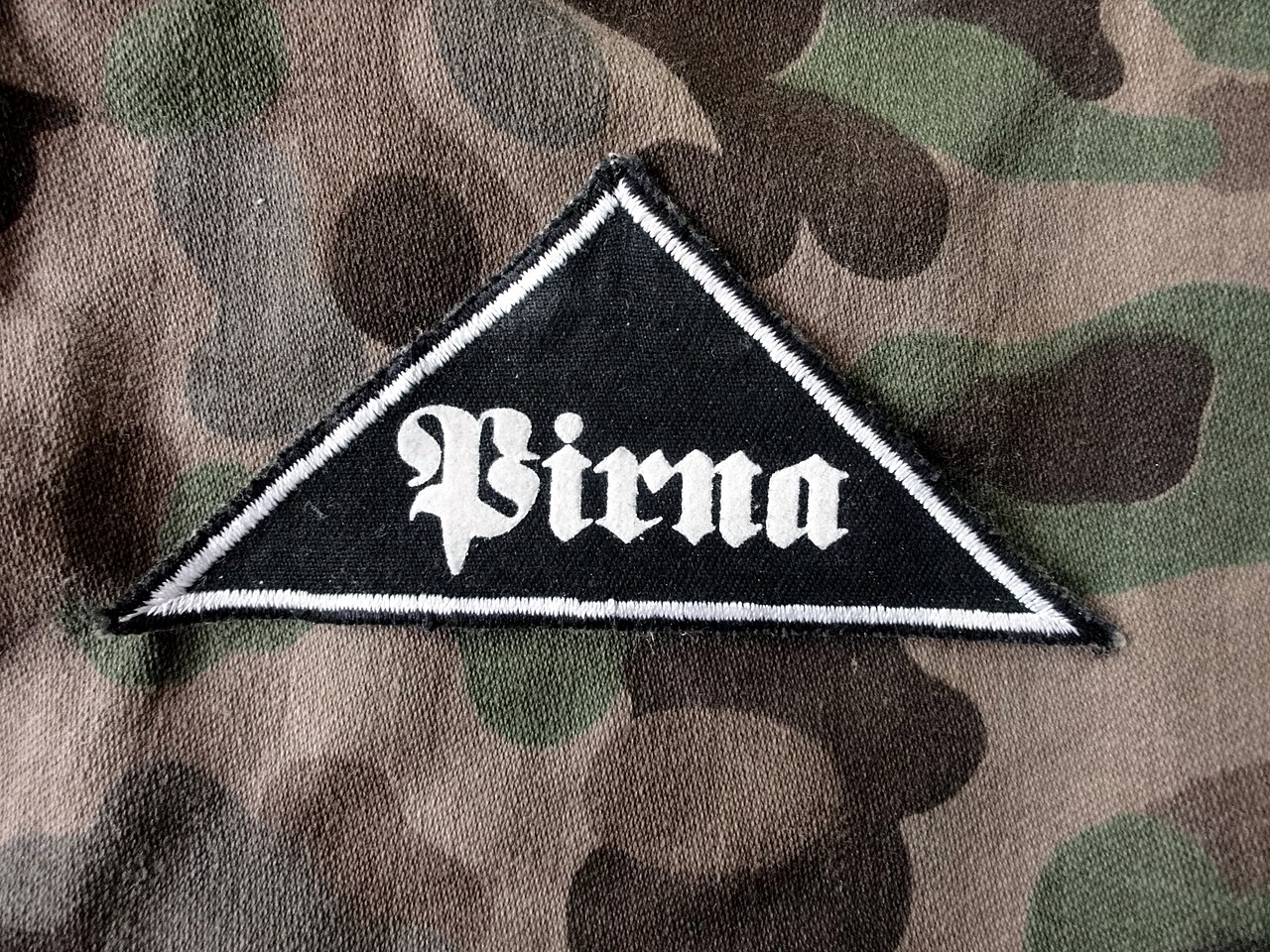
The "Gaudreieck," a triangular sleeve patch naming the Adolf Hitler Schule of Pirna, Saxony, one of the roughly ten AHS actually built and staffed by the early 1940s. Photo by Wikimedia contributor Blusts, 2011, via Wikimedia Commons. Public domain as an official German insignia predating 1945 (PD-Coa-Germany-b1945); its display is restricted in Germany and several other countries outside a documentary or educational context such as this one.
- The gap between plan and reality. Wartime material and funding shortages stalled the rollout badly: as late as the end of 1943 only about ten AHS were actually operating, with a total of roughly 2,027 pupils — a small fraction of Ley's stated target.
- The intended pipeline. AHS graduates were meant to go on, after labour service and army service, to one of the party's Ordensburgen (Krössinsee, Vogelsang in the Eifel, Sonthofen in the Allgäu) for further training from about age 25 to 30, and from there into the NSDAP's own leadership corps, up to and including Gauleiter, the party's regional chiefs — a career ladder run entirely inside the party, parallel to and competing with the Napola-to-Wehrmacht/SS ladder.
- The end. Like the Napolas, the AHS's remaining students and staff were drawn into the 1944-45 collapse; the Volkssturm call-ups that absorbed many of them were organised and commanded locally by the same Gauleiters the AHS existed to produce.
How it works
- Transfer: the Napolas reused the buildings, boarding-school discipline and name-adjacent prestige of the old Prussian Kadettenanstalten, a military tradition the Versailles settlement had forced Germany to abandon, to make a brand-new 1933 institution feel like the restoration of something older and legitimate.
- Euphemism / doublespeak: "Nationalpolitische Erziehungsanstalt," National Political Education Institute, describes a boarding school built on racial medical exams, paramilitary drill and SS political direction in the bureaucratic language of ordinary schooling; "character and achievement," the AHS's stated selection criterion, describes a screen for ideological loyalty and Hitler Youth standing.
- Identity fusion: both systems put candidates through days-long group selection camps, uniformed cohort life (the Napolas' Jungmannen) and shared ritual (Hitler's own 1941 visit to Graz), building an identity fused to the institution and, through it, to the regime, before a student had any career of his own to weigh it against.
- Glittering generalities: both schools were sold in the vocabulary of leadership and character, "Führernaturen," national political education, rather than in the concrete terms of what they actually selected for (racial medical criteria, family political reliability, Hitler Youth rank) or what graduates would actually do (staff the Wehrmacht, the SS and the party apparatus).
- Plain folks: the AHS's own selling point against the Napolas was explicitly populist — no fee, no academic exam, open to a worker's or farmer's son on paper-equal terms with an officer's — a promise of a classless meritocracy inside a state that was, in the same years, deciding who counted as a citizen at all on racial grounds.
- Bandwagon: the 15 January 1938 simultaneous groundbreaking of ten AHS buildings across ten Gaue in a single staged day, like the Napolas' own reported growth from 3 to some 40 schools, presented institutional expansion itself as proof of the project's inevitability, ahead of the far smaller number the war actually let either system reach.
- Testimonial: Hitler's April 1941 visit to the Napola in Graz put the regime's own founder visibly behind one competitor in a rivalry his own government had never resolved.
- Card stacking: neither system's public presentation gave equal space to the other side of its own numbers — the roughly four-fifths of Napola applicants turned away, the AHS's actual ten operating schools and 2,027 pupils by the end of 1943 against Ley's stated target of fifty schools and 15,000, or the fact that a boy who entered the AHS at twelve gave up the ordinary secondary and university track for good.
Then and now
The pairing of an elite state or military boarding school with a parallel, more explicitly political youth movement, run by different arms of the same government and each claiming to grow the country's future leadership, recurs well outside 1930s Germany. Post-Soviet Russia has both: a network of state Suvorov Military Schools and Nakhimov Naval Schools, selective boarding institutions with roots in a wartime 1943 Soviet decree, expanded and rebranded since the 2000s as a pipeline into the officer corps, and, running alongside it since 2015-16, the Yunarmiya ("Youth Army"), a Ministry of Defence-backed youth movement with a reported membership above a million that Reuters and RFE/RL have documented growing further, with new branches and closer school integration, after Russia's 2022 invasion of Ukraine.
The scale and the stakes differ sharply. The Suvorov schools and Yunarmiya are not, on the documented record, gated by anything resembling the Napolas' racial medical examination, and no reporting shows their graduates conscripted as young teenagers into a losing war's final defence, as happened to Napola and AHS students in 1945. What repeats is the structure: two state-linked channels, one more military and ministry-run, one more openly a political youth movement, both selling the same promise of shaping a country's next generation of leaders, expanding together under the same government without either fully absorbing the other.
Positions on the record
- The regime's own framing. Rust's ministry and Heissmeyer's SS inspectorate presented the Napolas as a state service selecting Germany's most physically and racially capable youth for leadership on strictly meritocratic, "national political" grounds. Ley and Schirach presented the Adolf Hitler Schools as the more genuinely National Socialist alternative: free, open on character alone, and free of the ministry bureaucracy and, implicitly, of the SS's growing hold on the Napolas.
- What is documented. The founding decree and date of the first three Napolas; Heissmeyer's February 1936 appointment and his tenure to the war's end; the AHS's 15 January 1937 announcement and 20 April 1937 opening; the 15 January 1938 simultaneous groundbreaking; the roughly ten operating AHS and 2,027 pupils recorded at the end of 1943 against Ley's stated target; the Napolas' selection practices and roughly one-in-five acceptance rate; Hitler's April 1941 Graz visit; Schloss Plön's 23 April 1945 closure.
- What is contested or imprecise in the record. The exact wartime peak number of Napolas (accounts give figures from 37 to 43) and the precise total enrolled; how far Heissmeyer's SS inspectorate actually displaced Rust's ministry in day-to-day control at different schools and different dates, which varied by location and was never resolved on paper; and how explicit an institutional "reply to the SS" the AHS's founders stated their own motive to be at the time, as opposed to how later historians have read the sequence of events.
- Not ruled on here. Whether either system produced measurably better military or administrative leaders than conventional German schooling and officer training did; this page describes how the two pipelines were built, sold and run against each other, not their operational payoff to the regime.
Same-method test
The Soviet Union ran a broadly comparable pair of rival-but-overlapping channels. The Suvorov Military Schools, established by a 1943 Sovnarkom decree to take boys (many war orphans at first, later a wider pool) into military-style boarding education feeding the Red Army's officer corps, match the Napolas' military-selection track closely enough that some later Russian reporting draws the comparison directly. Alongside them, the Communist Party ran its own separate ladder for political, not military, cadres: district and regional Party schools and, at the top, the Higher Party School (Vysshaya Partiynaya Shkola) in Moscow, training functionaries for Komsomol and Party leadership much as the Ordensburgen trained the NSDAP's own Gauleiter track, after the Adolf Hitler Schools had already selected and formed them. As in Germany, one channel ran through a uniformed, ministry-linked institution and the other through the ruling party's own apparatus, and both drew on the same youth organisation, the Komsomol's Pioneer movement, for their early selection pool.
Maoist China shows the same shape in its wartime base areas. From 1936 the Chinese Communist Party ran the Anti-Japanese Military and Political University (Kangda) at Yan'an, a fast-expanding cadre school combining military training with intensive ideological vetting, feeding commanders and political officers into the party's own forces, comparable in function to the Napolas' officer pipeline. Running alongside it, the party's own network of Party schools (Dangxiao), reorganised and tightened during the 1942-45 Rectification Movement documented on this archive's The Yan'an Rectification Movement: doctrine, self-criticism and the Rescue Campaign (1942-1945) page, trained the political functionaries the party would need to administer territory it controlled or expected to control, the same role the Ordensburgen played for the NSDAP after the Adolf Hitler Schools. In both the Soviet and Chinese cases, as in Germany, the two channels answered to different parts of the same one-party state, competed for the most promising recruits from the same youth feeder organisation, and were justified in the same language of producing a uniquely qualified future leadership rather than an ordinary trained one.
How to spot it
- Ask who actually controls a "state" institution day to day, not just whose budget line funds it. The Napolas stayed on the education ministry's books for their entire existence while an SS officer ran their political direction from 1936; the formal chain of command and the real one had come apart years before anyone changed the paperwork.
- Watch for a populist selling point, "no fee," "on character alone," "open to anyone," offered by one institution as a pointed contrast to a rival's more exclusive gate, inside a state that was simultaneously deciding who counted as eligible at all on other grounds.
- Treat a simultaneous, multi-site launch event, like ten school groundbreakings staged on one day across ten regions, as a display of momentum aimed at the public and rivals alike, and check it later against how many of those sites were actually finished and used.
- When two arms of the same government or party run parallel training pipelines that both claim to grow "the future leadership," look for the underlying turf competition between the institutions actually running them, not just the shared slogan both use to describe their graduates.
- Compare a system's own stated target (schools planned, pupils to be enrolled) against an independent wartime count of what was actually operating; the gap between the two is itself information about how much of the original claim was aspiration dressed as fact.
Images
| Image | Source | Licence |
|---|---|---|
| Mechanism diagram (above) | Drawn for FRAME from this page's sourced facts (make_diagrams_youth_napola.py) |
CC BY 4.0, FRAME |
| A Napola physics class demonstrating the "processes of a shot" and air resistance on projectiles; the Bundesarchiv's own original caption notes the school's greater emphasis on "military-oriented thinking" than an ordinary secondary school | Wikimedia Commons, Bundesarchiv, Bild 146-1978-013-07 | CC BY-SA 3.0 DE |
| Boys departing the Napola housed in Vienna's Theresianum building, 13 March 1940, marking the school's first anniversary after the 1938 Anschluss | Wikimedia Commons, Bundesarchiv, Bild 146-1978-013-10 | CC BY-SA 3.0 DE |
| Regional sleeve insignia ("Gaudreieck") of the Adolf Hitler Schule Pirna | Wikimedia Commons, photo by Wikimedia contributor Blusts | Public domain (official German insignia pre-1945, PD-Coa-Germany-b1945) |
| Schloss Plön, the building that housed the first Napola (1933-1945), photographed in 2014 | Wikimedia Commons, photo by Freddy Fehmarn | CC BY 2.0 |


.jpg)
Image gaps
- An NPEA student armband. Commons holds a photograph of a Napola student's swastika armband (file "NPEA Student Armbinde.JPG"), CC BY-SA 3.0. Identified and licence-checked; download failed in this session because repeated requests to Wikimedia Commons were rate-limited from the build environment (a known constraint noted on other FRAME pages built from this environment, and sharper here with several sessions drawing on Commons in parallel). Fillable by re-fetching that file.
- Adolf Hitler Schule material culture beyond the Pirna insignia. Commons holds several 1941 pages from an AHS pupil's booklet ("Livret Die Adolf Hitler-Schule im Jahre 1941"), held by a French museum collection; this session could not confirm a clear reusable licence tag for that scanned booklet within the time available, so it is cited rather than hosted.
- August Heissmeyer, Robert Ley or Baldur von Schirach in an official capacity tied specifically to these schools. Commons holds Bundesarchiv portraits of all three men, but none located in this session's searching was captioned specifically to a Napola or AHS event; using an unrelated portrait risked implying a link this page does not make, so none is hosted here.
- The Battle of Berlin or other 1945 combat involving Napola or AHS students specifically. No openly licensed photograph identifying Napola or AHS students by name or unit in the 1945 fighting was located; the wider Hitler Youth combat record of spring 1945 is documented on other FRAME pages rather than repeated here without a specific, sourced image.
Sources
- Harald Scholtz, Nationalsozialistische Ausleseschulen: Internatsschulen als Herrschaftsmittel des Führerstaats (Vandenhoeck & Ruprecht, 1973), the founding academic study of the Napola system.
- Helen Roche, The Third Reich's Elite Schools: A History of the Napolas (Oxford University Press, 2021), the standard modern history, drawing on over 80 archives and more than 100 former pupils' testimony.
- Horst Ueberhorst, ed., Elite für die Diktatur: Die Nationalpolitischen Erziehungsanstalten 1933-1945 (Droste, 1969).
- Lisa Pine, Education in Nazi Germany (Berg, 2010), for the comparative institutional account of the Napolas and Adolf Hitler Schools and their rivalry.
- Michael H. Kater, Hitler Youth (Harvard University Press, 2004), on the Adolf Hitler Schools' Hitler Youth-based selection and their intended Gauleiter pipeline.
- Gilmer W. Blackburn, Education in the Third Reich: A Study of Race and History in Nazi Textbooks (State University of New York Press, 1985), for the wider curricular context.
- Bernhard Rust, decree founding the Nationalpolitische Erziehungsanstalten, 20 April 1933.
- Robert Ley and Baldur von Schirach, joint announcement founding the Adolf Hitler Schools, 15 January 1937.
- United States Holocaust Memorial Museum, Holocaust Encyclopedia, on Nazi-era schooling and the Hitler Youth: ushmm.org.
- German History in Documents and Images (GHDI), "Adolf Hitler Visits the National Political Educational Institute [Napola] in Graz (April 1941)": germanhistorydocs.org.
- Wikimedia Commons, Category:Nationalpolitische Erziehungsanstalt and Category:Adolf Hitler Schools, for the image inventory described under Image gaps.
- On the Soviet comparison: Sovnarkom decree establishing the Suvorov Military Schools (1943); reporting on the Yunarmiya youth movement's post-2022 growth by Reuters and RFE/RL.
- On the Chinese comparison: FRAME case study The Yan'an Rectification Movement: doctrine, self-criticism and the Rescue Campaign (1942-1945) and its own sources on Kangda and the Yan'an Party school system.
- FRAME case study From a fire to a vote: the Reichstag Fire Decree and the Enabling Act, February-March 1933, for the wider 1933 institutional context the Napolas were founded into.
- FRAME case study Before the state: the NSDAP's propaganda in its fringe years, 1920-1923, for the party apparatus that later built the Adolf Hitler Schools.