Content note. This page quotes an antisemitic Nazi Party rally chant ("Juda verrecke!") and describes 1932 campaign rhetoric that blamed Jews and "Marxists" for Germany's crisis, and SA street violence that accompanied the campaigns. It is quoted as evidence of the method used, not this archive's description of anyone.
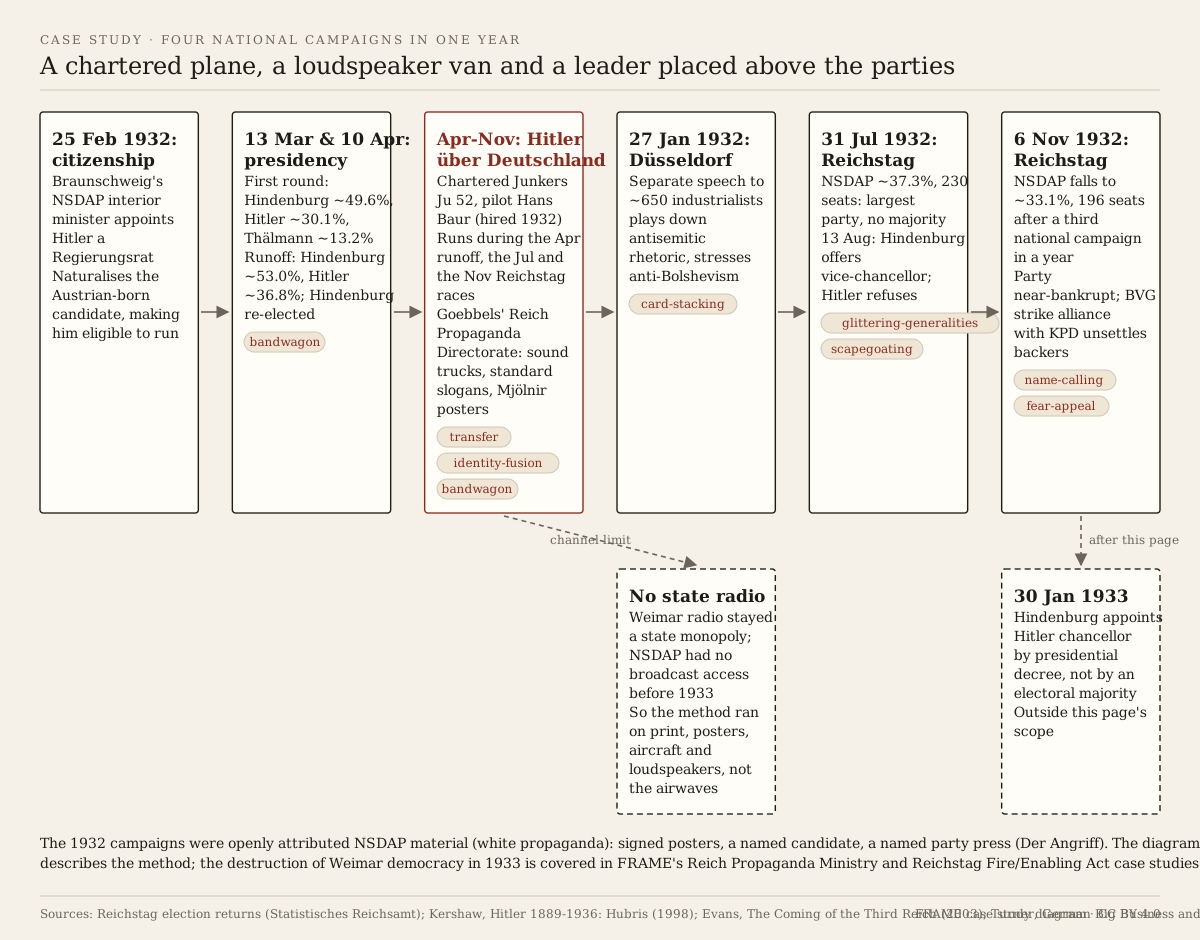
In one line: across four national campaigns in a single year — the presidential race against Hindenburg (March-April), the July Reichstag election and the November Reichstag election — the NSDAP paired a chartered aircraft that let Hitler address more than a dozen cities within days ("Hitler über Deutschland") with sound trucks, standardised posters and a "leader above the parties" pitch, took the party from a runner-up presidential vote to the largest Reichstag party in July, then watched that vote share fall in November, eleven weeks before Hindenburg appointed Hitler chancellor by decree rather than by any electoral majority.
What happened
Getting on the ballot
- 25 February 1932. Hitler, born an Austrian subject and stateless since renouncing his Austrian citizenship in 1925, is appointed a Regierungsrat (government councillor) attached to the Braunschweig state legation to the Reich, an administrative post arranged by Braunschweig's NSDAP interior minister, Dietrich Klagges. The appointment carries automatic German citizenship, which is required to stand for the Reich presidency.
The presidential race
- 13 March 1932. First round of the presidential election. Paul von Hindenburg, the 84-year-old incumbent running as a cross-party independent, takes about 49.6%; Hitler about 30.1%; the Communist candidate Ernst Thälmann about 13.2%; the nationalist Theodor Duesterberg (Stahlhelm/DNVP) about 6.8%. Hindenburg falls just short of the absolute majority needed to win outright, forcing a runoff.
- 3-10 April 1932. For the runoff, the NSDAP runs the first "Hitler über Deutschland" (Hitler Over Germany) campaign: a chartered Junkers Ju 52, flown by Hans Baur (hired as Hitler's personal pilot in 1932, a post he kept until 1945), carries Hitler between cities so he can speak in several places on the same day rather than campaign by rail. Exact city counts vary across contemporary NSDAP claims and later accounts; historians agree the method let Hitler personally address far more places, in far less time, than any German candidate had managed before.
- 10 April 1932. Runoff result: Hindenburg re-elected with about 53.0%; Hitler about 36.8%, an improvement of roughly 6.7 points on the first round; Thälmann about 10.2%. Hindenburg's second term begins.
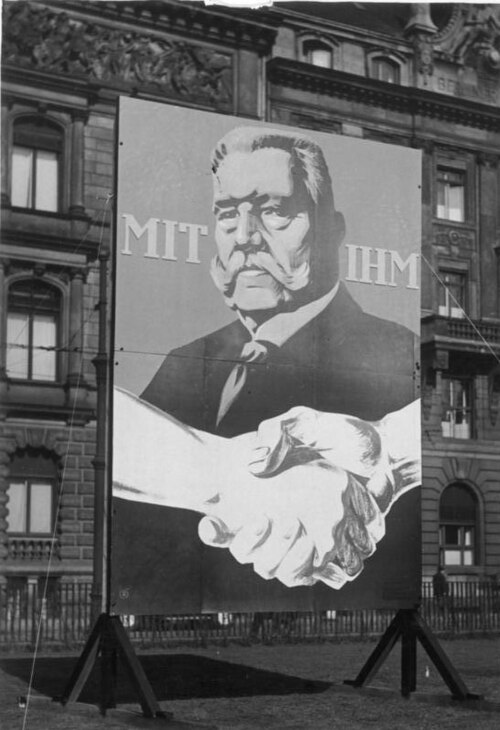
Election poster for the incumbent, Paul von Hindenburg, on a hoarding in Berlin: his portrait over a handshake, with the words "Mit ihm" ("With him"). Press photograph, March 1932, presidential campaign. Bundesarchiv, Bild 183-R99203, CC BY-SA 3.0 DE.
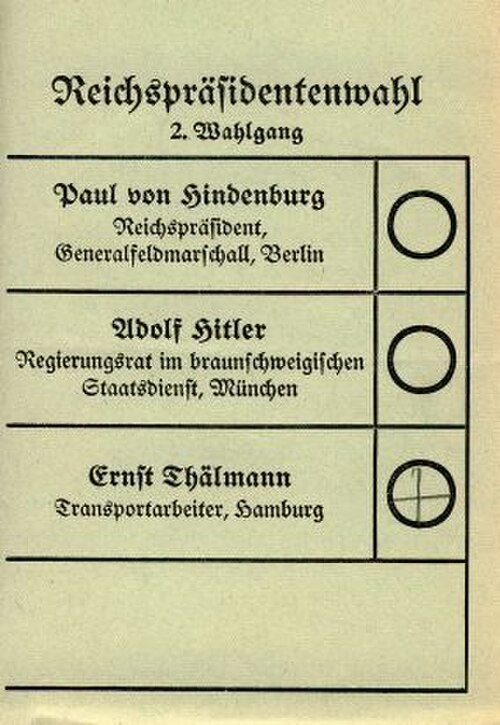
Ballot paper for the second round of the Reich presidential election, 10 April 1932, listing Paul von Hindenburg (Reichspräsident, Generalfeldmarschall, Berlin), Adolf Hitler (Regierungsrat in the Braunschweig state service, Munich) and Ernst Thälmann (Transportarbeiter, Hamburg). This copy is marked for Thälmann. Scan on Wikimedia Commons, public domain.
Content note: Photograph of Adolf Hitler speaking at a 1932 campaign rally with uniformed SA men beside him. This object is shown as it was published. Why 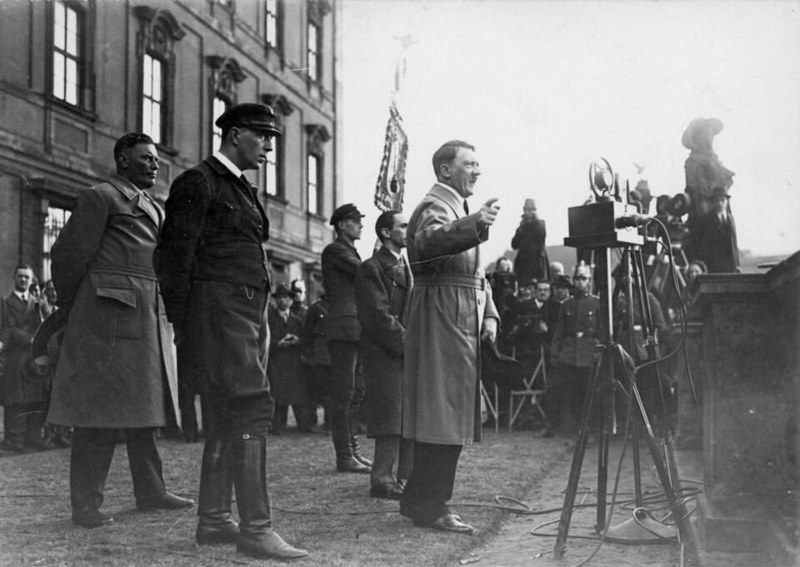
Adolf Hitler speaking at a microphone in the Lustgarten, Berlin, 4 April 1932, during the runoff campaign against Hindenburg; press photographers and a film camera stand beside the platform. Photograph by Georg Pahl, Bundesarchiv, Bild 102-14271B, CC BY-SA 3.0 DE.
Audience-tailored messaging
- 27 January 1932. Before the presidential campaign proper, Hitler addresses roughly 650 businessmen at the Industrieclub in Düsseldorf. The two-and-a-half-hour speech stresses the threat of Bolshevism to private property and plays down the racial and antisemitic themes that filled NSDAP rally speeches and Der Angriff editorials in the same months. Historians of the speech (notably Henry Ashby Turner) treat it as a case of the party tailoring its public message to its audience rather than winning over industrialists as a bloc; big business remained divided on Hitler through 1932.
State elections and street violence
- 24 April 1932. Landtag (state) elections in Prussia, Bavaria, Württemberg, Hamburg and Anhalt, run with the same aircraft-and-rally method, make the NSDAP the largest party in the Prussian Landtag (roughly 36% of the vote), Germany's largest state, though without a governing majority.
- 1 June 1932. Franz von Papen becomes chancellor by presidential appointment, not election, heading a cabinet with almost no party backing in the Reichstag.
- 16 June 1932. Papen lifts the ban on the SA and SS that Chancellor Brüning had imposed in April; street violence between the SA, the Communist Rotfrontkämpferbund and the police rises sharply through the summer, including the 17 July 1932 clashes in Altona ("Altona Bloody Sunday").
The July Reichstag campaign and its ceiling
- July 1932. The NSDAP runs a second, larger "Hitler über Deutschland" tour for the Reichstag election, again pairing the aircraft campaign with standardised posters (many by Hans Schweitzer, who signed his work "Mjölnir," Der Angriff's chief artist since 1926), sound trucks and loudspeaker vans for street meetings, and a party-wide script coordinated through Goebbels' Reich Propaganda Directorate (established under him in April 1930).
- 31 July 1932. Reichstag election. The NSDAP takes about 37.3% and 230 seats, becoming the largest party in the Reichstag for the first time — but well short of a majority in a chamber that would need 50%-plus to govern alone.
- 13 August 1932. Hindenburg receives Hitler and offers the NSDAP the vice-chancellorship and other cabinet posts under Papen; Hitler demands the chancellorship for himself with emergency powers and is publicly rebuffed. A government communiqué issued the same day makes the refusal known.
- 12 September 1932. A no-confidence vote (512 to 42) brings down Papen's government; the Reichstag is dissolved again.
The November campaign and the fall-back
- October-November 1932. A third national campaign in a single year strains the party's finances; historians (Kershaw among them) describe the NSDAP as close to bankrupt by the autumn, with local party organisations reporting exhaustion after three "Hitler über Deutschland"-style tours and the spring's state elections in one year.
- 3-7 November 1932. A Berlin transport workers' strike (the BVG strike) against wage cuts draws support from both the NSDAP and the Communist KPD, an unusual tactical alliance on the same picket lines that unsettled some of the NSDAP's conservative and business-world backers.
- 6 November 1932. Reichstag election. The NSDAP falls to about 33.1% and 196 seats, a drop of roughly 4 points and 34 seats from July — the clearest sign in the record that the party's free-election vote share had peaked and was receding before Hitler took power.
- 17 November 1932. Papen resigns; Kurt von Schleicher becomes chancellor on 3 December, also by appointment rather than election, and fails within weeks to build a workable majority or split the NSDAP.
- 30 January 1933. Hindenburg appoints Hitler chancellor of a coalition cabinet, in a deal brokered chiefly by Papen among a small circle around the president — a presidential appointment, not the product of any electoral majority the NSDAP had won. This date, and everything after it, is outside this page's scope.
How it works
- Transfer: the aircraft campaign's name, "Hitler über Deutschland" ("Hitler over Germany"), literally placed the candidate above the country in the audience's imagination — flight itself, still a novelty most Germans had never experienced, lent Hitler the era's association with modernity, speed and command of distance. The same borrowing ran through NSDAP banners and uniforms, which combined the old imperial black-white-red with the swastika to claim the authority of German nationhood for one party.
- Identity fusion: the campaign pitched Hitler as a leader standing above party politics ("die Parteien," the parties, plural, versus the movement) at a moment when Weimar cabinets had changed repeatedly and the Reichstag itself was reduced to a rubber stamp for presidential emergency decrees under Article 48. Presenting one man's cause as identical with the nation's, rather than one party's platform among several, is the same fusion the SA's "Deutschland erwache!" ("Germany, awake!") rally banners carried into the street.
- Bandwagon: four national campaigns compressed into eleven months, each reported by the party's own press as record turnout and unstoppable momentum, built an impression of inevitability. The July result, in which the NSDAP became the Reichstag's largest party, was used to argue the trend could only continue — a claim the November result then contradicted.
- Glittering generalities: rally banners carried virtue words with no attached policy — "Freiheit" (freedom), "Ehre" (honour), "Arbeit" (work) — while the party's Sofortprogramm (emergency economic programme), drafted chiefly by Gregor Strasser in 1932, promised "Arbeitsbeschaffung" (job creation) in terms vague enough that voters could read into it what they wanted.
- Name-calling: NSDAP rhetoric branded the Weimar coalition parties collectively as "Systemparteien" (system parties) and "Novemberverbrecher" (November criminals, for the 1918 armistice and revolution), labels that stood in for any specific policy argument.
- Scapegoating: campaign speeches and Der Angriff editorials tied the Depression, unemployment (which reached roughly six million by early 1932) and the Versailles settlement to "Jewish finance" and "Marxism" together, a fusion of two separate target groups into one blamed cause. At NSDAP and SA rallies of the period, participants chanted "Juda verrecke!" ("Perish, Judah!" or "Death to Judah!"), a slogan documented in contemporary and scholarly accounts of the movement's antisemitism (see Friedländer and Kershaw in Sources).
- Fear appeal: posters and speeches presented a Communist seizure of power, and the street violence between the SA and the Rotfrontkämpferbund that both sides fed through 1932, as proof that only the NSDAP could restore order — an argument that treated the disorder the party's own paramilitary wing helped produce as the case for voting for it.
- Card stacking: the Düsseldorf industrialists' speech of 27 January 1932 omitted the antisemitic and revolutionary language that filled mass rallies in the same weeks, presenting a different selection of the party's positions to a different audience rather than a false one.
Then and now
The specific device — a candidate chartering aircraft to multiply personal appearances within a compressed campaign window, so that saturation local coverage substitutes for the time travel by road or rail would take — became standard practice in democratic elections within a few decades and remains one today. Multi-city "fly-around" tours in the final days of a campaign, hitting several media markets in a single day to maximise local television and now livestream coverage, are routine in the United States, India and other large democracies, used by candidates across the political spectrum.
The differences are large and load-bearing, not incidental. The 1932 tours ran inside a republic whose parliament had been sidelined by presidential emergency decree, whose largest party fielded an armed street militia (the SA) that fought pitched battles with a rival party's militia, and whose head of state would, within a year, hand power to the tour's candidate by appointment rather than through the ballot box that had just handed him a shrinking vote share. Modern fly-around tours run inside institutions with independent courts, a competitive press under no licensing requirement, and a losing candidate who leaves office. The technique — compressing geography to manufacture momentum — is the same; the political system it operates inside is not.
Positions on the record
- The NSDAP's stated position. Campaign material presented Hitler as a leader who stood outside and above the failed party system, offering national renewal, work and an end to the Depression and the Versailles settlement's terms; the party's Sofortprogramm (1932) proposed public works and credit expansion in general terms. Party and SA rhetoric named Jews and "Marxists" as the source of Germany's crisis.
- Critics' position at the time. The Social Democratic press (Vorwärts) and the Communist press (Die Rote Fahne) each warned that a Hitler government would end parliamentary democracy, though they also fought each other as bitterly as they fought the NSDAP through 1932 and did not combine against it. Centre Party and liberal commentators, and foreign correspondents citing Mein Kampf (1925-26), argued Hitler's public reassurances (as at Düsseldorf) could not be squared with the party's own programme and rally rhetoric.
- What is documented. The dates and vote shares of the four 1932 national contests; Hitler's 25 February 1932 naturalisation; the existence and operation of the "Hitler über Deutschland" aircraft campaigns and Hans Baur's role as pilot; Goebbels' position as NSDAP Reich Propaganda Leader from 1930; the Düsseldorf Industrieclub speech and its documented content; Hindenburg's 13 August 1932 rebuff of Hitler; the November 1932 vote decline; the 30 January 1933 appointment.
- What is contested. How much of the 1932 rise is attributable to the propaganda method itself, as against structural causes — mass unemployment, the collapse of the Weimar centre-right and centre-left vote, and the elite miscalculation in January 1933 that Hitler could be "boxed in" by conservative cabinet partners (a judgment historians agree was wrong, but whose exact mix of causes remains debated between structuralist and intentionalist readings of the seizure of power). Exact attendance figures for individual 1932 rallies, as reported by the NSDAP's own press at the time, are not independently verifiable and are treated by historians as propaganda claims rather than counts.
- Not ruled on here. The substantive economic and political arguments between the Weimar parties, and how much responsibility rests with the industrialists, army leaders and conservative politicians who judged in January 1933 that a Hitler chancellorship could be controlled. This page scores how the 1932 campaigns were built and run, not the wider question of why Weimar democracy failed.
Same-method test
The compressed multi-city tour, radio-era mass rallies and "every man a king" glittering generalities of Louisiana's Huey Long score the same way on this page's tags. As a sitting U.S. senator (from 1932) and former governor, Long ran statewide radio broadcasts, chartered travel between rallies and a personality-driven movement ("Share Our Wealth," 1934) built around slogans ("Every Man a King") that promised concrete-sounding redistribution in terms vague enough to mean different things to different listeners — Glittering generalities and Bandwagon by the same test used above. Long also scapegoated a target, but a different and narrower one: Wall Street bankers and utility companies, named as a class of economic actor, not an ethnic minority — Scapegoating, with a target selection this page does not treat as equivalent to the NSDAP's.
The scale and the guardrails were entirely different. Long operated inside a federal constitutional system with an independent judiciary, a free national press that investigated and criticised him at length, and state and federal elections he could lose; his Louisiana political machine was authoritarian by U.S. standards of the time (patronage, intimidation of opponents) but commanded no paramilitary force fighting pitched battles with a rival party's militia, and it ended with his assassination in 1935, not with the seizure of a national government. The NSDAP's 1932 campaigns ran inside a republic whose parliament had already been sidelined by decree rule and whose largest party's street militia was a documented participant in escalating political violence; within a year its candidate held power by appointment, and within two years opposition parties, free elections and the free press Long had operated under were all gone. Same techniques, tagged the same way; a democracy that survived its populist versus one that did not survive its authoritarian movement.
How to spot it
- Watch for a party candidate marketed as standing "above" or "outside" party politics while running an ordinary party campaign; note who benefits from blurring that line.
- Check whether a compressed, technology-enabled multi-city tour is producing genuinely large in-person audiences or mostly generating repeatable photographs and headlines about crowd size.
- Ask whether opponents are named by a broad category (a "system," a class, an ethnicity) rather than by a specific, checkable policy disagreement.
- Track a campaign's vote share across its full cycle, not just its peak headline result — a July win says nothing on its own about a November decline, and momentum claims should be checked against the next data point, not just the last one.
- Notice when a movement's public register changes with its audience (a business-club speech versus a mass rally); a consistent gap between what is said to different rooms is itself information.
Images
| Image | Source | Licence |
|---|---|---|
| Mechanism diagram (above) | Drawn for FRAME from the sources below (make_diagrams_rtp_hog.py) |
CC BY 4.0, FRAME |
| Berlin, Wahlplakat für Hindenburg (1932-03) | Wikimedia Commons; Bundesarchiv, Bild 183-R99203 / CC-BY-SA 3.0 | CC BY-SA 3.0 DE |
| Stimmzettel zur Reichspräsidentenwahl 1932, 2. Wahlgang (April 10, 1932) | Wikimedia Commons; Official ballot paper, 10 April 1932; scan by Hoffmann.th, Wikimedia Commons | Public domain |
| Reichspräsidentenwahl, Ansprache Adolf Hitler (April 4, 1932) | Wikimedia Commons; Bundesarchiv, Bild 102-14271B / Pahl, Georg / CC-BY-SA 3.0 | CC BY-SA 3.0 DE |


Image gaps
- "Unsere letzte Hoffnung: Hitler" (Our Last Hope: Hitler), 1932 election poster by Hans Schweitzer ("Mjölnir"). This is the era's best-known image of the campaign — a crowd of gaunt, unemployed figures looking upward toward an unseen source of hope — reproduced in the German Historical Museum's collection (DHM) and widely in scholarship (e.g. Welch, The Third Reich: Politics and Propaganda). Not hosted here: it is a German work from 1932 whose U.S. copyright status is unclear, so per this archive's rule for Nazi-era material it is cited, not displayed.
- NSDAP campaign posters generally, 1932 (Sofortprogramm posters, "Hitler über Deutschland" tour posters, Mjölnir's other Der Angriff cartoons). Same unclear U.S. copyright status; not hosted.
- Photographs of the "Hitler über Deutschland" flights and rallies. A Lustgarten speech of 4 April 1932 is shown above (Bundesarchiv Bild 102-14271B, CC BY-SA 3.0 DE). No photograph of the aircraft tours themselves was hosted; see the Wikimedia Commons category "Adolf Hitler in 1932" (commons.wikimedia.org), largely drawn from the Bundesarchiv.
- A photograph of Hans Baur or the chartered Junkers Ju 52. No openly licensed, U.S.-cleared image was found; Baur's own postwar memoir (Hitler's Pilot, 1958) is not an image source.
- A photograph of the Industrieclub Düsseldorf speech. No openly licensed image with clear U.S. status was found for this indoor 1932 event.
Sources
- Reichstag and presidential election returns, 1932: Statistisches Reichsamt, Statistik des Deutschen Reichs, vol. 372 (1932-33), the standard contemporary compilation cited by later historians for the vote and seat totals above.
- Ian Kershaw, Hitler 1889-1936: Hubris (W. W. Norton, 1998), chapters on the 1932 campaigns, the Düsseldorf speech, the August 1932 Hindenburg meeting and the January 1933 appointment.
- Richard J. Evans, The Coming of the Third Reich (Penguin Press, 2003), on the 1932 election cycle and the collapse of Weimar party government.
- Henry Ashby Turner, German Big Business and the Rise of Hitler (Oxford University Press, 1985), on the 27 January 1932 Industrieclub Düsseldorf speech and business opinion of Hitler through 1932.
- Joseph Goebbels, diaries for 1932, published as Die Tagebücher von Joseph Goebbels, ed. Elke Fröhlich (K. G. Saur, various volumes), the standard edition for the campaign planning behind the Reich Propaganda Directorate's 1932 work.
- Hans Baur, Hitler's Pilot (Frederick Muller, 1958; German original Ich flog Mächtige der Erde, 1956), on his hiring as Hitler's pilot in 1932 and the aircraft campaigns.
- Saul Friedländer, Nazi Germany and the Jews, Volume 1: The Years of Persecution, 1933-1939 (HarperCollins, 1997), for the documented history of "Juda verrecke" and related NSDAP/SA antisemitic sloganeering in this period.
- German Historical Museum (Deutsches Historisches Museum), Lebendiges Museum Online (LeMO), entries on the 1932 elections and Hans Schweitzer ("Mjölnir"): dhm.de/lemo.
- Wikimedia Commons, Category: Adolf Hitler in 1932: commons.wikimedia.org, for the photographic record not hosted here (see Image gaps).
- T. Harry Williams, Huey Long (Alfred A. Knopf, 1969), for the same-method comparison.
- William L. Shirer, The Rise and Fall of the Third Reich (Simon & Schuster, 1960), for a contemporary journalist's account of the 1932 campaign atmosphere, used with care as a secondary rather than archival source.