Content note. This page shows swastika banners and other NSDAP symbols, and quotes party slogans, as historical evidence of how the rallies were staged. They are shown for documentation, not endorsement. The organization these rallies built later carried out genocide; that record is covered in FRAME's genocide and Holocaust-era case studies, not scored here.
In one line: Between a September 1923 coalition march-past and the September 1933 "Rally of Victory," the NSDAP turned an annual gathering of a few thousand into a staged display of massed columns, a relic ritual and national press coverage, doing the work of a much larger movement for a party that won just 2.6 percent of the vote in 1928 — a rehearsal the party completed only after it already held the state.
What happened
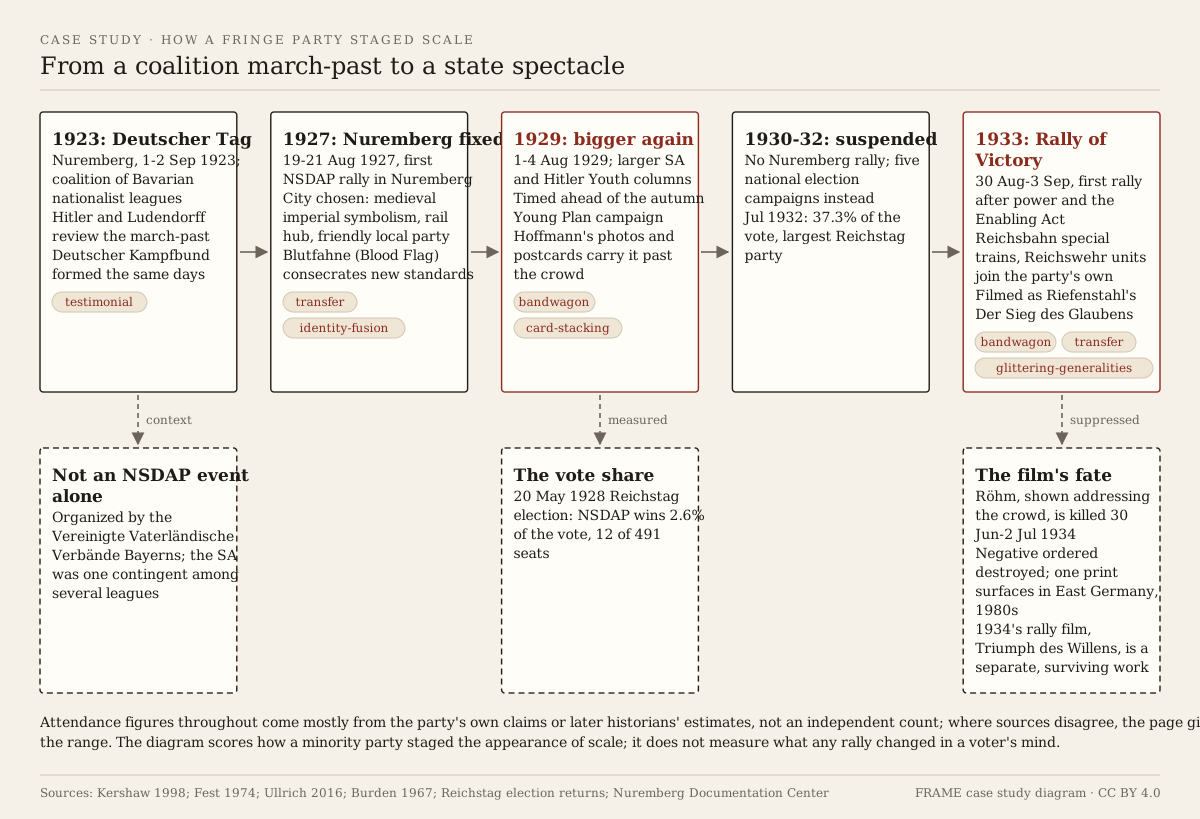
- 27-29 January 1923, Munich. The NSDAP holds its first postwar party congress (Parteitag), despite a Bavarian government ban that Hitler negotiates down to a restricted permit. About 5,000-6,000 SA men parade before Hitler on the Marsfeld, and unit standards are formally consecrated for the first time (Kershaw, Hubris; Fest, Hitler).
- 1-2 September 1923, Nuremberg. A "Deutscher Tag" (German Day) is held in Nuremberg, organized not by the NSDAP alone but by the Vereinigte Vaterländische Verbände Bayerns (United Patriotic Associations of Bavaria), a coalition of nationalist paramilitary leagues that includes the NSDAP's SA alongside the Bund Oberland and the Reichsflagge. Estimates of the total crowd run to roughly 100,000; Adolf Hitler and General Erich Ludendorff — Germany's deputy supreme commander in the First World War and, by 1923, a symbol of the "stab-in-the-back" myth — together take the salute at a march-past of the assembled formations. In the same days the participating leagues merge into the Deutscher Kampfbund (German Combat League), with Hitler as its political leader; this alliance carries out the Beer Hall Putsch on 8-9 November 1923 (Kershaw; Fest; Ullrich, Ascent).
- 8-9 November 1923. The Putsch fails in Munich. The NSDAP is banned across Germany and Hitler is imprisoned at Landsberg, where he dictates Mein Kampf. The party stays dormant until Hitler refounds it on 27 February 1925.
- 3-4 July 1926, Weimar. The first postwar Reichsparteitag is held not in Bavaria but in Thuringia, whose government is more tolerant; Bavaria still bars Hitler from public speaking (a ban lifted only state by state from 1927). At Weimar the party performs, for the first time, the ritual that becomes standard at every later rally: new SA and SS standards are consecrated by touching them to the Blutfahne (Blood Flag), the banner reportedly carried during the 1923 Putsch and stained, the party said, with the blood of participants shot dead outside the Feldherrnhalle.
- 19-21 August 1927, Nuremberg. The NSDAP holds its first Reichsparteitag in Nuremberg and keeps the city from then on. Standard accounts give three reasons for the choice: the city's medieval standing as an unofficial capital of the Holy Roman Empire, host to historic imperial diets and home to the Kaiserburg; its position at a major rail junction, useful for moving marchers from across Germany; and a friendly local government and a strong local party organization under Gauleiter Julius Streicher, which secured use of the Luitpoldhain grounds (Burden, The Nuremberg Party Rallies; Documentation Center Nazi Party Rally Grounds, Nuremberg). Estimates of the marching SA and SS contingent run from about 15,000 to 30,000; no independent count survives, and the party's own published figures ran higher. Nationally the party remains a fringe force: in the Reichstag election of 20 May 1928 it wins 2.6 percent of the vote and 12 of 491 seats.
- 1-4 August 1929, Nuremberg. A second Nuremberg rally is larger again: historians' estimates for total participants and spectators together range from roughly 60,000 into the low hundreds of thousands, against the party's own higher claims; the Hitler Youth marches in visible numbers for the first time. The rally comes a few months before the party allies with Alfred Hugenberg's German National People's Party (DNVP) in the autumn 1929 campaign against the Young Plan, a partnership that hands the NSDAP national press coverage it could not otherwise have bought.
- 1930-1932. No Nuremberg rally is held. The party instead puts its resources into five national campaigns in three years: the Reichstag election of September 1930 (18.3 percent, the second-largest party), the presidential election of spring 1932, and two Reichstag elections that year (37.3 percent on 31 July, the largest single party though short of a majority, then 33.1 percent on 6 November) (Evans, The Coming of the Third Reich).
- 30 January 1933. Hitler is appointed chancellor. 23 March 1933: the Enabling Act passes. Through the following months other parties are banned or dissolve themselves; by July the NSDAP is the only legal party.
- 30 August-3 September 1933, Nuremberg: the Reichsparteitag des Sieges (Rally of Victory). The first Nuremberg rally after the seizure of power is also the first with the machinery of the state behind it: the Reichsbahn (state railways) runs special trains, and units of the Reichswehr (the army) take part alongside the party's own formations for the first time. Estimates for total attendance run into the hundreds of thousands, again without an independent count. Leni Riefenstahl, working at short notice with a small crew, films it as Der Sieg des Glaubens (Victory of Faith) — her first Nuremberg rally film, and a different, separate work from her more famous 1935 film of the following year's rally, Triumph des Willens, which FRAME covers in Film under Goebbels: Triumph des Willens (1935) and Der ewige Jude (1940). SA chief Ernst Röhm appears throughout, addressing the crowd alongside Hitler as a near-equal.
- 30 June-2 July 1934. In the Night of the Long Knives, Röhm and other SA leaders are killed on Hitler's order. With Röhm now purged from the official record, Goebbels has the negative of Der Sieg des Glaubens destroyed; the film is presumed lost until a single surviving print turns up in a private East German collection in the 1980s (Hinton, The Films of Leni Riefenstahl).
- 4-10 September 1934, Nuremberg. The next rally, the Reichsparteitag der Einheit und Stärke (Rally of Unity and Strength), is the one Riefenstahl films as the surviving Triumph des Willens — the version most widely remembered today, and the subject of FRAME's separate case study.
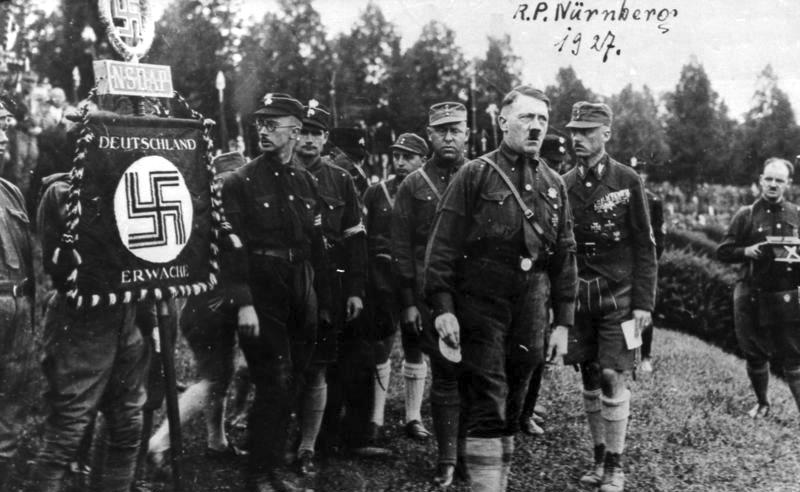
Adolf Hitler (front) marches with SA and party figures, including Rudolf Hess and Franz Pfeffer von Salomon, behind a swastika standard reading "Deutschland Erwache" ("Germany Awake") at the Nuremberg rally, August 1927. Bundesarchiv, Bild 146-1969-054-53A, CC BY-SA 3.0 DE. The party's national vote share that period was in the single digits; the column and the standard project a larger movement.
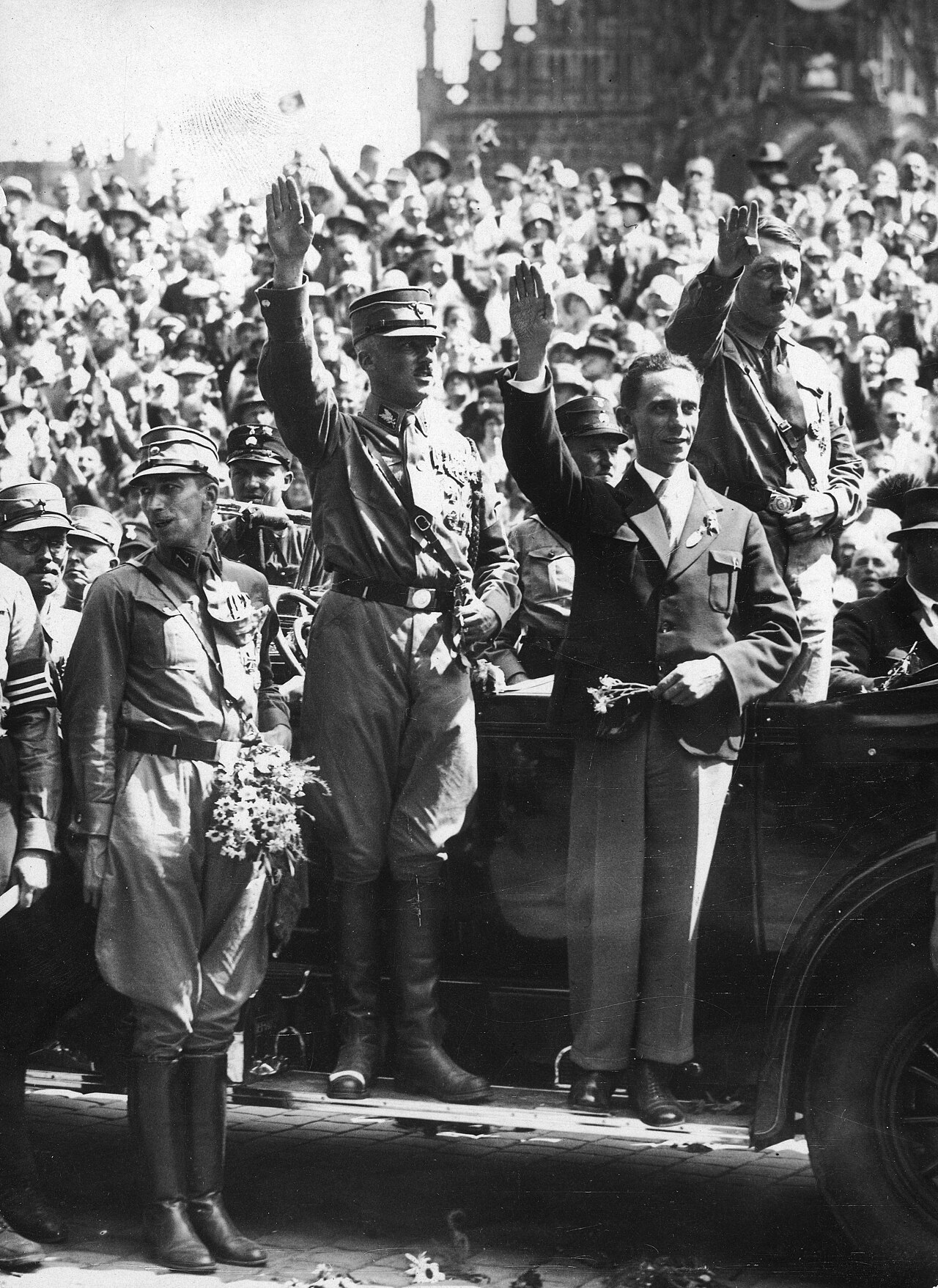
Adolf Hitler, Joseph Goebbels and SA commander Franz Pfeffer von Salomon salute a crowd from an open car at the Nuremberg rally, 1-4 August 1929. Photo by Robert Sennecke, published by Internationaler Illustrations-Verlag, October 1929; held by the Narodowe Archiwum Cyfrowe (Polish National Digital Archive), marked with a Public Domain Mark. First published in 1929, the photograph entered the U.S. public domain on 1 January 2025 under the 95-years-from-publication rule.
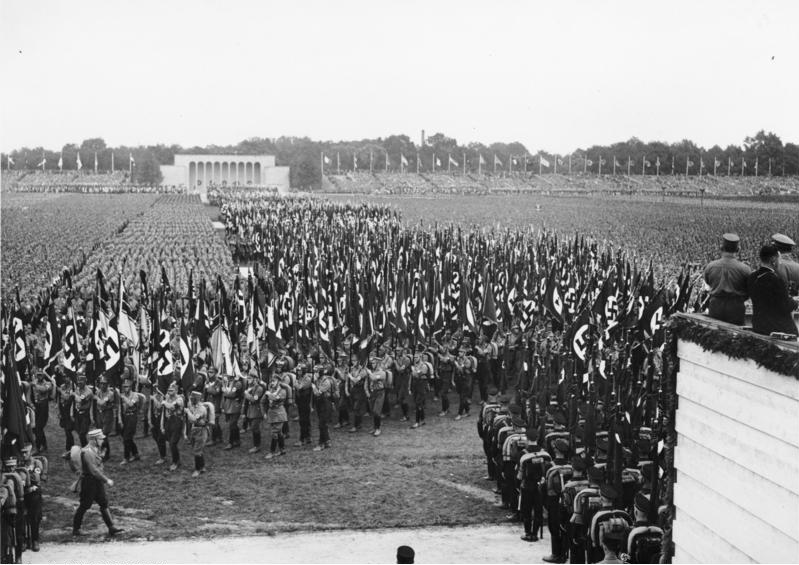
SA units massed with swastika standards on the Luitpoldhain parade ground at the Reichsparteitag des Sieges (Rally of Victory), Nuremberg, August-September 1933 — the first rally staged with the resources of the state behind it. Bundesarchiv, Bild 183-1987-0410-501, CC BY-SA 3.0 DE.
How it works
- Transfer: choosing Nuremberg borrowed the prestige of the old Reich for a party that had none of its own. The city's medieval standing as a free imperial city, host to historic Reichstage and home to the Kaiserburg, let a party six years old present itself in the visual language of a thousand-year empire; in 1933 it added the borrowed authority of the actual army marching beside its own formations.
- Identity fusion: the Blutfahne ritual, begun at Weimar in 1926 and repeated at every rally after, fused ordinary party membership with a shared martyr myth. Touching a new standard to a flag presented as stained with the blood of the 1923 dead made joining the SA an act of communion with sacrifice, not a policy choice a member could reconsider without symbolically betraying the dead.
- Bandwagon: the growing columns, year over year, and the party's own attendance claims (consistently higher than independent estimates) were offered as proof that the nation was already turning to the movement, even while its own Reichstag vote share was 2.6 percent in 1928. The 1933 rally repeated the move at a different order of scale, with the state's own railways and army now visibly part of the column.
- Card stacking: the party's official photographer, Heinrich Hoffmann, and its pictorial weekly Illustrierter Beobachter (launched 1926) selected flattering, full-formation angles of the rallies for national circulation; commercial photo agencies (Sennecke's Internationaler Illustrations-Verlag, later foreign wire services) carried the same kind of images further still. What the coverage left out — the party's minority status before 1930, local opposition, and the three years, 1930-1932, in which it could not spare the money or the campaign time for a rally at all — is no less part of the record than what it showed.
- Testimonial: General Erich Ludendorff, reviewing the 1923 march-past beside Hitler, lent the still-marginal NSDAP the borrowed authority of a nationally known military hero and a living symbol of wartime command, years before the party had any electoral standing of its own.
- Glittering generalities: banners reading "Deutschland Erwache" ("Germany Awake") and speeches promising national rebirth and unity offered listeners a feeling of renewal without a program to check it against; the rallies' actual content was mostly parade drill, standard-bearing and set speeches.
Then and now
The same staging logic runs through North Korea's mass rallies and military parades today, covered in FRAME's The Kim leader cult, the anti-US month and the leaflets sent back: choreographed columns, large published attendance figures, and state media coverage built to reach citizens who never stood in the square, offered as proof of a devotion the numbers cannot independently confirm.
The differences are large. North Korea today is a one-party state whose population cannot lawfully decline to attend or applaud, whose domestic media carries no other line, and whose leader cult has been built across three generations. The NSDAP of 1927-1929 was a minor party inside a multiparty republic that still had a free opposition press — which mocked the rallies as provincial theatre by a fringe movement — competitive elections, and no power to compel anyone's presence at Nuremberg. Only by 1933, after the Reichstag election returns and the Enabling Act had already done the political work, did the rally itself gain the state's own machinery.
Positions on the record
- The party's own account. In Mein Kampf (1925-26), Hitler set out a rationale for mass meetings directly: an individual who feels isolated and doubtful in ordinary life, he wrote, gains "for the first time the picture of a large community" among thousands of others, an effect he attributed to what he called mass suggestion (Massensuggestion) (Hitler, trans. Manheim, chapter "War Propaganda"). On that account the rallies were not decoration but a deliberate psychological technique.
- Contemporary critics. Social Democratic and Communist newspapers, and much of the mainstream Weimar press, covered the 1927 and 1929 rallies as a provincial spectacle mounted by a fringe party, a reading the party's own 1928 vote share (2.6 percent) supported at the time (Kershaw; Evans).
- What is documented. The dates and locations of the 1923, 1927, 1929 and 1933 rallies; the Bavarian speaking ban and its 1927 partial lifting; the founding of the Blutfahne ritual at Weimar in 1926; the Reichstag results of 1928 and 1932; the participation of Reichsbahn and Reichswehr units from 1933; Riefenstahl's authorship of Der Sieg des Glaubens and its post-1934 suppression.
- What is contested. Precise attendance at every rally before 1933: no independent count exists for any year, the party's own published figures are consistently the highest in the range, and historians (Burden 1967; Kershaw 1998) give lower estimates without full agreement on exact numbers. How much of the 1923 Deutscher Tag's roughly 100,000 attendees should be credited to the NSDAP specifically, as opposed to the several other nationalist leagues that co-organized it, is also not settled in the sources consulted for this page.
- Not ruled on here. Whether the rallies caused the party's later electoral gains, as against the Depression, other parties' failures, and the NSDAP's separate door-to-door and print campaigning covered elsewhere in FRAME's early-NSDAP case studies; and the broader political collapse of the Weimar Republic.
Same-method test
The same scoring applies wherever an organizer stages a mass march and lets photographs and newsreel of the column stand in for a vote count, whatever the cause. FRAME's case study on the second Ku Klux Klan, The second Ku Klux Klan: selling membership as '100% Americanism', tags its 8 August 1925 march of an estimated 25,000-50,000 members down Pennsylvania Avenue in Washington, D.C. — covered by newsreel and wire photo nationwide — with Bandwagon and Transfer for the same reason argued here: a march built to look like proof of a movement's size, staged in a location (the national capital, rather than an old imperial city) chosen for its own symbolic weight.
The differences are still worth stating. The Klan's 1925 march took place lawfully inside a constitutional democracy whose courts, elections and press kept functioning throughout, and most historians read the march itself as evidence the movement had already passed its peak membership, not proof of unstoppable growth. The NSDAP's 1927 and 1929 rallies took place in a republic whose institutions still functioned too, and where the party's own numbers stayed small for years afterward; only the 1933 rally was staged from inside a state that had just closed down its opposition. Same method, tagged the same way; very different institutions around it and very different outcomes.
How to spot it
- Compare the organizer's own attendance claim against any independent count and against the group's actual vote share or membership at the time. A crowd photograph is not a poll.
- Ask why a venue was chosen. When a city's historical symbolism, rather than its size or logistics alone, is stressed in an organizer's own account, prestige is being borrowed on purpose.
- Look for a relic or ritual object — a flag, a banner, a sacred object — used to consecrate new members or units. Fusing membership with a shared sacrifice story raises the cost of ever leaving or questioning the group.
- Check who controlled the camera and how the images travelled afterward. A rally's reach is set less by who stood in the square than by whose photographs and newsreel later reached everyone else.
- Note what years are missing. A movement that skips its own signature event for several years, as the NSDAP did in 1930-1932, was not always building toward its later scale in a straight line.
Images
| Image | Source | Licence |
|---|---|---|
| Mechanism diagram (above) | Drawn for FRAME from this page's sourced facts (make_diagrams_rtp_nuremberg.py) |
CC BY 4.0, FRAME |
| Hitler and party leaders marching, Nuremberg rally, August 1927 | Wikimedia Commons, Bundesarchiv, Bild 146-1969-054-53A | CC BY-SA 3.0 DE |
| Hitler, Goebbels and Pfeffer von Salomon saluting a crowd, Nuremberg rally, August 1929 | Wikimedia Commons, photo by Robert Sennecke, Narodowe Archiwum Cyfrowe | Public Domain Mark 1.0 (published 1929; U.S. public domain since 1 Jan 2025) |
| Massed SA formations, Rally of Victory, Nuremberg, September 1933 | Wikimedia Commons, Bundesarchiv, Bild 183-1987-0410-501 | CC BY-SA 3.0 DE |


Image gaps
- The 1923 Nuremberg "Deutscher Tag" and Hitler-Ludendorff march-past. Wikimedia Commons holds Bundesarchiv photographs of this event (Bild 102-00162 and Bild 102-00163, "Nürnberg, 'Deutscher Tag', Ludendorff"), which carry the same CC BY-SA 3.0 DE licence used above. They were not downloaded for this page because Commons rate-limited repeated requests from the build environment. This gap can be filled by re-fetching those two files.
- The Blutfahne (Blood Flag) consecration ceremony itself. No openly licensed photograph of the ritual at the 1926 Weimar, 1927 or 1929 rallies was located within this page's sourcing constraints.
- Frames from Der Sieg des Glaubens (1933). The single surviving print is a restricted archival item, not openly licensed, and the film's rediscovery history makes its rights status unclear; no still is hosted here for that reason.
- A photograph of the 1929 Reichstag election results or the 1928/1932 vote-share context. Left as text with cited figures rather than a chart, to avoid implying a level of statistical precision the underlying attendance estimates elsewhere on this page do not have.
Sources
Full text in this archive: Mein Kampf (German, 1943 printing of the 1925/26 text), with a content note and the edition caveat on its page.
- Ian Kershaw, Hitler 1889-1936: Hubris (New York: W. W. Norton, 1998).
- Joachim C. Fest, Hitler, trans. Richard and Clara Winston (New York: Harcourt Brace Jovanovich, 1974).
- Volker Ullrich, Hitler: Ascent, 1889-1939, trans. Jefferson Chase (New York: Knopf, 2016).
- Richard J. Evans, The Coming of the Third Reich (New York: Penguin Press, 2003).
- Hamilton T. Burden, The Nuremberg Party Rallies: 1923-39 (New York: Praeger, 1967).
- Adolf Hitler, Mein Kampf, trans. Ralph Manheim (Boston: Houghton Mifflin, 1943 [1925-26]), chapter "War Propaganda."
- Documentation Center Nazi Party Rally Grounds, Nuremberg Museums: "The History of the Nazi Party Rallies" and "Leni Riefenstahl's 'Triumph of the Will'".
- David B. Hinton, The Films of Leni Riefenstahl (Metuchen, NJ: Scarecrow Press, 1978; rev. ed. 2000), on Der Sieg des Glaubens's suppression and rediscovery.
- David Welch, Propaganda and the German Cinema, 1933-1945 (Oxford: Clarendon Press, 1983; rev. ed., London: I. B. Tauris, 2001), on Heinrich Hoffmann and the Illustrierter Beobachter.
- Linda Gordon, The Second Coming of the KKK (New York: Liveright, 2017), for the same-method comparison.
- FRAME case study: Film under Goebbels: Triumph des Willens (1935) and Der ewige Jude (1940) (Riefenstahl's 1935 Triumph des Willens and 1940's Der ewige Jude).
- FRAME case study: The Reich Ministry of Public Enlightenment and Propaganda, 1933-1945 (the ministry the 1933 rally's state backing anticipated).
- FRAME case study: The second Ku Klux Klan: selling membership as '100% Americanism' (the 1925 Washington, D.C. march used in the same-method test above).
- FRAME case study: The Kim leader cult, the anti-US month and the leaflets sent back (the modern parallel used in "Then and now" above).