In one line: from 1948 the Soviet Union, and later most of its allies, broadcast noise on the frequencies of Western radio stations to stop their own citizens hearing what those stations called news and what Moscow called subversion; the United Nations condemned the practice in 1950, the jamming was switched off and on with the state of relations, and it ended in the USSR on 29 and 30 November 1988.
This page covers jamming as a counter-measure: who did it, on what legal and political case, and what it achieved. The Western broadcasters themselves, their funding and their content, belong to the Cold War broadcasting pages.
What happened
- 1936. The League of Nations adopts the International Convention concerning the Use of Broadcasting in the Cause of Peace. Its Article 1 binds parties to stop broadcasts "of such a character as to incite the population of any territory to acts incompatible with the internal order or the security of a territory." Soviet diplomats later cite this principle of non-interference against Western broadcasting.
- 1947. The International Telecommunication Union's Atlantic City conference tightens the rule against "harmful interference" with other countries' registered radio services.
- 1948. The Soviet Union begins jamming Western broadcasts aimed at its territory.
- 14 December 1950. The UN General Assembly adopts Resolution 424 (V), "Freedom of information: interference with radio signals." It calls on member states to refrain from deliberately interfering with the reception of foreign radio signals, as an interference with their peoples' right to freedom of information. The vote is 49 in favour and 5 against.
- March 1953. Radio Liberty (then Radio Liberation) begins broadcasting to the USSR. Its Russian and other Soviet-language services are jammed continuously from 23 March 1953 until November 1988.
- 1956. Poland becomes the first Eastern bloc state to stop jamming Western broadcasts.
- 1956 to 1959. During the Cyprus Emergency, the British colonial government under Field Marshal Sir John Harding jams Athens Radio's Greek broadcasts to Cyprus, which supported the EOKA insurgency, and Greece jams British broadcasts to the island. The House of Commons debates the jamming in 1956. It is the one sustained jamming contest between Western states in the period.
- 19 June 1963. Around the signing of the US-Soviet "hotline" agreement and before the Limited Test Ban Treaty, the Soviet Union stops jamming the Voice of America, the BBC and Deutsche Welle. It keeps jamming Radio Liberty. Romania, Hungary and Czechoslovakia soon stop jamming the Western state broadcasters too.
- 21 August 1968. With the Warsaw Pact invasion of Czechoslovakia, the Soviet Union resumes jamming the Voice of America, the BBC and Deutsche Welle.
- 1973 to 1975. During détente, the Soviet Union stops jamming the Voice of America, the BBC and Deutsche Welle again in 1973, and leaves them unjammed until 1980. At the Helsinki conference, the United States seeks a clause banning jamming and the Soviet Union blocks it. The Final Act (1 August 1975) only has the parties "note the expansion in the dissemination of information broadcast by radio" and express the hope that it will continue. Western governments read this as ruling out jamming; the Soviet side reads jamming as a lawful answer to broadcasts that break the Act's aim of "mutual understanding."
- September 1974. Bulgaria, the last Warsaw Pact state still jamming the Voice of America, stops.
- August 1980. As Solidarity strikes spread in Poland, the Soviet Union resumes jamming the Voice of America in Russian, Ukrainian and Armenian, the BBC and Deutsche Welle. The State Department calls it a breach of the Helsinki Final Act.
- 1987. Under glasnost, the Soviet Union stops jamming the BBC and then, in late May, the Voice of America. Radio Liberty, Radio Free Europe and Deutsche Welle stay jammed.
- 21 November 1988. RFE/RL's monitoring station at Schleissheim, near Munich, reports that the jamming of Radio Free Europe and Radio Liberty by the USSR and several Eastern European states has stopped abruptly. Radio Liberty dates the end of the Soviet jamming of its Russian service to 29 November 1988; other accounts give 30 November.
- After 1988. Jamming continues elsewhere. China had largely stopped jamming the Voice of America and the BBC around 1978 to 1979 and resumed after the Tiananmen Square protests of June 1989. Cuba has jammed the US government's Radio Martí (launched 1985) and TV Martí (1990), starting 24-hour jamming of Radio Martí in Havana in May 1990.
How it worked
- Two kinds of jammer. Skywave jammers were powerful transmitters that bounced noise off the ionosphere onto large areas, often from far away. Groundwave jammers were local transmitters in cities. Groundwave jamming worked well in city centres, less well in the suburbs, and poorly or not at all in the countryside.
- What was sent. Noise jamming broadcast a buzz or rasp on the target frequency. So-called mayak jamming broadcast a distorted Soviet domestic programme on the same frequency.
- Scale. Accounts based on post-Soviet records describe thousands of jamming transmitters. Rimantas Pleikys, a Lithuanian specialist on the subject, counts 11 jamming stations with about 140 transmitters in the Baltic republics alone, and about 300 transmitters in Ukraine. The network cost, on Western estimates, tens of millions of dollars a year; US officials of the 1980s said the Soviets spent more on jamming than the Voice of America's whole worldwide budget. No Soviet budget figure for jamming has been published that this page could check.
- Who was jammed hardest. Radio Free Europe and Radio Liberty, which were set up in secret by the CIA and openly funded by Congress after 1971, were jammed almost continuously. The official state broadcasters (VOA, BBC, Deutsche Welle) were jammed on and off, in step with relations with the West.
No FRAME technique is tagged on this page. Jamming is a way of blocking a message, not a message that can be scored against the technique list.
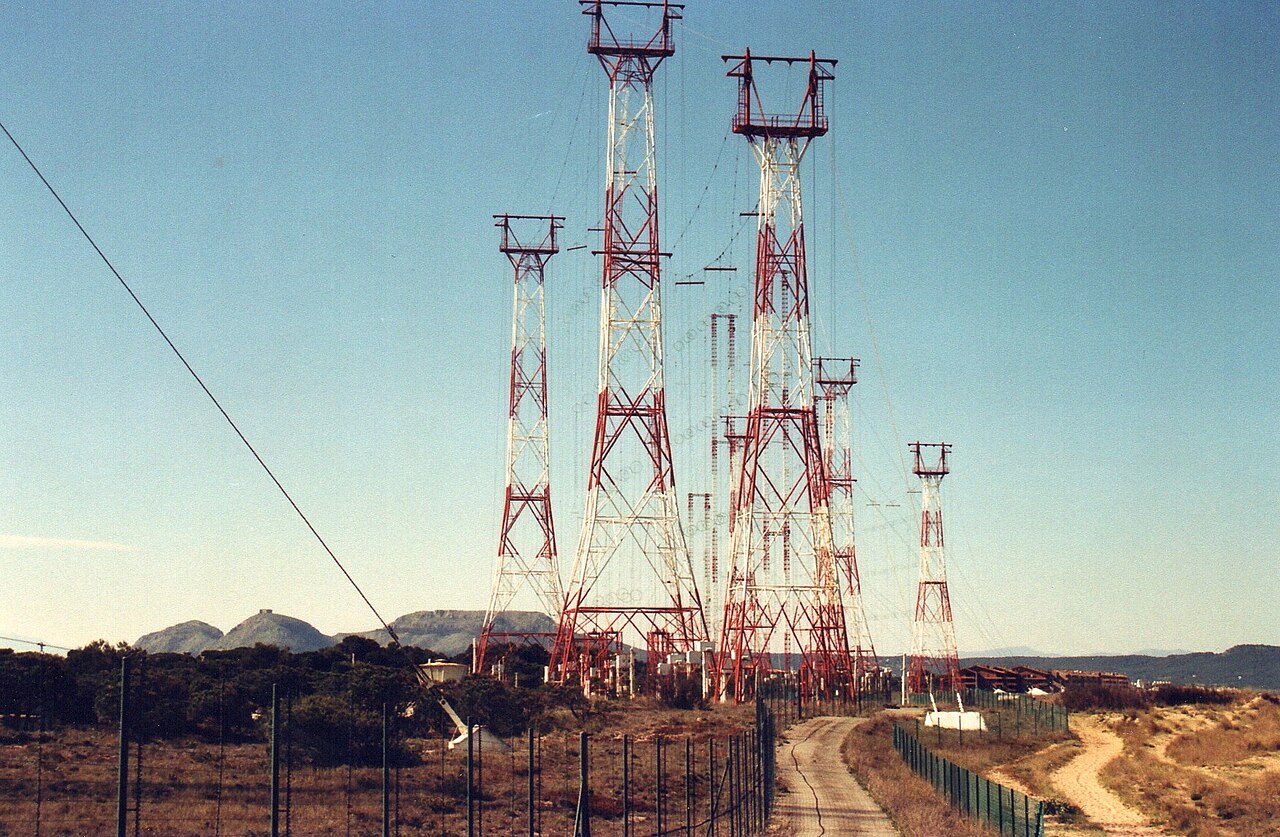
Antenna masts of the Radio Liberty and Radio Free Europe transmitting station at Pals, Catalonia, Spain, photographed in 2005. Radio Liberty began broadcasting from Pals in 1959. Photo: Saint-Aniol, Wikimedia Commons, CC BY-SA 3.0.
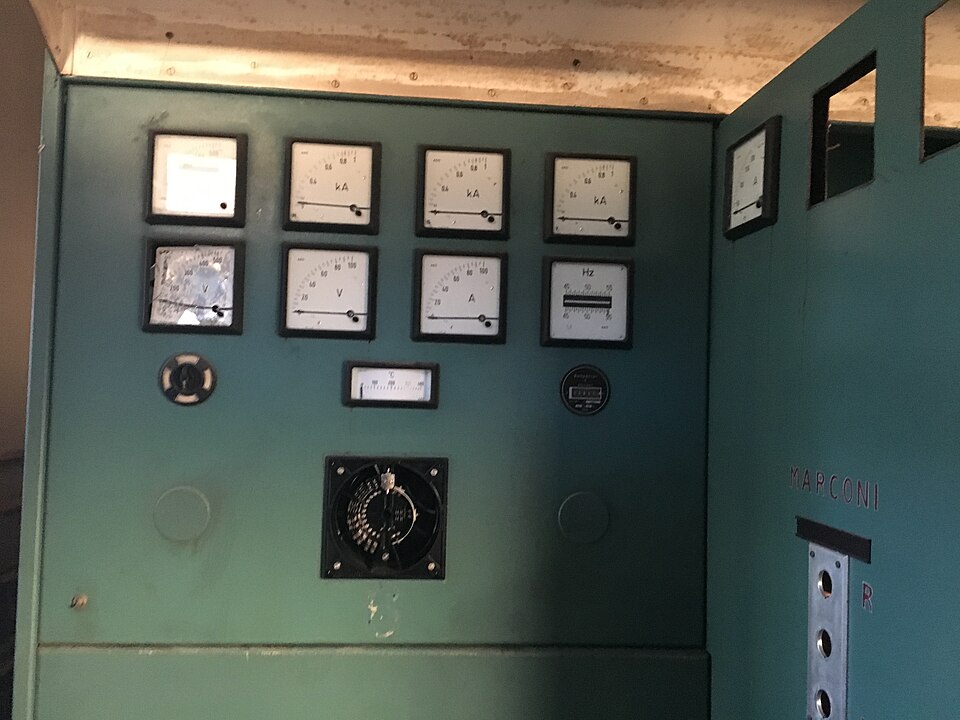
Meters on an equipment cabinet in the remains of the Pals station, photographed on 26 March 2016, after the station had closed. Photo: Davidpar, Wikimedia Commons, CC BY-SA 4.0.
Measured effect
The only systematic audience data comes from the Western broadcasters' own research, chiefly R. Eugene Parta's surveys for Radio Liberty, based on about 51,000 interviews with Soviet citizens travelling abroad between 1972 and 1990. The sample was not random, and the broadcasters had an interest in the results. With that caveat, it shows:
- Jamming reduced listening but did not stop it. In an average week in 1978 to 1990, Parta's figures put the Voice of America at nearly 15 per cent of Soviet adults, and the BBC and Radio Liberty at 5 to 10 per cent. Roughly a third of Soviet urban adults listened to Western radio at some point.
- Listeners found gaps. They listened in the countryside, at dachas and weekend cottages, and during power cuts, when the local jammers went off too. They switched to services in other languages that were not jammed, such as the BBC's German service in Czechoslovakia.
- The jammed station grew most when jamming ended. After November 1988 Radio Liberty's weekly reach rose to 15 to 16 per cent of the adult population, about 35 million people, making it the most heard Western broadcaster in the USSR. That is the clearest measure of how much jamming had held its audience down.
- The same limits appear elsewhere. British jamming of Athens Radio in Cyprus was expensive and never fully effective, with rural areas still in reach. The US Government Accountability Office reported in 2009 that US broadcasters to Cuba still lacked reliable data on the number, type and effect of Cuban jammers.
Whether Western radio, jammed or not, changed Soviet opinion or hastened 1989 to 1991 is a separate question with no settled answer. Former Soviet and Eastern European figures at a 2004 Hoover Institution conference credited the broadcasts with influence; that testimony is not a measurement.
Positions on the record
- The Soviet government: foreign broadcasting aimed at Soviet citizens without consent was interference in the internal affairs of another state. Andrei Gromyko proposed an international ban on such broadcasting except by mutual agreement. Soviet authorities called the Western stations "enemy voices", described RFE and RL as illegal, CIA-run centres of "ideological subversion" and "psychological warfare", and treated jamming as defence against them. At Helsinki they argued that such broadcasts, not jamming, broke the Final Act.
- Western governments and the UN majority: jamming breached the right to "seek, receive and impart information … regardless of frontiers" (Universal Declaration of Human Rights, Article 19), Resolution 424 (V), ITU rules on harmful interference and, from 1975, the spirit of the Helsinki Final Act. The US State Department treated each resumption as a violation.
- Critics of the Western broadcasters: that RFE and RL were set up and funded in secret by the CIA until 1971 is documented, and gave weight to the Soviet charge that they were an intelligence operation. The British jamming in Cyprus shows a Western government using the same method, on the same stated ground of stopping incitement, when the broadcasts were aimed at a territory it governed.
- Later debate: in 1994, human-rights groups urged the United States to jam Radio Télévision Libre des Mille Collines during the Rwandan genocide. The US government declined, citing cost, the need to fly an aircraft over Rwanda, international law and free-speech principles, and the precedent it would set. The lawyer Jamie Metzl, writing in the American Journal of International Law in 1997, argued that international law allowed jamming in such a case. The episode shows the principle Western governments used against Soviet jamming being weighed against a broadcast that was inciting killing.
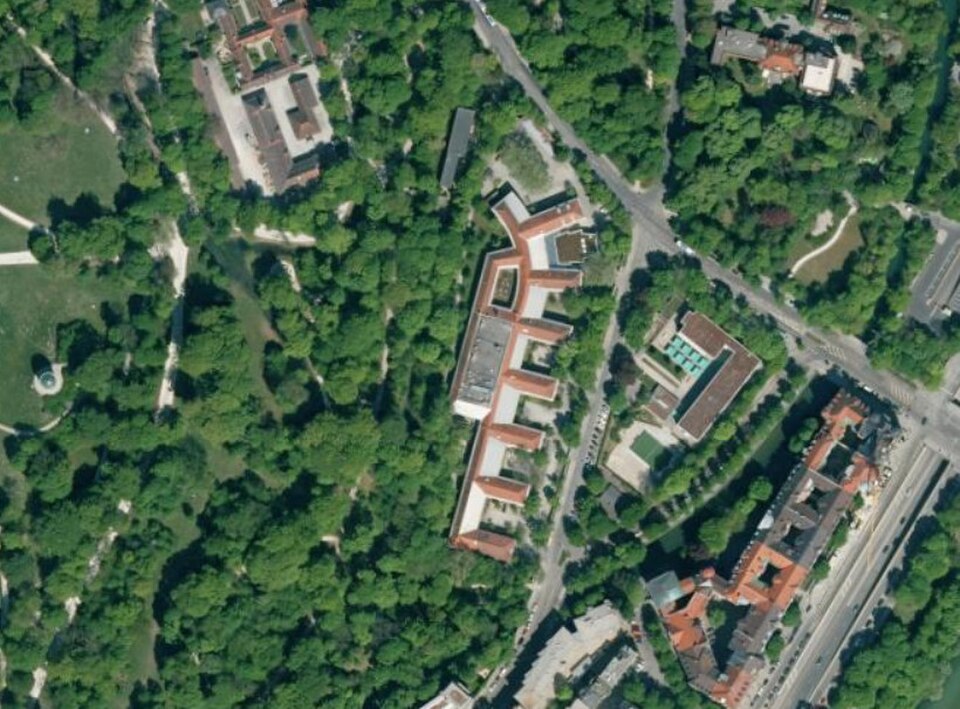
Aerial photograph (2018) of the former Radio Free Europe headquarters at Oettingenstraße 67, beside the Englischer Garten in Munich, from which the station broadcast from 1951. Bayerische Vermessungsverwaltung, Wikimedia Commons, CC BY 3.0 DE.
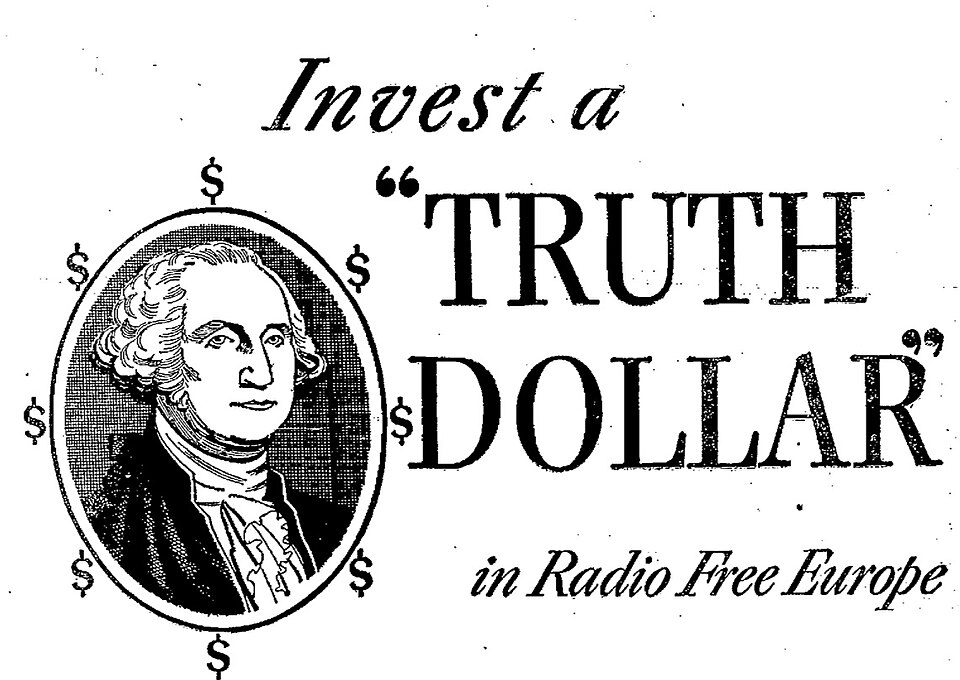
Invest a "Truth Dollar" in Radio Free Europe, Crusade for Freedom advertisement for Radio Free Europe, 1954. The station's main funder until 1971 was the U.S. government, through the CIA. Public domain.
Same-method test
The test applied to Soviet jamming, whether a state stopped its own population receiving foreign broadcasts and on what ground, applies unchanged to Britain in Cyprus, to China since 1989 and to Cuba since 1990. What differs is scale and duration: the Soviet network ran, with pauses, for forty years across a continent and was the largest ever built. What is the same is the stated reason, that the foreign broadcasts were incitement or interference, and the limited result, since in every documented case listeners in the countryside and on other frequencies still got through.
What the record shows and doesn't
- Documented: the dates when jamming began, paused and ended, from Western monitoring and US government records; UN Resolution 424 (V) and its vote; the Helsinki negotiating positions; the British jamming in Cyprus; the Radio Liberty audience figures before and after 1988, with the sampling caveat above.
- Estimated, not audited: the cost of the Soviet network and the number of transmitters. Western and post-Soviet accounts agree it was very large; exact figures vary.
- Not shown: that jamming changed what Soviet citizens believed. The audience data shows who could hear the broadcasts, not what they concluded.
See also
- The Active Measures Working Group (1981 to 1992): the US counter-measure against Soviet disinformation in the same period.
- Government fact-check units: Russia, China, India and Ukraine: later state tools for labelling rather than blocking foreign reports.
- The debate over counter-disinformation: the present-day argument over whether states should block or label information at all.
- Countering propaganda: the index of this section.
Images
| Image | Source | Licence |
|---|---|---|
| Radio Liberty transmitting station, Pals, Catalonia | Wikimedia Commons, Saint-Aniol | CC BY-SA 3.0 |
| Meter panel in the remains of the Radio Liberty Pals station | Wikimedia Commons, Davidpar | CC BY-SA 4.0 |
| Former Radio Free Europe headquarters, Oettingenstraße 67, Munich (aerial view) | Wikimedia Commons, Bayerische Vermessungsverwaltung | CC BY 3.0 DE |
| Truth Dollar advertisement, 1954 | Gallery entry Invest a "Truth Dollar" in Radio Free Europe (provenance in examples/entries/) |
Public domain |


Image gaps
- A Soviet-era jamming tower. Commons holds only present-day photos of Czech "rušička" sites and no dated Cold War image with a verified link to jamming, so none is hosted. The Pals masts and the Munich building show the broadcasters that were jammed, not the jammers.
- The RFE/RL Schleissheim monitoring station. No image found.
- A copy of UN Resolution 424 (V). UN documents can be linked; the UN's terms of reuse were not checked for hosting. Linked, not hosted.
- A 1953 Gregory Peck Radio Free Europe publicity photo. On Commons as "public domain, published without notice" from an eBay source; that basis was not verified, so it is not hosted.
Sources
- UN Digital Library: Resolution 424 (V), Freedom of information: interference with radio signals (14 December 1950)
- UN Dag Hammarskjöld Library: resolutions of the fifth session, with votes
- Refworld: International Convention concerning the Use of Broadcasting in the Cause of Peace (Geneva, 1936)
- Rochelle B. Price, "Jamming and the Law of International Communications", Michigan Journal of International Law 5 (1984)
- Tapio Varis, "The Control of Information by Jamming Radio Broadcasts", Cooperation and Conflict (1970)
- US Office of the Historian, FRUS 1977-80 vol. XXX, document 210 (Soviet resumption of jamming, August 1980)
- US Office of the Historian, FRUS 1977-80 vol. XXX, document 212
- US Office of the Historian, FRUS 1981-88 vol. X, document 4 (CIA memorandum on Soviet views of the radios)
- US Office of the Historian, FRUS 1964-68 vol. XIV, document 302
- CIA reading room: 1968 report on the resumption of Soviet jamming
- US Helsinki Commission: the Helsinki process and the OSCE
- UPI: Soviets allow broadcast of VOA today (25 May 1987)
- Cold War Radio Museum: Soviet bloc jamming of Western freedom radios
- Cold War Radio Museum: Soviet Union resumes jamming of VOA over Solidarity
- Rimantas Pleikys, Jamming: jamming by the free world
- Hoover Institution: Cold War Broadcasting Impact, conference report (2004)
- R. Eugene Parta, "Audience research in extremis: Cold War broadcasting to the USSR", Participations 8:1 (2011)
- R. Eugene Parta, Discovering the Hidden Listener (Hoover Institution Press, 2007)
- Kristin Roth-Ey, "Listening Out, Listening For, Listening In", The Russian Review (2020)
- RFE/RL: How listeners thwarted radio jamming in Czechoslovakia
- RFE/RL: Our history
- Russia Beyond: How the USSR and U.S. battled each other with radio waves (2017)
- Hansard, House of Commons: Athens Radio broadcasts (representations), 25 January 1956
- Hansard, House of Commons: Cyprus, 14 March 1956
- Jamie Metzl, "Rwandan Genocide and the International Law of Radio Jamming", American Journal of International Law 91 (1997)
- US GAO: Broadcasting to Cuba, GAO-09-127 (2009)
- Wikipedia: Radio jamming in China (used for orientation)
- Wikipedia: Radio in the Soviet Union (used for orientation)