In one line: From 7 October 1949 to 3 October 1990 the Socialist Unity Party (SED) governed the German Democratic Republic as a one-party state in the Soviet bloc, with a party-directed press, radio and television, a Ministry for State Security that kept files on large parts of the population, and a fortified border closed on 13 August 1961 and described officially as an "anti-fascist protective rampart", while West German and US-funded broadcasters reached most of its territory.
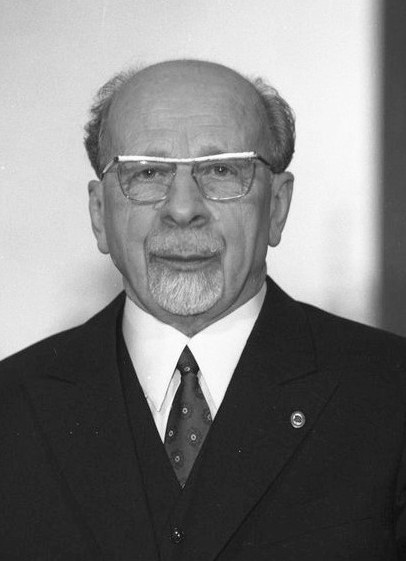
General Secretary, from 1953 First Secretary, of the SED; Chairman of the State Council from 1960 · 1950 to 1971
Walter Ulbricht: Read more
Led the SED from July 1950 until Honecker replaced him on 3 May 1971 with Soviet backing; deputy minister-president from 1949, Chairman of the State Council from 1960, and the public face of the border closure of 13 August 1961. Died 1 August 1973.
In their words
“No one has the intention of building a wall.”
Leader
Photo: Unknown. Originally uploaded to Wikimedia Commons by Raymond and cropped by Fer1997. Later cropped and reuploaded in present format by Emiya1980, CC BY-SA 3.0 de
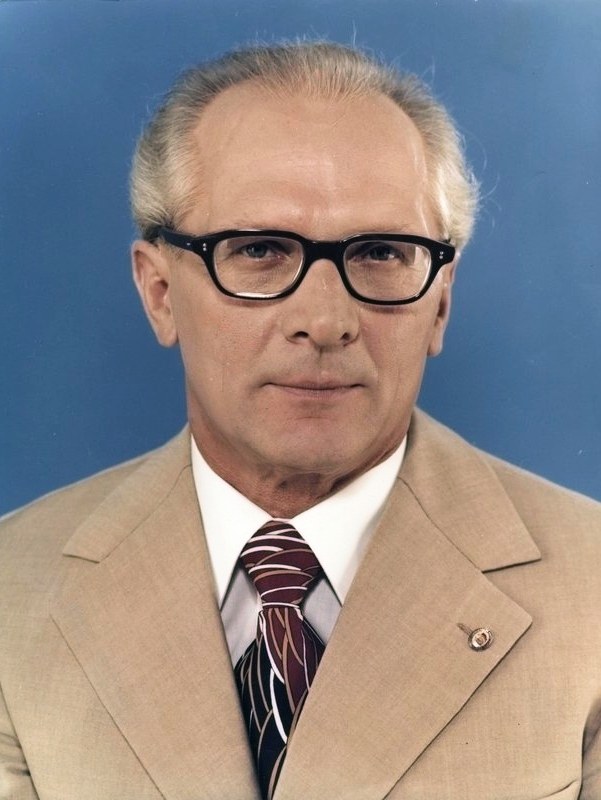
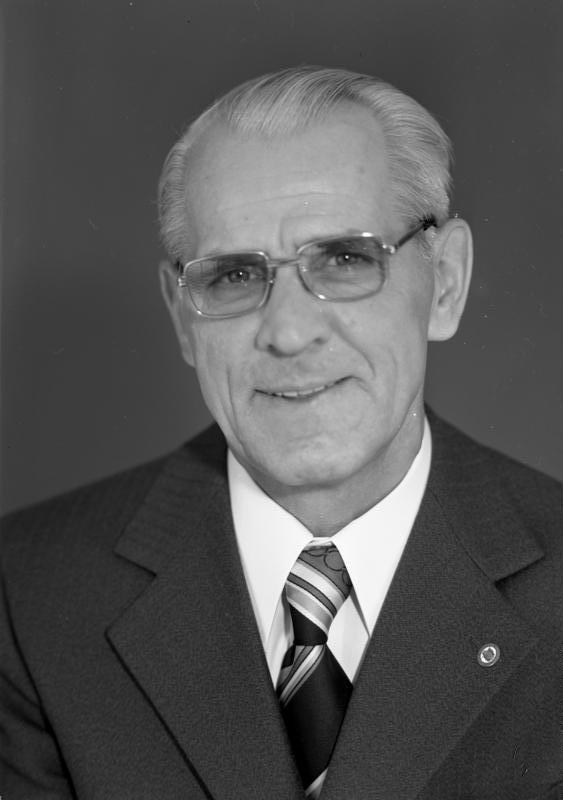
Erich Honecker
First Secretary, from 1976 General Secretary, of the SED; from 1976 Chairman of the State Council · 1971 to 1989
Erich Honecker: Read more
Succeeded Ulbricht as party leader on 3 May 1971, added the chairmanship of the State Council in October 1976, signed the Helsinki Final Act in 1975, and was removed by the Politburo on 18 October 1989.
In their words
“The Wall will still be standing in 50 and even in 100 years, if the reasons for it have not yet been removed.”
State
WPNo portrait hosted.
Wilhelm Pieck
President of the Republic · 1949 to 1960
Wilhelm Pieck: Read more
Co-chairman of the SED with Grotewohl from 1946 to 1954 and the only holder of the office of President, elected on 11 October 1949 and re-elected until his death on 7 September 1960, after which the State Council replaced the presidency.
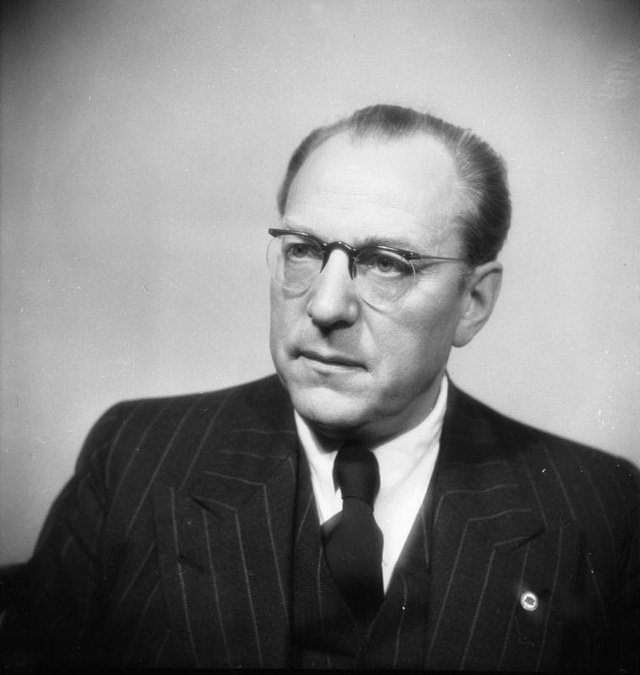
Minister-President (Chairman of the Council of Ministers) · 1949 to 1964
Otto Grotewohl: Read more
Former SPD chairman in the Soviet zone and SED co-chairman, head of government from 12 October 1949 until his death on 21 September 1964; the tag carried by most of this regime page’s collection objects before 1964.
Chairman of the Council of Ministers; Chairman of the State Council 1973 to 1976 · 1964 to 1973 and 1976 to 1989
Willi Stoph: Read more
Defence minister from 1956 to 1960, head of government from 24 September 1964 to 1973 and again from 1976 until 7 November 1989, and Chairman of the State Council from 1973 to 1976; the collection tag for the 1980s objects on this page.
Secretary of the Central Committee for science, education and culture · 1955 to 1989
Kurt Hager: Read more
The party’s chief spokesman on ideology and cultural policy, a Politburo member from 1963, who headed the Ideological Commission and whose 1987 Stern interview on Soviet reforms was widely quoted.
Photo: Avraham Pisarek This cropped version uploaded by Charles01, CC BY-SA 3.0 de
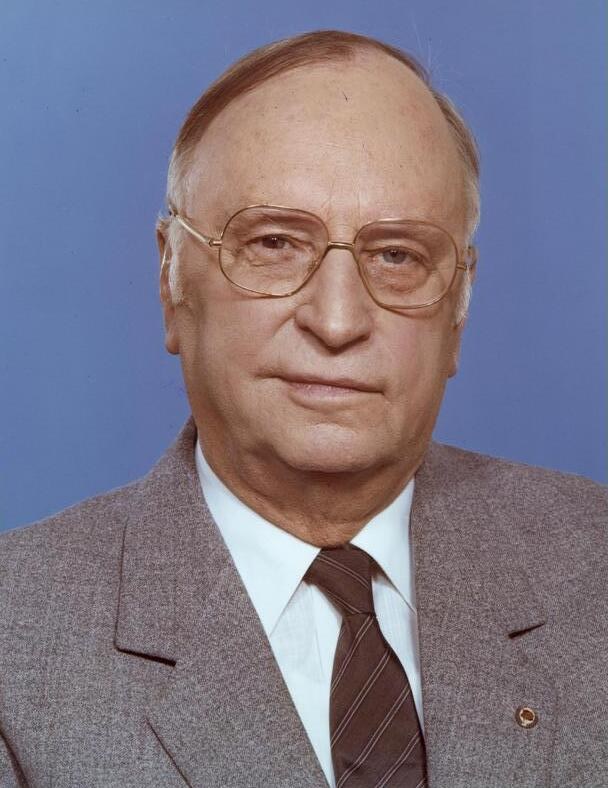
Hermann Axen
Editor-in-chief of Neues Deutschland; later Central Committee secretary for international relations · 1956 to 1989
Hermann Axen: Read more
Edited the party daily from 1956 to 1966, then served as Central Committee secretary (1966 to 1989) and Politburo member (1970 to 1989); a Jewish communist who survived Auschwitz and Buchenwald.
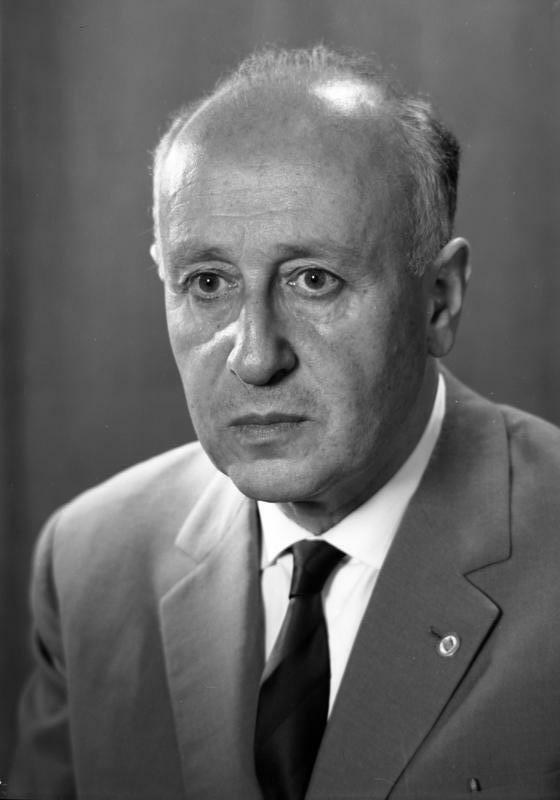
Secretary for Agitation of the Central Committee and head of the Politburo’s Agitation Commission · 1955 to 1967
Albert Norden: Read more
Led the party’s agitation work from 15 April 1955 to 22 April 1967, a Politburo member from 1958, and the organiser of the 1965 Braunbuch listing former Nazi officials in West German posts.
WLNo public-domain or openly licensed portrait found with a verified identification of the sitter. Nearest: source, CC BY-SA 3.0 de (Bundesarchiv), a 1975 two-person crop that shows the film director Frank Beyer and Lamberz, not used because the file page does not say which man is which.
Werner Lamberz
Secretary of the Central Committee for Agitation · 1967 to 1978
Werner Lamberz: Read more
Former FDJ secretary who held the agitation portfolio from 1967 and sat in the Politburo from 1971 until he died in a helicopter crash in Libya on 6 March 1978.
JHNo portrait hosted.
Joachim Herrmann
Secretary of the Central Committee for Agitation; earlier editor-in-chief of Neues Deutschland · 1978 to 1989
Joachim Herrmann: Read more
Edited Neues Deutschland from 1971 to 1978, then ran the party’s agitation and media apparatus until the autumn of 1989 and sat in the Politburo from 1978.
Editor-in-chief of Neues Deutschland; later SED chief in East Berlin · 1978 to 1989
Günter Schabowski: Read more
Edited Neues Deutschland from 1978 to 1985, led the East Berlin party organisation from 1985, and announced the new travel rules at the press conference of 9 November 1989 that led to the opening of the border.
In their words
“As far as I know, it takes effect ... immediately, without delay.”
Security
EMNo portrait hosted.
Erich Mielke
Minister for State Security · 1957 to 1989
Erich Mielke: Read more
Headed the Ministry for State Security from November 1957 to 7 November 1989, a Politburo candidate from 1971 and full member from 1976, and the minister whose ministry issued Directive 1/76 of 1976.
Commentator and presenter of Der schwarze Kanal · 1960 to 1989
Karl-Eduard von Schnitzler: Read more
State radio and television commentator who presented 1,322 of the 1,519 editions of the weekly programme that criticised West German television output with cut extracts and his own commentary; earlier at the Northwest German Broadcasting service in the British zone before moving to East Berlin in 1947.
HANo portrait hosted.
Heinz Adameck
Chairman of the State Committee for Television · 1968 to 1989
Heinz Adameck: Read more
Director of the Deutscher Fernsehfunk from 1954 and then chairman of the State Committee for Television, responsible for the political direction of GDR television, including Aktuelle Kamera and the weekly Der schwarze Kanal.
Background and rise to power
Germany was divided into four occupation zones in 1945. In the Soviet zone the Communist Party (KPD) and the Social Democratic Party (SPD) were merged into the SED on 21 and 22 April 1946, under Soviet pressure in the Soviet zone and not in the western zones; its newspaper, Neues Deutschland, appeared from 23 April 1946. The Federal Republic of Germany was founded on 23 May 1949 from the three western zones. On 7 October 1949 the People's Council in the Soviet zone declared itself the Provisional People's Chamber (Volkskammer) and put the constitution of the German Democratic Republic (GDR) into force. Wilhelm Pieck, co-chairman of the SED, became President on 11 October and Otto Grotewohl, the other co-chairman, became Minister-President on 12 October. Walter Ulbricht, deputy minister-president, was the SED's dominant figure and became its General Secretary in July 1950 (the title was changed to First Secretary in 1953).
The 1949 constitution named a parliamentary republic and guaranteed freedom of opinion, while Article 6 made "Boykotthetze" (incitement to boycott democratic institutions) a crime, a provision later used in political trials. The elections of 15 October 1950 offered one list of the National Front, which included the SED, the "block" parties and the mass organisations, and the official result was over 99 per cent in favour (Weber, Judt). On 17 June 1953 strikes over higher work quotas spread into a nationwide uprising that Soviet troops and the East German police put down; at least 50 people were killed and thousands arrested (Kowalczuk; Hertle). The Ministry for State Security (MfS, "Stasi") had been created on 8 February 1950. Between 1949 and 1961 an estimated 2.7 million people left for the West, many of them young and skilled; the exodus was the main pressure on the state's economy and on its claim to legitimacy (Harrison; Taylor).
How power was organized
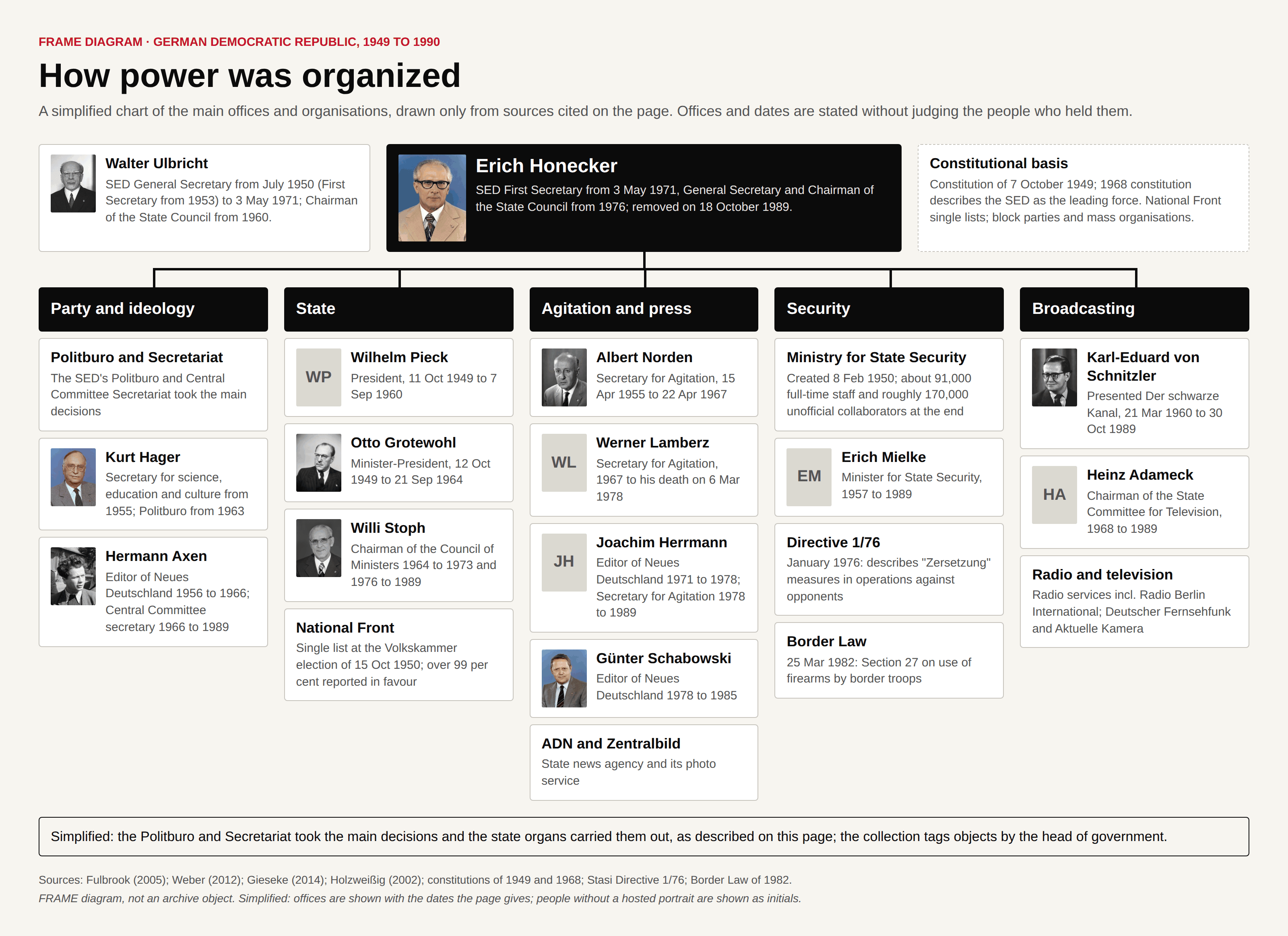
The SED's Politburo and Central Committee Secretariat took the main decisions; the Council of Ministers, headed by Grotewohl until his death on 21 September 1964 and then by Willi Stoph, carried them out. Ulbricht chaired the new State Council from 1960; Honecker replaced him as party leader on 3 May 1971 with Soviet backing, and from 1976 held both the party leadership (General Secretary) and, as chairman of the State Council, the formal headship of state until 18 October 1989. The 1968 constitution described the SED as the leading force of society. The "block" parties (CDU, LDPD, NDPD, DBD) and mass organisations (the youth organisation FDJ, the trade-union federation FDGB, the women's league DFD, the Pioneers, the Society for Sport and Technology) sat inside the National Front and took part in single-list elections; the reported turnout and approval were above 98 per cent through the 1980s. For the local elections of 7 May 1989, citizen groups counted the votes at polling stations and published results that differed from the official 98.85 per cent approval (Kowalczuk).
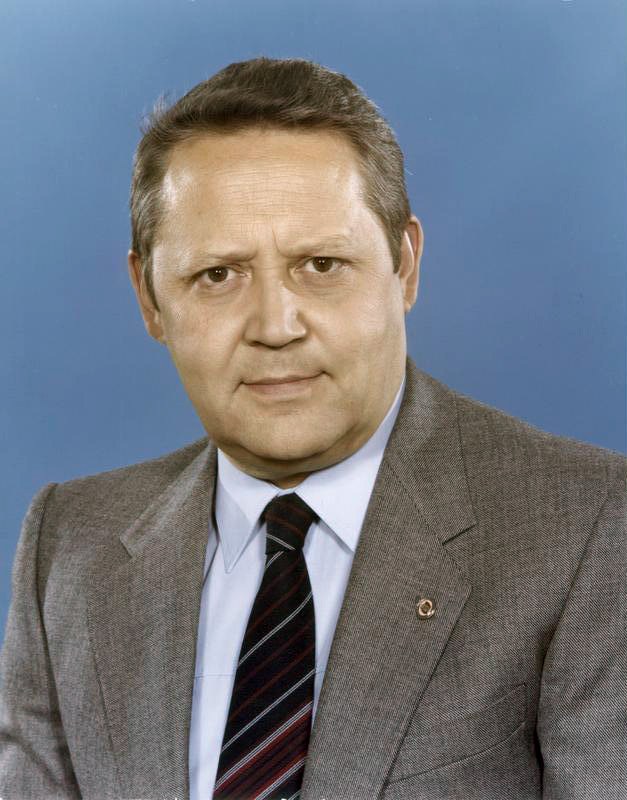
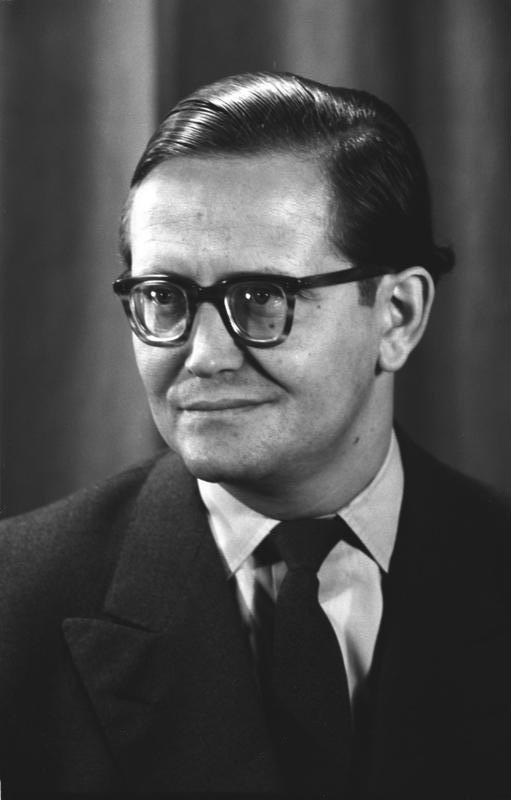
The main offices and organisations of the German Democratic Republic, 1949 to 1990, simplified from the sources cited on this page. Source: FRAME diagram. Portraits, cropped to thumbnails: Bundesarchiv, Bild 183-B0917-0008-001 / Peter Heinz Junge / CC-BY-SA 3.0 de; Bundesarchiv, Bild 183-R1220-401 / Unknown. Originally uploaded to Wikimedia Commons by Raymond and cropped by Fer1997. Later cropped and reuploaded in present format by Emiya1980 / CC-BY-SA 3.0 de; Bundesarchiv, Bild 183-1982-0504-421 / UnknownUnknown / CC-BY-SA 3.0 de; Deutsche Fotothek, Fotothek df pk 0000225 003 cropped so just Hermann Axen.jpg / Avraham Pisarek This cropped version uploaded by Charles01; Bundesarchiv, Bild 183-41751-0001 / Zimontkowski / CC-BY-SA 3.0 de; Bundesarchiv, Bild 183-1984-0615-434 / UnknownUnknown / CC-BY-SA 3.0 de; Bundesarchiv, Bild 183-19204-3150 / UnknownUnknown / CC-BY-SA 3.0 de; Bundesarchiv, Bild 183-J1231-1002-002 / Hans-Joachim Spremberg / CC-BY-SA 3.0 de; Bundesarchiv, Bild 183-R0430-0305A / UnknownUnknown / CC-BY-SA 3.0 de, CC BY-SA 3.0 de (the portraits that carry it); other portraits: CC BY 3.0.
The Ministry for State Security under Erich Mielke (Minister 1957 to 1989) combined a secret police, an intelligence service (headed by Markus Wolf for foreign intelligence) and prison and investigation functions. At the end it had about 91,000 full-time staff and, by the estimates of the Stasi Records Agency and historians, roughly 170,000 unofficial collaborators (Inoffizielle Mitarbeiter), among about 16 to 17 million inhabitants (Gieseke). Its Directive 1/76 of January 1976 described "Zersetzung" (literally "decomposition": measures such as discrediting a person or disrupting their private and working life) as a method for operations against opponents, and case files in the archive record such measures (Gieseke; Behnke and Fuchs). The Border Law of 25 March 1982 (Section 27) set out when border troops could use firearms. At least 140 people died in connection with the Berlin Wall between 1961 and 1989, according to the 2017 study by the Centre for Contemporary History Potsdam and the Berlin Wall Foundation; the figure for the whole inner-German border is higher and is counted differently by different bodies.
Economic planning ran through Five-Year Plans and the State Planning Commission. In the 1980s the GDR owed substantial hard-currency debts to Western banks and relied on credits from the Federal Republic, arranged in 1983 and 1984 (Steiner). In October 1989 mass demonstrations, above all the Monday demonstrations in Leipzig, and the flight of citizens through Hungary and the West German embassies in Prague and Warsaw ended the SED's hold on power.
Illustration, not an archive object
The propaganda apparatus
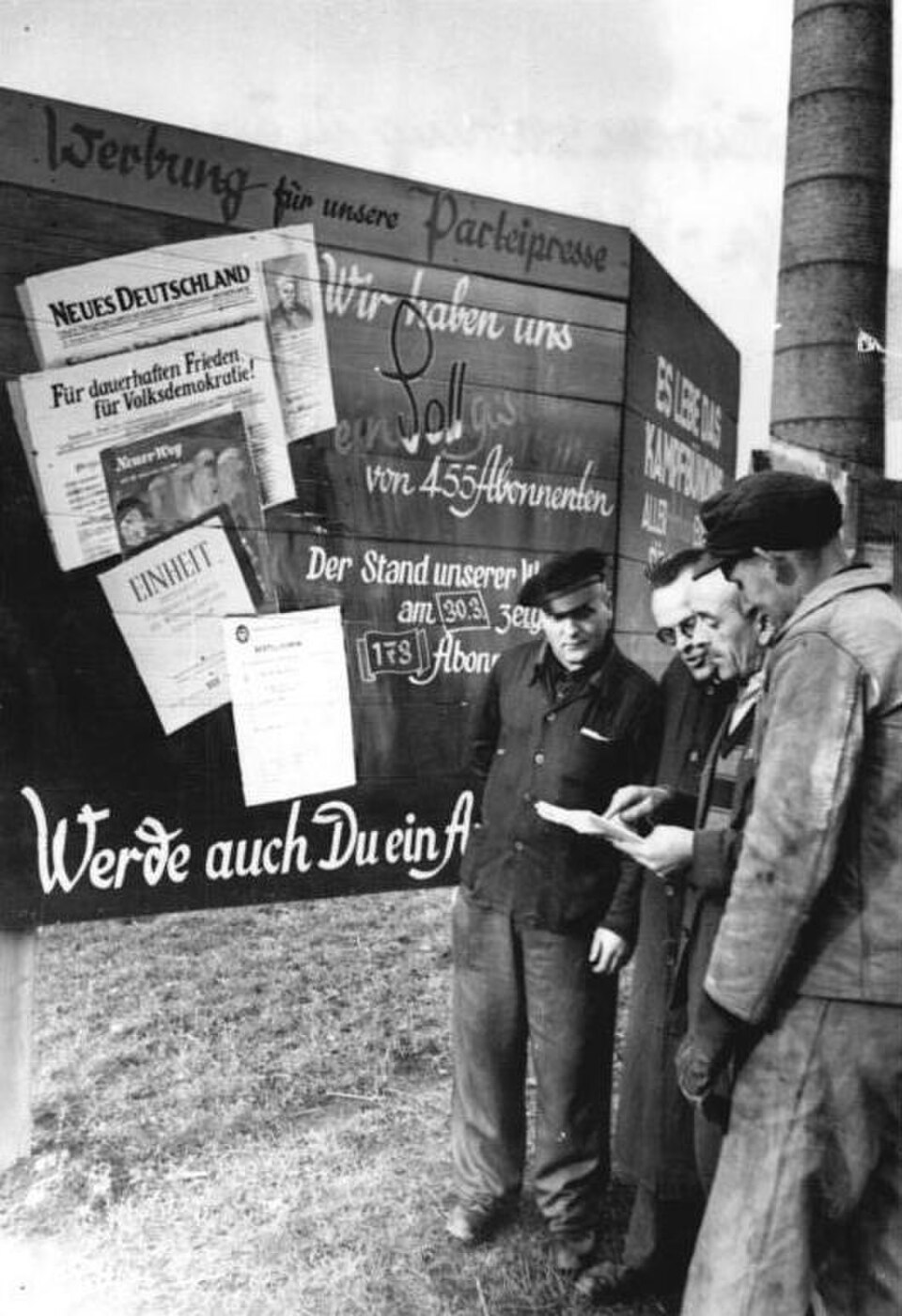
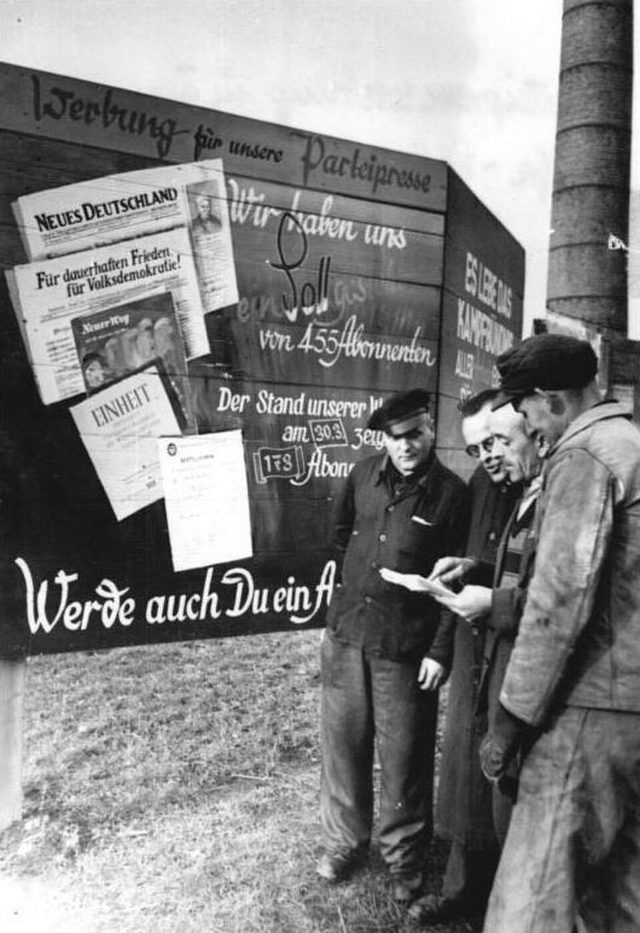
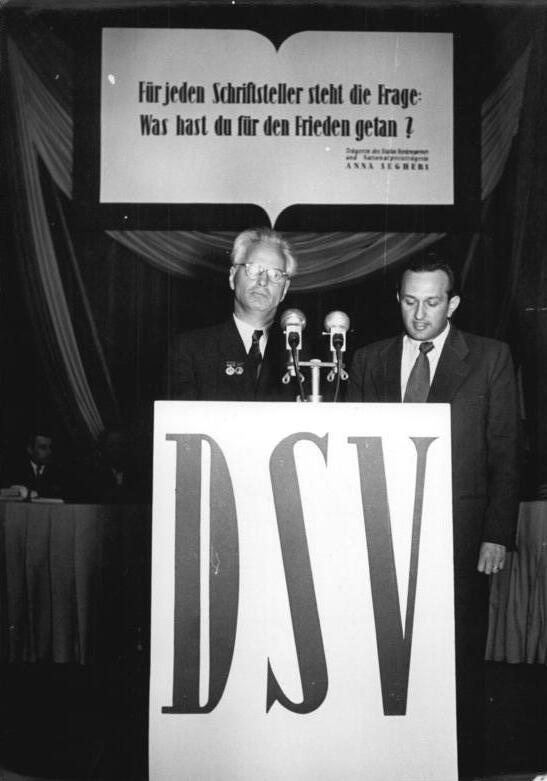
Party direction. The Central Committee's Agitation and Propaganda apparatus set the line for the media. Albert Norden headed the Politburo's Agitation Commission and was Secretary for Agitation from 1955 to 1967, Werner Lamberz held the post from 1967 until his death in a helicopter crash in Libya on 6 March 1978, and Joachim Herrmann held it from 1978 to 1989 (after leading Neues Deutschland from 1971 to 1978). Kurt Hager, Secretary for science, education and culture from 1955 and a Politburo member from 1963, was the party's chief spokesman on ideology. The press was run through licensing and paper allocation, the state news agency ADN and its photo service Zentralbild, and weekly guidance to chief editors from the party apparatus (Holzweißig). Neues Deutschland, the SED's central organ from 1946, had a print run of roughly one million at its peak. Its editors-in-chief included Hermann Axen (1956 to 1966), Joachim Herrmann (1971 to 1978) and Günter Schabowski (1978 to 1985); regional SED newspapers, the block parties' papers and the FDJ's Junge Welt followed in a graded hierarchy (a 1951 subscription-drive board for the party press).
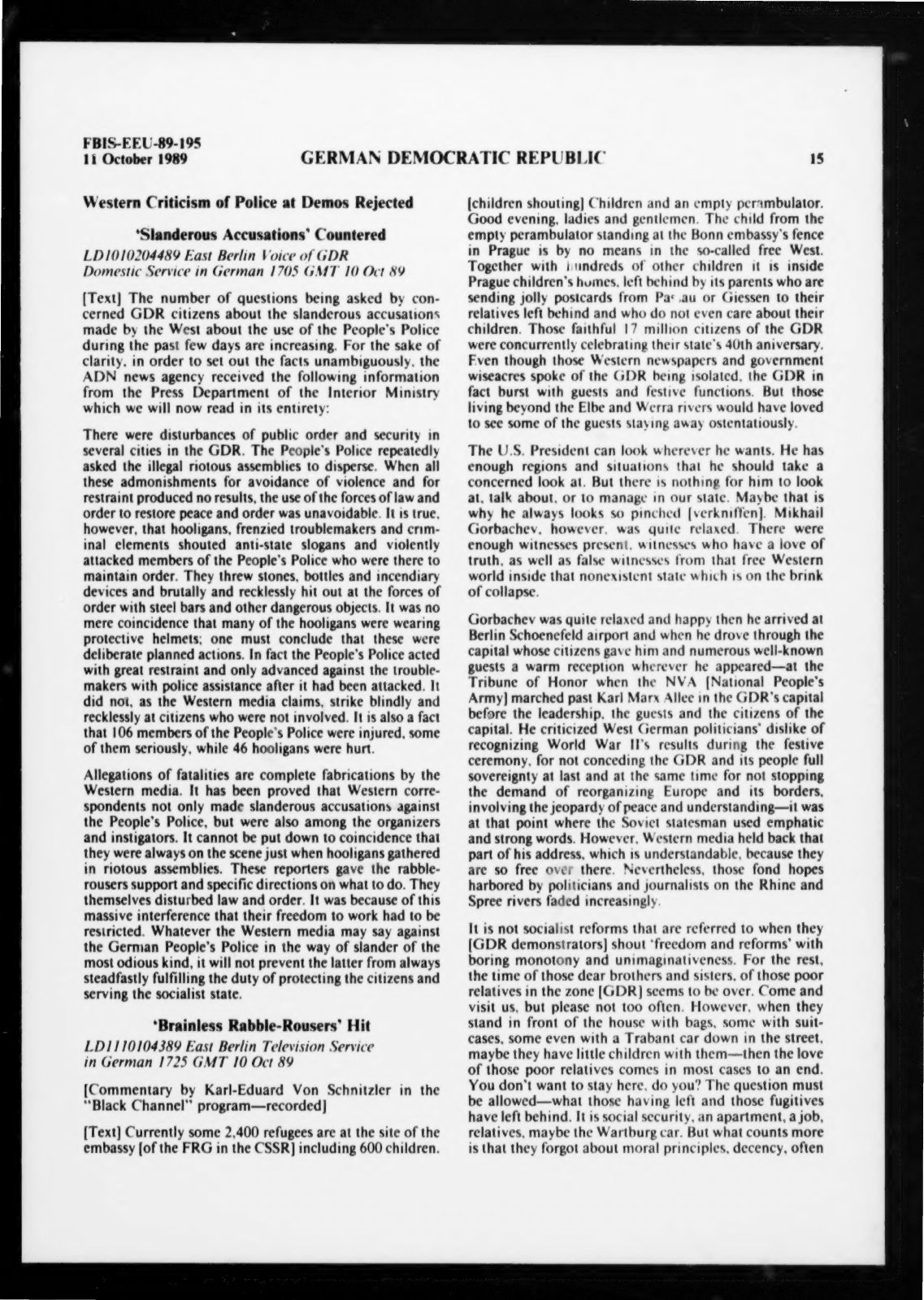
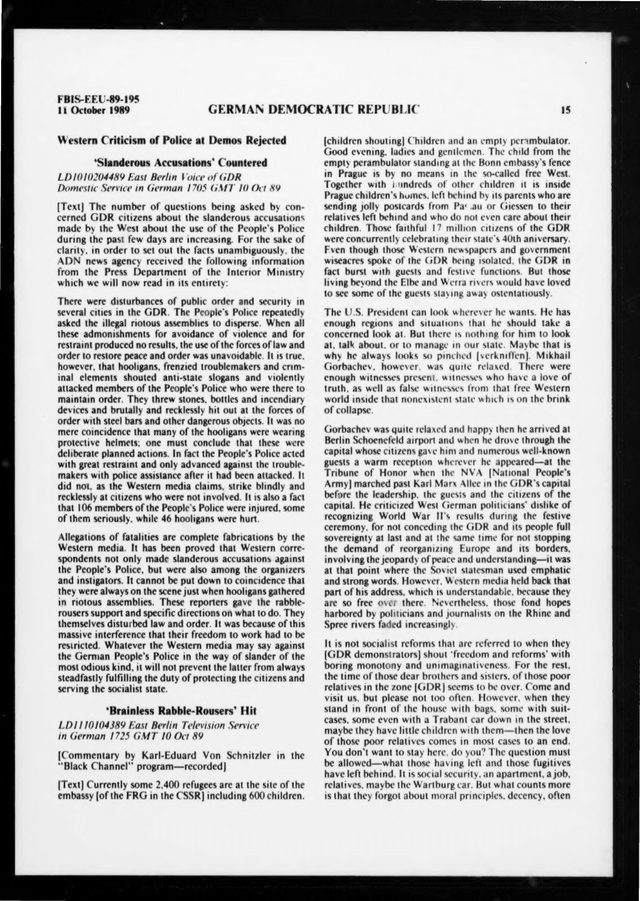
Content note: State broadcasts calling demonstrators 'hooligans' and 'criminal elements' and denying reports of deaths at the October 1989 demonstrations; includes a commentary casting emigrants as parents who abandoned their children. This object is shown as it was published. Why
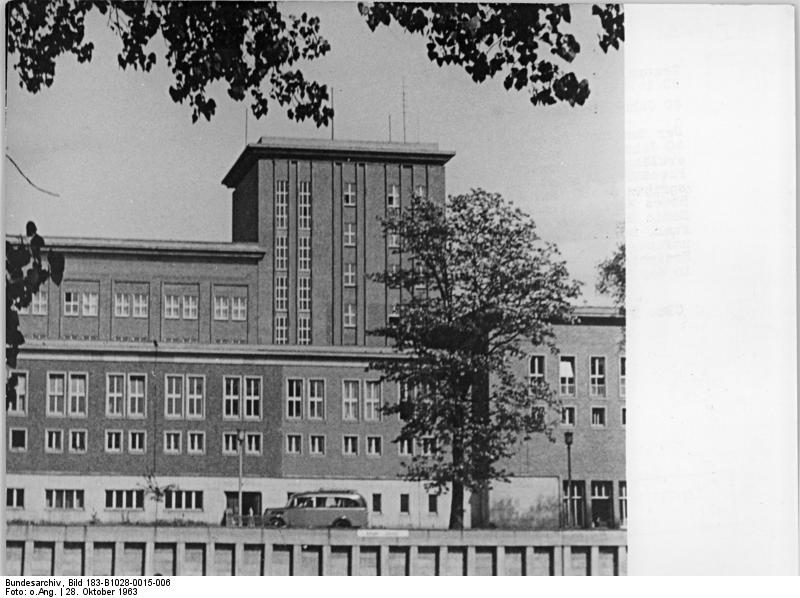
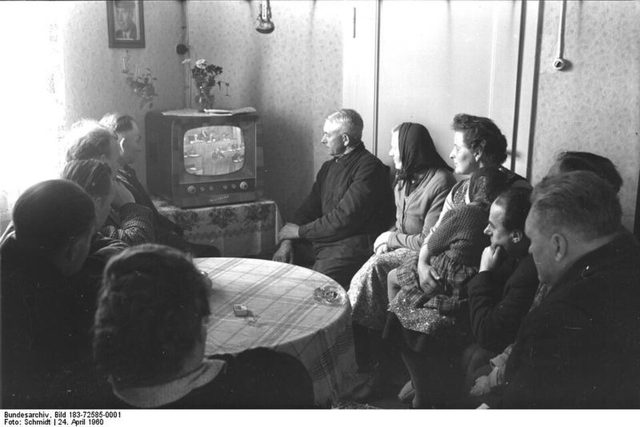
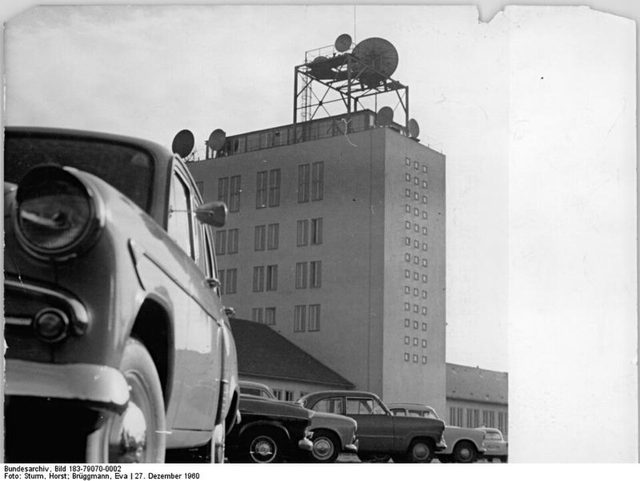
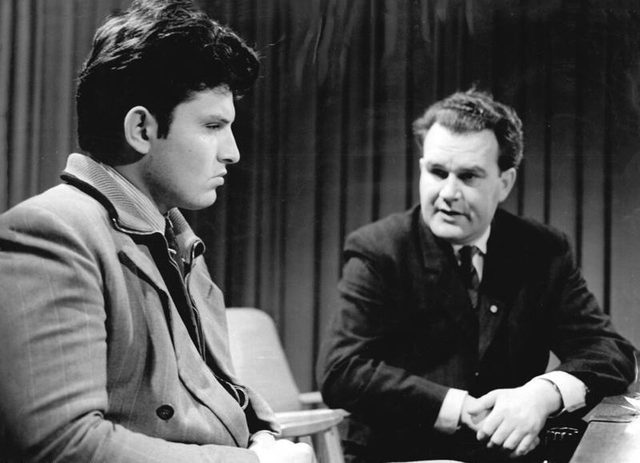
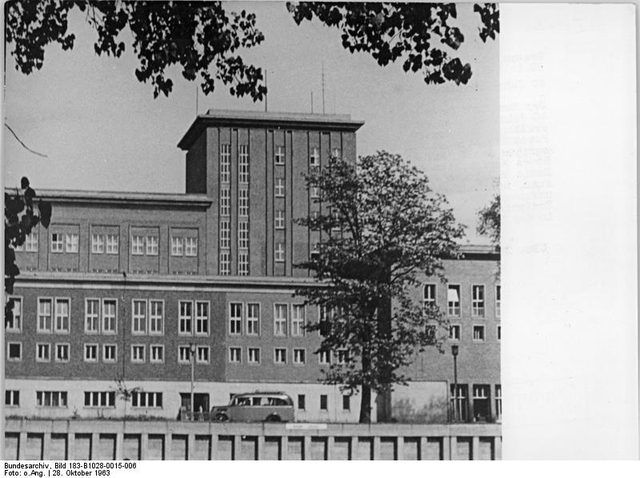
Radio and television. A State Radio Committee ran the radio services (Berliner Rundfunk, Radio DDR, the Deutschlandsender and, for foreign listeners, Radio Berlin International, which broadcast in several languages from 1959). The Deutscher Fernsehfunk began regular television in December 1952, with the news programme Aktuelle Kamera; its main building stood at Berlin-Adlershof, and Heinz Adameck chaired the State Committee for Television from 1968 to 1989 (the Adlershof centre; an Aktuelle Kamera interview of December 1961; the 1963 report on the radio services). From 21 March 1960 to 30 October 1989 Karl-Eduard von Schnitzler presented Der schwarze Kanal (the Black Channel), a weekly programme of about 20 minutes that showed cut extracts from West German television news and political magazines with his own commentary; it ran for 1,519 episodes, and the GDR's own audience surveys, according to later accounts, put its viewership at a few per cent by the 1980s (Holzweißig; the Deutsche Rundfunkarchiv). It was begun in answer to a West German programme, Die rote Optik (1958 to 1960), which had analysed GDR television.
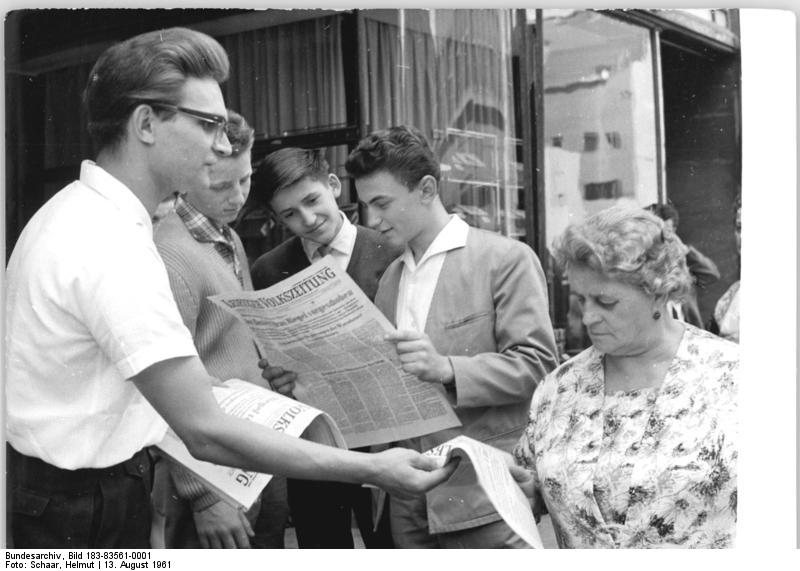
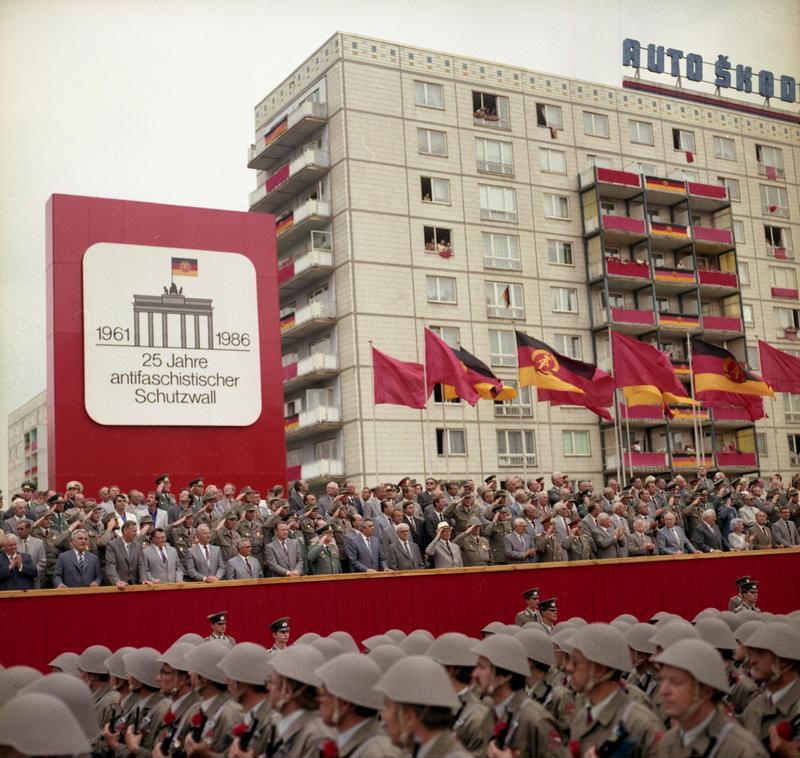
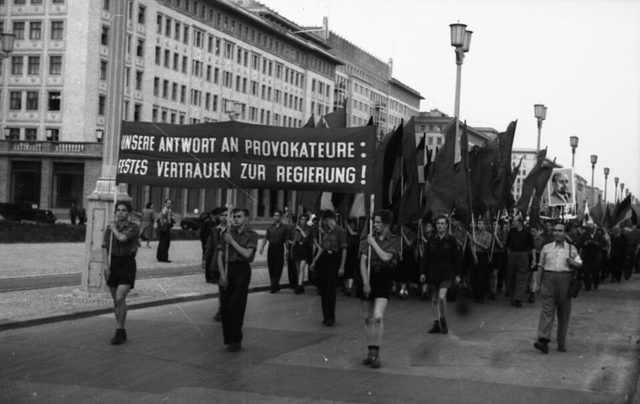
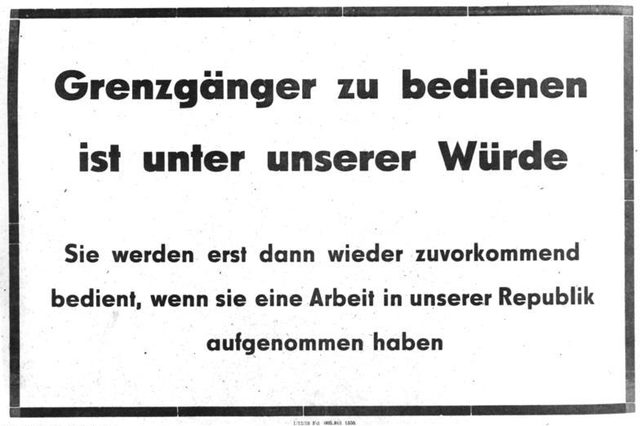
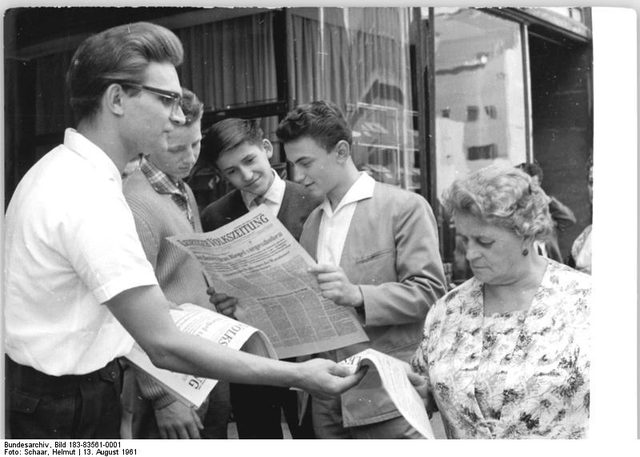
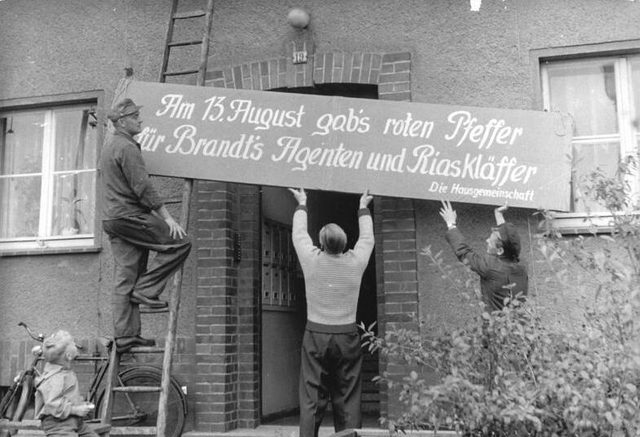
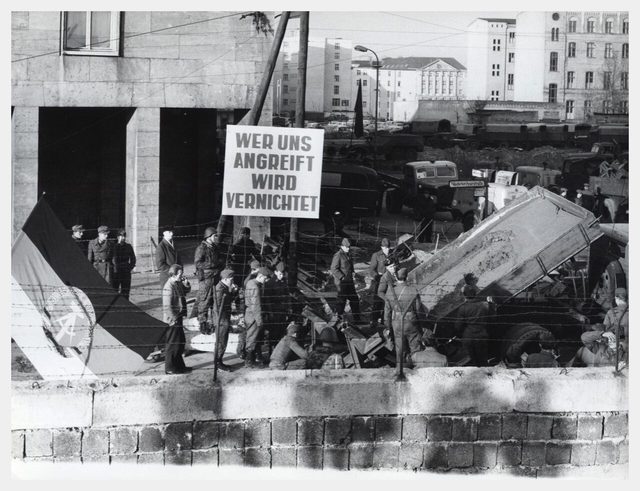
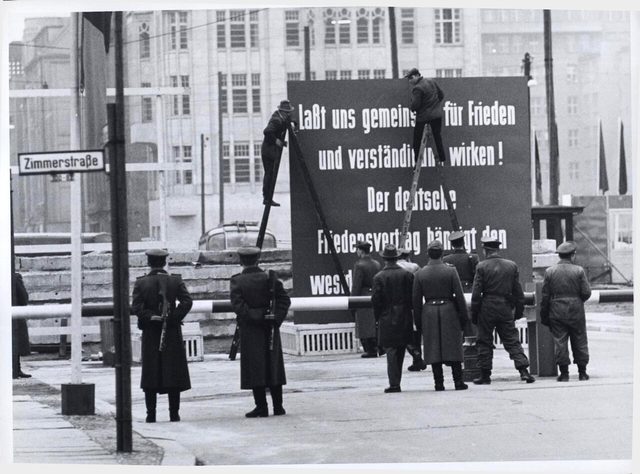
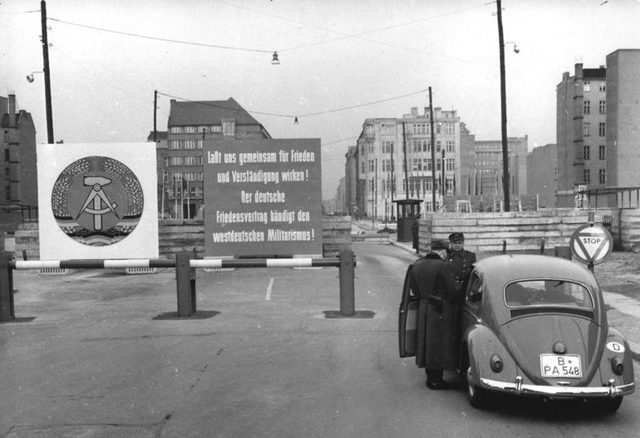
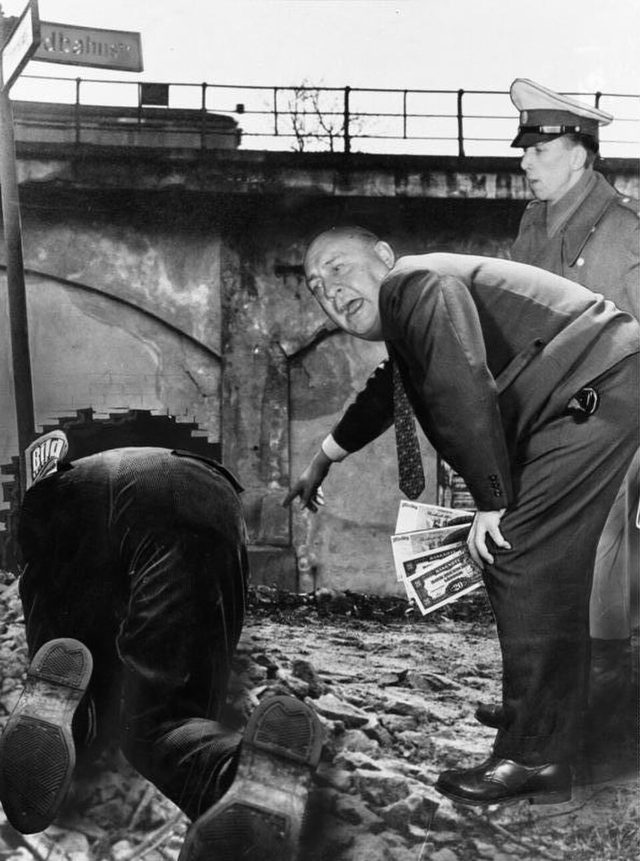
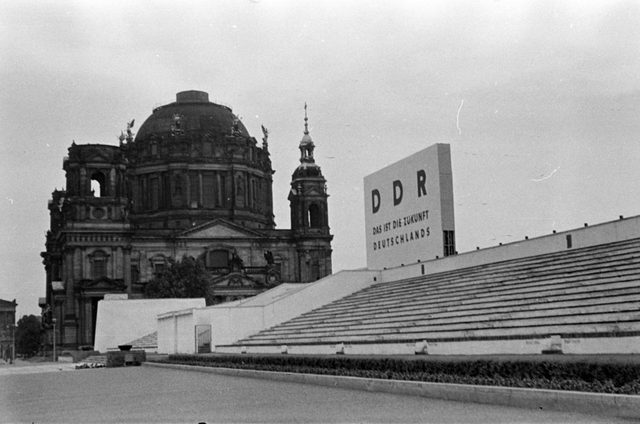
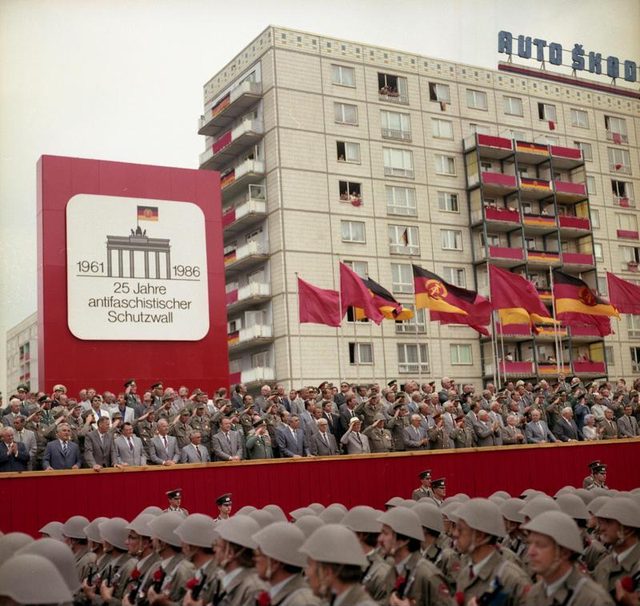
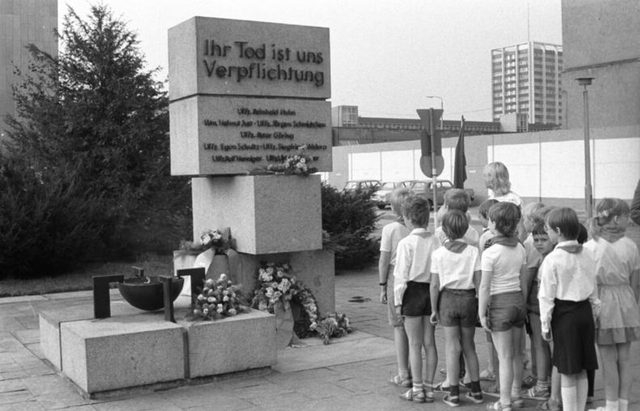
The Berlin Wall. On 15 June 1961 Ulbricht answered a journalist's question about a possible wall in Berlin with the sentence "Niemand hat die Absicht, eine Mauer zu errichten". Border crossings were closed in the early hours of 13 August 1961. The official GDR term for the barrier was antifaschistischer Schutzwall (anti-fascist protective rampart), and the press called the closure "Grenzsicherungsmaßnahmen" (border-securing measures); the stated reasons included the claims that West Berlin was a base for recruitment of workers, espionage and a NATO attack. Historians record that the closure ended the mass departures that had been under way since 1949 and that Soviet and East German leaders had discussed it for months (Harrison; Hertle; Taylor). The framing appeared on banners, posters and in schools and ceremonies for the next 28 years (a Leipzig newspaper extra distributed on 13 August 1961; a sign beside the new wall, November 1961; a house-community banner in Bitterfeld; a 1986 parade for the 25th anniversary; Pioneers at the border-troops memorial, 1986).
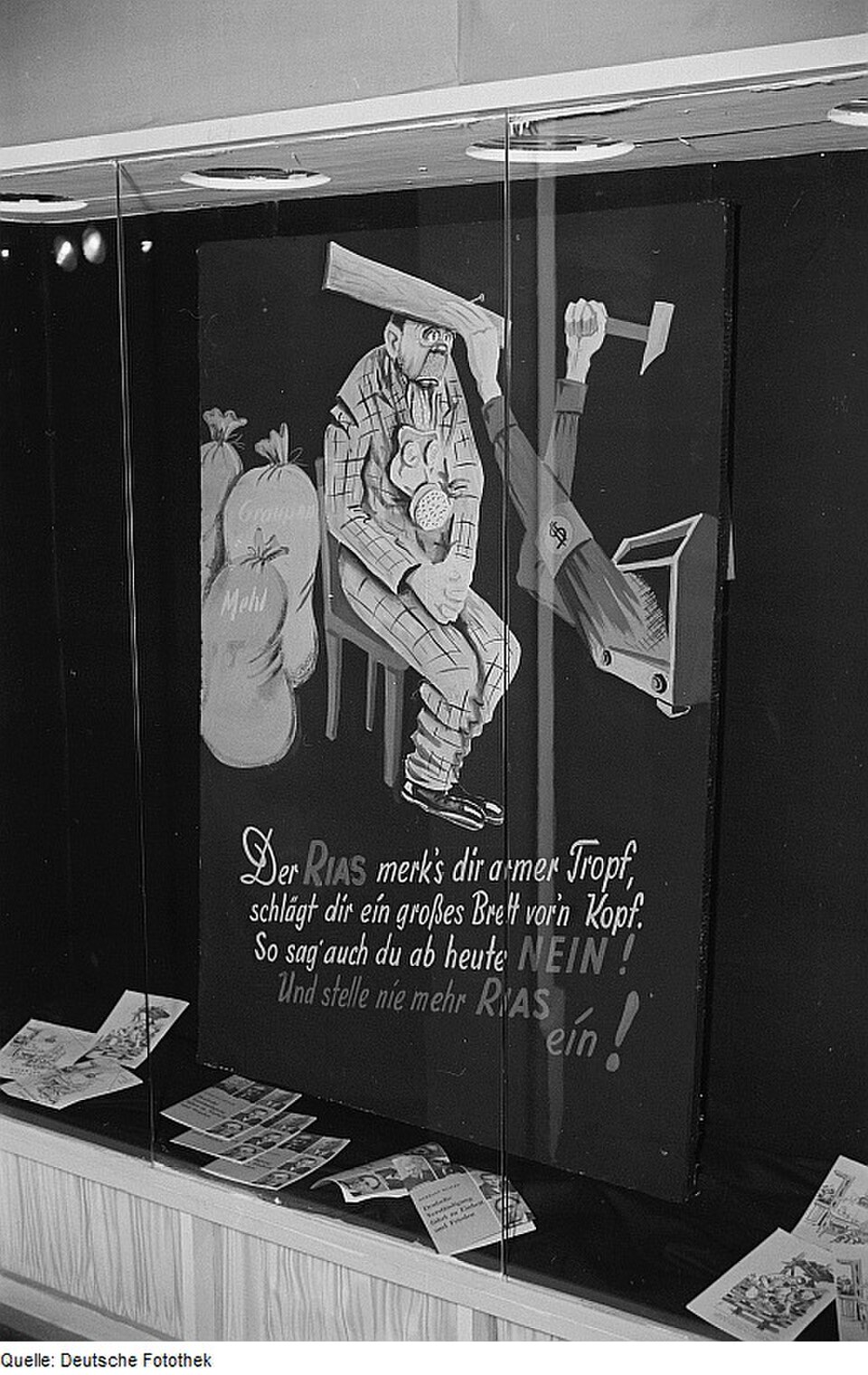
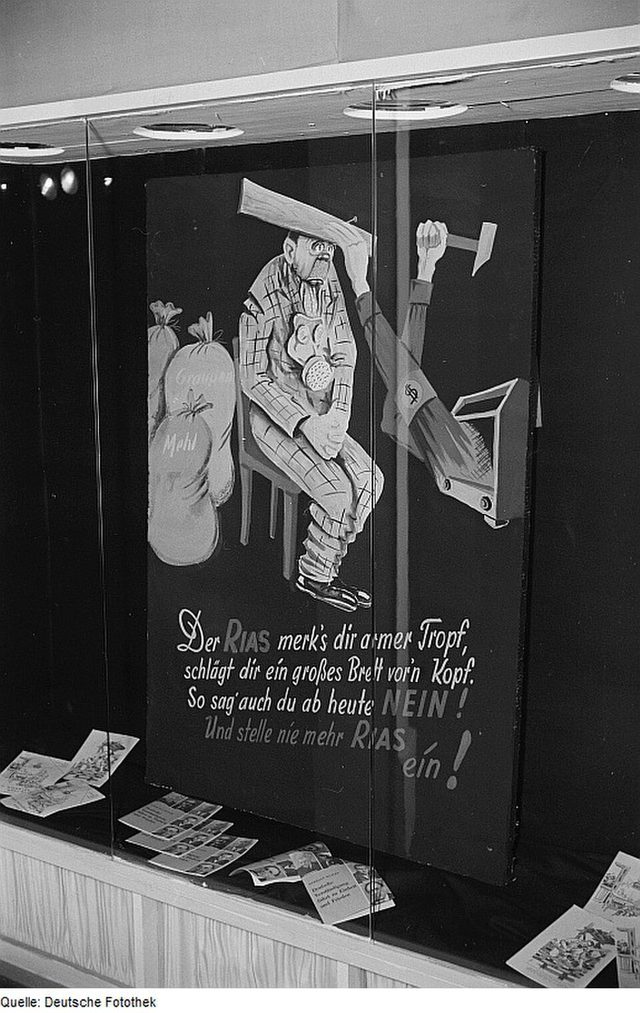
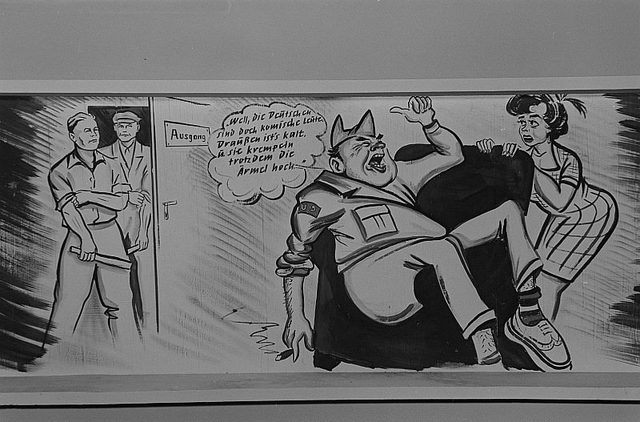
Broadcasts aimed at the GDR, and the response. The same definitions apply to external broadcasting by any state. RIAS (Radio in the American Sector) began in Berlin in 1946 under the US Military Government and was funded by the US government until its merger into Deutschlandradio in 1994; it had a mostly German staff and its schedule combined news, commentary, cultural and entertainment programmes. Deutschlandfunk, a West German federal broadcaster that began in January 1962, and the ARD and ZDF television networks, whose signals covered most of the GDR, were funded by the Federal Republic or by licence fees and, in the case of Deutschlandfunk, had a statutory duty to address all Germans. Nicholas Schlosser's study of RIAS describes its reporting of the strikes of 17 June 1953 and the way US officials and German editors shaped content; the GDR's authorities called it the "Hetzsender" (agitation station) and attributed its reports to US war aims (the 1952 Leipzig display-case panel against RIAS). The GDR's response had several parts: campaigns against listening, such as the FDJ's "Aktion Blitz kontra NATO-Sender" of September 1961 which targeted television antennas pointed west; radio jamming of Western stations, documented for the 1950s and after (the jamming write-up); and Der schwarze Kanal. West Germany and the United States ran a parallel set of Cold War broadcasts, among them Radio Free Europe, as state-funded or state-sponsored persuasion directed at the GDR and its neighbours. The two sides differed in structure: GDR citizens could in practice choose between domestic and foreign media, and most did tune to the West where they could, while West German citizens had far less access to GDR broadcasts and no comparable domestic monopoly existed there. The record on how far listeners believed either side's broadcasts is partial (Schlosser; Meyen).
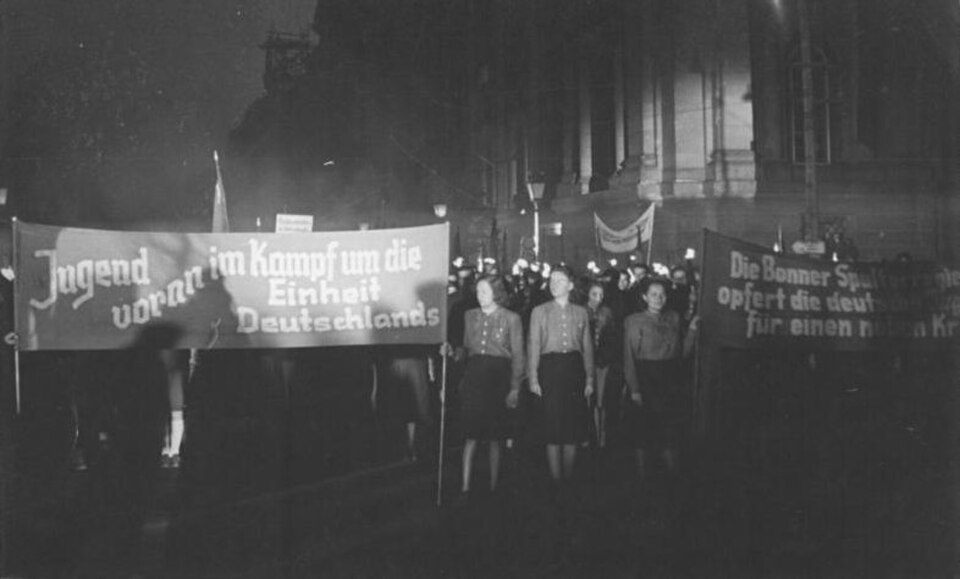
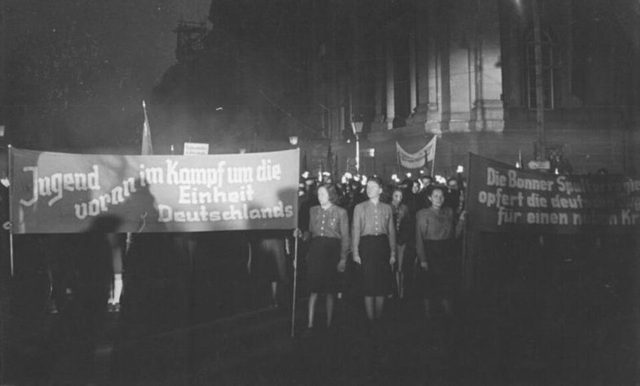
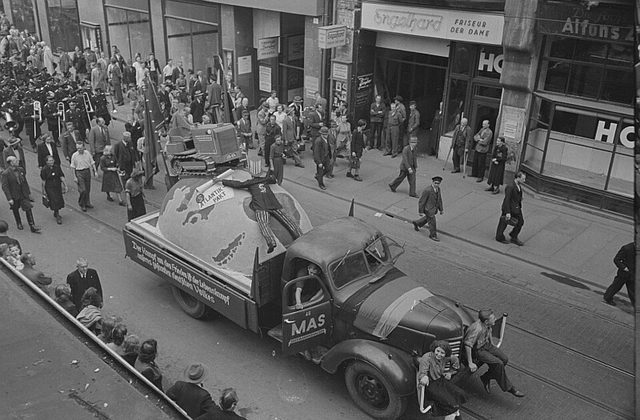
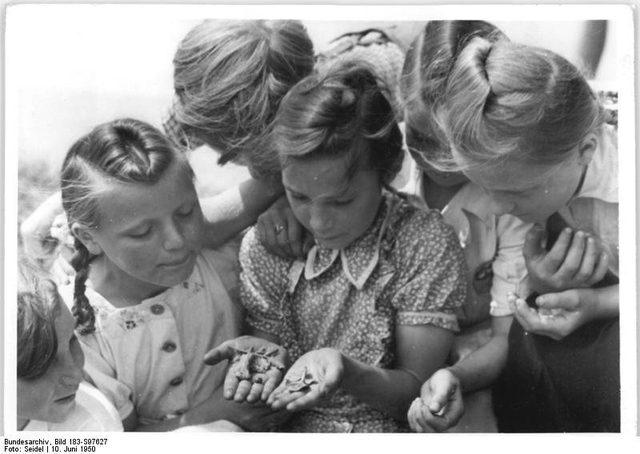
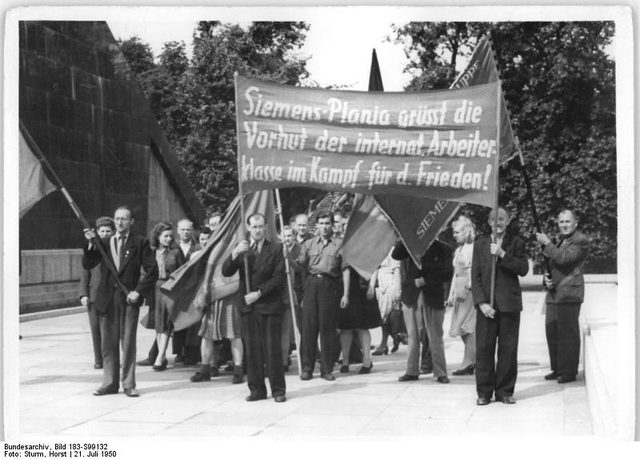
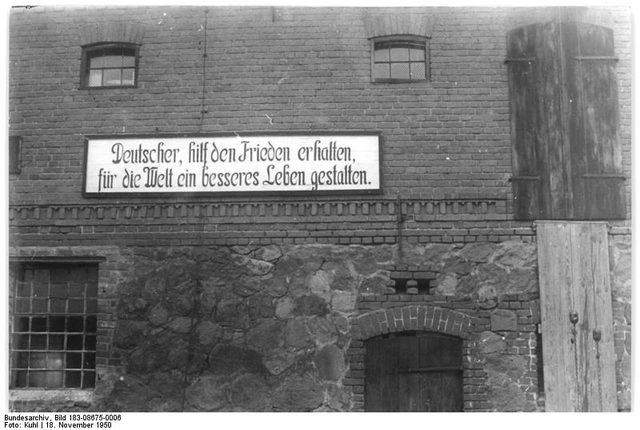
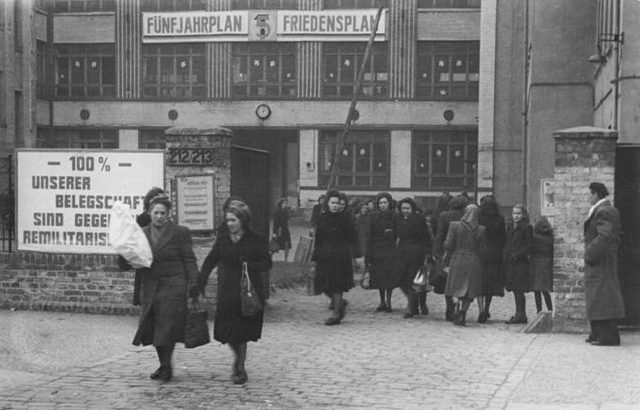
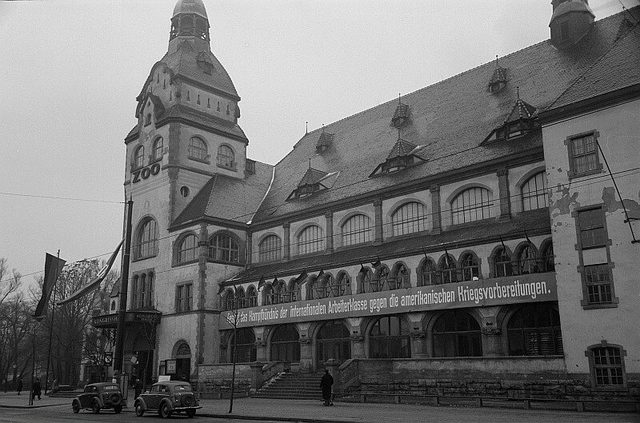
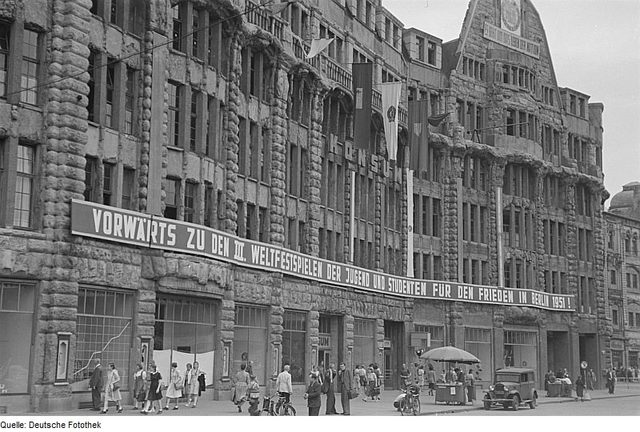
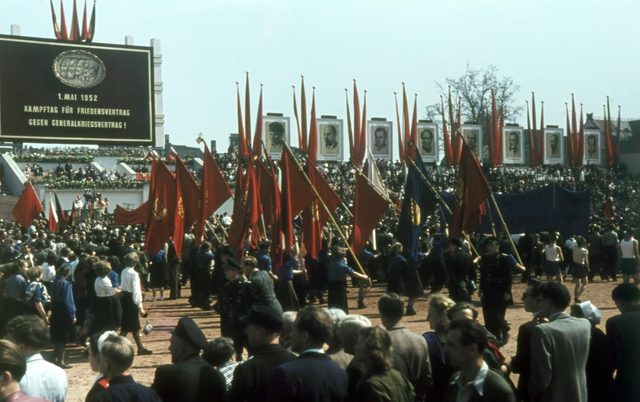
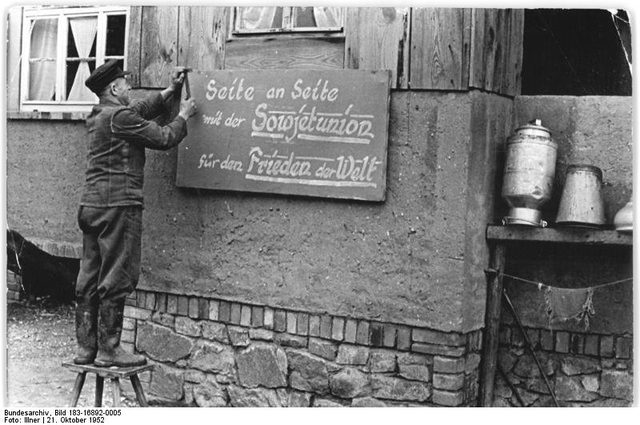
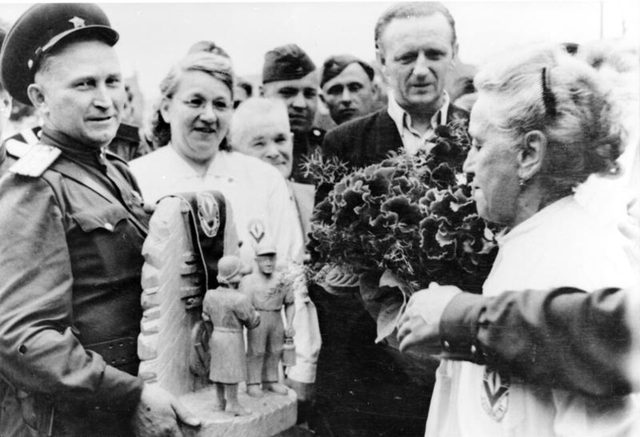
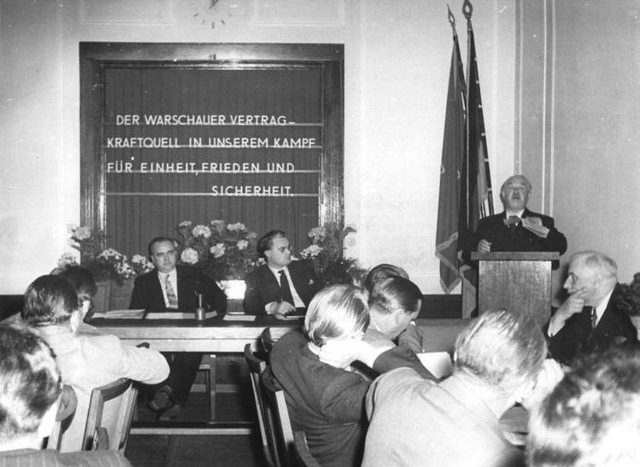
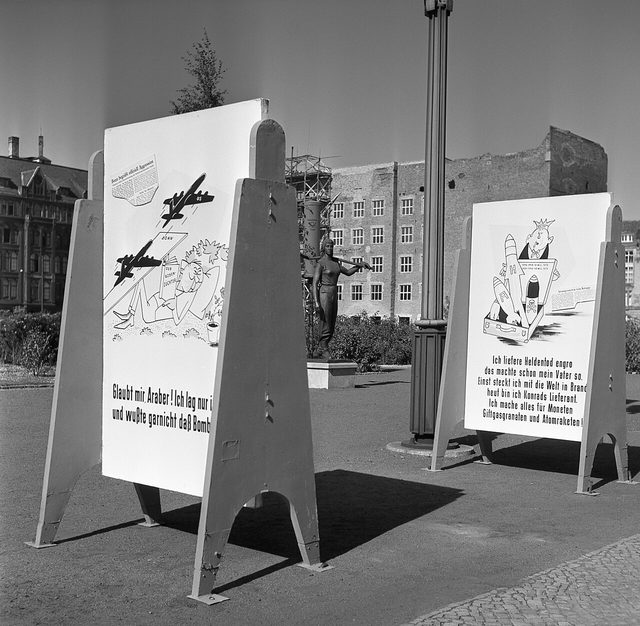
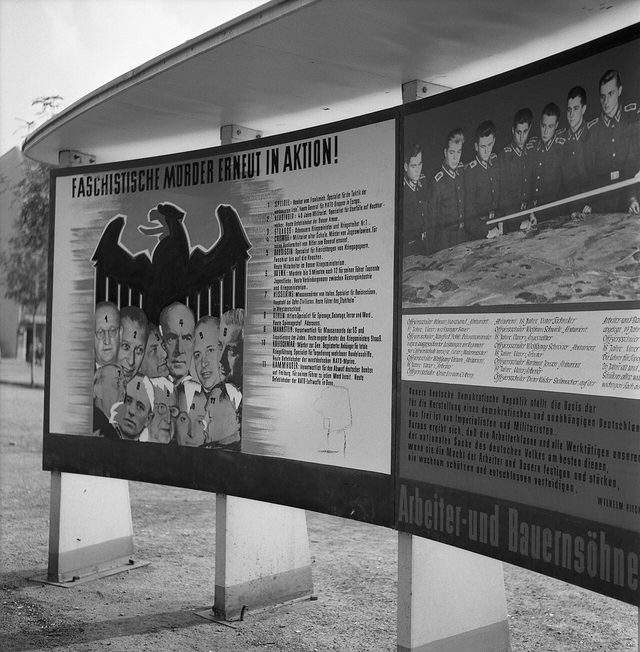
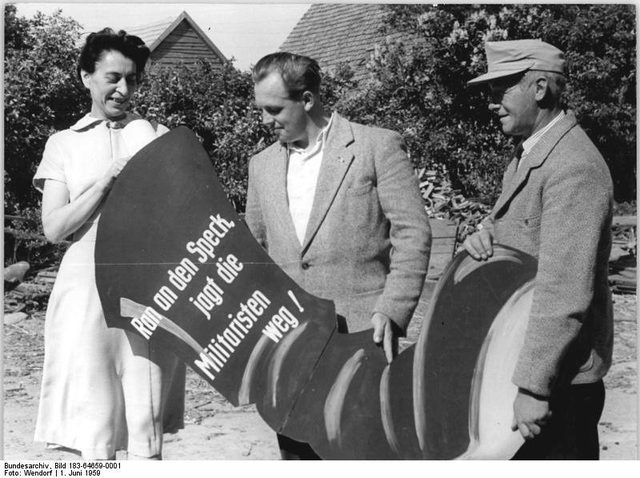
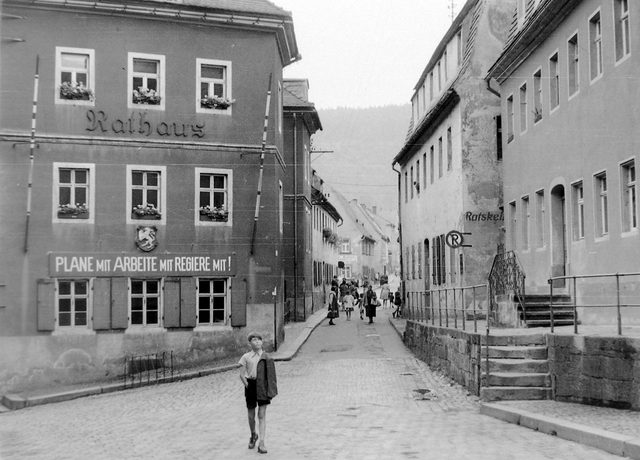
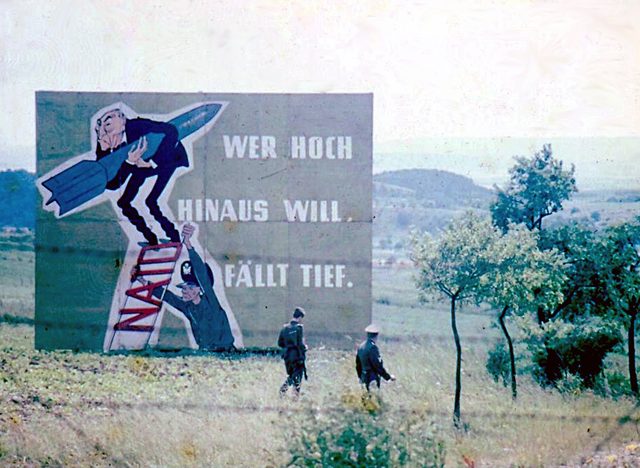
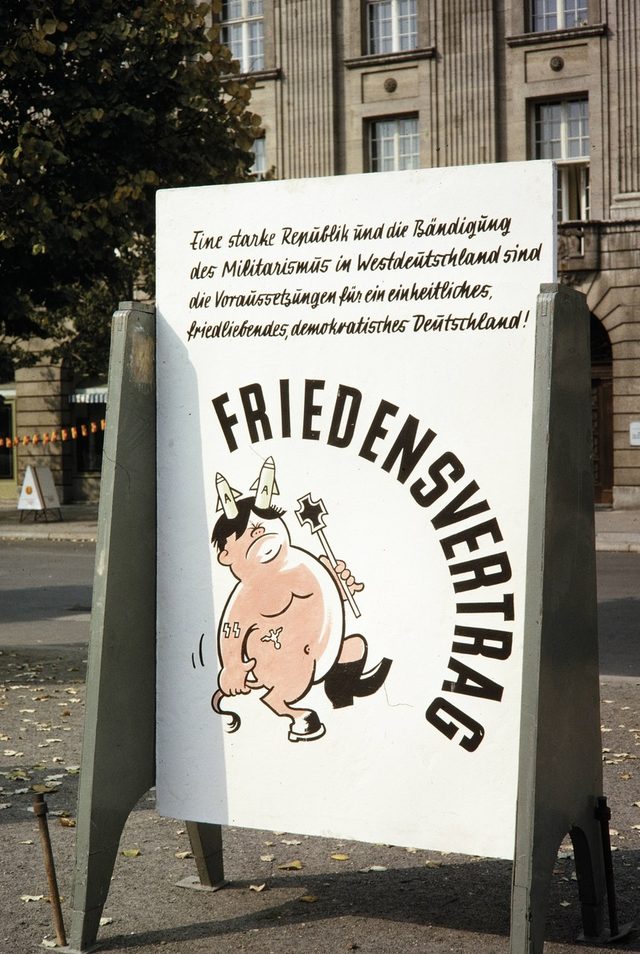
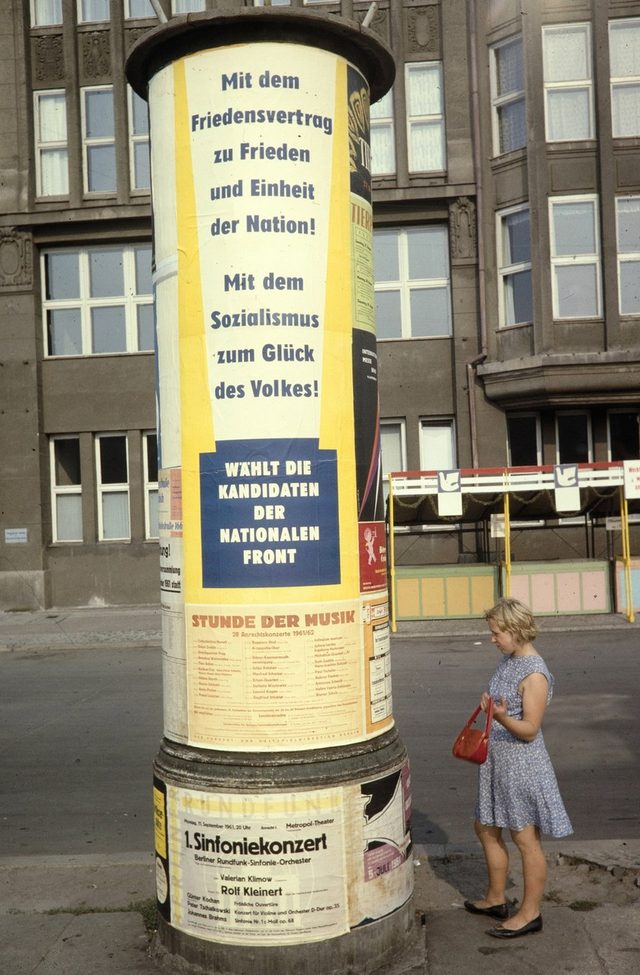
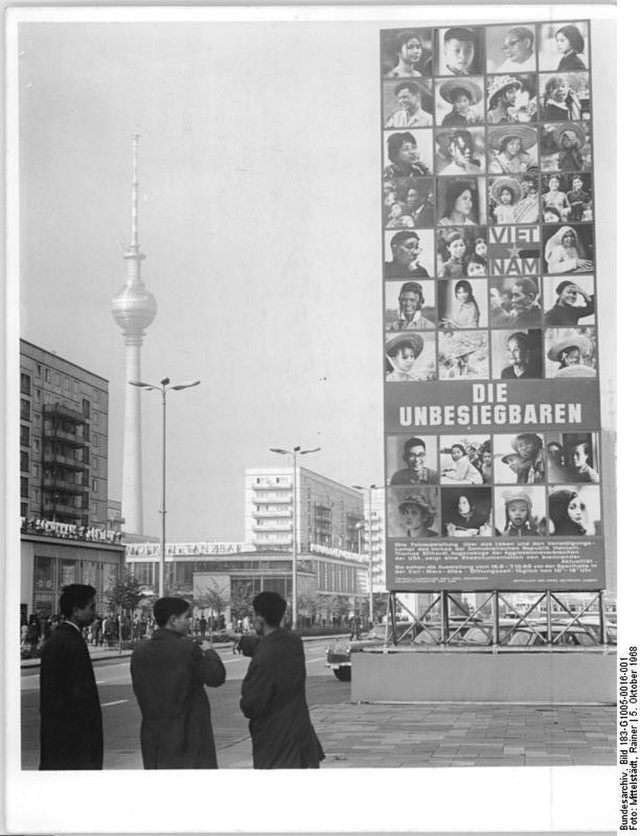
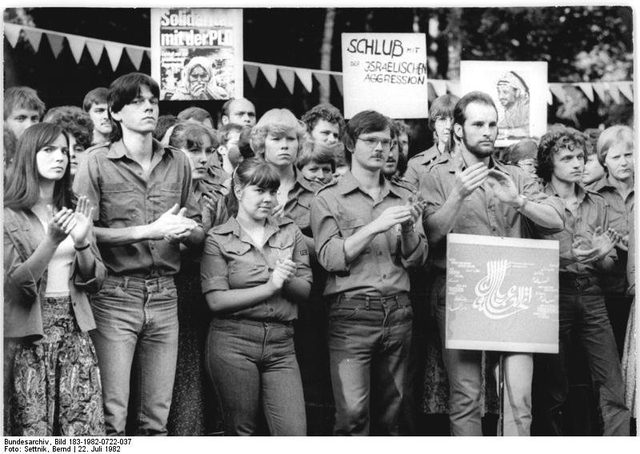
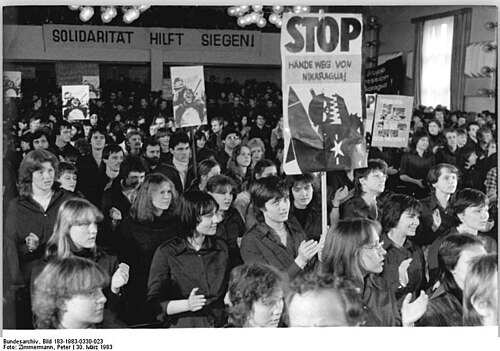
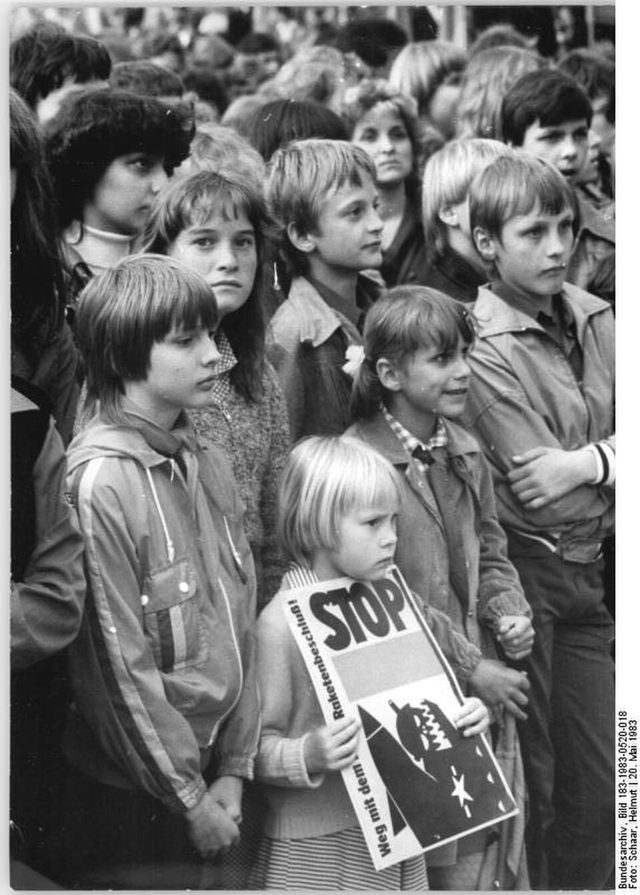
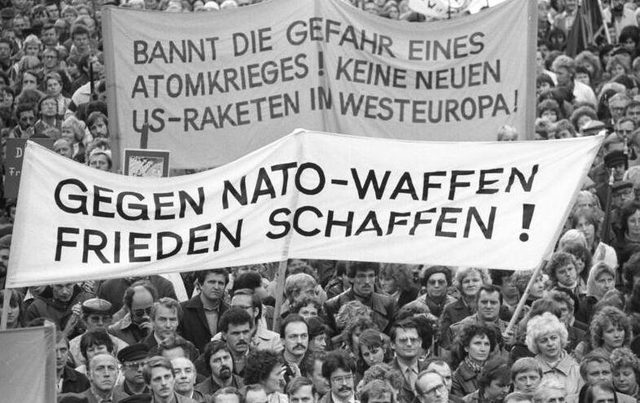
Campaigns and themes. The state's own output returned to a small number of themes: the "peace" campaigns against West German rearmament and NATO (the 1950 factory boards against remilitarisation; the 1950 Leipzig "Atlantic Pact" float; the 1950 "American beetle" campaign), friendship with the Soviet Union, the National Front's elections (the 1961 election poster pillar), the mass youth rallies (the 1949 FDJ torchlight march) and, in the 1980s, protests against US missiles in Western Europe (Halle, 1983; Suhl, 1983). The archive's definitions fit most clearly: name-calling ("Hetzsender", "Kriegstreiber" for Western leaders), scapegoating (Western "militarists" and "revanchists"), fear appeal (the war-threat posters), manufactured consensus (single-list elections), euphemism (the "protective rampart"), card stacking (the selective editing of Western clips in Der schwarze Kanal) and identity fusion (the party song "Die Partei, die Partei, die hat immer recht").
Timeline
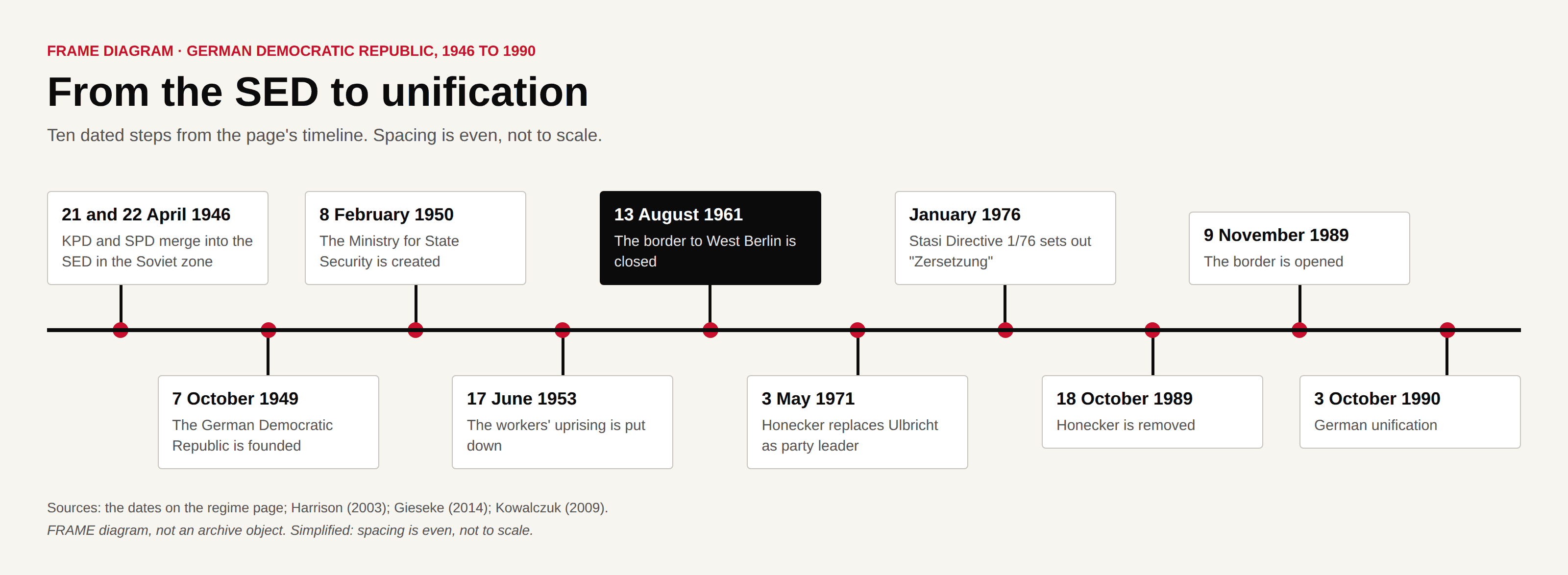
21 and 22 April 1946: the KPD and SPD merge into the SED in the Soviet zone; Neues Deutschland first appears on 23 April.
23 May 1949: the Federal Republic of Germany is founded.
7 October 1949: the German Democratic Republic is founded; Pieck becomes President on 11 October, Grotewohl Minister-President on 12 October.
8 February 1950: the Ministry for State Security is created.
15 October 1950: first single-list elections to the Volkskammer.
17 June 1953: the workers' uprising is put down.
December 1952 and 1960: regular television begins; Der schwarze Kanal starts on 21 March 1960.
15 June 1961: Ulbricht's statement on the wall; 13 August 1961: the border is closed.
3 May 1971: Honecker replaces Ulbricht as party leader.
21 December 1972: Basic Treaty with the Federal Republic; 18 September 1973: both states join the UN.
January 1976: Stasi Directive 1/76 sets out "Zersetzung"; 16 November 1976: the singer Wolf Biermann is expatriated.
19 January 1989: Honecker says the Wall will stand for 50 or 100 years.
7 May 1989: local elections with the published counter-counts; 7 October 1989: the 40th anniversary; 18 October: Honecker is removed.
30 October 1989: the last Der schwarze Kanal; 9 November 1989: the border is opened after Schabowski's press conference.
18 March 1990: first free Volkskammer election; 3 October 1990: German unification.
Content note: Photograph of a newspaper extra whose agency caption uses the official term 'Grenzsicherungsmaßnahmen' for the closing of the Berlin border. This object is shown as it was published. Why
Content note: Photograph of a military parade with a board using the GDR's official name for the Berlin Wall ('antifaschistischer Schutzwall'); the agency caption lists named officials. This object is shown as it was published. Why
The German Democratic Republic, 21 April 1946 to 3 October 1990, using the dates given on this page; spacing is even, not to scale, simplified from the sources cited on this page. Source: FRAME diagram, drawn from the sources listed on this page, CC BY 4.0 (FRAME archive content).
How it ended
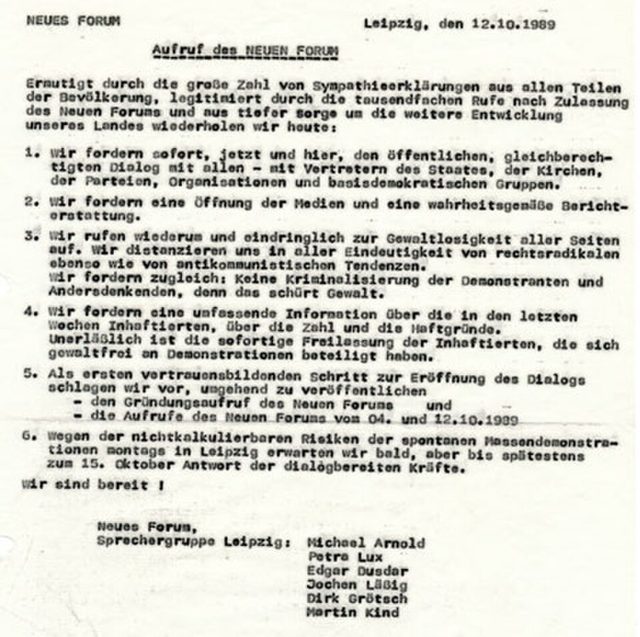
On 4 September 1989 the Monday demonstrations began again in Leipzig and grew to about 70,000 people on 9 October and about 300,000 on 23 October. After Honecker's removal on 18 October, Egon Krenz became General Secretary and head of state. On 9 November 1989 the Politburo's travel regulations were announced at a press conference by Günter Schabowski, who answered when they took effect with "Das tritt nach meiner Kenntnis ... ist das sofort, unverzüglich"; crowds went to the crossings and the guards opened them that night. The SED gave up its constitutional leading role on 1 December 1989, the Ministry for State Security was renamed in November 1989 and dissolved by January 1990, and a Volkskammer elected freely on 18 March 1990 negotiated unification with the Federal Republic, which took effect on 3 October 1990. The Stasi Records Act of 1991 opened the Stasi files to the people concerned.
Same-standard note
This page uses the same structure and definitions as every other regime page: a technique is listed only where the archive's working definition and a documented example fit, the same technique ids are applied to every regime, and offices and dates are stated without judging the people who held them. The scale and purpose are set out as history, not ranked: a one-party state of about 17 million people, dependent on the Soviet Union, with a political police that recruited a large informant network, a closed border on which people were shot, and a media system in which the party set the line. The US-funded RIAS, the West German broadcasters and the GDR's own foreign and domestic services are described under one definition (state-sponsored broadcasting aimed at another state's audience), and they differ in context: RIAS and Deutschlandfunk operated beside a plural domestic press in the West, whereas the GDR had no independent domestic press. Other regime pages record other systems, each with its own scale, intent and context.
Sources
Constitution of the German Democratic Republic, 7 October 1949 (Article 6) and 6 April 1968 (Article 1); Border Law of 25 March 1982; Stasi Directive 1/76 (Richtlinie Nr. 1/76 zur Entwicklung und Bearbeitung Operativer Vorgänge), January 1976, in the holdings of the Bundesbeauftragter für die Unterlagen des Staatssicherheitsdienstes (BStU, now the Stasi Records Archive of the Bundesarchiv): https://www.stasi-unterlagen-archiv.de
Mary Fulbrook, The People's State: East German Society from Hitler to Honecker (Yale University Press, 2005); Hermann Weber, Die DDR 1945 bis 1990 (Oldenbourg, 2012); Ilko-Sascha Kowalczuk, Endspiel: Die Revolution von 1989 in der DDR (2009) and 17. Juni 1953 (2013); Andreas Malycha and Peter Jochen Winters, Die SED (2009).
Hope M. Harrison, Driving the Soviets Up the Wall: Soviet-East German Relations, 1953 to 1961 (Princeton University Press, 2003); Frederick Taylor, The Berlin Wall: 13 August 1961 to 9 November 1989 (2006); Hans-Hermann Hertle, Chronik des Mauerfalls (1996); Hans-Hermann Hertle and Maria Nooke (eds.), Die Todesopfer an der Berliner Mauer 1961 bis 1989 (Ch. Links, 2009; 2017 update by the Zentrum für Zeithistorische Forschung Potsdam and the Stiftung Berliner Mauer): https://www.chronik-der-mauer.de
Jens Gieseke, The History of the Stasi: East Germany's Secret Police, 1945 to 1990 (Berghahn, 2014); Klaus Behnke and Jürgen Fuchs (eds.), Zersetzung der Seele (1995).
Gunter Holzweißig, Die schärfste Waffe der Partei: Eine Mediengeschichte der DDR (Böhlau, 2002); Michael Meyen, Denver Clan und Neues Deutschland: Mediennutzung in der DDR (2003).
Nicholas J. Schlosser, Cold War on the Airwaves: The Radio Propaganda War against East Germany (University of Illinois Press, 2015); Deutsches Rundfunkarchiv, Der schwarze Kanal programme documentation: https://www.dra.de
Andre Steiner, The Plans That Failed: An Economic History of the GDR (Berghahn, 2010); Tony Judt, Postwar: A History of Europe since 1945 (2005); Louis Fürnberg, "Lied der Partei" (1949); speeches of Walter Ulbricht (15 June 1961) and Erich Honecker (19 January 1989) as printed in Neues Deutschland, 16 June 1961 and 20 January 1989.
.jpg)
.jpg)


